


This is engineering guidance, not legal advice. Confirm specifics with qualified counsel.
Why this matters
Most telemedicine projects that blow their budget did not misjudge the video call — they misjudged everything wrapped around it. A founder prices "a doctor-patient video app," a vendor quotes the video feature, and four months later the project discovers that the video was the easy 20%, while protecting patient data to the legal standard and wiring into a hospital's record system were the other 80% nobody scoped. This article is for the founder, product manager, or health-system lead who needs to turn a telemedicine idea into a scope and a realistic estimate — the number you take to a board, an investor, or a build partner. Getting the estimate right is not about precision to the dollar; it is about pricing the two multipliers that quietly double or triple a naïve feature estimate, so the number you commit to is the number the project actually costs.
Scope first, estimate second
An estimate is only as good as the scope underneath it. "How much does a telemedicine app cost?" has no answer for the same reason "how much does a building cost?" has no answer — it depends entirely on what is inside it and what it has to connect to. So the work is sequential: define the scope, then estimate the scope. Skipping to a number is how projects get a number that is wrong.
Scoping a telemedicine project means answering three questions in order. First, what does the product do — the feature list, written plainly. Second, how sensitive is the data it touches — because the same feature costs very different amounts depending on whether it handles protected health information and what kind. Third, what must it connect to — because every outside system you integrate with adds work that has nothing to do with your own features. The rest of this article is a method for turning those three answers into an effort estimate you can defend.
One scoping decision sits upstream of all three and changes the entire shape of the project: which clinical vertical you are building for. A mental-health visit, an urgent-care triage flow, and a remote-monitoring program for chronic disease are three different products with three different data flows and rule sets. If you have not settled that yet, settle it first — the vertical scoping guide walks through how the vertical choice drives everything downstream, including this estimate.
A note on what this article is not. It is the scoping process and the two multipliers. The underlying cost-model arithmetic — day rates, the line-by-line breakdown, the downloadable cost model — lives in the telemedicine cost model. This article tells you how to build the scope that you feed into that model; it does not re-derive the model itself.
The estimate equation
Here is the whole method in one line, and then we unpack each piece:
Estimate = (base feature effort) × (compliance-tier multiplier) × (integration-count multiplier)
The base feature effort is the engineering work your own features would take if patient data and outside systems did not exist. The compliance-tier multiplier is how much that base grows once you must protect the data to the legal standard. The integration-count multiplier is how much it grows again for every external system you connect. Naïve estimates quote only the first term and are wrong by the product of the other two.
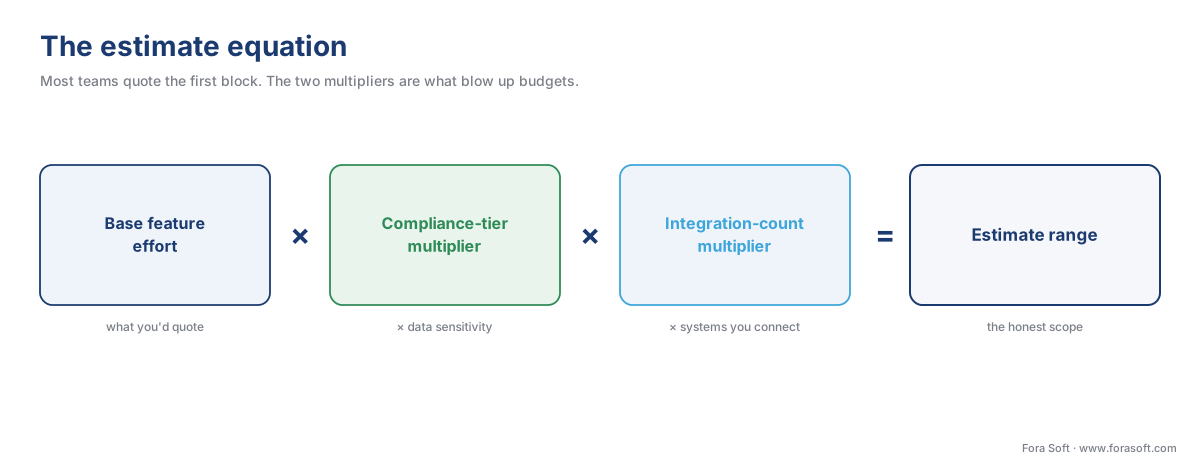 Figure 1. The estimate equation. The base feature effort is the part most teams quote; the two multipliers are the part that blows up budgets when they are left out.
Step one: the feature-to-effort map
Start by listing every feature in plain language, then sort each into one of three effort buckets. You are not estimating hours yet — you are sizing relative effort so the scope is honest about where the weight sits. A useful shorthand is small (S), medium (M), and large (L), where each step up is roughly three to four times the effort of the one below.
The table below maps the features a typical telemedicine product needs onto effort buckets. Treat it as a starting template, not a quote — your product will add and remove rows.
| Feature group | Examples | Effort bucket |
|---|---|---|
| Accounts and roles | Patient and provider sign-up, login, role separation | S–M |
| Scheduling | Calendar, slots, reminders, time-zone handling | M |
| Real-time video consult | One-to-one clinical video on a rented video layer | M |
| Waiting room and queue | Check-in, provider-ready signal, triage order | M |
| In-call clinical tools | Chat, file/photo share, screen share, vitals display | M–L |
| Documentation and notes | Visit notes, after-visit summary, record storage | M |
| Recording | Capturing the session, with consent and retention | L |
| Payments and insurance | Card payments, insurance claims, eligibility checks | L |
| Notifications | Email, SMS, and push that never carry patient data | S–M |
| Admin and reporting | Dashboards, audit views, operational metrics | M |
Two features on that list deserve a flag because teams routinely under-size them. Recording is large, not medium, because the captured session is patient data that must be stored encrypted, retained for a defined period, accessed under controls, and reconciled with all-party consent rules — the camera is the easy part. Payments and insurance is large because insurance eligibility and claims touch their own standards and their own data-sharing agreements; "take a card" is medium, "bill insurance" is large.
Sum the buckets and you have a base feature effort — the first term in the equation. Now the two multipliers turn that base into a real estimate.
Step two: the compliance-tier multiplier
This is the multiplier teams discover too late. Every telemedicine product in the United States that handles patient data sits on the same legal floor: the Health Insurance Portability and Accountability Act (HIPAA), the federal law that governs protected health information (PHI) — any health data tied to an identifiable person. Meeting HIPAA's Security Rule is not a feature you add at the end; it is a tax on every feature that touches PHI, because each one must be encrypted, access-controlled, and audit-logged, and each outside tool that sees the data needs a signed contract. The Security Rule names these technical safeguards directly — access control, audit controls, and encryption among them (45 CFR §164.312) — alongside administrative safeguards like a contingency plan (45 CFR §164.308). None of that is optional, and all of it is engineering work.
Crucially, the size of the tax depends on what the product does, not just whether it is "in healthcare." So sort your product into one of three compliance tiers, and apply the matching multiplier to the PHI-touching part of your base effort.
Tier 1 — light PHI (multiplier ≈ 1.3×). The product handles basic identifiable data and live video but stores little: a connect-and-consult tool with no recording, minimal record-keeping, and no prescribing. The compliance work is real but contained — encryption in transit and at rest, access controls, audit logging, and a signed Business Associate Agreement (the contract a vendor must sign before it may touch PHI on your behalf, required by 45 CFR §164.502(e)) with your video vendor.
Tier 2 — standard clinical (multiplier ≈ 1.6×). The product stores clinical records, captures recordings or documentation, and keeps a meaningful patient history. Now the safeguards multiply: retention policies, designated-record-set handling, consent management, de-identification for any analytics, and a BAA with every vendor in the data path. This is where most real telemedicine products land.
Tier 3 — high-sensitivity or prescribing (multiplier ≈ 2.0× or more). The product prescribes controlled substances, handles behavioral-health or substance-use records, or carries especially sensitive data. Prescribing controlled substances pulls in the Drug Enforcement Administration's electronic-prescribing requirements under the Ryan Haight Act, including a two-factor identity step; substance-use records pull in a separate, stricter federal privacy rule (42 CFR Part 2). Each adds engineering, audit, and legal scope on top of the Tier 2 baseline.
 Figure 2. The compliance-tier multiplier. The same feature list costs more as the data gets more sensitive — sort your product into a tier before you multiply.
One more thing pushes on this multiplier from the future, regardless of tier: the floor is rising. HIPAA's Security Rule — the part that dictates the technical safeguards — is in the middle of its first major update in over twenty years. As of June 2026 the update is a Notice of Proposed Rulemaking (NPRM, RIN 0945-AA22, published January 6, 2025); it is proposed, not final, but it proposes to turn several controls that are today "addressable" into hard requirements, including multi-factor authentication and encryption. Scope as if that floor will rise during your build, because retrofitting safeguards after launch costs more than building them in. The HIPAA guide for product teams covers the requirement in full.
A separate regulatory line can change your tier — and your scope — without changing your data sensitivity: artificial-intelligence features that diagnose. A feature that supports a clinician's decision is one thing; a feature that outputs a diagnosis on its own may be a regulated medical device under the Food and Drug Administration's Software-as-a-Medical-Device framework, which adds a validation and clearance scope that dwarfs ordinary feature work. If your roadmap includes AI that interprets clinical data toward a diagnosis, flag it in scope now; where AI fits in a telemedicine product draws the line.
Step three: the integration-count multiplier
The second multiplier is the one that surprises even experienced teams: each external system you integrate with adds work roughly equal to a medium feature, and that work compounds. A telemedicine product rarely lives alone. It connects to the hospital's electronic health record (EHR) so visits land in the patient's chart, to a pharmacy network so prescriptions flow, to a lab so results come back, to a scheduling system, to a payment and insurance processor, and to an identity provider so clinicians sign in with their hospital credentials.
Each connection is its own small project. Even when a modern standard exists — and the dominant one for health-record data is HL7 FHIR (Fast Healthcare Interoperability Resources), the data format US certified record systems are required to expose under the ONC's API rule (45 CFR §170.315(g)(10)) — you still have to map your data to it, get access approved by the system's owner, test against their sandbox, and handle their particular quirks. A standard reduces the work; it does not remove it. And integrations multiply rather than add, because each one needs maintenance, monitoring, and a data-sharing agreement, so three integrations is meaningfully more than three times one.
A simple rule of thumb for scoping: count your required integrations, and add a medium-feature's worth of effort for each, then a little more for every one beyond the second to account for the compounding maintenance and coordination cost. A product with no external integrations carries a 1.0× integration multiplier; a typical product wiring into an EHR plus a pharmacy plus payments might carry 1.4× to 1.6×; a hospital platform connecting to half a dozen systems can carry 2.0× or more.
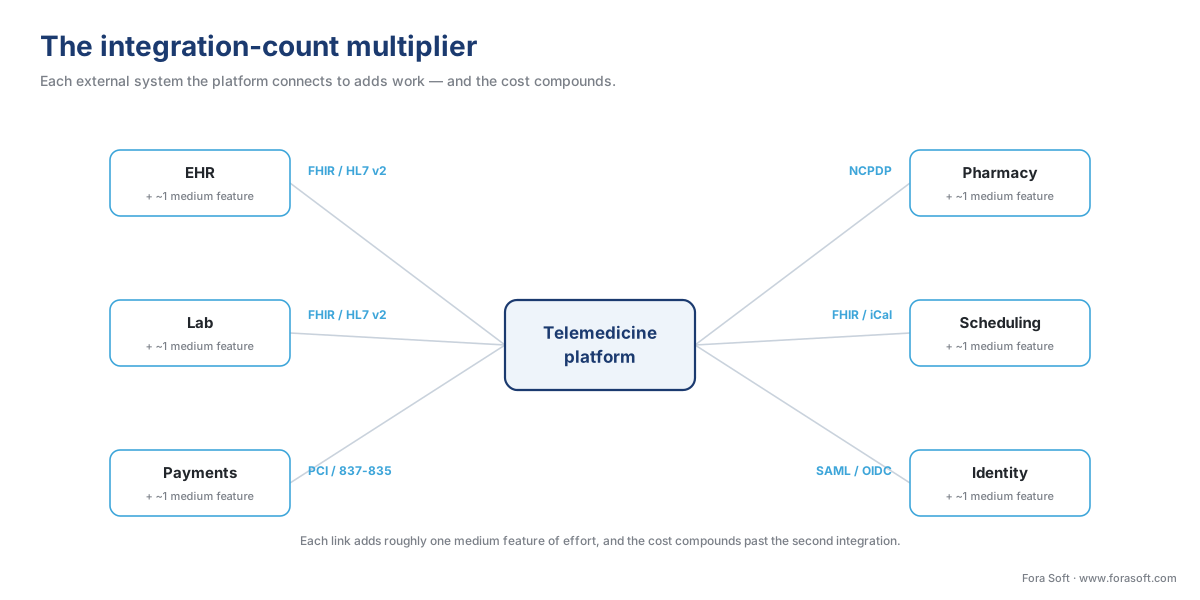 Figure 3. The integration-count multiplier. Each external system the platform connects to adds roughly a medium feature's worth of effort, and the cost compounds as the count rises.
How you connect changes the multiplier too. Building each integration directly is the most work; routing through an aggregator that pre-connects many record systems trades a per-connection build for a subscription and less control. That direct-versus-aggregator decision is a scope lever in its own right — the integration decision guide lays out the four paths so you can pick the one that fits your integration count.
A worked estimate, out loud
Numbers make the method concrete. Walk the arithmetic with round planning figures — the shape is what matters, and your real numbers will replace these.
Start with the base feature effort. Say your scope sums to roughly 9 months of engineering effort for the features alone — accounts, scheduling, video consult, waiting room, documentation, notifications, and an admin dashboard, sized from the map above. Write that on one line: base = 9 engineer-months.
Now apply the compliance-tier multiplier. The product stores clinical records and captures visit documentation, so it is Tier 2: multiplier ≈ 1.6×. Multiply: 9 × 1.6 = 14.4 engineer-months. The 5.4 months of difference is not bureaucracy — it is the encryption, access control, audit logging, consent handling, retention, and BAA work that the records demand.
Now apply the integration-count multiplier. The product writes visits to one EHR and takes card payments — two integrations — for a multiplier of about 1.4×. Multiply: 14.4 × 1.4 ≈ 20 engineer-months. That final number, not the 9 you started with, is the honest scope. The two multipliers more than doubled the naïve estimate, and every project that quotes the 9 and discovers the 20 mid-build is the cautionary tale this article exists to prevent.
Convert engineer-months to a budget and a calendar using your own day rates and team size in the cost model; the worksheet at the end of this article walks you through producing your own version of this calculation.
The six-to-nine-month reality
Effort is not the same as calendar time, and telemedicine has a characteristic shape: a realistic first compliant version is usually a six-to-nine-month build, not the few weeks a consumer app might take. A basic video MVP without the healthcare wrapping can be quicker — industry timelines for a bare telehealth MVP commonly run three to six months — but the compliant, integration-connected product the estimate above describes lands later, and the gap is the compliance and integration work, plus the weeks of security and compliance verification that come after the features are "done."
The build moves through recognizable phases. Discovery and scope (the work this article describes) comes first — turning the idea into the feature map, the tier, and the integration count. Core build follows: the features and the rented video layer. Compliance hardening runs alongside and after: implementing and documenting the safeguards, signing the BAAs, and preparing for audit — and this is the phase teams forget to put on the calendar. Then a pilot with real clinicians and a small patient group, because the technical launch is the easy half and clinician workflow surprises only show up with real use. Only then, launch.
 Figure 4. The six-to-nine-month reality. Compliance hardening and a clinician pilot are real phases on the calendar, not afterthoughts bolted to the end of the build.
One date belongs in every telemedicine scope because it shapes what is worth building: Medicare's pandemic-era telehealth flexibilities — the rules that let Medicare pay for telehealth broadly — were extended through December 31, 2027 by the Consolidated Appropriations Act, 2026 (signed February 3, 2026), and they change on a regular legislative cycle. Reimbursement rules decide which features earn revenue, so a scope built around a flexibility that expires mid-project is a scope at risk. Cite the year, note the expiry, and revisit it; reimbursement rules that shape the product covers how the rules steer the build.
The common mistake: estimating the features, ignoring the tax
The single most expensive scoping error in telemedicine is to estimate the feature list and stop there. The feature list is the base term — the part that looks like an app you have seen before. The compliance tier and the integration count are the multipliers, and they are invisible in a feature demo, which is exactly why they get cut from the estimate and then reappear as overruns. "We'll add HIPAA later" is the phrase that precedes most telemedicine rebuilds, because the safeguards are not a layer you paint on; they are structural, and adding them after the fact often means redoing the data model, the storage, and the logging you already built.
A related trap is treating "encrypted" as "compliant." Encryption is necessary but not sufficient — a tool can be fully encrypted and still be a HIPAA violation if no Business Associate Agreement covers it. If your scope assumes a free analytics or messaging tool because it is "secure," check whether the vendor will sign a BAA before you count on it; if it will not, that tool is out of scope or it changes your architecture, and either way it changes the estimate. Scope the BAA coverage, not just the encryption.
Where Fora Soft fits in
Fora Soft has built real-time video software since 2005, including telemedicine platforms where the compliance tier and the integration count — not the video call — were the bulk of the work. We scope a telemedicine build the way this article describes: feature map first, then the compliance-tier and integration-count multipliers made explicit, so the number a client commits to is the number the project costs. Because this is healthcare, we lead with the requirement: we identify the PHI path, the tier, and the BAA coverage during scoping, not after, so the estimate reflects the safeguards the product actually needs. Our experience also spans video conferencing, streaming, e-learning, and surveillance, which is why a clinical video layer rarely surprises us — it is the wrapper around it that we help teams scope honestly.
What to read next
- The telemedicine cost model — turn your scoped effort into a budget with day rates and a line-by-line breakdown.
- Build vs buy vs hybrid for telemedicine — the decision that sits just upstream of this estimate.
- The integration decision guide — direct, aggregator, or embedded, and what each does to your integration multiplier.
Call to action
- Talk to a telemedicine engineer — book a 30-minute scoping call to talk through your telemedicine project cost estimate plan.
- See our case studies — 250+ shipped projects across video streaming, WebRTC, OTT, telemedicine, e-learning, surveillance, and AR/VR.
- Download the Telemedicine Project Scoping & Estimate Worksheet — One page: list and size your features (S/M/L), set your compliance tier and its multiplier, count your integrations and apply that multiplier, then work the estimate equation to a defensible engineer-month range before you commit a budget.
References
- 45 CFR Part 164 — HIPAA Security Rule (technical safeguards §164.312: access control, audit controls, encryption; administrative safeguards / contingency plan §164.308; business-associate contracts §164.502(e)). Electronic Code of Federal Regulations. https://www.ecfr.gov/current/title-45/subtitle-A/subchapter-C/part-164 (Tier 1 — the safeguards that define the compliance-tier multiplier.)
- HIPAA Security Rule To Strengthen the Cybersecurity of Electronic Protected Health Information (NPRM, RIN 0945-AA22), 90 FR 898, published 2025-01-06; proposed, not final as of 2026-06-15. U.S. Department of Health and Human Services / Federal Register. https://www.federalregister.gov/documents/2025/01/06/2024-30983/hipaa-security-rule-to-strengthen-the-cybersecurity-of-electronic-protected-health-information (Tier 1 — the rising floor every scope should anticipate.)
- ONC 21st Century Cures Act API certification — standardized API for patient and population services (45 CFR §170.315(g)(10); HL7 FHIR data standard). Office of the National Coordinator for Health IT. https://www.healthit.gov/topic/standards-technology/standards/fhir (Tier 1 — the standard behind the integration-count multiplier for EHR data.)
- Software as a Medical Device (SaMD) — guidance overview (the decision-support vs diagnosis line that can change a product's regulatory scope). U.S. Food and Drug Administration. https://www.fda.gov/medical-devices/digital-health-center-excellence/software-medical-device-samd (Tier 1 — when an AI diagnostic feature enters scope.)
- Ryan Haight Act / electronic prescribing of controlled substances (EPCS) — telemedicine prescribing requirements and identity-proofing. U.S. Drug Enforcement Administration, Diversion Control Division. https://www.deadiversion.usdoj.gov/ (Tier 1 — the Tier 3 prescribing scope driver.)
- Medicare Telehealth Flexibilities extended through December 31, 2027 (Consolidated Appropriations Act, 2026, signed 2026-02-03). Telehealth.HHS.gov / CMS. https://telehealth.hhs.gov/providers/telehealth-policy/policy-changes-after-the-covid-19-public-health-emergency (Tier 1 — the reimbursement date that shapes which features earn revenue.)
- The telemedicine cost model — day rates and the line-by-line cost breakdown this article's scope feeds. Fora Soft Learn. /learn/telemedicine/articles-telemedicine/telemedicine-cost-model (Section reference — the model the scope is fed into.)
- Telemedicine App Development Cost: Full Breakdown for 2026 — industry survey of MVP timelines (3–6 months) and cost bands, used for orientation only. Cleveroad. https://www.cleveroad.com/blog/telemedicine-app-development-cost/ (Tier 6 — orientation on market timelines, not a regulatory source.)
- How Much Does Telemedicine App Development Cost in 2026? — secondary industry timeline reference (compliance certification adds 4–8 weeks after build). Folio3 Digital Health. https://digitalhealth.folio3.com/blog/how-much-does-it-cost-to-develop-a-telemedicine-app/ (Tier 6 — orientation only.)
