A specialist review of your video or streaming product covering latency, media server architecture, WebRTC, playback reliability, real-time chat, and scalability. Every finding is specific, located, and fixable. Delivered within a week.
Users report buffering, drops, and desync. Your engineers see clean logs. The issue is somewhere in the stack — media server, signaling, encoder, CDN, or the interplay between all of them. Video systems are complex enough that finding the real root cause requires someone who knows exactly where to look.
Concurrency, geographic spread, and device variance expose problems a staging environment never will.
End-to-end latency in video stacks has four or five contributing layers. Fixing the wrong one changes nothing.
Architecture decisions made early in a video product are expensive to reverse. Better to catch them now.
Inherited video systems carry hidden assumptions — about network conditions, session counts, codec choices — that only show up when they fail.
Six areas, each with failure modes that only become visible under production conditions. Every finding is specific to your stack — not generic recommendations.

SFU vs MCU fit for your use case, capacity planning, simulcast configuration, bitrate ladder design, and failover under load. Where LiveKit, mediasoup, Janus, and Wowza go wrong in production.

ICE negotiation latency, STUN/TURN configuration, reconnection logic, and signaling server architecture. Why your WebRTC call setup adds 800ms before a single frame is transmitted.

RTMP ingest, HLS/DASH segment sizing and delivery, low-latency HLS, and protocol selection for your use case. How HLS segment sizing creates unnecessary buffering your users experience as stalling.

Lip-sync drift causes, encoder settings, buffer management, and playout delay tuning. The interaction between encode pipeline, network jitter, and player buffer that produces the desync your users report.

WebSocket backpressure, message ordering, delivery guarantees, presence and signaling system performance. The real-time data layer that breaks under concurrent load in ways the video stream doesn't.

What fails first at 2×, 5×, 10× current load. CDN topology, origin configuration, and transcoding pipeline design. Where the system holds and where it collapses under real concurrent session counts.
One call. No obligation. Every finding specific, located, and fixable.
No commitment required. The review is yours regardless of what you decide next.
We spend one hour understanding your product, the stack, and the specific problems you're seeing or anticipating. You share repository access and any relevant documentation. We sign an NDA before anything is shared.
1 hour + repo accessOur engineers go through the video stack systematically. Every finding is documented with technical detail as we go. If we find something that needs your immediate attention, we'll flag it before the report is done.
Same or next business dayYou receive all four documents and a walkthrough session. The full review is yours at no cost. If you want Fora Soft to handle the fixes or rebuild components, that's a separate engagement we can scope immediately.
30–60 minute sessionStructured in layers — a summary for leadership, full technical findings for your engineers, and a fix roadmap with clear next steps.
An executive overview of the overall state of the video product. Area-by-area verdict (critical / review / pass), the top three risks, and a plain-language description of what's at stake. Safe to share with non-technical stakeholders.
Every issue found, documented with: the specific area (latency, media server, signaling, etc.), a technical description of the problem, why it matters for your product, and where it lives in the stack. Referenced to code or configuration where applicable.
An evaluation of the overall architecture — whether the chosen approach fits the product's actual requirements. This is where we flag problems that can't be solved by tuning parameters: wrong media server topology, incompatible protocol choices, structural scalability limits.
Issues ranked by impact and effort. What to fix immediately, what to schedule, what requires architectural rethinking. Each item includes an effort estimate and, where relevant, alternative approaches or vendor options.
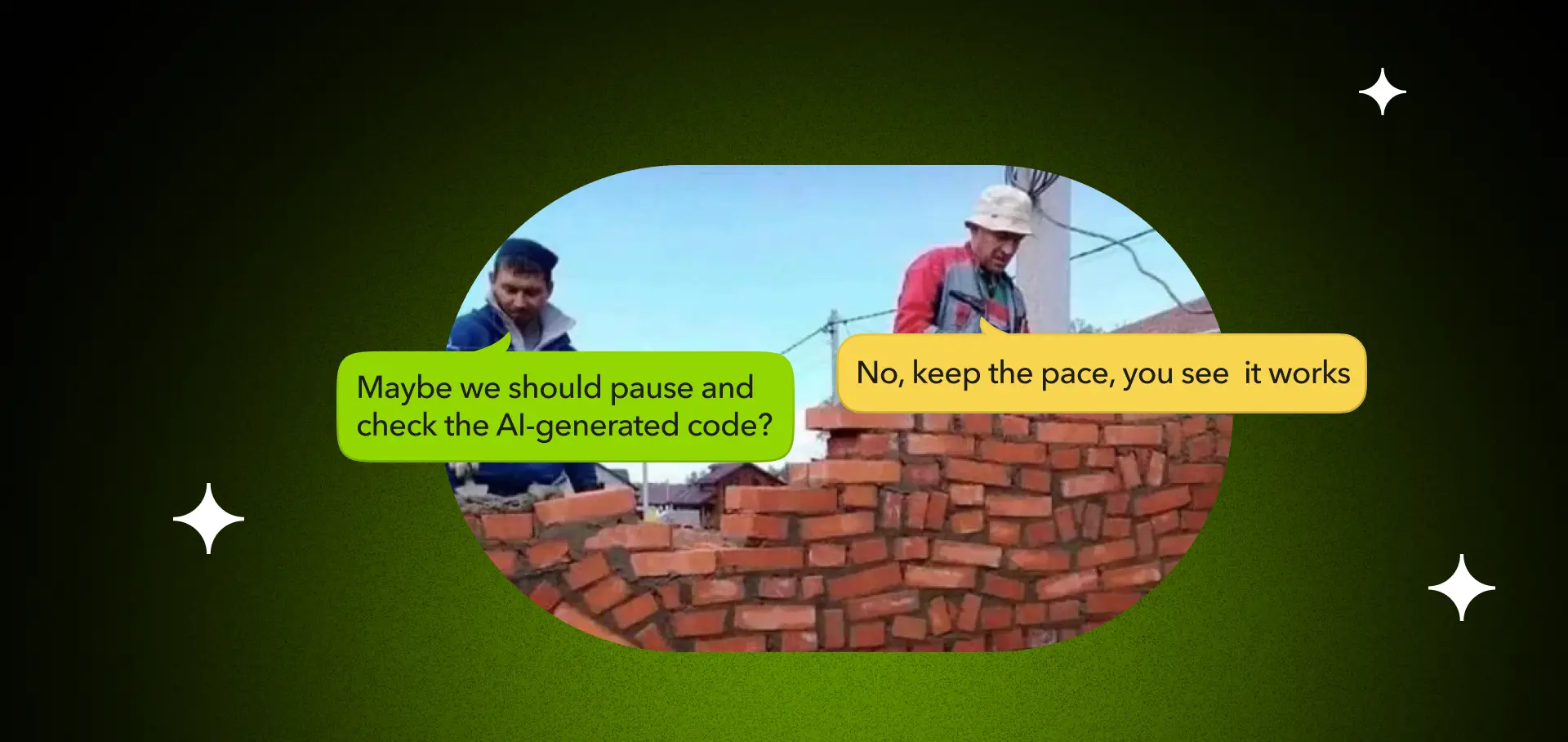
A telemedicine platform was using LiveKit for one-on-one video calls. The codebase had been generated with the help of an AI model. The team brought us in to review it before a broader rollout.
What we found wasn't a handful of bugs. The AI-designed architecture had produced 4,000 lines of code for a component that typically requires around 300. The excess wasn't sophistication — it was confusion. The code was full of hardcoded values with no apparent logic, and directly contradictory instructions sitting next to each other: one block said "if this event occurs, end the call." The next block said "if this event occurs, reconnect." Both conditions could trigger on the same event.
In a telemedicine context — where a dropped call during a consultation is not just a UX issue — this kind of logic was causing frequent, unpredictable crashes. The technical debt wasn't just slowing development. It was a reliability risk in a high-stakes environment.
The contradictory logic was documented with specific code references, then resolved. The architecture was rebuilt to be both correct and maintainable. The team went from a fragile, crash-prone system to a stable codebase they could actually understand and extend — at a fraction of the original size.
A standard code audit finds security issues and dead code. It won't tell you why your SFU is dropping packets at 50 concurrent sessions or why your WebRTC ICE negotiation adds 800ms to every call setup.
Streaming platforms, telemedicine systems, real-time collaboration tools, interpretation platforms. We know the specific failure modes of this stack — not from reading documentation, but from shipping to production and fixing what broke.
We know how RTMP ingest breaks under encoder variance, where HLS segment sizing creates unnecessary buffering, and why adaptive bitrate ladders misconfigured for mobile produce the exact buffering pattern your users are reporting.
If the issue is how things are connected rather than how they're coded — CDN topology, origin configuration, transcoding pipeline design, media server sizing — we find and document it. The review covers the full stack, not just the application layer.
Most reviews we do are of live products. We work from the codebase and, where relevant, from configuration files and architecture documentation. We don't need production access, credentials, or a running environment.
We work across WebRTC-based systems (LiveKit, mediasoup, Janus, custom implementations), streaming platforms (RTMP/HLS/DASH delivery, Wowza, Ant Media), and cloud video infrastructure (AWS IVS, Agora, Daily, Twilio Video). If your stack isn't listed, ask — we've likely worked with it or something close enough.
Yes — most reviews we do are of live products. We work from the codebase and, where relevant, from configuration files and architecture documentation. We don't need production access or credentials. The review is done from the code and config, not from a running environment.
That's covered. The Architecture Assessment section addresses infrastructure-level decisions — media server topology, CDN configuration, origin setup, transcoding pipeline design. If the issue is how things are connected rather than how they're coded, we'll find and document it.
Within one week from the discovery call — same or next business day in most cases. The scope of a video product review is more bounded than a full codebase audit, which is what makes the fast turnaround possible. We focus on the video stack specifically, not the entire application.
We do this for qualified projects because a real audit demonstrates our thinking better than any proposal could. If the report is useful and you want us to handle the fixes or build something new, we talk about that separately. If you take the report and fix things internally, that's a good outcome too. We'd rather earn the engagement than charge for the diagnosis.
Products with real video infrastructure complexity — live streaming, WebRTC, media servers, real-time communication. Not simple video embed or playback implementations. After the discovery call, we'll tell you honestly whether we think the review will be valuable for you. If it won't, we'll say so.

Within 24 hours you get a realistic estimate, technical recommendations and next steps. Free, no obligations.