

Key takeaways
• Age verification software answers one question: is this person old enough? It is not identity verification. A good age check can confirm someone is over 18 without ever learning their name, and that difference shapes the whole build.
• The law turned real in 2025–2026. The UK Online Safety Act, a US Supreme Court ruling, roughly 25 US state laws, an EU blueprint, and an Australian under-16 ban all landed inside 18 months. The age gate is now a compliance control, not a nice-to-have.
• Face age estimation and ID checks solve different problems. Estimation is fast, private, and approximate (NIST puts top algorithms near 2.5–4 years of error); an ID check is exact but high-friction and collects a full identity. Most good designs use estimation first and fall back to ID only in the grey zone.
• A birthday field defends nothing. Regulators now expect methods that resist a lying user and a deepfake. That means liveness, a challenge-age buffer, and injection-attack defenses, not a date picker.
• Build vs buy turns on volume. Hosted APIs charge per check; custom orchestration is a flat build that pays back once your fees outgrow it. Read this as a build map and a decision tool, with the numbers drawn honestly.
A fourteen-year-old types a fake birth year into your signup form, clicks a box that says "I am 18 or older," and your age gate waves them through. In 2026 that is not just a product problem, it is a fine. Age verification software is the set of methods that check a user meets an age requirement before they see restricted content or buy a restricted product, using facial age estimation, document checks, digital identity, or verified parental consent instead of a self-declared date. Get it wrong and you either lock out paying adults or let minors past a control a regulator now audits. Get it right and the gate is quiet, fast, and defensible.
We're Fora Soft. Since 2005 we've built video and computer-vision products where a camera has to make a decision it can defend later, from object and face recognition systems to remote identity checks with legally valid e-signing on ProVideoMeeting. This is the briefing we hand a platform, marketplace, or game studio on day one of an age-assurance build: what the methods actually are, where each regulator draws the line, how a face-estimation flow decides, what to buy versus build, and what it costs.
Why Fora Soft wrote this age verification guide
Age verification sits on top of two things we do for a living: computer vision and secure, auditable video. A facial age-estimation model is the same class of machine learning as the face and object recognition our computer vision development team has shipped for years, and the gate around it, consent, liveness, a decision, a record you can show a regulator, is the same discipline we bring to identity checks inside a live call.
On the vision side, we've built systems that read what a camera sees and act on it, including the surveillance-grade video work behind VALT, used by 770+ US organizations and 50,000+ users under HIPAA. On the regulated side, CirrusMED has run HIPAA-grade telehealth video in production for years without a failed audit. An age gate borrows that same posture: encryption in motion and at rest, data minimization, and a record that survives scrutiny.
Two honest limits up front. We build and orchestrate the platform; the age-estimation model itself is usually a specialist vendor's, and we'll say plainly where that line sits and why. And the rules here change country by country and month by month, so treat the legal sections as a map of what to check with counsel, not legal advice. Every number below carries a year and a source, and any vendor price comes from a vendor's own page on the date we read it.
Scoping an age gate for your product?
Tell us your markets, your traffic, and how strict the rule is. We'll map the methods and quote a fixed range in 30 minutes.
What age verification software actually is
Age verification software is a system that confirms a user satisfies an age requirement, most often 13, 16, or 18, before granting access to restricted content, features, or purchases. It takes some signal about the person, a selfie, a scanned ID, a digital credential, or a verified parent, and returns a decision: allow, block, or step up to a stronger check. The important part is what it does not need. A well-designed age check can prove "over 18" without storing who the person is.
Three terms get mixed up, and keeping them apart saves you money and legal grief. Age verification confirms an age against a document or authoritative record, so it is exact and usually collects identity. Age estimation infers an age or age range from a signal like a face, so it is fast and private but approximate. Age assurance is the umbrella over both, the term regulators like Ofcom now use, because it covers everything from a hard ID check to a soft estimate. When someone says they need "age verification," they often really need age assurance, and the cheapest compliant path is frequently estimation, not a full ID.
This is also where age assurance parts ways with KYC, and the distinction is worth drawing sharply. Video KYC answers who are you: it ties a real, named individual to a verified identity for a bank or regulated financial account. Age assurance answers how old are you, and for most consumer platforms the name is a liability you do not want. If you find yourself collecting passports to keep children off a game, you are probably doing KYC when a private age estimate would clear the bar. Build the lighter control unless the law or your risk model genuinely demands identity.
The one-line test: if your goal is to keep the wrong ages out, you need age assurance. If you also need to know exactly who the person is and screen them against sanctions, that's KYC. Building the second when you only need the first is the most common and most expensive mistake in this space.
Age estimation vs ID checks vs the other methods
There are five methods worth knowing, and no single one wins everywhere; the right build usually combines two. The trade always runs along the same three axes: accuracy, friction (how many users you lose at the gate), and privacy (how much you have to collect). Facial age estimation is low friction and high privacy but approximate. An ID check is exact but high friction and identity-heavy. The others sit in between.
Facial age estimation reads a selfie with a machine-learning model and returns an estimated age or range, with no document and no name. ID or document verification scans a passport or driver's licence, reads it with OCR and, on chipped documents, the NFC chip, then matches the photo to a live selfie; this is the same engine behind video KYC. Credit or database checks match a name against a record that implies adulthood, which works for adults but not teenagers. Digital ID and reusable credentials, such as the EU Digital Identity Wallet the bloc's 2025 blueprint is built on, can prove "over 18" cryptographically while revealing nothing else. Verified parental consent checks a parent rather than the child, which COPPA requires for under-13s in the US.
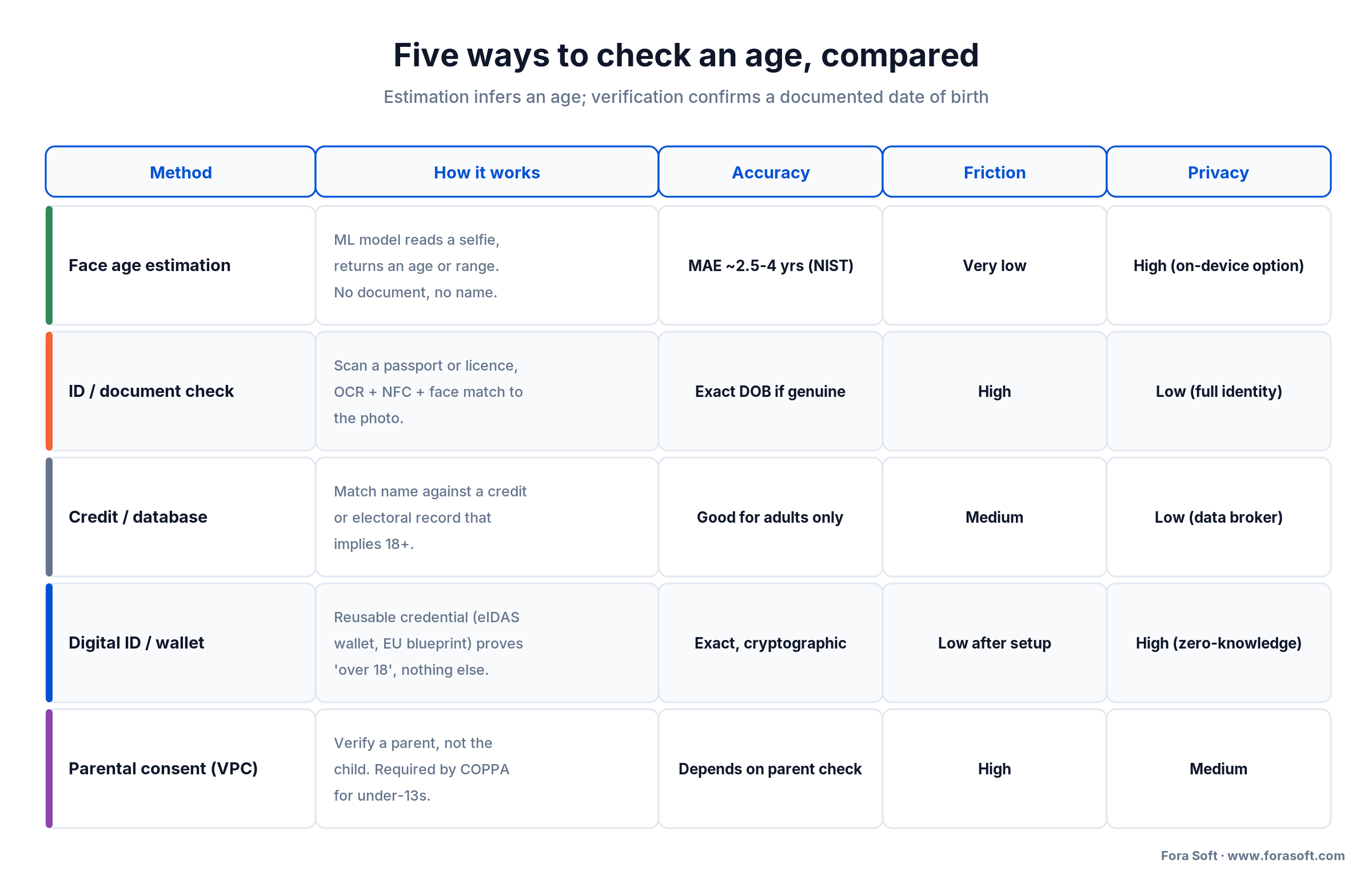
Figure 1. Estimation infers an age; verification confirms a documented date of birth. Most compliant designs lead with the private, low-friction method and escalate only when they must.
Where age verification is required: the 2026 law map
The short answer is: in more places than a year ago, and with real penalties attached. Between January 2025 and mid-2026 five major regimes turned age checks from guidance into enforceable duty. Building as if one country's rule covers the world is the fastest way to a fine, because the thresholds and accepted methods differ by jurisdiction.
The UK went first and hardest. Ofcom published its guidance on "highly effective age assurance" on 16 January 2025, and user-to-user services carrying pornography had to have those checks fully in place by July 2025 under the Online Safety Act. Penalties reach up to £18 million or 10% of qualifying worldwide revenue, and Ofcom is using them: on 9 July 2026 it fined one operator £630,000 for age-check failings.
The US moved on two fronts. The FTC's amended COPPA Rule took effect on 23 June 2025, tightening verifiable parental consent for under-13s and adding biometric identifiers to the data it covers. On 27 June 2025 the Supreme Court, in Free Speech Coalition v. Paxton, upheld Texas's law requiring age verification for sexually explicit sites, and roughly 25 states now have similar adult-content laws. App stores are next: Utah's App Store Accountability Act, signed 26 March 2025, pushes an age-category check to the store itself, with operational duties phasing in through 2026 and 2027.
The EU and Australia rounded it out. The European Commission released its age-verification blueprint, a privacy-preserving mini-app built on the EU Digital Identity Wallet, on 14 July 2025 to support Article 28 of the Digital Services Act. Australia's under-16 social-media ban took effect on 10 December 2025, with penalties up to AUD $49.5 million for platforms that fail to take reasonable steps. Different ages, different methods, one direction of travel.
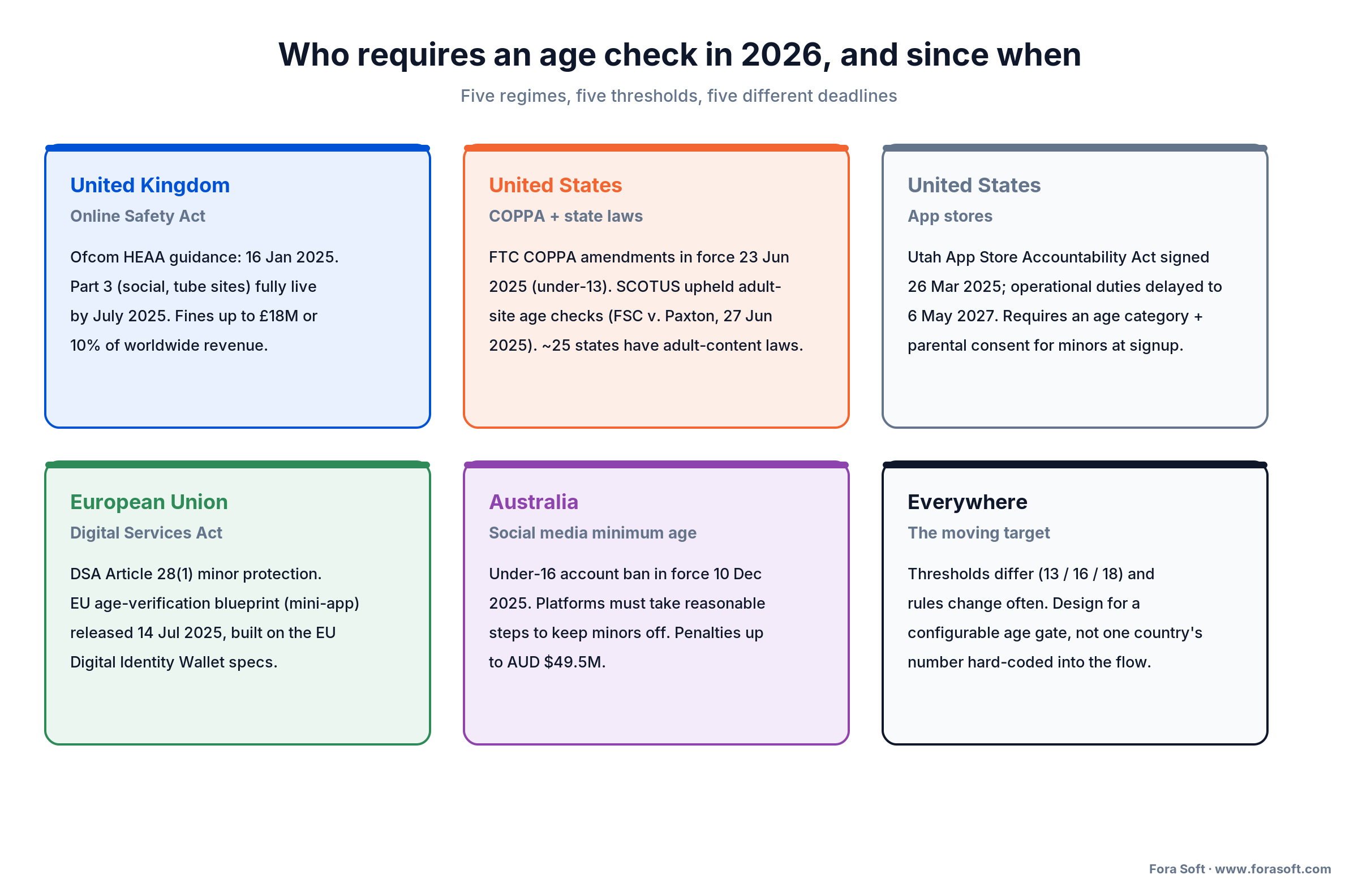
Figure 2. Five regimes, five thresholds, five deadlines. The safe engineering assumption is a configurable age gate, not one country's number hard-coded in.
"Highly effective" and the accuracy bar regulators expect
Regulators are converging on a standard of "highly effective," and the striking thing is that most of them refuse to name a single number. Ofcom's guidance says an age-assurance method must be technically accurate, reliable, fair, and hard to circumvent, and it deliberately declined to set a "99% accurate" threshold. Instead it lists methods that can be highly effective, open banking, photo-ID matching, facial age estimation, mobile-network checks, credit-card checks, and digital identity, and names the ones that never are: self-declaration and a simple "I am 18" button.
That refusal to publish a magic number is a feature, not a gap. It means the bar is contextual: a stricter product (adult content) needs a stronger method than a softer one (a 13+ social feed), and a method that passes today can fail if attackers learn to beat it. Standards bodies fill in the detail. IEEE 2089.1, approved in 2024, sets principles for online age verification built around children's rights, and schemes like the UK's PAS 1296 and the emerging ISO/IEC 27566 give auditors something concrete to certify against.
For a build, the practical reading is: pick a method the regulator already lists as capable of being highly effective, certify it against a recognized standard, and keep evidence that it works in your context. Do not invent your own accuracy claim and hope. The gate has to be defensible on the day someone asks, and "we used a listed method, certified to a published standard, with these results" is a far better answer than a number you made up.
Design note: because "highly effective" is contextual, build the strictness in as a setting. The same platform may need estimation-only for a 16+ area and an ID fallback for an 18+ purchase. Hard-coding one method to one age is how a compliant product in one country becomes a fine in another.
Not sure which method your regulator accepts?
We'll map your markets to the methods each one lists as highly effective, and tell you where estimation is enough and where you need an ID fallback.
How face age estimation works, step by step
A facial age-estimation flow is five stages, and only one of them looks at age. The model is the famous part, but the stages around it are what make the result trustworthy and the design private. Here is the path a good flow takes from a captured face to a decision.
First, capture a selfie or a short video with clear consent. Second, run a liveness check so you know you're looking at a real, present person and not a photo, a screen replay, or a generated face; this is the stage attackers target, so it carries the most weight. Third, estimate the age, either on the device (the image never leaves the phone, only a number does) or on a server. Fourth, apply a buffer: compare the estimate to a "challenge age" set above the legal threshold, so ordinary model error can't let a minor through. Fifth, decide on the buffered range.
The decision is a fork, and it is where the privacy win lives. If the estimate clears the buffer comfortably, the user passes with no document and nothing retained. If it lands in the grey zone near the threshold, you step up to an ID check or a digital-ID credential. If it falls clearly below, you block or, for under-13s, route to verified parental consent. The point is that most users never reach the friction of a full ID check, and you never collect an identity you don't need.
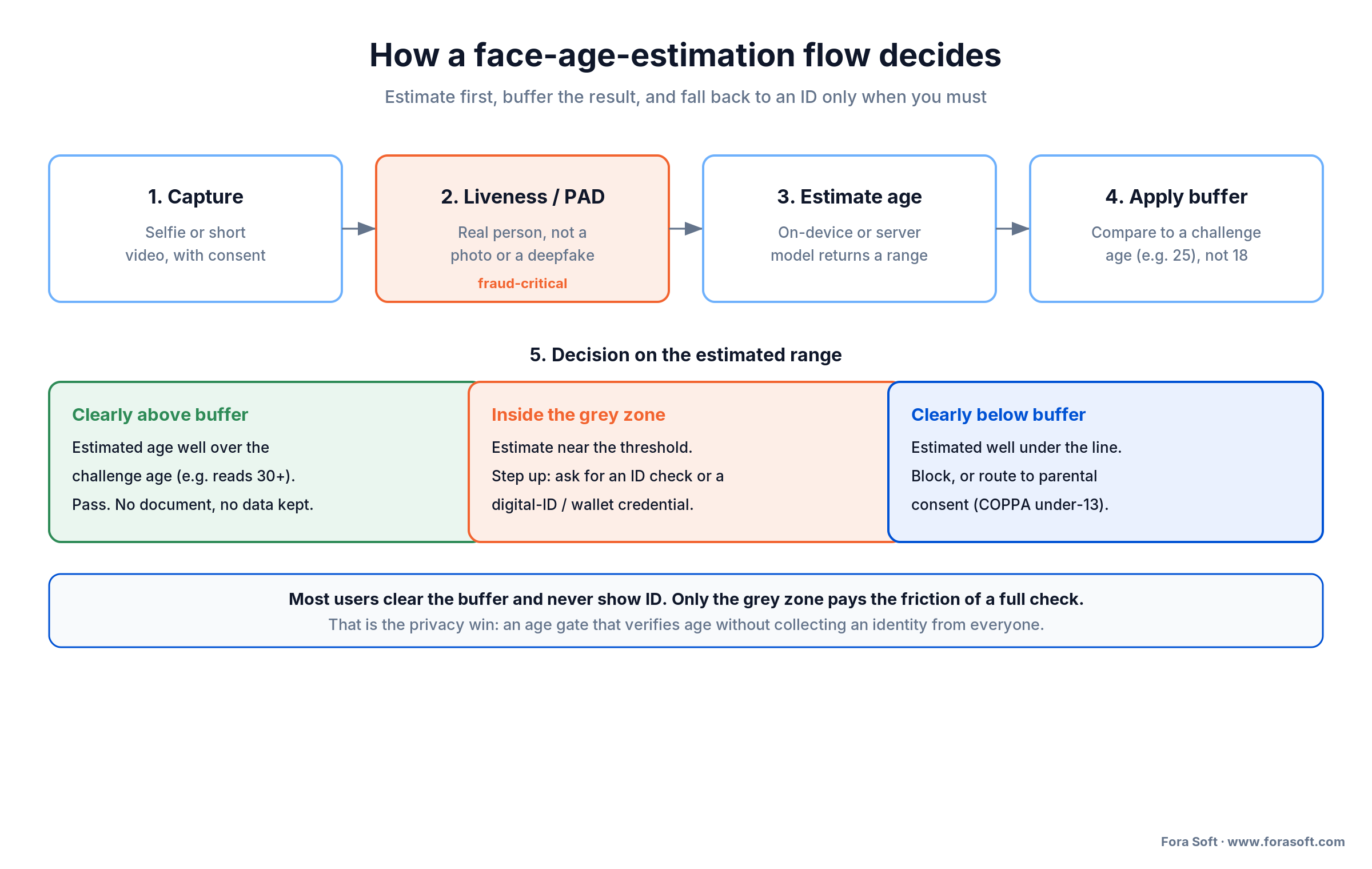
Figure 3. Estimate first, buffer the result, and fall back to an ID only in the grey zone. That is how an age gate verifies age without collecting an identity from everyone.
The challenge-age buffer: excluding minors without over-blocking adults
The challenge age is the single most important design idea in age estimation, and it exists because the model is never exact. If your legal threshold is 18 and you pass anyone the model estimates at 18 or over, then every teenager the model reads a couple of years old slips through, because estimation carries error in both directions. The fix is to set the pass bar higher than the law: require an estimate of, say, 21 or 25 before you allow an 18+ action.
That buffer converts model error into a design choice you control. Germany's youth-protection body, the KJM, has accepted a three-year buffer for 18+ content, which is why vendors quote their accuracy against a challenge age rather than the raw threshold. Yoti, for example, reports (in its own July 2025 white paper) that with a three-year buffer, only about 0.7% of 13-to-17-year-olds are wrongly estimated as over 21. Treat vendor figures as vendor figures, not independent audit, but the mechanism is sound and standard across the field.
The cost of a buffer is that some genuine young adults get caught and have to prove their age another way. That is exactly what the step-up path in the flow is for: an 18-year-old the model reads as 19 falls in the grey zone, shows an ID or a digital credential once, and is through. You tune the buffer to your risk: wider for adult content where a false pass is disastrous, narrower for a 16+ feature where friction costs you more than the occasional edge case.
Accuracy in numbers: NIST, MAE, and vendor claims
The honest headline is that facial age estimation is good and getting better, but it is not exact, and anyone who tells you otherwise is selling. The neutral benchmark is NIST, which restarted its age-estimation evaluation (FATE Age Estimation and Verification) with first results on 30 May 2024, its first look in about a decade. On a common face database, the mean absolute error of the algorithms it tested improved from 4.3 years in 2014 to 3.1 years in 2024, with the best performers dipping under three years on some image sets.
Two caveats matter for a build. First, NIST found error is almost always higher for female faces than male, and it varies across demographics, which is exactly the fairness dimension Ofcom's "highly effective" test cares about; you cannot ship a model that works well on one group and poorly on another. Second, the leaderboard moves every few weeks as vendors submit new algorithms, so any specific ranking you read today is a snapshot. Design for "which vendor is near the top and fair across groups," not "vendor X is best forever."
Vendor white papers report tighter numbers than NIST, often around one year of error for teenagers, but they measure on their own data with their own buffer, so they are a starting point for a shortlist, not a verified fact. The way to trust a number is to test the shortlisted models on faces that look like your users, measure error and fairness yourself, and pick the challenge-age buffer that hits your risk target. Accuracy is something you verify, not something you accept from a slide.
Reach for estimation when: your threshold is 16 or 18, you want low friction and minimal data, and an occasional grey-zone step-up is acceptable. Reach for a mandatory ID check when the law names it, when the action is high-stakes (a regulated purchase), or when your risk model can't tolerate any false pass.
Privacy by design: on-device, data minimization, and verifiable credentials
The privacy question is the one that sinks age-verification projects, and it is answerable if you design for it from the start. The public objection, seen loudly in privacy forums and in commentary from groups like the EFF, is that mandatory age checks turn every website into a surveillance point that hoards IDs and selfies. That fear is legitimate, and it is also a design failure, not an inherent property of age assurance. The whole point of estimation and of digital credentials is to prove an age without building that honeypot.
Three moves keep you on the right side of it. Run age estimation on-device where you can, so the image is processed on the phone and only a yes/no or an age band leaves it. Practice data minimization: if you do take an ID for a step-up, extract the one fact you need (over 18) and delete the document, rather than storing scans "just in case," which the 2025 COPPA amendments and GDPR both push against. And prefer verifiable credentials, the model behind the EU's age-verification blueprint, where a trusted issuer vouches that the holder is over 18 and your service learns nothing more, with no way to track the user across sites.
This is also good engineering, not just good ethics. Every ID you don't store is a breach you can't suffer and a retention duty you don't carry. The same discipline that keeps camera-based AI systems on the right side of privacy law applies here: collect the minimum, keep it the shortest time, and be able to explain exactly what you hold and why.
Deepfakes and injection attacks: the 2026 threat model
If a document photo and a single selfie were ever enough, they are not now, because the attacker has generative tools too. There are two attack classes to defend, and they hit different parts of the pipeline. Presentation attacks show a fake to a real camera: a printed photo of an older face, a screen replay, or a mask. Injection attacks skip the camera entirely, feeding a virtual-camera stream or a deepfake video straight into the app, and they are the faster-growing threat as generation gets cheaper.
Presentation attacks are handled by presentation-attack detection (PAD), tested and reported under ISO/IEC 30107-3 and certified by labs such as iBeta at Level 1 (photos, replays) and Level 2 (3D masks). This is table stakes; any serious estimation or liveness vendor will hold a current certificate, and you should ask to see it. But PAD alone does not stop an injected stream, because there is no physical presentation to detect.
Injection attacks need a different layer: device- and platform-integrity signals that flag an emulator or a virtual camera, plus analysis of the media itself for the artifacts of AI generation. This is the same arms race we describe in our video KYC guide, and the same discipline behind detection systems like real-time video threat detection: assume the input can be forged, verify integrity, and keep a human reviewer on the cases a model is unsure about. An age gate that can't tell a live teenager from an injected adult face isn't a control, it's decoration.
Ask every vendor two things: a current ISO/IEC 30107-3 PAD certificate (which lab, which level, what date), and how they detect injection attacks that bypass the camera. If the second answer is vague, the gate will fold against a virtual camera, and 2026's attackers know how to run one.
Reference architecture for an age verification system
A production age gate is a small number of components wired around one decision engine, and the design goal is to keep the sensitive parts thin and swappable. At the edge sits the capture SDK in your web or mobile client, handling consent, the selfie or document capture, liveness, and, when you run it on-device, the estimation model. Keeping estimation at the edge is the privacy default; only escalations should send data onward.
Behind it, an orchestration layer is where your logic lives: it applies the challenge-age buffer, routes grey-zone users to a step-up (ID check or digital credential), calls whichever specialist APIs you've chosen, and returns allow, block, or refer. A decision and policy service holds the rules that differ by country and product, so you change a threshold in configuration rather than in code. A human-review console handles referrals and appeals, because no automated gate should be the last word for a user it wrongly blocks. And an append-only audit log records what was decided, on what evidence, under which policy, which is what you show a regulator.
The pattern that keeps this maintainable is to treat the age-estimation and document models as pluggable vendors behind your own interface. The model market moves fast and accuracy leaders change; if swapping a provider means a config change rather than a rebuild, you can chase accuracy and price without re-architecting. This is the same orchestration-over-best-of-breed approach we use for AI integration generally: own the flow and the data, buy the models.
Build vs buy: age verification APIs vs custom orchestration
Almost nobody should train their own age-estimation model, and almost everybody has to decide how much of the flow to own around it. There are three honest paths, and they trade speed to launch against control and unit economics.
Hosted age-assurance API. Vendors such as Yoti, Veriff, Sumsub, Persona, and others hand you estimation, liveness, and an ID fallback behind one SDK. You integrate in weeks and pay per check. The trade is a ceiling on customization, per-check economics that grow with you, and your age gate living partly inside someone else's SDK and data flows.
Custom orchestration over best-of-breed models. You own the flow, the challenge-age logic, the UX, and the audit log, and you call a specialist estimation or document API where it makes sense. This is the path when the age gate is part of your product experience, when you need control of the data and privacy story, or when your volume is high enough that a flat build beats per-check fees. It's what we build most often.
Fully custom, models included. Training and maintaining your own estimation model is a research program with an ongoing arms race against new attacks and a fairness burden you carry alone. We'll talk you out of it unless you have a genuine reason and the labelled, consented data to back it.
| Option | Best for | Control & UX | Privacy ownership | Cost shape |
|---|---|---|---|---|
| Custom orchestration | Own UX, data control, scale | Full | Exactly what you design | Build once + pass-through fees |
| Hosted age API | Fast launch, standard flows | Themed inside their SDK | Vendor-held; check retention | Per check |
| Digital-ID / wallet | EU, privacy-first, reusable | High, credential-based | Best (zero-knowledge) | Low per check after setup |
| Fully custom models | Rare; special data needs | Full, and full burden | Yours, including fairness | High build + ongoing R&D |
What age verification software costs to build
There are two costs to reason about separately: the one-time build and the per-check fees, and the build-vs-buy call is arithmetic between them. A custom orchestration layer over best-of-breed models, with a configurable age gate, a step-up path, a review console, and an audit log, typically runs about $60–140k depending on how many platforms and methods you support. That is the flow you own; the estimation model behind it is a pass-through API you pay per call.
Per-check fees are where volume decides everything. Prices vary widely by method and vendor, and most publish little publicly, so treat any figure as a starting point to confirm on the vendor's own page. As one public reference, Stripe Identity lists document verification from $1.50 per check (its pricing page, 2026); a face-estimation-only call is generally cheaper than a full ID verification. The pattern to internalize is that a face estimate is the low-cost, high-volume path and an ID check is the expensive fallback, which is another reason to lead with estimation and escalate rarely.
Run the worked example against your own traffic. At one million checks a year and a conservative blended $0.50 per check, you are paying roughly $500,000 a year in fees before any ID upgrades, which clears a $60–140k build in the first year. At a hundred thousand checks a year, the hosted API is almost certainly cheaper than a build. The crossover is your volume against the fee, and it moves the moment your estimation-to-ID ratio or your traffic changes, so model it before you commit.
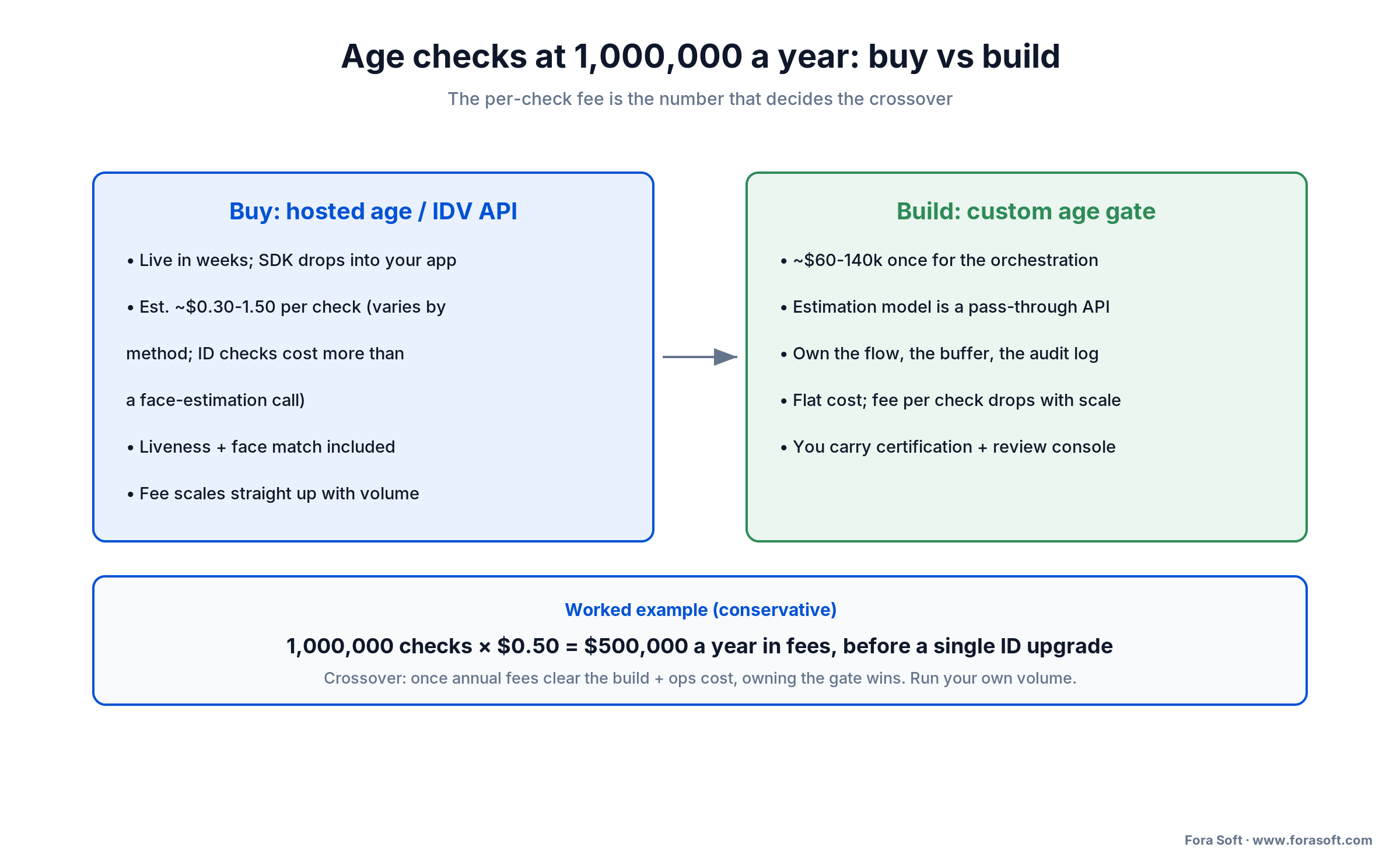
Figure 4. The per-check fee is the number that decides build vs buy. Below the crossover, buy; above it, owning the gate wins. Always run your own volume.
Want the build-vs-buy math for your volume?
Bring your traffic, your markets, and your threshold. We'll model per-check fees against a custom build and show you the crossover, with real numbers.
Age verification use cases: adult content, social, gaming, alcohol, app stores
The method you need follows the threshold and the stakes, and the same building blocks serve very different products. Here is how the common cases map, so you can see where estimation is enough and where the law pushes you toward a document or a wallet.
Adult content is the strictest, at 18+ with a false pass treated as a serious failure, so it usually needs estimation with a wide buffer plus a mandatory ID or digital-ID fallback, and it is the case the UK OSA and US state laws target directly. Social platforms face a 13-or-16 threshold (COPPA under-13, Australia under-16), where low-friction estimation fits best, with parental consent flows for younger users. Gaming and app stores increasingly push the check to the platform layer, as Utah's app-store law does, so a game may consume an age signal rather than run its own.
Alcohol, vaping, and gambling sit at 18 or 21 with real liability, so they lean toward stronger checks and often combine an estimate with an ID at purchase. Regulated marketplaces and fintech frequently need age and identity, which is where age assurance meets full onboarding and KYC. The design lesson across all of them is the same: set the threshold in configuration, choose the method by stakes, and keep the strictest path available as a step-up rather than forcing it on everyone.
Mini-case: the computer-vision and identity spine we've shipped
We haven't shipped a public product called "age verification," and we'd rather tell you what we have built than dress up something we haven't. The two engines an age gate needs, a vision model that judges a face and an auditable pipeline that records a decision, are both things we've run in production at scale, which is why this build is a short step for us rather than a research project.
On the vision side, our video and object recognition work is the same class of computer vision a facial age-estimation model uses: detect a face, extract features, return a judgment, and handle the messy real-world capture conditions that break naive models. On the auditable-video side, VALT runs recorded, access-controlled video for 770+ US organizations and 50,000+ users under HIPAA, which is precisely the discipline an age gate's evidence log demands: who did what, when, and on what basis, kept safely and retrievably.
Put those together and the age-gate build is the orchestration in between: consent capture, a liveness and estimation call to a specialist model, the challenge-age logic, a step-up path, and the append-only record. Across 250+ projects since 2005 we've built that identity-and-audit spine in healthcare, fintech, and surveillance contexts where getting it wrong has consequences. Point it at an age threshold instead of a HIPAA record, and it's the same engineering we do every week.
A decision framework in five questions
Before you pick a vendor or write a line of code, answer these five questions. They decide the method, the strictness, and the build-vs-buy call more reliably than any feature comparison.
1. What is the threshold, and where are your users? 13, 16, 18, or 21 changes the method, and a multi-country footprint means a configurable gate, not one hard-coded age. 2. How bad is a false pass? Adult content and regulated purchases demand a wide buffer and an ID fallback; a 16+ feature can accept lighter estimation. 3. Do you actually need identity, or just age? If the name is a liability, stay in age assurance and avoid KYC.
4. What's your volume? Per-check fees against a flat build set the crossover; model it before committing. 5. Who owns the data and the audit? Buy, and you inherit a vendor's retention and data flows; build, and the record and the privacy posture sit where you decide. If you want a partner who's answered all five for regulated video and vision before, that's the conversation we have every week.
When NOT to build custom age verification
Custom is not always the answer, and we'll tell you when to buy instead, because a build you don't need is money you don't get back. If your volume is modest, a few thousand checks a month, a hosted API is almost certainly cheaper than a build and will stay that way; the per-check fee never grows into the crossover. If you need to launch in weeks to meet a deadline like a new state law taking effect, an SDK you drop in beats a build that lands after the fine.
There are two more honest "don'ts." Don't train your own estimation model unless model quality is your actual product and you have the consented, representative data to do it fairly, because you'll inherit an accuracy and fairness burden that full-time teams struggle with. And don't build an age gate at all if a self-declared date genuinely satisfies your obligation, which is rare now but still true for some low-risk, low-threshold contexts. Match the control to the requirement; over-building an age gate wastes money and collects data you'll wish you hadn't.
Rule of thumb: buy at low volume or under deadline; build when the gate is part of your product, your volume clears the crossover, or your privacy story requires owning the data. Almost nobody should train their own model.
FAQ
What is age verification software?
Age verification software confirms that a user meets an age requirement, usually 13, 16, or 18, before granting access to restricted content or purchases. It uses methods such as facial age estimation, ID or document checks, digital identity credentials, or verified parental consent instead of a self-declared birthdate, and returns an allow, block, or step-up decision. A well-designed system can confirm someone is over 18 without collecting or storing their identity.
What's the difference between age verification, age estimation, and age assurance?
Age verification confirms an age against a document or authoritative record, so it's exact and usually collects identity. Age estimation infers an age or range from a signal like a face, so it's fast and private but approximate. Age assurance is the umbrella term regulators use for both. Many compliant designs lead with estimation for privacy and low friction, then fall back to verification only for users near the threshold.
How accurate is facial age estimation?
NIST's 2024 evaluation found top algorithms reaching a mean absolute error of roughly 3.1 years on a common face database, with the best dipping under three years on some image sets, and error typically higher for female faces. Vendors report tighter numbers, often around a year for teenagers, but measured on their own data. Because it's approximate, systems apply a "challenge age" buffer, requiring an estimate well above the legal threshold, so ordinary error can't let a minor through.
Is age verification legally required?
Increasingly, yes, depending on your content and market. The UK Online Safety Act requires "highly effective age assurance" for pornography (fully in force by July 2025). US COPPA requires parental consent for under-13s, the Supreme Court upheld age checks for adult sites in June 2025, and about 25 states have adult-content laws. The EU's DSA and Australia's under-16 social-media ban add more. Thresholds and accepted methods differ by jurisdiction, so treat this as a map to check with counsel.
How much does it cost to build age verification software?
A custom orchestration layer over best-of-breed models, with a configurable gate, step-up path, review console, and audit log, typically runs about $60–140k depending on platforms and methods. On top of the build you pay per-check vendor fees, which vary by method (a face estimate is cheaper than a full ID verification). At high volume, a flat build beats growing per-check fees; at low volume, a hosted API is cheaper. Run your own traffic against the fee to find the crossover.
Does age verification have to collect and store IDs?
No, and good design avoids it. Facial age estimation can run on-device so only an age band leaves the phone. Digital-ID and verifiable credentials (the model behind the EU's 2025 blueprint) prove "over 18" without revealing identity or enabling cross-site tracking. If you do take an ID for a step-up, extract the one fact you need and delete the document rather than storing scans. Every ID you don't keep is a breach you can't suffer.
Can age verification be fooled by deepfakes?
It can if it's weak. A document photo plus a single selfie is no longer safe. Presentation-attack detection (ISO/IEC 30107-3, iBeta Level 1 or 2) stops fakes shown to the camera, and device-integrity signals plus AI-generated-media analysis stop injection attacks that feed a virtual camera or deepfake stream past it. Ask any vendor for a current PAD certificate and for how they detect injection attacks, and keep a human reviewer on uncertain cases.
Should we build age verification or buy an API like Yoti or Veriff?
Buy a hosted age-assurance API when you need to launch fast, your flows are standard, and your volume is modest, since per-check fees beat a build at low scale. Build custom orchestration when the age gate is part of your product, you need control of the data and privacy story, or your volume makes a flat build cheaper than growing per-check fees. Almost nobody should train their own estimation model, given the accuracy and fairness burden.
What to read next
Identity
Video KYC Solution Development
When you need who-you-are, not just how-old, this is the identity build.
Computer vision
Video Recognition Software Development
The vision engine behind facial age estimation and liveness.
Privacy & ethics
AI Video Surveillance: Ethics and Privacy
How camera-based AI stays on the right side of privacy law.
Fintech
Video Banking Platform Development
Where age and identity checks plug into a full remote-banking build.
Services
AI Integration Services
How we wire estimation, liveness, and ID models into one age gate.
Ready to add age verification to your product?
Age verification stopped being optional in 2025, and the good news is that the engineering is well understood. Lead with a private, low-friction facial age estimate, buffer it with a challenge age so ordinary error can't let minors through, and fall back to an ID or a digital credential only in the grey zone. Defend the flow against presentation and injection attacks, keep the strictness configurable by country and product, and record every decision in a log you can show a regulator. Learn the AI pieces deeper in our AI for video engineering track.
The build-vs-buy call comes down to volume and control. A hosted API gets you live in weeks and charges per check; custom orchestration is a flat build that pays back past a volume threshold and keeps the data and the privacy story yours. Decide it on the arithmetic, get the buffer and the anti-fraud defenses right, and the rest is engineering we do all the time.

The book · Volume 6 of 7
AI for Video: A Complete Guide to Intelligence in Video Products: From Models and Inference to Computer Vision, Speech, Search, and Generative Video
An age gate is a face model wrapped in a flow you can defend to a regulator. Volume 6 covers the model side in depth: the life cycle of an AI feature, deployment topologies for on-device and cloud inference, model artifacts and the ML basics for judging vendor accuracy claims, and computer vision from detection and tracking to segmentation and pose. Written by Nikolay Sapunov, CEO at Fora Soft.
Read it on Amazon →Kindle & paperback · Fora Soft Video Engineering Handbook
Build an age gate that's private, compliant, and hard to fool
30 minutes, real engineering opinions, no slides. Bring your markets, threshold, and volume; leave with a method map and a build-vs-buy call.