
Key takeaways
• Blockchain in education is now a credentials problem, not a hype problem. W3C Verifiable Credentials Data Model 2.0 became a Recommendation in May 2025; Open Badges 3.0 aligns with it. The standards are settled, so the work is integration, not invention.
• Permissioned and L2 chains beat L1 mainnet for credentials. Hyperledger Indy/Aries, EBSI on Hyperledger Besu, and Polygon are the chains real institutions ship on. Issuance fees on L2 are pennies; on Ethereum L1 they can be dollars per credential.
• The right architecture stores hashes on-chain, not student data. Personal data lives off-chain — encrypted in the issuer’s store and the student’s wallet — while a hash anchored to a chain proves the credential hasn’t been altered. This keeps you GDPR- and FERPA-defensible.
• Mobile wallets are the verification interface. Apple Wallet ID and Google Wallet credentials, plus EUDI Wallet across the EU, mean students present a tap or QR scan and the verifier resolves the DID instantly — no calls back to the institution.
• A credential MVP ships in 12–16 weeks at $60–$120K. A production-grade blockchain e-learning platform with selective disclosure, AI grading attestation, and admin tooling lands in 6–9 months for $180–$320K.
Why Fora Soft wrote this blockchain e-learning playbook
We’ve built software since 2005 — 250+ projects, 50+ in-house specialists — and a good slice of that is e-learning platforms and blockchain features inside mobile apps. The combination matters: most teams writing about blockchain in education either don’t ship learning products or don’t ship blockchain, so the advice reads as too academic or too speculative.
Our reference project on the e-learning side is Scholarly — an Asia-Pacific learning platform with 15,000+ active users and capacity for 2,000 participants in a single live class, named the most innovative EdTech startup in Asia Pacific by AWS. On the blockchain side, our recent use-case breakdown covers the five blockchain mobile patterns that actually pay off in 2026, including credential anchoring. This article narrows that lens to e-learning specifically and answers the question: when does a blockchain e-learning system make sense, what does it cost, and how do you build it?
The honest answer: blockchain in e-learning is not a UX upgrade. Students don’t want it. Teachers don’t demand it. The buyers who fund it are registrars, accreditors, employers, and ministries of education — the people whose job depends on a credential being real. If you serve those buyers, blockchain pays off; if you don’t, you’re building infrastructure for a problem your users don’t have. This playbook is for product owners deciding which side of that line they sit on.
Trying to decide if blockchain belongs in your e-learning roadmap?
Bring your credential workflow and verification audience. We’ll tell you straight whether blockchain pays off or just adds cost — no deck, no upsell.
What blockchain in e-learning actually fixes — and what it doesn’t
Strip the marketing and blockchain in e-learning solves three concrete problems: credential authenticity, selective disclosure, and portability across institutions. Everything else — tokenized rewards, DAOs, NFT certificates — is downstream of those three.
Credential authenticity. A digitally signed credential anchored to a public ledger can’t be silently revised by the issuer or forged by a third party. Verifiers check the signature against a public key in the issuer’s DID document and the hash against the ledger. No phone calls, no paperwork, no trust in a single registrar’s database.
Selective disclosure. A student should be able to prove “I’m over 18 and hold a CompTIA A+” without leaking their birthday, address, or any other course they’ve taken. Selective disclosure is what makes verifiable credentials genuinely better than PDF transcripts; without it you’re just digitizing the old privacy problem.
Portability. A credential issued by one institution and held in a student’s wallet can be presented to any verifier — an employer, a regulator, another university for credit transfer — without round-tripping through the issuer. This is the value driving EBSI in Europe and DCC at MIT.
What blockchain doesn’t fix. Course-content delivery, video streaming, classroom collaboration, gradebook UX, lesson planning, AI tutoring — none of it benefits from being on chain. Putting course materials on IPFS doesn’t make them better. Putting attendance on chain doesn’t make it more accurate. Be honest about which surface you’re actually upgrading.
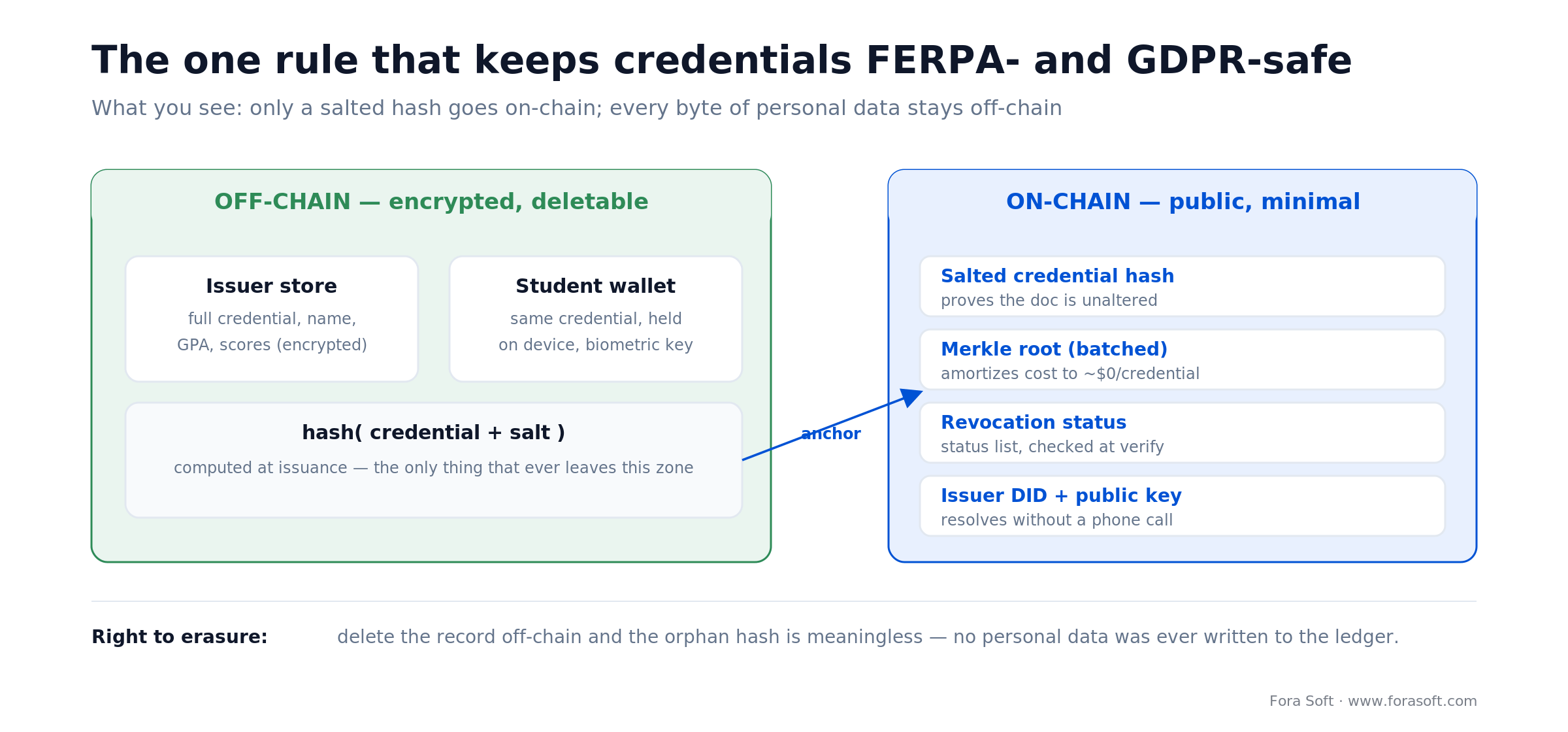
Figure 1. The compliance rule that keeps you FERPA- and GDPR-safe: anchor a salted hash on-chain, keep every byte of personal data off-chain.
Reach for blockchain in e-learning when: your credential needs to be verified by parties who don’t trust the issuer’s database (employers, regulators, foreign institutions) and the verification volume is high enough to matter (hundreds per month).
The credential fraud baseline in 2026
The reason blockchain e-learning has a buyer is the size and stickiness of credential fraud. The UK’s HEDD service, run by Jisc, has helped identify more than 400 bogus institutions issuing fake UK degrees and shut down more than 80 of them. Employer verification through HEDD starts at £14 per enquiry; for a high-volume recruiter that adds up fast.
In the US, diploma mills remain a persistent issue. They award degrees within days for fees, adopt names mimicking real universities, and operate in jurisdictions where prosecution is slow. Recruiters report that manual verification of a single foreign degree can take weeks of email back-and-forth, and the failure mode is silent — recruiters skip the check rather than wait.
The cost stack of credential fraud splits across three audiences: students lose interview slots when their real degree is overshadowed by fake competition, employers lose hires to fraud and pay for verification services, and accredited institutions lose brand value every time a counterfeit certificate circulates with their name on it. A blockchain-anchored credential closes the verification loop in seconds for all three audiences at the same time.
The catch: this only works at scale on the verifier side. If only one university issues blockchain credentials and no employer’s ATS knows how to verify them, the credential is just a fancier PDF. EBSI’s value — and the reason the EU funded it — is that the verifier ecosystem ships on the same standards as the issuer ecosystem.
W3C Verifiable Credentials 2.0 and Open Badges 3.0: the spec that won
The standards picture finally cleared up in 2025. Three specs now matter, and any blockchain e-learning system you build in 2026 should align to them.
W3C Verifiable Credentials Data Model 2.0. Reached W3C Recommendation status on May 15, 2025. This is the canonical format: a JSON-LD credential, cryptographically signed by an issuer DID, presentable via a Verifiable Presentation. Earlier versions are deprecated for new work.
W3C Decentralized Identifiers (DID Core). Recommendation since 2022 with 46 implementations in the conformance suite and 100+ DID method specifications. DIDs are the issuer and holder identities behind every credential; pick a method that fits your chain (e.g., did:ethr for Ethereum, did:indy for Hyperledger Indy, did:web for institutions that prefer DNS-anchored identity).
Open Badges 3.0 / Comprehensive Learner Record (1EdTech). Open Badges 3.0 published by 1EdTech (formerly IMS Global) is now built directly on the W3C VC Data Model 2.0. That means an Open Badge is a Verifiable Credential. The same goes for Comprehensive Learner Records, which let institutions describe full learning histories in the same format.
Why these matter together: a credential issued in OB 3.0 by a university is verifiable by any employer ATS that understands W3C VC 2.0, regardless of the chain. Standards alignment is what lets you swap chains later without breaking your verifier ecosystem — and it’s what lets EBSI in Europe interoperate with DCC in the US.
Five blockchain e-learning use cases that pay off in 2026
We’ve evaluated dozens of blockchain e-learning concepts over the last three years. The five below have actual paying buyers and shipping production references; everything else is either too early or too small to fund.
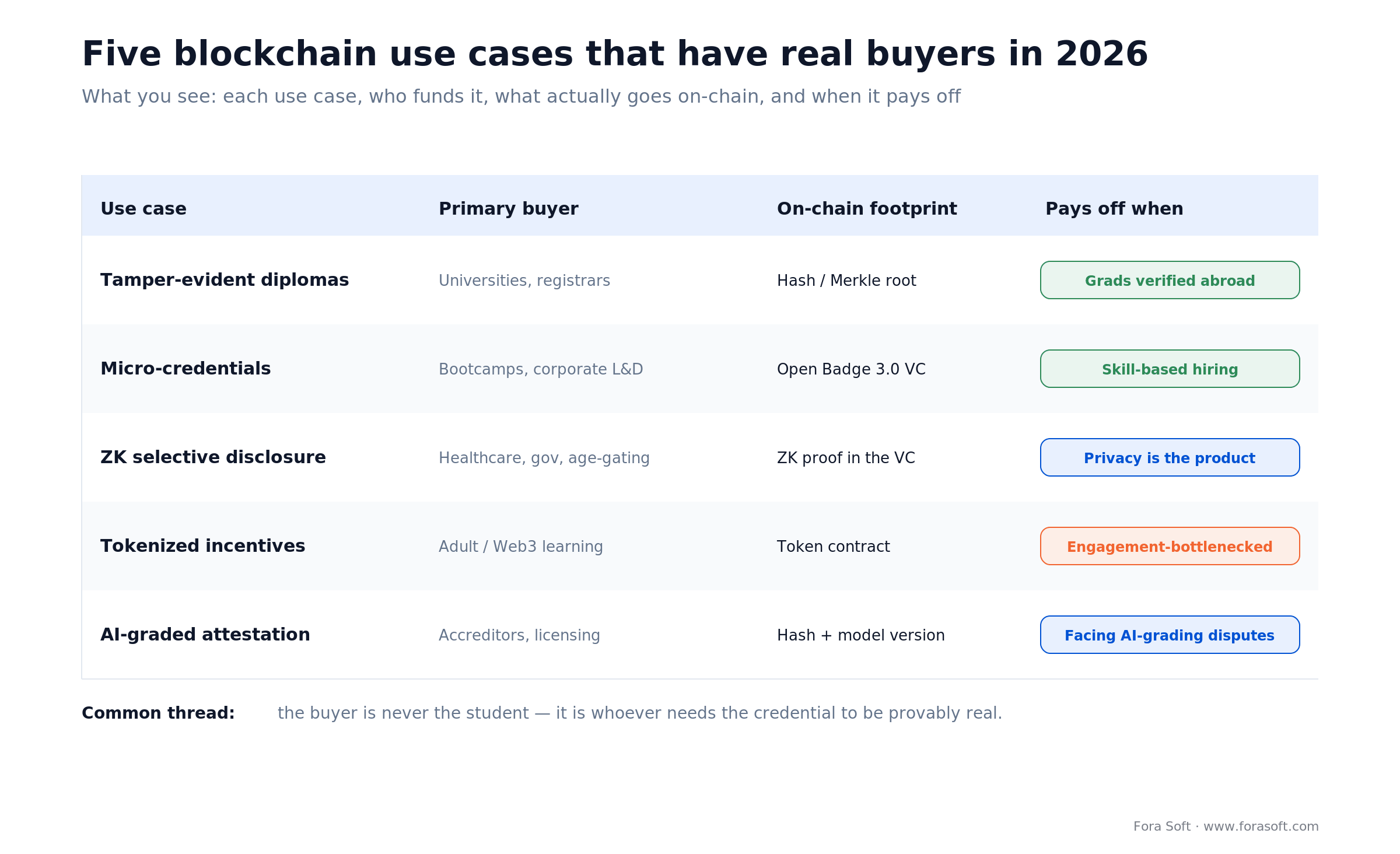
Figure 2. The five use cases with real, paying buyers in 2026 — and exactly what each one writes to the chain.
Use case 1: tamper-evident diplomas and transcripts
What it is. The diploma, transcript, or certificate is hashed; the hash and the issuer signature are written to a chain at issuance time. The full document lives off-chain in the institution’s store and in the student’s wallet. Verifiers fetch the hash, recompute it from the document the student presents, and confirm the match.
Who buys it. Universities, vocational schools, professional certifications. Reference deployments include BCdiploma, which issues blockchain credentials for 130+ institutions across 19 countries (University of Toronto, ESCP, Stanford, TOEIC, WHO); the University of Toronto School of Continuing Studies alone reported saving roughly 170 workdays and $170,000 in overhead. The MIT Digital Credentials Consortium is a university-led open-source stack (nine universities at its 2019 launch), and EBSI runs a diploma use case across EU member states.
Cost shape. Per-credential issuance on Polygon or an L2 is fractions of a cent at typical 2026 gas; on Ethereum L1 it’s anywhere from $0.20 to several dollars depending on congestion. Most production systems batch issuance to a Merkle tree and write only the root, dropping per-credential cost to negligible.
Limits. If your buyer is one institution issuing fewer than 1,000 credentials a year, the verification volume probably doesn’t justify the spec, integration, and wallet UX work. The pattern compounds when there are many issuers, many credentials, and many independent verifiers.
Reach for blockchain diplomas when: graduates need to be verified by employers in countries where your registrar has no relationships, or accreditation requires tamper-evident records held outside the institution’s database.
Use case 2: stackable micro-credentials and skill passports
What it is. Discrete skills (a workshop, a coding kata, an internal training module) issued as Open Badge 3.0 verifiable credentials. Students collect them across institutions and platforms; verifiers see a portable, machine-readable skill graph instead of a list of unverified resume bullets.
Who buys it. Bootcamps, corporate L&D, vendor certifications (think AWS, Microsoft, CompTIA), workforce development programs. The buyer’s pain isn’t fraud; it’s that traditional resumes don’t carry skills well, and recruiters skip nuanced training because they can’t verify it cheaply.
Cost shape. Issuance is typically batched and pennies per badge; the heavier work is the badge taxonomy and competency framework, which is design effort, not blockchain effort. Plan 30–50% of project cost on framework + verifier integrations vs. on chain.
Limits. Without a verifier ecosystem, badges are decoration. The trick is partnering with employers or ATS vendors early so the badge actually shortens a hiring step. The OB 3.0 standard helps because it’s the same wire format as a verifiable credential; LinkedIn, ATS vendors, and HR systems can ingest it without custom integrations per issuer.
Reach for micro-credentials when: your buyers are employers in skill-based hiring — tech, healthcare, regulated trades — and you can sign at least three verifier integrations before launching.
Use case 3: zero-knowledge selective disclosure
What it is. A student proves a property of their credential (“I hold a degree from an accredited US university”) without disclosing which one, the date, or the GPA. Implementation uses zero-knowledge proofs — ZK-SNARKs or STARKs — embedded in the verifiable credential.
Who buys it. Privacy-conscious verticals: healthcare licensing, government clearance, age-gated platforms, anti-discrimination hiring pilots. EBSI and the EUDI Wallet are standardizing ZK-based predicates (age-over, membership) for credentials, though production support is still maturing in 2026. Polygon ID and similar projects offer ZK-credential SDKs for general-purpose use.
Cost shape. ZK proof generation on a phone has gotten dramatically faster in the last 18 months — sub-second proving for typical credential predicates is now realistic. Library integration adds 4–8 weeks to an MVP timeline; the predicate design (which properties can be selectively disclosed) is the hard part.
Limits. Most current verifiers don’t know how to consume ZK proofs. If your verifier integration story can’t handle ZK presentations yet, fall back to plain selective-disclosure JWT (SD-JWT VC) which has wider 2026 support and gets you most of the privacy benefit.
Use case 4: tokenized learning incentives and DAOs
What it is. Students earn tokens for completing modules, peer-reviewing work, contributing to course content, or maintaining streaks; tokens redeem for course credits, premium features, or community governance rights. Some platforms use a DAO structure where token holders vote on curriculum decisions.
Who buys it. Open-network learning platforms, DAO-native education projects, and adult-learning communities where engagement is the bottleneck. The pattern is more common in Web3 education than mainstream EdTech.
Cost shape. Tokens add a regulatory dimension (securities classification, KYC for token sales, tax reporting) that often dwarfs the engineering cost. Plan a legal-engineering budget that’s comparable to the technical build.
Limits. Tokenization works best in voluntary adult-learning contexts. In K-12 and accredited higher ed, tokens often clash with anti-gambling, advertising, and child-protection rules. Don’t add tokens to a system whose primary buyer is a school district or ministry of education.
Reach for tokenized incentives when: your audience is adult, voluntary, and engagement-bottlenecked — not when accreditors, parents, or regulators are the primary stakeholder.
Use case 5: AI-graded work attestation
What it is. AI systems are now grading essays, coding assignments, design portfolios, and oral exams at scale. Anchoring the grading model version, the prompt, and the score to a chain creates an audit trail that survives even if the AI vendor changes models, prices, or disappears. The verifiable credential carries a pointer to the AI-grading attestation alongside the human signature — the same auditable pattern we build into AI integration work.
Who buys it. Accreditation bodies under pressure to validate AI-graded outcomes, professional licensing programs that accept AI-graded competency exams, and any institution facing legal challenges over AI-driven grade assignments.
Cost shape. Light. The on-chain footprint is a hash + metadata; the meaningful work is on the off-chain side — logging the AI call, the input, the model version, and the output, then signing the bundle. Add 2–4 weeks to an existing AI grading pipeline.
Limits. This is a defensive use case — it doesn’t make the AI grading better, it makes the institution’s position defensible. If you’re not facing regulatory pressure, you probably don’t need it yet.
Chain choice: Ethereum L2, Polygon, Hyperledger, or EBSI
Five chains dominate real-world blockchain e-learning deployments in 2026. They differ in cost, governance, and the regulatory story you can tell to a registrar or ministry.
| Chain | Type | Per-credential cost | Best for | Watch out |
|---|---|---|---|---|
| Ethereum L1 | Public PoS | $0.20–$5+ per write | Anchor of last resort, batched roots only | Fee volatility kills predictable budgets |
| Polygon PoS | Public PoS L2 | ~$0.001 per write | High-volume credential issuance | Bridge security; consider zkEVM variants |
| Arbitrum / Base | Public optimistic L2 | $0.005–$0.05 | Balanced cost + Ethereum security | 7-day finality challenge window |
| Hyperledger Indy / Fabric | Permissioned | No per-tx fee | Consortium-run credential networks | You operate validator nodes |
| EBSI (Hyperledger Besu) | EU public-sector | No per-tx fee for accredited issuers | EU institutions, EUDI Wallet integration | EU jurisdictional scope only |
For most non-EU credential projects in 2026, the practical default is a permissioned network (Hyperledger Indy/Aries, frequently inside Sovrin or a Trust over IP framework) for the issuer + holder + verifier protocol, anchored to a public chain like Polygon or Arbitrum for tamper-evident roots. EU projects default to EBSI for the regulatory tailwind that comes with eIDAS 2.0 alignment.
Stuck on chain choice for your credential pipeline?
We’ll match your verifier audience, compliance footprint, and budget against the five real chain options for 2026.
Reference architecture for a blockchain-backed e-learning mobile app
A defensible architecture has four layers; mistakes happen when teams collapse them or push personal data into the wrong layer.
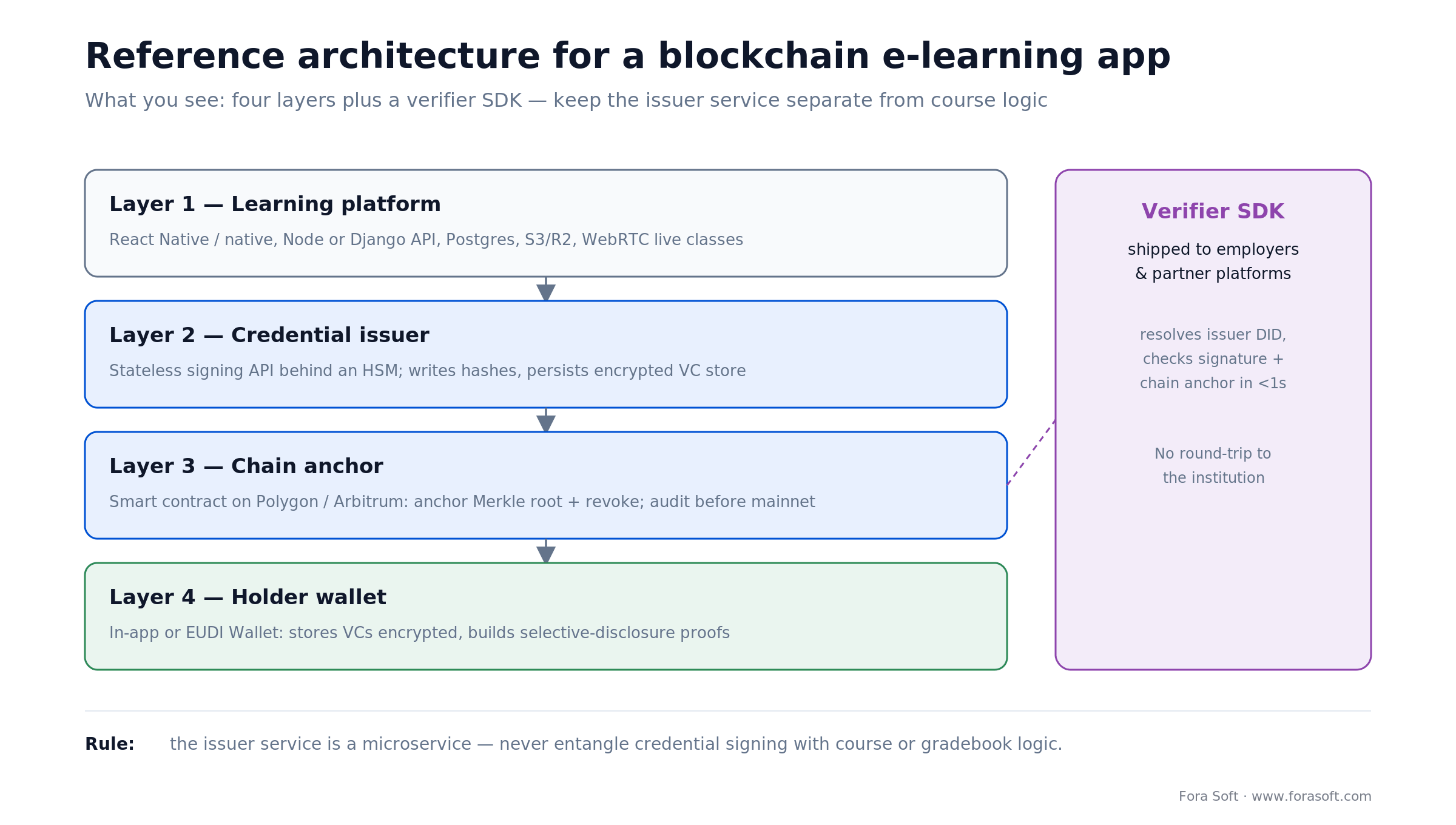
Figure 3. Four layers plus a verifier SDK; the issuer service stays a separate microservice, never entangled with course logic.
Layer 1 — the learning platform. Your existing or new e-learning app: courses, video lectures, assessments, gradebook. We typically build this with React Native or native iOS/Android, a Node or Django API, Postgres for relational data, and S3 / Cloudflare R2 for media. Streaming over WebRTC for live classes when participation matters; if live video is core, our video-encoding guide covers the streaming stack in depth.
Layer 2 — the credential issuer. Backend service that signs verifiable credentials with the issuer’s private key, persists them in an issuer ledger (Postgres, encrypted), and writes hashes to the chain. This is a microservice; do not entangle it with course logic. We build it as a stateless API behind a HSM-backed signing service in production.
Layer 3 — the chain anchor. A smart contract on Polygon, Arbitrum, or whatever chain you chose, exposing two methods: anchor a Merkle root and revoke a credential. Audit the contract before mainnet. We use OpenZeppelin templates as the starting point and extend only when we have to.
Layer 4 — the holder wallet. Mobile app component (or external wallet like EUDI Wallet) that stores credentials encrypted, presents Verifiable Presentations on demand, and produces selective-disclosure proofs. We build this in the e-learning app itself for tight UX, with an export option to standards-compliant external wallets so the credential is never trapped.
Cross-cutting: the verifier SDK. A small library you ship to employers or partner platforms so they can verify a presented credential against the public DID resolver and the chain anchor in <1 second. Without this, your credentials don’t close the verification loop.
Mobile wallet UX: how students actually present a credential
The interaction we coach product teams through has three steps; deviating from this pattern adds friction and tanks adoption.
Step 1: receive. When a credential is issued, the student gets a push notification. Tapping it opens the wallet inside the e-learning app and shows the credential — issuer, date, what it certifies, expiration if any. One tap to add to wallet; the credential is encrypted with a key derived from the device biometric.
Step 2: present. A verifier (employer, accreditor, partner university) sends a presentation request — either via QR code on a verifier portal, an NFC tap at a kiosk, or a deep link in an email. The wallet shows what’s being requested, what will be revealed, and lets the student deny or approve. Selective disclosure happens here: the student can show “degree from accredited US university, conferred 2024” without showing the institution name or GPA.
Step 3: verify. The verifier’s system resolves the issuer DID, fetches the public key, validates the signature, and checks the chain anchor. The whole thing completes in <1 second on a normal connection. The verifier sees a clean “valid / invalid / revoked” result.
Apple Wallet’s ID-in-Wallet feature and Google Wallet credentials are now legitimate fallbacks: in the jurisdictions that support them (still a limited set in 2026), students can store credentials in the OS wallet instead of (or alongside) your app’s wallet. The EUDI Wallet, mandated under eIDAS 2.0 (Regulation (EU) 2024/1183), must be offered by every member state by the end of 2026, with obligated private-sector verifiers required to accept it by 2027. Plan for interoperability with at least one OS-level wallet from day one.
Security and compliance: FERPA, GDPR, eIDAS 2.0
FERPA (US). Educational records are protected. The good news for blockchain credentials: a hash on a public chain is not a record — it’s a fingerprint of a record. The full record stays in the institution’s store and the student’s wallet. Student consent governs presentation. Your FERPA exposure is structurally lower than a traditional database leak.
GDPR (EU + reach). The same logic applies; never write personal data on chain. Hashes are debated as personal data when they can be re-identified, so use salt with the hash and rotate keys to reduce risk. The right to erasure is satisfied because the institution and the student can both delete the underlying record; the on-chain hash without the record is meaningless.
eIDAS 2.0 (EU). Regulation (EU) 2024/1183 requires every member state to provide citizens an EUDI Wallet by the end of 2026 and to accept verified credentials presented through it; obligated private-sector verifiers must accept it by 2027. Education is in scope: diplomas, professional licenses, and learning records issued via EBSI are first-class citizens. If you’re building for the EU market, alignment with EBSI/EUDI is no longer optional.
App Store and Play Store. Both stores accept blockchain features now, but require clear disclosure of any token mechanics, careful handling of in-app purchase rules, and bullet-proof account-deletion flows. Our app-store approval guide walks through the reviewer’s checklist for crypto and credential apps.
Compliance sanity check: if your architecture would put any personal data on chain (names, IDs, scores), redesign it. Hash the credential, store the data off-chain, anchor only the hash. That single rule keeps you defensible across FERPA, GDPR, and eIDAS 2.0.
Real 2026 cost model for a blockchain e-learning MVP
We scope bottom-up using Agent Engineering (AI-assisted design, code, and testing) as part of our custom software development work, which compresses delivery time meaningfully versus 2023 baselines. Realistic ranges for blockchain e-learning projects we’ve quoted in 2026:
Lean credential MVP. One issuer, one credential type (e.g., a course completion badge), no selective disclosure, basic mobile wallet inside an existing e-learning app, anchor on Polygon. 12–16 weeks, roughly $60–$120K. Suitable for piloting with a single university department or training program.
Production credential platform. Multiple issuer types, batch issuance with Merkle trees, selective disclosure (SD-JWT VC), revocation, admin dashboards, verifier SDK, EUDI Wallet interop. 6–9 months, $180–$320K. Fits a mid-size institution rolling credentials at scale.
Consortium-grade. Multi-institution governance, ZK selective disclosure, AI grading attestation, audit-ready logs, integration with national education registries. 9–14 months, $400K–$900K. The shape of an EBSI-aligned project or a multi-university consortium.
Ongoing. Plan for 18–25% of build cost annually for chain costs, audit refreshes, wallet UX iteration, and verifier-ecosystem support. Wallet adoption is what makes credentials valuable, and that work doesn’t stop.
For our methodology and what drives mobile-app costs in 2026, see our software estimation guide and the 2026 mobile cost guide.
Mini-case: Scholarly-grade e-learning with verifiable credentials
Situation (an illustrative composite, modeled on platforms at Scholarly’s scale). A regional EdTech buyer in Asia Pacific wanted to add tamper-evident certificates of completion for their professional development modules. Their existing platform served 15K active users with capacity for 2K participants per session, but employers in three countries had begun asking for “blockchain-verifiable” certificates and the manual verification load was eating two registrar FTEs.
14-week plan. Weeks 1–4: pick chain (Polygon PoS), design the issuer/holder/verifier flow against W3C VC 2.0, model a cost-aware Merkle-batched issuance pattern. Weeks 5–9: build the issuer service, smart contract on Polygon, mobile wallet inside the existing app, verifier portal. Weeks 10–13: wire selective disclosure (SD-JWT VC), integrate with the registrar console, audit. Week 14: pilot with one corporate L&D buyer + one accreditation partner.
Outcome. Verification round-trip dropped from days to seconds for the corporate buyer; the registrar team reclaimed roughly 60% of weekly verification time; per-credential cost on Polygon stayed under $0.001 with batched issuance. The platform owner could now market “portable, employer-verifiable certificates” as a differentiator. Want a similar assessment for your platform? Book a 30-min credential review and we’ll map your starting point against the same plan.
A decision framework: pick blockchain in five questions
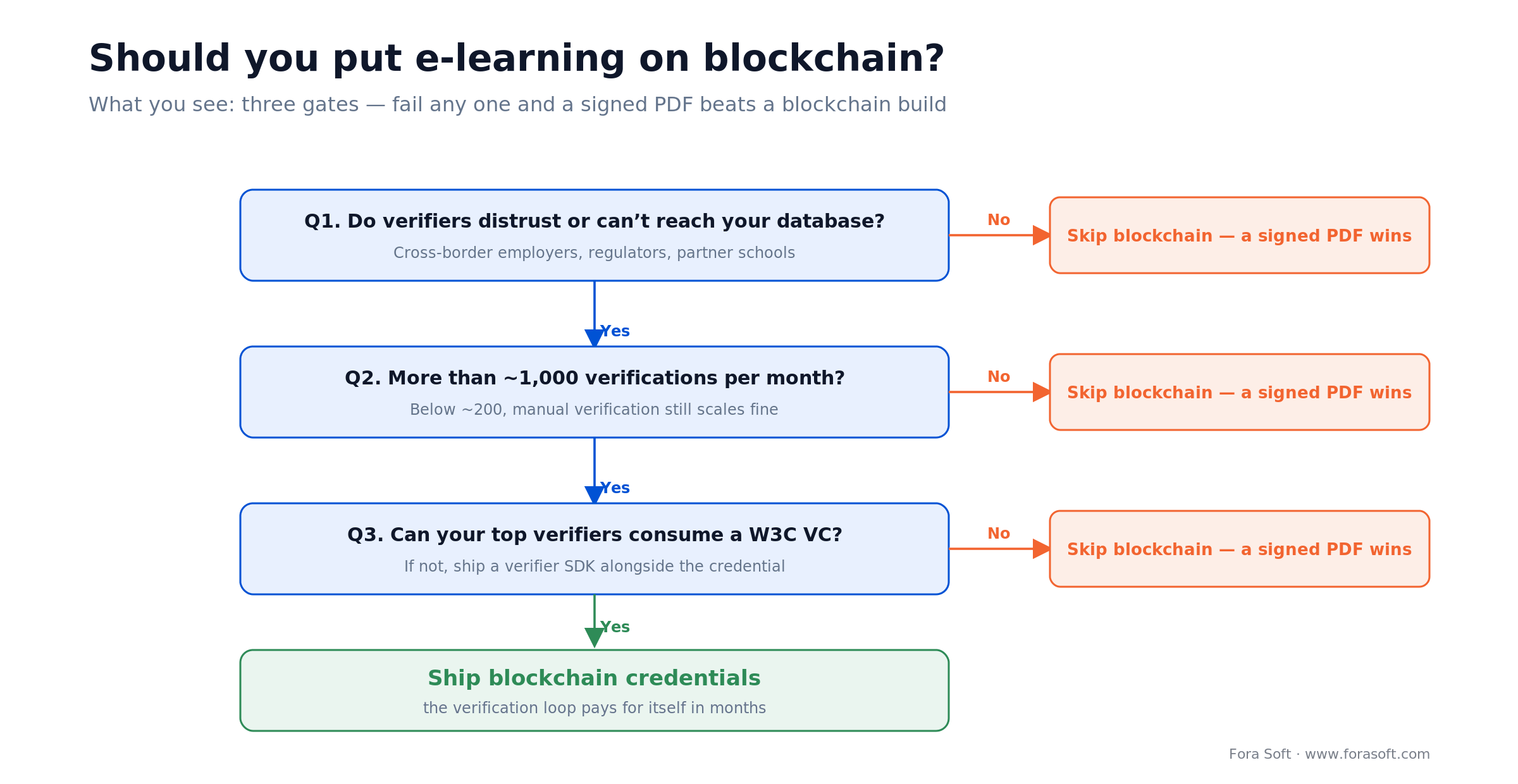
Figure 4. Three gates decide it: fail any one and a signed PDF beats a blockchain build.
Q1: Who verifies, and do they trust your database? If only your own systems verify credentials, blockchain is overkill. The pattern earns its keep when verifiers don’t trust (or can’t reach) your registrar — cross-border employers, regulators, partner institutions.
Q2: How many verifications per month? Below ~200 credential checks/month, manual verification scales. Above ~1,000, manual verification falls over and blockchain’s self-service model pays for itself.
Q3: Are your verifiers ready to consume verifiable credentials? ATS vendors, government portals, and partner institutions vary wildly. If your top three verifiers can’t accept a W3C VC presentation, ship a verifier SDK alongside the credential or your launch will fall flat.
Q4: What’s your jurisdiction’s wallet posture? EU = EBSI / EUDI Wallet by default. US = pluralistic, often institution-issued wallets. UK = HEDD-friendly with W3C VC alignment. Asia Pacific = mixed; pick chain based on the verifier audience, not the issuer location.
Q5: Do you have credentials that change after issuance? Things like revocation, suspension, or honor-code annotations need a thoughtful design pattern — a status list such as the W3C Bitstring Status List v1.0, or an on-chain revocation registry. If your credentials are write-once and never change, the pattern is simpler and cheaper.
Five pitfalls that sink blockchain e-learning projects
1. Personal data on chain. The single most common mistake. Names, IDs, scores, even hashes-without-salt can land you in GDPR or FERPA trouble. Always anchor a salted hash; never write the underlying record.
2. No verifier ecosystem. Issuing credentials nobody can verify is like printing diplomas in a language nobody reads. Sign verifier integrations before launch — ATS vendors, partner institutions, employer portals.
3. Picking a chain by tech politics, not buyer fit. Teams choose Ethereum L1 because it sounds prestigious, then watch issuance fees blow the budget. Pick the chain your verifier audience can resolve and your CFO can predict.
4. Rebuilding the wallet from scratch. Wallet UX is one of the hardest surfaces in software. Use a battle-tested SDK (Veramo, Trinsic, the EUDI Wallet reference implementation) and ship interoperability with at least one OS-level wallet on day one.
5. Ignoring revocation. Credentials get pulled — an honor-code violation, a license suspended, a credential issued in error. If your design has no revocation flow, your credential is undefendable in disputes. Build a status list from day one.
KPIs that tell you the system is working
Quality KPIs. Verification success rate >99% (a failure here is a chain or signing bug, not a UX issue), median verification latency <1 second p95, selective-disclosure adoption rate >30% on verifications that support it (proxy for whether students value the privacy benefit).
Business KPIs. Verification volume per month (the headline number for buyer ROI), % of credentials presented at least once within 90 days of issuance (a credential never presented isn’t valuable), registrar time saved per month (the most fundable metric for institutional buyers), employer integrations live (the leading indicator for verifier ecosystem health).
Reliability KPIs. Issuer service uptime >99.9%, anchor latency <5 minutes from issuance to chain confirmation, revocation propagation <15 minutes from registrar action to verifier-visible status change, monthly chain cost variance <15% (so you can budget).
When to not put e-learning on blockchain
Single-institution single-verifier loops. If your buyer is one university whose credentials only get verified by their own systems, blockchain adds cost without value. A signed PDF is fine.
Course-content delivery. Lectures, videos, quizzes don’t belong on chain. The properties blockchain offers (immutability, decentralization) are anti-features for course materials, which need to be edited and updated.
K-12 with no portable-credential need. Children don’t need verifiable credentials portable to employers; the privacy and tokenization patterns clash badly with child-protection rules.
Token-first projects with no real verifier audience. If the only buyer for your “Web3 education platform” is the secondary market for the token, the credential is a costume, not a product. Ship the token-free version first.
FAQ
Do students need a crypto wallet to use blockchain credentials?
No. The wallet is part of the e-learning app or the OS-level wallet (Apple Wallet, Google Wallet, EUDI Wallet). Students never touch a seed phrase, gas, or token. The chain is invisible — the experience is “tap to add credential, tap to share.”
Can a blockchain credential be revoked?
Yes. The common pattern is a status list — the current standard is the W3C Bitstring Status List v1.0 (2025), a compressed bitstring published off-chain as a status credential; an on-chain revocation registry is the alternative when you want the status itself anchored. The credential isn’t deleted from the wallet, but verifiers see “revoked” when they check status. Build revocation in from day one.
What about the energy cost of blockchain credentials?
Largely solved. Ethereum migrated to proof-of-stake in 2022, cutting energy use by ~99.95%. Polygon, Hyperledger, and EBSI are all PoS or consensus-based. Per-credential energy cost is now negligible compared to e-mailing a PDF.
How does this work if a student loses their phone?
Standard practice is encrypted backup of the wallet keys to the institution’s key escrow or a user-controlled cloud backup (iCloud Keychain, Google account). The credential itself can always be re-issued by the institution because the credential record stays in the issuer’s store. Loss recovery is a UX flow, not a fundamental problem.
Is putting credentials on blockchain GDPR-compatible?
Yes, when designed correctly. Personal data lives off-chain in the issuer store and the holder wallet. Only a salted hash is anchored on chain, which is not personal data when the underlying record can be deleted. Right-to-erasure is satisfied by deleting the record at the issuer and the holder; the orphan hash is meaningless.
What chain should we choose for a US-only credential project?
Polygon PoS or Arbitrum/Base for cost-predictable issuance, with Hyperledger Indy for permissioned issuer/holder/verifier protocol if you have a consortium of institutions. Reserve Ethereum L1 for batched Merkle roots only.
How do AI tutoring or AI grading systems integrate with verifiable credentials?
The credential carries a pointer to the AI-grading attestation: the model version, prompt, input hash, and signed output. The verifiable credential itself remains human-issued by the institution; the AI attestation makes the AI’s contribution auditable. Useful when accreditors challenge AI-graded outcomes.
Can we build this on top of an existing LMS like Canvas or Moodle?
Yes. The issuer service runs as a separate microservice that subscribes to LMS completion events (via LTI 1.3, IMS Caliper, or webhook) and issues credentials when a course is completed. We’ve done this against Canvas, Moodle, and several proprietary LMSes — the integration is typically 2–4 weeks.
What to read next
Blockchain
Blockchain in Mobile Apps: 5 Use Cases That Pay Off in 2026
The five mobile blockchain patterns with real buyers — supply chain, identity, loyalty, records, NFTs.
AI Agents
Build and Deploy LiveKit AI Voice Agents
For e-learning teams adding AI tutors, the LiveKit-based real-time agent stack — with cost and architecture detail.
Cost
2026 Mobile App Development Cost Guide
What drives mobile-app cost and how to scope a credential-bearing app realistically.
Case Study
Scholarly: Asia-Pacific EdTech at 15K Users
How we built a regional e-learning platform with classroom-scale streaming and admin tooling.
App Stores
Get Your App Approved on Google Play and App Store
Reviewer checklist for crypto, credential, and education apps in 2026.
Ready to build a blockchain e-learning credential system that actually pays off?
Blockchain in education is a credentials problem, not a UX problem. The standards are settled (W3C VC 2.0, Open Badges 3.0, DIDs); the chains are mature (Polygon, Hyperledger, EBSI); the wallets are arriving (Apple, Google, EUDI). What changes is whether your verifier audience — employers, accreditors, partner institutions — can actually consume the credentials you issue.
If your credentials need to leave your database and earn trust elsewhere, blockchain pays off in months. If they don’t, you’re building infrastructure for a problem your users don’t have. The decision framework, the chain comparison, and the cost ranges in this playbook are the same ones we use on client engagements — they’ll keep your blockchain e-learning project from sliding into a year-long hype build with no buyer.
The handbook · 7 volumes
Fora Soft Video Engineering Handbook
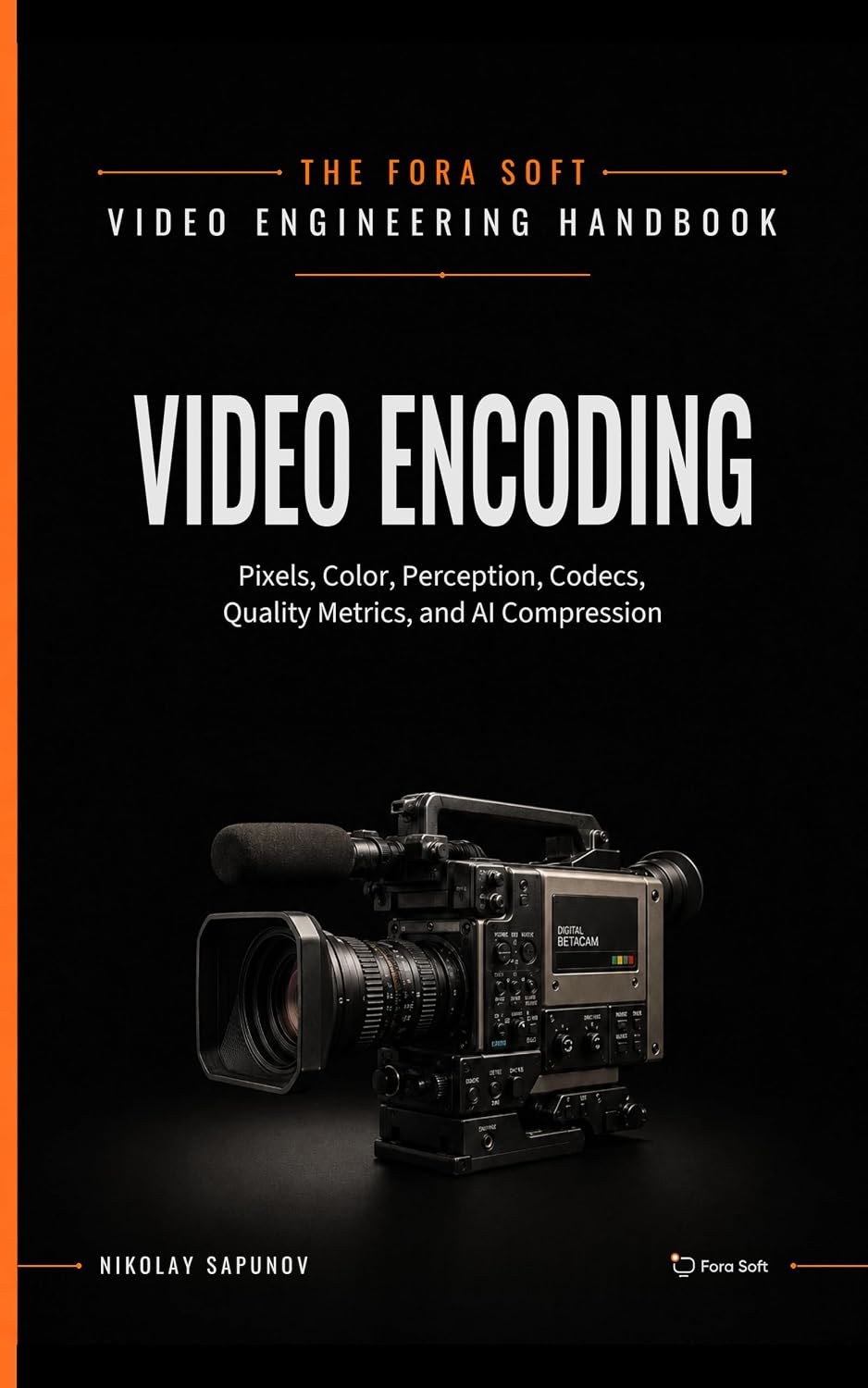
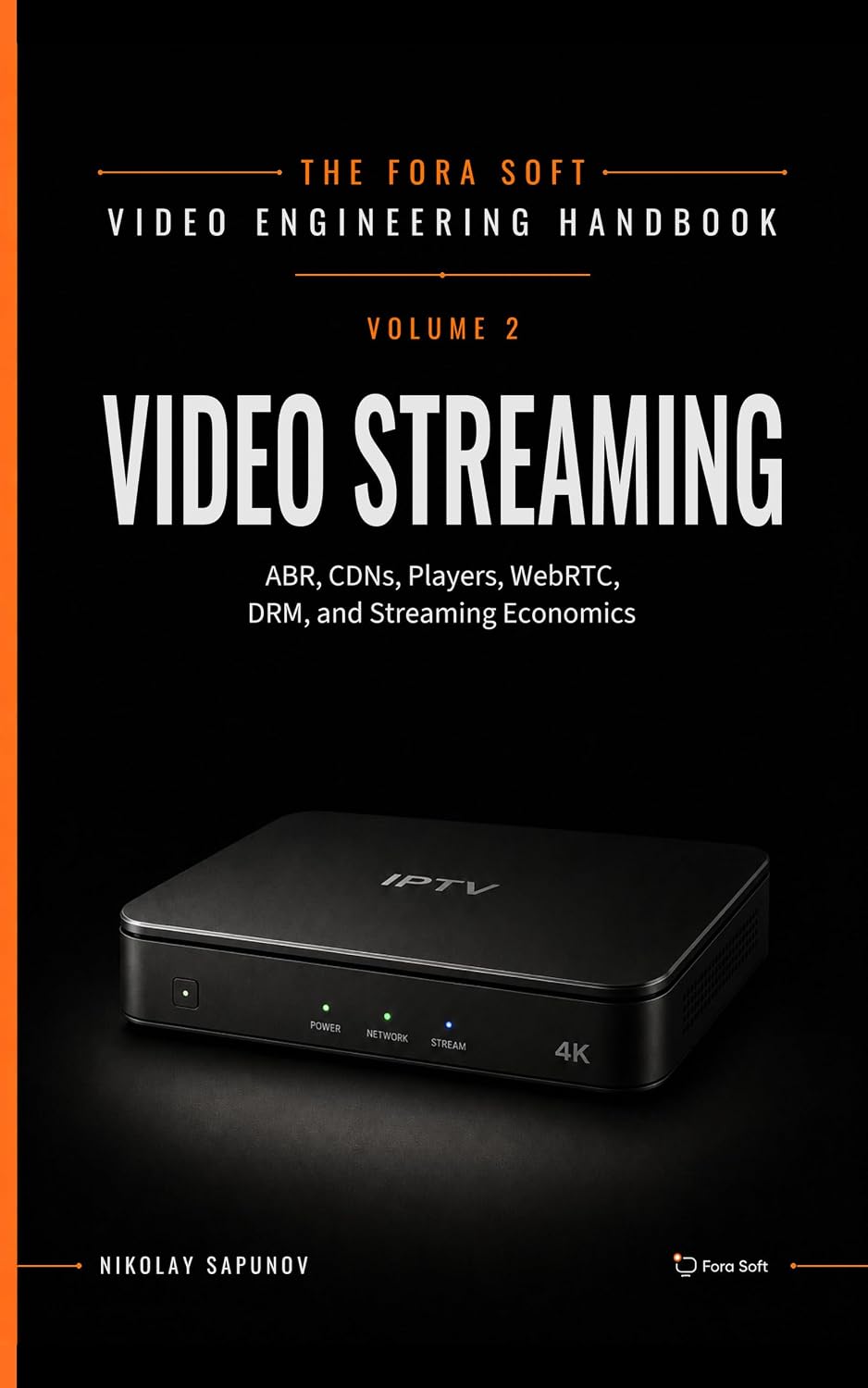
Verifiable credentials prove a course was completed; the course itself is usually live video and recorded lectures. Our seven-volume handbook covers the stack an e-learning platform runs on; start with Volume 3 for live class delivery, players and WebRTC, then Volume 1 for lecture encoding and Volume 4 for clear classroom audio and captions. Written by Nikolay Sapunov, CEO at Fora Soft.
Browse the handbook on Amazon →7 volumes · 9,000+ pages · Kindle & paperback
Want a 30-min credential-system review?
We’ll map your verifier audience, scope a credential MVP for your platform, and tell you straight whether blockchain belongs in your roadmap.

