

Key takeaways
• Healthcare video conferencing is now an architecture decision, not a vendor pick. The December 2024 HIPAA Security Rule NPRM is still proposed (final action now expected around 2027), but it points hard at mandatory encryption, MFA, asset inventory, and audit logging — and the platforms winning hospital deals are already built that way.
• Buy first, build second, unless three conditions hold. Doxy.me, Zoom for Healthcare, or Microsoft Teams cover you under ~50 providers, one EHR, and no workflow vendors refuse to ship. Past that line, a custom build wins on cost and margin.
• EHR integration is where the budget actually goes. A clean WebRTC core is $40–90K with agent engineering. Wiring in Epic, Oracle Health, or Meditech adds $50–200K per EHR, and the failure modes (rate throttling, MRN collisions, audit mismatches) cost more than the build.
• Five pitfalls wreck most custom builds. TURN outside the BAA, PHI in Datadog or Sentry, recording without state-aware consent, rolling your own encryption, and treating a vendor SDK’s BAA as cover for your wrapper code.
• Fora Soft ships HIPAA-grade video on agent-engineering speed. Since 2005 we’ve delivered 250+ real-time products (WebRTC, LiveKit, SIP, FHIR); CirrusMED, our browser-based telehealth platform, runs across 48+ US states today.
Why Fora Soft wrote this playbook
Fora Soft has built real-time video products since 2005. Across 250+ shipped products, and with a 50-engineer in-house team, we’ve run WebRTC at clinical scale, launched apps from inside Epic and Oracle Health on the SMART on FHIR side, and stood up HIPAA-aware infrastructure on AWS, GCP, and Hetzner. Our co-founder Polina Sapunova leads the healthcare practice, so compliance isn’t a checkbox we bolt on at the end.
One number makes the case. We built CirrusMED, a “Netflix for Medicine” telehealth platform, from scratch for a Nevada practice: browser-based WebRTC video, an EMR, e-prescribing, and a subscription model, all under one HIPAA umbrella. It now serves patients across 48+ US states with 20+ physicians on the network. We’ve also shipped travel telemedicine at AirDoctor scale (20K+ doctors, 80K+ patients) and video surveillance for 770+ US organizations on VALT. The point isn’t the logos; it’s that we’ve seen where healthcare video conferencing projects actually break.
This playbook is the document we wish those teams had on day one. It names vendors, gives real 2026 numbers, and tells you when not to build. Where we link to a Fora Soft case or service, it’s because the example moves the decision. Read it, settle build vs buy on the same page, and if the answer is build, book a 30-minute scoping call. For the wider context, start with our healthcare software compliance playbook and the HIPAA-compliant video platform deep dive.
Stuck between Zoom for Healthcare and a custom build?
Tell us your provider count, EHR list, and workflow gaps. We’ll give you a build-vs-buy verdict with cost ranges, no slide deck.
Video conferencing in healthcare in 2026: a market snapshot
The post-COVID plateau is over. Video is a permanent service line for almost every US health system, and the benefits of video conferencing in healthcare — access for rural and homebound patients, fewer no-shows, faster specialist referrals — now show up on the balance sheet, not just in patient-satisfaction surveys.
The market numbers depend entirely on whose methodology you trust. Grand View Research pegs the 2025 telehealth market near $77.4B growing about 11.5% a year; Fortune Business Insights and Precedence Research model it far larger, $186–197B in 2025 rising past $219–244B in 2026 on a 23–25% CAGR. Pick whichever definition you like; they all agree on direction, and North America is roughly 45% of it. The buyer’s job in 2026 isn’t “pick a Zoom alternative.” It’s to design a healthcare video conferencing platform that survives an HHS audit, plugs into at least one EHR without breaking it, supports ambient AI scribing without leaking PHI, and costs less than the revenue it brings in.
What good healthcare video conferencing looks like
A platform a CTO can defend in 2026 hits all of the following, whether you build or buy:
- Encryption everywhere. SRTP + DTLS on the media path, TLS 1.3 for signalling, AES-256 at rest with KMS-managed keys, separate per tenant.
- BAA-covered across every component: SFU, TURN, recording storage, observability, identity, AI scribing, translation. One uncovered box fails the audit.
- MFA enforced for clinicians, admins, and any API integration. WebAuthn or TOTP, never SMS alone.
- Immutable audit logs in append-only storage (S3 Object Lock, GCS Bucket Lock), 90 days online and years archived.
- State-aware recording consent with a per-call consent receipt stored next to the recording.
- Launch from the clinician’s EHR context via SMART on FHIR, so nobody copy-pastes a patient ID between systems.
- Connect fast, stay up. Our operational bar: P95 connect under 5 seconds, MOS above 4.0, call-drop under 1%. Worse than that and clinicians quietly abandon the platform inside a month.
HIPAA in 2026: what the proposed 2024 rule would change
Here’s the part most vendor blogs get wrong, so read it carefully. On December 27, 2024, HHS issued a Notice of Proposed Rulemaking (NPRM) to modernize the HIPAA Security Rule — the biggest change since 2013. It was published in the Federal Register on January 6, 2025, and the comment period closed March 7, 2025. As of mid-2026 it is still proposed, not final. HHS floated a 2026 finalization; the federal rulemaking calendar now points at 2027, and the rule could still change, slip, or be withdrawn. Treat what follows as the direction of travel, not today’s black-letter law — but build to it now, because retrofitting after a breach is the expensive path.
Five proposals reshape what a healthcare video stack has to do.
1. Encryption stops being optional. The NPRM would require ePHI to be encrypted in transit and at rest, with narrow exceptions. SRTP + DTLS for media, TLS 1.3 for signalling, AES-256 for storage. Plain HTTP between microservices, even inside a VPC, would fail.
2. MFA becomes mandatory. Clinicians, admins, and any service-to-service integration touching PHI would need a second factor. Short-lived tokens (OAuth 2.0 with brief-TTL JWTs) for inter-service traffic. SMS OTP alone would no longer count.
3. A living asset inventory with verified BAAs. The proposal puts asset inventory at the center: automated discovery of every third-party SDK, library, and cloud service handling PHI, each with a signed BAA. The classic miss is a developer adding an error tracker that quietly ships PHI in stack traces.
4. Scheduled vulnerability testing. The NPRM proposes vulnerability scans at least every six months and penetration testing at least once a year, with the findings tracked and remediated. Snyk, Dependabot, and AWS Inspector all qualify if you keep the logs.
5. Goodbye “addressable.” Today’s Security Rule lets you treat some safeguards as “addressable” and document why you skipped them. The NPRM removes that escape hatch: implementation specifications would become required, with encryption, network segmentation, and audit controls no longer optional. That single change is why the proposal matters even before it’s final.
Why this matters financially: the penalties bite under today’s rule already. The 2025 inflation-adjusted amounts (effective January 2026) run from $145 per violation to $2,190,294, with an annual cap of $2,190,294 per identical provision. A breach touching 500+ patients also triggers notice to HHS, the media, and every affected individual within 60 days. A compliance investment that looks expensive at $40–80K reads cheap next to that.
For non-US deployments, GDPR Article 32, plus the EU AI Act’s treatment of clinical-decision-support software, add cost. The 2026 Digital Omnibus agreement pushed the AI Act’s high-risk deadlines back: the general Annex III rules now apply from December 2027, and AI regulated as a medical device has until August 2028. The standard answer is to keep EU patient data in EU regions (AWS Frankfurt, GCP Belgium, Hetzner Falkenstein) with separate KMS keys. Budget roughly 20–40% more infrastructure for a dual-region setup.
Build vs buy: the four conditions that flip the answer
Buying is the right default. A custom build is the right answer only when at least three of these hold:
1. Provider count above ~50 and growing. Around 50 providers, Zoom for Healthcare and enterprise platforms already cost more per year than running a self-hosted LiveKit cluster on a Hetzner AX-line pair. Above 100, the gap is decisive.
2. Two or more EHRs, or a non-mainstream one. Vendors integrate cleanly with Epic and Oracle Health. athenahealth is workable. Meditech, NextGen, and regional systems are usually a fight. Live across two or more and per-EHR vendor licensing eats the savings of buying.
3. A clinical workflow vendors won’t ship. Ambient scribing on a custom oncology template; multi-party consent for telepsychiatry with a parent in a different state; AR overlays on dermatology video. Any of these and your buy options shrink to two or three platforms with painful customization fees.
4. The video experience is the product. If you’re a digital-health startup whose pitch is the video experience itself, you can’t rent it. Investors discount a rented moat to zero. Build is the only path.
Reach for buy when: you have fewer than 50 providers, one EHR, no workflow vendors refuse to ship, and video isn’t your differentiation. Doxy.me or Zoom for Healthcare gets you to a real revenue ceiling with zero engineering risk.
Reach for build when: three of the four conditions hold — provider scale, multiple EHRs, a vendor-blocked workflow, or platform-as-product. Below that threshold, building is engineering vanity.
Vendor comparison matrix: the options buyers actually shortlist
Pricing is 2026 published or quote-based where vendors don’t list it. “EHR launch” means launching from clinician context, not a Zapier connector. Treat a couple of these as moving targets: Amwell spent 2025 restructuring, so validate its roadmap before a multi-year commitment.
| Platform | BAA | Price (2026) | EHR launch | Best for |
|---|---|---|---|---|
| Doxy.me | Yes (free + paid) | Free / $35 / $50 per user/mo | Limited | Solo & small clinics |
| Zoom for Healthcare | Yes (eligible plan) | From ~$200/mo, enterprise | Epic, Oracle Health | Mid-market, low engineering |
| Microsoft Teams (Healthcare) | Yes | Bundled in M365 | Native (M365) | M365-locked health systems |
| Amwell | Yes | Custom / enterprise | Epic, Oracle Health, athenahealth | Enterprise (validate roadmap) |
| eVisit / Mend | Yes | Custom / quote | Epic, Oracle Health (partial) | RPM & chronic-care programs |
| Custom (Fora Soft) | Your responsibility | $40–700K build, then ops | Any (FHIR R4 / SMART) | Multi-EHR, custom workflows, platform-as-product |
Reference architecture for a HIPAA-grade video stack
A 2026 healthcare video conferencing stack has six layers. Each has a default-safe choice and one or two valid alternatives. The dashed line in the diagram is the boundary that matters: everything inside it is BAA-covered, encrypted, and audit-logged. This is the same architecture we deliver through our telemedicine app development practice.
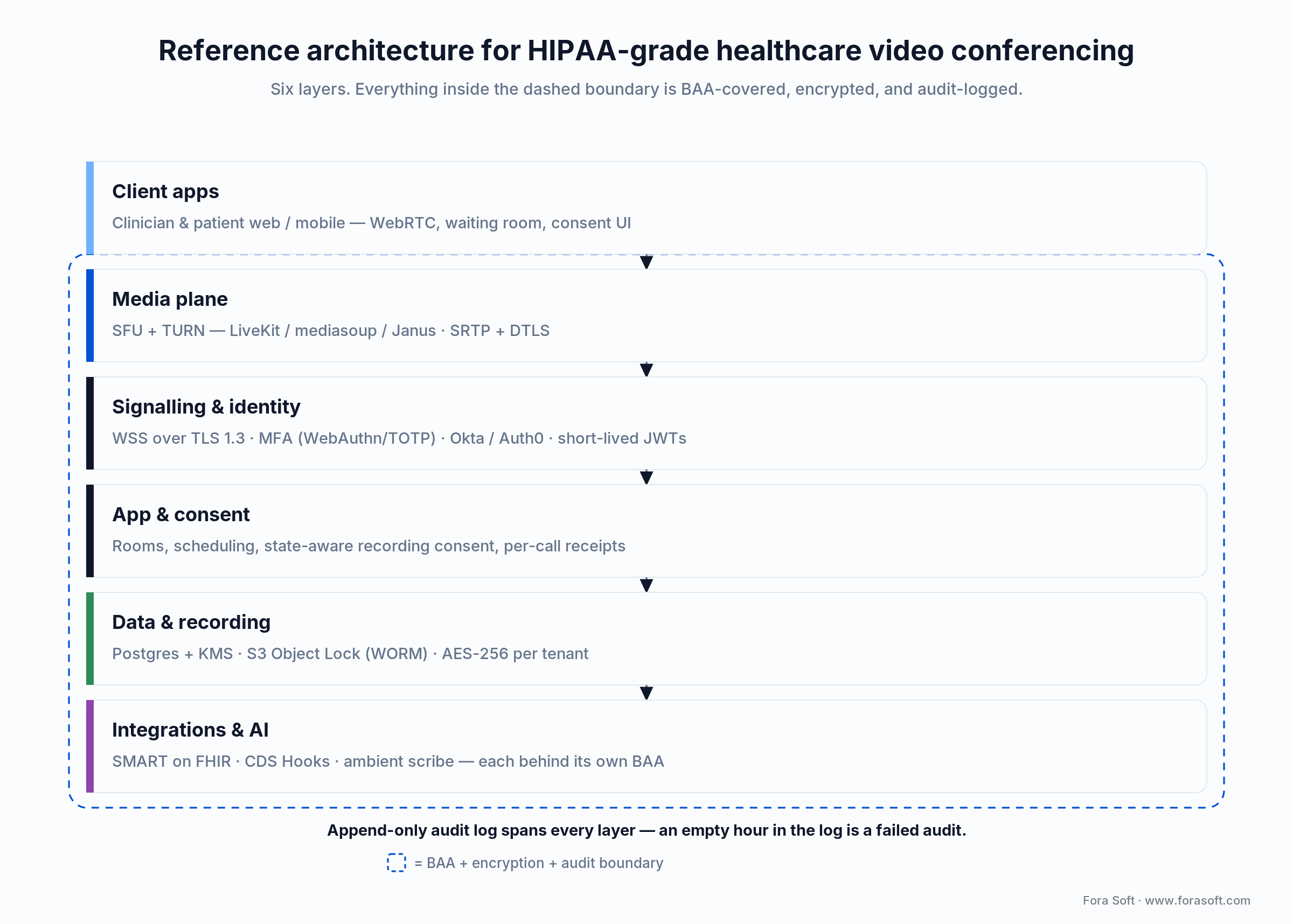
Figure 1. Six layers, one boundary. Everything inside the dashed line is BAA-covered, encrypted, and audit-logged.
Media plane: SFU + TURN
LiveKit (Apache 2.0) is the default: self-hosted on AWS or Hetzner, BAA-covered on AWS, roughly $15K/year of ops for ~500 concurrent providers. mediasoup is the lower-level option when you need bespoke routing (AR overlays, sub-100ms specialist workflows). Janus is the lightweight pick for clinic-edge boxes. We’ve shipped all three; for guidance see our LiveKit AI agents guide and the Agora.io alternative comparison.
Signalling and SIP
WebSocket signalling over TLS 1.3, with JWT room tokens issued from your auth service. SIP trunking via Asterisk or Kamailio for legacy phone bridging is unavoidable in hospitals; we cover the integration patterns in our OpenAI Realtime API + WebRTC + SIP article.
Identity, MFA, and authorization
Okta or Auth0 with a BAA addendum, WebAuthn or TOTP, and SCIM provisioning from the hospital’s directory. Service-to-service auth uses short-lived JWTs (15-minute TTL) signed by AWS KMS. Never SMS OTP on its own: SIM-swap attacks are a documented breach vector.
Data layer
AWS RDS PostgreSQL with KMS-managed encryption is the default. Tokenize every PHI field and keep the mapping in a separate vault schema. Recordings go to S3 with Object Lock plus per-tenant KMS keys. For non-US work, GCP Cloud SQL or Hetzner-hosted Postgres works, as long as the keys stay in region.
Observability without leaking PHI
CloudTrail for API actions, CloudWatch with PHI-stripping log filters, and error tracking configured to drop request bodies. Datadog and New Relic are fine only with a BAA addendum; the default contracts don’t cover PHI. The classic mistake is a stack trace carrying a patient’s last name inside a SQL query.
Integrations and AI services
Ambient scribing through Abridge, Suki, or Microsoft Dragon Copilot — all carry HIPAA BAAs in 2026. AWS Transcribe Medical or a self-hosted model for in-house work. Real-time interpretation via Google or Amazon speech services under a Workspace or AWS BAA. For clinical decision support, wire advisory calls through a CDS Hooks server and keep a human in the loop; never surface raw model output to a clinician as fact.
Want a second opinion on your architecture?
Send us your stack diagram. We’ll mark it against our HIPAA architecture playbook and tell you which boxes fail an audit, in writing.
EHR integration: FHIR, SMART on FHIR, and where it goes wrong
EHR integration is where most healthcare video budgets actually go. The video core is a solved problem. The integration is not.
SMART on FHIR launch is the modern pattern: Epic, Oracle Health (Cerner), and athenahealth all let a clinician launch your video app from inside the chart with a token carrying patient context. The cost ranges below are our 2026 estimates, and they vary by health system.
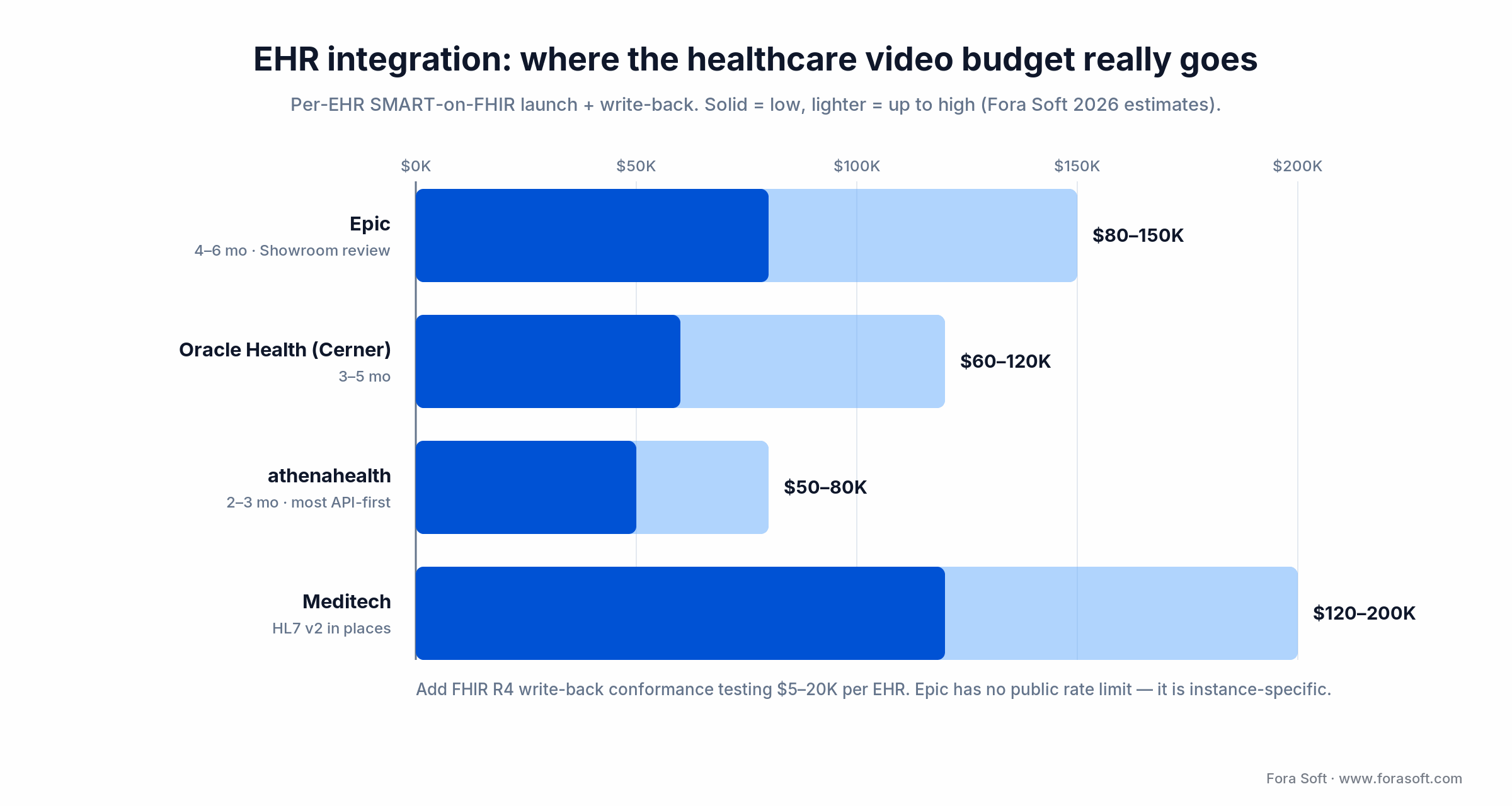
Figure 2. Per-EHR integration effort and cost (Fora Soft 2026 estimates). Solid bar is the low end; the lighter extension reaches the high end.
Epic is the most involved ($80–150K) because of its review process; its marketplace is now Showroom, since App Orchard was retired in 2024. athenahealth is usually cheapest ($50–80K) because the API is genuinely API-first. Meditech is the most painful ($120–200K) because parts of the surface are still HL7 v2. Add FHIR R4 write-back — pushing the encounter summary or note back into the chart — and budget another $5–20K per EHR for conformance testing. Skip it and your calls live in a silo the clinicians ignore.
Where it goes wrong. Epic enforces per-connection rate limits, but there’s no public number to design against: the throttle is set per health system’s InterConnect configuration, so two hospitals on the same Epic version can behave differently. Build in exponential backoff and caching, and confirm the real limit with the customer’s Epic technical account manager. Add MRN collisions when two EHRs issue overlapping IDs, and audit-log mismatches where the chart’s “who viewed this” report disagrees with yours. Plan a four-week hardening tail on every EHR connection.
Cost model: honest 2026 numbers with agent-engineering speed
Fora Soft uses Claude- and Codex-assisted agent engineering across delivery, which trims roughly 25–35% off boilerplate-heavy work: test scaffolding, FHIR mapping code, audit-log instrumentation, Terraform. The numbers below assume that advantage and stay conservative. They’re build cost only, and they exclude EHR integration, ops, and the compliance program.
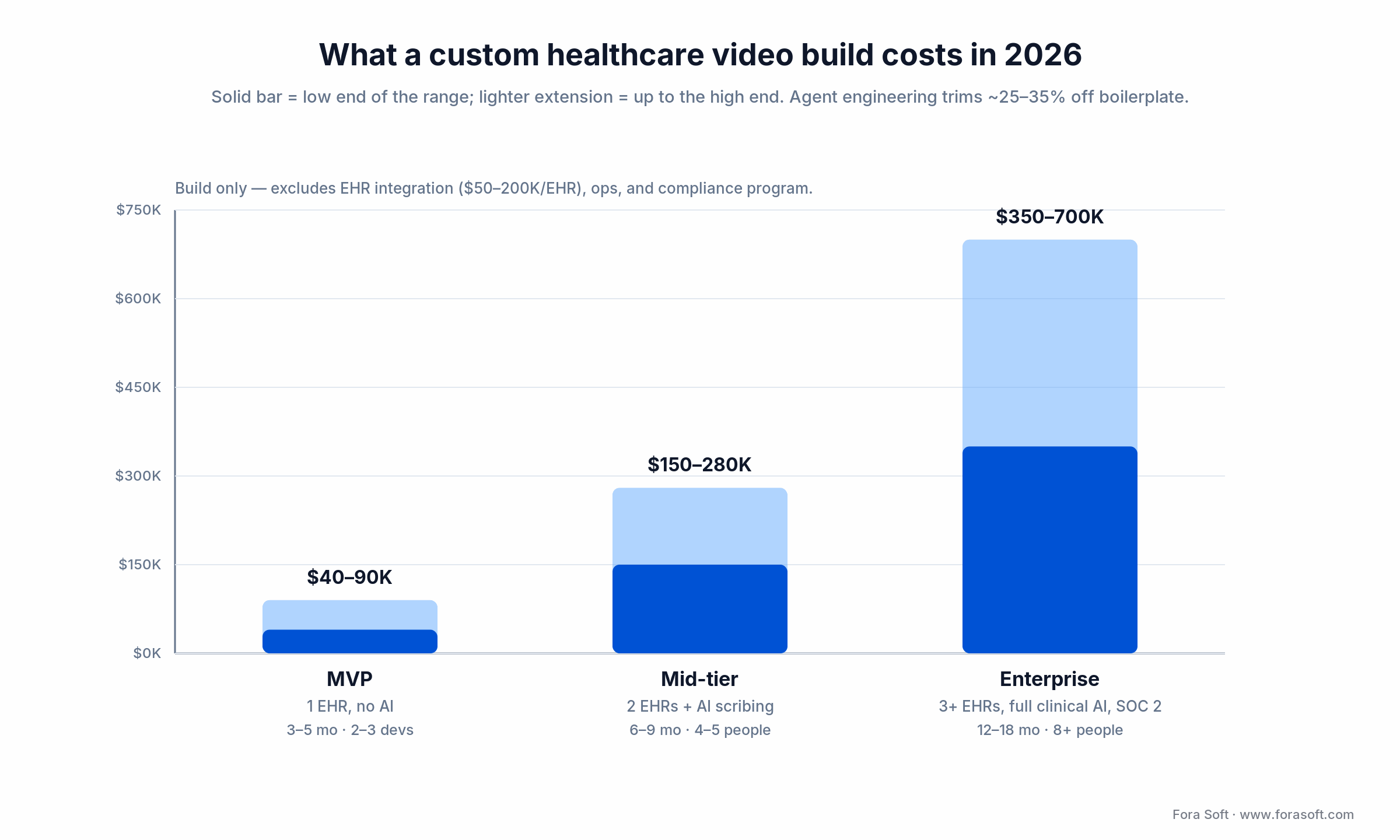
Figure 3. Build cost by tier. Solid bar is the low end; the lighter extension reaches the high end. Excludes EHR integration and ops.
MVP: 3–5 specialties, 1 EHR, no AI
Build: $40–90K. Team: one architect (0.5 FTE), two to three engineers, one QA. Timeline 3–5 months. Deliverables: WebRTC SFU + TURN, MFA with Okta, Postgres + KMS, S3 audit logs, one EHR SMART-on-FHIR launch, a clinician dashboard. Year-1 ops: $10–20K/month.
Mid-tier: multi-specialty, 1–2 EHRs, AI scribing
Build: $150–280K. Add a clinical advisor, more QA, and an integration engineer for the second EHR. Timeline 6–9 months. Deliverables: full multi-specialty UI, two EHRs, AI note generation (Abridge or Suki, or a self-hosted model if data residency demands it), and a documented HIPAA program. Year-1 ops: $20–35K/month.
Enterprise: multi-tenant, 3+ EHRs, full clinical AI
Build: $350–700K. Team: an architect lead, six to eight engineers, two QA, a compliance officer, a clinical advisor. Timeline 12–18 months. Deliverables: multi-tenant SaaS, 3+ EHR integrations, AI scribing plus decision support, a SOC 2 audit, and a dedicated incident-response team. Year-1 ops: $40–80K/month. EHR integration ($50–200K per system) is tracked separately.
Cost reality check: these figures exclude marketing, ongoing R&D, and any FDA pathway if you claim diagnostic features. They also exclude breach-remediation reserves. A single willful-neglect penalty plus notification cost can run higher than the entire enterprise build, which is why we treat compliance spend as insurance, not overhead.
Mini case: CirrusMED ships a “Netflix for Medicine” platform
Situation. A Nevada private practice wanted out of per-visit billing and into Direct Primary Care: patients subscribe to their doctor and get unlimited video visits, messaging, and ongoing care under one HIPAA umbrella. Off-the-shelf tools charged per visit and couldn’t hold the subscription workflow, e-prescribing, and records in one place.
Plan. We built it from scratch as a browser-based platform: WebRTC video, a React front end, Node.js services on AWS with MongoDB, and Twilio and Stripe for messaging and subscriptions, with HIPAA architected in. Recorded consultations, collaborative document sharing, an EMR tracking allergies, history, vitals, and prescriptions, plus lab and imaging referrals and SMS/email scheduling. Scope-wise it’s the MVP-to-mid band above.
Outcome. CirrusMED runs a Direct Primary Care membership from $39/month with unlimited visits, and it’s now licensed across 48+ US states with 20+ physicians on the network, after going through Nevada’s InNEVator accelerator. Christopher Highley of Preferred Family Medicine summed it up: “All my requirements are taken care of. Highly recommended!” Want a similar scope for your practice?
A decision framework: pick a path in five questions
Answer these honestly. Score three or more “yes” and a custom build wins; one or two, sequence it; zero, just buy.
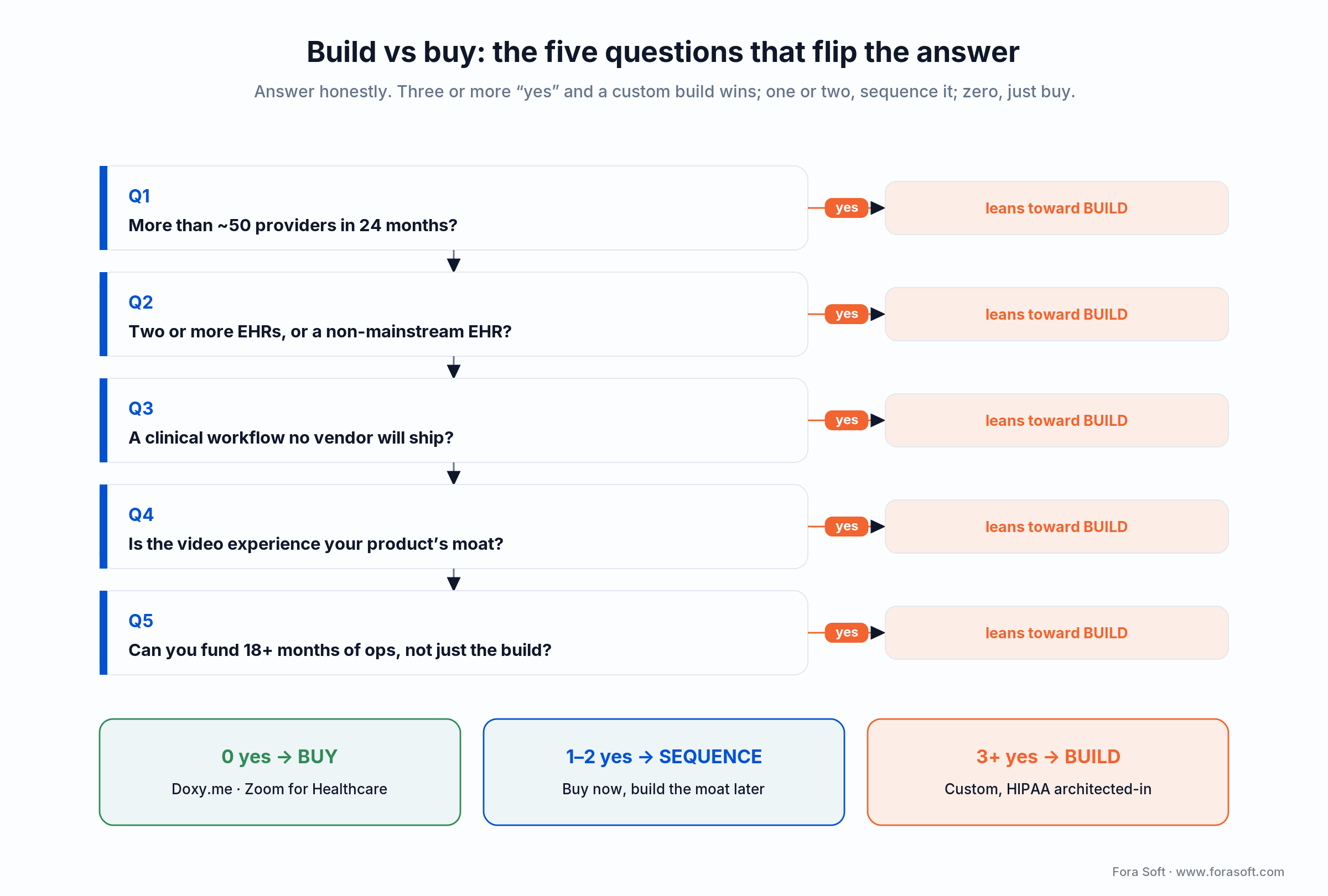
Figure 4. Five questions that flip build vs buy. Each “yes” pushes toward a custom build.
Q1. How many providers in 24 months? Under 50, buy. 50–150, buy now and plan a build for month 18. Above 150, build.
Q2. How many EHRs do you live across? One mainstream EHR, vendor integrations are fine. Two or more, or anything non-mainstream, build.
Q3. Is there a workflow no vendor will ship? Ambient scribing on a custom template, AR overlays for dermatology, multi-state telepsychiatry consent — if yes, you can’t rent it.
Q4. Is the platform your differentiation? If your investor pitch leans on the video experience, build. If video is plumbing for a different product, buy.
Q5. Can you fund 18+ months of ops? If the honest answer is “not yet,” buy first and build later. We’ve helped clients sequence both phases without throwing the first effort away.
Five pitfalls that wreck custom healthcare video builds
1. TURN servers outside the BAA. Spinning up TURN on a cheap consumer cloud or a personal account not enrolled in the BAA. Media still flows through it, and the BAA doesn’t retroactively cover it. Fix: every component touching media or signalling lives inside a BAA-enrolled account, full stop.
2. PHI leaking into Datadog, New Relic, or an error tracker. A stack trace with a patient’s last name in the SQL; an exception logging the encounter ID. Fix: PHI-stripping log filters at the source, a BAA addendum on every tool that holds PHI, and CloudTrail plus S3 Object Lock as the default-safe alternative.
3. Recording without state-aware consent. Twelve states require all-party consent to record: California, Connecticut, Delaware, Florida, Illinois, Maryland, Massachusetts, Montana, Nevada, New Hampshire, Pennsylvania, and Washington. A telehealth call routinely crosses state lines and is governed by the law on both ends, so the safe engineering posture is to treat every multi-state call as all-party: ask every participant before the first frame is captured, and store an immutable consent receipt. The 2025–26 ambient-AI wave turned this from a footnote into live litigation.
4. Treating a vendor SDK’s BAA as cover for your wrapper. A vendor’s BAA covers the vendor’s client. Your custom-branded app embedding their SDK is your responsibility: auth, logging, key management, every byte of your code. Fix: a separate security review of your wrapper before launch, and clear documentation of which surfaces are theirs and which are yours.
5. Rolling your own encryption. Writing a homegrown AES wrapper, deriving keys with sketchy entropy, or assuming TLS plus KMS equals end-to-end. Fix: use battle-tested protocols (SRTP + DTLS, and MLS for group calls), and commission an external crypto audit ($15–40K) before launch. Never roll your own.
KPIs that tell you the platform is actually working
Clinical KPIs. No-show rate down 15–25% against the in-person baseline. Follow-up handle time in the 18–25 minute band. Referral completion within 48 hours above 70%. AI-scribe note acceptance before edit above 80% — the one metric that decides whether AI scribing pays back.
Business KPIs. Telehealth share of new bookings 30–50% within a year. Revenue per visit at parity with in-person; telehealth shouldn’t quietly leak 20–30% through coding mismatches. Offered-to-completed visit conversion above 85%.
Reliability KPIs. Call-drop below 1% (target 0.5%). MOS above 4.0. P95 connect under 5 seconds. Audit-log completeness at 100%; an empty hour in the log is a failed audit, every time. For measurement method, see our WebRTC stream-quality testing playbook, and for the compliance groundwork our telemedicine engineering guide on Learn.
AI features: where they pay off and where they leak PHI
Ambient clinical scribing is the highest-ROI AI feature in 2026 healthcare video. Ignore vendor accuracy percentages — they’re unstandardized marketing — and weigh adoption and outcomes instead. Abridge (a $5.3B valuation as of mid-2025, deployed at Mayo Clinic, Duke, Johns Hopkins, Kaiser, and 250+ systems) has been named Best in KLAS for ambient AI two years running; a University of Kansas Medical Center study found 73% of clinicians spent less time documenting after hours and 67% reported lower burnout risk. Suki runs at 300+ health systems. Microsoft’s ambient scribe, now Dragon Copilot (which replaced DAX Copilot in March 2025), is the default if you already live in Teams, though a 2025 randomized trial found its documentation-time savings small and not statistically significant — so pilot it before you promise clinicians their evenings back. A self-hosted model keeps everything in your VPC under your own BAA, at the cost of accuracy and a lot more ops.
Real-time interpretation for limited-English-proficiency patients cuts handle time and widens access. We built the interpreter platform behind TransLinguist (75+ languages, 30,000+ interpreters, on the NHS England framework), so here’s the honest line: machine translation is fine for scheduling and intake, but for a consult with clinical consequences you route through a licensed human interpreter. Faithfulness beats latency in those minutes. The engineering pattern is in our AI call assistants API guide.
Clinical decision support through CDS Hooks — drug-interaction alerts, contraindication flags, risk calculators — pays off only when a clinician-in-the-loop check is mandatory. Ship advisory, never autonomous.
The leak vector to watch: any AI feature calling a third-party API needs a BAA. OpenAI offers one via Enterprise, Anthropic via Claude for Business, Google via Workspace, and AWS Bedrock via the master AWS BAA. The default API endpoints do not cover PHI. That is the single most common audit finding on AI-enabled healthcare video in 2026.
Adding AI scribing without leaking PHI?
We’ll map your AI features to the right BAAs, pick build vs buy per feature, and keep every model call inside the audit boundary.
The compliance program around the platform
A compliant stack with no compliance program still fails an audit. The minimum viable program for a 2026 healthcare video platform:
- A named Privacy Officer and Security Officer — real people, not job titles on a chart.
- Written policies: access control, incident response, breach notification, BYOD, vendor management, log retention.
- Annual workforce training — HIPAA basics for engineers, advanced phishing drills for clinical-facing staff.
- Quarterly access review — who still has admin, and who left the company but kept SSO.
- Annual risk assessment with a documented remediation plan.
- A tabletop incident-response drill at least yearly — the only way to know whether the 60-day notification clock actually starts on time.
Most digital-health startups underestimate this. Budget roughly $40–80K a year once you pass 1,000 patient records. SOC 2 Type II adds $25–60K and hospital procurement increasingly demands it, so if you sell enterprise, get on it inside year one.
When NOT to build a custom healthcare video platform
There are cases where a custom build is the wrong move, and we’ll say so on the first call. Skip it if any of these are true:
- You’re pre-product-market-fit. Use Doxy.me or Zoom until you understand the workflow that retains patients. Build too early and you rebuild when the workflow finally lands.
- You have under 20 providers and one mainstream EHR. Vendor licensing is cheaper than the smallest sustainable engineering team.
- You can’t fund 18 months of running cost. Custom builds need ops budget for years two and three, not just delivery. Tight runway means buy.
- You have no in-house clinical voice. Without a clinician on the team you’ll ship a product clinicians refuse to use. Hire or contract one before kickoff.
- The procurement decision is “Microsoft everything.” If the hospital is M365-locked, Teams is hard to beat on total cost. Build only the parts Teams can’t do.
A pragmatic sequencing: buy first, build second
For most growing health systems and digital-health startups, the right play is sequenced. Year one on Doxy.me or Zoom for Healthcare to learn the clinical workflow. Year two on a custom MVP that owns the differentiated workflow — intake, scribing, multi-EHR launch — while vendor video handles the long tail. Year three onward on the full custom platform.
This avoids the two failure modes we see most: building too early on assumptions clinicians later overturn, and over-paying licensing for years because nobody scoped the build honestly. We help clients run both phases without writing off the year-one spend; the workflow learnings translate straight into build scope.
For the build-vs-buy framing across video products generally, our build-vs-buy video platform analysis applies the same trade-offs to non-healthcare verticals. The healthcare-specific overlay is the compliance mass and the EHR integration block, both covered above.
FAQ
Is video conferencing in healthcare secure?
It can be, but only when the whole stack is. Secure healthcare video conferencing means SRTP + DTLS on the media path, TLS 1.3 signalling, AES-256 at rest, MFA, immutable audit logs, and a signed BAA covering every component that touches PHI. Consumer video tools without a BAA are not HIPAA-compliant, no matter how well they encrypt the call.
Is Zoom HIPAA-compliant out of the box?
No. Standard Zoom is not. You need Zoom for Healthcare on an eligible plan with a signed BAA, and even then the BAA covers Zoom’s own infrastructure. Any custom wrapper, embedded SDK app, or external recording bucket you build around it falls under your own BAA scope. Doxy.me, by contrast, offers a BAA on both its free and paid plans.
How much does a custom healthcare video platform cost in 2026?
An MVP with one EHR and no AI lands at $40–90K with agent-engineering speed. Mid-tier with multi-specialty support, one to two EHRs, and AI scribing is $150–280K. Enterprise multi-tenant with 3+ EHRs and full clinical AI runs $350–700K, plus $50–200K per EHR integration and $10–80K/month of year-one ops depending on tier.
Did the 2024 HIPAA Security Rule update take effect yet?
Not yet. The December 27, 2024 NPRM is still proposed. It was published in the Federal Register on January 6, 2025, the comment period closed March 7, 2025, and final action is now expected around 2027. It could still change or slip. Build to it anyway: it points at mandatory encryption, MFA, asset inventory, six-month vulnerability scans, and the removal of “addressable” safeguards.
Which WebRTC SFU is best for a healthcare deployment?
LiveKit is the 2026 default: mature, Apache 2.0-licensed, and BAA-friendly when self-hosted on AWS. Pick mediasoup if you need fine-grained media routing such as AR overlays or sub-100ms specialist workflows. Pick Janus only for lightweight clinic-edge deployments. Avoid commercial PaaS SFUs unless you have a clear path to a contract-level BAA.
How long does Epic integration take, and why is it expensive?
Allow 4–6 months and $80–150K. The cost is partly the review process (Epic’s marketplace is now Showroom, since App Orchard was retired in 2024), partly the testing labour, and partly designing around per-connection rate limits that Epic sets per health system rather than publishing. athenahealth ($50–80K, 2–3 months) and Oracle Health ($60–120K, 3–5 months) are usually faster.
Are OpenAI or Anthropic models allowed for clinical scribing?
Yes, but only under a BAA: OpenAI via Enterprise, Anthropic via Claude for Business, Google via Workspace, AWS Bedrock via the master AWS BAA. The default public API endpoints are not HIPAA-covered. For strictly in-VPC work, a self-hosted open-weight model keeps you under your own BAA scope at the cost of accuracy and ops effort.
What are the disadvantages of video conferencing in healthcare?
The real ones are practical, not technical: you can’t do a hands-on exam over video, connectivity gaps exclude some patients, multi-state licensure limits who a clinician can see, and recording without state-aware consent creates legal exposure. A well-built platform manages each — triage what needs in-person, degrade gracefully on weak networks, enforce licensure at scheduling, and gate recording on consent — but none of them disappear.
What to read next
Compliance
HIPAA-Compliant Video Platform Development
The compliance-first deep dive: encryption, BAAs, audit logs, and incident response.
Healthcare Software
Healthcare Software Compliance & Security
The wider compliance-and-security playbook for healthcare product teams.
Architecture
Build & Deploy LiveKit AI Voice Agents
The reference architecture we lean on most for HIPAA-grade real-time stacks.
Build vs Buy
Build vs Buy: SDK to Custom Video Platform
The general build-vs-buy framework that pairs with this healthcare overlay.
Quality
How to Test WebRTC Stream Quality
getStats, MOS, and P95 connect-time method — the KPIs above, made measurable.
Ready to ship healthcare video that survives a 2026 audit?
Healthcare video conferencing in 2026 isn’t a Zoom-vs-Teams pick. It’s four decisions: build to where the proposed 2024 HIPAA rule is heading, choose buy or build against four hard conditions, get the EHR integration right, and run a real compliance program around the platform. Get those four right and you ship something clinicians adopt, auditors accept, and finance sees pay back inside a year.
Fora Soft has done this since 2005, from CirrusMED’s 48-state telehealth platform to interpreter video at national scale. Whether you’re at “buy first, learn fast” or already scoped for a custom build, the cheapest hour you’ll spend on the decision is the first call with a team that has shipped it. We’ll walk the whole build-vs-buy decision tree with you on the call.
Get a HIPAA-grade scoping call this week
30 minutes, no slide deck. We’ll show the build-vs-buy decision tree, give honest cost ranges, and name the audit traps to dodge.

