

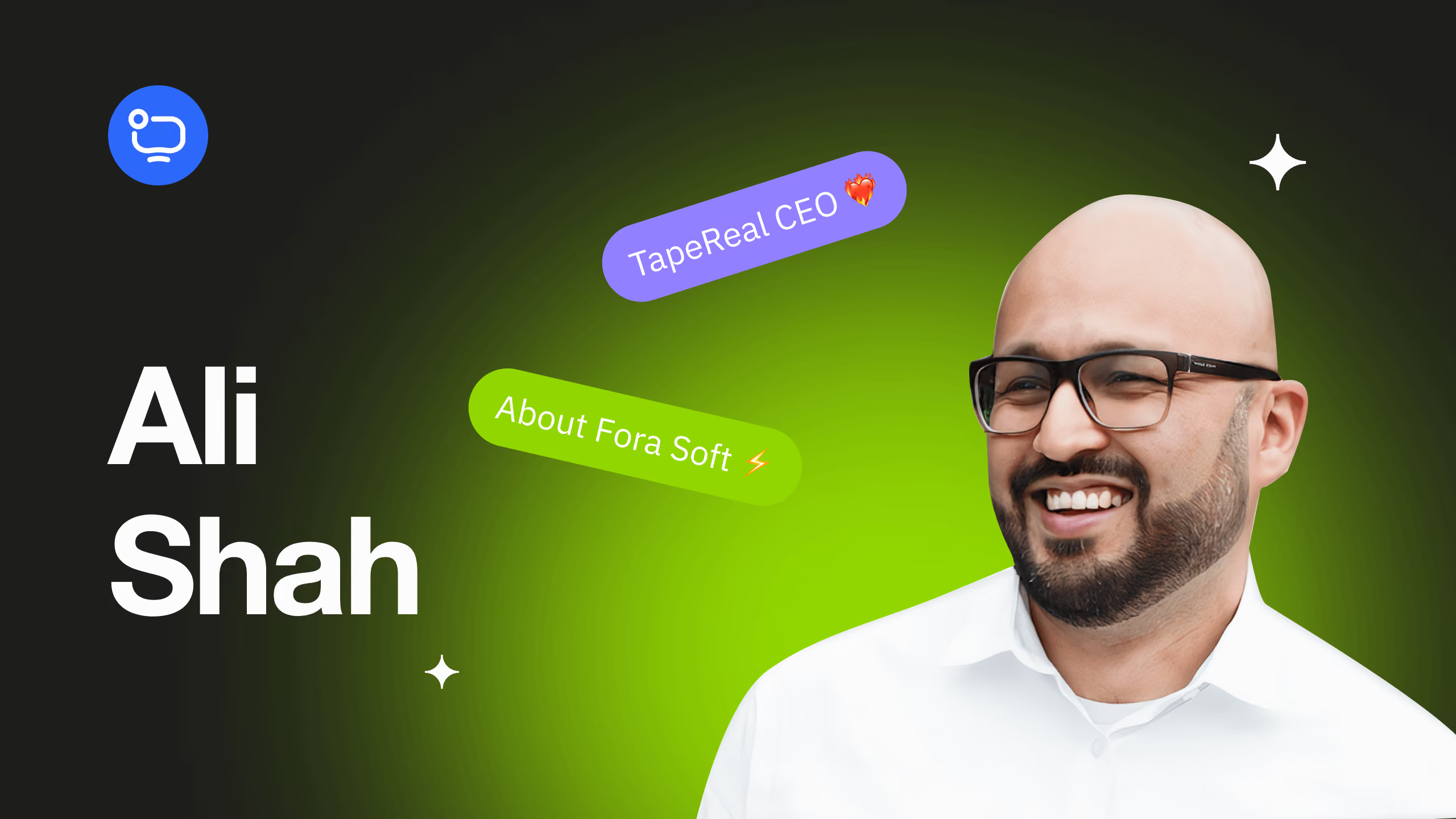
“The team treated the project like their own. They wanted to see the client succeed.” That is how Ali — CEO and founder of TapeReal, an iOS video social network for creators — summarized working with Fora Soft. TapeReal came to us in August 2020 with an existing codebase, a set of unstable features, and a vision for what YouTube would look like if it were built today. This is the conversation our team had with Ali after his first milestone with us shipped.
Key takeaways
- Why Fora Soft: Ali picked us after trying several other teams; the reason was streaming expertise, focus on quality, and commitment to client success.
- What changed: sprints got tighter, user stories became clearer, milestones landed on their dates, and crash/recording bugs were stabilized in the iOS App Store.
- Measurable impact: more positive App Store reviews, stabilized call–recording and solo–recording features, clearer weekly status cadence.
- What the client valued most: proactive communication, budget consciousness for a startup, and alternative solutions when the first option was not the right fit.
About TapeReal — the product Ali is building
TapeReal is an iOS–native, creator–first video social network headquartered in Vancouver. The platform is designed around authenticity, audio + video storytelling, and algorithm–free distribution — the things Ali felt mainstream platforms had drifted away from.
Ali’s framing is simple: “TapeReal is a better version of YouTube. Like, if YouTube was built today instead of 2005, for the people of today.” The product emphasizes monetization via RealCoins, screen–capture protection for paid content, and long–form creator workflows that do not exist on TikTok or Instagram.
Project snapshot
Client: TapeReal, Vancouver
Product: iOS creator–first video social network
Start of engagement: August 2020
Role: iOS engineering, streaming, feature stabilization, sprint planning
Case study: See the TapeReal case study
The interview — in Ali’s own words
Our copywriter Nikita sat down with Ali after his first milestone with our team shipped. Below is the transcript, lightly edited for length and clarity.
Was Fora Soft your first choice?
“No, it was not. Before this, I was working with a number of developers and other software developing companies with varying degrees of success. We got some MVP prototypes.
I decided to turn to Fora Soft because I was impressed by their expertise in streaming technologies, the focus on quality, and their commitment to client’s success.”
Why this matters. TapeReal tried several teams first — and picked Fora Soft after evaluating real alternatives. We see this pattern often on video and streaming products: teams learn the hard way that not every “mobile shop” can deliver a real–time–media app. Our 20+ years on streaming and WebRTC is a large part of why clients like Ali choose us after a false start.
Before and after working with Fora Soft
“Before working with Fora Soft, our development sprints were planned a little differently. I would put together the requirements for design, but I was not involved in user stories.”
“With Fora Soft we planned our sprints more effectively, they were more precise, the user stories were very clear.”
“The project manager provided a clear development plan about what is going to be achieved on certain days and certain milestones. So that part, I think, helped make the sprints more successful. The team was very involved in the whole planning process and provided a lot of great feedback as well.”
Can you share measurable figures — reviews, users, crashes?
“In the App Store, we generated more positive reviews. The app was stabilized in many respects as well. We were facing a lot of issues with call recording and also with solo recording features. The team was able to fix some of those bugs and stabilize that experience for the community as well.”
Outcome
More positive App Store reviews; stabilized call–recording and solo–recording features; predictable sprint cadence; clearer user stories and milestone reporting. This is what “reliable delivery” looks like on a streaming product.
Were there any difficulties while developing the app?
“We had an existing codebase, so it took some time for the team to familiarize themselves with the codebase.”
“Whenever there were challenges, the team did their best to overcome them, or they presented alternative options and solutions.”
“They communicated very effectively. In the beginning, it was just a matter of us getting used to each other’s communication styles and timelines. So, there were some miscommunications, some expectations from both ends that were a little bit challenging. Once we got to the standardized process, we had some clear expectations. The project ran pretty smoothly thereafter.”
Communication, professionalism, determination — how would you rate us?
“In terms of communication, professionalism, and determination, nobody is perfect. I would like to give you a score of 10, but obviously, we are human beings. We make mistakes sometimes, but the main thing is that we learn from them, and we overcome them. In that respect, I really appreciated working with you guys.
In terms of communication, you are very proactive. The weekly status reports are really helpful, kind of gives you an idea of what was achieved, what is planned for next week. You always communicated on Skype effectively. The professionalism also was always there.”
“The team treated the project like their own. They wanted to see the client succeed.”
“As for determination, I would say that when there is a technical challenge, the team enjoys trying to solve it. They put forth the best solution for it, which is great. If they are unable to do it, you guys present the options or the alternatives for achieving the result in the end.
In that respect, I also really appreciated the eye on the budget. Obviously, being a startup, we have limited funds. The team took that into consideration whenever they planned all their sprints, so I appreciate that, too.”
Closing notes
Thanks to Ali for the transparent feedback. On behalf of the whole Fora Soft team, we wish TapeReal all the best with the product and the community Ali is building. We believe it has a great future.
What we actually did for TapeReal
For readers who found this via search and want the technical picture, here is a concise description of the work.
iOS engineering on a live codebase. We took over an existing Swift codebase, went through onboarding with Ali’s previous vendors, and stabilized critical features. Key areas: call recording, solo recording, upload pipeline, and crash hotspots.
Sprint planning and user–story definition. We introduced a tighter two–week sprint cadence with user stories written jointly, weekly status reports, and explicit milestone dates so Ali could plan product comms and fundraising in sync with engineering.
Streaming–media reliability. Most of TapeReal’s differentiation depends on recording being reliable. We applied the same WebRTC and media–pipeline know–how we use on BrainCert, VOLO.live, and Meetric — test coverage on edge cases, analytics on session failures, and a prioritized bug queue.
Startup–aware scoping. Every sprint was scoped with limited runway in mind. Our project manager worked with Ali to separate “must–ship” work from “later” work, a discipline we describe in our software estimating guide.
Why founders like Ali choose Fora Soft
Ali’s experience is representative. When we look at the 350+ projects we have shipped since 2005, four patterns repeat.
Deep streaming and real–time media expertise. WebRTC, recording pipelines, cross–device synchronization — the hard parts of video apps. Agencies that can ship this well are rare; Ali evaluated several before picking us.
Agent Engineering velocity. Our Agent Engineering approach — AI doing the first 80%, senior engineers finishing the last 20% — delivers estimates roughly 30–40% faster and cheaper than the agencies still working by hand, which is why budget–conscious founders like Ali get more done on a fixed runway with us.
Sprint discipline. Weekly status reports, clear user stories, explicit milestones. Read our planning, requirements and visualization process for the shape of how we run sprints.
Product ownership. When Ali says the team treated the project like their own, he means the team flagged risks early, presented alternatives when the first approach stalled, and gave him budget–aware choices — not a blind path forward.
Related reading and projects
If Ali’s story resonates with the product you are building, these pages are the next best places to go.
Case study
TapeReal — iOS creator video network
Full case study on the product Ali is building.
Case study
BrainCert — WebRTC classroom LMS
Another long–running engagement: $3M ARR, 4× Brandon Hall winner.
Process
Our planning and visualization process
How we run sprints, user stories, and weekly status.
Estimation
Software estimating guide
How we scope sprints for startups with limited runway.
Strategy
Mobile vs web with a limited budget
How to pick the platform that ships first when runway is short.
Service
WebRTC development services
The streaming–media expertise Ali referenced as the reason he picked us.
FAQ for founders evaluating an engineering partner
How do you work with an existing codebase?
We onboard with the previous vendor where possible, read through the codebase in the first week, document the architecture and risk areas, and land a short “stabilization sprint” before new features. TapeReal followed this pattern and was smooth within a month.
How do you plan sprints for a startup on limited runway?
We separate “must–ship” from “later”, price each feature in realistic hours, and give the founder budget choices rather than a fixed plan. When a feature costs more than it is worth, we say so before we ship it.
Do you work with video, streaming, and WebRTC projects only?
Those are our strongest areas and the reason clients like Ali pick us. But we also ship AI–first products, e–learning platforms, telemedicine, and anything media–adjacent. We turn down briefs that are outside our wheelhouse rather than pretend to know them.
How quickly can you start on a new project?
A scoping call within a week, an estimate within 48 hours after discovery, and kickoff within 2–4 weeks for most briefs. Book the scoping call via Calendly to get the process started.
Can you read more client reviews?
Yes — we publish client interviews regularly. See the Fora Soft blog for more client voices, or the projects page for outcome data on our long–running engagements.
Building a video product?
Tell us what you are building — get a realistic scope back in 48 hours.
We will scope your feature list, recommend the right streaming stack, and give you a fixed–price estimate that beats agency rates by 30–40%.
Book your 30-min call →
