


Updated October 2026: WhisperX 3.8.6 with pyannote community-1 diarization, October 2026 Deepgram and AssemblyAI batch prices, a quick-start and an FAQ, and OpenAI's gpt-4o-transcribe-diarize compared.
What Is WhisperX? The Short Answer
WhisperX is a free, open-source pipeline (BSD-2-Clause) that wraps OpenAI's Whisper and adds the two things Whisper lacks: an accurate start and end time for every word, and a speaker label for every word. It does this with three extra stages — voice activity detection, wav2vec2 forced alignment and pyannote speaker diarization — and runs batched transcription up to 70× faster than real time on a GPU (WhisperX GitHub, 2026). As of October 2026 the latest stable release is WhisperX 3.8.6 (25 May 2026), built on faster-whisper 1.2+ and pyannote.audio 4, with the speaker-diarization-community-1 model doing the speaker step (PyPI, 2026).
- WhisperX vs Whisper: the same transcription engine, but Whisper's own timestamps are segment-level and drift, while WhisperX gives forced-aligned word-level timestamps — 93.2% vs 85.4% precision on telephone speech at a 200 ms tolerance (Bain et al., 2023).
- Is WhisperX free? The code and models cost nothing; you pay for the GPU and the engineer who runs it. Diarization needs a free Hugging Face token.
- Is WhisperX real time? No. It transcribes finished files; live audio needs a streaming ASR.
Why This Matters
If your product needs to know when each word was spoken or who spoke it, plain Whisper will quietly let you down, and WhisperX is the most common open-source fix. Subtitles that highlight each word as it is read — the karaoke effect on social clips — need per-word timing. A meeting summary that says "Maria committed to the deadline, not Tom" needs speaker labels. A telemedicine record that separates the doctor's voice from the patient's needs both. A searchable video archive that jumps you to the exact second a phrase was said needs accurate word timestamps, not Whisper's rough guesses that can be several seconds off — and those word-timed transcripts are the backbone of the retrieval index covered in the video RAG over an archive lesson. This article is for the product manager, founder, or engineering lead deciding whether to self-host WhisperX or buy a hosted transcription API. By the end you will understand the three stages WhisperX adds, the specific ways each one fails, the cost and operational trade-offs against a paid API, and the four-question test for picking the right path.
Where WhisperX Sits — And What Came Before It
This lesson builds directly on the previous one. In the streaming ASR in production lesson we compared three ways to turn live audio into text while a person is still talking. WhisperX solves a different, narrower problem: it transcribes a finished recording — a file you already have — and it does so with two qualities that plain Whisper cannot deliver on its own. The first is an accurate timestamp for every word. The second is a speaker label for every word. WhisperX is a batch tool, not a streaming one, and that single fact shapes everything about where it fits. (For the live-caption case, where a transcript is produced and fanned out to viewers in real time, see the live captions SFU fan-out lesson instead.)
Start with the word transcription. It means turning recorded speech into the text of what was said. Automatic speech recognition, abbreviated ASR, is the technology that does it. OpenAI's Whisper, released in 2022 under the permissive MIT license, is the open-source ASR model most teams reach for first: it is free to run on your own servers, handles 99 languages, and holds up well against accents and background noise (Radford et al., 2022). But Whisper was built to answer one question — what words were said? — and it answers two other questions badly.
The first question it answers badly is exactly when was each word said? Whisper produces a timestamp for each chunk of text it emits, but those timestamps are known to drift, sometimes by several seconds, and per-word timing was not part of the model's output (Bain et al., 2023). The open-source package later added an optional word_timestamps setting, but it estimates word times from the model's attention weights rather than aligning them to the sound, so it inherits the same drift. The second question it cannot answer at all is who said it? Whisper transcribes a two-person conversation into one undifferentiated wall of text, with no idea that two people were talking.
WhisperX, published by Max Bain and colleagues at Oxford's Visual Geometry Group in 2023, exists to answer all three questions (Bain et al., 2023). It keeps Whisper as the engine that decides what was said, and adds machinery around it to decide when and who.
The Three Stages WhisperX Adds
The cleanest way to understand WhisperX is as Whisper plus three bolt-on stages, run in order. Picture an assembly line. The raw audio enters on the left, passes through four stations, and a fully timed, speaker-labelled transcript comes out on the right.
The first station is a voice activity detector, abbreviated VAD — a small, cheap model whose only job is to mark which slices of the audio contain speech and which are silence, music, or noise. The second station is Whisper itself, transcribing the speech into words. The third station is forced alignment — a separate model that snaps each word onto its true position in the sound. The fourth station is diarization — a model that figures out how many distinct voices are present and which stretches of audio belong to each. We will walk through each one, because each adds a real capability and each fails in a specific way you need to plan around.
 Figure 1. WhisperX is Whisper plus three stages: a voice-activity detector finds the speech, forced alignment fixes the timing, and diarization assigns the speakers.
Stage One — Voice Activity Detection And The "Cut & Merge" Trick
Recall the one hard fact about Whisper from the streaming lesson: the model reads audio in fixed blocks of 30 seconds, because that is the length it was trained on. To transcribe a one-hour podcast, plain Whisper slides a 30-second window across the recording. The problem is that the window has to land somewhere, and it often lands in the middle of a word. A word cut in half at a window boundary gets mis-transcribed, and worse, Whisper uses its own shaky timestamps to decide where to slide the window next — so an error in one window pushes the next window to the wrong place, and the mistakes pile up. The technical name for this pile-up is drift (Bain et al., 2023).
WhisperX removes the guesswork by looking at the audio before Whisper does. It runs a voice activity detector first. The VAD produces a map of exactly where speech starts and stops across the whole recording. Now WhisperX can chop the audio at moments of silence, never in the middle of a word.
But there is a subtlety, and it is the clever part of the design. Whisper works best with close to 30 seconds of context, so feeding it lots of tiny one-second speech snippets would waste its ability and hurt accuracy. So WhisperX applies what the paper calls Cut & Merge. It cuts any speech region longer than 30 seconds at the quietest point inside it — the moment of least vocal activity, which is the safest place to split. Then it merges short neighbouring speech regions together until each combined chunk is close to, but not over, 30 seconds (Bain et al., 2023). The result is a set of chunks that are each about 30 seconds long and each begin and end on silence.
This buys two things at once. Because no chunk depends on any other chunk's timestamp, they no longer have to be processed in sequence — Whisper can transcribe all of them in parallel, in a batch, which is much faster. And because every chunk is cut on silence and sized to Whisper's sweet spot, the transcription is also more accurate, with less drift and fewer hallucinated words (Bain et al., 2023). The paper reports this batched approach gave a roughly twelve-fold speed-up over Whisper's sequential sliding window (Bain et al., 2023). The current open-source version pushes that further — its README reports up to 70 times faster than real time on the large model — by also swapping in a faster inference engine called faster-whisper, the same CTranslate2-based runtime we met in the streaming lesson (WhisperX GitHub, 2026).
A Note On The Two Speed Numbers
You will see two different speed claims for WhisperX and they are both true. The paper measured 11.8 times Whisper's own speed on an NVIDIA A40 GPU — close to the "twelve-fold" the authors headline — and, crucially, with no loss in transcription quality; the same VAD Cut & Merge that enables the batching also lowered word error rate and cut hallucination (Bain et al., 2023, Tables 2 and 3). The "70× real time" on the current GitHub page is a later engineering figure that combines that batching with the faster-whisper runtime, measured against a different baseline (WhisperX GitHub, 2026). Neither is wrong; they measure different things. The honest takeaway is that WhisperX turns a recording that plain Whisper transcribes slowly into one that finishes many times faster — the exact multiple depends on your GPU, the model size, and the batch you choose.
Stage Two — Forced Alignment: Pinning Each Word To The Sound
This is the stage that gives WhisperX its name and its main reason to exist. After Whisper has produced the words, WhisperX runs a second, smaller model over the same audio to find the precise start and end time of every single word. The technique is called forced alignment.
The idea is best understood by analogy. Imagine you have the script of a song and the recording, and you want to mark the exact instant each word is sung — the way a karaoke machine highlights lyrics in time. You are not guessing the words; you already know them from the script. You are only solving the timing: matching known text to known sound. That matching problem is forced alignment, and it is much easier and more precise than transcription, because the answer to "what was said" is already fixed.
WhisperX does this with a model from a family called wav2vec2, trained to recognise the individual speech sounds — the phonemes — in audio. For English, the default is a standard wav2vec2 model trained on 960 hours of audiobook speech, the model the paper found performs most consistently (Bain et al., 2023). The model scans the audio and, for each tiny slice, scores how likely each phoneme is. WhisperX then runs dynamic time warping over that score map — an algorithm that finds the single best time-path matching the sequence of phonemes in Whisper's transcript to the sound — and takes the start of a word's first phoneme and the end of its last phoneme as that word's timestamps (Bain et al., 2023).
The payoff shows up in a measurable way. The paper evaluates timing with a word-segmentation test: a predicted word counts as correct only if its time window overlaps the human-labelled window within a 200-millisecond tolerance (a "collar") and the word text is an exact match. On that test, over telephone speech (the Switchboard corpus), WhisperX reaches 93.2% precision and 65.4% recall, versus 85.4% and 62.8% for using Whisper's own timestamps; on harder meeting audio (the AMI corpus) WhisperX reaches 84.1% precision and 60.3% recall, versus Whisper's 78.9% and 52.1% (Bain et al., 2023, Table 2). In plain terms: Whisper alone misses or mis-places far more word boundaries — which is why WhisperX runs a dedicated alignment stage rather than trusting Whisper's timestamps. For karaoke captions, clip-highlighting, or jumping to the exact second of a search hit, that gap is the whole product.
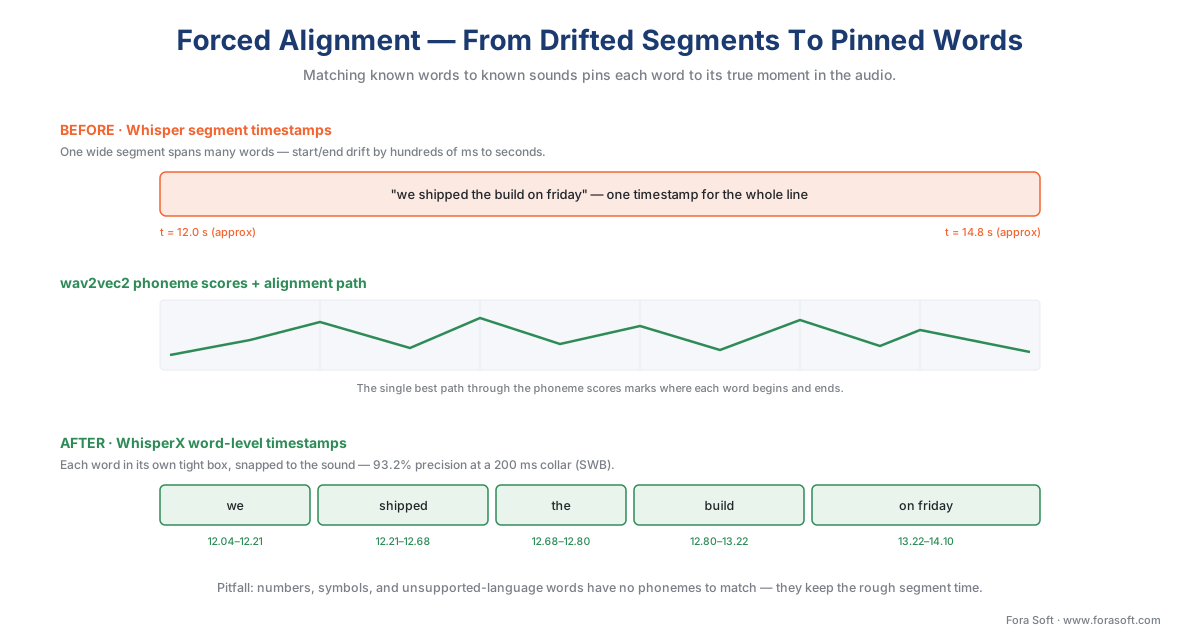 Figure 2. Forced alignment matches known words to known sounds, snapping each word from a drifted segment guess onto its true position — 93.2% precision on telephone speech at a 200 ms collar, versus 85.4% for Whisper alone.
The Forced-Alignment Pitfall You Will Hit
Forced alignment has one failure mode you must design around. The wav2vec2 model only knows the sounds of ordinary spoken words. When Whisper transcribes something that is not a normal dictionary word — a number written as digits like "2014", a currency amount like "£13.60", a symbol, or a word in a language the aligner does not cover — the aligner has no phonemes to match and cannot place that token. WhisperX then borrows the timestamp of the nearest neighbouring phoneme in the transcript for that word (Bain et al., 2023), so a transcript that is otherwise tightly aligned will have a few words pinned only loosely. If your product depends on perfect per-word timing — say, a legal transcript with timestamped figures — test specifically on audio full of numbers and names, because that is where alignment quietly degrades.
A second, related caution: the alignment model, wav2vec2, is less robust to noise than Whisper itself. On clean studio audio the timestamps are excellent; on a noisy phone call they degrade faster than the transcription does (Towards AI, 2026). Clean audio in, clean timing out — which is why teams that run WhisperX on call recordings often clean the audio first with the techniques in the real-time noise suppression lesson.
Stage Three — Diarization: Labelling Who Spoke
The third stage answers who said it? The word is diarization — splitting an audio recording into segments by speaker, and labelling each segment with an anonymous tag like "Speaker A" and "Speaker B". It does not put names to voices; it only separates them. Attaching real names is a later step your application does, usually by asking the user or matching against known voices.
WhisperX hands this job to a separate, specialised library called pyannote.audio, the open-source standard for speaker diarization (WhisperX GitHub, 2026). Pyannote listens to the whole recording, decides how many distinct voices are present, and produces a timeline of which voice is active when. WhisperX then does the final, simple join: for each word it has already timed in stage two, it looks up which speaker's segment that word's time falls inside, and tags the word with that speaker (WhisperX GitHub, 2026). Because the words are already accurately timed, this overlap-matching is reliable — which is a nice illustration of why the stages run in this order. Accurate timing is what makes accurate speaker assignment possible.
Which pyannote model does the work depends on the WhisperX version. Since WhisperX moved to pyannote.audio 4, the default is speaker-diarization-community-1, published in September 2025 to replace the older 3.1 pipeline. On pyannote's own benchmark table it lowers diarization error rate (DER) on the AMI meeting corpus from 18.8% to 17.0% and on CALLHOME phone calls from 28.5% to 26.7% (pyannote, 2025). pyannoteAI's paid precision-2 model, which runs on their servers rather than yours, scores 12.9% and 16.6% on the same sets — that gap is what a hosted diarization service is selling. Community-1 also returns an "exclusive" diarization with one active speaker per moment, designed to make joining speaker turns to word timestamps cleaner.
We treat diarization as its own deep topic in the next lesson on Pyannote in production; here the point is only how WhisperX wires it in and what it costs you operationally.
Two Things That Will Trip You Up On Diarization
First, the friction. The pyannote diarization model is gated: to download it you must create a free Hugging Face account, accept the terms of pyannote/speaker-diarization-community-1, and pass a read token to WhisperX with --hf_token alongside the --diarize flag (WhisperX GitHub, 2026). This is a one-time setup, but it surprises teams who expected pip install to be the end of it, and it is a recurring complaint in the project's issue tracker (WhisperX GitHub issues, 2026). Budget ten minutes for it and document the token handling, because a missing or revoked token on a fresh deployment stops the diarization step from loading its model.
Second, the limits. Diarization is the slowest and most memory-hungry stage of the pipeline, and it is the least reliable. It struggles when two people talk over each other — overlapping speech is genuinely hard — and it can merge two similar voices into one or split one voice into two. The WhisperX authors are candid that diarization is "far from perfect" (WhisperX GitHub, 2026). Plan for a human to be able to correct speaker labels in any product where getting them wrong matters, such as a medical or legal record.
The Whole Pipeline In One View
The four stages run as a chain, and each one feeds the next. The table below is the mental model to keep.
| Stage | What it does | Model used | What it gives you | Where it fails |
|---|---|---|---|---|
| Voice activity detection (stage one) | Finds where speech is; cuts & merges into ~30 s chunks on silence | pyannote VAD | Faster, more accurate, batchable input | Very quiet speech can be missed |
| Transcription (Whisper) | Turns speech into words, in parallel batches | Whisper (via faster-whisper) | The text of what was said | Rare words, heavy accents, noise |
| Forced alignment (stage two) | Pins each word to its true start/end time | wav2vec2 phoneme model | Word-level timestamps within a 200 ms collar | Numbers, symbols, unsupported languages |
| Diarization (stage three) | Splits and labels the audio by speaker | pyannote.audio | "Speaker A / B" tag on every word | Overlapping or similar voices; needs HF token |
Sources: Bain et al. (2023); WhisperX GitHub (2026).
Quick Start — Running WhisperX 3.8
Once GPU drivers are in place, a first diarized, word-timed transcript takes two commands. WhisperX 3.8.6 needs Python 3.10–3.13 and pulls in PyTorch 2.8, faster-whisper 1.2+ and pyannote.audio 4; the project recommends CUDA 12.8 for GPU use (PyPI, 2026; WhisperX GitHub, 2026).
pip install whisperx
# first accept the terms of pyannote/speaker-diarization-community-1 on Hugging Face
whisperx interview.wav --model large-v3 --diarize --hf_token $HF_TOKEN --highlight_words True
Two defaults catch people out. The command-line tool uses the small Whisper model unless you pass --model, so a first test can look far less accurate than the benchmarks; name large-v2, large-v3 or the faster large-v3-turbo explicitly. And the speaker step cannot download its gated model without a token. By default every run writes SRT, VTT, TXT, TSV and JSON files side by side; --output_format srt keeps just one, and the JSON is the one that carries per-word start, end and speaker fields. In Python the pipeline is three pairs of calls — load_model and transcribe, load_align_model and align, then DiarizationPipeline from whisperx.diarize and assign_word_speakers (WhisperX GitHub, 2026).
On hardware, large-v2 runs in under 8 GB of GPU memory at beam size 5; if you run short, lower --batch_size or switch to --compute_type int8. The same int8 setting with --device cpu runs WhisperX on a CPU or a Mac, which is fine for testing and too slow for a production queue.
WhisperX Versus A Hosted API
The real decision most teams face is not "WhisperX or plain Whisper" — it is "self-host WhisperX, or pay a hosted API like Deepgram or AssemblyAI that gives word timestamps and diarization as a built-in feature". The streaming lesson covered those APIs in depth; here is the comparison that matters specifically for the timestamp-and-speaker job.
| Criterion | WhisperX (self-hosted) | Hosted API (Deepgram / AssemblyAI) |
|---|---|---|
| Cost model | Your GPU time only; software is free | Per-audio fee: batch from $0.15/hr (AssemblyAI Universal-2) to $0.26/hr (Deepgram Nova-3), October 2026 |
| Word timestamps | Forced-aligned (93.2% precision on telephone speech) | Built in, vendor-tuned |
| Diarization | pyannote community-1, free, needs HF token | Built in; included on Deepgram batch, +$0.02/hr on AssemblyAI |
| Data location | Stays on your servers | Vendor cloud by default (Deepgram also sells self-hosted) |
| Streaming | No — batch only | Yes |
| Setup effort | GPU, CUDA, models, token, tuning | An API key |
| Languages | 99 transcribe; about 40 with a default aligner | Vendor-dependent |
| Best when | On-prem rules; high steady volume; full control | Ship fast; spiky volume; want streaming |
Sources: Bain et al. (2023); WhisperX GitHub (2026); Deepgram and AssemblyAI pricing pages, checked October 2026.
A third hosted option has arrived since the WhisperX paper: OpenAI's gpt-4o-transcribe-diarize. It returns speaker-labelled segments with start and end times and can map up to four known speakers from 2–10-second reference clips, but it does not return word-level timestamps — in OpenAI's API, word granularity is only available on whisper-1 — and it is not supported in Realtime sessions (OpenAI docs, 2026). If your feature needs per-word timing, it does not replace WhisperX's alignment stage.
The license is part of this decision. WhisperX is released under the permissive BSD-2-Clause license, Whisper under MIT, pyannote's code under MIT and the default community-1 diarization weights under CC-BY-4.0, which asks only for attribution — all of which let you ship them inside a commercial product for free (WhisperX GitHub, 2026). The only catch is the gated pyannote model weights, which are free but require accepting their terms. So "free" is true, with an asterisk: free software, free models, but you pay for the GPU and the engineer who runs it.
Worked Example — What Self-Hosting WhisperX Actually Costs
Numbers in the abstract do not settle a budget, so put real ones through. Suppose you need to process 2,000 hours of recorded audio per month — a podcast network, a course library, or a backlog of recorded consultations — and you want word timestamps and speaker labels on all of it. This is batch work: the files already exist, so latency does not matter, only throughput and cost.
WhisperX on the large model runs at up to 70 times real time on a capable GPU, but for planning we assume a conservative 30 times real time once diarization and alignment are included, since those stages are slower than transcription (the 70× is from WhisperX GitHub, 2026; the 30× is our planning assumption, not a benchmark). At 30× real time, one GPU processes 30 hours of audio per wall-clock hour:
2,000 hours of audio ÷ 30 hours processed per GPU-hour = 66.7 GPU-hours per month.
Rent a suitable cloud GPU at about $1.00 per hour and the raw compute bill is:
66.7 GPU-hours × $1.00/hour = about $67 per month — in compute.
That is strikingly cheap, and it is why self-hosting WhisperX is attractive for steady batch volume. But the compute number is not the whole cost. Add the one-time engineering to build the pipeline, the ongoing maintenance, the GPU you may keep partly idle to absorb peaks, and the human time to spot-check diarization. For comparison, at October 2026 list prices a hosted batch API bills 2,000 × $0.17 = $340 per month on AssemblyAI Universal-2 with diarization ($0.15 + $0.02 per hour), or 2,000 × $0.258 = $516 per month on Deepgram Nova-3 pre-recorded, where diarization is included — five to eight times the WhisperX compute, but with zero pipeline to build or run (AssemblyAI pricing, 2026; Deepgram pricing, 2026). At this volume the saving is roughly $270–$450 a month, so self-hosting only pays if running and patching the pipeline takes a few engineer-hours a month or less; at 20,000 hours of audio a month the gap grows to roughly $2,700–$4,500, and the case for self-hosting becomes clear.
The lesson is the mirror image of the streaming lesson's. For batch work at steady volume, WhisperX's per-hour compute cost is far below a hosted API, and the break-even tips toward self-hosting much sooner than it does for streaming — because you are not paying for idle GPUs waiting on live calls, you are running a queue flat-out. The hosted API still wins when volume is low or spiky, when you have no ML engineer, or when you need it shipped this week.
Common Mistake — Trusting Word Timestamps On Hard Tokens
The most damaging mistake we see with WhisperX is assuming every word timestamp is equally trustworthy. In a demo on clean speech, the timing looks flawless, so teams build features — a clickable transcript, a captioning engine, a clip-cutter — that treat every word's time as exact. Then real audio arrives full of prices, dates, phone numbers, and proper nouns, and a fraction of those tokens were never aligned at all. They borrow a neighbouring word's timestamp instead, and the clickable transcript jumps to the wrong second, or the auto-cut clip starts mid-word.
The fix is to know which words were truly aligned and which fell back. WhisperX's output marks this — an aligned word carries a tight start and end; an unaligned one inherits a neighbour's bounds. Build your feature to read that distinction: for anything irreversible or user-facing, treat a fallback timestamp as "approximate" and, where it matters, widen the clip boundary or flag the word for review. Test on audio that is deliberately full of numbers and names before you trust the timing in production, not after the first complaint.
How To Choose — Four Questions
The decision comes down to four questions, in order.
First, do you actually need word-level timing or speaker labels? If you only need a plain transcript of what was said, plain Whisper or faster-whisper is simpler and you can skip WhisperX entirely. WhisperX earns its extra two stages only when when or who matters.
Second, must the audio stay on your own servers? For medical, legal, or otherwise regulated recordings that cannot be sent to a third-party cloud, self-hosted WhisperX is often the simplest compliant option, and the operational cost is the price of that control. Hosted vendors do offer HIPAA business associate agreements, and Deepgram also sells a self-hosted deployment, so check those before ruling them out.
Third, is the work batch or live? WhisperX is batch-only — it processes finished files. If you need word timing on a live stream, WhisperX is the wrong tool; you want the streaming options from the previous lesson or a custom streaming alignment setup.
Fourth, do you have the team and the volume? WhisperX rewards steady, high batch volume and an engineer who can run a GPU pipeline. At low or spiky volume, or with no ML capacity, a hosted API that gives timestamps and diarization behind one API key will be cheaper all-in and far faster to ship.
 Figure 3. Four questions, asked in order, route most timestamp-and-speaker projects to the right tool.
WhisperX FAQ
What is WhisperX?
WhisperX is an open-source pipeline around OpenAI's Whisper that adds word-level timestamps through wav2vec2 forced alignment and speaker labels through pyannote diarization, and batches transcription for up to 70× real-time speed. Max Bain and colleagues at Oxford published it in 2023; it lives at github.com/m-bain/whisperX.
Is WhisperX free for commercial use?
Yes. WhisperX is BSD-2-Clause, Whisper is MIT and pyannote.audio's code is MIT; the default community-1 diarization weights are CC-BY-4.0, which allows commercial use with attribution. Your real costs are GPU time and engineering.
Does WhisperX need a GPU?
It runs without one, but production speed needs a GPU. Large-v2 fits in under 8 GB of GPU memory at beam size 5; on a CPU use --compute_type int8 --device cpu and expect it to be much slower.
Does WhisperX need a Hugging Face token?
Only for diarization. The speaker step downloads the gated pyannote/speaker-diarization-community-1 model, which requires accepting its terms on Hugging Face and passing --hf_token.
WhisperX vs faster-whisper: which should I use?
faster-whisper is the transcription engine inside WhisperX. Use it alone when you only need the text; add WhisperX when you need per-word timing or speaker labels. For transcription in the browser or on the device, see client-side ASR with faster-whisper and WebAssembly.
Which Whisper model should I run in WhisperX?
The project's own examples use large-v2; large-v3 is the newer multilingual checkpoint, and large-v3-turbo trades some accuracy for much faster decoding. Test on your own audio — the alignment and diarization stages work the same whichever you pick.
How accurate are WhisperX word timestamps?
In the WhisperX paper, word-segmentation precision — the word text matches and its timing lands within a 200 ms tolerance — is 93.2% on telephone speech (Switchboard) and 84.1% on meeting audio (AMI), against 85.4% and 78.9% for Whisper's own timestamps (Bain et al., 2023). Numbers, symbols and unsupported languages fall back to a neighbouring word's timing.
Can WhisperX transcribe live audio?
No. WhisperX is a batch tool for finished recordings. For live captions or a voice agent, use a streaming ASR such as Deepgram, AssemblyAI or a streaming Whisper setup.
Where Fora Soft Fits In
We build transcription features into the video products our clients ship, and the choice between WhisperX and a hosted API comes up constantly. We have used WhisperX where word-level timing and speaker labels had to be produced on the client's own infrastructure — searchable transcripts for OTT and surveillance archives, speaker-separated records for telemedicine consultations — the job an AI scribe does inside the AI telehealth video platforms we build, and word-timed captions for e-learning libraries. Sometimes hosted is the right answer: on VALT, the observation-recording platform we have built for 770+ U.S. organisations, spoken-word search inside recorded video runs on Amazon Transcribe. The recurring lesson is that the model is the easy part. The hard part is the integration: extracting clean audio at the right sample rate, handling the alignment fallbacks so timestamps never silently lie, managing the Hugging Face token and gated models without breaking a deployment, and deciding honestly whether the client's volume justifies a GPU pipeline or a hosted API. We pick by the four questions above, not by which tool is fashionable. If you need diarized, word-timed transcripts in your own product, our speech-to-text development team builds the WhisperX or hosted-API pipeline end to end, and our AI integration engineers wire the transcripts into search, captions and summaries.
What To Read Next
- Streaming ASR in production — Whisper, Deepgram, and AssemblyAI in 2026
- Speaker diarization with Pyannote in production
- AI meeting transcription tooling — the build-vs-buy landscape
- Real-time multilingual speech translation in calls
Call to action
- Talk to a video engineer — book a 30-minute scoping call to talk through your whisperx plan.
- See our case studies — 250+ shipped projects across video streaming, WebRTC, OTT, telemedicine, e-learning, surveillance, and AR/VR.
- Download the WhisperX Pipeline Setup Checklist — One-page printable checklist for standing up a WhisperX transcription pipeline: the four stages, the Hugging Face token and gated-model steps, the alignment-fallback handling, a self-host-vs-hosted-API mini decision table, and a….
References
- Bain, M., Huh, J., Han, T., Zisserman, A. WhisperX: Time-Accurate Speech Transcription of Long-Form Audio. Interspeech 2023 (ISCA Archive, doi:10.21437/Interspeech.2023-78); arXiv:2303.00747.
https://www.isca-archive.org/interspeech_2023/bain23_interspeech.pdf. Primary source for the three-stage architecture (VAD pre-segmentation, Cut & Merge into ~30 s chunks, batched Whisper transcription, wav2vec2 forced alignment via dynamic time warping), the 11.8× / "twelve-fold" batched-inference speed measured on an NVIDIA A40, the drift problem in buffered Whisper, the nearest-neighbour-phoneme fallback for out-of-dictionary tokens, the default configuration (Table 1: large-v2 Whisper, wav2vec2 BASE 960H, pyannote VAD), and the Table 2 word-segmentation results at a 200 ms collar — WhisperX 93.2% precision / 65.4% recall on Switchboard and 84.1% / 60.3% on AMI, versus Whisper's 85.4% / 62.8% and 78.9% / 52.1% — plus the TED-LIUM (WER 9.7) and Kincaid46 (WER 11.8) long-form numbers. All timing-accuracy claims in this article trace to this table, read directly from the ISCA PDF. - Radford, A., Kim, J. W., Xu, T., Brockman, G., McLeavey, C., Sutskever, I. Robust Speech Recognition via Large-Scale Weak Supervision (Whisper). arXiv:2212.04356, 2022.
https://arxiv.org/abs/2212.04356. Primary source for Whisper's architecture (Transformer encoder-decoder), 680,000-hour training set, 30-second input window, 99-language coverage, MIT license, and the hallucination failure mode that WhisperX's VAD stage mitigates. - WhisperX GitHub repository (m-bain/whisperX), release v3.8.6, accessed 2026-10-09.
https://github.com/m-bain/whisperX. Source for the current default models (large-v2 showcased, faster-whisper backend), the up-to-70×-real-time figure, the <8 GB GPU memory requirement for large-v2 at beam_size 5, the--diarizeflag and Hugging Face token requirement, the wav2vec2 default alignment models and the language coverage of default aligners, the assign-word-to-overlapping-speaker logic, the BSD-2-Clause license, and the documented limits on alignment of non-dictionary tokens and on diarization of overlapping speech. - wav2vec 2.0 — Baevski, A., Zhou, H., Mohamed, A., Auli, M. wav2vec 2.0: A Framework for Self-Supervised Learning of Speech Representations. arXiv:2006.11477, 2020.
https://arxiv.org/abs/2006.11477. Primary source for the self-supervised speech-representation model that WhisperX's forced-alignment stage uses to score phonemes. - Bredin, H. et al. pyannote.audio: neural building blocks for speaker diarization. ICASSP 2020; project at
https://github.com/pyannote/pyannote-audio, accessed 2026-05-31. Primary source for the diarization library WhisperX calls in its diarization stage, its MIT-licensed code, and its gated pretrained model weights that require a Hugging Face token. - CTC and forced alignment — Graves, A., Fernández, S., Gomez, F., Schmidhuber, J. Connectionist Temporal Classification: Labelling Unsegmented Sequence Data with Recurrent Neural Networks. ICML 2006.
https://www.cs.toronto.edu/~graves/icml_2006.pdf. The connectionist-temporal-classification formulation underlying the phoneme alignment WhisperX performs; standards-equivalent algorithmic source for the dynamic-programming alignment search. - TorchAudio Forced Alignment Tutorial. PyTorch documentation, accessed 2026-05-31.
https://pytorch.org/audio/stable/tutorials/forced_alignment_tutorial.html. The reference implementation of the trellis-and-backtrack (Viterbi) forced-alignment procedure that WhisperX's alignment stage adapts, and the source of its default wav2vec2 torchaudio bundles. - Modal. Choosing Whisper Variants for Production Transcription. modal.com/blog, 2026, accessed 2026-05-31.
https://modal.com/blog/choosing-whisper-variants. Secondary source for the practitioner positioning of WhisperX as the go-to open-source option when word-level timestamps and speaker labels matter. No timing-accuracy number in this article relies on it — all such figures now come from the paper's Table 2 (reference 1). Vendor-blog tier. - Towards AI. Whisper Variants Comparison: Features and Implementation. towardsai.net, 2026, accessed 2026-05-31.
https://towardsai.net/p/machine-learning/whisper-variants-comparison-what-are-their-features-and-how-to-implement-them. Secondary source for the practical observation that wav2vec2 alignment is less noise-robust than Whisper transcription and degrades faster on noisy audio. - whisperx on PyPI, accessed 2026-10-09.
https://pypi.org/project/whisperx/. Source for the latest stable release (3.8.6, 25 May 2026), the Python 3.10–3.13 range and the dependency floor (faster-whisper ≥1.2.0, pyannote-audio ≥4.0.0, torch 2.8). - pyannote. speaker-diarization-community-1 model card, Hugging Face, benchmark table updated September 2025, accessed 2026-10-09.
https://huggingface.co/pyannote/speaker-diarization-community-1. Source for the CC-BY-4.0 license, the gating terms, exclusive diarization, and the DER comparison of 3.1, community-1 and precision-2 on AMI and CALLHOME. - OpenAI. Speech to text guide, accessed 2026-10-09.
https://developers.openai.com/api/docs/guides/speech-to-text. Source for gpt-4o-transcribe-diarize (diarized_json segments, up to four known-speaker reference clips, no Realtime support) and for word timestamps being limited to whisper-1. - Deepgram pricing, accessed 2026-10-09.
https://deepgram.com/pricing. Nova-3 monolingual pre-recorded at $0.0043 per minute with diarization included. - AssemblyAI pricing, accessed 2026-10-09.
https://www.assemblyai.com/pricing. Universal-2 pre-recorded at $0.15 per hour and speaker diarization at $0.02 per hour.
