


Updated October 2026: ETSI TS 103 634 V1.7.1 (July 2026) and the new LC3plus Lossless mode, LC3 and LC3plus codec delay by frame size, and which phones, PCs and earbuds support LC3 today (Android 13+, Pixel 8 Auracast, Windows 11, still no iPhone).
What is LC3? The short answer
LC3, the Low Complexity Communication Codec, is the mandatory audio codec of Bluetooth LE Audio: it sounds as good as the old SBC codec at about half the bitrate, runs at 8–48 kHz with 10 ms or 7.5 ms frames, and is the codec behind Auracast broadcast audio and LE Audio hearing aids. LC3plus (also written LC3+) is Fraunhofer's superset of LC3, standardized as ETSI TS 103 634 (current edition V1.7.1, July 2026), which adds frames as short as 1.25 ms for about 7 ms end-to-end latency in gaming headsets, high-resolution audio up to 96 kHz, stronger packet loss concealment and a lossless mode. Earbuds use LC3 only when both the earbud and the phone or PC support LE Audio; otherwise they fall back to SBC, AAC or aptX over Classic Bluetooth. In 2026 that means an Android 13+ phone or a Windows 11 PC with LE Audio; iPhone supports neither LC3 nor Auracast.
| Question | LC3 | LC3plus (LC3+) |
|---|---|---|
| What it is | Bluetooth LE Audio's mandatory codec (Bluetooth SIG, LC3 1.0.1) | Fraunhofer IIS superset of LC3 (ETSI TS 103 634 V1.7.1, 2026) |
| Frame durations | 10 ms, 7.5 ms | 10, 7.5, 5, 2.5, 1.25 ms |
| Codec delay | 12.5 ms (10 ms frames), 11.5 ms (7.5 ms frames) | down to 2.5 ms (1.25 ms frames) |
| Lowest end-to-end latency | depends on the link; higher than the codec delay | about 7 ms in gaming modes (Fraunhofer) |
| Sample rates | 8–48 kHz | up to 96 kHz lossy, up to 192 kHz lossless |
| Quality | LC3 at 80–96 kbit/s beats SBC at 132–198 kbit/s | Hi-Res Wireless certified by the Japan Audio Society |
| Where you meet it | LE Audio earbuds, hearing aids, Auracast | gaming headsets, hi-fi, wireless microphones, DECT |
LC3 and LC3plus at a glance. Sources: Bluetooth SIG; ETSI; Fraunhofer IIS (codec delay figures from the LC3plus implementation product sheet, June 2026).
Why this matters
If you build video conferencing, telemedicine, e-learning, OTT, or any product where sound leaves a phone and arrives at a wireless earbud, you do not control the last wireless hop — Bluetooth does — and the codec on that hop sets a ceiling on the quality and latency your users actually experience. This article is written for a product manager, founder, or operations lead with no audio background: by the end you will understand what LC3 is, why it replaces SBC, how it compares on quality and battery, what LC3plus adds, and what the move to Bluetooth LE Audio means for call quality, lip-sync, and hearing accessibility in the products you ship. Every codec number traces back to the controlling standard — the Bluetooth SIG LC3 specification and ETSI TS 103 634 — or to its makers' published figures; device and platform support is cited to the platform owners or named reporting.
The codec that finally replaces SBC
For twenty years, almost every Bluetooth headset has used the same compression engine. When sound travels from your phone to a wireless earbud, it cannot travel raw — the radio link is too narrow — so a codec squeezes it down first and expands it again at the earbud. A codec is just that: an agreed method for compressing sound on one end and reconstructing it on the other.
Classic Bluetooth audio runs over a profile called A2DP, the Advanced Audio Distribution Profile, and A2DP's mandatory, always-present codec is SBC — the Low Complexity Sub-band Codec. SBC was built in the early 2000s for one goal: make any headset work with any phone. It was designed for interoperability, not efficiency, so it needs a lot of data to sound decent — typically 192 to 345 kbit/s (SoundGuys; Bluetooth SIG). Every device has it, which is why it is the floor nobody falls below, and also why it is the bottleneck nobody could move past.
The new codec is LC3, the Low Complexity Communication Codec, specified by the Bluetooth Special Interest Group — the SIG, the body that governs Bluetooth — and developed jointly by Fraunhofer IIS (the institute behind MP3 and AAC) and Ericsson (Bluetooth SIG, Low Complexity Communication Codec, current version 1.0.1; Fraunhofer IIS). LC3 is the audio engine of Bluetooth LE Audio, the next-generation Bluetooth audio architecture announced in January 2020. The LC3 specification itself was published in late 2020, and the full set of LE Audio specifications was completed on 12 July 2022 (Bluetooth SIG; Electronics Weekly, July 2022).
The one fact to hold onto: LC3 delivers the same audio quality as SBC at roughly half the data rate, and that single efficiency gain is what makes the entire next generation of Bluetooth audio — longer battery life, true wireless earbuds, standardized hearing aids, and broadcast audio — possible.
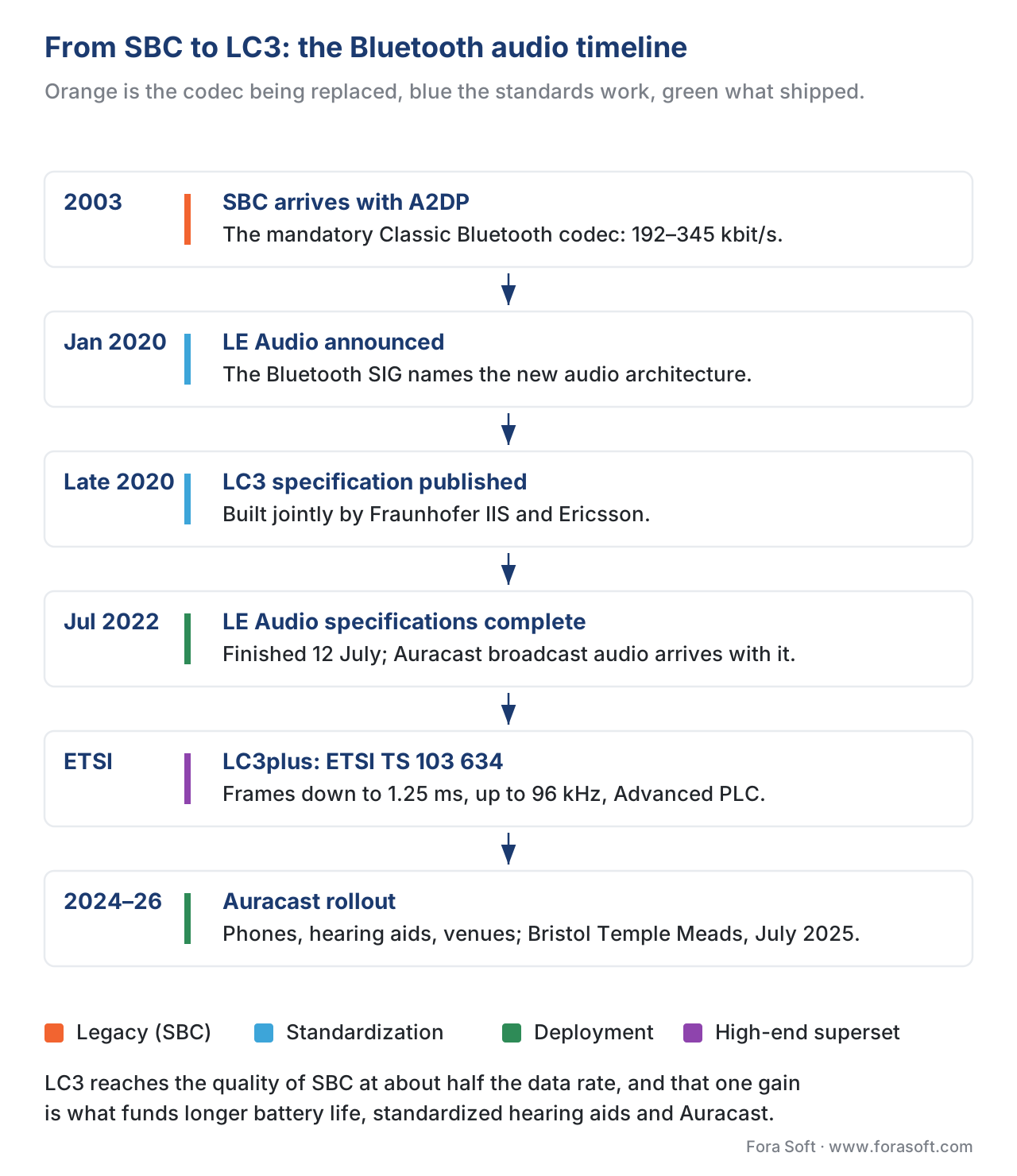 Figure 1. From SBC in 2003 to LC3 and Auracast in the 2020s. The 2022 completion of the LE Audio specifications is the moment LC3 became the designated successor to SBC.
What LC3 actually is, in plain terms
LC3 is a block-based transform codec (Bluetooth SIG). That phrase has two halves worth unpacking.
"Block-based" means LC3 chops the incoming sound into short slices and compresses one slice at a time. Each slice is called a frame, and LC3 frames are either 10 milliseconds or 7.5 milliseconds long (Bluetooth SIG). Think of it like a film: continuous motion stored as a run of still frames. Shorter frames mean the system reacts faster — lower latency — at a small cost in efficiency, which is why a phone call might choose 7.5 ms and music might choose 10 ms.
"Transform codec" means LC3 turns each frame of sound into a list of frequency ingredients — how much bass, how much midrange, how much treble — and then spends its limited bits only where the human ear will actually notice, throwing away detail the ear cannot hear. This is the same family of math, the Modified Discrete Cosine Transform, that powers AAC and Opus, explained in how audio compression works.
LC3 is flexible about what goes in. It accepts the standard sample rates a video product meets — 8, 16, 24, 32, 44.1, and 48 kHz — at 16, 24, or 32 bits per sample, and it places no fixed limit on the number of channels (Bluetooth SIG). The sample rate is how many times per second the system measures the sound, explained in sample rate; the bit depth is how finely each measurement is recorded, explained in bit depth and dynamic range. Crucially, LC3 lets the device choose a bitrate freely across a wide range rather than locking it to the sample rate, so a designer can trade quality against battery and radio time on the fly. Google's open-source liblc3 library (Apache-2.0), which also sits in the Android Bluetooth stack, accepts 16 to 320 kbit/s per stream (google/liblc3, 2026).
Why "half the bitrate" matters: quality and battery
The headline claim — same quality at half the data — comes from the Bluetooth SIG's own listening tests, and it is worth seeing the numbers.
The SIG ran subjective tests using the ITU-R BS.1116-3 method, the recognized standard for judging small impairments in audio, which scores quality on a 1-to-5 scale where 5 means the impairment is imperceptible (Bluetooth SIG; ITU-R BS.1116-3, 2015). In those tests, LC3 at 80–96 kbit/s consistently scored higher than SBC at 132–198 kbit/s (Bluetooth SIG, LC3 Characterization; Avantree). In one widely cited point on the curve, SBC at 345 kbit/s scored just above 4.0, while LC3 reached an even higher score at 160 kbit/s — less than half the data (Bluetooth SIG).
Why does halving the data rate matter so much to a product team? Because on a battery-powered earbud, the radio is one of the hungriest components, and radio energy scales with how much data you send. Send half the bits and you cut a large share of the transmit energy. The math is direct:
If equal quality needs ~96 kbit/s on LC3 vs ~192 kbit/s on SBC,
the audio payload over the air is halved: 192 → 96 kbit/s.
That saved energy is what buys longer earbud runtime, or lets the same battery shrink into a smaller true-wireless bud. The Bluetooth SIG built LE Audio specifically to deliver lower power consumption, smaller devices, and true wireless operation with an independent, synchronized stream to each earbud — and LC3's efficiency is the enabler for all three (Bluetooth SIG).
 Figure 2. LC3 reaches a given quality at roughly half the bitrate of SBC. The gap is what funds longer battery life and the new LE Audio features. Quality axis per ITU-R BS.1116-3; curves redrawn from the Bluetooth SIG LC3 characterization data.
What Bluetooth LE Audio unlocks
LC3 is the codec, but it arrived as part of a larger architecture — Bluetooth LE Audio — and three of that architecture's features matter directly to anyone building communication or media products.
True wireless, properly synchronized. Classic Bluetooth sent one stream to a primary earbud, which relayed to the second; LE Audio sends an independent, tightly synchronized stream to each earbud (Bluetooth SIG). For a video call, that means both ears stay locked to the same moment, which keeps the two ears from drifting apart and the audio timing predictable for lip-sync, covered in lip-sync windows.
Standardized hearing aids. LE Audio defines, for the first time, a single interoperable standard for Bluetooth hearing aids — so a hearing aid and a phone from different makers can work together (Bluetooth SIG). LC3's low power is essential here, because hearing aids run on tiny batteries.
Auracast broadcast audio. This is the genuinely new use case. Auracast lets one transmitter broadcast an LC3 audio stream that an unlimited number of nearby devices can tune into, like joining a public Wi-Fi — a gate announcement at an airport, the audio of a silent TV in a gym, or an assistive-listening feed in a theatre (Bluetooth SIG). Auracast depends entirely on LC3's efficiency to broadcast good sound at low power. Rollout is underway: Bristol Temple Meads became the first UK railway station to switch on Auracast in July 2025, and venues including the National Theatre and Southbank Centre have committed to Auracast by 2030 (RNID; Bluetooth SIG). On the device side, recent Samsung Galaxy phones, earbuds from Sennheiser, and hearing aids such as GN ReSound Nexia and Oticon Intent already support it. In September 2025 Google extended LE Audio and Auracast audio sharing to Pixel 8 and newer phones, so a listener can share audio to a second pair of LE Audio headphones or join a public broadcast by scanning a QR code (Google, September 2025).
Common mistake: assuming a wireless earbud "supports LC3"
The most common planning error is to assume that because LC3 is a 2020 standard, any modern earbud uses it. It does not work that way. LC3 lives in Bluetooth LE Audio, which is a different stack from the Classic Bluetooth (BR/EDR) that A2DP and SBC run on. A device must implement the LE Audio stack — and both ends, phone and earbud, must support it and negotiate it — before a single LC3 frame is exchanged. Many earbuds sold today still fall back to SBC or a vendor codec like aptX or AAC over Classic Bluetooth. For a product team, the practical consequences are two: do not assume your users get LC3 quality or latency just because their hardware is new, and if your app's audio path touches a wireless device, test on the real Classic-Bluetooth fallback, not only on an LE Audio bench. Designing for the SBC floor and treating LC3 as a bonus is the safe posture in 2026.
LC3plus: the high-end superset
LC3 covers mainstream earbuds and calls. For applications that need more — lower latency or higher fidelity — Fraunhofer IIS built LC3plus, a superset of LC3 standardized by ETSI as ETSI TS 103 634, whose current edition is V1.7.1, published in July 2026 (Fraunhofer IIS; ETSI). LC3plus is backward compatible with LC3 in Bluetooth LE Audio, so an LC3plus device still talks to an LC3-only device (Fraunhofer IIS). It extends LC3 along four axes.
Lower latency. LC3 offers 10 and 7.5 ms frames; LC3plus adds 5, 2.5, and 1.25 ms frame durations, reaching an end-to-end latency as low as 7 ms — the reason it ships in premium gaming headsets where audio lag costs you the round (Fraunhofer IIS).
Higher resolution. LC3plus supports sample rates up to 96 kHz with total-harmonic-distortion-plus-noise as low as −132 dB, and it carries the Hi-Res Wireless certification from the Japan Audio Society, whose criteria include 96 kHz sampling, at least 24 bits per sample, and reproduction of frequencies of 40 kHz and above (Fraunhofer IIS; Japan Audio Society).
More robustness. LC3plus turns on Advanced Packet Loss Concealment by default, making it up to three times more robust against packet loss than plain LC3 — it hides missing audio frames more convincingly when the radio link drops data (Fraunhofer IIS). Packet loss concealment is the art of filling gaps when frames go missing, covered in packet loss concealment.
Lossless mode. Fraunhofer reported in August 2026 that LC3plus Lossless is now part of the ETSI standard: it reconstructs audio bit-exactly at 44.1, 48, 96 and 192 kHz and switches seamlessly to lossy coding, with the same frame structure and latency, when the radio link cannot carry the rate (Fraunhofer IIS audio blog, August 2026). The cost is bandwidth. In Fraunhofer's measurements on 14 music tracks, lossless averaged about 308–702 kbit/s per channel for 16-bit audio and 648–1,380 kbit/s per channel for 24-bit, across 44.1–192 kHz, several times what lossy LC3 needs (Fraunhofer IIS, LC3plus implementation product sheet, June 2026). That is why lossless is a feature for hi-fi links with radio headroom, not for calls.
LC3plus already ships in real products: gaming headsets such as the HyperX Cloud III Wireless, Audeze Maxwell, Corsair HS80 Max and Turtle Beach Atlas Air; true-wireless earbuds such as the JBL Tour Pro 3 and ASUS ROG Cetra True Wireless SpeedNova; hi-fi from Bang & Olufsen and TCL; and wireless microphones such as the Sony ECM-W3 and ECM-S1 and the AnkerWork M650 (Fraunhofer IIS partner list, checked October 2026). For a content-creation or live-production pipeline, the wireless-microphone angle matters: low latency keeps captured audio in sync with video at the source.
| Property | SBC | LC3 | LC3plus |
|---|---|---|---|
| Governing body | Bluetooth SIG (A2DP) | Bluetooth SIG (LE Audio) | ETSI TS 103 634 |
| Stack | Classic (BR/EDR) | LE Audio | LE Audio / A2DP |
| Frame durations | fixed framing | 10, 7.5 ms | 10, 7.5, 5, 2.5, 1.25 ms |
| Typical bitrate for good quality | 192–345 kbit/s | 80–160 kbit/s | configurable, incl. hi-res |
| Max sample rate | 48 kHz | 48 kHz | 96 kHz (192 kHz lossless) |
| Lowest end-to-end latency | high | low | ~7 ms |
| Packet-loss handling | basic | PLC recommended | Advanced PLC (≈3× more robust) |
| Hi-res certified | no | no | Hi-Res Wireless (JAS) |
| Designed for | interoperability | mainstream LE Audio + Auracast | gaming, hi-fi, pro mics |
Table 1. SBC, LC3, and LC3plus compared. SBC is the universal floor; LC3 is the efficient new default; LC3plus is the high-performance superset. Sources: Bluetooth SIG (SBC, LC3); Fraunhofer IIS and ETSI TS 103 634 V1.7.1 (LC3plus).
LC3 latency: what the codec adds and what the link adds
The LC3 codec adds about 12.5 ms of delay with 10 ms frames and 11.5 ms with 7.5 ms frames; LC3plus cuts the codec share to 7.5, 5.0 and 2.5 ms with its 5, 2.5 and 1.25 ms frames (Fraunhofer IIS, LC3plus implementation product sheet, June 2026). That is only the codec's part. What a user hears end to end also includes the radio schedule the two devices negotiate, retransmissions, and the presentation delay the earbuds add so that both ears play the same sample at the same moment, so real LE Audio earbuds measure higher than the codec figure. The lowest published end-to-end number is Fraunhofer's: about 7 ms for LC3plus in gaming modes.
| Frame duration | Codec delay | Available in |
|---|---|---|
| 10 ms | 12.5 ms | LC3, LC3plus |
| 7.5 ms | 11.5 ms | LC3, LC3plus |
| 5 ms | 7.5 ms | LC3plus |
| 2.5 ms | 5.0 ms | LC3plus |
| 1.25 ms | 2.5 ms | LC3plus |
Table 2. Codec delay by frame duration. Source: Fraunhofer IIS, LC3plus implementation product sheet (June 2026). End-to-end latency over Bluetooth is higher and depends on the link settings.
For a video call, the codec share is small next to the network jitter buffer, so LC3 versus SBC matters more for voice clarity and battery than for delay. For gaming, live monitoring and a wireless microphone on a camera, the codec and link delay decide whether sound stays tight to picture, which is where LC3plus short frames earn their place.
Which phones, PCs and earbuds support LC3 in 2026
LC3 works only when both ends speak Bluetooth LE Audio. In October 2026 that means an Android 13 or newer phone whose maker enabled LE Audio, a Windows 11 PC with LE Audio-capable hardware, and earbuds, headsets or hearing aids that implement LE Audio. iPhone does not stream LC3 or join Auracast broadcasts.
- Android. Android 13 (API level 33) added built-in LE Audio support, with LC3 replacing SBC for media and mSBC for calls (Android Developers). Samsung flagships since 2023 (Galaxy S23 to S25, Z Fold5 to Fold7), Pixel 8 and newer, and selected Xiaomi and POCO models support LE Audio and Auracast sharing (Google, September 2025). Apps can check with
BluetoothAdapter.isLeAudioSupported()andisLeAudioBroadcastSourceSupported(). - Windows. Windows 11 uses LE Audio from version 22H2 when the PC's Bluetooth hardware and drivers support it (Microsoft). Version 24H2 adds super wideband stereo: since 2025 it keeps game and call audio in stereo at 32 kHz super wideband with the microphone open, where Classic Bluetooth drops to mono hands-free audio (Microsoft, reported by Windows Central, September 2025).
- Apple. Apple has not announced LE Audio streaming or Auracast for iPhone, and the WWDC26 keynote on 8 June 2026 added neither (AuraHear, June 2026). iPhone users stay on AAC or SBC.
- Earbuds, headphones and hearing aids. Samsung Galaxy Buds2 Pro and later Galaxy Buds (Samsung), Sony LE Audio headphones (supported on Android since 2025), the LC3plus devices listed above, and LE Audio hearing aids such as GN ReSound Nexia and Oticon Intent. Look for "LE Audio" or "LC3" on the spec sheet: "Bluetooth 5.3" alone does not mean the earbud has LC3.
Where this lands for a video product
The takeaway for anyone shipping calls or media: the wireless last hop is getting better, but unevenly, and you should plan for both worlds. On an LE Audio device, LC3 gives you cleaner voice at lower power and tighter two-ear sync; on the millions of Classic-Bluetooth devices still in use, you are on SBC and must design for its higher latency and lower efficiency. The honest planning rule is to target the SBC floor for correctness and treat LC3 and LC3plus as quality upside you detect and exploit when present.
LC3 and LC3plus FAQ
What does LC3 mean?
LC3 stands for Low Complexity Communication Codec. It is the audio codec of Bluetooth LE Audio, specified by the Bluetooth SIG and developed by Fraunhofer IIS and Ericsson.
What is LC3plus (LC3+)?
LC3plus is Fraunhofer IIS's superset of LC3, standardized as ETSI TS 103 634 (V1.7.1, July 2026). It adds 5, 2.5 and 1.25 ms frames, sample rates up to 96 kHz, Advanced Packet Loss Concealment and a lossless mode, and it is backward compatible with LC3 in Bluetooth LE Audio.
Is LC3 better than SBC?
Yes. In the Bluetooth SIG listening tests, LC3 at 80–96 kbit/s scored higher than SBC at 132–198 kbit/s, and LC3 at 160 kbit/s beat SBC at 345 kbit/s, so LC3 gives the same or better sound with about half the radio data.
What is the latency of LC3?
The LC3 codec adds about 12.5 ms with 10 ms frames and 11.5 ms with 7.5 ms frames; end-to-end latency on real earbuds is higher because the Bluetooth link adds its own delay. LC3plus reaches about 7 ms end to end in gaming modes.
Is LC3plus lossless?
LC3plus has an optional lossless mode that Fraunhofer added to the ETSI standard in 2026: it reconstructs audio bit-exactly at up to 192 kHz and falls back to lossy coding when the link cannot carry the rate. Its default mode is lossy.
Do my earbuds or headphones support LC3?
Only if the spec sheet says LE Audio or LC3 and your phone or PC supports LE Audio too. LC3 earbuds include Samsung Galaxy Buds2 Pro and later and Sony LE Audio models; LC3plus headphones include the JBL Tour Pro 3, HyperX Cloud III Wireless and Audeze Maxwell.
Does the iPhone support LC3?
No. As of October 2026 Apple has not shipped LE Audio streaming or Auracast on iPhone, so iPhone audio to earbuds still uses AAC or SBC.
Free download: Bluetooth audio codecs — cheat sheetOne page: SBC vs LC3 vs LC3plus, the bitrate-and-quality numbers, what Bluetooth LE Audio and Auracast unlock, and the “a new earbud does not guarantee LC3” fallback pitfall.Where Fora Soft fits in
We build video conferencing, telemedicine, e-learning, OTT, and AR/VR products, and the wireless audio path shows up in almost all of them — a doctor wearing earbuds on a consult inside the products our telemedicine software development team builds, a learner in a noisy room, a viewer on a soundbar. The engineering work around codecs like LC3 is practical: measuring real mouth-to-ear latency across Classic and LE Audio paths, keeping a clean fallback to SBC so nobody gets silence, protecting lip-sync when each ear has its own stream, and making accessibility features like Auracast assistive listening reachable inside the product. We have made those audio trade-offs across conferencing, streaming, and telemedicine builds since 2005. Our video calling and conferencing developers test LE Audio headsets on the real device matrix, and our real-time audio processing team handles lip-sync, fallback and echo control around the Bluetooth link.
The book
Audio for Video: A Complete Guide to Sound in Video Products: From PCM and Codecs to Loudness, Accessibility, and Real-Time Voice Processing
We wrote a seven-volume series that takes the video stack apart from the pixel to production, so that someone who works through it can design and build a system like the one this article describes. Volume 4 is the one that sits under this page: 1,229 pages that give LC3 and Bluetooth a chapter of their own, alongside the chapters on the AAC family, the speech codecs a call falls back to, and the real-time voice processing — echo cancellation, gain control, noise suppression — that runs before a single frame reaches the radio. Volume 5 picks up where the codec stops: jitter buffers, packet loss concealment, lip-sync across two independently synchronized earbuds, and the quality metrics you score the result with. Written by Nikolay Sapunov, CEO at Fora Soft.
Do you know which Bluetooth codec your users are actually on?
Tell us what your product does with sound — calls, consultations, lessons, playback — and we will come back with what the wireless hop costs you today: measured mouth-to-ear latency on Classic Bluetooth against LE Audio, where the SBC fallback hurts and where it does not, what two independently synchronized earbuds do to lip-sync, and whether Auracast assistive listening is worth a place on your roadmap. 250+ video products shipped since 2005.
See our case studies
Case study
WorldCast Live
Concert streaming at 0.4–0.5 s latency, five channels of audio on a 1.5 Gbit/s feed, 10,000 simultaneous viewers — a budget that tight is exactly where the wireless last hop stops being somebody else's problem.
Case study
TransLinguist
Interpretation across 75+ languages with closed captioning in 22, on the NHS national framework — the accessibility side of this page, where hearing aids and assistive listening decide whether a session works at all.
Case study
VocalViews
Video interviews and focus groups with speech recognition in 30+ languages across 800,000 verified panelists — every one of them on whatever earbud they own, which is what designing for the SBC floor actually means.
What to read next
Codecs
How audio compression works: the four ideas behind every modern codec
The transform math LC3 is built on, one idea at a time.
Codecs
Opus: the open codec that ate WebRTC
The other modern low-latency codec, and where each one wins.
Real-time voice
Echo cancellation on speakerphones, Bluetooth and AirPods
What the same wireless hop does to echo cancellation on a call.
Real-time voice
Packet loss concealment: hiding the missing frames
The gap-filling that LC3plus strengthens about threefold.
References
- Bluetooth SIG, Low Complexity Communication Codec (LC3) 1.0.1 specification (specification page, accessed 2026-10-10; current version, supersedes 1.0). The controlling specification for LC3: defines the block-based transform codec, the 10 ms and 7.5 ms frame intervals, the 8–48 kHz sample rates, the 16/24/32-bit depths, and the unlimited-channel support. https://www.bluetooth.com/specifications/specs/low-complexity-communication-codec-1-0-1/
- ETSI TS 103 634, Low Complexity Communication Codec plus (LC3plus) (V1.7.1, July 2026; checked 2026-10-10). The controlling specification for LC3plus: the algorithm description, the additional 5/2.5/1.25 ms frame durations, high-resolution support, and Advanced Packet Loss Concealment. Software and full text published by ETSI. https://www.etsi.org/deliver/etsi_ts/103600_103699/103634/01.07.01_60/ts_103634v010701p.pdf
- Bluetooth SIG, A Technical Overview of LC3 (Bluetooth blog, M. Afaneh, 2 November 2020; updated 2026). First-party source for LC3's technical properties (block-based transform, frame intervals, sample rates, bit depths), the four LE Audio features, and the SBC-to-LC3 quality graph using ITU-R BS.1116-3 grading. https://www.bluetooth.com/blog/a-technical-overview-of-lc3/
- Bluetooth SIG, LC3 Characterization white paper (v1, 2023). The published listening-test data behind the claim that LC3 at 80–160 kbit/s outperforms SBC at 132–345 kbit/s, scored per ITU-R BS.1116-3. https://www.bluetooth.com/wp-content/uploads/2023/07/LC3Characterization_WP.pdf
- ITU-R BS.1116-3 (February 2015), Methods for the subjective assessment of small impairments in audio systems. The standard scoring method (1–5 impairment scale) used in the LC3-vs-SBC listening tests; the source for the quality-axis definition in Figure 2. https://www.itu.int/dms_pubrec/itu-r/rec/bs/R-REC-BS.1116-3-201502-I!!PDF-E.pdf
- Fraunhofer IIS, LC3 / LC3plus (product page, accessed 2026-06-05). First-party source from the codec's developer for LC3plus: backward compatibility with LC3, the 10/7.5/5/2.5/1.25 ms frame durations, the ~7 ms end-to-end latency, 96 kHz support, −132 dB THD+N, Advanced Packet Loss Concealment (≈3× more robust), the Japan Audio Society Hi-Res Wireless certification, and the partner-device list. https://www.iis.fraunhofer.de/en/ff/amm/communication/lc3.html
- Bluetooth SIG, Bluetooth SIG Announces Completion of LE Audio Specifications (12 July 2022). Source for the completion date of the LE Audio specification set, the introduction of Auracast broadcast audio, and the LE Audio architecture (multi-stream, true wireless, hearing aids, broadcast). https://www.bluetooth.com/learn-about-bluetooth/feature-enhancements/le-audio/
- Electronics Weekly, Bluetooth LE Audio specification complete, adding local audio broadcast (July 2022). Independent confirmation of the 12 July 2022 LE Audio completion and the Auracast broadcast capability; used as the secondary corroboration of the Bluetooth SIG announcement. https://www.electronicsweekly.com/news/design/communications/bluetooth-le-audio-specification-complete-adding-local-audio-broadcast-2022-07/
- SoundGuys, Understanding Bluetooth codecs (accessed 2026-06-05). Used only for the framing of SBC as the mandatory A2DP baseline codec and its typical 192–345 kbit/s operating range; the LC3 quality and bitrate facts come from the Bluetooth SIG sources above, which override any vendor or editorial figure where they differ. https://www.soundguys.com/understanding-bluetooth-codecs-15352/
- RNID, Auracast: A revolution in audio accessibility (thought-leadership report, March 2025), and contemporaneous venue reporting (Bristol Temple Meads, July 2025; National Theatre / Southbank Centre commitments). Source for the real-world Auracast rollout used in the LE Audio section; deployment framing only, with the codec facts cross-checked against the Bluetooth SIG. https://rnid.org.uk/2025/02/auracast-a-revolution-in-audio-accessibility/
- Fraunhofer IIS, LC3plus Lossless (Fraunhofer audio blog, 11 August 2026). Source for the lossless mode joining the ETSI standard, bit-exact reconstruction at 44.1–192 kHz, and seamless lossless-to-lossy switching with the same frame structure and latency. https://www.audioblog.iis.fraunhofer.com/?p=9968
- Fraunhofer IIS, LC3plus Implementation product sheet (version 06-2026). Source for the codec delay by frame duration (12.5 / 11.5 / 7.5 / 5.0 / 2.5 ms) and the average lossless bitrates per channel. https://www.iis.fraunhofer.de/content/dam/iis/en/doc/ame/Whitepaper/lc3/LC3plus_Implementation_Productsheet.pdf
- Android Developers, Bluetooth Low Energy Audio overview (accessed 2026-10-10). Source for built-in LE Audio support from Android 13 (API level 33) and LC3 replacing SBC and mSBC. https://developer.android.com/guide/topics/connectivity/ble-audio/overview
- Google, LE Audio and Auracast support expands to more Android devices (Android blog, 3 September 2025). Source for Pixel 8 and newer, Samsung flagships since 2023, Xiaomi and POCO support, and Auracast audio sharing. https://blog.google/products-and-platforms/platforms/android/le-audio-auracast-support/
- Windows Central, Windows 11 adds super wideband stereo for Bluetooth LE Audio (7 September 2025), reporting Microsoft's announcement. Source for 32 kHz stereo with the microphone open and the Windows 11 24H2 requirement. https://www.windowscentral.com/microsoft/windows-11/windows-11-fixes-sound-new-super-wideband-stereo-finally-boosts-game-chat-over-bluetooth-le-audio
- AuraHear, Apple disappoints on Auracast support at WWDC26 keynote event (June 2026). Source for the absence of LE Audio and Auracast announcements for iPhone at WWDC26. https://aurahear.com/2026/06/apple-disappoints-on-auracast-support-at-wwdc26-keynote-event/
- Google, liblc3 (GitHub, Apache-2.0, accessed 2026-10-10). Source for the 16–320 kbit/s bitrate limits of the open-source LC3 implementation and its LC3plus high-resolution mode. https://github.com/google/liblc3
- Samsung Newsroom UK, Galaxy Buds2 Pro evolves LE Audio capabilities. Source for LE Audio and Auracast support on Galaxy Buds2 Pro. https://news.samsung.com/uk/galaxy-buds2-pro-evolves-le-audio-capabilities-bringing-new-auracast-to-samsung-smart-tv
