


Why This Matters
You will meet MPEG-2 in three situations that an experienced product team has to handle without surprise. The first is broadcast: any product that ingests, transcodes, or distributes content from a traditional television network will land on MPEG-2 Transport Stream files, even when the video inside is encoded with a newer codec. The second is legacy compatibility: any platform with a long tail of older devices — a hotel TV system, a corporate digital-signage fleet, a long-running government archive, a regional cable headend — will be on MPEG-2 until somebody buys new hardware. The third is licensing strategy: now that the patents have expired, MPEG-2 is one of the very few codecs you can ship with no royalty exposure of any kind, which makes it a useful fallback in price-sensitive markets and a clean choice for archival masters.
This article walks you through what MPEG-2 is, why it was a watershed for the industry, the technical pieces you actually need to understand, where it still earns its keep in 2026, and where it doesn't. You don't need prior knowledge of codecs. Every term is defined in plain language before we use it.
What MPEG-2 Actually Is
A codec is two things glued together: an encoder that takes raw pictures and packs them into a small file, and a decoder that reverses the process to put the pictures back on a screen. The name is a portmanteau — coder + decoder. MPEG-2 is the codec that the broadcast industry standardised on between 1995 and the early 2000s to move television off analog wires and onto digital ones.
The standard is published under two parallel names because two standards bodies wrote it together. The Moving Picture Experts Group (MPEG) sits inside the International Organization for Standardization (ISO) and the International Electrotechnical Commission (IEC) — the two consensus-based bodies that publish most of the world's industrial standards. The Video Coding Experts Group (VCEG) sits inside the Telecommunication Standardization Sector of the International Telecommunication Union (ITU), the United Nations agency that coordinates global telecoms. The same document is therefore called ISO/IEC 13818 when you cite the MPEG side and ITU-T H.262 when you cite the ITU side. They are word-for-word identical. 1
ISO/IEC 13818 is itself split into eleven numbered Parts, each of which covers a different layer of the system. The three Parts you need to know by name are:
- Part 1 (Systems / H.222.0) — how to wrap encoded audio and video into a stream that can be transmitted or stored. This is where the famous MPEG-2 Transport Stream (TS) lives.
- Part 2 (Video / H.262) — the actual video codec, the focus of this article.
- Part 3 (Audio) and Part 7 (Advanced Audio Coding, AAC) — the audio codecs that ride alongside the video.
When somebody says "MPEG-2", context decides whether they mean Part 2 (the video), Part 1 (the transport stream), or the whole stack. The video codec is what most engineers picture; the transport stream is what most broadcasters actually deal with on a daily basis.
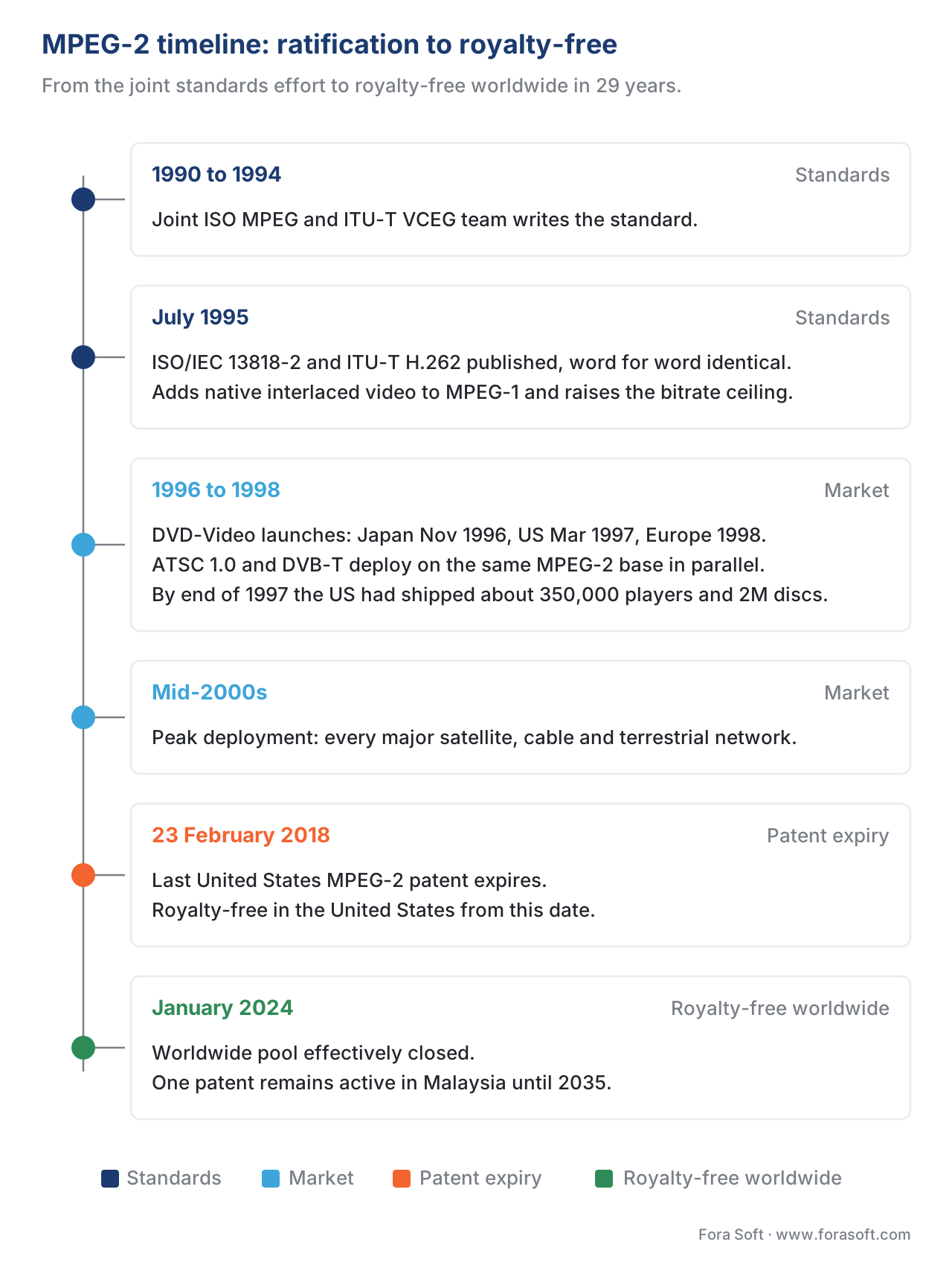 Figure 1. The MPEG-2 timeline. The standard was published in 1995, drove the launch of digital TV and the DVD-Video disc between 1996 and 1998, hit peak deployment in the mid-2000s, and outlived its US patent pool in 2018.
A Short History: Why MPEG-2 Was a Watershed
MPEG-1 came first. Published as ISO/IEC 11172 in 1993, MPEG-1 was designed to fit a movie onto a Video CD at roughly 1.5 megabits per second, and it succeeded — VCDs were a hit in Asia through the mid-1990s. But MPEG-1 had a hole that broadcasters could not live with: it had no support for interlaced video, the scan pattern that every analog television in the world used. Without interlaced support, MPEG-1 could not encode a normal NTSC, PAL, or SECAM TV signal without losing information. We explain interlacing in Progressive vs interlaced scan.
MPEG-2 was built to plug that hole and to raise the bitrate ceiling. The ISO/IEC approval process was completed in November 1994, and the first edition was approved in July 1995. 1 It added native handling of interlaced fields, extra profiles for higher quality and higher resolution, and a transport-stream container designed for the noisy, lossy world of cable and satellite delivery. With those three additions the broadcast industry had everything it needed to switch from analog to digital, and within five years it did.
The commercial knock-on effects were enormous and rapid. DVD-Video launched in Japan on 1 November 1996, in the United States on 24 March 1997 to coincide with the 69th Academy Awards, and in Europe in 1998. By the end of 1997, the United States had shipped roughly 350,000 DVD players and two million discs, all of them running MPEG-2 video. 2 Across the same window, the Advanced Television Systems Committee (ATSC) published the ATSC 1.0 standard for over-the-air digital TV in the US (using MPEG-2 Part 2 inside a transport stream at up to 19.39 megabits per second per channel) 3, and Digital Video Broadcasting (DVB) rolled out DVB-S for satellite and DVB-T for terrestrial in Europe on the same MPEG-2 base. Direct-broadcast satellite services such as DirecTV in the US and Sky in Europe replaced single-analog-channel transponders with MPEG-2 multiplexes carrying six to ten compressed digital channels apiece — a bandwidth multiplier that turned satellite television into a profitable business overnight.
That coordinated arrival of one codec across discs, terrestrial broadcast, cable, and satellite is what makes MPEG-2 a watershed. No video format before or since has been adopted by so much infrastructure in so short a time. Every digital television standard published since 1995 has either used MPEG-2 directly or designed for backward compatibility with it.
How MPEG-2 Compresses Video, in Plain English
MPEG-2 is a hybrid block-based codec, the same architecture introduced by H.261 in 1988 and still used by every codec on the market in 2026. We unpack the full architecture in Hybrid video codec architecture; here is the short version with MPEG-2's specific choices.
Every frame is cut into squares of pixels called macroblocks, each one 16 pixels wide and 16 pixels tall. The encoder then does four things for every macroblock, in order:
- Prediction. Guess what the macroblock contains, either from neighbouring pixels in the same frame (intra prediction) or by looking at a similar patch in a previous or future frame (motion-compensated prediction). The output is the small residual, the difference between the prediction and the truth.
- Transform. Run the residual through an 8×8 Discrete Cosine Transform (DCT) — a piece of mathematics from 1974 that re-expresses a small patch of pixels as a list of 64 frequency coefficients. Most coefficients turn out to be tiny because real images don't contain much high-frequency content. 1
- Quantization. Divide every coefficient by a step size and round, throwing away the small coefficients entirely. This is where quality is permanently lost and where the encoder's quality knob lives.
- Entropy coding. Write the surviving coefficients to the bitstream using variable-length codes (specifically, MPEG-2 uses Huffman-style code tables, not the arithmetic coding that later codecs introduced).
The same four steps run on every macroblock, in every frame, end to end. The codec then groups frames into Groups of Pictures (GOPs) of three types — I-frames (encoded from scratch, no prediction across frames), P-frames (predicted from a previous I or P frame), and B-frames (predicted from both a previous and a future frame) — and a typical DVD GOP looks like IBBPBBPBBPBBPBB, repeating every 15 frames. 4 B-frames are the big compression win MPEG-1 introduced and MPEG-2 inherited; they cost decoder complexity (you have to decode out of display order) but cut bitrate sharply. We cover the mechanics in GOP structure: I, P, B-frames, open vs closed GOP.
MPEG-2's specific contribution on top of MPEG-1 is its handling of interlaced material. An interlaced frame is really two fields — odd lines and even lines, captured at slightly different moments. MPEG-2 lets the encoder choose, per macroblock, whether to treat the two fields as a single frame picture or as two separate field pictures, and whether to do motion search in frame mode or in field mode. 4 That single feature is what let broadcasters fold their existing PAL/NTSC libraries into MPEG-2 without resampling, and it is the main reason MPEG-2 — not MPEG-1 — became the broadcast standard.
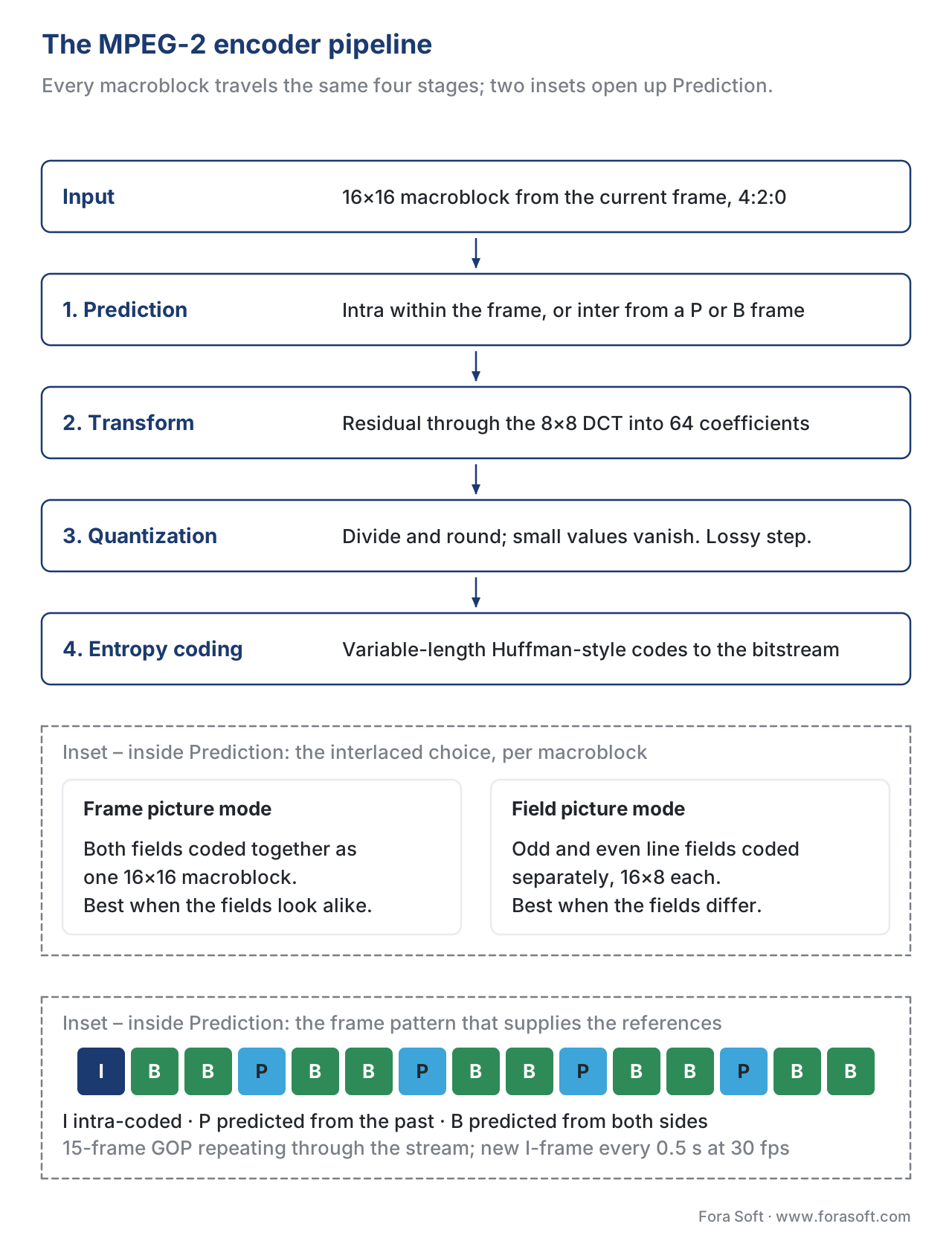 Figure 2. The MPEG-2 encoder pipeline. Every modern codec uses a more powerful version of these same four stages.
Profiles and Levels: How the Same Codec Ships at Six Quality Tiers
A codec spec like MPEG-2 covers a wide range of use cases — from a low-resolution videoconference to a studio master. To keep decoder chips affordable, the standard slices the feature set into a grid of Profiles (which coding tools you may use) and Levels (the resolution, frame rate, and bitrate caps). A decoder is built to a specific Profile/Level combination, and an encoder must stay within that envelope. 1
MPEG-2 defines five Profiles — Simple, Main, SNR-Scalable, Spatially Scalable, and High — plus a non-hierarchical addition called the 4:2:2 Profile for professional studio work. It defines four Levels — Low, Main, High-1440, and High. The combinations everyone actually ships are a much shorter list.
| Profile @ Level | Max resolution | Max bitrate | Where it shipped |
|---|---|---|---|
| Main Profile @ Main Level (MP@ML) | 720×576 @ 25 fps | 15 Mbps | DVD-Video, DVB-T SD, ATSC SD, digital cable SD |
| Main Profile @ High Level (MP@HL) | 1920×1152 @ 60 fps | 80 Mbps | First-generation HDTV (ATSC HD, DVB-S HD) |
| 4:2:2 Profile @ Main Level (422P@ML) | 720×608 @ 30 fps | 50 Mbps | Broadcast studio (Sony IMX, MPEG IMX) |
| 4:2:2 Profile @ High Level (422P@HL) | 1920×1080 @ 60 fps | 300 Mbps | HD broadcast contribution and editing |
Table 1. The MPEG-2 Profile/Level combinations that actually shipped in volume.
The two numbers that matter most for product decisions are Main Profile @ Main Level and Main Profile @ High Level. MP@ML is what every DVD and every standard-definition digital TV broadcast in the world runs on, at bitrates of 4 to 9 megabits per second for typical content. MP@HL is what first-generation HDTV broadcasts used, with ATSC 1.0 capping a single 6 MHz over-the-air channel at 19.39 megabits per second, enough for one HD stream or several SD streams multiplexed together. 3 The 4:2:2 Profile keeps full chroma resolution and was the bedrock of professional broadcast workflows for a decade — the Sony IMX VTR format and the MPEG IMX tape system both used it.
The bitrate math is simple. A 90-minute movie encoded at 6 Mbps of MP@ML occupies:
6 Mbps × 90 min × 60 s = 32,400 Mb total
32,400 Mb ÷ 8 = 4,050 MB ≈ 3.96 GB
That's why a DVD-5 (4.7 GB single-layer) fits roughly two hours of MPEG-2 video at the typical bitrate, and why a DVD-9 (8.5 GB dual-layer) fits a long movie with all its extras. The whole DVD-Video format was designed around exactly this calculation.
Compression Efficiency: How MPEG-2 Compares to What Came After
The single most useful number for any codec is its bitrate savings — how many fewer bits a newer codec needs to deliver the same picture quality. MPEG-2 is the baseline against which every successor has measured itself.
| Codec | Year | Bitrate at matched quality vs MPEG-2 |
|---|---|---|
| MPEG-2 (H.262) | 1995 | baseline (100%) |
| H.264 / AVC | 2003 | ≈ 50% |
| H.265 / HEVC | 2013 | ≈ 25% |
| AV1 | 2018 | ≈ 17% |
| H.266 / VVC | 2020 | ≈ 12% |
Table 2. Approximate bitrate at matched perceptual quality, expressed as a fraction of MPEG-2's bitrate. Lab numbers; real-world savings are typically two-thirds to three-quarters of the headline. See Comparison table: codec matrix for the full picture.
Plug numbers in to see what those ratios buy. A standard-definition cable channel that uses 6 Mbps of MPEG-2 would need:
H.264:  6 Mbps × 0.50 ≈ 3.0 Mbps
HEVC:   6 Mbps × 0.25 ≈ 1.5 Mbps
AV1:    6 Mbps × 0.17 ≈ 1.0 Mbps
That headroom is why broadcasters fit four to eight modern channels into the bandwidth one MPEG-2 channel used to occupy, and why nobody designs a new streaming service around MPEG-2 video in 2026. The codec is one to four generations behind, depending on which successor you compare it to.
But efficiency is not the only axis. MPEG-2 has two operational properties that newer codecs do not match. Encoding latency is one — a software MPEG-2 encoder runs in a fraction of a second per frame, whereas H.264, HEVC, and VVC encoders running at competitive quality can introduce one to several seconds of latency. Compute cost is the other — an MPEG-2 decoder runs on a microcontroller, while an AV1 decoder typically requires recent silicon. Those two properties keep MPEG-2 alive in low-latency broadcast contribution and on long-lived embedded devices.
The MPEG-2 Transport Stream: The Real Workhorse
The MPEG-2 Transport Stream (TS), defined in ISO/IEC 13818-1, is arguably the most important piece of MPEG-2 in 2026 even though it has nothing to do with video compression itself. The TS is a container format — a structured way to wrap one or more encoded audio and video streams into a single bytestream suitable for transmission over a lossy channel. 1
The TS was designed for the cable and satellite world of 1995, where dropped packets and noisy lines were a fact of life. Its design choices reflect that. Every TS file is a sequence of fixed-size packets of 188 bytes, each one carrying a small header (which stream the packet belongs to, whether the payload is encrypted, where the next picture starts) and a chunk of payload. A receiver that loses sync can find the next packet boundary in 188 bytes maximum; a receiver that loses an entire packet can pick up at the next I-frame without crashing. Packets from many streams are multiplexed into a single stream — a single transport stream often carries six to ten television channels, each with its own video, several language audio tracks, subtitle tracks, and electronic-programme-guide data.
The reason the TS survives is that almost every piece of broadcast infrastructure ever built understands it. DVB-T, DVB-S2, DVB-C2, DVB-T2, ATSC 1.0, ISDB-T, DMB-T, the satellite uplink chain, the regional cable headend, the IPTV multicast network in your apartment building — they all speak MPEG-2 TS as their lingua franca. Even ATSC 3.0, the IP-native next-generation US standard published in 2017, includes a backward-compatibility profile that lets ATSC 3.0 services be redistributed inside an MPEG-2 TS. 5 When a streaming service ingests a live feed from a broadcaster today, the wire format on the way in is almost always MPEG-2 TS, even when the video inside is H.264 or HEVC. We cover modern alternatives in Containers: MP4, fMP4, MKV, WebM, MOV, MPEG-TS.
Patents: Why MPEG-2 Is Effectively Royalty-Free in 2026
For two decades, MPEG-2 was the canonical example of a well-run codec patent pool. MPEG LA (renamed Via LA after the 2023 acquisition by Via Licensing Corp) collected a flat per-unit royalty — historically about $2.50 per decoder — from device makers and distributed it to roughly 25 patent holders. The published rate card, the predictable terms, and the single-pool structure made it easy for any manufacturer to ship a compliant decoder without bespoke negotiation. The H.264 pool that followed was modelled directly on the MPEG-2 pool's success.
The patents have now run their course. The last United States MPEG-2 patent expired on 23 February 2018, and as of early 2024 the worldwide pool is closed, with the sole remaining patent active in Malaysia expected to expire in 2035. 6 7 In every market that matters commercially, you can build, ship, and distribute MPEG-2 encoders and decoders without paying a royalty.
That changes the strategic picture. MPEG-2 joins VP8, VP9, AV1, and (after long delay) H.264 as a codec with no remaining patent-licensing risk for typical commercial use. We map the full licensing landscape in H.265 / HEVC: +50% over H.264 and the patent nightmare and the comparison view in Comparison table: codec matrix.
Where MPEG-2 Still Lives in 2026
A reasonable engineer in 2026 will keep MPEG-2 on the shortlist for four scenarios.
Broadcast ingest and contribution. Any pipeline that touches traditional broadcasters will see MPEG-2 — either as the video codec on legacy SD channels and many HD channels, or as the Transport Stream container around newer-codec video. A production system that cannot demux MPEG-2 TS is incomplete.
Long-lived embedded fleets. Hotel TV systems, hospital patient-care displays, corporate digital-signage installations, in-flight entertainment racks, older surveillance recorders — anything with a long replacement cycle is on MPEG-2 because every cheap decoder chip can play it.
Government and archival pipelines. Public broadcasters, national archives, and government media offices that retain content for decades pick MPEG-2 for archival masters because the format is mature, well-documented, royalty-free, and supported by an enormous installed base of software. The Library of Congress lists MPEG-2 Main Profile as a recommended format for digital television preservation. 8
Low-latency contribution links. The fast encoder makes MPEG-2 useful for outside-broadcast vans and stadium-to-studio contribution links where the budget for end-to-end latency is sub-second. Newer codecs can be tuned for this, but MPEG-2 was designed for it.
Common Pitfalls
Three errors come up enough at Fora Soft that they are worth naming explicitly.
Treating MPEG-2 TS like an MP4. They are completely different containers. MP4 / fMP4 is the streaming-friendly modern format with random-access boxes at known offsets. MPEG-2 TS is a packetised broadcast format with no global index. A player that opens both still has two code paths inside it; do not assume one will work for the other.
Confusing the audio. "MPEG-2 audio" can mean two completely different codecs. MPEG-2 Part 3 is the backward-compatible extension of MPEG-1 Audio (Layer I, II, III — the last is MP3). MPEG-2 Part 7 is AAC, a non-backward-compatible new design that became the audio backbone of MPEG-4 and almost every modern format. When a spec sheet says "MPEG-2 audio", read the next sentence carefully.
Assuming patent expiry means free everything. The MPEG-2 video and TS patents are expired in every relevant market, but a real product also carries audio (AAC has its own pool), DRM (a separate licensing chain), and may include modern subtitling that touches other rights. Treat patent expiry as one box ticked on a longer list, not as a green light to ship.
Free download: MPEG-2 Quick ReferenceOne-page A4 reference: MPEG-2 parts, key profiles and levels, typical bitrates, patent status, and where the codec is still used in 2026.Where Fora Soft Fits In
We have built, transcoded, and shipped MPEG-2 inside customer products in every vertical that still relies on it. Our video streaming and OTT projects often handle MPEG-2 TS ingest from broadcaster source feeds before transcoding to H.264 or AV1 for delivery, and our video surveillance work routinely interoperates with cameras and NVRs that emit MPEG-2 video or wrap H.264 in MPEG-2 TS. Telemedicine and e-learning systems we maintain include legacy archive playback paths where the original content was captured in MPEG-2 and must remain bit-identical for years. When a client asks whether MPEG-2 is "still a thing", the honest answer is yes — for one specific set of workloads, and we know which ones because we ship them every week.
The book
Video Encoding: A Complete Guide to Video Compression
This article compresses MPEG-2 into four boxes; the book gives each of them a chapter. The 8×8 DCT and the integer transforms that replaced it, quantization and the rate-control loops built on top of it, motion compensation from MPEG-2’s 16×16 macroblocks through to AV1’s compound modes, and the interlaced handling that made MPEG-2 the broadcast standard are all worked through with the arithmetic written out. The comparison in Table 2 also gets its measurements: 1,522 pages on where the 50, 25 and 17 percent actually come from and what they cost in encode time. Written by Nikolay Sapunov, CEO at Fora Soft.
Does your pipeline still have to speak MPEG-2?
Send us the feed you have to ingest — a transport stream off a satellite receiver, a cable headend multiplex, an archive of MP@ML masters — and we will tell you what it takes to demux it, what to transcode it to, and which of your target devices can decode the result. You get the answer against your own streams, with the bitrates and the device list written down. 250+ video products shipped since 2005.
See our case studies
Case study
Mindbox
Video management across 50+ deployments, pulling RTSP cameras through FFmpeg into HLS. This is the long-lived embedded fleet the article describes: recorders and cameras that outlast three codec generations, which is why the ingest side has to keep understanding MPEG-2 and MPEG-2 TS.
Case study
Worldcast Live
Concert streaming at 1.5 Gb/s with 0.4–0.5 s latency to 10,000 simultaneous viewers. Sub-second contribution is the one axis where MPEG-2’s cheap, fast encoder still argues for itself against codecs that are four generations more efficient.
Case study
Speed.Space
Remote production used on Netflix, EA and HBO shoots, recording at 1080p / 8 Mbps with per-shoot control of resolution, fps, codec and bitrate. Exactly the Profile-and-Level decision from Table 1, made per job: how much chroma and how many megabits the master is allowed to keep.
What to read next
Codecs
Comparison Table: MPEG-2, H.264, H.265, VP9, AV1, VVC
Table 2 with the rest of the columns filled in: licensing, hardware support and encode cost next to the bitrate numbers.
Containers
Containers: MP4, fMP4, MKV, WebM, MOV, MPEG-TS
Why a 188-byte transport stream and an MP4 need two code paths in your player, and which one belongs on which side of your pipeline.
Architecture
GOP Structure: I, P, B-Frames, Open vs Closed GOP
The IBBP cadence from Figure 2 taken apart: what B-frames cost the decoder, and why your GOP length sets your channel-change time.
Foundations
Progressive vs Interlaced Scan: What You Actually Need to Know
The hole in MPEG-1 that MPEG-2 was built to plug, and the combing artefacts you still inherit when broadcast material reaches a progressive screen.
-
H.262 / MPEG-2 Part 2. Wikipedia. Accessed 2026-05-16. https://en.wikipedia.org/wiki/H.262/MPEG-2_Part_2 ↩↩↩↩↩
-
DVD. Wikipedia. Accessed 2026-05-16. https://en.wikipedia.org/wiki/DVD ↩
-
ATSC standards. Wikipedia. Accessed 2026-05-16. https://en.wikipedia.org/wiki/ATSC_standards ↩↩
-
Frames, Fields, Pictures (I, P, B). Bretl.com tutorial archive. Accessed 2026-05-16. https://www.bretl.com/mpeghtml/pixtypes.HTM ↩↩
-
MPEG transport stream. Wikipedia. Accessed 2026-05-16. https://en.wikipedia.org/wiki/MPEG_transport_stream ↩
-
Sharwood, Simon. "Waddawewant? Free video codecs! When do we… oh, look, the last MPEG-2 patent expired!" The Register, 15 February 2018. https://www.theregister.com/2018/02/15/world_farewells_the_last_mpeg2_patent/ ↩
-
MPEG-2 Licensing Program. Via Licensing Alliance. Accessed 2026-05-16. https://www.via-la.com/licensing-2/mpeg-2/ ↩
-
MPEG-2 Video Encoding (H.262). Library of Congress Sustainability of Digital Formats. Accessed 2026-05-16. https://www.loc.gov/preservation/digital/formats/fdd/fdd000028.shtml ↩
