


Why this matters
The metrics in the rest of this section — the pixel-error measure PSNR, the structural measure SSIM, the fused perceptual score VMAF — all need the original video to compare against. The moment you measure a live broadcast or a phone upload, that original is gone, and every full-reference tool you know stops working. This article is for the streaming engineer, the UGC-platform developer, the live-operations lead, or the QA engineer who has to put a quality number on content that arrived without a reference. The wrong tool gives you a confident score that means nothing; the right one, read honestly, tells you when a stream is degrading and where. Knowing which open-source tool to reach for — and how far to trust its output — is the difference between a quality signal and a number that lies to you.
What "no-reference" means, in one paragraph
Start with the distinction that organizes everything below. A full-reference metric needs the pristine original and the compressed copy side by side; it measures the difference between them. A no-reference metric — also called a blind metric — looks only at the video in front of it and estimates quality from the picture's own statistics, the way an experienced colourist can glance at a frame and say "that's been over-compressed" without ever seeing the source. The conceptual treatment of why this is hard, and where it fails, lives in no-reference quality for live and UGC. This article is the tools sibling: what you can actually install and run today, and how to read what it prints.
One framing to carry through: a full-reference metric grades an exam against the answer key; a no-reference metric grades it on handwriting, grammar, and the shape of the argument, with no key at all. It can be remarkably good — and it can be confidently wrong on content it has never seen.
The four tiers of the open-source toolbox
The open implementations sort into four tiers by what they measure and what they cost you to run. Pick the tier before you pick the tool.
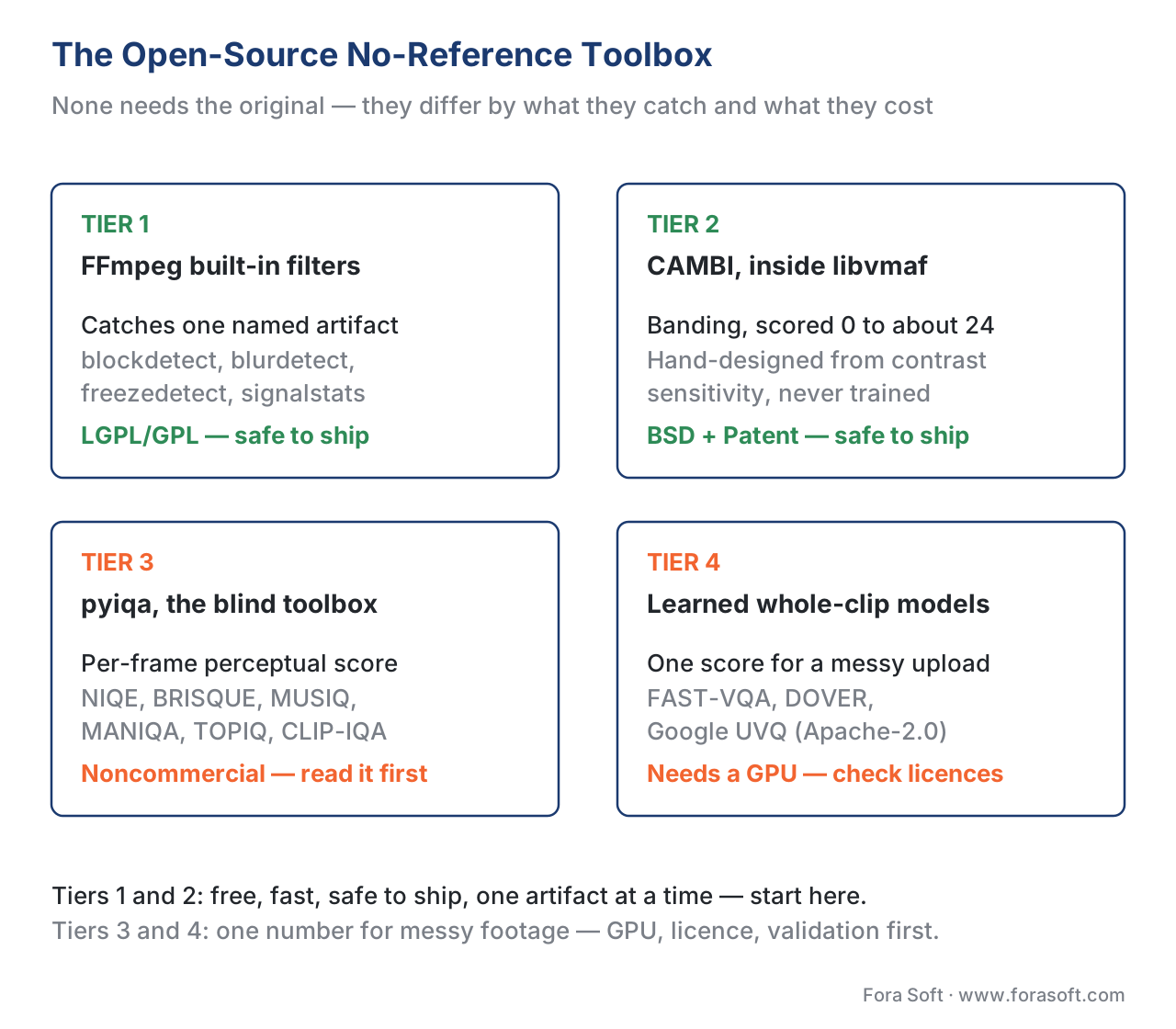 Figure 1. The open-source no-reference toolbox in four tiers. The left two are handcrafted, free, and commercial-friendly; the right two add learned perceptual scores at the cost of a GPU and a licence you must read.
Tier 1 — FFmpeg's built-in filters. You almost certainly already have these. FFmpeg ships several no-reference detectors, each tuned to one artifact: blockdetect measures blockiness (the DCT-grid pattern of over-compression, covered in blocking and the DCT grid), blurdetect measures perceptual blur, freezedetect finds frozen or duplicated frames, and signalstats reports per-frame luma/chroma statistics. blurdetect and blockdetect landed in FFmpeg 5.1 (2022); the others are older. They do not give you a single calibrated "MOS" — a Mean Opinion Score, the 1-to-5 average a panel of viewers would give — but they are free, fast, commercial-safe under FFmpeg's licence, and perfect for catching one specific failure.
Tier 2 — CAMBI, the banding detector. Banding — the visible steps where a smooth gradient like a sky should be continuous — is the artifact most metrics miss, and the one open tool that catches it well is Netflix's CAMBI (Contrast Aware Multiscale Banding Index). It is a no-reference, frame-by-frame detector built into libvmaf, hand-designed from the human contrast sensitivity function rather than trained on a dataset (Netflix, PCS 2021). Its score starts at 0 (no banding) and rises with visible banding; Netflix's own rule of thumb puts roughly 5 at "slightly annoying" and around 24 at "unwatchable" (Netflix CAMBI documentation, 2026). It is the rare blind metric that is both production-grade and free to ship.
Tier 3 — pyiqa, the unified blind-image toolbox. When you want a perceptual score rather than an artifact flag, the modern home is pyiqa (the IQA-PyTorch project): one pip install pyiqa gives you reimplementations of dozens of no-reference image metrics — the training-free NIQE, the trained BRISQUE, and learned models like MUSIQ, MANIQA, TOPIQ, and CLIP-IQA — calibrated against the original MATLAB and GPU-accelerated (IQA-PyTorch, v0.1.15, 2026). These score a single frame, so for video you run them per frame and pool the results. The catch is the licence, and it is a serious one — see the common-mistake callout below.
Tier 4 — learned whole-clip video models. For user-generated content, where the degradations are "unpredictable, complicated, and often commingled" (Tu et al., UGC-VQA, IEEE TIP 2021), the accuracy leaders are deep models that score a whole clip at once. FAST-VQA (ECCV 2022) uses "fragment sampling" — scoring small space-time patches instead of the full frame — to run fast enough for near-real-time use. DOVER (ICCV 2023) splits a UGC clip's quality into a technical score and an aesthetic score, and ships a lightweight DOVER-Mobile variant. Google's UVQ (CVPR 2021), trained on YouTube uploads, is permissively licensed under Apache-2.0. All three need a GPU and careful validation, but they are the state of the art for "how good does this messy upload look?"
Which tool to reach for
The tier tells you the family; your situation tells you the tool. The decision is mostly driven by three questions: do you have the original (if so, you do not need this article — use the full-reference FFmpeg and libvmaf workflow), what specifically are you trying to catch, and do you have a GPU.
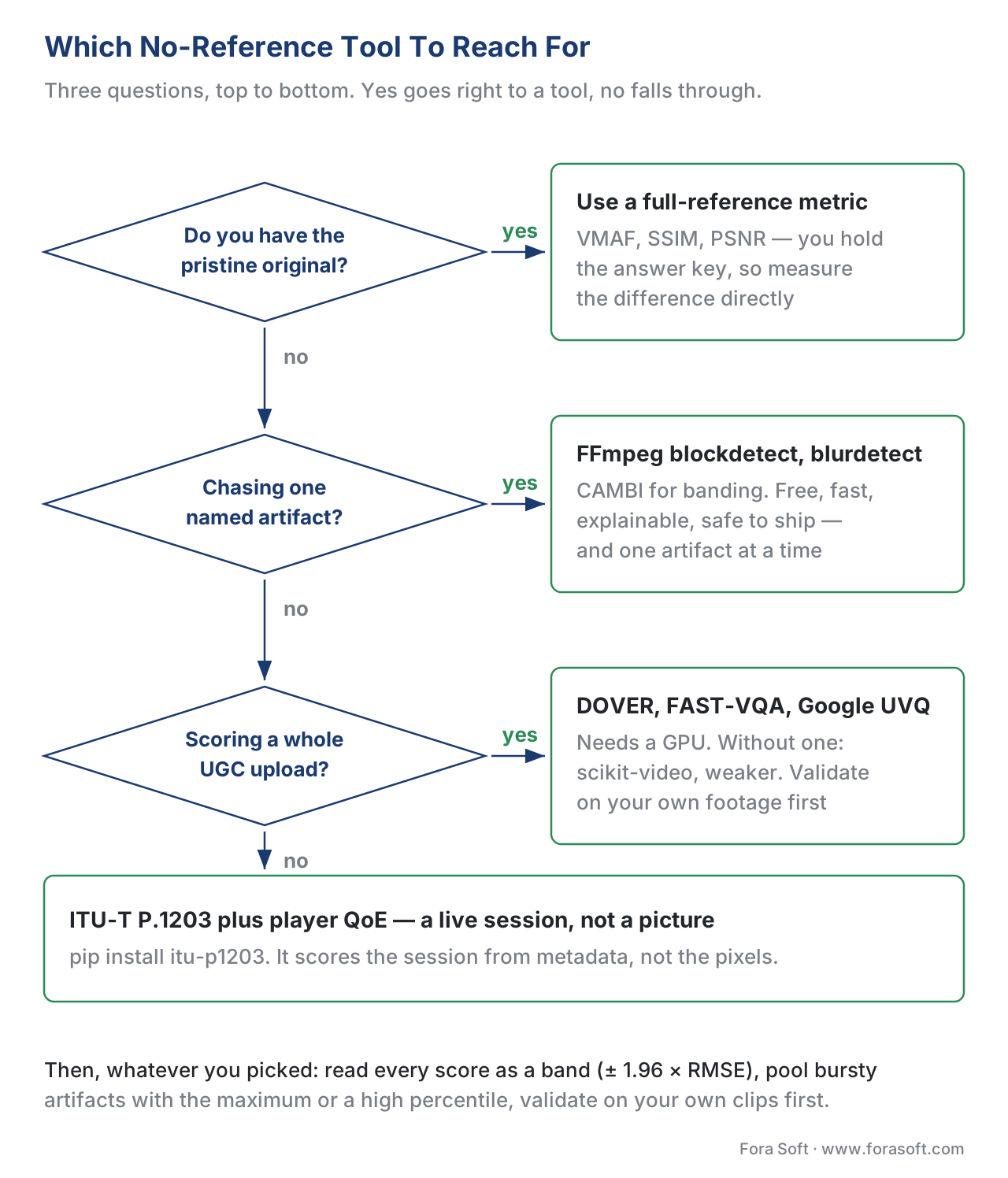 Figure 2. Picking a no-reference tool. If you have the pristine original, use a full-reference metric instead. If not, branch on what you need to catch and whether a GPU is available.
If you are chasing one named artifact, stay in the handcrafted tiers: blockdetect for blocking, blurdetect for softness, CAMBI for banding. They are cheap, explainable, and commercial-safe. If you need one perceptual score for a finished upload and you have a GPU, reach for a learned model — DOVER or FAST-VQA for UGC, UVQ when the Apache licence matters. If you are measuring a live session rather than a picture, the question is not a pixel metric at all but session quality of experience, which comes from the standardized bitstream model ITU-T P.1203 (open-source as the itu-p1203 Python package) and the player metrics in streaming QoE metrics.
The companion script for this article, the open-source no-reference toolbox advisor, encodes exactly this logic: tell it your use case, whether you have a GPU, and whether you ship commercially, and it names the tool, the install command, and the licence catch.
How to run them: three commands
A tools article should leave you able to measure something. Here are the three highest-value no-reference invocations, all of which take only the video you want to score.
Blockiness, per frame, with FFmpeg:
# No original needed — reads blockiness straight off the encoded file.
ffmpeg -i suspect_clip.mp4 -vf blockdetect,metadata=print:file=block.log -f null -
Banding, per frame, with CAMBI through libvmaf. CAMBI is no-reference, but it rides libvmaf's full-reference interface, so you pass the same clip as both inputs:
# CAMBI needs no reference; point both inputs at the same file.
ffmpeg -i suspect_clip.mp4 -i suspect_clip.mp4 \
  -lavfi "libvmaf=feature=name=cambi:log_path=cambi.json:log_fmt=json" -f null -
A learned per-frame score with pyiqa, from the command line:
# BRISQUE has no reference; lower is better. (Licence: noncommercial — see below.)
pyiqa brisque -t suspect_frame.png
In every case there is no -r reference.mp4 and no answer key — that is the whole point.
Read the output as a band, not a point
Here is the discipline that separates a useful no-reference number from a misleading one. A blind metric is a model fitted to human scores, and like any model it carries error. The honest way to report that is a confidence band, derived from the model's RMSE — the root-mean-square error between its predictions and real human ratings on a test set, in the units of the opinion scale (the procedure is standardized in ITU-T P.1401, 2020).
Work an example. Suppose a learned UGC model reports a correlation of about 0.85 with human scores and an RMSE of about 0.42 on a 1-to-5 scale — figures in the range that FAST-VQA and DOVER report in-distribution on the large LSVQ dataset (Wu et al., 2022, 2023). A clip scores 3.8. The 95% band is the score plus or minus 1.96 times the RMSE:
band = 3.8 ± (1.96 × 0.42)
     = 3.8 ± 0.82
     = [2.98, 4.62]
So "3.8" really means "somewhere around 3.0 to 4.6." Now a second clip scores 4.1. Is it better? Combine the two errors in quadrature to get the noise gate: 1.96 × 0.42 × √2 ≈ 1.16. The gap between the clips is only 4.1 − 3.8 = 0.3, far inside that 1.16 noise band, so the two are not distinguishable — declaring clip B the winner would be reading noise. The --band mode of the companion script does this arithmetic for you.
A worked example: pooling a banding score
The same "a number summarizes, it does not tell the whole story" lesson decides how you pool a per-frame detector into one figure. Run CAMBI on a clip with a banded sky and you might get a mean of 4.8 across all frames and a maximum of 9.1. Reading pooling per-frame to one number tells you why this matters: the mean of 4.8 sits right at "slightly annoying," which a tired reviewer might wave through, but the maximum of 9.1 says that in the worst frames — the slow sky pans — the banding is plainly visible. Banding, blocking, and freezes are all bursty: they ruin a few seconds, not the whole clip. Pool them with the maximum or a high percentile (say the 95th), never the mean, or the average will dilute a real defect into an acceptable-looking number.
Common mistake: shipping a research-licensed metric in a commercial product. The single most expensive error with this toolbox is legal, not technical. pyiqa is released under the PolyForm Noncommercial license plus the NTU S-Lab license, and many learned models (FAST-VQA, DOVER) ship as research code with their own non-commercial terms (IQA-PyTorch, 2026). That is fine for internal benchmarking and research, but embedding them in a product you sell can breach the licence. For commercial shipping, stay on the permissive tools — FFmpeg's filters (LGPL/GPL), CAMBI in libvmaf (BSD-plus-patent), and Google's UVQ (Apache-2.0) — or obtain a commercial licence. Check the licence file before the code reaches production, not after.
How accurate are these tools, really
Be clear-eyed about the ceiling. On content that looks like their training set — "in-distribution" — the best learned blind models reach a correlation with human scores of roughly 0.83 to 0.88 on large UGC datasets, while a good full-reference metric like VMAF reaches 0.94 or higher (Wu et al., 2022, 2023; LSVQ, Ying et al., 2021). Blind metrics are genuinely useful, but they trail the full-reference tools that get to see the answer.
The bigger trap is what happens off-distribution. The handcrafted classics — NIQE and BRISQUE — were built and tuned on photographic distortions, and their correlation with human judgment on real user-generated video falls well below the level you would trust for a decision. A 2024 benchmark of UGC transcoding found that every one of ten full-reference and eleven no-reference metrics scored below 0.6 correlation on that content (BVI-UGC, Katsenou et al., 2024). The lesson is not "don't use blind metrics"; it is "don't believe a blind metric's number until you have checked it against human scores on footage like yours."
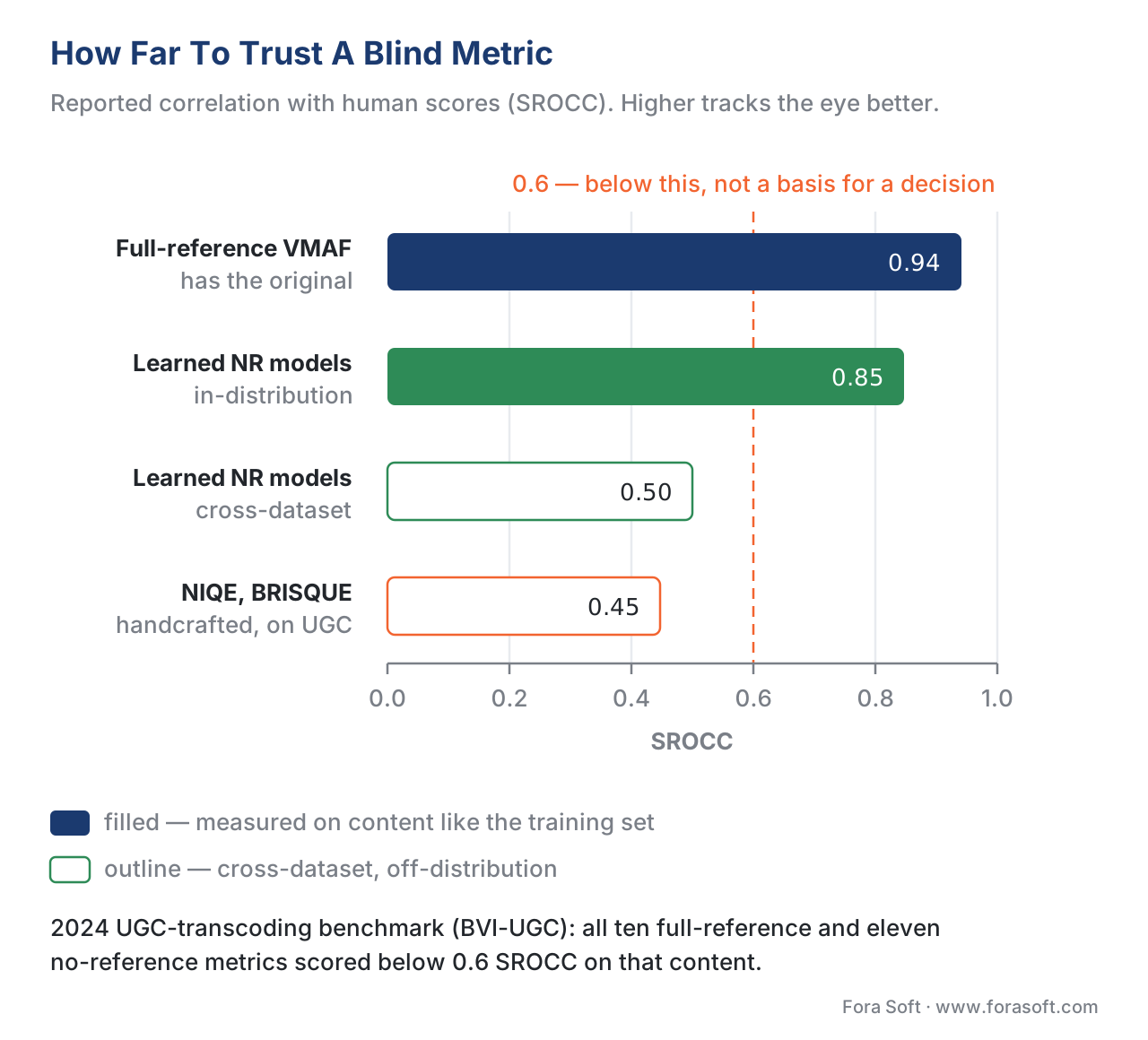 Figure 3. Reported correlation with human scores (SROCC) by tool family. The gap between the in-distribution and cross-dataset bars for the learned models is the whole story: a blind metric is only as good as the match between its training set and your footage.
This is why the practice that closes the article matters more than the tool choice. Validate any blind metric against a small set of human-rated clips from your own catalogue before you wire it into a gate (the method is in validating metrics against human scores, and the ground-truth standard is ITU-R BT.500-15, 2023). Then band every score, pool with a percentile, and treat the number as a screening signal that flags clips for a human to look at — not as a verdict.
A comparison you can act on
The table below is the article in one view: what each open tool measures, how you get it, whether it is safe to ship, and — the column that keeps you honest — where it lies.
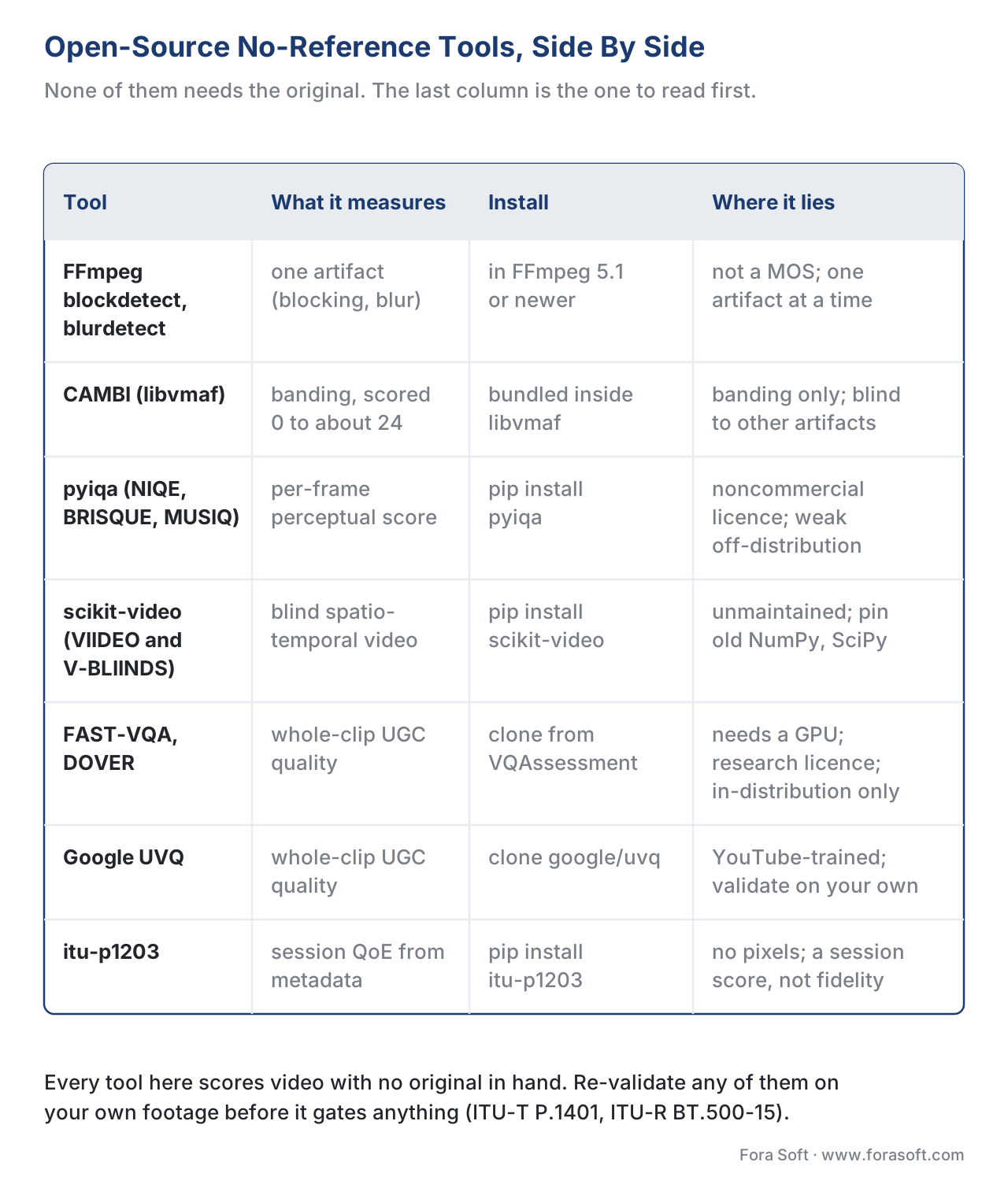 Figure 4. The open-source no-reference tools side by side. The last column — where each one lies — is the one to read before you trust a score.
| Tool | What it measures | Install | Reference | Where it lies (blind spot) |
|---|---|---|---|---|
FFmpeg blockdetect / blurdetect |
one artifact (blocking, blur) | in FFmpeg ≥ 5.1 | none | not a calibrated MOS; one artifact at a time |
| CAMBI (libvmaf) | banding visibility (0 → ~24) | bundled in libvmaf | none | banding only; says nothing about other artifacts |
| pyiqa (NIQE, BRISQUE, MUSIQ…) | per-frame perceptual quality | pip install pyiqa |
none | per-frame; noncommercial licence; weak off-distribution |
| scikit-video (VIIDEO, V-BLIINDS) | blind spatio-temporal video | pip install scikit-video |
none | effectively unmaintained; pin old NumPy/SciPy |
| FAST-VQA / DOVER | whole-clip UGC quality | clone from VQAssessment | none | needs a GPU; research licence; in-distribution only |
| Google UVQ | whole-clip UGC quality | clone google/uvq |
none | trained on YouTube; validate on your content |
| itu-p1203 | session QoE from metadata | pip install itu-p1203 |
none | no pixels; a session score, not picture fidelity |
Where Fora Soft fits in
Much of what we build at Fora Soft is exactly the content that arrives without a reference: live video conferencing and webinars, surveillance feeds, telemedicine sessions, and user uploads in social and e-learning platforms. For that work we lean on the blind toolbox — CAMBI and FFmpeg's filters for specific artifacts, learned models where a single perceptual score earns its keep — and we hold to one rule: every no-reference score is banded, pooled with a percentile, and validated against human ratings on the client's own footage before it gates anything. Our benchmark methodology describes how we attach that provenance so a number stays trustworthy. The capability we offer is not a magic score; it is the discipline to know when a blind metric is telling the truth.
The handbook
Fora Soft Video Engineering Handbook
We wrote a seven-volume handbook that takes the whole video stack apart across 9,000+ pages: encoding, delivery, audio and AI. Volume 1 is where the metrics in this article come from — what PSNR, SSIM and VMAF actually measure, and why a blind model has to estimate the same thing without the answer key; volume 6 covers the models and inference behind the learned scorers like FAST-VQA and DOVER; volume 3 covers the players and QoE monitoring where a no-reference number ends up being used. Read them and you can design and build the pipeline this article measures, not just score it. Written by Nikolay Sapunov, CEO at Fora Soft.
Need a quality number for video that arrives without an original?
Tell us what you are measuring — a live stream, a UGC upload, a surveillance feed — and we will tell you which blind tool fits, what it will cost you to run, and how to validate it before it gates anything. 250+ video products shipped since 2005.
See our case studies
Case study
Worldcast Live
Live concert streaming at 0.4–0.5 s latency and 1.5 Gb/s for 10,000 simultaneous viewers: by the time the picture reaches a player there is no master to diff against, so quality has to be read off the delivered frames.
Case study
VocalViews
A market-research platform where 1M+ participants record interviews on their own phones and webcams. The upload is the only copy that exists, which is exactly the case a learned whole-clip model is built for.
Case study
Mindbox
An AI video management system in 50+ deployments, carrying RTSP to FFmpeg to HLS. Because it ships to customers, the quality checks in the pipeline stay on the commercial-safe tools — FFmpeg’s filters and CAMBI.
What to read next
No-reference
No-Reference Quality for Live and UGC
The concept these tools implement: why a blind metric is the only option when the master is gone, and where it breaks.
Tooling
The Video-Quality Tooling Landscape
Where the open toolbox sits next to the commercial suites and the full-reference metrics.
Subjective testing
Validating Metrics Against Human Scores
How to check a blind score against real ratings on your own footage before it gates anything.
Metrics
Pooling: Per-Frame to One Number
Why bursty detectors like CAMBI need a maximum or a high percentile, never a mean.
References
- CAMBI: Contrast-aware Multiscale Banding Index — K. Tomar, L. Krasula, et al. (Netflix), Picture Coding Symposium (PCS), 2021, and the libvmaf CAMBI documentation, 2026. Tier 1 (metric-author defining work). The no-reference banding detector, its 0-to-~24 score scale, and the frame-by-frame design. https://github.com/Netflix/vmaf/blob/master/resource/doc/cambi.md
- No-Reference Image Quality Assessment in the Spatial Domain (BRISQUE) — A. Mittal, A. K. Moorthy, A. C. Bovik, IEEE Transactions on Image Processing 21(12), 2012. Tier 1 (metric-author defining work). The trained spatial-domain natural-scene-statistics model behind BRISQUE. https://live.ece.utexas.edu/publications/2012/TIP%20BRISQUE.pdf
- Making a "Completely Blind" Image Quality Analyzer (NIQE) — A. Mittal, R. Soundararajan, A. C. Bovik, IEEE Signal Processing Letters 20(3), 2013. Tier 1 (metric-author defining work). The training-free, opinion-unaware blind image metric. https://live.ece.utexas.edu/publications/2013/mittal2013.pdf
- UGC-VQA: Benchmarking Blind Video Quality Assessment for User Generated Content (VIDEVAL) — Z. Tu, Y. Wang, N. Birkbeck, B. Adsumilli, A. C. Bovik, IEEE Transactions on Image Processing 30, 2021. Tier 1 (metric-author defining work). The UGC-VQA benchmark and the "unpredictable, complicated, and often commingled" framing of UGC degradation. https://arxiv.org/abs/2005.14354
- Recommendation ITU-T P.1401 (2020): Methods, metrics and procedures for statistical evaluation, qualification and comparison of objective quality prediction models — International Telecommunication Union. Tier 1 (official standard). The RMSE / PLCC / SROCC evaluation procedure behind the score-as-a-band discipline. https://www.itu.int/rec/T-REC-P.1401
- Recommendation ITU-R BT.500-15 (2023): Methodologies for the subjective assessment of the quality of television pictures — International Telecommunication Union. Tier 1 (official standard). The subjective ground truth every blind metric must be validated against. https://www.itu.int/rec/R-REC-BT.500
- IQA-PyTorch (pyiqa): PyTorch Toolbox for Image Quality Assessment — C. Chen, J. Mo, et al., v0.1.15, 2026. Tier 3 (first-party tooling). The unified blind-metric toolbox, its metric list (NIQE, BRISQUE, MUSIQ, MANIQA, TOPIQ, CLIP-IQA), and the PolyForm Noncommercial + NTU S-Lab licensing. https://github.com/chaofengc/IQA-PyTorch
- FFmpeg Filters Documentation — blockdetect, blurdetect, freezedetect, signalstats, siti — FFmpeg Project, 8.0, 2026. Tier 3 (first-party tooling). The built-in no-reference filters, their parameters, and the metadata output. https://ffmpeg.org/ffmpeg-filters.html
- FAST-VQA: Efficient End-to-End Video Quality Assessment with Fragment Sampling — H. Wu, C. Chen, J. Hou, L. Liao, et al., ECCV 2022 (and FasterVQA, TPAMI 2023). Tier 5 (peer-reviewed). Fragment sampling for low-latency blind video quality; ~0.83 SROCC on LSVQ. https://arxiv.org/abs/2207.02595
- Exploring Video Quality Assessment on User Generated Contents from Aesthetic and Technical Perspectives (DOVER) — H. Wu, E. Zhang, L. Liao, et al., IEEE/CVF ICCV 2023. Tier 5 (peer-reviewed). The aesthetic/technical disentanglement and DOVER-Mobile. https://arxiv.org/abs/2211.04894
- Rich Features for Perceptual Quality Assessment of UGC Videos (UVQ) — Y. Wang, J. Ke, H. Talebi, et al. (Google/YouTube), CVPR 2021; open-sourced at github.com/google/uvq, Apache-2.0. Tier 4 (credible-deployer release). The YouTube-trained blind model. https://research.google/blog/uvq-measuring-youtubes-perceptual-video-quality/
- BVI-UGC: A Video Quality Database for User-Generated Content Transcoding — A. V. Katsenou, F. Zhang, et al. (University of Bristol / Tencent), arXiv:2408.07171, 2024. Tier 5 (peer-reviewed/institutional). Evidence that ten full-reference and eleven no-reference metrics all score below 0.6 SROCC on UGC transcoding. https://arxiv.org/abs/2408.07171
- scikit-video — skvideo.measure (NIQE, BRISQUE, VIIDEO, V-BLIINDS) — scikit-video project, v1.1.11. Tier 3 (first-party tooling). The open Python home of VIIDEO and V-BLIINDS outside MATLAB; effectively unmaintained since ~2019. https://www.scikit-video.org/stable/measure.html
Where sources disagreed, the official standards and metric-author work (Tier 1) were followed over vendor or educational summaries. In particular, vendor "VMAF/SSIM-killer" accuracy claims for blind metrics were down-weighted in favour of the peer-reviewed cross-dataset numbers, which show blind metrics trailing full-reference metrics and collapsing off-distribution.
