


Why this matters
Most of the video the world now watches has no pristine original to measure against: a live sports feed, a video call, a security camera, or a phone clip uploaded to a social platform. The full-reference metrics that anchor this section — PSNR, SSIM, VMAF — all need that original, frame for frame, so they simply cannot run here. This article is for the streaming, conferencing, or platform engineer who has to put a quality number on content with no reference, and who needs to know which no-reference metric to pick, how far to trust it, and how to deploy it at scale. Pick the wrong model, or quote its number without its error bar, and you will optimize for a quality signal that does not track what your viewers actually see.
Two situations with no original to compare
Start with the word that defines the whole problem. A full-reference metric needs the pristine original — the master file the encoder started from — and scores the impaired copy by comparing the two frame by frame. A no-reference metric, also called a blind metric, gets only the impaired video and must estimate its quality with nothing to compare against. (The full taxonomy of full-reference, reduced-reference, and no-reference setups lives in full, reduced, and no-reference metrics; this article is about the no-reference metrics that work for the two hardest real-world cases.)
Those two cases arrive at "no reference" by different roads. The first is live. When a camera feed is encoded and streamed in real time, the pristine master never sits next to the player, the edge, or the monitoring probe — there is nothing stored to diff against, and often you must produce a score within seconds, while the stream is still running. Even if the source exists somewhere, it is not where the measurement happens.
The second is user-generated content (UGC) — the phone clips, screen recordings, and webcam videos that people upload to a platform. Here the trap is subtler: there is a file you could call the original, but it is already degraded. It was shot on a small sensor, compressed once in the camera, maybe edited and re-saved, then uploaded. Engineers call this an unpristine reference: a "master" that is itself full of distortion. Google's YouTube team put the consequence plainly — most UGC uploads are non-pristine, so reference-based scores "become inaccurate and inconsistent" for UGC, because the same pixel difference means very different things depending on how good the upload was to begin with (Wang et al., Rich Features for Perceptual Quality Assessment of UGC Videos, CVPR 2021).
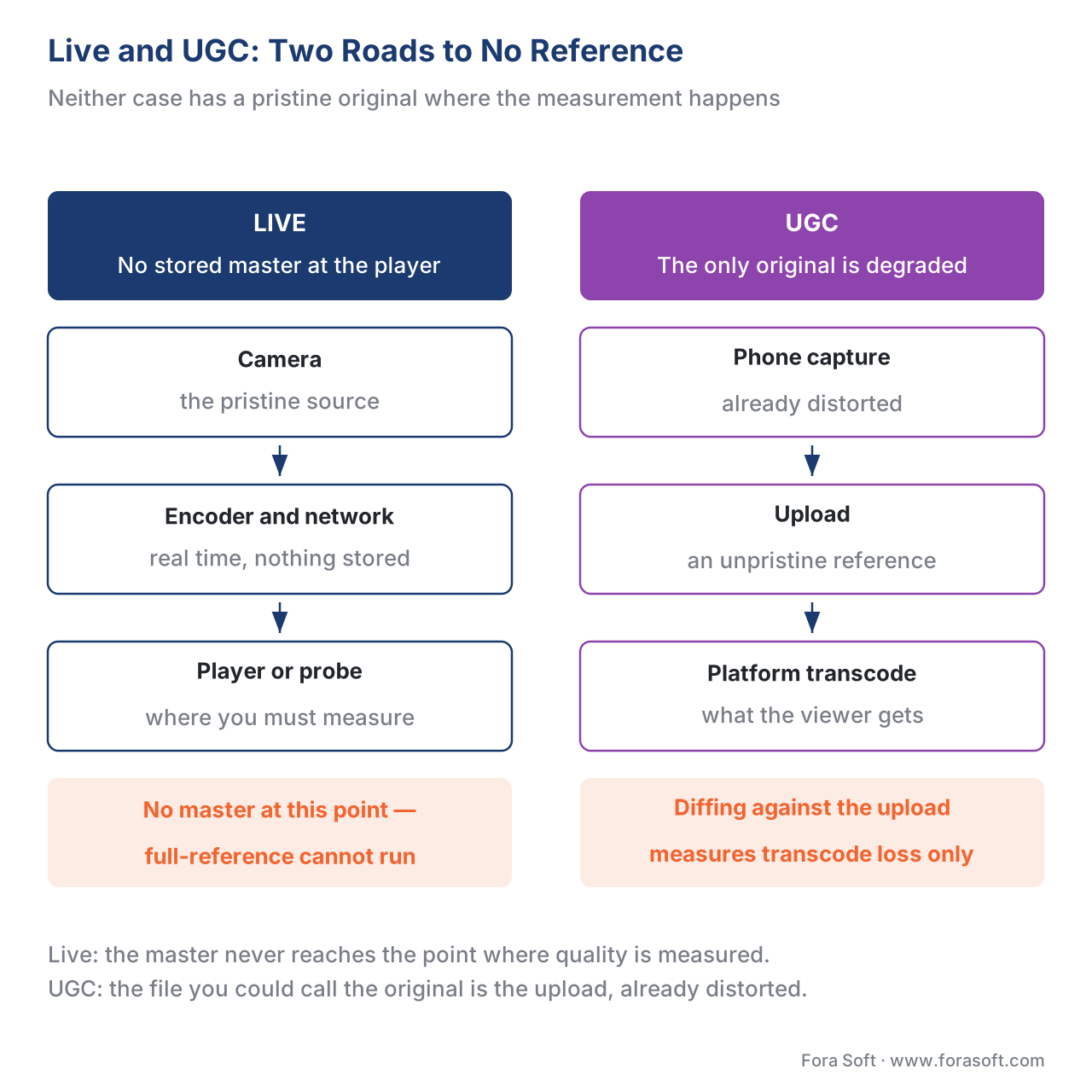 Figure 1. Two roads to "no reference." Live: the pristine master never reaches the measurement point. UGC: the only available "original" is the upload, which is already degraded — an unpristine reference.
Why full-reference metrics break here
A full-reference metric is a difference engine. VMAF, SSIM, and PSNR all line the impaired frame up against the pristine frame and quantify how far apart they are; the score is only as meaningful as the original is perfect. (For what VMAF measures and where it lies, see VMAF explained.)
Take that original away and the metric has nothing to subtract. On a live stream there is no master at the player, so VMAF cannot be computed there at all. You can still run VMAF at encode time, against the source the live encoder ingested — that is a real and useful measurement — but it scores the encode, not the delivered picture the viewer received, which is a different thing covered in connecting objective metrics to QoE.
UGC breaks full-reference metrics in a worse way, because the metric runs but lies. If you diff a transcoded clip against its unpristine upload, you measure only the quality lost in transcoding, not the total quality the viewer sees — and worse, you reward an encoder for faithfully preserving the upload's own blur, noise, and blocking. A 2024 benchmark built specifically on non-pristine references (BVI-UGC) tested ten full-reference and eleven no-reference metrics on UGC transcoding and found all of them correlating with human opinion at below 0.6 — poor, for a field where a good full-reference metric clears 0.9 on clean content. No-reference assessment is therefore not "full-reference without the reference." It is a different, harder problem: estimating absolute quality from the picture alone.
What a no-reference metric actually estimates
With no original to subtract, a blind metric has to answer a harder question — does this look like good video? — from the impaired clip alone. There are two broad ways to do it, and which one fits you depends on what you can get your hands on: the encoded bitstream, or only the decoded pixels.
Family 1 — bitstream and parametric models
The first family never looks at the picture as pixels. It reads the encoded stream and its metadata — codec, resolution, frame rate, bitrate, quantization, frame types, packet loss — and predicts quality from how the video was coded. This is the approach standardized for streaming. ITU-T P.1203 (2017) predicts a 1–5 session score and runs in four modes by how much it can see, from Mode 0 (metadata only — codec, resolution, frame rate, bitrate) up to richer bitstream access. The newer ITU-T P.1204 (2023) family extends this up to 4K with three flavors: a bitstream model (P.1204.3), a reduced-reference pixel model (P.1204.4), and a hybrid no-reference pixel model (P.1204.5). These are cheap to run, scale across millions of streams, and fit naturally where you control the encoder and can read the stream — the production-monitoring case covered in monitoring quality in production. Their blind spot is the flip side of their strength: reading coding parameters tells you what compression did, but little about how good the source was before it was encoded — exactly the part UGC gets wrong.
Family 2 — pixel-based blind metrics
The second family looks only at the decoded pixels, the way a viewer's eye does, and is what most people mean by "no-reference video quality." It has two generations.
The older generation is built on natural scene statistics (NSS) — the finding that undistorted natural images and video obey consistent statistical regularities, and that blur, noise, and compression break those regularities in measurable ways. Think of it as a metric that has memorized what "natural-looking" video statistics are, and scores how far your clip has drifted from them. BRISQUE (Mittal, Moorthy & Bovik, IEEE TIP 2012) does this for a single frame using locally normalized luminance, and is trained on human-rated distorted images. NIQE (Mittal, Soundararajan & Bovik, IEEE Signal Processing Letters 2013) uses the same statistics but is completely training-free: it scores how far an image deviates from a model fit to a corpus of pristine natural photos, needing no human ratings at all. For video, V-BLIINDS (Saad, Bovik & Charrier, IEEE TIP 2014) adds a motion model to spatial NSS and is trained, while VIIDEO (Mittal, Saad & Bovik, IEEE TIP 2016) is training-free, predicting quality from the intrinsic regularities of natural video. The training-free models are attractive because they deploy anywhere with no labeled data, but they are also the least accurate on messy real-world content.
The newer generation is learned: it trains on large sets of real videos that humans have scored, so it can pick up distortions hand-designed features miss. VIDEVAL (Tu, Wang, Birkbeck, Adsumilli & Bovik, IEEE TIP 2021) fuses a curated 60 of 763 statistical features into one efficient model and defined the UGC-VQA benchmark. RAPIQUE (Tu et al., IEEE OJSP 2021) combines scene-statistics features with deep convolutional features for speed. Google's UVQ (CVPR 2021, open-sourced 2022) runs three subnetworks — one for content, one for distortion, one for compression — and aggregates them into a 1–5 score with a diagnostic rationale, trained on the YouTube-UGC dataset. The current research frontier is transformer-based: FAST-VQA (ECCV 2022) scores efficiently by sampling small "fragments" of the video instead of every pixel, and DOVER (ICCV 2023) disentangles the aesthetic quality of UGC from its technical quality. These learned models are the most accurate available — on the content they were trained on.
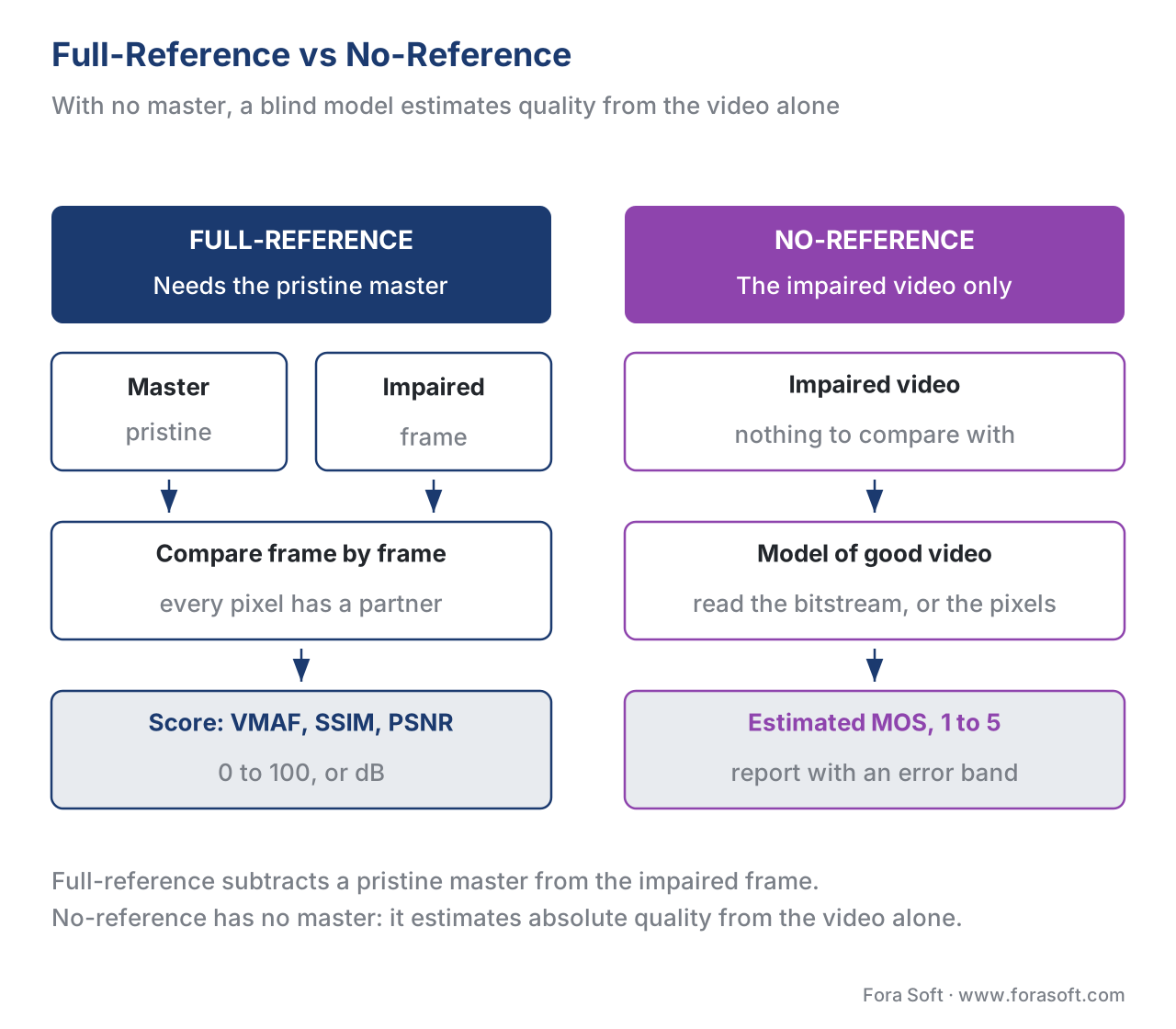 Figure 2. Full-reference subtracts a pristine master from the impaired frame. No-reference has no master: it estimates quality from the impaired video alone, either from the bitstream or from a model of what good pixels look like.
The two families compared at a glance:
| Family | What it reads | Example models | What it measures well | Where it lies |
|---|---|---|---|---|
| Bitstream / parametric | the encoded stream and metadata | ITU-T P.1203, P.1204.3, P.1204.5 | compression damage, cheaply and at scale | blind to pre-encode source quality — the part UGC gets wrong |
| Pixel — handcrafted NSS | decoded pixels | NIQE, BRISQUE, VIIDEO, V-BLIINDS | deploys with little or no training data | weak on in-the-wild UGC; training-free ones lag most |
| Pixel — learned | decoded pixels | VIDEVAL, RAPIQUE, UVQ, FAST-VQA, DOVER | best accuracy on UGC like its training set | collapses across mismatched datasets; needs a content match |
 Figure 3. The two families of no-reference metric, with example models and where each one lies. Choose by what you can read — the encoded stream, or the decoded pixels.
How accurate is it, really
Here is the rule that should sit above every no-reference number: a blind metric is a proxy of a proxy. A full-reference metric is already a proxy for the human eye, validated against subjective scores; a no-reference metric estimates quality without even the reference the full-reference metric enjoyed, so it tracks the eye less well. Treat its output as an estimate with an error bar, never as a fact.
The numbers bear this out. Accuracy is reported as SROCC (Spearman rank-order correlation, how well the metric ranks clips the way humans do, where 1.0 is perfect and 0 is random) and PLCC (Pearson linear correlation after a fitting step). On a single large in-the-wild UGC dataset such as LSVQ (about 39,000 clips; Ying et al., Patch-VQ, CVPR 2021), the best learned models — FAST-VQA and DOVER — reach roughly 0.83 SROCC, with the strongest recent models pushing toward 0.88. Good, but not the 0.94+ a tuned full-reference metric reaches on clean content.
The harder truth is cross-dataset collapse. A model trained on one content distribution and tested on another degrades sharply, because a learned metric is only as good as the data it saw. Reported cross-dataset figures for the handcrafted models are sobering — NIQE around 0.18–0.46 SROCC and BRISQUE around 0.31–0.58 across mismatched datasets — and even deep models lose ground when the test content differs from training. The BVI-UGC benchmark above is the same lesson on unpristine references: every metric tested fell below 0.6. The practical meaning is direct: a model validated on phone-shot social clips may be near-useless on screen recordings, surveillance footage, or medical video, and you will not know unless you check.
So the honesty rule is procedural. Report the SROCC, PLCC, and RMSE of your chosen model on content that matches yours, following the evaluation procedure in validating metrics against human scores and the standardized statistics of ITU-T P.1401, which fits a monotonic logistic curve to map the metric onto the opinion scale and then reports the residual error. That residual error is what turns a single score into a band.
Common mistake — quoting a blind score as if it were VMAF. A VMAF number is comparable across content because it always has the same pristine reference. A no-reference score is content-sensitive and only as accurate as its training match. Never compare two clips' blind scores without their dataset, their RMSE, and the uncertainty band below.
A no-reference score is a band, not a point
Make the uncertainty concrete with arithmetic. Suppose you have validated a no-reference model on a content-matched test set, fit the P.1401 logistic mapping from its raw output to the 1–5 opinion scale, and measured a residual RMSE of 0.42 MOS — a realistic figure for a good blind model on in-the-wild video. The RMSE is the typical gap between the model's predicted score and a human panel's actual score.
A single clip then scores, say, a predicted MOS of 3.8. Convert the RMSE to a 95% band the usual way:
band = z × RMSE        (z = 1.96 for 95%)
band = 1.96 × 0.42  =  0.82 MOS
interval = 3.8 ± 0.82  →  roughly 3.0 to 4.6
So "3.8" really means "somewhere around 3.0 to 4.6." Now compare two encodes: clip A predicts 3.8, clip B predicts 4.1. The difference is 0.3, well inside the 0.82 band — their intervals overlap heavily, so the metric cannot tell them apart. Declaring B the winner would be reading noise as signal, the same discipline that governs subjective and full-reference comparisons in building a QC report: never crown a winner on overlapping intervals.
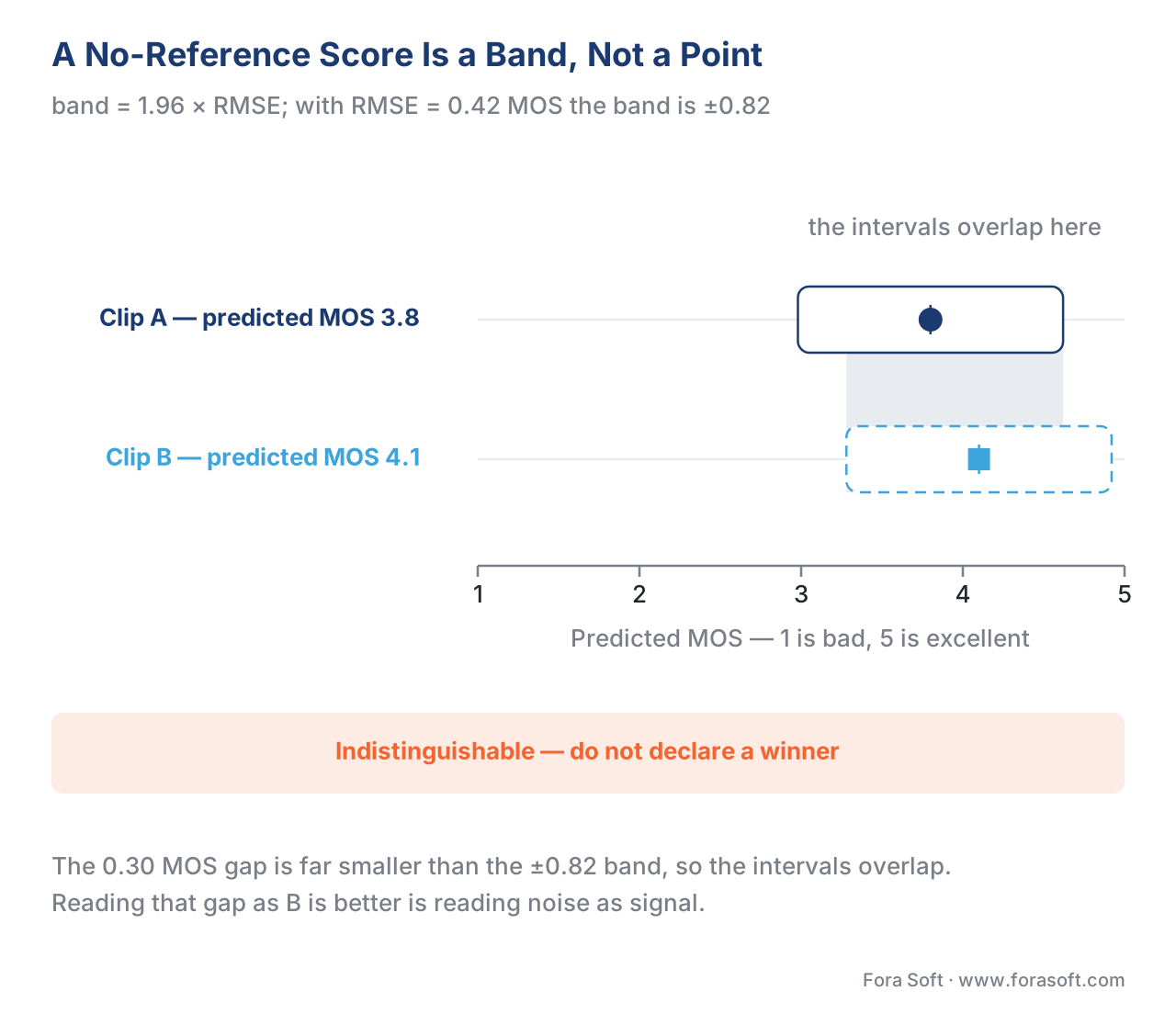 Figure 4. The same arithmetic as a picture: a ±0.82 band around each score (band = 1.96 × RMSE, RMSE = 0.42). Clip A and clip B differ by 0.3, inside the band, so their intervals overlap and the metric cannot pick a winner.
You can reproduce this calculation, and band your own scores, with the no-reference score readout tool shipped with this article; its --demo flag prints this exact example.
Deploying no-reference quality for live and UGC
Translate all of this into a deployment. Five decisions matter.
Pick the family by where you sit. If you are inside the streaming path and can read the encoded stream — your own live or VOD delivery — a bitstream or parametric model (P.1203 / P.1204) is cheap, scales, and folds straight into a session score, as the player-side metrics article describes. If all you have is decoded pixels — UGC ingest, a live monitoring screen, a surveillance recorder — you need a pixel-based blind metric.
Respect the latency budget for live. Scoring every pixel of every frame in real time is rarely affordable. The newer learned models are designed around this: FAST-VQA's fragment sampling scores a handful of small patches rather than the whole frame, and bitstream models are cheap by construction. Choose a model whose cost fits the time you have before the score is needed.
Sample; do not score everything. At platform scale you cannot run a blind metric on every second of every stream. Score a representative sample and read the distribution, not one global average — the sampling math and the alerting that sits on top of it are covered in monitoring quality in production.
Match the model to your content, then re-validate on your own clips. A model's published accuracy was measured on its dataset, not yours. Before you trust a number in production, run the model against a few hundred of your clips with human scores and confirm the correlation holds. If your content is unusual — screen capture, low-light surveillance, telemedicine — assume the published figure is optimistic until you have checked.
Band every score, and combine it with delivery. Report each blind score with its uncertainty, and remember the blind metric only estimates the picture half of experience. The session also has startup, rebuffering, and switching, and the honest full picture comes from joining the no-reference picture estimate to those delivery metrics, as in connecting objective metrics to QoE. For the open-source implementations of the metrics named here, see open-source no-reference tools.
Free download: no-reference score readout toolA dependency-free Python tool that never decodes video. It maps a raw blind-model output onto the 1-5 MOS scale with the ITU-T P.1401 monotonic logistic, turns the residual RMSE into the confidence band that belongs with the score, and refuses to call a winner when two intervals overlap - the same discipline this article argues for. Its --demo flag reproduces the 3.8 against 4.1 example above, number for number.Common mistake — running a model out of its training distribution and trusting it. A metric trained on social UGC can rank surveillance or screen content backwards. The published SROCC does not transfer; only a check on your own labeled clips does.
Where Fora Soft fits in
Fora Soft has built live video — conferencing, telemedicine, surveillance, and streaming — since 2005, and almost none of it has a pristine reference at the point we need to measure it. A telemedicine call, a security feed, and a user's uploaded clip all arrive with no master to compare against, so we lean on no-reference estimation: a bitstream model where we own the encode, a pixel-based blind metric where we have only the picture, each matched to the content and reported with its uncertainty band rather than as a bare number. Because learned blind metrics carry the bias of their training data, we re-validate them against human scores on the client's own content before trusting a quality gate to them, under the dated, reproducible approach in our benchmark methodology. The discipline is the one this whole section preaches: name what the metric measures, and name where it lies.

The handbook
Fora Soft Video Engineering Handbook
We wrote a seven-volume handbook that walks the whole video stack, from a single pixel to a running production system, across more than 9,000 pages; an engineer who works through it can design and build the systems a blind score is asked to judge. Volume 1, Video Encoding, sits closest to this article: it takes PSNR, SSIM and VMAF apart and shows what a quality number is actually measuring and where each one stops being safe to quote. Volume 6, AI for Video, covers the learned models behind UVQ, FAST-VQA and DOVER and why a network trained on one content distribution ranks another backwards, and Volume 3, Video Streaming, carries the same question into the delivered session, where P.1203 and P.1204 turn bitstream parameters into a viewer score. Written by Nikolay Sapunov, CEO at Fora Soft.
Need a quality number for video that has no original to compare against?
Tell us where the measurement has to happen - a live edge, a UGC ingest, a surveillance recorder - and we will name the family that fits what you can read there, the model worth starting from, and the size of the error bar you should be quoting beside every score. 250+ video products shipped since 2005.
See our case studies
Case study
Worldcast Live
Concert streaming at 1.5 Gb/s with 0.4-0.5 s latency to 10,000 simultaneous viewers, stepping down to lower rungs on weak connections - the master is never beside the player, so every statement about the delivered picture there is a no-reference statement.
Case study
Mindbox
An intelligent VMS in 50+ deployments pulling RTSP camera feeds through FFmpeg into HLS, with face recognition at 99.5% accuracy - the recorder sees decoded pixels only, and a blind model trained on social clips can rank low-light surveillance backwards.
Case study
VocalViews
A market-research platform with 1M+ participants recording interviews on their own phones and laptops - every upload is an unpristine reference, so the quality number has to come from the clip itself rather than from a diff against it.
What to read next
Taxonomy
Full, reduced, and no-reference metrics
Where blind metrics sit among the three setups, and what each one needs to run.
Tools
Open-source no-reference tools
The working implementations of NIQE, VIDEVAL, UVQ and FAST-VQA, and what they cost.
Validation
Validating metrics against human scores
How a published SROCC becomes a number you can defend on your own content.
Production
Monitoring quality in production
Sampling, alerting, and reading a distribution instead of one global average.
References
- A. Mittal, A. K. Moorthy, A. C. Bovik. No-Reference Image Quality Assessment in the Spatial Domain (BRISQUE). IEEE Transactions on Image Processing, 21(12), 2012. The trained spatial-domain NSS model for blind image quality. https://live.ece.utexas.edu/publications/2012/TIP%20BRISQUE.pdf
- A. Mittal, R. Soundararajan, A. C. Bovik. Making a "Completely Blind" Image Quality Analyzer (NIQE). IEEE Signal Processing Letters, 20(3), 2013. The training-free NSS model that scores deviation from pristine natural-image statistics. https://live.ece.utexas.edu/publications/2013/mittal2013.pdf
- A. Mittal, M. A. Saad, A. C. Bovik. A Completely Blind Video Integrity Oracle (VIIDEO). IEEE Transactions on Image Processing, 25(1), 2016. Training-free blind video quality from intrinsic natural-video regularities. https://live.ece.utexas.edu/publications/2016/07332944.pdf
- M. A. Saad, A. C. Bovik, C. Charrier. Blind Prediction of Natural Video Quality (V-BLIINDS). IEEE Transactions on Image Processing, 23(3), 2014. Spatio-temporal NSS plus a motion model, trained against subjective scores. https://live.ece.utexas.edu/publications/2014/Saad_VideoBLIINDS.pdf
- Z. Tu, Y. Wang, N. Birkbeck, B. Adsumilli, A. C. Bovik. UGC-VQA: Benchmarking Blind Video Quality Assessment for User Generated Content (VIDEVAL). IEEE Transactions on Image Processing, 30, 2021. The UGC-VQA benchmark and the 60-of-763 feature-fusion model. https://arxiv.org/abs/2005.14354
- Y. Wang, J. Ke, H. Talebi, J. G. Yim, N. Birkbeck, B. Adsumilli, P. Milanfar, F. Yang. Rich Features for Perceptual Quality Assessment of UGC Videos (UVQ). IEEE/CVF CVPR, 2021; model open-sourced 2022. The Content/Distortion/Compression subnetwork model; states why reference-based scores fail on non-pristine UGC. https://openaccess.thecvf.com/content/CVPR2021/papers/Wang_Rich_Features_for_Perceptual_Quality_Assessment_of_UGC_Videos_CVPR_2021_paper.pdf
- International Telecommunication Union. Recommendation ITU-T P.1204: Video quality assessment of streaming services over reliable transport for resolutions up to 4K (2023). The multi-model standard: bitstream (P.1204.3), reduced-reference pixel (P.1204.4), and hybrid no-reference pixel (P.1204.5) models. https://www.itu.int/rec/T-REC-P.1204
- International Telecommunication Union. Recommendation ITU-T P.1203: Parametric bitstream-based quality assessment of progressive download and adaptive audiovisual streaming services over reliable transport (2017). The parametric session-quality standard with operating Modes 0–3. https://www.itu.int/rec/T-REC-P.1203
- International Telecommunication Union. Recommendation ITU-T P.1401: Methods, metrics and procedures for statistical evaluation, qualification and comparison of objective quality prediction models (2020). The logistic mapping of an objective score to the opinion scale and the RMSE / RMSE* / PLCC / outlier-ratio evaluation procedure. https://www.itu.int/rec/T-REC-P.1401
- Z. Ying, M. Mandal, D. Ghadiyaram, A. C. Bovik. Patch-VQ: 'Patching Up' the Video Quality Problem (the LSVQ dataset). IEEE/CVF CVPR, 2021. The ~39,000-clip large-scale in-the-wild UGC quality dataset used to benchmark blind models. https://arxiv.org/abs/2011.13544
- H. Wu, C. Chen, J. Hou, L. Liao, et al. FAST-VQA: Efficient End-to-End Video Quality Assessment with Fragment Sampling. ECCV, 2022. Fragment sampling for efficient transformer-based blind VQA. https://arxiv.org/abs/2207.02595
- H. Wu, E. Zhang, L. Liao, et al. Exploring Video Quality Assessment on User Generated Contents from Aesthetic and Technical Perspectives (DOVER). IEEE/CVF ICCV, 2023. Disentangles aesthetic from technical quality for UGC. https://arxiv.org/abs/2211.04894
- International Telecommunication Union. Recommendation ITU-R BT.500-15: Methodologies for the subjective assessment of the quality of television pictures (2023). The subjective ground truth any blind metric must be validated against. https://www.itu.int/rec/R-REC-BT.500
- A. V. Katsenou, F. Zhang, et al. BVI-UGC: A Video Quality Database for User-Generated Content Transcoding (2024). A non-pristine-reference UGC benchmark; ten full-reference and eleven no-reference metrics all score below 0.6 SROCC. https://arxiv.org/abs/2408.07171
