


Why this matters
Every streaming dashboard you have ever trusted is downstream of a player emitting events, and if you do not know how those events become metrics you cannot tell a real quality regression from an instrumentation bug. This article is for the streaming engineer, player developer, and QoE analyst who has to stand up player telemetry, choose or audit an analytics platform, and read the numbers it produces without being fooled. It is the "where the data comes from" companion to the streaming QoE framing article and the deep dives on rebuffering, startup time, and bitrate switching. Those articles define the metrics; this one explains how a player and an analytics stack actually produce them — and the measurement traps hiding in that pipeline.
What "player-side" means, and why it is a different question
Start with the distinction that organizes this whole section. A full-reference picture metric — VMAF, SSIM, PSNR — compares a compressed frame to the pristine original and answers "how good is this encode?" It needs the master file, runs at encode time, and never sees a real viewer. Player-side quality metrics, by contrast, are measured on the device during playback and answer a different question: "what experience did this session actually deliver?" They do not need the original, because they are not scoring pixels — they are scoring events.
The two are complements, not substitutes, and confusing them is the first mistake. A clip can encode to VMAF 96 and still deliver a miserable session if it took eight seconds to start and stalled twice; a modest VMAF 82 encode that starts instantly and never buffers can feel excellent. Player-side metrics capture the half of quality the picture metric cannot see — the delivery experience — which is why a serious quality program runs both and reconciles them (the subject of connecting picture metrics to QoE).
A useful analogy: a picture metric is the chef tasting the dish in the kitchen; player-side metrics are the diner's experience at the table — was it served hot, did it arrive at all, did the waiter vanish for ten minutes. Both matter, and only one of them involves the viewer.
The raw signal: what a player actually emits
Player-side metrics are derived from a low-level event stream the media element produces as it plays. On the web, the HTML5 <video> element fires a defined set of media events (the WHATWG HTML Living Standard specifies them), and native players on iOS, Android, Roku, and smart TVs expose equivalents. The handful that carry quality information:
loadstart/play— the viewer asked for video; the start-attempt clock begins.playing— frames are actually rendering; the firstplayingends startup.waiting— playback stopped because the next frame is not available yet. This is the raw signature of a rebuffer, fired when the buffer underruns mid-playback.seeking/seeked— the user jumped; awaitingbracketed by a seek is a seek wait, not a network stall, and must be excluded from rebuffering.ratechange,ended,error— speed change, normal completion, and a fatal or non-fatal failure.
One thing the standard events do not give you is the played bitrate: which rung of the bitrate ladder is on screen is an adaptive-streaming decision, so the player's ABR layer (or the analytics SDK hooking it) has to log each rendition change itself. That is why bitrate and switching telemetry is more fragile across players than startup and rebuffering: it depends on a non-standard hook.
The instrumentation job is to watch this event stream like a flight data recorder and turn raw transitions into metrics: the interval from the play intent to the first playing is startup time; every waiting→playing pair that is not a seek is a rebuffer with a measured duration; every logged rendition change is a switch; an error before the first playing is a startup failure. Get these derivations right and everything above them is trustworthy. Get one wrong — count seek waits as stalls, miss the bitrate hook on one platform — and the dashboard lies with total confidence.
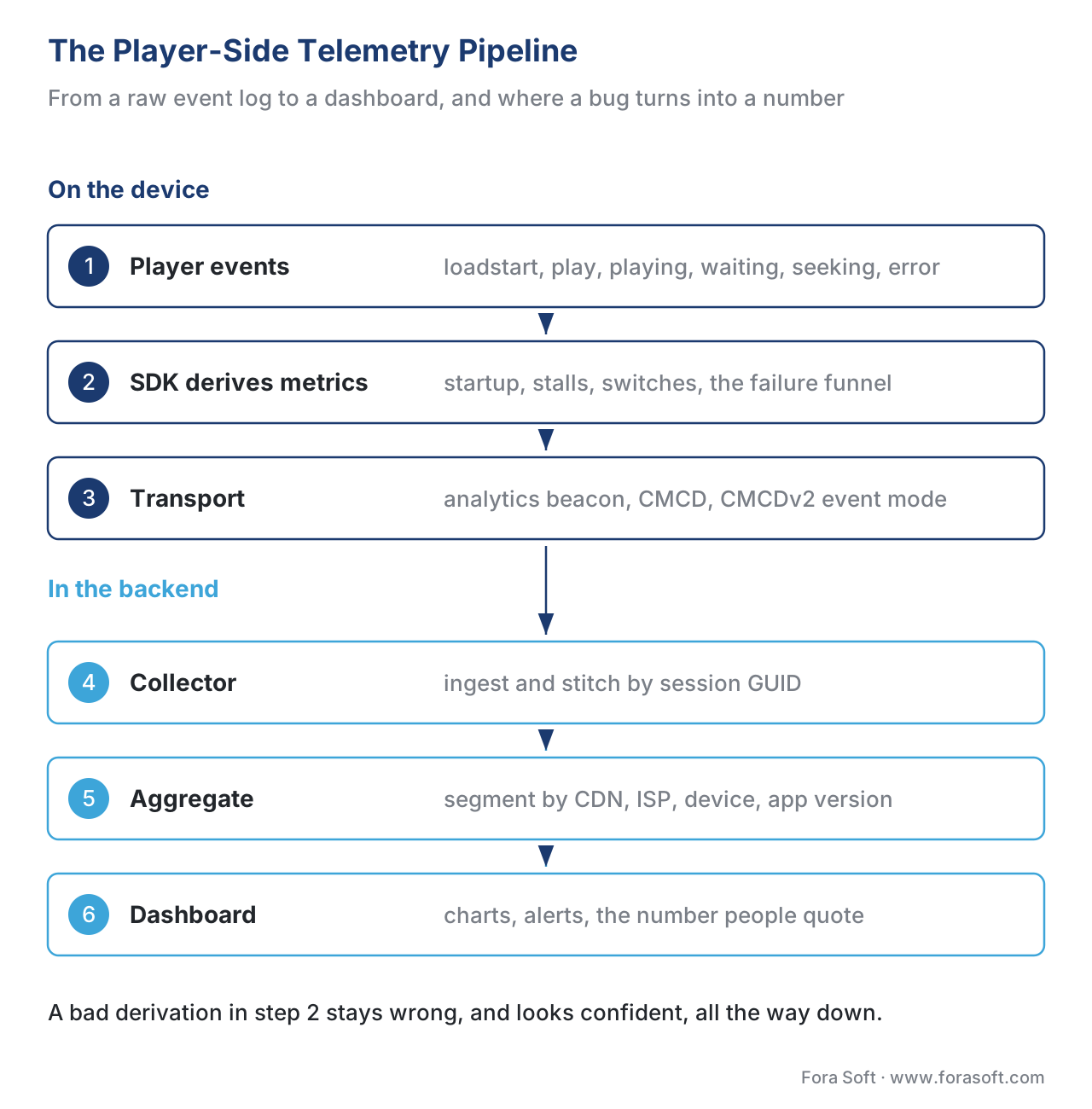 Figure 1. The player-side telemetry pipeline. Raw media events are derived into QoE metrics on the device, transported off it (an analytics beacon or CMCD/CMSD), collected, aggregated, and surfaced as a dashboard or an alert. A bug at the left becomes a confident wrong number at the right.
The standard event taxonomy: CTA-2066
If every player and every analytics vendor names and computes these metrics differently, two dashboards over the same sessions will disagree, and you will waste a night arguing about whose number is "right." The fix is a shared vocabulary. CTA-2066, "Streaming Quality of Experience Events, Properties and Metrics" (Consumer Technology Association, 2020), specifies a common set of player events, properties, and QoE metrics — and, critically, how each metric should be computed — so the same session produces the same number across systems, players, and analytics vendors.
The taxonomy groups player-side quality into four families, which map exactly onto the deep-dive articles in this block:
- Startup — time to first frame, and the start-up failures and abandonments around it (the subject of 6.3).
- Rebuffering — the frequency, duration, and ratio of mid-playback stalls (6.2).
- Bitrate and switching — the average delivered bitrate and the quality changes around it (6.4).
- Failures — sessions that never started or died mid-play, the funnel that the happy-path metrics ignore.
That last family deserves names, because it is the one teams forget. Video Startup Failure (VSF) is a session that attempted playback but hit an error before the first frame. Exits Before Video Start (EBVS) is a viewer who waited at least a second and then abandoned before playback began — a startup problem the startup-time metric cannot see, because a session that never starts has no start time to average. Video Playback Failure (VPF) is a fatal error mid-stream that ends the view early. A dashboard that reports a beautiful median startup time while a tenth of sessions silently fail to start is measuring the survivors and missing the casualties.
Worked example: reconstructing a quality view from an event log
Make it concrete. Here is the timestamped event log from one video-on-demand session, in seconds from the moment the viewer pressed play, exactly the kind of log a player SDK records:
t=0.0    loadstart        (start attempt begins)
t=2.0    playing          (first frame on screen)
t=2.0    rendition 5.0 Mbps
t=40.0   rendition 2.5 Mbps   (switch down)
t=95.0   waiting          (buffer underrun → stall begins)
t=98.0   playing          (stall ends)
t=120.0  rendition 5.0 Mbps   (switch up)
t=300.0  ended            (view complete)
Now derive the standard metrics, showing the arithmetic.
Startup time is the play intent to the first playing: 2.0 − 0.0 = 2.0 s.
Rebuffering: one waiting→playing pair, not bracketed by a seek, lasting 98.0 − 95.0 = 3.0 s. So one stall, 3.0 seconds.
Playing time is the wall-clock span minus startup minus stall: 300.0 − 2.0 − 3.0 = 295.0 s.
Rebuffering ratio depends on a choice of denominator, and this is where the same metric splits in two. The CTA-2066 / rebuffering-ratio convention divides stall time by stall-plus-play: 3.0 ÷ (3.0 + 295.0) = 1.01%. A common analytics convention (for example, Mux's "rebuffering percentage") divides by total watch time including startup: 3.0 ÷ (2.0 + 3.0 + 295.0) = 1.00%. Both are defensible; they are not the same number; and if you do not know which one your dashboard uses, you cannot compare it to anyone else's. That is the entire reason CTA-2066 exists.
Average bitrate is the time-weighted mean over playing time only (stalls do not count):
(5.0×38 + 2.5×55 + 2.5×22 + 5.0×180) ÷ 295
= (190 + 137.5 + 55 + 900) ÷ 295
= 1282.5 ÷ 295
≈ 4.35 Mbps
Switches: two rendition changes (down at t=40, up at t=120). Funnel state: the session reached playing, so it is not a VSF or an EBVS; it ended normally, so not a VPF. One clean session, fully described by six numbers — and every one of them came from timestamps, not pixels.
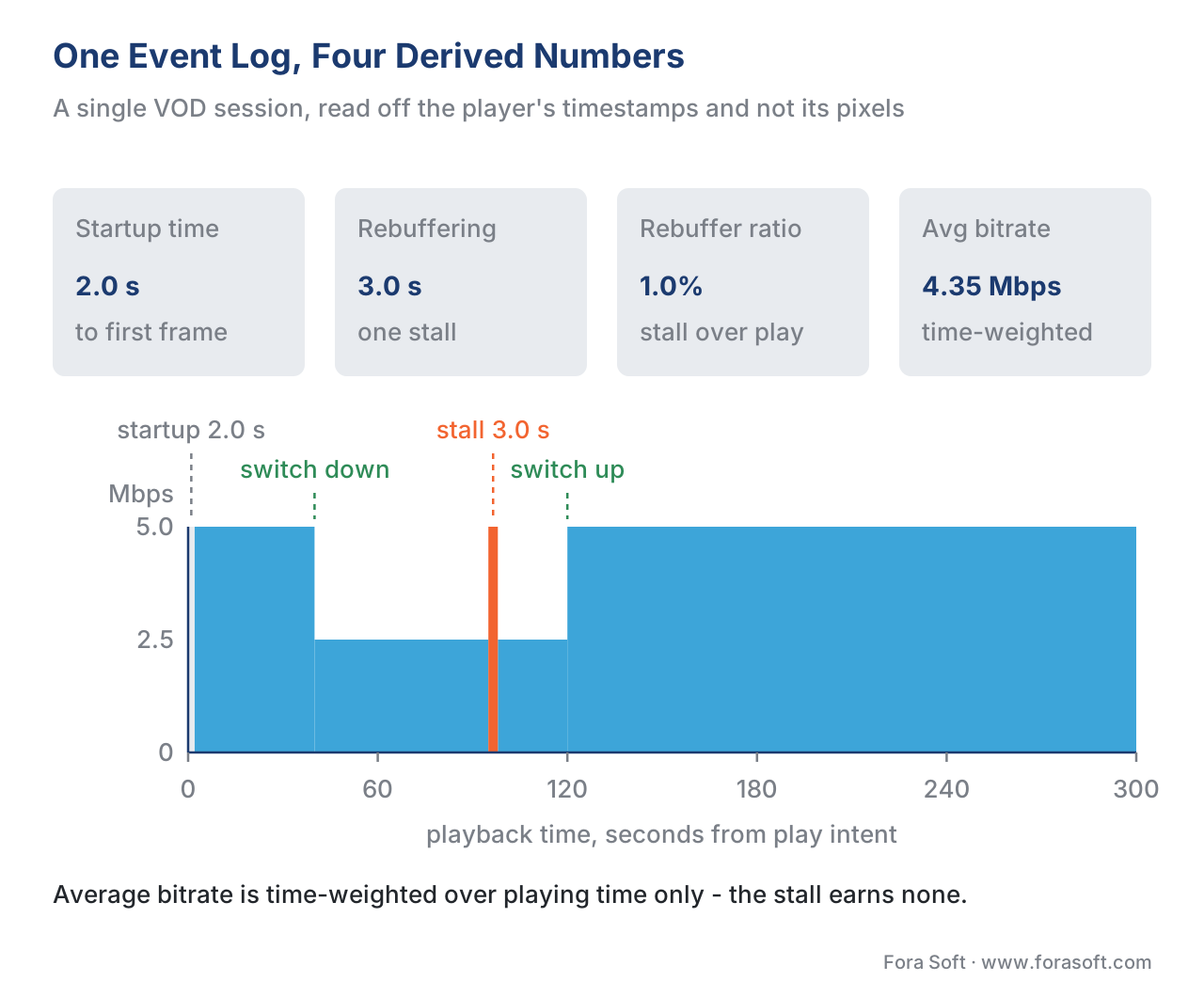 Figure 2. The event log above, drawn as a timeline. Startup (2.0 s), one 3.0 s stall, two rendition switches, and the derived numbers — startup time, rebuffering ratio, average bitrate — read straight off the events.
Getting the data off the device
A metric computed on the device is useless until it reaches your backend, and there are two distinct transport models, which most production stacks run together.
The first is the analytics beacon. A vendor SDK embedded in the player batches the derived metrics and sends them to a collector — at session start and end, on key events (a stall, an error), and on a periodic heartbeat (often every 10 seconds) so long sessions report progress before they finish. This is the path Conviva, Mux Data, Bitmovin Analytics, NPAW, and Datazoom use, and it carries rich, player-aware data because the SDK sees the whole session.
The second is CMCD — Common Media Client Data (CTA-5004, 2020) — which takes a different route: the player attaches a compact set of key-value fields to each media request it already makes to the CDN, as an HTTP header or query argument. The reserved keys are exactly the quality signals this article is about: encoded bitrate (br), buffer length (bl), a buffer-starvation flag (bs, set when the player just rebuffered), measured throughput (mtp), a startup flag (su), top playable bitrate (tb), and a session GUID (sid) that ties thousands of CDN log lines into one session. Because it rides the CDN's own logs, CMCD lets you reconstruct the bitrate and stall sequence at the delivery layer with no separate beacon — and, deliberately, it carries no IP address, cookie, or location, buckets its numbers, and orders its keys to minimize device fingerprinting.
Its server-side mirror, CMSD — Common Media Server Data (CTA-5006, 2022) — runs the other direction: the origin and intermediaries attach data to each response, so the player and the CDN can share a picture (an edge throughput estimate to seed the first bitrate, a suggested rung, prefetch hints). Together CMCD and CMSD make the delivery path itself observable without a proprietary SDK.
The 2026 update matters for measurement. CMCDv2 (CTA-5004-A, February 2026) adds multi-mode reporting, including an event mode: telemetry is no longer chained to segment requests, so the player can emit health on a stall transition, periodically, or when a threshold is crossed, and send it to a collector directly. The practical effect is that standards-based telemetry can now carry session health the way a proprietary beacon does — the cadence is no longer hostage to the segment cadence.
| Source | Direction | Standardized | Carries | Best for | Where it lies / limit |
|---|---|---|---|---|---|
| Analytics SDK beacon | Player → collector | Vendor-specific schema | Full derived QoE + device/app context | Rich session analytics, alerting | Schema differs per vendor; an SDK bug taints everything |
| CMCD (CTA-5004) | Player → CDN, per request | Yes (CTA) | br, bl, bs, mtp, su, tb, sid … |
Delivery-layer QoS from CDN logs, no SDK | v1 cadence tied to segment requests; hints, not guarantees |
| CMSD (CTA-5006) | Server → player | Yes (CTA) | Edge throughput, suggested bitrate, prefetch | Coordinating player and CDN | Needs CDN/origin support along the path |
| CMCDv2 event mode (CTA-5004-A) | Player → collector | Yes (CTA, 2026) | Event/periodic/threshold health | Standards-based session telemetry | New; adoption still ramping in 2026 |
The analytics stack and what each layer hides
Above the transport sits the analytics stack: a collector that ingests beacons and logs, an aggregation layer that rolls millions of sessions into metrics sliced by content, CDN, ISP/ASN, device, app version, and region, and a presentation layer of dashboards and alerts. The platforms differ less in which metrics they compute — they all report the CTA-2066 families — than in where they put their effort.
| Platform | Known for | Best fit |
|---|---|---|
| Conviva | Longest-standing dedicated video QoE analytics (since 2006); real-time at tier-1-OTT scale | Live operations and failure response at scale |
| Mux Data | Clean modern pipeline; metrics sliced by every dimension | Engineering teams that want speed and clarity |
| Bitmovin Analytics | Granular per-session timelines | Diagnosing why one specific session was bad |
| Datazoom | Routes normalized raw events to your warehouse and tools | Owning your own data infrastructure |
| NPAW | Broad operator deployments | Large OTT/operator estates |
This article is the measurement reading of that landscape; the Video Streaming section's analytics deep dive covers the platforms as products, and its player-observability article covers the delivery-side instrumentation in depth — link out, do not re-derive.
Two layers of the stack hide traps a measurement-honest engineer has to name. First, aggregation hides the floor: a healthy global average can sit on top of a CDN, device, or region segment that is failing, so segment the data and report a low percentile, not just the mean — the same floor-not-average discipline that drives a trustworthy QC report and underpins production monitoring at scale. Second, volume forces sampling: with four-second segments a stream makes about 15 media requests a minute, so CMCD on every request from 100,000 concurrent viewers is 15 × 100,000 = 1,500,000 records a minute (about 25,000 a second), while a 10-second heartbeat is 6 × 100,000 = 600,000 a minute. At that scale you sample and aggregate, and CMCDv2's event mode helps by emitting only on the transitions that matter — but sampling that is not representative will quietly bias the very averages you trust.
From telemetry to a single score
Stakeholders want one number, and there are two honest ways to give them one. The standardized route is ITU-T P.1203 (2017), the parametric model that folds per-segment quality, initial loading delay, stalls, and switches into a single 1-to-5 session mean opinion score, running in one of four modes depending on how much bitstream metadata it can see. The vendor route is a composite experience score (Mux's Viewer Experience Score, Conviva's VQ-style indices), a weighted blend of the same families tuned to predict engagement.
Both are useful and both can mislead if you treat the score as ground truth rather than as a model of it. A composite number is only as good as its inputs and its weights, and those weights are fit to a dataset, not handed down as law. The discipline is the one that runs through this whole section: an objective or composite score is a proxy that must be validated against a properly run subjective test (ITU-R BT.500-15), and when the score and a careful human viewing disagree, the human wins. Report the composite with its components visible, not as a lonely gauge.
 Figure 3. The four player-side metric families. Each is derived from specific player events and each has a blind spot — startup time cannot see sessions that never start, average bitrate is not picture quality, and a composite score is only as honest as its inputs.
Common mistakes
Player-side measurement is forgiving until one of these quietly corrupts the dashboard everyone trusts.
Trusting a metric name without its computation. The same label can be two numbers: a vendor's real-time "rebuffering percentage" and its historical "rebuffer percentage" can use different denominators and windows, so they do not match even within one product. Always pin down the formula, the window, and the denominator before you compare across tools — the reason CTA-2066 exists.
Counting seek waits as stalls. A waiting event that a user seek caused is not a network rebuffer. If the instrumentation does not exclude seek-induced waits, an engaged viewer scrubbing through a video inflates your rebuffering ratio and you "fix" a problem that was never there.
Measuring only the happy path. Median startup time over sessions that started ignores the ones that never did. Report Video Startup Failure and Exits Before Video Start beside startup time, or you are grading the survivors.
Reading the global average. A 0.9% aggregate rebuffering ratio can hide one CDN or device at 4%. Segment by CDN, ISP/ASN, device, app version, and region, and watch a low percentile, not just the mean.
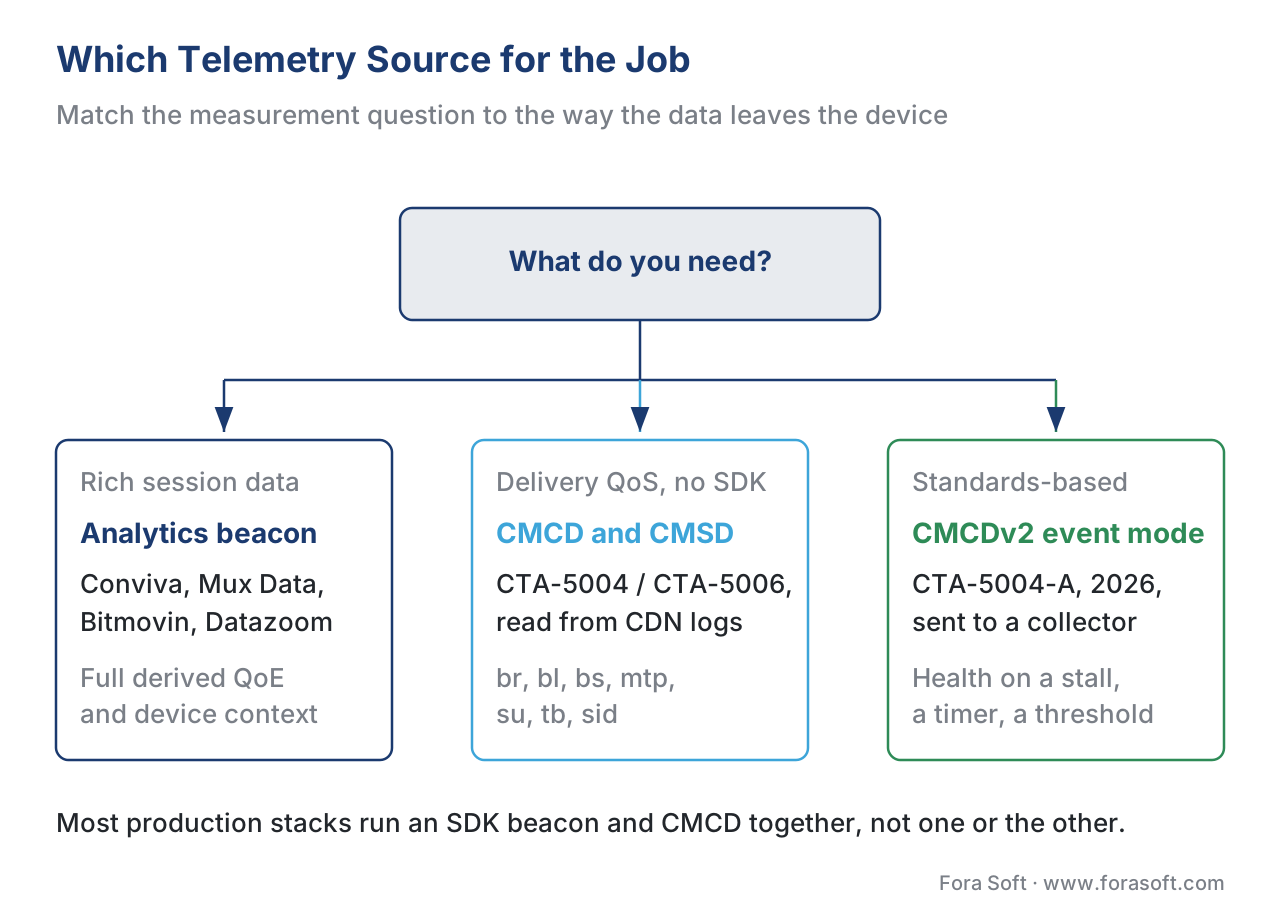 Figure 4. Choosing a telemetry source. Match the question to the transport: rich session analytics to an SDK beacon, delivery-layer QoS to CMCD/CMSD from CDN logs, and standards-based session health to CMCDv2's event mode.
Forgetting the clock. Player-side timestamps come from client devices with skewed clocks and variable timer resolution; a session's internal deltas (startup, stall duration) are reliable, but cross-device wall-clock comparisons are not. Measure intervals within a session, not absolute times across sessions.
Treating the composite as truth. A single Viewer Experience Score or P.1203 MOS is a model output. Keep its components visible and validate it against subjective data before you let it drive a decision.
Free download: player-telemetry QoE parserA dependency-free Python tool (standard library only) that does on your log exactly what the worked example above does by hand. Feed it a raw player-event log -loadstart/play, playing, waiting, seeking/seeked, rendition <kbps>, error, ended - and it reconstructs the standard player-side metrics: startup time, stall count and duration with seek waits excluded, the rebuffering ratio under both conventions so you can see how far apart they land, time-weighted average bitrate over playing time, switch count, and the funnel state (VSF, EBVS, VPF). It is the audit tool for the question this article asks: does your dashboard compute the metric the way you think it does?
Where Fora Soft fits in
We build streaming, OTT, video conferencing, e-learning, and telemedicine platforms where the team that ships the player also owns whether anyone can tell a real regression from a metric artifact. Standing up player-side instrumentation that derives startup, rebuffering, bitrate, and the failure funnel correctly — excluding seek waits, capturing the bitrate hook on every platform, segmenting before averaging — is the unglamorous work that makes a QoE dashboard worth looking at. We treat the analytics stack as a measurement instrument, not a wall display: define every metric's computation, validate composite scores against how the experience actually feels, and read the floor, not the mean. The same provenance discipline runs through our benchmark methodology.

The handbook
Fora Soft Video Engineering Handbook
We wrote a seven-volume handbook that walks the whole video stack - encoding, delivery, audio and AI - across more than 9,000 pages, so an engineer who works through it can design and build the system this telemetry is measuring. Volume 3, Video Streaming, covers the layer these metrics are read off: ABR and the rendition hook, the buffer that underruns, CDNs and players, and what a stall costs once you price it. Volume 2 covers the HLS and DASH requests CMCD rides on, and Volume 1, Video Encoding, holds the picture-quality half - PSNR, SSIM and VMAF - that player-side numbers have to be reconciled against. Written by Nikolay Sapunov, CEO at Fora Soft.
Does your QoE dashboard measure the session, or just the survivors?
Send us the player and the analytics stack you run today, and we will trace each metric back to the events it is derived from - whether seek waits are excluded, whether the bitrate hook fires on every platform, which denominator the rebuffering ratio uses, and how many sessions never reach a chart at all - and tell you which numbers you can act on. 250+ video products shipped since 2005.
See our case studies
Case study
Worldcast Live
Concert streaming at 1.5 Gb/s with 0.4-0.5 s latency for 10,000 simultaneous viewers, where startup time and every rendition change were read off real sessions rather than a lab run.
Case study
TradeCaster
Live desktop streaming for 46,000+ traders that auto-scales through market-hour spikes - the plainest argument for segmenting telemetry by time, device and region instead of reading one global average.
Case study
Sprii
Live shopping across 72,000+ events, where viewers stay 20 minutes against 54 seconds on a static page - a stall or a failed start is measured in revenue, not in complaints.
What to read next
QoE
Streaming QoE metrics: what keeps a viewer watching
The framing for the four metric families this telemetry feeds.
Rebuffering
Rebuffering ratio: the real cost of a stall
The denominator problem above, worked out in full.
Startup
Startup time and time to first frame
What the 2.0 s in the worked example is made of, and the failures it hides.
Production
Monitoring video quality in production at scale
Sampling, segmentation and alerting on exactly this telemetry.
References
- Streaming Quality of Experience Events, Properties and Metrics (CTA-2066), Consumer Technology Association, 2020. Official recommended-practice standard. Specifies a common set of player events, properties, and QoE metrics, and how each metric should be computed, for consistent representation across systems, players, and analytics vendors. Tier 1. https://github.com/cta-standards/R4WG20-QoE-Metrics
- Web Application Video Ecosystem — Common Media Client Data (CMCD), CTA-5004, Consumer Technology Association, September 2020. Official standard. Defines the four header shards (CMCD-Request/Object/Status/Session) and the reserved keys a player attaches to each media request — including
br,bl,bs(buffer starvation),mtp,su,tb, and thesidsession GUID — plus the no-PII privacy model. Basis for the CMCD transport section. Tier 1. https://cdn.cta.tech/cta/media/media/resources/standards/pdfs/cta-5004-final.pdf - Web Application Video Ecosystem — Common Media Server Data (CMSD), CTA-5006, Consumer Technology Association, November 2022. Official standard. Defines the server-to-client response data (edge throughput estimate, suggested bitrate, prefetch hints) that complements CMCD on the delivery path. Tier 1. https://shop.cta.tech/products/web-application-video-ecosystem-common-media-server-data-cta-5006
- Common Media Client Data, CTA-5004-A (CMCDv2), Consumer Technology Association, February 2026. Official standard (version 2). Adds multi-mode reporting, including an event mode that decouples telemetry from segment requests so player health can be emitted on transitions, periodically, or on threshold crossings. Basis for the CMCDv2 event-mode point. Tier 1. https://www.cta.tech/standards/wave-common-media-client-data/
- Recommendation ITU-T P.1203: Parametric bitstream-based quality assessment of progressive download and adaptive audiovisual streaming services over reliable transport, ITU-T, 2017. Official standard. Folds per-segment quality, initial loading delay, stalls, and switches into a 1–5 session MOS across four operating modes. Basis for the "telemetry to a single score" section. Tier 1. https://www.itu.int/rec/T-REC-P.1203
- HTML Living Standard, Section 4.8.11 (Media elements / event summary), WHATWG, accessed 2026-06-25. The controlling web standard for the
<video>element's media events (loadstart,playing,waiting,seeking,ratechange,error,ended) that player-side metrics are derived from. Basis for the raw-signal section. Tier 1. https://html.spec.whatwg.org/multipage/media.html - Recommendation ITU-R BT.500-15: Methodologies for the subjective assessment of the quality of television pictures, ITU-R, 2023. Official standard. The subjective ground truth a composite QoE or P.1203 score must be validated against; when a model and a careful viewing disagree, the viewing wins. Tier 1. https://www.itu.int/rec/R-REC-BT.500
- Mux Data documentation — "Understand Monitoring Metrics and Dimensions" and "Understand metric definitions," Mux, accessed 2026-06-25. First-party tooling reference for the operational definitions of Video Startup Time, Rebuffering Percentage, Video Startup Failure, Exits Before Video Start, and Playback Failure — and the explicit note that the real-time and historical versions of the same metric are computed differently. Basis for the metric definitions and the "same name, different math" mistake. Tier 3. https://www.mux.com/docs/guides/monitoring-metrics
- F. Dobrian et al., "Understanding the Impact of Video Quality on User Engagement," ACM SIGCOMM, 2011 (Conviva). Large-scale player-telemetry study establishing which player-side metrics move engagement, with rebuffering carrying the largest single effect. Basis for why player-side telemetry is worth instrumenting well. Tier 5. https://www.cs.cmu.edu/~hzhang/papers/sigcomm2011_QualityEngagement.pdf
- R. Oakley, "CMCD v2: Should Proprietary Metrics Providers Be Worried?", Synamedia, March 2026. Vendor engineering commentary corroborating CMCDv2's event-mode reporting and its effect of decoupling telemetry cadence from segment cadence. Tier 4 (credible deployer). https://www.synamedia.com/blog/cmcd-v2-should-proprietary-metrics-providers-be-worried/
Where lower-tier sources disagreed with the standards, the standards won: vendor docs each define the QoE metrics in their own house style and even compute the same metric two ways within one product, so this article anchors the definitions and the computation rule on CTA-2066 and the CTA-5004/5006 standards, and uses the vendor docs (tier 3–4) only to illustrate real-world variation.
