


Why this matters
A quality gate proves an encode was good the day it was built; it says nothing about the stream a viewer in another country pulled through a struggling CDN edge six weeks later. Production monitoring is the standing measurement that closes that gap — it watches delivered quality after launch, at scale, and tells you when it drops before the support tickets do. This article is for the platform engineer, the streaming lead, and the SRE who owns "is video good right now?" and has to answer it across millions of concurrent sessions without a pristine reference to compare against. It is the operations counterpart to the pre-launch regression suite: the suite catches drift in the lab before you ship, and this catches the failure that only appears in the wild — a bad encode profile, a CDN brown-out, a device-specific decoder bug — where the reference is gone and the only ground truth is what the viewer got.
Three different things people call "monitoring quality"
"Monitoring quality" hides three separate jobs, and confusing them is the first way a monitoring program goes wrong. The first job is encode-time quality control: measuring the file your pipeline just produced, against the pristine source you still hold, before it is published. This is the world of the quality gate and the regression suite — full-reference measurement, run in your own infrastructure, where you own both the original and the encode.
The second job is delivered-picture monitoring: measuring the actual bitstream a viewer's player received and decoded, out in production, where the original master is no longer sitting next to the stream. The third is session experience monitoring — quality of experience, or QoE: the number that captures whether playback started fast, stayed smooth, and held a good bitrate, built not from pixels at all but from events the player reports. The picture can be flawless and the session miserable (a perfect encode that rebuffers every ten seconds), so these two are genuinely different measurements, and a serious program runs both.
This article is about jobs two and three — measurement after launch, at the viewer's end of the wire. Job one is the rest of Block 5. The reason the three need different tools comes down to one question: do you still have the reference?
 Figure 1. Where quality is measured, and whether a reference exists at each point. At encode time you hold the source, so a full-reference metric works. On the delivered stream and at the player, the source is gone — monitoring switches to bitstream/no-reference models and to telemetry the player reports.
Why you cannot just run VMAF in production
The metric most teams trust, the one that compares a compressed frame to the original and predicts a human opinion score, called VMAF (Video Multi-method Assessment Fusion), is a full-reference metric: it requires the pristine original frame-for-frame alongside the compressed one to produce a number (Netflix VMAF documentation, accessed 2026). At encode time you have that original — it is the mezzanine master your pipeline is compressing — so full-reference measurement is exactly right there, and it scales further than people expect. Netflix measures the perceptual quality of its encodes at catalogue scale through a dedicated Video Quality Service built on its Cosmos platform, computing VMAF (and other metrics) on demand across the library (Netflix Technology Blog, Video Quality at Scale with Cosmos Microservices, 2021). If your monitoring question is "are the files we are publishing good," that full-reference service, run at encode time, is the answer.
Production monitoring asks a different question — "is the stream the viewer is receiving good" — and at that point the original is gone. The player on a phone in another city never had the mezzanine master; it has only the bytes it pulled from the CDN. Asking for VMAF there is asking for a measurement whose required input does not exist. Live is the extreme case: a live stream has no pristine reference anywhere, not even in your pipeline, because the content is being produced and encoded in the same instant. The hard distinction between full-reference and no-reference, introduced in the three measurement setups, is the whole reason production monitoring needs its own toolbox. When you have no original to compare against, you measure one of two things instead: the encoded bitstream itself, or the experience the player reports.
Measuring the delivered bitstream: parametric and bitstream models
You can say a great deal about a delivered video without ever seeing its source, because the encoded bitstream carries the fingerprints of its own quality — the resolution, the framerate, the codec, the quantization the encoder chose frame by frame. The standards body that governs telecom quality, the ITU-T, built a model series for exactly this. ITU-T P.1203, published in 2017 and described as the first standard for the quality of experience of HTTP adaptive streaming over sessions of one to five minutes, predicts a mean opinion score — a 1-to-5 quality rating — from the stream's metadata and bitstream, with no access to the original (ITU-T Rec. P.1203, 2017; Raake et al., QoMEX 2017).
What makes P.1203 a monitoring tool rather than a lab tool is that it works at four levels of input, so it fits whatever a probe can see. In Mode 0 it uses only metadata — codec, resolution, framerate, bitrate. Mode 1 adds per-frame type and size. Modes 2 and 3 add the frame-level quantization parameter from deeper bitstream access (ITU-T Rec. P.1203.1, 2017). A monitoring probe sitting at the CDN edge or in the packager, with light access to the stream, can run Mode 0 cheaply on enormous volumes; a probe with full bitstream access runs the higher modes for a sharper estimate. Crucially, P.1203's integration module folds in the stall and startup events too, so its session output reflects rebuffering and quality switching, not just the picture (ITU-T Rec. P.1203, 2017).
For higher resolutions, ITU-T P.1204 (2020) extended the family up to 4K/UHD. Its members split by exactly the reference question: P.1204.3 is bitstream-based and needs no original, reading the encoded stream to score a 5-to-10-second segment; P.1204.5 is a hybrid that fuses bitstream and pixel data, still with no reference; only P.1204.4 is pixel-based and reference-using (Raake et al., IEEE Access, 2020; ITU-T Rec. P.1204.3, 2020). For production monitoring, where there is no reference, the no-reference members — P.1203, P.1204.3, P.1204.5 — are the ones that apply. The no-reference metrics themselves, including the learned blind metrics used for live and user-generated content, are the subject of no-reference quality for live and UGC; this article's concern is the operation of running them across a fleet.
Measuring the experience: player telemetry
The other half of production monitoring never touches a pixel. It listens to the player. Every modern video player knows things no probe can infer reliably: exactly when playback started, every moment the buffer ran dry and the spinner appeared, every bitrate switch, the throughput it measured, the device and app version it runs on. Collected across a fleet, those events are the raw material of QoE monitoring, and they are cheap — a few key-value pairs per request, not a pixel decode.
Two standards make this data portable. Common Media Client Data (CMCD), the CTA-5004 specification, defines a common vocabulary the player attaches to each media request — encoded bitrate, buffer length, measured throughput, content and session IDs, playback rate — so a CDN or analytics backend gets the same fields from any compliant player (CTA-5004, 2020; the CMCDv2 revision CTA-5004-A followed in 2026). The companion CTA-2066 recommended practice standardizes the streaming QoE events, properties, and metrics themselves — what counts as a rebuffering event, how startup time is defined — so that "startup time" means the same thing across vendors (CTA-2066, 2020). These session metrics — startup time, rebuffering ratio, bitrate, switching — are the heart of Block 6's streaming QoE, and connecting them back to the picture metrics is its own discipline (connecting objective metrics to QoE). The analytics backend that ingests and slices this telemetry — the player-side analytics stack — is a Video Streaming topic in its own right; here it is simply the data source the monitor reads. For monitoring, the point is operational: telemetry is light enough to collect from nearly every session, which makes it your widest, fastest early-warning net.
You do not measure every stream: sampling at scale
Here is the instinct to unlearn: that monitoring "at scale" means measuring every stream. It does not, and it cannot. Player telemetry is small enough to gather from almost all sessions, but a bitstream or pixel model is heavy — you will not decode and score one hundred million concurrent streams, and you do not need to. Measuring delivered picture quality is a sampling problem, and sampling has well-known arithmetic that tells you precisely how little you need.
Suppose you want to know what fraction of delivered sessions fall below your quality target — a proportion. The uncertainty in an estimated proportion from a random sample of size n is its margin of error, which at 95% confidence and the worst-case proportion of 0.5 is:
margin_of_error = 1.96 x sqrt( p x (1 - p) / n )
                = 1.96 x sqrt( 0.5 x 0.5 / n )
                = 0.98 / sqrt(n)
Plug in sample sizes and the result is striking — precision is driven by the number you sample, not the fraction of the population:
| Sessions sampled (n) | Margin of error (95%) | What it buys you |
|---|---|---|
| 100 | ±9.8% | A rough hint, easily fooled by noise |
| 1,000 | ±3.1% | A usable trend |
| 2,400 | ±2.0% | A solid hourly number |
| 10,000 | ±1.0% | A precise fleet-wide rate |
| 38,400 | ±0.5% | Diminishing returns |
Table 1. Margin of error for an estimated "below-target" rate, by sample size, at 95% confidence (worst-case p = 0.5). The population size barely matters once it is large: 10,000 sampled sessions give ±1% whether you have 1 million or 100 million. Sample the number you need for the precision you need, then stop.
Ten thousand fully measured sessions, refreshed continuously, give you a fleet-wide "below-target rate" good to about one percentage point — out of a population of any size. That is the whole game: decide the precision you need, read the sample size off the arithmetic, and spend your decode budget there instead of trying to measure everything. The one caveat is representativeness. A sample is only as good as its spread: if you only sample one CDN, one device class, or one title, your tight ±1% describes that slice, not the fleet. Stratify the sample across the dimensions that matter — device, platform, region, CDN, content type — so every segment is represented. Which is the same discipline the next section forces for a different reason.
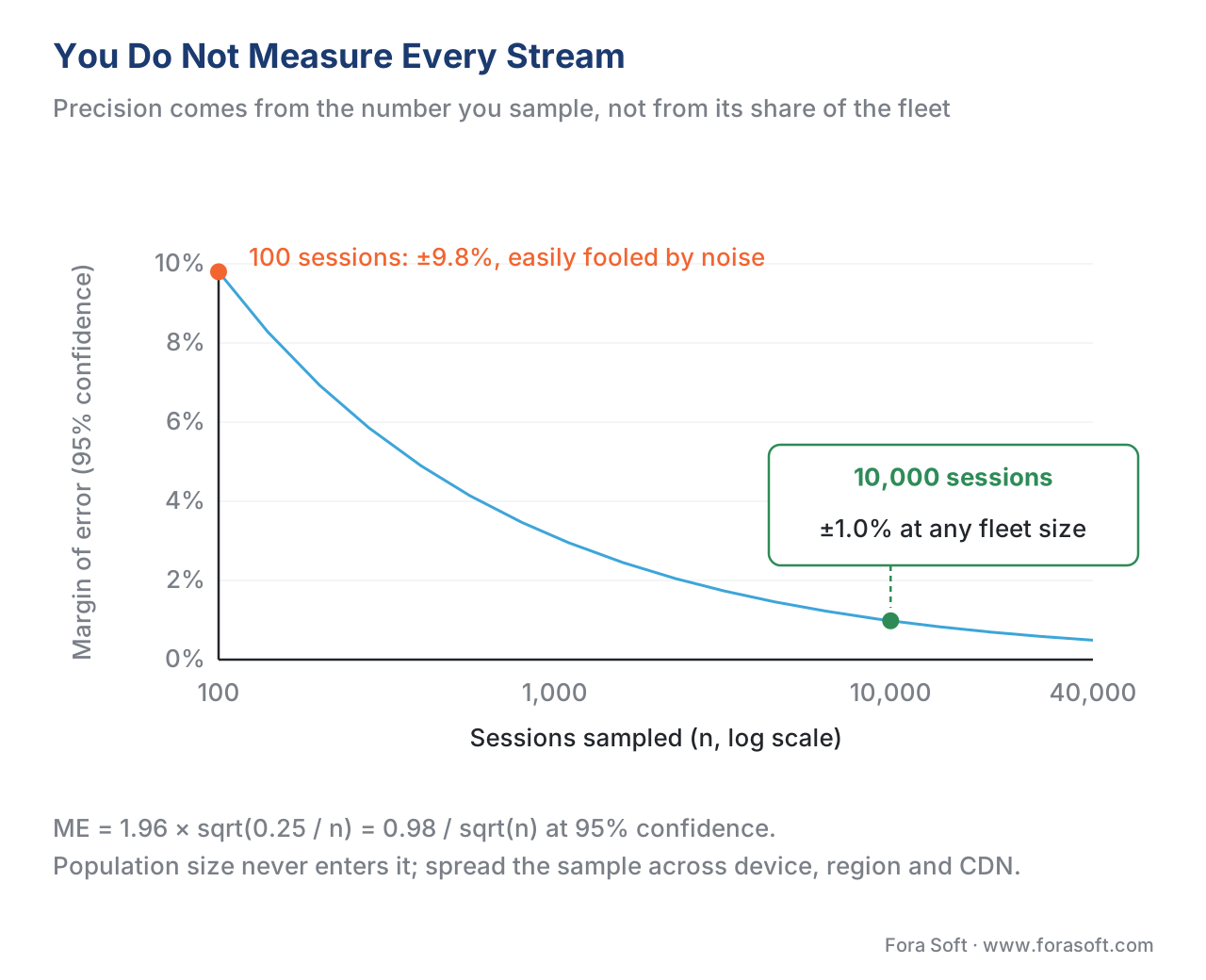 Figure 2. Why you sample instead of measuring everything. Margin of error falls as the square root of sample size, so precision is cheap at first and then flattens. About 10,000 measured sessions reach ±1% at 95% confidence; doubling again barely moves the number. The population size does not appear in the formula.
The global average lies: segment, or you are blind
The single most dangerous number in production monitoring is the global average, because it is exactly the number that hides the failure you most need to see. Picture a fleet-wide below-target rate sitting at a calm 0.85%. Inside it, one CDN edge serving one device type in one region has quietly jumped to 2.1% after a config push. Because that segment is a small share of total traffic, the global average barely twitches — it might read 0.88% — and the dashboard stays green while a few hundred thousand viewers get a degraded stream. The average did not lie about the fleet; it lied about those viewers, by drowning them.
The cure is to never trust an aggregate you have not sliced. Every quality metric is tagged at collection with the dimensions that localize a failure — device model, app version, OS, region, CDN, content type, encode profile — and monitored per segment, not just in total. This is precisely how large operators run it: Netflix's real-time playback observability tags every measurement with anonymized device, app, and region detail so it can isolate a problem affecting only one app version or one country, rather than watching a single global line (Netflix real-time observability, Imply case study, 2023). A monitoring system that shows you one number is not monitoring at scale; it is averaging at scale, which is worse than nothing because it manufactures false calm.
Alerting on a quality drop
A dashboard nobody is staring at must raise its own hand when quality falls, and the mechanism is the same control-chart logic the regression suite uses for drift — moved from the lab to live traffic and applied per segment. You establish a baseline for each metric in each segment over a stable period: a mean and a standard deviation. Then you set an alerting threshold a few standard deviations above the baseline, and fire when a fresh measurement window clears it. The recommended-practice approach is exactly this — a baseline equal to the mean of the aggregated metric per group, with the threshold set as a multiple of the standard deviation above that baseline (streaming QoE anomaly-detection practice, 2024).
Work it through with the segment from the last section. Suppose that segment's below-target rate has a stable baseline mean of 0.80% with a standard deviation of 0.15%. A three-sigma upper control limit is:
upper_limit = mean + 3 x sigma
            = 0.80% + 3 x 0.15%
            = 0.80% + 0.45%
            = 1.25%
The segment's current 2.1% sails past 1.25%, so the alert fires — and because the metric was segmented, the alert names the CDN, device, and region, turning "video is bad somewhere" into a page an on-call engineer can act on. Two tuning rules keep the system trusted rather than muted. Choose the sigma multiple to balance missed drops against false alarms — too tight and content-mix noise pages you nightly; too loose and a real cliff slips through. And require a breach to persist across a few windows before paging, so a single noisy minute does not wake anyone. An alert that cries wolf gets silenced within a week, and a silenced alert is the same as no monitoring at all.
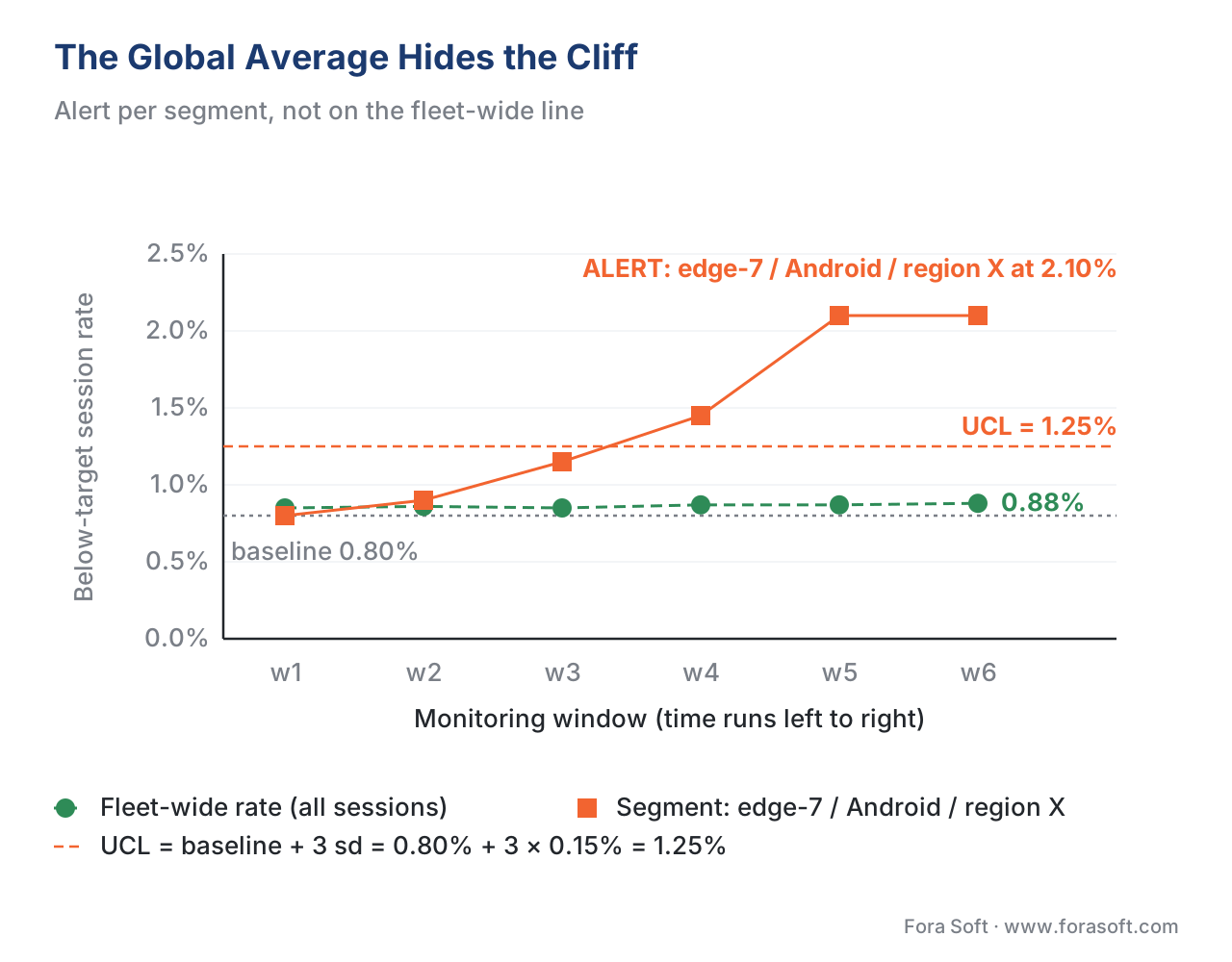 Figure 3. Alerting per segment. The global below-target rate stays calm inside its band, so a fleet-wide alert never fires. The CDN-and-device segment crosses its own baseline-plus-three-sigma limit and pages — localized, because every metric was tagged and monitored per segment.
Common mistakes that hollow out a monitoring program
The failure modes are predictable, and naming them is half the defense. The first is demanding a reference that is not there — wiring full-reference VMAF into a live or delivered-stream monitor, then wondering why it cannot run; the delivered stream has no original, so the tool is wrong, not broken. The second is trusting the global average, covered above: an unsegmented number is a comfort blanket that hides the localized cliff. The third is confusing encode quality with delivered quality — a green VMAF at encode time and a miserable session are fully compatible, because the encode metric never sees the rebuffering, the ABR down-switch, or the CDN error that happens between your packager and the viewer's eye.
The fourth is mistaking sampling for completeness in the wrong direction — either sampling so little that a rare-but-severe failure never appears, or sampling non-representatively so a tight margin of error describes one slice and is read as the fleet. The fifth is a fixed global threshold that ignores content mix: a hard "alert below VMAF 80" line fires all night the moment a high-motion sports event enters the catalogue, because hard content scores lower at the same true quality — which is why the alert is a per-segment deviation from that segment's own baseline, not one universal number. Underneath all five is the same root the rest of this section keeps returning to: a metric is only as honest as the conditions you read it under, and in production those conditions — reference or not, which segment, which content — change constantly.
 Figure 4. The three measurement setups side by side. Encode-time QC needs a reference and runs before launch; the two production-monitoring setups have no reference and each catches what the other misses — the delivered picture and the session experience are different measurements.
Where Fora Soft fits in
Fora Soft has built video streaming, OTT, conferencing, surveillance, e-learning, and telemedicine systems since 2005, and the difference between a demo and a service is usually what happens to quality after launch, at scale, when the source is gone and the traffic is real. We help teams stand up the monitoring this article describes: bitstream and parametric measurement (the ITU-T P.1203/P.1204 family) for delivered picture quality where there is no reference, player telemetry (CMCD and standardized QoE events) for the session experience, a sampling plan sized to the precision the team actually needs, and per-segment alerting that names the CDN, device, and region when something drops. For live products — conferencing, surveillance, live OTT — where no reference exists anywhere, the monitoring leans on the no-reference and telemetry side from day one. The goal is the same one a good encode pipeline has: catch the bad experience before the viewer reports it.

The handbook
Fora Soft Video Engineering Handbook
We wrote a seven-volume handbook that walks the whole video stack, from a single pixel to a running production system, across more than 9,000 pages; an engineer who works through it can design and build the monitoring this article describes. Volume 3, Video Streaming, is the closest to this topic - CDNs, player behaviour, QoE monitoring and the economics of delivery, which is where a production monitor reads its signal. Volume 1, Video Encoding, works out what PSNR, SSIM and VMAF measure and why a full-reference metric needs the master, and Volume 6, AI for Video, covers the learned models that score a stream once the master is gone. Written by Nikolay Sapunov, CEO at Fora Soft.
Do you know how good your video is right now, for the people watching it?
Tell us what your players report and what a probe can see at your edge, and we will say which measurement belongs where - a bitstream model on the delivered stream, telemetry on the session, a sample sized to the precision you actually need, and per-segment alerting that names the CDN, device and region instead of paging you about the fleet. 250+ video products shipped since 2005.
See our case studies
Case study
Worldcast Live
Concert streaming at 1.5 Gb/s with 0.4-0.5 s latency for 10,000 simultaneous viewers - live, so no pristine reference exists anywhere and the only quality signal is the delivered stream and what the players report.
Case study
Mindbox
An intelligent VMS with 50+ deployments pulling RTSP camera feeds through FFmpeg into HLS - hundreds of delivered streams to watch at once, where a fleet average would hide the one site that went bad.
Case study
Speed.Space
Remote production recording at 1080p and 8 Mbps for Netflix, Electronic Arts and HBO shoots - a fixed quality target that has to hold on real connections, not only in the lab.
What to read next
No-reference
No-reference quality for live and UGC
The blind metrics this monitor runs when there is no reference at all.
Telemetry
Player-side quality metrics and the analytics stack
Where CMCD and QoE events land, and what the backend does with them.
QoE
QoE vs QoS in video streaming
Why a flawless picture and a miserable session are two different numbers.
Pre-launch
Regression testing and golden references
The lab counterpart: catching drift while you still hold the master.
References
- Recommendation ITU-T P.1203. "Parametric bitstream-based quality assessment of progressive download and adaptive audiovisual streaming services over reliable transport." International Telecommunication Union, 2017. Tier 1 (official standard). The first standard for HTTP-adaptive-streaming QoE over 1–5 min sessions; predicts a 1–5 MOS from metadata/bitstream with no reference, integrating stalls and quality switching. Basis for the delivered-bitstream monitoring section and the no-reference framing. https://www.itu.int/rec/T-REC-P.1203
- Recommendation ITU-T P.1203.1. "Parametric bitstream-based quality assessment… — Video quality estimation module." International Telecommunication Union, 2017. Tier 1 (official standard). Defines the Pv module's Modes 0–3 (metadata only → frame type/size → frame-level QP). Basis for the "four input modes fit whatever a probe can see" point. https://www.itu.int/rec/T-REC-P.1203.1/en
- Recommendation ITU-T P.1204.3. "Video quality assessment of streaming services over reliable transport for resolutions up to 4K with access to full bitstream information." International Telecommunication Union, 2020. Tier 1 (official standard). The bitstream-based, no-reference member of the P.1204 family; segment-level MOS to UHD/4K. Basis for the higher-resolution no-reference monitoring point. https://www.itu.int/rec/T-REC-P.1204.3/en
- A. Raake, S. Borer, S. M. Satti, J. Gustafsson, R. R. Ramachandra Rao, et al. "Multi-model standard for bitstream-, pixel-based and hybrid video quality assessment of UHD/4K: ITU-T P.1204." IEEE Access, vol. 8, 2020. Tier 5 (peer-reviewed, by the standard's authors). Documents the P.1204 split: P.1204.3 bitstream/no-reference, P.1204.4 pixel/reference, P.1204.5 hybrid/no-reference. Basis for the "members split by the reference question" table. https://ieeexplore.ieee.org/document/9234526
- A. Raake, M.-N. Garcia, W. Robitza, P. List, S. Göring, B. Feiten. "A bitstream-based, scalable video-quality model for HTTP adaptive streaming: ITU-T P.1203.1." QoMEX, 2017. Tier 5 (peer-reviewed). The scalable Pv model across input modes. Basis for the bitstream-fingerprint explanation. https://www.itu.int/rec/T-REC-P.1203.1/en
- CTA-5004. "Web Application Video Ecosystem — Common Media Client Data (CMCD)." Consumer Technology Association, 2020 (CMCDv2 / CTA-5004-A, 2026). Tier 1 (standard). The common key-value vocabulary a player attaches to each media request (bitrate, buffer length, throughput, content/session IDs). Basis for the player-telemetry section. https://cdn.cta.tech/cta/media/media/resources/standards/pdfs/cta-5004-final.pdf
- CTA-2066. "Streaming Quality of Experience Events, Properties and Metrics." Consumer Technology Association, 2020. Tier 1 (standard). Standardizes streaming QoE events/metrics — rebuffering, startup time — so they mean the same thing across vendors. Basis for the standardized-telemetry point. https://shop.cta.tech/products/streaming-quality-of-experience-events-properties-and-metrics-cta-2066
- Netflix Technology Blog. "Video Quality at Scale with Cosmos Microservices." Netflix, Inc., 2021. Tier 4 (vendor engineering, credible deployer). The Video Quality Service (Optimus/Plato/Stratum on Cosmos) computes VMAF/SSIM on demand at catalogue scale. Basis for "full-reference measurement scales at encode time, where you still hold the source." https://netflixtechblog.com/video-quality-at-scale-with-cosmos-microservices-552be631c113
- Netflix / VMAF project. "VMAF Models" (Netflix/vmaf, resource/doc/models.md), accessed 2026-06-24. Tier 1 (metric-author primary). VMAF is a full-reference metric requiring the pristine source; the default/phone/4K models score differently. Basis for "VMAF needs the original, which the player does not have." https://github.com/Netflix/vmaf/tree/master/model
- "Netflix Delivers Real-Time Observability for Playback Quality." Imply (case study), 2023. Tier 6 (vendor case study). Netflix's playback telemetry tags each measure with anonymized device/app/region to isolate issues affecting one app version, device, or country. Basis for the "segment or you are blind" section. https://imply.io/case-studies/netflix-real-time-observability/
- W. Robitza, S. Göring, A. Raake, et al. "HTTP Adaptive Streaming QoE Estimation with ITU-T Rec. P.1203 — Open Databases and Software." ACM MMSys, 2018. Tier 5 (peer-reviewed). The open-source P.1203 implementation and dataset — how the model is deployed in practice. Basis for "P.1203 is a deployable monitoring tool, not only a lab model." https://dl.acm.org/doi/10.1145/3204949.3208124
- Recommendation ITU-R BT.500-15. "Methodologies for the subjective assessment of the quality of television pictures." International Telecommunication Union, 2023. Tier 1 (official standard). The subjective ground truth every objective monitor is ultimately validated against; when the monitor and a careful viewing disagree, the viewing wins. Basis for the measurement-honest framing. https://www.itu.int/rec/R-REC-BT.500
