


Why this matters
An encoding pipeline is not built once and left alone — it gets a new codec version, a tuned preset, a refactored filter chain, a dependency bump, and any one of them can lower the picture quality your viewers see without throwing an error. A regression test is the standing safety net that catches that: a fixed library of clips, a saved set of known-good scores, and an automatic comparison on every change. This article is for the encoding lead, the platform engineer, and the QA engineer who has to build that safety net and trust it — who needs to know which clips to put in it, what to compare against, and how to tell a real regression from the metric's own jitter. It is the test suite that sits behind the quality gate in CI/CD: the gate is the tripwire that fails one build; the regression suite is the curated reference library and the baseline scores that make the tripwire mean something over months and hundreds of builds.
A golden reference, borrowed from software testing
The term comes from software, not video, and the lineage is worth knowing because it tells you exactly what a golden reference is for. When a developer has a piece of code whose behaviour they want to protect through a refactor, they can write a characterization test — a test that records what the code currently does and then fails if a later change alters that recorded behaviour. The technique was named by Michael Feathers in Working Effectively with Legacy Code (2004), and it goes by two other names you will see in the same breath: golden master testing and approval testing. The recorded output — the snapshot the test compares against — is the golden master, or the golden reference (Feathers, 2004; Characterization test, Wikipedia, accessed 2026).
The mechanics are simple. The first time the test runs, it captures the output and saves it as the baseline; that capture is "blessed" as correct. Every run after that re-executes the code and compares the new output to the saved baseline. Same output, the test passes; different output, the test fails and a human looks at the diff to decide whether the change was intended (Anderson, Golden Master Regression, 2017). In "verification mode," as one practitioner puts it, the saved snapshot "works as a regression test" — it does not know what correct looks like, only what unchanged looks like.
A video quality regression test is the same machine pointed at the picture. The golden reference is a fixed, version-controlled source clip — or, more usefully, a set of them — together with the quality scores a known-good build produced on them. On every change to the encoding path, the pipeline re-encodes those exact clips with the new code, measures quality, and compares the new scores against the saved baseline. If quality dropped beyond a tolerance, the test fails. The reference is not a measure of good; it is a measure of unchanged. That distinction is the whole point of the technique, and it is what separates a regression test from the absolute floor in the quality gate: the floor asks "is this encode good enough?"; the regression test asks "is this encode worse than the one we already trusted?"
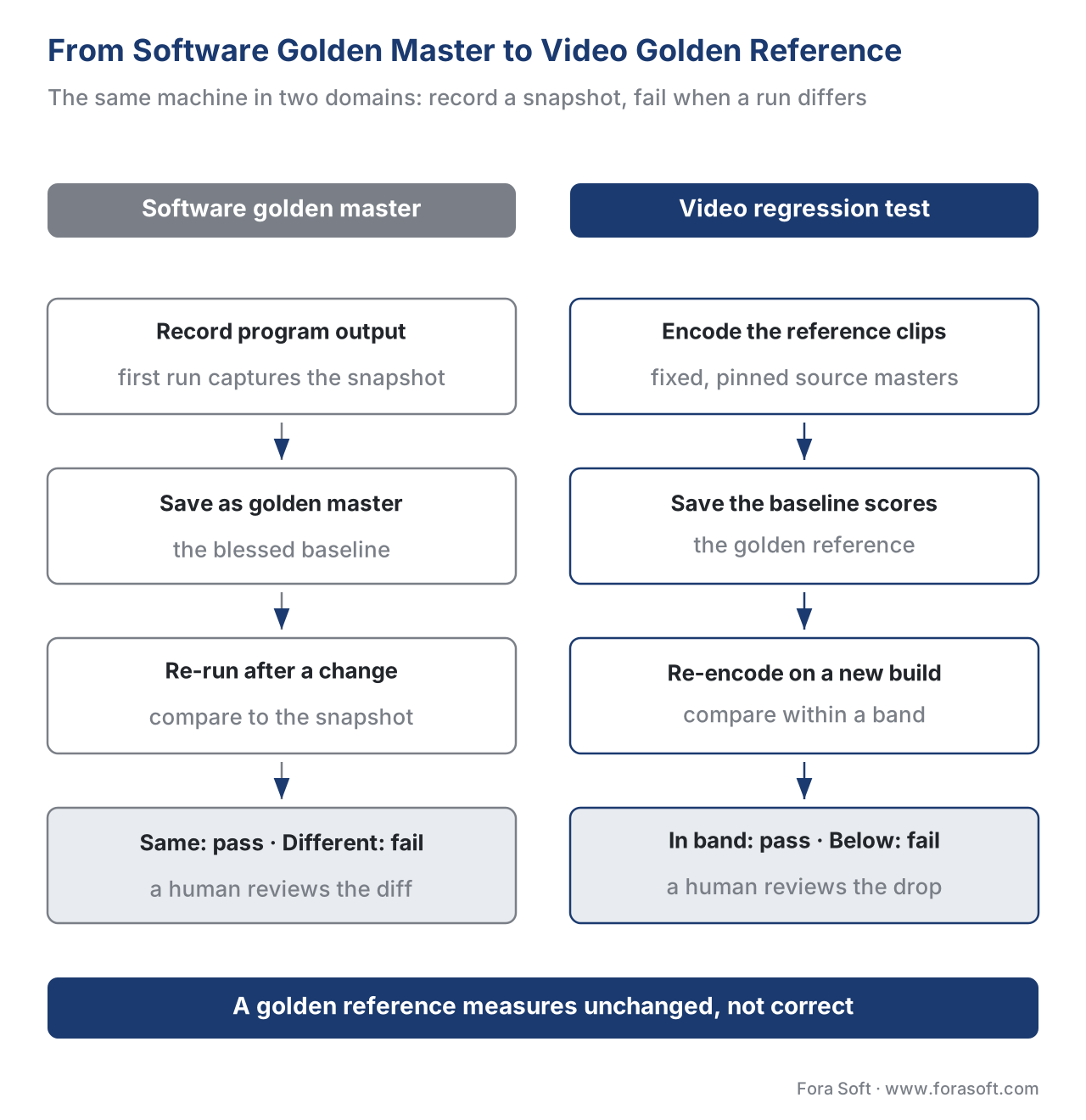 Figure 1. The same machine, two domains. Software golden-master testing records a snapshot of program output and fails when a later run differs; a video regression test records the quality scores of known-good encodes of fixed reference clips and fails when a new build scores worse. The golden reference measures "unchanged", not "correct".
What a golden reference clip actually is
A golden reference in video has two parts, and teams that skip the second one ship a test that drifts. The first part is the source master: a fixed, pristine clip, stored under version control or in pinned object storage, that never changes. It must be high quality with headroom to spare — if your reference source is already a mediocre 4 Mbps file, every encode of it scores low and the test cannot tell a good build from a bad one. Reference sources are chosen so a good encode lands in the upper range of the scale (VMAF roughly 92–95 on the top rung), where the test has room to see a drop (encoding practice; reference-clip selection guidance, 2024).
The second part is the baseline scores: the per-clip, per-rendition, per-frame quality numbers that the current production build produces on that source, recorded and committed alongside it. These are the golden master proper — the snapshot every future build is checked against. Saving the headline number alone is not enough; save the per-frame curve, because when a regression fires you will need to see where in the clip quality fell, not just that it did (reading the worst frames explains why the distribution matters more than the mean).
Three things must be pinned, or the baseline silently re-bases itself and the test goes flaky for reasons that have nothing to do with the encoder. Pin the source clip (a re-fetch from a public URL that changes is a different reference). Pin the VMAF model file — the default, phone, and 4K models produce different scores, so an unpinned model moves every baseline (VMAF in depth covers model selection). Pin the tool versions — the libvmaf filter's option syntax has shifted across FFmpeg releases, and a floating tool can change the number. This is the video equivalent of what approval-testing practitioners call a scrubber: the part of a golden-master harness that removes non-deterministic noise — timestamps, random IDs — before the comparison, so the test reacts only to real changes (approval-testing practice, octopusinvitro, 2021). You cannot scrub the VMAF score itself, so instead you lock everything that feeds it and absorb the residual noise with a tolerance band — which is the next section.
The threshold is a band, not a line
Here is where video departs from a textbook software golden master, and getting it wrong is the most common way these suites fail. A classic golden-master test does an exact comparison: byte-for-byte, the new output either matches the snapshot or it does not. That works when the output is deterministic. A video quality score is not deterministic. Run the same encode twice and VMAF can move by a few tenths of a point because most encoders are not bit-exact run to run — multithreading changes the output slightly. Layer on top of that the fact that VMAF is itself a prediction from a model trained on human scores, so it carries a confidence interval: Netflix's bootstrap models (for example vmaf_b_v0.6.3) report a standard deviation directly, where the 95% interval is roughly the score plus or minus 1.96 standard deviations (Netflix, VMAF Confidence Interval documentation, since v1.3.7, 2018).
So an exact comparison is the wrong tool. If you assert "new score must equal 93.4", the test fails on the first re-encode that returns 93.3, and a test that cries wolf on noise gets muted within a week. This is a known pattern far beyond video: non-deterministic systems are tested with tolerances and thresholds, not exact matches — acceptable numerical ranges or approximate-equality operators with a defined tolerance (testing practice for non-deterministic systems, 2025). The golden master for a video metric is therefore a band: a baseline score plus an allowed-drop tolerance.
The right width for that band is the metric's own noise, and it falls out of arithmetic rather than guesswork. Combine the model's standard deviation and the encoder's run-to-run standard deviation in quadrature, then scale to 95%:
combined_sigma = sqrt(model_sigma^2 + run_to_run_sigma^2)
               = sqrt(0.5^2 + 0.3^2)
               = sqrt(0.34)
               = 0.58 VMAF

tolerance band = 1.96 x 0.58 = 1.14 VMAF
A drop inside about 1.1 VMAF on this clip is indistinguishable from noise and must pass; a drop beyond it is a real change worth a human's attention. (The quality gate article walks the same quadrature for the single-build gate; the regression suite applies it per clip, because the noise differs by content — a high-motion clip jitters more than a static one.) Each reference clip and each rendition therefore gets its own band, measured once when the baseline is blessed:
| Reference clip | Content stress | Baseline VMAF (1080p) | Measured noise band | Fail if drop exceeds |
|---|---|---|---|---|
grain_field |
Film grain, texture | 94.1 | ±1.2 | 1.2 VMAF |
night_drive |
Dark, low-light | 92.8 | ±1.5 | 1.5 VMAF |
sports_pan |
High motion | 91.6 | ±1.6 | 1.6 VMAF |
screen_share |
Text, sharp edges | 95.3 | ±0.9 | 0.9 VMAF |
animation_2d |
Flat color, gradients | 96.0 | ±0.7 | 0.7 VMAF |
Table 1. Each golden reference carries its own baseline and its own noise-sized band. Noisier content (dark, high-motion) earns a wider band; clean content (animation, screen text) a tighter one. A build fails the clip when its drop from baseline exceeds that clip's band. Numbers are illustrative; measure your own per clip and encoder.
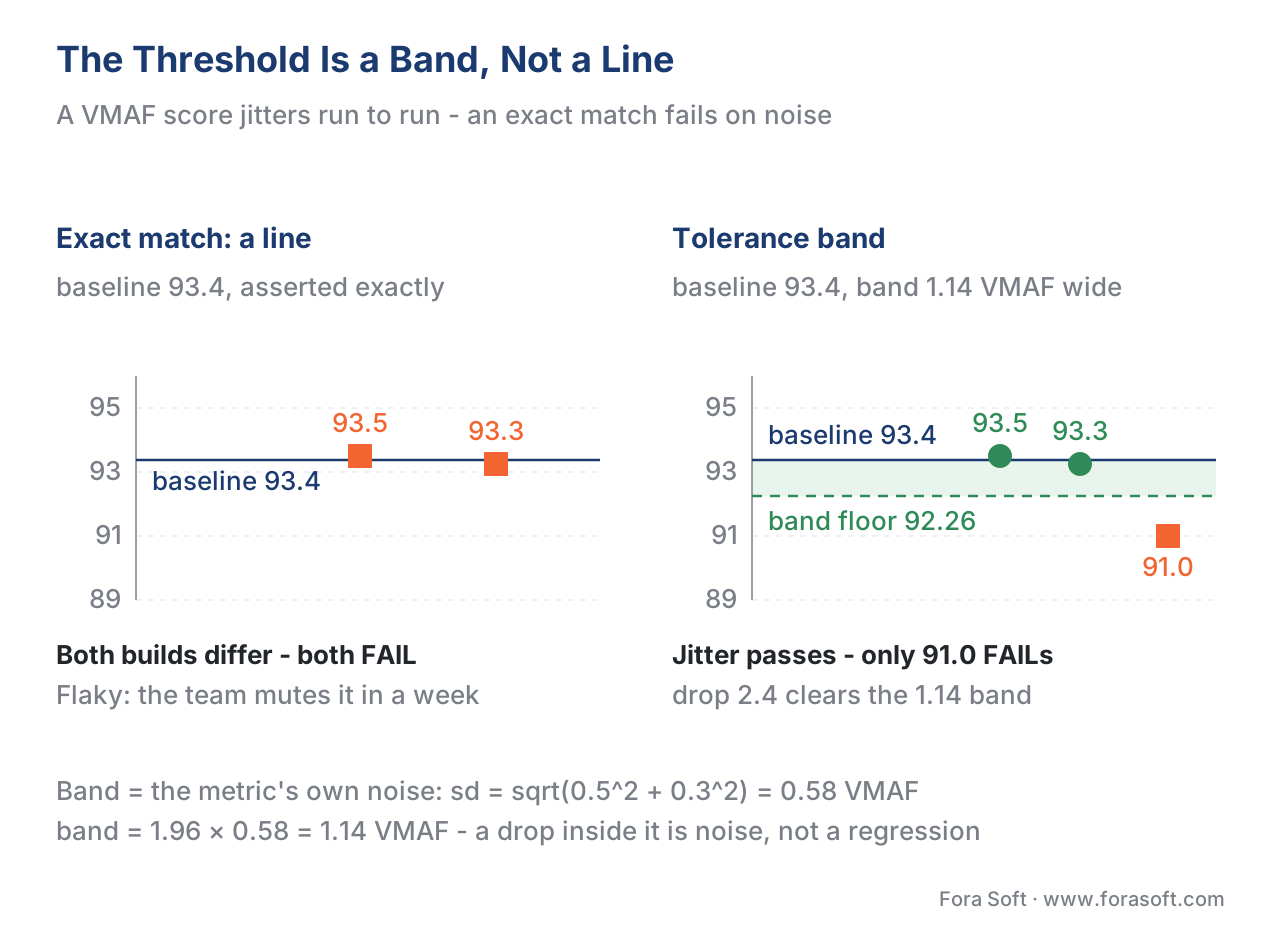 Figure 2. Why the comparison is a band, not a line. An exact-match line (left) fails on every re-encode that jitters by a tenth of a point. A tolerance band (right), sized to the metric's combined model-and-encoder noise, passes the jitter and fails only a drop that clears the noise — a real regression.
One clip is not a suite: building the reference set
A regression suite with a single clip tests one kind of content and is blind to the rest. The danger is specific: objective metrics have content-dependent blind spots, so a regression that only shows up on, say, a dark gradient will sail past a suite built from a bright talking-head clip. The job of the reference set is to span the content that breaks encoders and the content that fools metrics, so that whatever a change degrades, some clip in the set feels it.
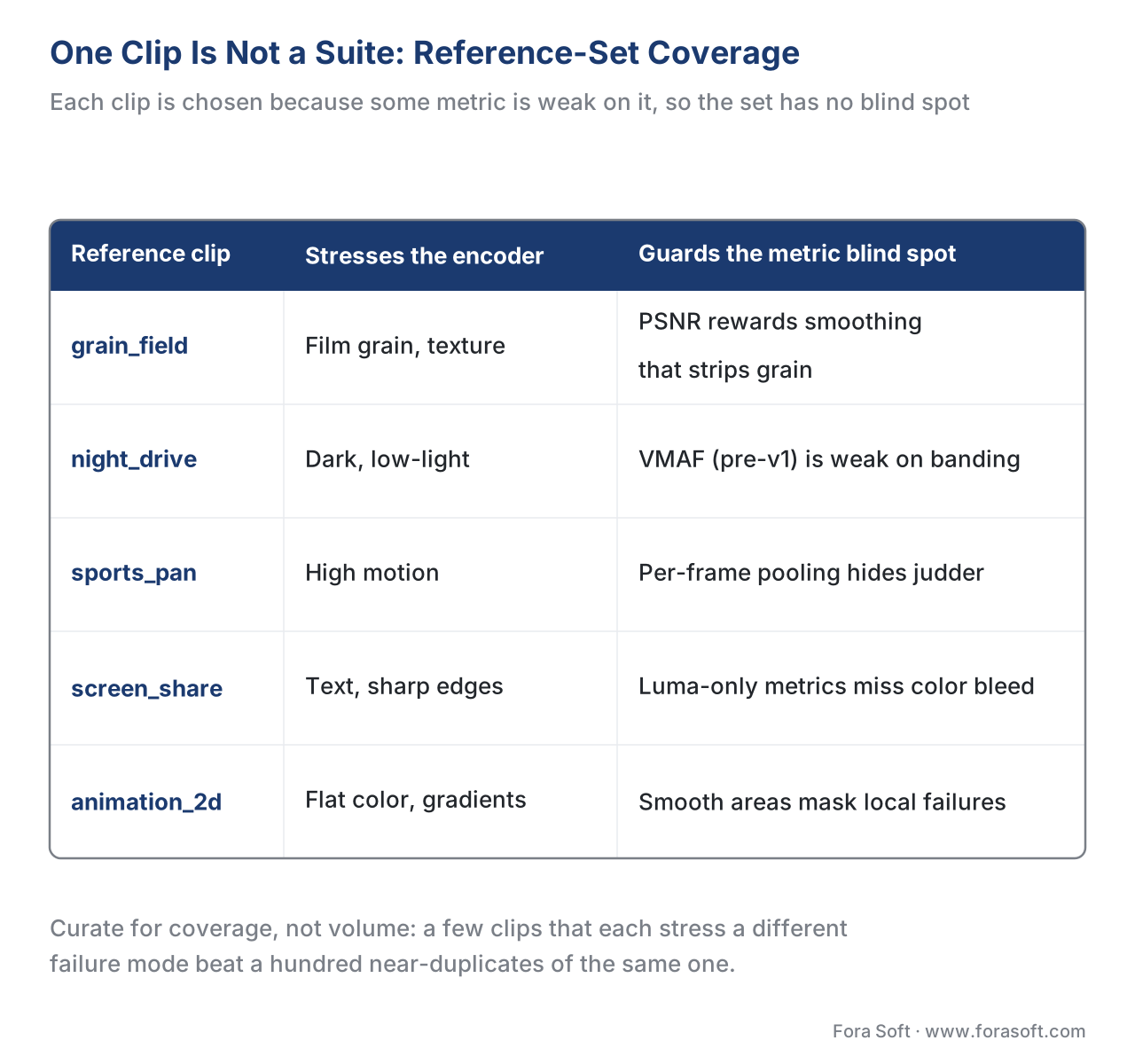 Figure 3. The reference set as a coverage map. Each clip earns its place by stressing a different encoder weakness and guarding a different metric blind spot, so no single failure mode is left untested.
Curate for coverage, not volume. A handful of well-chosen clips that each stress a different failure mode beats a hundred near-duplicates. The standard hard cases, each mapped to the artifact it provokes and the metric weakness it exposes:
| Content type | What it stresses in the encoder | The metric blind spot it guards | Link |
|---|---|---|---|
| Film grain / texture | Detail retention vs denoising | PSNR rewards smoothing that strips grain | where objective metrics lie |
| Dark / low-light | Banding in near-black gradients | VMAF (pre-v1) is weak on banding | banding |
| High motion / sports | Temporal handling, frame drops | Per-frame pooling hides judder | judder |
| Screen content / text | Sharp edges, ringing, chroma | Luma-only metrics miss color bleed | color artifacts |
| Animation / flat color | Gradient banding, contouring | Smooth areas mask local failures | banding |
Table 2. A reference set spans the content that breaks encoders and the content that fools metrics. Each clip is chosen because some metric is weak on it, so the suite as a whole has no blind spot a single clip would leave open.
This is also where a regression suite earns its keep beyond a single gate: by holding a standing library of the content types your real catalogue contains, it turns "the encode looks fine on my test clip" into "the encode held quality across grain, dark, motion, text, and animation." Curating that library is a one-time investment that pays back on every build for the life of the pipeline. The cause-side reasons each content type is hard — bit depth and grain, frame-rate handling, chroma subsampling — live in the Video Encoding section; the suite's job is to measure the result, not re-derive the mechanism.
The regression no single build trips: catching slow drift
The most dangerous regression is the one no individual build is guilty of. Picture a baseline at VMAF 96.0 and a tolerance band of 1.1. Build by build, quality slips: 96.0 → 95.6 → 95.2 → 94.8 → 94.4 → 94.0. Every single step is a drop of 0.4 VMAF — comfortably inside the 1.1 band — so a check that only compares each build to the last good build passes every one of them, forever. Six builds later, quality has fallen 2.0 VMAF from where it started, a third of a just-noticeable difference (one JND ≈ 6 VMAF; Ozer, 2017) and heading toward visible, and a compare-to-last test never showed a single red build.
Compare-to-last-build (each step vs the previous):
  96.0 -> 95.6   step 0.4  < 1.1  PASS
  95.6 -> 95.2   step 0.4  < 1.1  PASS
  95.2 -> 94.8   step 0.4  < 1.1  PASS
  94.8 -> 94.4   step 0.4  < 1.1  PASS
  94.4 -> 94.0   step 0.4  < 1.1  PASS   <- never fires

Compare-to-frozen-baseline (each build vs the original 96.0):
  build 3: 95.2  cumulative 0.8  < 1.1  PASS
  build 4: 94.8  cumulative 1.2  > 1.1  FAIL  <- caught here
  build 6: 94.0  cumulative 2.0  > 1.1  (already failing)
The fix is a discipline, not a cleverer threshold: always compare against a frozen golden baseline, not only against the previous build. The frozen baseline is the snapshot blessed when the suite was created (or last deliberately re-based); it does not move because a build nudged it. Comparing every build to that fixed point turns the slow slide into a cumulative number that clears the band the moment the total loss exceeds it — here at build four, the first build whose cumulative drop (1.2) beats the 1.1 band, even though build four's own step was a tiny 0.4. Pairing this with a trend view — plotting each build's score against the frozen baseline over time, the way a control chart watches a process — lets a human see the slope long before it crosses the line.
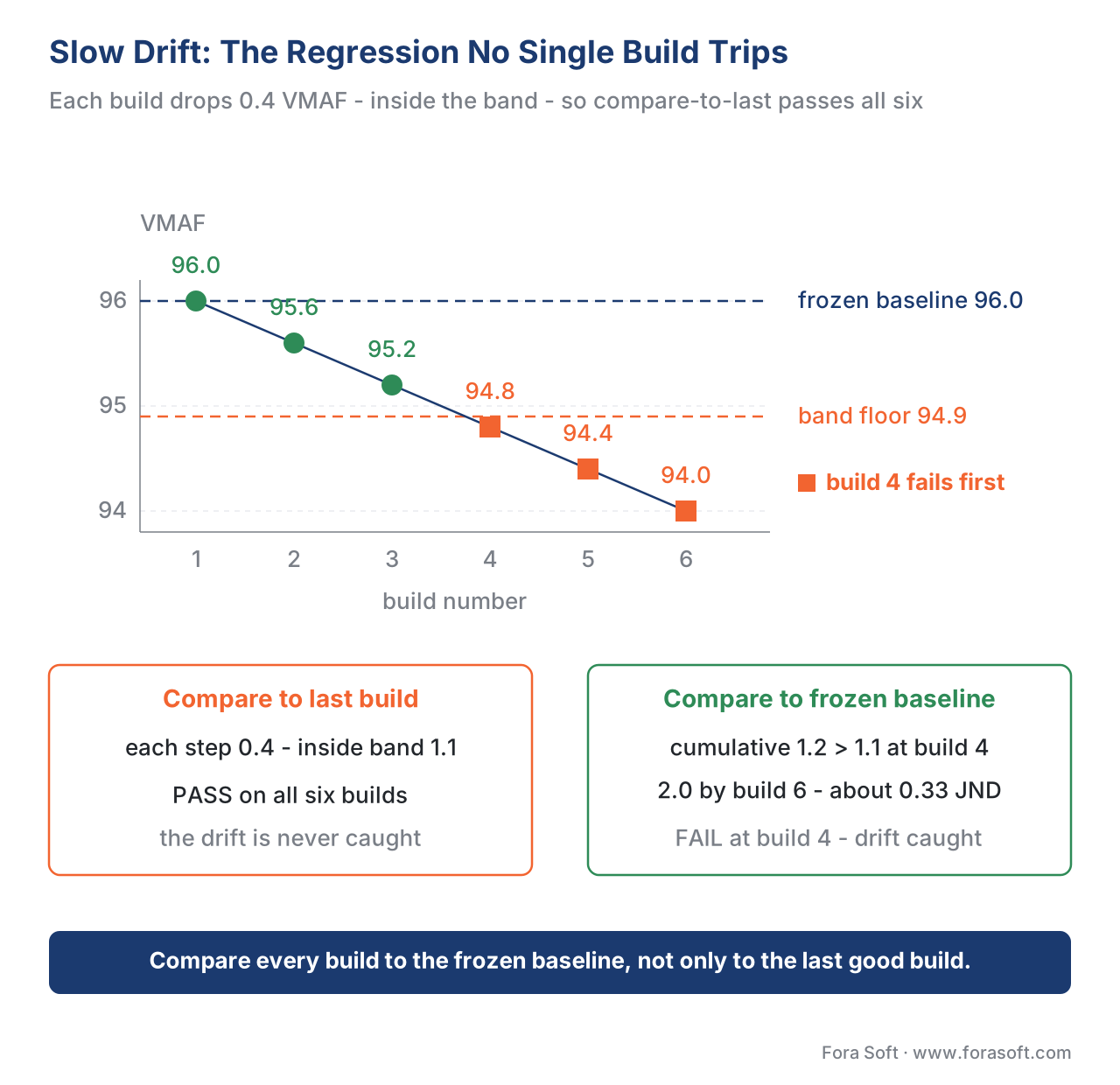 Figure 4. Slow drift defeats a compare-to-last-build test. Each step (0.4 VMAF) sits inside the noise band, so a build-to-build check passes all six. Measured against the frozen baseline, the cumulative loss clears the band at build four — the regression the suite must catch.
Re-baselining without blessing a regression
A frozen baseline is the point of the technique, but baselines do sometimes have to move — and how you move them is where a regression suite is quietly compromised or kept honest. There are exactly two legitimate reasons to re-bless a golden master. The first is a deliberate, verified quality improvement: a better encoder truly raises VMAF, you confirm it on the per-frame curves and ideally a quick subjective check, and you commit the higher scores as the new baseline. The second is a measurement change you have decided to adopt: most importantly a VMAF model upgrade — for instance to VMAF v1 (June 2026), which adds chroma and banding awareness the older models lacked (Netflix Technology Blog, VMAF v1, 2026) — which shifts every score and forces a clean re-measurement of every baseline in the same change.
The failure mode to refuse is re-baselining on red: a build comes in low, and someone "fixes" the failing test by blessing the new, lower scores as the baseline. That does not fix the regression; it launders it into the new normal, and the next slide starts from there. The guard is process: re-baselining is an explicit, reviewed, human-approved action — never an automatic "update baseline on failure." The golden master is approved the same way a pull request is, by a person who looked at the diff and the per-frame plot and decided the change was intended. Bake that into the tooling: the suite should refuse to overwrite a baseline unless a human passes an explicit approve flag, so a red build can never silently become the new green.
When the bitrate changes too: compare on the curve
One case breaks a fixed-bitrate regression check. If a change alters both the bitrate and the quality — a new codec spending fewer bits, say — comparing VMAF at a single operating point is unfair to whichever build spends less. The honest comparison holds quality constant and asks about bits: BD-rate (Bjontegaard Delta rate) reports the average bitrate difference between two encodes at matched quality, where a negative number means equal quality for fewer bits (Bjontegaard, VCEG-M33, 2001). For a codec or preset upgrade in the suite, run each reference clip at several bitrates, build the rate-quality curve, and regression-test the BD-rate against the baseline curve — so a genuine efficiency win passes even though the per-file VMAF moved, and a build that needs more bits for the same quality fails. Keep BD-rate distinct from the quality score: it is a saving at equal quality, not a quality number. Our own BD-rate method and figures are in BD-rate explained, with our numbers.
A common mistake: testing against last green instead of a frozen baseline
The two errors that hollow out a regression suite are mirror images, and both come from forgetting what a golden master is. The first is compare-to-last-build, the drift trap from earlier: by always measuring against the most recent green build, the suite lets quality erode one sub-threshold step at a time and never fires. The cure is the frozen baseline plus a trend view. The second is re-baselining on failure: making a red test green by accepting the lower scores, which blesses the regression instead of catching it. The cure is an explicit, human-approved re-baseline that can only happen on purpose. Both mistakes share a root — a golden reference only protects you while it stays fixed and is only moved deliberately. The ground truth behind all of it is still a properly run subjective test (ITU-R BT.500-15, 2023): when the suite and a careful viewing disagree, the viewing wins, and the suite is recalibrated to match the eye, not the other way around.
Free download: Golden-reference regression suite toolA dependency-free Python tool that runs the suite this article describes: it loads a frozen baseline, checks every build against it per clip and per rendition inside that clip's own noise band, and refuses to re-bless a baseline without an explicit human approval flag.Where Fora Soft fits in
Fora Soft has built video streaming, OTT, conferencing, e-learning, surveillance, and telemedicine systems since 2005, and on the ones with their own encoding pipeline a regression suite is what keeps a routine dependency bump or codec upgrade from quietly eroding the picture over a quarter. We help teams stand up the suite this article describes — a curated reference library that spans their real content types, frozen baselines with per-clip noise bands, a frozen-baseline drift check rather than a compare-to-last-build one, and a re-baseline step that a human has to approve on purpose. Where a project needs the rate-quality data behind a baseline for a specific codec and content type, our measured benchmarks (see our benchmark methodology) supply the starting numbers. The aim is a suite that stays quiet for months and then goes red on exactly the build that deserved it.
The handbook
Fora Soft Video Engineering Handbook
We wrote a seven-volume handbook that walks the whole video stack, from a single pixel to a running production system, across more than 9,000 pages; an engineer who works through it can design an encoding pipeline and the measurement that keeps it honest. Volume 1, Video Encoding, is the one to open after this article - codecs, presets and the quality metrics your reference clips are scored with, plus the rate-quality data a baseline is anchored to. Volume 3, Video Streaming, carries the same discipline downstream into ABR ladders, players and QoE monitoring, and Volume 6, AI for Video, covers the model artifacts and inference behind a trained metric like VMAF - the file you pin so a baseline never moves on its own. Written by Nikolay Sapunov, CEO at Fora Soft.
Would your pipeline tell you if the next build quietly lowered the picture?
Send us your reference clips and the scores you keep, and we will tell you what the suite is missing: a reference source with no headroom, a band guessed instead of measured per clip, a check that compares each build to the last one and so never sees the slide, or a baseline that gets re-blessed whenever the test goes red. 250+ video products shipped since 2005.
See our case studies
Case study
Speed.Space
A remote production platform recording at 1080p and 8 Mbps for Netflix, Electronic Arts and HBO shoots, where creators set resolution, fps, codec and bitrate themselves - every one of those knobs is a change a frozen baseline exists to catch.
Case study
Mindbox
An RTSP to FFmpeg to HLS transcoding path shipped in 50+ deployments across transport, pharma and gated communities - one preset change reaches every site at once, which is exactly when a suite has to be red before the build leaves CI.
Case study
Worldcast Live
Concert streaming at 1.5 Gb/s with 0.4-0.5 s latency for 10,000 simultaneous viewers, where there is no second take: the reference clips have to fail in the pipeline, because nothing can be re-encoded after the show.
What to read next
CI/CD
Quality gates in CI/CD for video encoding
The tripwire this suite feeds: hard gates, soft gates and what stops a build.
Targets
Setting a quality target and a quality budget
Where the number comes from before you freeze it as a baseline.
VMAF
VMAF in depth: models, 4K and confidence intervals
The model file you have to pin, and the interval that sizes the band.
Pooling
Video quality pooling: per-frame to one number
Why the per-frame curve is saved with the baseline, not just the mean.
References
- Michael C. Feathers. Working Effectively with Legacy Code. Prentice Hall, 2004. Tier 6. Coins the "characterization test" — a test that records existing behaviour and fails when a later change alters it. The conceptual origin of the golden-reference regression test applied here to video quality. https://www.oreilly.com/library/view/working-effectively-with/0131177052/
- "Characterization test." Wikipedia, accessed 2026-06-24. Tier 6. Summary of characterization / golden-master testing: protects existing behaviour against unintended change; the first run captures the "golden master", later runs compare against it. Basis for the borrowed-from-software framing. https://en.wikipedia.org/wiki/Characterization_test
- Adam Perry (anp). "Snapshots: Automating Golden Master Regression Tests." 2017. Tier 6. The mechanics of a golden-master test: capture output as the baseline on first run, compare every later run to it, fail on difference, human reviews the diff. Basis for the record-then-verify description. https://blog.anp.lol/rust/2017/08/18/golden-master-regression-in-rust/
- "Approval testing: Golden Master and seams." octopusinvitro, 2021. Tier 6. The "scrubber" that removes non-deterministic / flaky data before comparison; approval-testing terminology. Basis for the pin-and-scrub analogy (lock model, tool, and source so only real change shows). http://octopusinvitro.gitlab.io/blog/code-and-tech/approval-testing
- Netflix / VMAF project. "VMAF Confidence Interval" (Netflix/vmaf,
resource/doc/conf_interval.md), since v1.3.7 (June 2018), accessed 2026-06-24. Tier 1 (metric-author primary). The bootstrap models (vmaf_b_v0.6.3), theBOOTSTRAP_VMAFscore / stddev / ci95 outputs, and the 95% CI ≈ score ± 1.96·stddev, tighter at higher scores. Basis for the noise-band arithmetic (the model_sigma term) and the "a VMAF score is a prediction with a confidence interval" rule. https://github.com/Netflix/vmaf/blob/master/resource/doc/conf_interval.md - Netflix / VMAF project. "VMAF Models" (Netflix/vmaf,
resource/doc/models.md), accessed 2026-06-24. Tier 1 (metric-author primary). The default / phone / 4K models score differently, so the model file must be pinned and a model change re-bases every baseline. Basis for the pin-the-model rule. https://github.com/Netflix/vmaf/tree/master/model - Reza Rassool. "VMAF Reproducibility: Validating a Perceptual Practical Video Quality Metric." IEEE BMSB, 2017. Tier 5. VMAF correlates with subjective MOS at ~0.948 in independent validation (vs Netflix's ~0.963/0.939), and ~93 maps to MOS 4–5; basis for the reference-clip quality-headroom target (top rung ~92–95). https://realnetworks.com/sites/default/files/vmaf_reproducibility_ieee.pdf
- A. Kah, C. Friedrich, T. Rusert, C. Burgmair, W. Ruppel, M. Narroschke. "Fundamental relationships between subjective quality, user acceptance, and the VMAF metric…" SPIE 11842-38, 2021. Tier 5. Transparency ≈ VMAF 95; no visible difference within ~2 VMAF. Basis for framing a ~2 VMAF cumulative drift as heading toward visible. https://www.hs-rm.de/fileadmin/user_upload/SPIE_11842-38_HSRM.pdf
- Jan Ozer. "Finding the Just Noticeable Difference with Netflix VMAF." Streaming Learning Center, 2017. Tier 6. Records Netflix's guidance that ~6 VMAF points ≈ 1 JND; basis for expressing a 2.0-VMAF cumulative drift as ~0.33 JND. https://streaminglearningcenter.com/codecs/finding-the-just-noticeable-difference-with-netflix-vmaf.html
- Gisle Bjontegaard. "Calculation of average PSNR differences between RD-curves." ITU-T VCEG, document VCEG-M33, 2001. Tier 1 (method-author primary). Defines BD-rate — the average bitrate difference between two encodes at matched quality. Basis for the "when the bitrate changes too, regression-test the BD-rate" section. https://www.itu.int/wftp3/av-arch/video-site/0104_Aus/VCEG-M33.doc
- Recommendation ITU-R BT.500-15. "Methodologies for the subjective assessment of the quality of television pictures." International Telecommunication Union, 2023. Tier 1. The subjective-assessment ground truth the suite's metric is validated against; basis for the rule that a careful viewing overrides the suite when they disagree. https://www.itu.int/rec/R-REC-BT.500
- Mason K. "Wiring VMAF (and PSNR) into your encoder CI with FFmpeg 8.1 and ffmpeg-quality-metrics." DEV Community, 2026. Tier 6. A concrete CI regression check: per-rendition floors, exit non-zero on regression, cache the reference master, pin the model like a lockfile, keep per-frame JSON ≥30 days, and the frame/colour/resolution gotchas. Basis for the pin-the-inputs and keep-per-frame-data points. https://dev.to/masonwritescode/wiring-vmaf-and-psnr-into-your-encoder-ci-with-ffmpeg-81-and-ffmpeg-quality-metrics-1g6i
