


Why this matters
An encoder is software, and software changes — a new codec version, a tuned preset, a per-title algorithm, a refactor — can quietly lower the picture quality your viewers see, and you will not notice until support tickets arrive. A quality gate is the test that catches that regression in the pipeline, the same way a unit test catches a logic bug, by failing the build automatically. This article is for the encoding or streaming lead, the platform engineer, and the QA engineer who has to wire a quality threshold into a build and then defend it when it goes red. It turns "the encode still looks fine, probably" into a number the pipeline checks on every change. It is the automation that enforces the target from setting a quality target and a quality budget: that article tells you which score to aim at; this one makes the pipeline refuse to ship below it.
A quality gate, borrowed from software
The phrase comes from software engineering, not video. In a code pipeline, a quality gate is a set of pass/fail conditions — test coverage above 80%, zero new critical bugs, duplicated lines under 3% — that a change must satisfy before it is allowed to merge or deploy; if any condition fails, the gate fails and the pipeline stops (SonarSource, Quality Gates documentation, 2026). The idea is simple and powerful: encode the team's definition of "good enough" as a machine check, and let the build enforce it so no human has to remember to.
A video quality gate is the same idea pointed at the picture instead of the code. The condition is no longer "coverage ≥ 80%" but "the perceptual quality score of this encode ≥ 93", and the thing being measured is not a source file but a short, fixed test clip run through the encoder. When an engineer opens a pull request that touches the encoding path, the pipeline encodes the test clip with the new code, measures the quality, compares it to a threshold, and fails the build if the score fell too far. The bad change never merges. That is the whole mechanism; the rest of this article is how to choose the metric, set the threshold, and avoid the traps that make a gate either useless or maddening.
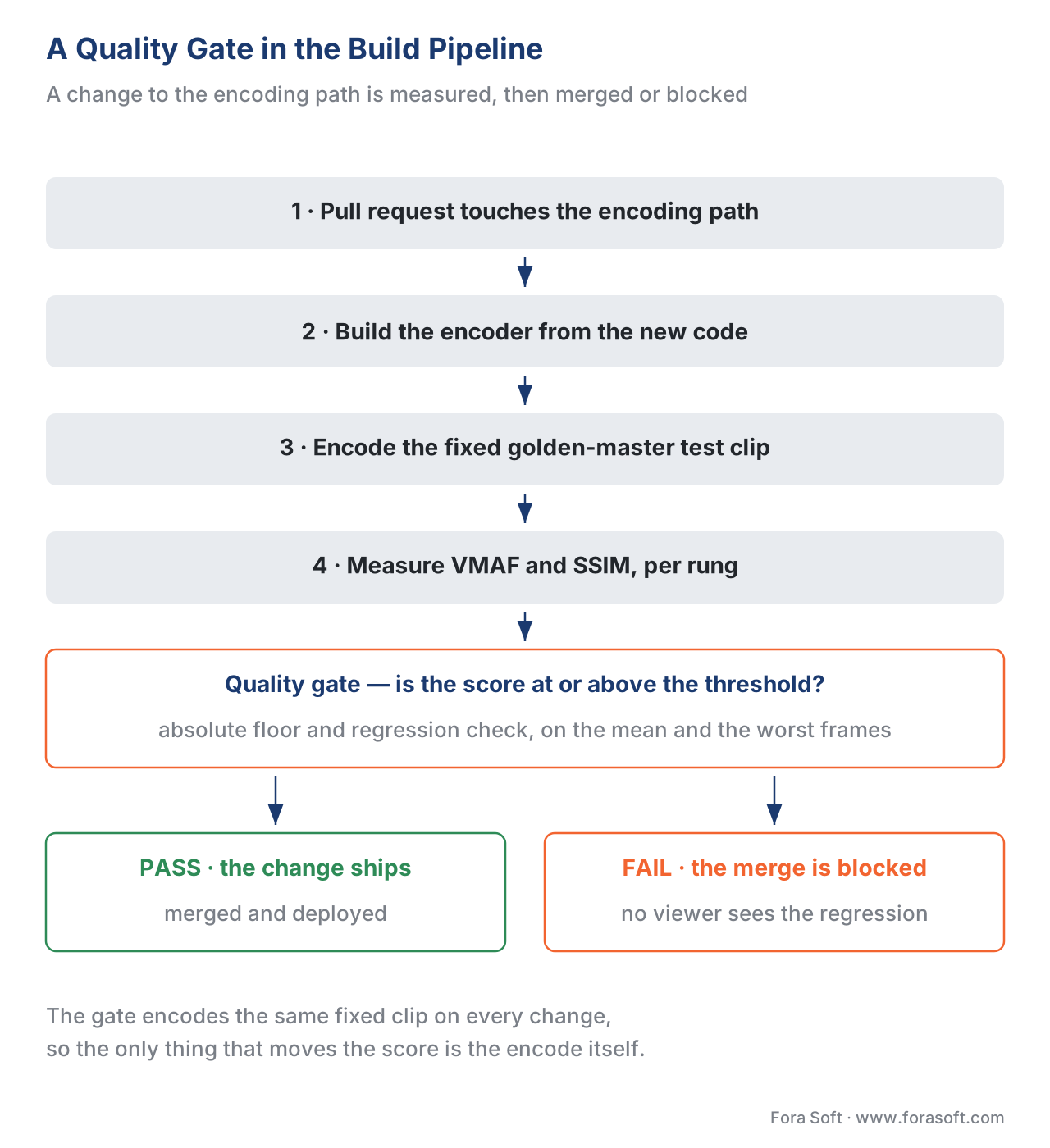 Figure 1. A video quality gate sits in the build pipeline. A change to the encoding path triggers an encode of a fixed test clip, a quality measurement, and a threshold check. Pass and the change merges; fail and the pipeline blocks it before any viewer sees the regression.
Why the gate must be perceptual: the PSNR-up, VMAF-down trap
The first decision is which number to gate on, and it is the decision most teams get wrong. For a decade the default check was PSNR — peak signal-to-noise ratio, the metric that measures how far each compressed pixel sits from the original, in decibels, higher being closer (see PSNR explained). PSNR is cheap, deterministic, and easy to threshold. It also measures the wrong thing. PSNR counts pixel error; it does not know whether the error is in a place a viewer would notice, so it correlates only weakly with what people actually see.
The gap becomes a real bug in one specific, common case. Modern encoders use psychovisual optimizations — they deliberately add or keep detail (film grain, texture) that the eye likes but that differs from the source pixel-for-pixel. Those tricks raise perceived quality and lower PSNR, because they increase pixel error on purpose (Twitter Engineering, VMAF percentiles, 2020, notes that x264's psychovisual tuning lowers PSNR while improving the look). Turn the case around and you get the dangerous one: an encoder change that strips that detail to chase pixel accuracy will make PSNR go up while the picture looks worse. A PSNR-only gate sees the higher number, declares success, and ships the regression.
A worked example makes it concrete. Two builds encode the same 720p test clip:
| Build | PSNR (dB) | VMAF (0–100) | What a viewer sees |
|---|---|---|---|
| Last good | 41.8 | 88.7 | Crisp detail, natural texture |
| New (PR) | 42.4 | 79.1 | Smoothed, plasticky, detail gone |
Table 1. PSNR rose 0.6 dB while VMAF fell 9.1 points. A PSNR-only gate passes the new build; a VMAF gate fails it. The regression is real — the encoder traded visible quality for pixel accuracy (example after Mason K, DEV, 2026).
 Figure 2. The trap a PSNR gate walks into. The new build's PSNR rises (better pixel accuracy) while its VMAF falls nine points (worse to the eye). A PSNR-only gate reads the higher number and ships the regression; the VMAF gate fails it.
This is why the gate is built on a perceptual metric: one trained to predict human ratings. The standard choice is VMAF — Video Multimethod Assessment Fusion, Netflix's metric scored 0–100, where higher is closer to the original to a human eye (see VMAF explained). VMAF catches the trade PSNR misses, because it was fused from features that track perceived detail and motion, then validated against subjective scores. PSNR still has a place as a cheap secondary signal — a large PSNR swing is worth a look — but it must never be the gate's primary condition. The reason traces to the most important rule in this section: every objective metric is a proxy for the viewer, and the proxy that ignores perception is the one that ships the perceptual bug. (For the full catalogue of where each metric lies, see where objective metrics lie.)
Two gates, not one: the floor and the regression check
A useful gate is really two checks with different jobs, and running only one leaves a hole.
The absolute floor is the simpler check: never ship a rendition below score X. It catches an encode that is bad in absolute terms — a corrupt output, a misconfigured rung, a resolution that fell off a cliff. The floor comes straight from the quality target: a premium top rung is "good enough" near VMAF 93 and transparent (indistinguishable from the source) near VMAF 95 (Rassool, IEEE, 2017; Kah et al., SPIE, 2021), so a sensible floor for that rung sits a little below the target, around 90–92. Each rung gets its own floor; the bottom rung's floor is far lower by design.
The regression check is the one that catches a bad encoder upgrade, and it is comparative: never drop more than a small margin below the last known-good build on the same clip. It needs a golden reference — a fixed, version-controlled test clip (or a small set) encoded by the current production code, whose scores are the baseline every new build is measured against (see regression testing and golden references for the full treatment). The floor would happily pass a build that quietly slipped from VMAF 96 to VMAF 93 — both clear 90 — but that 3-point slide is a real regression the team should see. Only the regression check catches it.
The two together cover both failure shapes: the floor stops an encode that is bad on its own, and the regression check stops an encode that is worse than what you shipped yesterday. A serious pipeline runs both on every change.
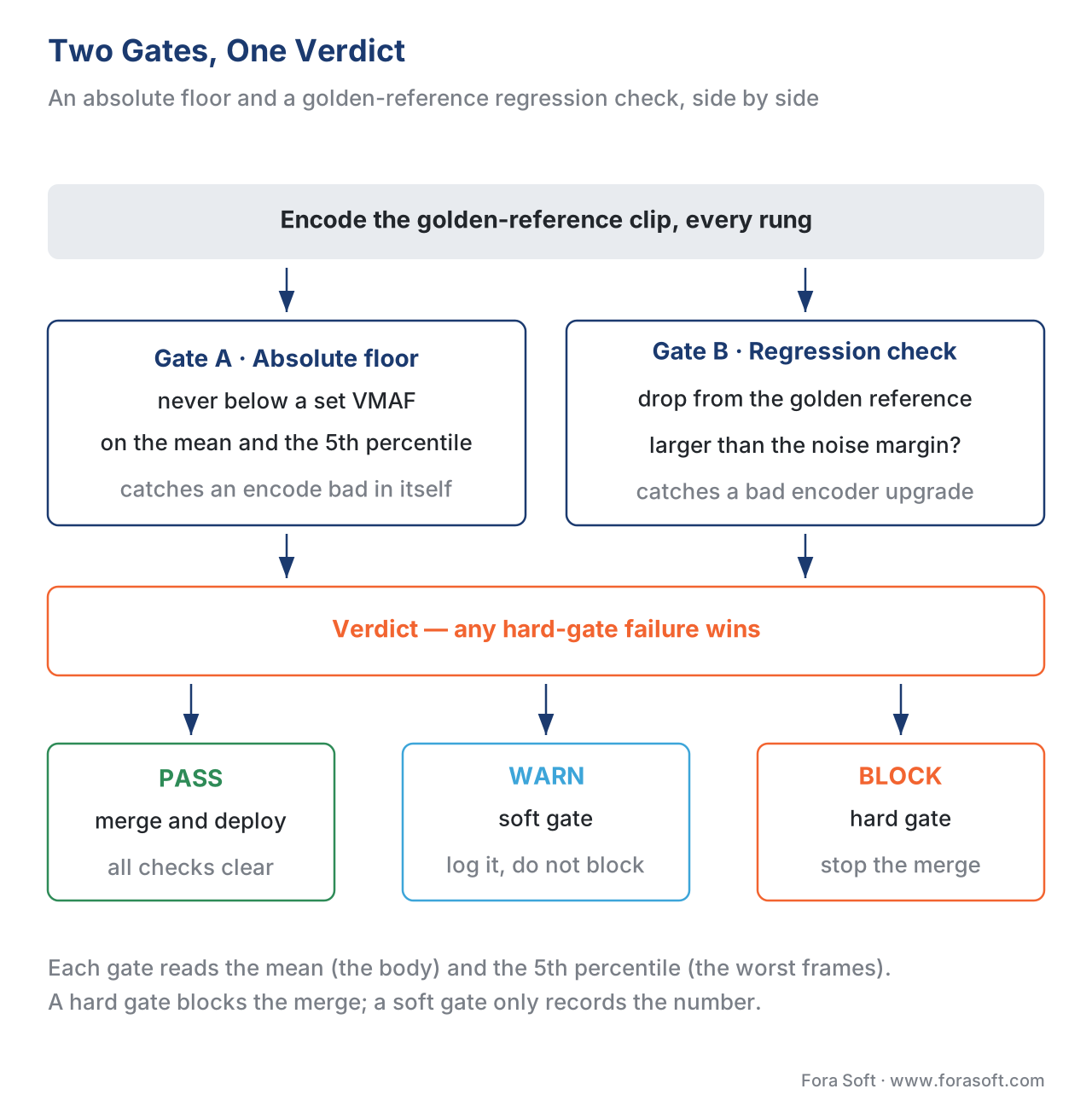 Figure 4. The gate is two checks. The absolute floor catches an encode bad in itself; the regression check, against a golden reference, catches a build worse than the last good one. Each reads the mean and the worst frames, and resolves to pass, warn (soft gate), or block (hard gate).
Setting the threshold without gating on noise
The hardest part of a regression gate is not writing it — it is choosing the drop that counts as a failure. Set it too loose and a real regression slips through; set it too tight and the gate goes red on noise, the team learns to ignore it, and you have a test nobody trusts. The way out is to anchor the margin to the metric's own uncertainty.
A VMAF score is not an exact constant. It is a prediction from a model trained on a sample of human scores, so it carries a confidence interval — a band around the number expressing how sure the model is. Netflix ships bootstrap models (for example vmaf_b_v0.6.3) that report this directly: a BOOTSTRAP_VMAF score with a standard deviation, where the 95% interval is roughly the score plus or minus 1.96 standard deviations (Netflix, VMAF confidence interval documentation, since v1.3.7, 2018; see VMAF in depth). Helpfully, the band is tighter at the high scores a top rung lives at. There is a second source of jitter on top of the model's: the encoder itself is not always bit-exact run to run — multithreading changes the output slightly — so re-encoding the same clip twice can move VMAF by a few tenths of a point.
Put the two together and the margin falls out of arithmetic. Suppose the golden-reference top rung scores a mean VMAF of 93.4, the bootstrap model reports a standard deviation of 0.5 at that score, and re-encoding the clip five times shows a run-to-run standard deviation of 0.3. The combined noise is the two added in quadrature:
combined_sigma = sqrt(model_sigma^2 + run_to_run_sigma^2)
               = sqrt(0.5^2 + 0.3^2)
               = sqrt(0.25 + 0.09)
               = sqrt(0.34)
               = 0.58 VMAF

95% noise margin = 1.96 x 0.58 = 1.14 VMAF
So any drop under about 1.1 VMAF on this clip is indistinguishable from noise, and the gate must not fail on it. Now test two builds against that margin:
Build A: mean VMAF 91.0  ->  drop = 93.4 - 91.0 = 2.4 VMAF  ->  2.4 > 1.14  ->  FAIL (real regression)
Build B: mean VMAF 92.9  ->  drop = 93.4 - 92.9 = 0.5 VMAF  ->  0.5 < 1.14  ->  PASS (within noise)
Build A's 2.4-point drop is more than twice the noise margin — a real regression, and about four-tenths of a just-noticeable difference (one JND is roughly 6 VMAF; Netflix, via Ozer, 2017), so it is heading toward visible. Block it. Build B's half-point dip is inside the noise band; failing on it would be crying wolf. This is the discipline that separates a gate engineers trust from one they mute: the threshold is the target minus a margin, and the margin is the measurement's own noise, not a number you guessed. The video quality gate tool shipped with this article computes this margin from a bootstrap standard deviation and a measured run-to-run figure, and runs the pass/fail decision above; pass --demo to reproduce these exact numbers.
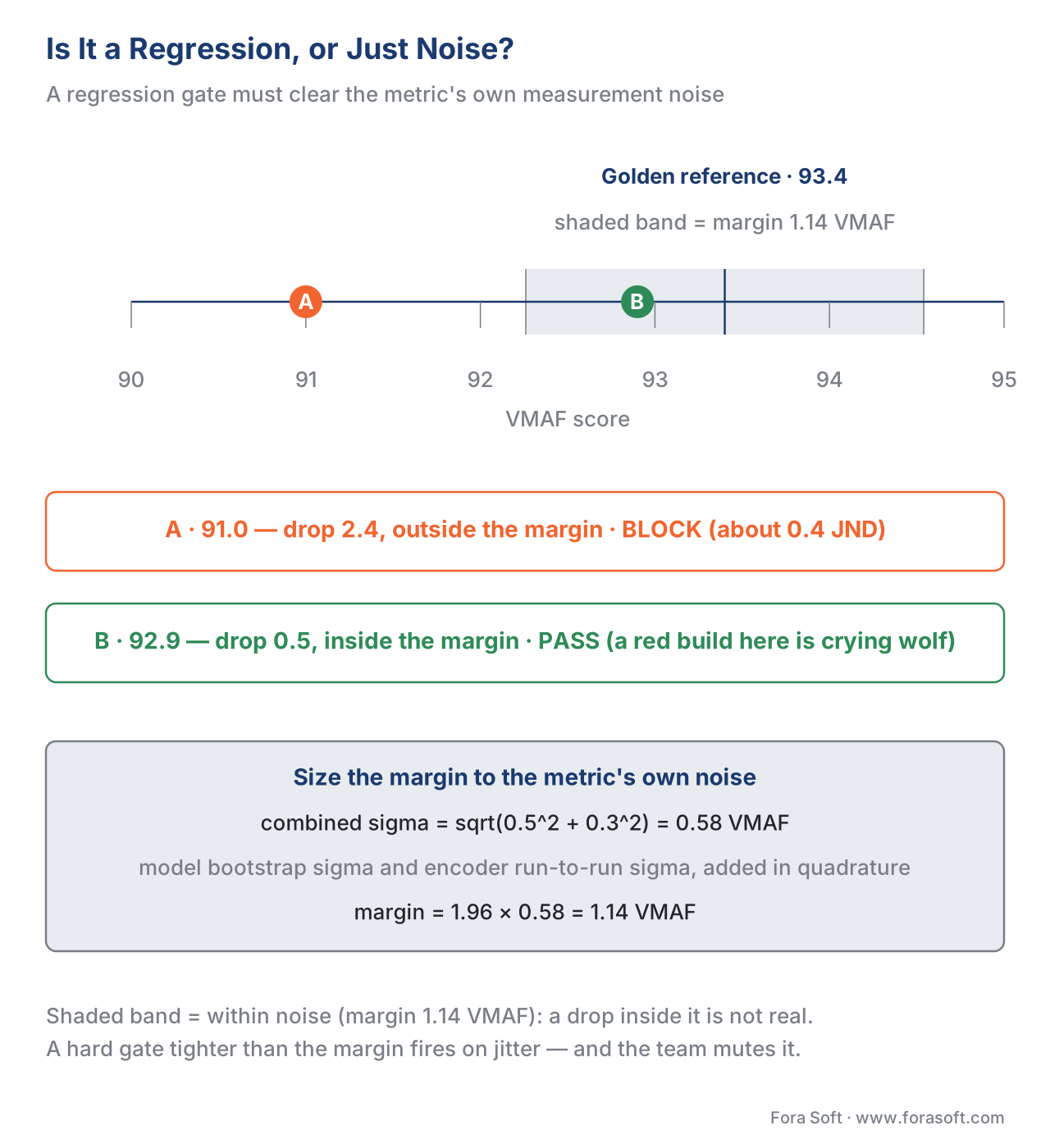 Figure 3. A regression gate must clear the metric's own noise. The baseline carries a confidence band; the noise margin (model uncertainty and encoder run-to-run jitter, added in quadrature) is shaded around it. A 2.4-point drop lands outside the band — a real regression to block; a 0.5-point dip lands inside — noise to ignore.
Do not gate on the mean alone: read the worst frames
A single average VMAF for a clip is a summary, and summaries hide their worst moments. An encode can average a comfortable VMAF 95 across a minute while one dark, high-motion two-second stretch sits at VMAF 60 — and that stretch is exactly what the viewer remembers. Twitter's engineers measured this on real content: a sequence whose frames averaged VMAF 97.7 still had a poor 1st and 5th percentile, and the average alone "misleads us into believing that the overall video quality is very good" (Twitter Engineering, 2020). A gate that reads only the mean passes the bad scene.
The fix is to make the gate read the distribution, not just its centre. Two pooling methods do this (pooling is how per-frame scores become one number; see pooling per-frame scores). The low percentile — the 1st or 5th percentile — is the score of the worst 1% or 5% of frames; gating on it puts a floor under the bad moments, not just the average. The harmonic mean weights low-scoring frames more heavily than a plain average does, so a few terrible frames pull it down where they would barely move the mean. A practical gate sets a high bar on the mean or harmonic mean and a lower, separate bar on the 5th percentile, so both "good on average" and "no terrible stretch" must hold for the build to pass. One number for the body of the clip, one number for its worst moments — fail on either.
Hard gate or soft gate: block or warn
Not every check should stop the line, and deciding which do is a policy choice the team makes once and writes down. A hard gate fails the build and blocks the merge — the pipeline exits non-zero and the change cannot land. A soft gate records the result and warns — it posts the number, maybe colours it red, but lets the change through. The distinction, and where each check sits in the wider pipeline, is the subject of the automated-quality-control overview; here the rule of thumb is what matters.
Make the absolute floor and a clear regression beyond the noise margin hard gates: these are the failures that visibly hurt viewers, and they should stop the release. Make borderline or noisy signals — a drop inside the margin, a small PSNR wobble, a single-frame blip — soft: surface them so a human can glance, but do not block a release on jitter. The failure mode to avoid is a hard gate that fires on noise; after the third false alarm, someone adds || true to the step and the gate is dead. A gate earns the right to block by being right when it blocks.
Flaky content, pinned inputs, and the gotchas that move the score
A gate is only as trustworthy as the inputs feeding it, and a few unpinned things will make a green gate flicker red for no real reason. Treat all of them as locked build inputs.
Pin the reference clip. The golden master must be a fixed, version-controlled file — cache it in object storage or Git LFS, never re-fetch it from a public URL on every run, or a CDN hiccup becomes a failed build (Mason K, DEV, 2026). Pin the VMAF model file like a lockfile: different model versions produce different scores, so an unpinned model silently re-baselines every threshold under you. When you do upgrade the model — for instance to VMAF v1 (June 2026), which adds chroma and banding awareness the older models lacked — bump it deliberately and re-measure every baseline in the same change. Pin the tool versions, too: the libvmaf filter's option syntax has changed across FFmpeg releases (the older model_path= versus the newer model='path=...'), so a floating FFmpeg can break the command or shift the number; record the version and treat it as part of the gate. The full wiring of the tool chain lives in measuring quality with FFmpeg and libvmaf and integrating quality measurement into CI/CD.
Then there are the comparison gotchas that produce noisy or simply wrong scores, all of them violations of the same rule — a metric comparison is only valid apples-to-apples, same frames, same resolution, same reference, same model. Mismatched frame counts make VMAF silently truncate to the shorter clip and the score surprises you; align both sides with explicit trims. A colour-space mismatch — a BT.709 source compared against a BT.601 encode — produces noisy scores; normalize first. And VMAF needs full-reference inputs: it compares the encode against the pristine original, so it cannot be run on a live or user-generated stream that has no reference (that case needs no-reference metrics; see no-reference quality for live and UGC). Lock the inputs and respect apples-to-apples, and the only thing left that moves the score is a real change in the encode — which is exactly what the gate is there to catch.
When the bitrate changes too: gate with BD-rate
One case breaks the simple "did VMAF drop?" check. If an encoder upgrade changes both the bitrate and the quality — a new codec that spends fewer bits, say — a fixed-bitrate VMAF comparison is unfair to whichever build spends less. The right comparison holds quality constant and asks about bits: BD-rate (Bjontegaard Delta rate) reports the average bitrate difference between two encoders at matched quality, where a negative number means the new encoder reaches the same quality for fewer bits (Bjontegaard, VCEG-M33, 2001). For an encoder-upgrade gate, BD-rate is the honest check: it fails the build if the new encoder needs more bits for the same quality, and passes a genuine efficiency win even though the raw per-file VMAF moved. Keep it distinct from the quality gate proper — BD-rate is a saving at equal quality, not a quality score — and reach for it only when bitrate is a variable. Our own BD-rate numbers and method are in BD-rate explained, with our numbers.
Reporting the result so a human can act
A gate that only prints "FAIL" wastes the most valuable thing it produces: the evidence of where the encode broke. Keep the per-frame scores as a build artifact for at least 30 days. The headline number says the build regressed; the per-frame curve says it regressed for two seconds starting at frame 1,400, which is what an engineer needs to find the cause (Mason K, DEV, 2026). Post the summary back to the pull request — the mean, the 5th percentile, the delta from the golden reference, and the pass/fail verdict per rendition — so the result is visible where the change is reviewed, not buried in a log. A frame-level plot in the CI artifacts turns "VMAF dropped" into "here is the dip", and turns a red build from an annoyance into a lead. How to shape that output for a non-engineer audience is the subject of building a QC report a stakeholder trusts; the gate's own report only needs to be precise and per-rendition.
A common mistake: a gate that fails on noise (or passes on the mean)
The two failure modes that kill quality gates are opposites, and both come from ignoring the distribution behind the number. The first is the flaky hard gate: a regression threshold set tighter than the metric's noise, so the build goes red on a 0.4-VMAF wobble that is pure jitter. The team's trust erodes with every false alarm until someone disables the step, and then a real regression sails through an open gate. The cure is the noise margin from earlier: never set a hard regression threshold below 1.96 times the combined model-and-encoder standard deviation. The second is the mean-only gate: a check that reads the average, passes a clip at VMAF 95, and never notices the two-second stretch at VMAF 60 that the viewer will. The cure is to gate the low percentile alongside the mean. Both mistakes share a root: a quality score is a summary of a noisy distribution, and a gate that forgets the noise (too tight) or forgets the tail (mean-only) is measuring half the picture. The ground truth behind all of it remains a properly run subjective test (ITU-R BT.500-15, 2023) — when the gate and a careful viewing disagree, the viewing wins and the gate is recalibrated.
Free download: Video quality gate toolA dependency-free Python script that runs both checks from this article on every rendition - an absolute VMAF floor on the mean and on a low percentile, and a regression check against a golden reference with a noise margin - and exits non-zero so the build fails.Where Fora Soft fits in
Fora Soft has built video streaming, OTT, conferencing, e-learning, surveillance, and telemedicine systems since 2005, and on the ones with their own encoding pipeline the quality gate is what keeps a routine code change from quietly degrading the picture in production. We help teams stand up the gate this article describes — a perceptual floor plus a golden-reference regression check, with a noise margin sized from the metric's confidence interval, reading the worst frames as well as the mean, and wired to block a merge rather than warn a log. Where a project needs the rate-quality data behind a threshold for a specific codec and content type, our measured benchmarks (see our benchmark methodology) supply it. The goal is a gate that is silent when the encode is fine and right when it is not — so the first time a pull request turns it red, the team is glad it did.
The handbook
Fora Soft Video Engineering Handbook
We wrote a seven-volume handbook that walks the whole video stack, from a single pixel to a running production system, across more than 9,000 pages; an engineer who works through it can design the encoding chain this gate guards and the measurement around it. Volume 1, Video Encoding, is the one closest to this article - what the encoder actually trades away under a preset change, and what PSNR, SSIM and VMAF each measure when you threshold them. Volume 3 covers the ABR ladder the gate runs per rung, the players that show the result, and the QoE monitoring that catches what a build-time check cannot. Written by Nikolay Sapunov, CEO at Fora Soft.
Would your pipeline notice if the next encoder upgrade cost you nine VMAF points?
Tell us what your encoding pipeline builds and how you measure it today, and we will say what the gate should be: the floor per rung, the regression margin sized from your own run-to-run numbers, which checks block a merge and which only warn. 250+ video products shipped since 2005.
See our case studies
Case study
Speed.Space
A remote production platform that records at 1080p and 8 Mb/s, over 5x the bitrate of standard conferencing, on shoots for Netflix, Electronic Arts and HBO - where the encode is the deliverable and a quiet drop in the picture shows up in the client's cut.
Case study
Worldcast Live
Concert streaming at 1.5 Gb/s with 0.4-0.5 s latency for 10,000 simultaneous viewers. A live show has no second take, so an encoding change is measured against the golden reference before the doors open, not after the complaints.
Case study
Mindbox
An RTSP to FFmpeg to HLS transcoding pipeline running across 50+ deployments. One change to the encoding path ships to every site at once, which is exactly the blast radius a regression check against a fixed clip is there to contain.
What to read next
Quality target
Setting a quality target and a quality budget
Where the number the gate enforces comes from, per rung.
QC pipeline
Automated video quality control: pipeline overview
Every automated check in the chain, and where the gate sits.
Tooling
Integrating video quality measurement into CI/CD
The wiring: runners, pinned tools, artifacts, and the measure step.
VMAF
VMAF in depth: models, 4K and confidence intervals
The bootstrap standard deviation the noise margin is built from.
References
- SonarSource. "Understanding quality gates" (SonarQube Server documentation), accessed 2026-06-24. Tier 6. The software-engineering origin of the quality gate: a set of pass/fail conditions on metrics that a change must meet to be releasable; the gate fails if any condition fails, and the status can fail the CI pipeline. Basis for the borrowed-from-software framing. https://docs.sonarsource.com/sonarqube-server/quality-standards-administration/managing-quality-gates/introduction-to-quality-gates
- Netflix / VMAF project. "Using VMAF with FFmpeg" (Netflix/vmaf,
resource/doc/ffmpeg.md), accessed 2026-06-24. Tier 1 (metric-author primary). The libvmaf filter syntax (libvmaf=log_fmt=xml:log_path=...:model_path=...:n_threads=4), the defaultvmaf_float_v0.6.1.jsonmodel path, and PTS/frame-rate alignment of reference and distorted. Basis for the measurement command and the apples-to-apples alignment rules. https://github.com/Netflix/vmaf/blob/master/resource/doc/ffmpeg.md - Netflix / VMAF project. "VMAF Confidence Interval" (Netflix/vmaf,
resource/doc/conf_interval.md), since v1.3.7 (June 2018), accessed 2026-06-24. Tier 1 (metric-author primary). The bootstrap models (vmaf_b_v0.6.3), theBOOTSTRAP_VMAF_score/stddev/ci95outputs, and the 95% CI ≈ score ± 1.96·stddev, with tighter intervals at higher scores. Basis for the noise-margin arithmetic. https://github.com/Netflix/vmaf/blob/master/resource/doc/conf_interval.md - Twitter Engineering (A. Anand, J. Korhonen, et al.). "Introducing VMAF percentiles for video quality measurements." 2020. Tier 4 (credible deployer). A production case that the average VMAF (97.7) hides difficult frames while the 1st/5th percentile exposes them; harmonic mean and percentile pooling for quality decisions; psychovisual tuning lowers PSNR while improving the look. Basis for the read-the-worst-frames section and the PSNR-vs-perception point. https://blog.x.com/engineering/en_us/topics/infrastructure/2020/introducing-vmaf-percentiles-for-video-quality-measurements
- Mason K. "Wiring VMAF (and PSNR) into your encoder CI with FFmpeg 8.1 and ffmpeg-quality-metrics." DEV Community, 2026. Tier 6. A concrete CI gate: per-rendition VMAF/SSIM floors, exit non-zero on regression, the worked PSNR-up-VMAF-down example (41.8→42.4 dB while VMAF 88.7→79.1), and the operational notes (cache the reference, pin the model, keep per-frame JSON, frame/colour/resolution gotchas). Basis for Table 1 and the flaky-content section. https://dev.to/masonwritescode/wiring-vmaf-and-psnr-into-your-encoder-ci-with-ffmpeg-81-and-ffmpeg-quality-metrics-1g6i
- Reza Rassool. "VMAF Reproducibility: Validating a Perceptual Practical Video Quality Metric." IEEE BMSB, 2017. Tier 5. VMAF ≈93 maps to MOS 4–5 ("indistinguishable, or noticeable but not annoying"); basis for the ~93 "good enough" floor anchor. https://realnetworks.com/sites/default/files/vmaf_reproducibility_ieee.pdf
- A. Kah, C. Friedrich, T. Rusert, C. Burgmair, W. Ruppel, M. Narroschke. "Fundamental relationships between subjective quality, user acceptance, and the VMAF metric..." SPIE 11842-38, 2021. Tier 5. Transparency ≈ VMAF 95; no visible difference within ~2 VMAF; basis for the floor/target anchoring of the gate threshold. https://www.hs-rm.de/fileadmin/user_upload/SPIE_11842-38_HSRM.pdf
- Jan Ozer. "Finding the Just Noticeable Difference with Netflix VMAF." Streaming Learning Center, 2017. Tier 6. Records Netflix's guidance that ~6 VMAF points ≈ 1 JND; basis for sizing a regression drop in human terms (a 2.4-point drop ≈ 0.4 JND). https://streaminglearningcenter.com/codecs/finding-the-just-noticeable-difference-with-netflix-vmaf.html
- Gisle Bjontegaard. "Calculation of average PSNR differences between RD-curves." ITU-T VCEG, document VCEG-M33, 2001. Tier 1 (method-author primary). Defines BD-rate — the average bitrate difference between two encoders at matched quality. Basis for the encoder-upgrade gate when bitrate is also a variable. https://www.itu.int/wftp3/av-arch/video-site/0104_Aus/VCEG-M33.doc
- Recommendation ITU-R BT.500-15. "Methodologies for the subjective assessment of the quality of television pictures." International Telecommunication Union, 2023. Tier 1. The subjective-assessment ground truth a gate's metric is ultimately validated against; basis for the rule that a careful viewing overrides the gate when they disagree. https://www.itu.int/rec/R-REC-BT.500
- Netflix Technology Blog (C. G. Bampis, Z. Li, K. Swanson, et al.). "VMAF v1: Good Is Not Good Enough." June 2026. Tier 4. The current VMAF generation adding chroma and banding awareness; basis for the "upgrade the model deliberately and re-baseline" note. https://netflixtechblog.com/vmaf-v1-good-is-not-good-enough-60d7e4244ea8
