


Why this matters
A quality number is only worth measuring if it changes what you ship, and at production scale a human cannot look at every asset. This article is for the engineer who has to wire that judgment into a pipeline: a streaming or encoding lead, a platform or DevOps engineer building a release gate, or a technical product owner who has to decide what "good enough to publish" means in code. Get the architecture right and a bad encoder upgrade, a corrupt source file, or a broken manifest is caught automatically before a viewer ever sees it. Get it wrong and either garbage ships, or every release stalls waiting on a queue of false alarms. The goal of this overview is to give you the reference design and the vocabulary so the rest of Block 5 reads as one system, not eight disconnected tricks.
What "automated quality control" actually means
Start with the words. Quality control is the process of checking an asset against a defined standard and acting on the result — keeping it, fixing it, or rejecting it. Automated quality control means a program performs the check and applies the decision rule, so a human is involved only by exception. Netflix describes its own content QC as a mix of "automated and manual inspections to identify and replace assets that do not meet our specified quality standards," with the automated inspections running "before and after the encoding process" (Netflix Technology Blog, 2015). That sentence contains the whole idea: machines check at fixed points, humans handle the exceptions.
The thing to hold onto is that QC is not a metric. A metric — the number that estimates perceived quality, like VMAF, or the number that counts pixel error, like PSNR — is an input. QC is the surrounding machinery that takes that input, compares it to a threshold, decides pass or fail, and does something. A VMAF score sitting in a log is measurement. A VMAF score that fails a build and blocks a release is quality control. The difference is the decision and the action attached to the number.
Think of it like a spell-checker wired into a publishing system. The spell-checker that underlines a word is a metric. The rule that refuses to publish the document until the red underlines are gone is the gate. This block is about the gates.
The reference architecture: three places QC sits
Almost every production video pipeline has the same backbone — a source comes in, it gets encoded into the renditions viewers will stream, it gets packaged into a delivery format, and it goes out. Automated QC lives at three checkpoints along that backbone, and naming them is the first step to designing the system.
Ingest validation — check what you received. Before you spend a CPU-hour encoding anything, confirm the source file is what it claims to be and conforms to spec. This is mostly a conformance check, not a perceptual one: is the container valid, are the codecs and the frame rate and the color metadata what the spec requires, is the audio present and at the right loudness, does the file actually decode end to end. Netflix open-sourced a tool for exactly this layer — Photon, a Java library that validates Interoperable Master Format (IMF) packages against the SMPTE ST 2067 standard so that "content will not be rejected due to packing issues after ingest" (Netflix/Photon, GitHub). Catching a bad source here is the cheapest catch in the pipeline, because every downstream stage you skip is work you did not waste.
Post-encode quality gate — check what you produced. After encoding, you have a new question the ingest check could not answer: did compression damage the picture too much? This is where the perceptual metrics earn their place. You compare each encoded rendition to the source and score it — typically with VMAF, the perceptual metric Netflix built and now uses "throughout its production pipeline," sometimes with PSNR or SSIM alongside — and you gate on the result (see choosing the right metric). Because the encode is compared to the pristine source, this is a full-reference measurement: it needs the original to compare against (the distinction is in full-, reduced-, and no-reference). This gate is the one most teams mean when they say "quality gate," and it is the subject of its own article.
Pre-publish check — check what the viewer will get. The encode can be perfect and the package still broken: a malformed HLS or DASH manifest, a missing rendition in the ladder, a thumbnail that does not match, a caption file that fails to load. The pre-publish check validates the deliverable as a whole, as close to the player's view as you can get without being the player. It is the last automated line before the asset is live.
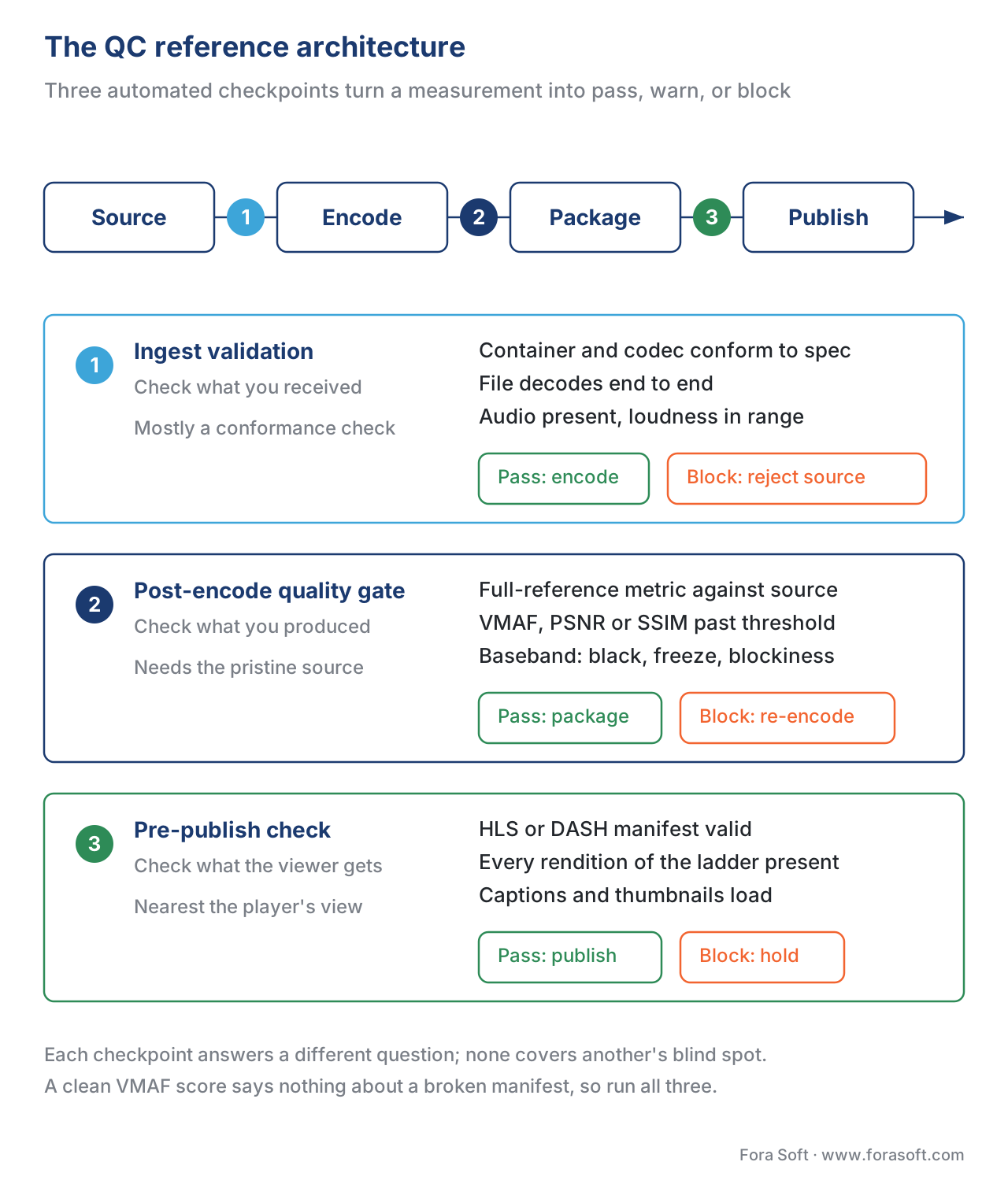 Figure 1. The QC reference architecture. Three automated checkpoints sit on the pipeline backbone — ingest validation before the encoder, a post-encode quality gate after it, and a pre-publish check before delivery. Each emits a verdict (pass / warn / block) that drives an action: continue, flag for review, or stop the release and alert.
These three checkpoints answer three different questions — is the source valid, is the encode good enough, is the package deliverable — and no single check covers another's blind spot. A perfect VMAF score says nothing about a broken manifest; a valid container says nothing about compression damage. A serious pipeline runs all three.
This overview is the backbone; the rest of Block 5 goes deep on each piece. The post-encode gate fires against a deliberate quality target, and that target is what drives per-title and per-shot encoding and the convex hull that picks each rung of the ladder. The gate logic gets wired into CI/CD, defended over time by regression testing against golden references, extended past launch by monitoring quality in production, and summarized for humans in a QC report a stakeholder trusts.
What an automated check actually inspects
"Check the video" is too vague to build. The broadcast industry spent years making it precise, and the European Broadcasting Union's QC project is the most useful reference: it publishes a public database of over 200 defined QC test items, and — more importantly for an architect — it organizes every test by the layer it inspects (EBU QC, qc.ebu.io). Those layers are the cleanest model for what an automated check can look at.
| QC layer | What it inspects | Example checks |
|---|---|---|
| Wrapper | The container's structure and metadata, without decoding pixels | Valid MP4/MXF/IMF structure, track count, timecode, declared frame rate |
| Bitstream | The encoded stream's structure and metadata, still without full decode | Codec profile/level, GOP structure, declared resolution, HDR metadata present |
| Baseband | The decoded essence — the actual frames and audio samples | Black frames, freeze frames, blockiness, loudness (LUFS), audio clipping |
| X-check | Agreement between layers (a cross-check) | Does the decoded frame size match the wrapper's declared size? |
| Programme layout | Patterns at specific times | Required bars-and-tone, slate, or black-and-silence at the head |
Table 1. The EBU QC layer model — the cleanest taxonomy for what an automated check can inspect. Cheap checks read the wrapper and bitstream without decoding; expensive checks decode the baseband essence; the most reliable checks cross-verify that the layers agree. Source: EBU QC (qc.ebu.io), 200+ published test items.
The layer model carries a practical lesson: checks get more expensive as you go down the table. Reading the wrapper is nearly free; decoding every frame to measure baseband blockiness or run a full-reference metric costs real compute. A good pipeline does the cheap conformance checks first and fails fast, so it only spends decode time on assets that already passed the structural tests. The cross-check (X-check) layer is the subtle one and the most valuable: a file can have a valid wrapper and valid pixels and still be wrong because the two disagree — the wrapper says 1080p, the decoded frames are 720p upscaled. Only a check that compares layers catches that.
This is also where modern automated QC is getting smarter. Beyond fixed-threshold tests, machine-learning detectors now find perceptual defects that were historically manual: Netflix recently described a neural-network system that flags pixel-level artifacts (hot or "lit" pixels) automatically, cutting that QC step from "hours" of full-frame manual review to "minutes" — roughly a 90% reduction (Netflix Technology Blog, 2025). The detector is new; the place it plugs in — the baseband layer of the post-encode or pre-publish check — is exactly the architecture above.
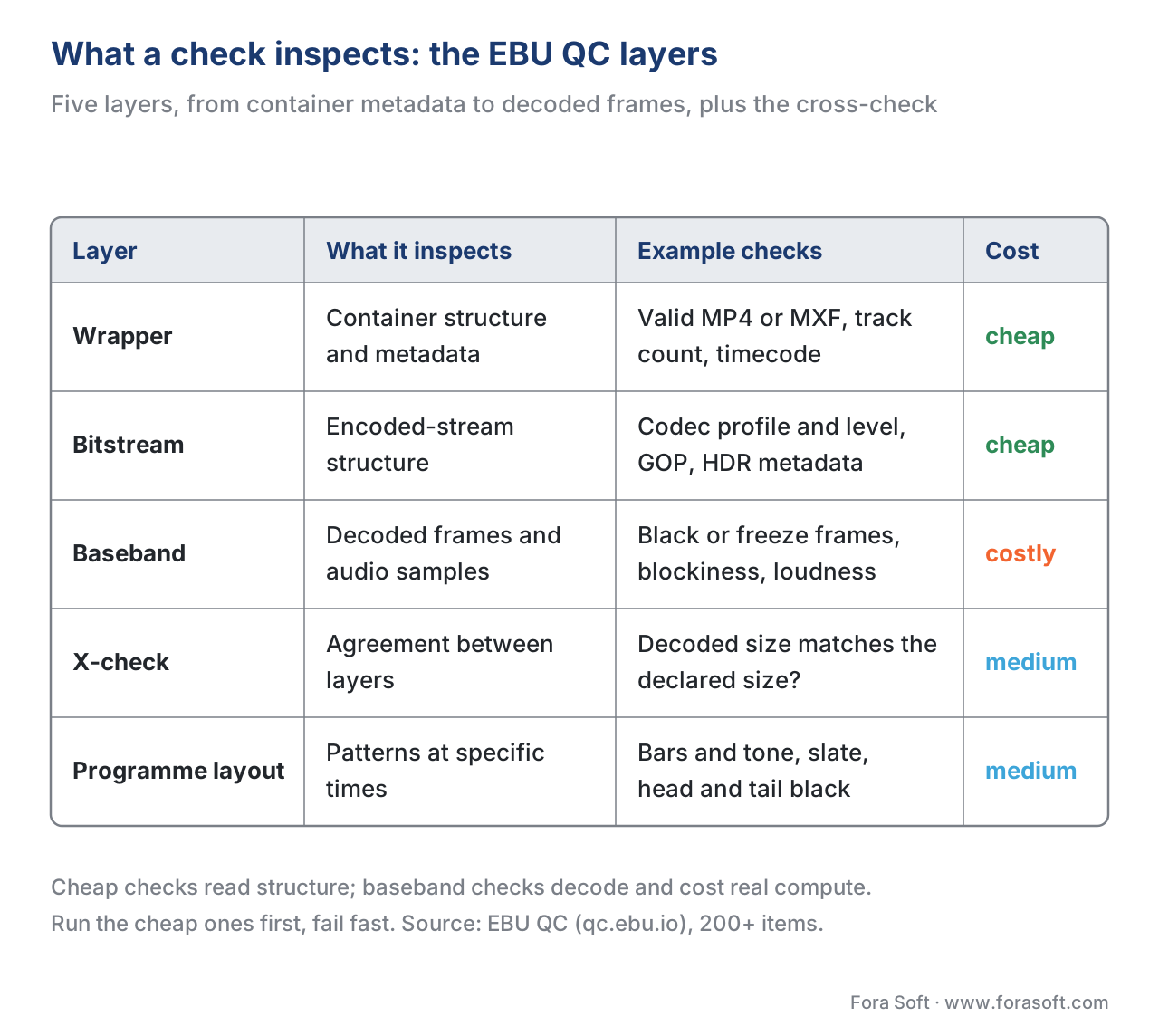 Figure 2. What a check inspects, by layer. Wrapper and bitstream checks read structure and metadata cheaply without decoding; baseband checks decode the essence and cost real compute; the X-check verifies the layers agree with each other. Run the cheap checks first and fail fast.
The most important decision: hard gate or soft gate
Once a check produces a verdict, one design choice dominates all the others: what happens when it fails. The vocabulary comes from software quality gates, and it maps perfectly onto media QC.
A hard gate (also called a blocking gate) stops the pipeline. If the asset fails, it does not advance — the release is blocked until the issue is fixed. Hard gates are, in the words of one quality-engineering guide, "merciless but they ensure improvement": nothing substandard gets through, at the cost of stopping the line whenever the gate trips (TIOBE; Sonar). A soft gate (informational or warning gate) lets the asset proceed but raises an alert, logs the failure, and escalates attention. Soft gates never block, so nothing is held up — but "decreases in quality will slip through unnoticed" if no one acts on the warnings.
Neither is correct everywhere; the choice is per-check and depends on the cost of a miss versus the cost of a false stop. A corrupt source that will not decode should be a hard gate at ingest — there is no point encoding it. A VMAF score that came in two points under target on one rendition might be a soft gate the first week you deploy it, while you learn what normal variation looks like, then harden into a blocking gate once you trust the threshold. The standard advice is exactly that progression: "start with soft gates to get familiar with the concept, but sooner or later the gate should become a hard gate" (TIOBE).
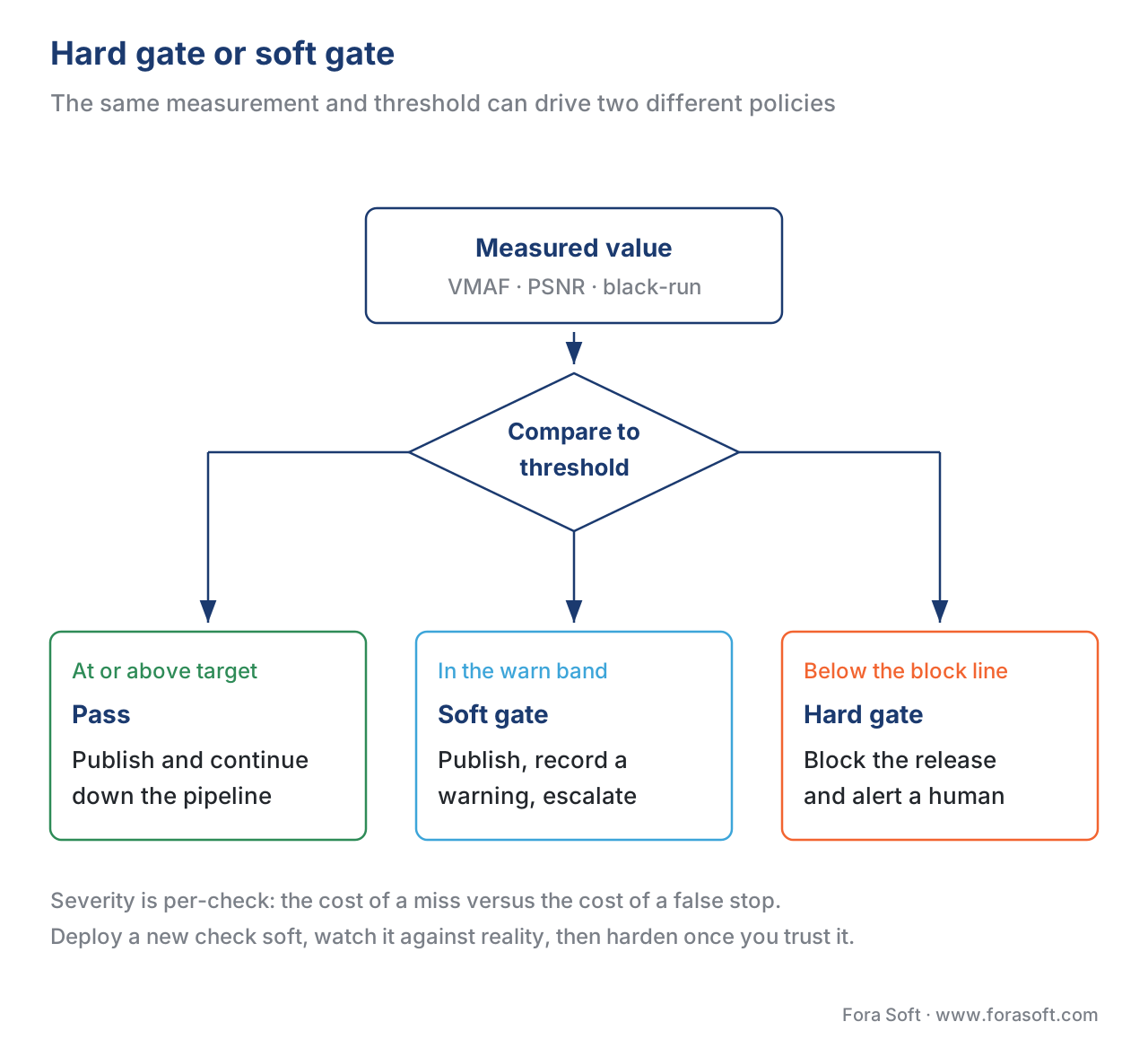 Figure 3. Hard gate versus soft gate. The same measurement and threshold can drive two different policies: a hard gate blocks the release and alerts a human; a soft gate publishes anyway but records a warning and escalates. The choice is per-check and depends on the cost of a miss versus the cost of a false stop.
Common mistake: making every gate a hard gate on day one. It feels safe, and it is the fastest way to get your QC system switched off. A noisy threshold you do not yet trust, applied as a blocking gate across a whole catalog, produces a flood of false stops; the on-call engineer starts rubber-stamping overrides, and within a month the "gate" is a checkbox nobody reads. Trust is earned: deploy a new check soft, watch what it flags against reality for a few weeks, tune the threshold, then promote it to hard. A hard gate you trust beats a hard gate you bypass.
The anatomy of a single automated check
Every check at every checkpoint, whether it reads a wrapper or runs a neural net, has the same five-step shape. Reference architectures for automated QC describe it as a chain of an ingestion/decode stage, a preprocessing stage that normalizes the input, an analysis stage, and a decision engine that "aggregates results into a pass/fail verdict or quality score," with the verdict wired through an API to trigger an action — "re-encode a segment, notify an operator, or pause delivery" (Promwad, 2026). Pulled apart, the five steps are:
- Acquire the asset (or the part you need — a wrapper read, or a decode of the frames).
- Normalize so the comparison is fair — align frames, match resolution, pick the metric model. (A full-reference metric run on misaligned or mismatched renditions is the classic way to get a meaningless number.)
- Measure — compute the metric or run the detector.
- Compare the result to the threshold or the conformance rule.
- Decide and act — emit pass / warn / block and trigger the consequence.
The discipline that separates a real QC system from a script that prints numbers lives in steps 2 and 4. Step 2 is where apples-to-apples comparison is enforced; skip it and your metric is noise. Step 4 is where the threshold lives, and a threshold is only trustworthy if the metric behind it actually tracks human perception — which you confirm by validating the metric against subjective scores using the statistical procedure in ITU-T P.1401 (correlation, error, and outlier-ratio against a mean opinion score). A gate built on a metric nobody validated for your content is a gate that will block good encodes and pass bad ones with equal confidence.
A worked example: tuning the gate without drowning in false alarms
Numbers make the trade-offs concrete. Take the post-encode quality gate first, then the catalog-scale view.
The threshold. Suppose your top rendition targets VMAF 93 — comfortably in the 90–95 band teams use for the highest rung of a bitrate ladder. How far below 93 should the gate fire? Use the perceptual unit. Netflix's VMAF team reports that a difference of about 6 VMAF points corresponds to roughly one just-noticeable difference (JND) — a change most viewers notice more than half the time (Netflix Technology Blog; VMAF documentation). So a drop from 93 to 92 is well under one JND — invisible, not worth blocking a release over. A drop to 89 is more than half a JND below target and creeping toward visible. A sensible policy: soft-warn below 92, hard-block below 90. Now a routine codec upgrade that quietly takes the top rung from 93.4 to 89.1 trips the hard gate (89.1 < 90), the release stops, and a human looks before viewers do — exactly the bad-upgrade catch the gate exists for.
The queue. Now scale it up, because a gate that is too trigger-happy fails a different way — it buries your team. Say you encode 10,000 assets a day, and the true defect rate is 1%, so 100 are genuinely bad. You tune the automated gate for high recall — catching defects matters more than the occasional false alarm, the same way Netflix tuned its predictive QC model "for low false-negative rate ... at the cost of increased false-positive rate" (Netflix Technology Blog, 2015). Say recall is 99% and the false-positive rate is 5%. Then:
- Defects caught: 99% × 100 = 99 (one slips through).
- False alarms: 5% × 9,900 good assets = 495.
- Manual review queue: 99 + 495 = 594 assets — instead of all 10,000.
That is a 94% cut in manual review while catching 99 of 100 defects. The lesson is in the 495: even a good gate sends far more false alarms than real defects to the humans, because defects are rare. Lower the false-positive rate and the queue shrinks fast; raise the gate's sensitivity recklessly and the queue explodes with good assets.
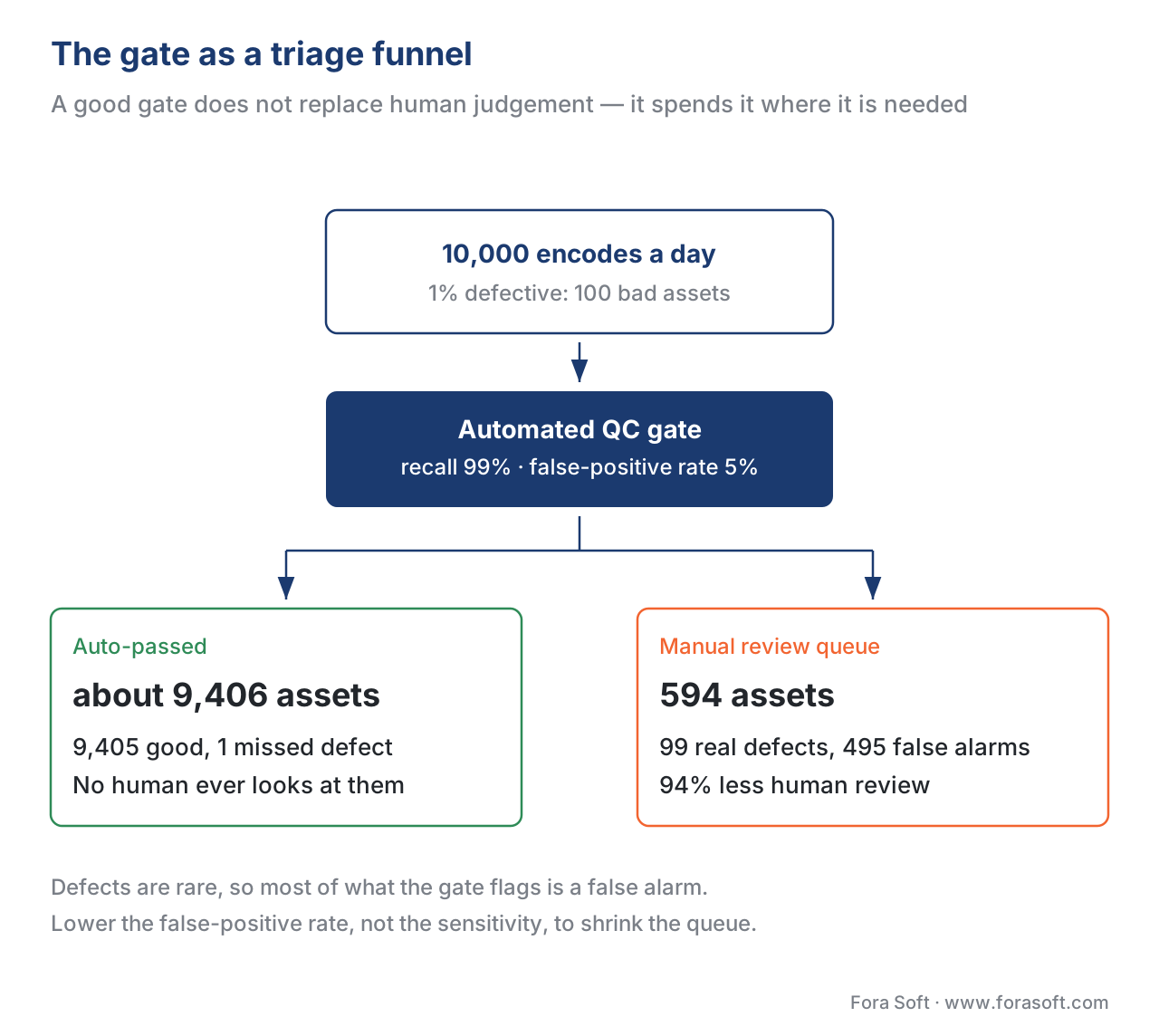 Figure 4. The gate as a triage funnel. Of 10,000 daily encodes at a 1% defect rate, a gate with 99% recall and a 5% false-positive rate sends 594 assets to manual review (99 real defects plus 495 false alarms) and auto-passes the rest — a 94% cut in human review. Because defects are rare, most of what a gate flags is a false alarm; lowering the false-positive rate, not raising sensitivity, is what shrinks the queue.
The point of an automated QC system is not to replace human judgment — it is to spend it only where it is needed. The companion QC gate evaluator below runs both of these calculations, and evaluates a batch of assets against a hard/soft policy, so you can see the trade-off on your own numbers.
Free download: QC gate evaluatorA dependency-free Python tool that models your checks across the three checkpoints, applies a hard/soft policy to a batch of assets, and sizes the manual review queue on your own numbers.Where Fora Soft fits in
Fora Soft has built video software since 2005 — streaming and OTT, video conferencing, e-learning, telemedicine, and surveillance — and in every one of those the same question recurs: how do you know the build you just shipped did not quietly degrade the picture? We treat automated QC as part of the delivery pipeline, not an afterthought: a conformance check at ingest, a full-reference metric gate after encoding, and a packaging check before publish, with each gate set hard or soft according to how expensive a miss is in that product. For an OTT or e-learning catalog the post-encode VMAF gate is the workhorse; for a surveillance or telemedicine system that records continuously, ingest conformance and baseband freeze/black-frame detection matter more. The reference architecture in this article is the one we wire into client pipelines, and our Block 7 benchmark methodology is the same measurement discipline applied to our own codec tests.
The handbook
Fora Soft Video Engineering Handbook
Seven volumes across the whole video stack, from the pixel to production. Volume 1 covers the encoder whose output the post-encode gate scores — prediction, transforms, rate control and the quality metrics themselves — and volumes 2 and 3 cover the packaging and delivery the pre-publish check validates, from HLS and DASH manifests to the bitrate ladder a missing rendition breaks. Work through the series and you can build the pipeline these three checkpoints guard. Written by Nikolay Sapunov, CEO at Fora Soft.
Not sure which of your checks should block a release?
Tell us what your pipeline produces and which defects have actually reached viewers, and we will tell you where each gate belongs, what threshold it should fire at, and whether it starts hard or soft. 250+ video products shipped since 2005.
See our case studies
Case study
Mindbox
AI video management in 50+ deployments across transport, pharma and gated communities, where RTSP feeds from cameras of every vintage are normalised by FFmpeg before HLS delivery — ingest conformance is the gate that earns its keep first.
Case study
Worldcast Live
Concert streaming at 1.5 Gb/s and 0.4–0.5 s latency for 10,000 simultaneous viewers: there is no re-encode window on a live show, so a check that cannot run in front of the stream is not a gate at all.
Case study
Speed.Space
Remote production used on Netflix, EA and HBO shoots, where the crew sets resolution, frame rate, codec and bitrate per shoot and records 1080p at 8 Mb/s locally — every one of those parameters is something a post-encode gate has to verify.
What to read next
CI/CD
Quality Gates in CI/CD for Video Encoding
The post-encode gate from this article, wired into a build that is allowed to fail.
Targets
Setting a Quality Target and a Quality Budget
Where the VMAF 93 in the worked example comes from, and how wide the warn band should be.
Metrics
Choosing the Right Video Quality Metric for the Job
Which number belongs behind the threshold, decided before you let it block anything.
Reporting
Building a QC Report a Stakeholder Trusts
What to put in front of the human who has to act on the 594 flagged assets.
References
- EBU QC (Quality Control) — Test Items and QC Layers, European Broadcasting Union, qc.ebu.io (database 2014–2026; Layers page rev. 2023). Tier 1 (standards/issuing-body reference, CC-BY). Publishes 200+ defined QC test items and the layer model (Wrapper, Bitstream, Baseband, X-check, Programme layout) used to classify what an automated check inspects. Basis for the "what a check inspects" taxonomy and Table 1. https://qc.ebu.io/help/layers
- VMAF — Video Multi-Method Assessment Fusion, Netflix (Z. Li, C. Bampis, et al.), GitHub repository and "VMAF: The Journey Continues," Netflix Technology Blog, 2018 (with later updates). Tier 1 (metric-author defining work). The perceptual metric used as the post-encode gate metric; source of the "~6 VMAF points ≈ 1 JND" perceptual-unit framing used to set the threshold. https://github.com/Netflix/vmaf
- Recommendation ITU-T P.1401, "Methods, metrics and procedures for statistical evaluation, qualification and comparison of objective quality prediction models," International Telecommunication Union, 2012 (current edition 2020). Tier 1 (official standard). Defines how to validate that a metric (the gate's input) tracks subjective MOS — Pearson correlation (PLCC), RMSE, outlier ratio, SROCC. Basis for the "validate the metric behind the threshold" point. https://www.itu.int/rec/T-REC-P.1401
- Photon — open-source IMF/MXF validation library, Netflix, GitHub (implements SMPTE ST 2067 IMF core constraints). Tier 3 (first-party tooling implementing a SMPTE standard). Validates AssetMap, PackingList, Composition Playlist, and essence at ingest so content "will not be rejected due to packing issues after ingest." Basis for the ingest-conformance checkpoint. https://github.com/Netflix/photon
- N. Govind and A. Balachandran, "Optimizing Content Quality Control at Netflix with Predictive Modeling," Netflix Technology Blog, 2015. Tier 4 (vendor engineering blog, credible deployer). States that automated inspections run "before and after the encoding process," that QC is automated plus manual, and that the predictive model is tuned "for low false-negative rate ... at the cost of increased false-positive rate." Basis for the two automated checkpoints and the recall-vs-false-positive worked example. https://netflixtechblog.com/optimizing-content-quality-control-at-netflix-with-predictive-modeling-712281658ab9
- "Accelerating Video Quality Control at Netflix with Pixel Error Detection," Netflix Technology Blog, 2025. Tier 4 (vendor engineering blog). Describes an ML detector for pixel-level artifacts that reduces a manual QC step from hours to minutes (~90%); example of an ML check plugging into the baseband layer. Basis for the "QC is getting smarter" paragraph. https://netflixtechblog.com/accelerating-video-quality-control-at-netflix-with-pixel-error-detection-47ef7af7ca2e
- "How to Quality Gate Software Code," TIOBE; and "What is a quality gate?," Sonar. Tier 6 (educational/practitioner). Define the hard/blocking versus soft/informational gate distinction and the "start soft, then harden" progression, applied here to media QC. Basis for the hard-vs-soft-gate section. https://www.tiobe.com/knowledge/article/how-to-quality-gate-software-code/
- "AI-QC: Automated Media Quality Control for Broadcast and Streaming Pipelines," Promwad, 2026. Tier 6 (educational). Describes the automated-QC component chain — ingestion/decode, preprocessing/normalization, analysis engines, and a decision engine that "aggregates results into a pass/fail verdict or quality score," with API-triggered actions (re-encode, notify, pause). Basis for the five-step check anatomy. https://promwad.com/news/ai-qc-automated-media-quality-control
- M. (DEV Community), "Wiring VMAF (and PSNR) into your encoder CI with FFmpeg and ffmpeg-quality-metrics," 2025. Tier 6 (practitioner). Concrete implementation of a post-encode quality gate that "runs PSNR, SSIM, and VMAF against a fixed reference ladder and fails the merge if VMAF drops below threshold." Orientation for the CI-gate practice. https://dev.to/masonwritescode/wiring-vmaf-and-psnr-into-your-encoder-ci-with-ffmpeg-81-and-ffmpeg-quality-metrics-1g6i
- "Understanding Quality Control for File-Based Video Workflows," The Broadcast Bridge, 2017. Tier 6 (educational). Orientation on the file-based QC tooling landscape and the baseband-versus-file-based distinction in broadcast workflows. Background for the QC-tooling context. https://www.thebroadcastbridge.com/content/entry/8002/understanding-quality-control-for-file-based-video-workflows
