


Why this matters
Startup time is the only quality metric a viewer experiences before they have watched a single frame, so it decides whether they become a viewer at all. A flawless encode with a high VMAF score earns nothing if the audience has left before the picture appears. This article is for the streaming engineer, player developer, QoE analyst, and product owner who own retention and need to measure the first impression correctly — to start the timer at the right moment, read the median and the tail, and understand why a player cannot simply load the highest-quality frame first. It is the deep dive behind the startup line in the streaming QoE framing article: that article names the metric; this one takes it apart, and it is the twin of rebuffering, the stall that happens after playback has begun.
What startup time actually measures
Start with the definition, because the wrong starting line quietly corrupts every number that follows. Startup time is the elapsed time from the moment the viewer asks for a video to the moment its first frame is rendered on screen. The same metric travels under several names — video startup time, video start time, join time, and time to first frame (TTFF) — but the measured quantity is the same: play intent in, first visible frame out (CTA-2066, CTA, 2020; Mux, 2025).
Two boundaries decide whether your number is honest. The first is where the clock starts. It starts at the viewer's intent to watch — the tap on play, or the instant an autoplay player becomes visible — not when the manifest loads and not when the first byte arrives. The second is where the clock stops: at the first frame actually painted on screen, not when the first segment finished downloading or decoding. Anything narrower measures a component and calls it the whole.
A useful split comes from player analytics practice. Video startup time covers the video path alone — from "play" to "playing" — while aggregate startup time also includes the web page loading and the player's own initialization (Mux, 2025). The distinction matters because the slow part is often not the video. Walk the arithmetic: a video startup time of 0.04 s and a player startup of 0.46 s sound excellent, but if the page itself takes 2.00 s to load, the viewer waited
aggregate startup = page load + player startup + video startup
                  = 2.00 s   + 0.46 s        + 0.04 s
                  = 2.50 s
Two and a half seconds — past the abandonment threshold we will meet below — despite a video path that was almost instant. Measure the video path to debug your delivery; measure the aggregate to see what the viewer actually felt.
One more boundary keeps this article distinct from its twin. Startup is not rebuffering. Startup is the first buffer fill, before frame one; rebuffering is a stall after playback has already begun, when the buffer later runs dry. They happen at different moments, they are judged by the viewer differently, and they have different fixes — so they are measured as separate metrics. Folding one into the other blurs two problems into a number that fixes neither.
Where the seconds go
A startup time is not one wait; it is a stack of smaller waits, and you cannot shorten it until you can see the stack. Think of pressing play as starting a relay: each leg must finish before the next begins, and the first frame appears only when the last runner crosses the line.
The first leg is network setup — resolving the hostname (DNS), opening the connection (TCP), and negotiating encryption (TLS). It is usually small but not free; moving to TLS 1.3, whose handshake needs one round trip instead of two, saves roughly 100 ms in high-latency regions (Fastpix, 2025). The second leg is the manifest fetch — downloading the playlist that tells the player what renditions and segments exist. The third leg is the first media download: the player pulls the initialization data and enough of the first segment to reach its start buffer threshold — the minimum amount of decoded video it insists on holding before it will begin. The final leg is decode and render of that first frame.
 Figure 1. Where the seconds go. Startup time is the sum of network setup, manifest fetch, the first-segment download up to the player's start buffer threshold, and decode-and-render — not any single one of them.
Two practical points fall out of this stack. First, time to first byte (TTFB) is one early leg, not the whole race. TTFB measures request sent to first response byte received; under 800 ms is considered healthy for a web response (Core Web Vitals, 2025). But TTFB ends long before any frame is on screen — it excludes the buffer fill, the decode, and the render. Reporting TTFB as "startup time" understates the viewer's wait, often badly.
Second, the start buffer threshold is usually the largest controllable leg. Most players wait until they hold a set amount of media — a number of segments, seconds, or megabytes — before starting playback, as a cushion against an immediate stall (RFC 9317, IETF, 2022). Work an example. Suppose the player starts only once it holds two seconds of media, the initial rendition is modest, and the network can move data at four times that rendition's bitrate. Downloading two seconds of media then takes about
fill time = media buffered ÷ (network speed ÷ rendition bitrate)
          = 2 s ÷ 4
          = 0.5 s   (plus ~0.1–0.2 s of request overhead)
Add ~90 ms of network setup, ~160 ms for the manifest, and ~100 ms to decode and render, and the budget lands near 1.0–1.1 s. Now cut the start threshold from two seconds of media to one: the fill leg roughly halves to ~0.25 s and the whole startup drops toward ~0.8 s. The lever that moved the number was not the codec or the CDN — it was how much cushion the player demanded before it dared to start. That cushion is also exactly what protects against an immediate stall, which is why startup and rebuffering are tuned together, never in isolation.
How the number is measured
You never read a startup time off the video file; there is nothing in the pixels about how long the viewer waited. It comes from player events. The player timestamps the play intent and the first rendered frame, and the difference is the metric. Where those events come from across players and analytics vendors — the instrumentation and event taxonomy — is the subject of player-side quality metrics.
Two standards keep the numbers comparable across teams. CTA-2066 defines the streaming QoE events and metrics — including video start time and the start-failure events — and specifies how each should be computed so that "startup time" on one dashboard means the same thing on another (CTA-2066, 2020). CTA-5004 (Common Media Client Data, CMCD) standardizes the fields a player attaches to each media request, so the data needed to reconstruct the startup sequence reaches any backend in the same shape (CTA-5004, 2020; the CMCDv2 revision CTA-5004-A followed in 2026). The operational rule from the rebuffering article applies here too: use the standard definitions, or two teams will quietly optimize different numbers.
For session-level experience scoring, the parametric model ITU-T P.1203 folds the initial loading delay — your startup time — into a single 1-to-5 session score alongside the picture, the bitrate switches, and any stalls (ITU-T Rec. P.1203, 2017). But here the model carries a subtle, important lesson: a one-time wait at the start weighs less on the in-session score than a stall mid-watch, because viewers forgive an opening pause more readily than an interruption once they are invested. That is not a reason to relax about startup — it is the opposite. Startup's real damage is not the points it shaves off a session score; it is the viewers who abandon before there is any session to score at all. The cost lives upstream of the metric, in the people who never became an audience.
A last measurement discipline: report the median and the 95th percentile, never the median alone. A healthy median can sit on top of a long, slow tail, and the viewers who waited longest — the ones in that tail — are exactly the ones who abandoned. The same "summarize the floor, not just the centre" principle that drives building a QC report applies to startup time.
Why the first few seconds decide retention
The reason startup time sits beside rebuffering at the top of every QoE dashboard is measured, and in the strongest study it is causal.
The landmark result comes from a quasi-experimental study of a large Akamai dataset (Krishnan & Sitaraman, IMC 2012). The authors bucketed views by startup delay and computed an abandonment rate for each — the share of would-be viewers who gave up before the video started. The shape of that curve is the finding to commit to memory: abandonment is near zero for the first two seconds, then climbs steeply, and a regression on the rising part shows that each additional second of startup delay raises the abandonment rate by about 5.8 percentage points (Krishnan & Sitaraman, 2012). Because the study used matched pairs to control for confounders like connection type and geography, that slope is causal — slow startup makes viewers leave, not merely coincides with leaving.
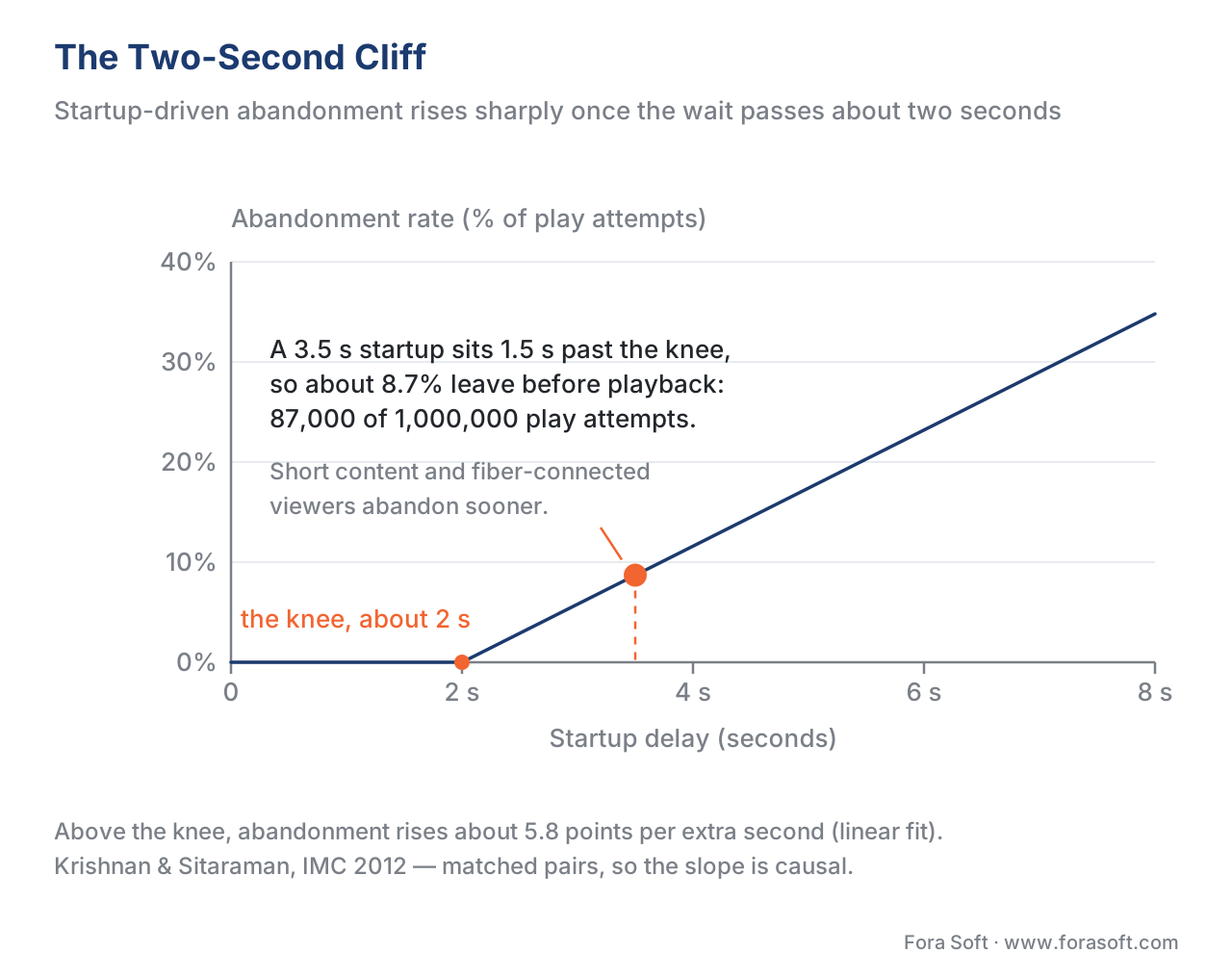 Figure 2. The two-second cliff, after Krishnan & Sitaraman (2012). Abandonment stays near zero until ~2 s, then rises about 5.8 points per extra second. A 3.5 s startup sits ~1.5 s past the knee — roughly 8.7% lost before playback.
Put a number on it. Suppose your player shows the first frame in 3.5 seconds. That is 1.5 seconds past the two-second knee, so the model predicts an extra
startup abandonment ≈ 5.8% × (3.5 s − 2.0 s)
                    ≈ 5.8% × 1.5
                    ≈ 8.7%
Now scale it across a launch night of 1,000,000 play attempts:
viewers lost ≈ 8.7% × 1,000,000
             ≈ 87,000 viewers gone before the video started
Eighty-seven thousand people who intended to watch and left during the spinner — no ad rendered, no minute watched, no second chance. The arithmetic is a linear reading of the study's slope within its measured range, not a universal law; your audience and content differ. But the order of magnitude is the point, and it is large.
Two refinements from the same paper sharpen where the cost falls. Viewers are less patient with short content than long — they will wait through a slow start for a feature film but abandon a news clip (Krishnan & Sitaraman, 2012, Assertion 5.2), an effect the authors tie to the psychology of queuing, where a longer expected payoff buys more patience. And counter-intuitively, better-connected viewers abandon sooner: those on fiber have the least patience, while mobile viewers wait the longest, because expectations are set by the speed people are used to (Krishnan & Sitaraman, 2012, Assertion 5.3). The correlational work that preceded it agrees that startup delay (there called join time) is among the metrics that move engagement, even as the buffering ratio carries the largest single effect (Dobrian et al., SIGCOMM 2011).
The trade-off a player makes the instant you press play
If startup is so costly, why not show the highest-quality first frame immediately? Because the first frame's quality and the speed of showing it pull in opposite directions, and the player must choose between them before it knows anything about the network. This is the startup face of adaptive bitrate (ABR) streaming: the player picks a rendition for that very first segment with an empty buffer and no throughput history.
Pick a low initial rendition and the first segment is small, so it downloads fast and the video starts quickly — but the opening seconds look soft, and those opening seconds are where the viewer forms their quality expectation. Pick a high initial rendition and the first frame is crisp — but there is more to download before the buffer threshold is met, so the start is slower and the risk of an immediate stall is higher. Most production players resolve this by starting low to win the fast start, then switching up once measured bandwidth or buffer occupancy justifies it (Mux, 2026). How often and how visibly they switch is its own QoE question, covered in bitrate, switching, and the ABR trade-off.
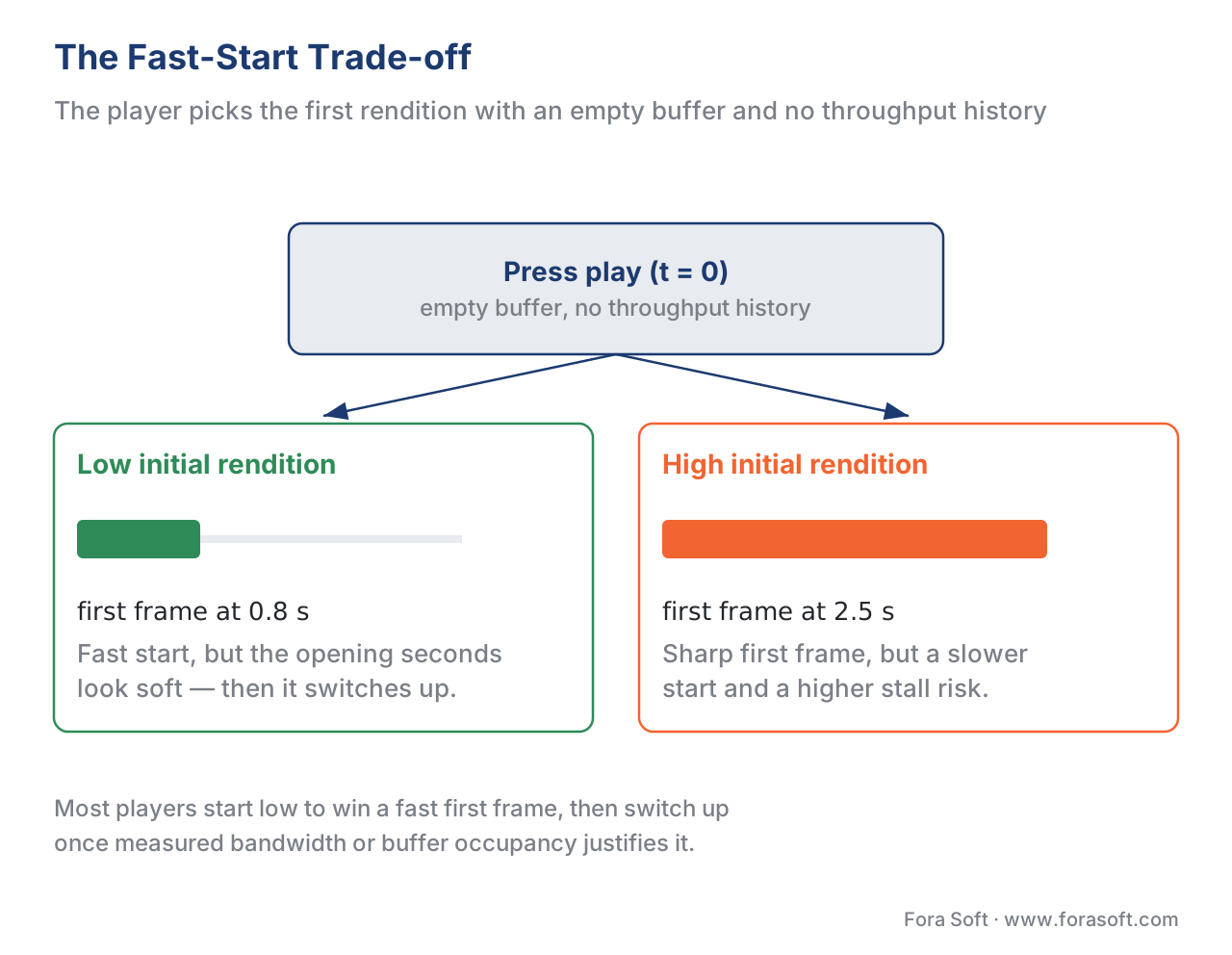 Figure 3. The fast-start trade-off. A low initial rendition starts fast but soft, then switches up; a high initial rendition starts sharp but slow, with more stall risk. The player bets on this with an empty buffer.
The levers that shorten startup without simply dropping quality all attack the largest legs from Figure 1: lower the start buffer threshold, use a shorter first segment so less must download before playback, keep segments short, and adopt low-latency HLS or DASH so the player can begin from a partial segment. The measurement takeaway is the one that belongs in this section: startup time is not a number you minimize in a vacuum. Drive it to zero by always starting at the lowest rendition and you have traded a startup problem for a first-impression problem; chase a pristine first frame and you invite the abandonment back. Read startup alongside the picture metrics from choosing the right metric and the rest of delivery, and remember that how the algorithm makes the choice is the Video Streaming section's territory — this section owns how you measure the result.
The survivorship trap: startup time, failures, and exits
The most dangerous mistake in startup measurement is not a miscalculation; it is a blind spot, and it deserves its own section because it can make a failing service look healthy.
A startup time can only be computed for a session that actually started. Every viewer who never got a first frame is, by definition, absent from your startup-time average. Two groups vanish this way. The first is video startup failure (VSF) — play attempts that terminate during startup with a fatal error, before any frame appears (CTA-2066, 2020; Conviva, 2026). The second is exit before video start (EBVS) — viewers who gave up voluntarily during the wait, the abandonment the Krishnan–Sitaraman curve counts. Neither group is in your startup-time number, because neither produced a first frame to time.
The consequence is a survivorship bias: optimize only the median startup time and you may be polishing the experience of the survivors while the failures and the impatient quietly leave. A service can report a tidy one-second median startup time on top of a brutal failure-plus-abandonment rate, and the dashboard will look fine. The fix is to measure all three together — startup time for those who started, VSF for those who failed, and EBVS for those who quit waiting — so the number that looks good cannot hide the viewers it excludes.
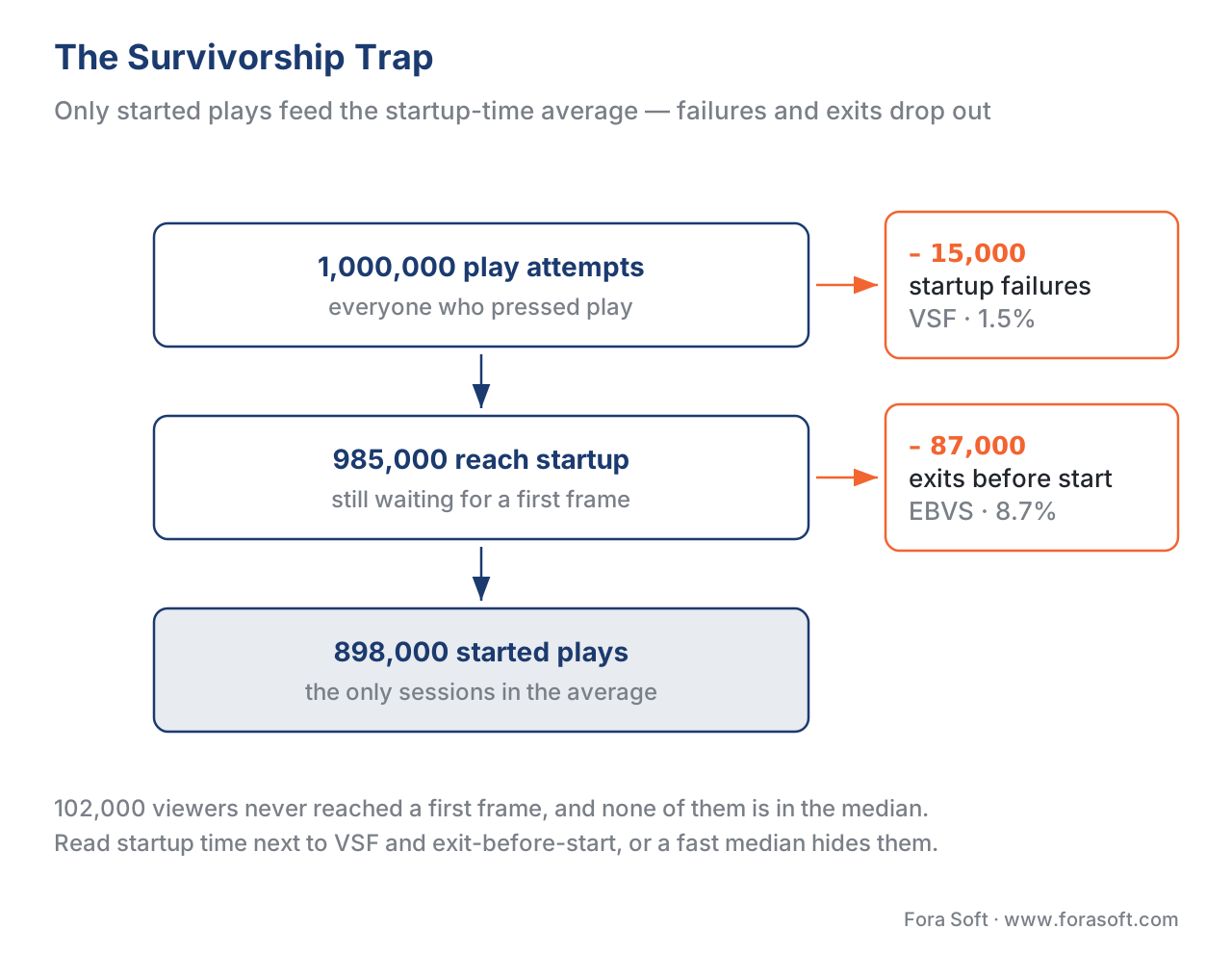 Figure 4. The survivorship trap. Only started plays feed the startup-time average; failures (VSF) and exits before start (EBVS) drop out first, so a healthy median can hide the viewers who never reached a first frame.
Common mistakes when measuring startup time
The same metric that predicts retention is easy to misread. Six traps recur.
The first is measuring time to first byte and calling it startup time — TTFB is one early leg of Figure 1 and ends before any frame is on screen. The second is starting the clock at the wrong moment: timing from manifest load rather than play intent erases the wait the viewer actually felt. The third is reporting the median alone, which hides the slow tail where the abandoners live; pair it with the 95th percentile, as monitoring quality in production insists for any fleet metric. The fourth is the survivorship trap above — a startup time read without VSF and EBVS. The fifth is letting preloaded video pollute the number: a video that began loading before the click reports a deceptively fast startup and corrupts any CDN comparison (Mux, 2025); pre-roll ads skew it the same way. The sixth is confusing startup with rebuffering — different moment, different metric, different fix — which the rebuffering article keeps carefully separate.
Free download: Startup-time calculatorA standard-library Python tool that turns player events into the startup-phase numbers the way the standards define them — video and aggregate startup time, the median and the 95th percentile, and the start-failure and exit-before-start rates the median hides.Where Fora Soft fits in
Fora Soft has built video streaming, OTT, conferencing, e-learning, telemedicine, and surveillance products since 2005, and in every one of them time to first frame is among the first numbers we put on the dashboard. We instrument startup from player events using the standardized definitions (CTA-2066) and client data (CMCD), so the metric means the same thing across web, mobile, and TV clients — and we always read it beside the start-failure and exit-before-start rates so a fast median cannot hide the viewers who never reached a frame. In live and conferencing products, where the first frame is the join experience and there is no second take, that telemetry is a primary quality signal. The job is not a prettier startup chart; it is catching the device, CDN, or region whose first frames arrive too late, before that audience decides the product is slow.

The handbook
Fora Soft Video Engineering Handbook
We wrote a seven-volume handbook that works through the whole video stack — encoding, delivery, audio and AI — across more than 9,000 pages. Volume 3 is where this article continues: the bitrate ladder and the rung a player picks with an empty buffer, the player state machine and its start buffer threshold, the CDN in front of the first segment, and the QoE monitoring that reads startup beside the stalls. Volume 2 sits one layer under it — DNS, TCP, TLS, QUIC, and the HLS and DASH manifests whose fetch is the second leg of every startup you measure — and volume 1 explains what is inside that first segment, and why a shorter GOP makes it arrive sooner. Written by Nikolay Sapunov, CEO at Fora Soft.
Do you know how long your viewers wait before the first frame — and how many never see one?
Tell us your player, your delivery path and the events you already collect, and we will come back with where the clock should start and stop, which legs of your startup stack are worth cutting, and the start-failure and exit-before-start rates to read beside the median. 250+ video products shipped since 2005.
See our case studies
Case study
Worldcast Live
Concert streaming at 1.5 Gb/s and 0.4–0.5 s glass-to-glass latency for 10,000 simultaneous viewers. When the whole delivery budget is half a second, the first frame is the join — there is no second take, and the start buffer threshold is tuned in tens of milliseconds.
Case study
TradeCaster
Live desktop streaming for 46,000+ stock traders, auto-scaling through the load spikes at market open. A trader who waits three seconds for a first frame has missed the move, so startup time is the number that shows the spike before the throughput graphs do.
Case study
Mindbox
An RTSP to FFmpeg to HLS pipeline across 50+ deployments in transport, pharma and gated communities. An operator clicking a camera is a cold start every time: segment length and the player’s buffer threshold, not the encoder, decide how fast that first frame lands.
What to read next
Streaming QoE
Streaming QoE Metrics: What Keeps a Viewer Watching
The framing this article sits inside: startup beside stalls, switches and failures.
Stalls
Rebuffering Ratio: The Real Cost of a Stall
The twin metric — the wait after playback starts, tuned against this one.
Player telemetry
Player-Side Quality Metrics & the Analytics Stack
Where the play-intent and first-frame events come from, and how to collect them.
Picture and QoE
Picture Quality vs QoE: Connecting VMAF to Experience
How a high VMAF and a slow first frame add up to one experience score.
References
- CTA-2066. "Streaming Quality of Experience Events, Properties and Metrics." Consumer Technology Association, 2020. Tier 1 (recommended-practice standard). Defines the streaming QoE events and metrics — including video start time and the start-failure events — and how each is computed for consistent cross-vendor reporting. Basis for the metric definition and the standardized-measurement points. https://shop.cta.tech/products/streaming-quality-of-experience-events-properties-and-metrics-cta-2066
- CTA-5004. "Web Application Video Ecosystem — Common Media Client Data (CMCD)." Consumer Technology Association, 2020 (CMCDv2 / CTA-5004-A, 2026). Tier 1 (standard). The key-value vocabulary a player attaches to each media request, enabling reconstruction of the startup sequence at the backend. Basis for the measurement-source and standardized-telemetry points. https://cdn.cta.tech/cta/media/media/resources/standards/pdfs/cta-5004-final.pdf
- Recommendation ITU-T P.1203. "Parametric bitstream-based quality assessment of progressive download and adaptive audiovisual streaming services over reliable transport." International Telecommunication Union, 2017. Tier 1 (official standard). Folds the initial loading delay into a 1–5 session score alongside picture, switches, and stalls; the basis for the "startup weighs less in-session than a stall, but its damage is abandonment upstream" framing. https://www.itu.int/rec/T-REC-P.1203
- Recommendation ITU-R BT.500-15. "Methodologies for the subjective assessment of the quality of television pictures." International Telecommunication Union, 2023. Tier 1 (official standard). The subjective ground truth every objective and QoE model is ultimately validated against; when a model and a careful viewing disagree, the viewing wins. Basis for the measurement-honest framing. https://www.itu.int/rec/R-REC-BT.500
- S. S. Krishnan, R. K. Sitaraman. "Video Stream Quality Impacts Viewer Behavior: Inferring Causality Using Quasi-Experimental Designs." ACM Internet Measurement Conference (IMC), 2012. Tier 5 (peer-reviewed causal study, large Akamai dataset). Abandonment is near zero below ~2 s of startup delay and rises ~5.8% per additional second; short content and better-connected viewers abandon sooner. Basis for the abandonment curve, the worked cost, and the patience refinements. https://people.cs.umass.edu/~ramesh/Site/HOME_files/imc208-krishnan.pdf
- F. Dobrian, V. Sekar, A. Awan, I. Stoica, D. Joseph, A. Ganjam, J. Zhan, H. Zhang. "Understanding the Impact of Video Quality on User Engagement." ACM SIGCOMM, 2011. Tier 5 (peer-reviewed, large Conviva dataset). Startup delay (join time) is among the metrics that affect engagement, with the buffering ratio carrying the largest single effect. Basis for placing startup among the engagement-driving metrics. https://www.cs.cmu.edu/~hzhang/papers/sigcomm2011_QualityEngagement.pdf
- RFC 9317. "Operational Considerations for Streaming Media." J. Holland, A. Begen, S. Dawkins. IETF, 2022. Tier 3 (standards-body operational guidance). Describes the player buffer model and the start buffer threshold that gates initial playback. Basis for the buffer-threshold component and the startup-vs-stall tuning point. https://www.rfc-editor.org/rfc/rfc9317.html
- Mux. "The Video Startup Time Metric Explained." Mux (engineering blog), updated 2025. Tier 4 (vendor engineering, credible deployer). Defines video startup time as play intent to first frame, separates video vs aggregate startup time (the 2.5 s worked example), and warns that preloaded video and pre-roll ads skew the metric. Basis for the intent/aggregate framing and two pitfalls. https://www.mux.com/blog/the-video-startup-time-metric-explained
- Fastpix. "Optimizing Video Startup Time: Tips for Better Streaming." Fastpix (engineering blog), 2025. Tier 4 (vendor engineering). Breaks startup into DNS, TCP, TLS, content delivery, and buffering/decoding, and notes the ~100 ms saving from a 1-RTT TLS 1.3 handshake. Basis for the network-setup component detail. https://www.fastpix.io/blog/what-is-video-startup
- Conviva. "Streaming QoE metrics: VST, VSF, EBVS." Conviva (resource/glossary), accessed 2026-06-25. Tier 4 (vendor, credible deployer at scale). Defines video startup time, video start failure (VSF), and exit before video start (EBVS) as distinct startup-phase metrics. Basis for the survivorship-trap section. https://www.conviva.ai/resource/ott-101-your-guide-to-streaming-metrics-that-matter/
- Core Web Vitals. "Time to First Byte (TTFB)." MDN Web Docs / web.dev, accessed 2026-06-25. Tier 6 (educational reference). TTFB is request-to-first-byte; under 800 ms is considered good. Used only to fix the TTFB-vs-TTFF boundary, not as a metric authority. https://developer.mozilla.org/en-US/docs/Glossary/Time_to_first_byte
