


Why this matters
If you run a streaming product, you almost certainly already measure QoS — your CDN and network dashboards are full of throughput graphs and error rates — and you may be reading those green numbers as proof that viewers are happy. They are not. QoS measures the pipe; QoE measures the person at the end of it, and a viewer abandons a stream over things a network graph never shows: a five-second startup, a single stall during the goal, a picture that is technically delivered but visibly mushy. Knowing the difference tells you which dashboard predicts churn, why "the network is fine" is not an answer to "why did viewers leave," and where to spend your next engineering hour. This is the bridge from the rest of this Video Quality & Measurement section into the streaming-QoE block, where each viewer-side metric gets its own article.
Two letters apart, two different questions
QoS and QoE differ by one letter and by an entire point of view. It pays to keep them apart, because teams that blur them optimize the wrong dashboard.
Quality of Service (QoS) is a system question: is the network and delivery pipeline doing its job? It is measured in the units engineers already track — megabits per second of throughput, milliseconds of latency, percent of packets lost. Quality of Experience (QoE) is a human question: is the viewer satisfied? It is measured in how fast the video started, whether it stalled, whether the picture held up — and, ultimately, whether the person stayed. One is a fact about infrastructure; the other is a fact about a person. They are correlated, which is the whole reason QoS is worth measuring, but they are not the same, and the space between them is where streaming mistakes live.
A restaurant analogy holds the idea in place. QoS is the kitchen's instrument panel: the oven temperature, the freezer's cold-chain log, the delivery truck's GPS showing it arrived on time. Every reading can be perfect. QoE is the only thing that actually pays the bill — whether the diner enjoyed the meal. A truck that arrives exactly on schedule with a cold, badly cooked dish has flawless logistics and a furious customer. The instrument panel is necessary, useful, and completely insufficient on its own. You still have to ask the diner.
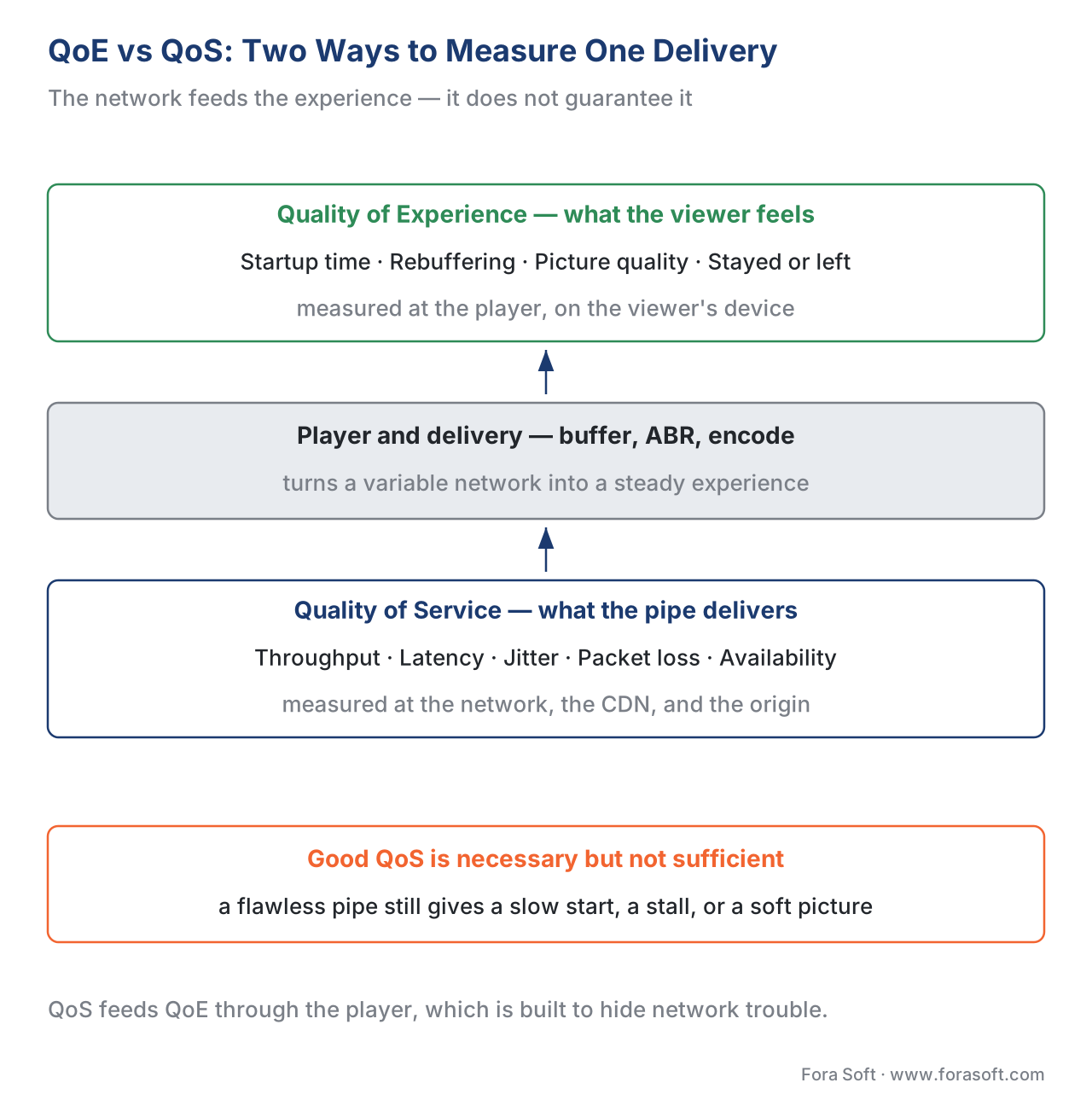 Figure 1. The same delivery, measured two ways. QoS measures the pipe from the bottom up; QoE measures the viewer from the top down. The pipe feeds the experience, but it does not guarantee it.
Quality of Service: what the pipe delivers
Quality of Service is the older, network-side discipline, and it has a formal definition. ITU-T Recommendation E.800 (09/2008) defines QoS as the "totality of characteristics of a telecommunications service that bear on its ability to satisfy stated and implied needs of the user of the service." In practice, for streaming video, that totality comes down to a handful of measurable network and delivery properties.
The first is throughput — how many bits per second the connection actually moves, reported in kilobits or megabits per second (kbps / Mbps). It sets a hard ceiling on the bitrate, and therefore the picture quality, you can deliver without stalling. The second is latency — the delay, in milliseconds, between a request and the first byte of response. The third is jitter — the variation in that delay, also in milliseconds, which matters enormously for live and real-time video. The fourth is packet loss — the percentage of data packets that never arrive, forcing retransmission or leaving gaps. The fifth is availability — the percentage of time the service is reachable at all.
To these network-layer numbers, a streaming pipeline adds its own delivery-side QoS: CDN cache-hit ratio, origin error rates (the share of HTTP 4xx/5xx responses), and segment download times. These are still system measurements — they describe how well the machinery ran, not how the video felt. A team can watch all of them stay green.
The strength of QoS is that it is objective, continuous, and diagnostic. When something breaks, QoS metrics tell you where in the system it broke — a saturated link, a failing origin, a lossy last mile. Its limit is equally important: QoS never tells you whether the viewer was happy. It cannot, because it never measures the viewer. A perfectly healthy network is a precondition for a good experience, not a measurement of one. For the delivery mechanics behind these numbers — adaptive bitrate, players, CDNs — this section links out to the Video Streaming section; here we are concerned with what to measure, not how the delivery works.
Quality of Experience: what the viewer perceives
Quality of Experience flips the point of view from the system to the person. ITU-T Recommendation P.10/G.100 — the standards body's official vocabulary for these terms — defines QoE, since its 2017 revision, as "the degree of delight or annoyance of the user of an application or service." It adds that this delight or annoyance "results from the fulfilment of his or her expectations" about the service, "in the light of the user's personality and current state." QoE is, by definition, subjective: it lives in the viewer, not in the wire.
Because it lives in a person, QoE is shaped by more than the network. The standards literature groups its drivers into three influencing factors: human factors (the viewer's expectations, mood, even what device they hold), system factors (the network, the encode, the player — the part QoS covers), and context factors (where they are, what they are doing, whether they are paying). The same stream can earn a different QoE from a commuter on a phone and a fan on a living-room TV. QoS sees one of these three groups; QoE sees all of them.
For streaming, QoE is made measurable through a set of viewer-side indicators that proxy for that delight or annoyance. Startup time (also called time-to-first-frame) is how many milliseconds or seconds pass between pressing play and seeing video. Rebuffering is the stalling that interrupts playback once it has started — counted as the number of stalls and, more importantly, the rebuffering ratio, the percentage of total watch time the viewer spent staring at a spinner. Average bitrate and the frequency of bitrate switches describe how good and how stable the picture was. Video start failures and exits before video start capture the viewers who never saw a frame at all. And sitting alongside all of these is the perceived picture quality of the frames that did play — the territory of objective metrics like VMAF and the subjective Mean Opinion Score (MOS) covered elsewhere in this section.
Each of these viewer-side metrics gets its own deep dive in the streaming-QoE block — rebuffering, startup time, and the bitrate-switching trade-off. What unites them is the point of view: every one is measured at the player, on the viewer's side of the glass, because that is the only place experience actually happens.
Why a perfect QoS can still produce a bad QoE
Here is the single most important idea in this article. Good QoS is necessary but not sufficient for good QoE. You cannot deliver a good experience over a broken network — but you can absolutely deliver a bad experience over a perfect one. The network being healthy does not mean the viewer is happy, and treating a green QoS dashboard as proof of a good experience is the most common, most expensive mistake in streaming.
Walk through the ways a flawless pipe still disappoints a viewer. The encode itself can be poor — a stall-free, error-free stream of a badly compressed picture is delivered perfectly and still looks bad; the network did its job and the viewer still sees mush. The startup can be slow — if the player's buffering logic waits five seconds before the first frame, the network moved every byte on time and the viewer still abandoned before playback began. The adaptive-bitrate ladder can be misconfigured — a player that flips resolutions every few seconds delivers a technically high average bitrate and a visibly unstable, distracting picture. And timing is everything — a single two-second rebuffer is a minor blip during the credits and a catastrophe during the penalty kick. QoS counts the stall; only QoE knows it happened at the worst possible moment.
The reverse asymmetry is just as real and just as instructive. A good experience can survive an imperfect network, because the player is designed to hide QoS problems from the viewer. The buffer absorbs jitter; adaptive bitrate trades a little sharpness for an unbroken stream when bandwidth dips. That is the entire job of a modern video player: to convert variable QoS into stable QoE. Which is exactly why you must measure QoE directly — the player is busy breaking the simple link between network health and viewer happiness in both directions.
What a stall actually costs — the arithmetic
The clearest evidence that QoE must be measured on its own comes from the relationship between rebuffering and engagement. The foundational study is Dobrian et al., presented at ACM SIGCOMM in 2011 using a large client-side dataset from the streaming-analytics company Conviva. Its central finding: of all the quality metrics they measured, the rebuffering ratio — the fraction of time spent buffering — had the largest impact on how long people watched, across every content type.
Put a number on it. The study reported that, for live content, a 1% increase in buffering ratio reduced engagement by more than three minutes on a 90-minute live event. Walk the arithmetic out loud:
Buffering ratio = time spent buffering ÷ total session time
1% of a 90-minute event = 0.01 × 90 min = 0.9 min ≈ 54 seconds of stalling
Result: > 3 minutes of lost watch time per affected viewer
So roughly 54 seconds of spinner did not cost 54 seconds of engagement — it cost more than three minutes, a loss several times larger than the stall itself, because a frustrated viewer does not just wait through the stall, they leave. Now notice what the QoS view of that same event would have shown: a brief dip in throughput, quickly recovered, well within tolerance. The network told a story of a minor, resolved hiccup. The viewer told a story of three lost minutes. Only one of those dashboards predicted the churn, and it was not the network's.
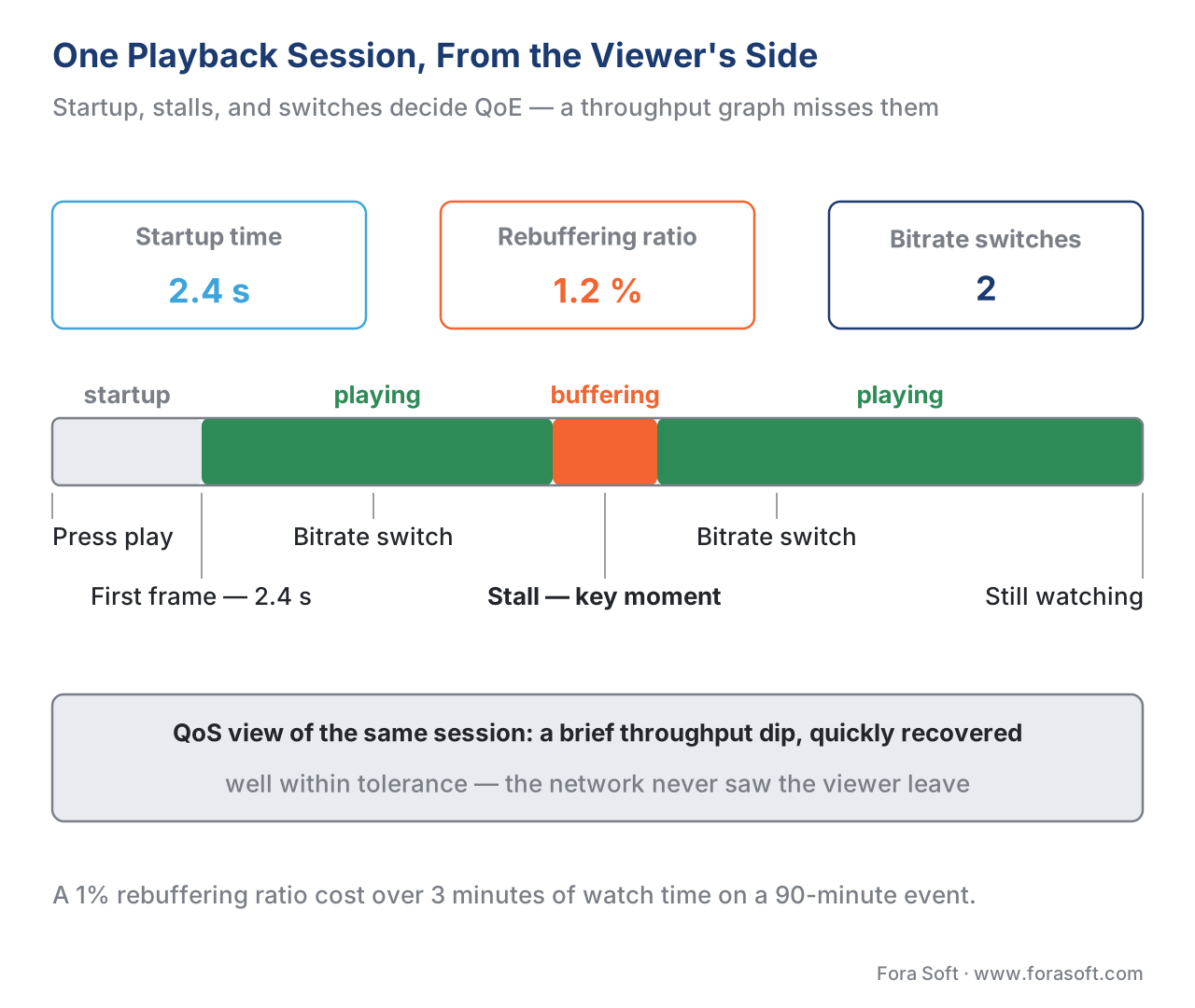 Figure 2. One playback session, seen from the viewer's side. Startup delay, a mid-stream stall, and bitrate switches are invisible to a throughput graph but decisive for whether the viewer stays.
Measuring both: the metrics map
Because the two answer different questions, a serious quality program measures both and keeps them clearly labeled. The table below is the map. Read it as two instruments with different jobs, not a list to choose from.
| Quality of Service (QoS) | Quality of Experience (QoE) | |
|---|---|---|
| Question it answers | Is the network and pipeline delivering correctly? | Is the viewer satisfied? |
| Point of view | The system / the pipe | The person / the player |
| What it measures | Throughput, latency, jitter, packet loss, availability, CDN/origin errors | Startup time, rebuffering ratio, bitrate, switches, start failures, picture quality |
| Units | Mbps, ms, %, error rate | ms/s, %, count, VMAF/MOS |
| Where it's measured | Network, CDN, origin, server logs | The player, on the viewer's device |
| Where it lies / its blind spot | Says nothing about whether the viewer was happy; green QoS ≠ good experience | Harder and costlier to instrument; influenced by human and context factors the pipeline can't control |
| Who owns it | Network / infrastructure / DevOps | Product / streaming / quality engineering |
Table 1. QoS and QoE as two instruments. QoS tells you whether the machinery ran; QoE tells you whether it mattered to the viewer. A mature program watches both, and never reads one as a substitute for the other.
The relationship between the two columns is causal but loose: QoS is an input to QoE, mediated by the player. Low packet loss and ample bandwidth make a good experience possible; the encode quality, the ABR logic, the startup behavior, and the content itself decide whether that possibility is realized. This is why connecting the picture-quality metrics to the delivery metrics — the subject of the connecting-objective-metrics-to-QoE article — is the synthesis the whole field is working toward.
The standards that pin this down
This is not loose terminology; the distinction is fixed in named recommendations, and citing them keeps a quality conversation precise. QoS is defined in ITU-T E.800 (09/2008). QoE is defined in ITU-T P.10/G.100, the official vocabulary, with the "delight or annoyance" wording dating from its 2017 revision. For streaming specifically, ITU-T P.1203 is the first standardized model that predicts a QoE score (a 1–5 MOS) for HTTP adaptive streaming from bitrate, resolution, and stalling events — a parametric, bitstream-based model rather than a full-reference one, and it can be combined with the picture-quality models of the P.1204 family. On the player-instrumentation side, CTA-2066, part of the Consumer Technology Association's WAVE project, standardizes the streaming-QoE events, properties, and metric definitions so that startup time and rebuffering mean the same thing across players and analytics vendors. When you report a QoE number, name the standard behind it; "QoE is good" without a model or a metric definition is as empty as "VMAF is high" without a model.
Common mistake: reading a green QoS dashboard as a happy viewer. The classic failure is to watch throughput, error rates, and packet loss, see all of them healthy, and conclude the experience is good. It is the streaming version of Goodhart's law: the network team optimizes the metric it owns, the metric stays green, and viewers still leave — because nobody measured the startup time, the rebuffer that hit during the goal, or the encode that was delivered flawlessly and still looked bad. A second, opposite mistake is over-optimizing one QoS knob at the experience's expense: pushing the highest bitrate the link can carry maximizes a QoS number and causes rebuffering the moment bandwidth dips, trading a metric the viewer cannot see for a stall they certainly can. The fix is the same in both cases — instrument the player, measure QoE directly, and treat QoS as a diagnostic input to it, never as a stand-in for it.
Where Fora Soft fits in
Fora Soft has built video products since 2005 — live streaming, OTT, WebRTC conferencing, e-learning, telemedicine, and surveillance — and across all of them we treat QoS and QoE as two instruments, not one. We instrument the network and the pipeline because that is where problems are diagnosed, but we judge a release by what the player reports on the viewer's side: how fast it started, whether it stalled, how stable the picture stayed. When a client's network dashboard is green and viewers still drop off, we go looking on the experience side — startup, rebuffering, the encode, the ABR logic — because that is where the answer almost always is. Naming the quality question before reaching for a number is the honest way to measure delivered experience, and it is the basis for the delivery-side measurements in our benchmark methodology.
The handbook
Fora Soft Video Engineering Handbook
We wrote a seven-volume handbook that walks the whole video stack, from a single pixel to a running production system, across more than 9,000 pages; an engineer who works through it can design and build a delivery chain and the measurement around it. Volume 3, Video Streaming, sits closest to this article - ABR ladders, CDNs, player behaviour, QoE monitoring and the economics of delivery, which is where the viewer-side numbers are made. Volume 2, Video Streaming, covers the transport half those QoS metrics come from - TCP and UDP, congestion control, QUIC, ingest and the segment protocols - and Volume 1, Video Encoding, works out the picture quality that a flawless pipe can still deliver badly. Written by Nikolay Sapunov, CEO at Fora Soft.
Your network dashboard is green - do you know what your viewers are seeing?
Tell us what your CDN reports and what your players report, and we will say which of the two explains the drop-off: startup time, the rebuffer that landed at the worst moment, an ABR ladder that switches too often, or an encode that arrives intact and still looks soft. 250+ video products shipped since 2005.
See our case studies
Case study
Worldcast Live
Concert streaming at 1.5 Gb/s with 0.4-0.5 s latency for 10,000 simultaneous viewers, with dynamic quality adjustment on poor connections - the player doing exactly the job this article describes, turning a variable network into a watchable show.
Case study
Sprii
A live shopping platform with 72,000+ events hosted and EUR 365M+ in sales, where viewers watch 20 minutes against 54 seconds on a static page - a stall during the product drop is measured in lost orders, not in dropped packets.
Case study
TradeCaster
Real-time desktop streaming for 46,000+ stock traders that auto-scales through the load spike at market open - the moment when a healthy throughput graph and a late frame are two very different reports.
What to read next
QoE block
Streaming QoE metrics: what keeps a viewer watching
The block this article opens: every viewer-side metric, one by one.
Rebuffering
Rebuffering ratio and the real cost of a stall
The 1% that cost three minutes, worked out properly.
Startup
Startup time and time to first frame
The 2.4 seconds before the first frame, and where they go.
Synthesis
Picture quality vs QoE: connecting VMAF to experience
How a picture-quality score joins up with what the player reports.
References
- Recommendation ITU-T E.800 (09/2008), Definitions of terms related to quality of service. International Telecommunication Union. Tier 1. The controlling definition of QoS — the "totality of characteristics of a telecommunications service that bear on its ability to satisfy stated and implied needs of the user of the service." https://www.itu.int/rec/T-REC-E.800-200809-I/en
- Recommendation ITU-T P.10/G.100 (2017 consolidated edition; the QoE "delight or annoyance" wording was introduced by Amendment 5, 2016 — Amendment 1, 2007, carried the earlier "overall acceptability" definition), Vocabulary for performance, quality of service and quality of experience. International Telecommunication Union. Tier 1. The official definition of QoE as "the degree of delight or annoyance of the user of an application or service," and the human / system / context influencing factors. https://www.itu.int/rec/T-REC-P.10
- Recommendation ITU-T P.1203 (and P.1203.1 / P.1203.3), Parametric bitstream-based quality assessment of progressive download and adaptive audiovisual streaming services over reliable transport. International Telecommunication Union. Tier 1. The first standardized QoE model for HTTP adaptive streaming; outputs a 1–5 MOS from bitrate, resolution, and stalling, and integrates with P.1204-family video models. https://www.itu.int/rec/T-REC-P.1203
- F. Dobrian, V. Sekar, A. Awan, I. Stoica, D. Joseph, A. Ganjam, J. Zhan, H. Zhang, "Understanding the Impact of Video Quality on User Engagement," Proc. ACM SIGCOMM 2011, pp. 362–373. Tier 5 (peer-reviewed). The foundational large-scale study (Conviva dataset) showing buffering ratio has the largest impact on engagement; the "1% buffering ratio ≈ 3+ lost minutes on a 90-min live event" figure. https://conferences.sigcomm.org/sigcomm/2011/papers/sigcomm/p362.pdf
- CTA-2066, Streaming Quality of Experience Events, Properties and Metrics. Consumer Technology Association (WAVE project). Tier 3 (standards-body specification). Standardizes player-side QoE event and metric definitions (startup time, rebuffering, bitrate) for consistent reporting across players and analytics vendors. https://shop.cta.tech/products/streaming-quality-of-experience-events-properties-and-metrics
- Recommendation ITU-T G.1011 (2022), Reference guide to quality of experience assessment methodologies. International Telecommunication Union. Tier 1. The taxonomy of QoE assessment approaches — subjective, objective/data-driven, and hybrid — and how QoE relates to QoS. https://www.itu.int/rec/T-REC-G.1011
- Recommendation ITU-T G.1000 (11/2001), Communications quality of service: A framework and definitions. International Telecommunication Union. Tier 1. Frames the four viewpoints of QoS (customer's requirements, provider's offering, achieved, perceived) — the bridge from network QoS to perceived quality. https://www.itu.int/rec/T-REC-G.1000
- S. S. Krishnan, R. K. Sitaraman, "Video Stream Quality Impacts Viewer Behavior: Inferring Causality Using Quasi-Experimental Designs," IEEE/ACM Transactions on Networking, vol. 21, no. 6, 2013. Tier 5 (peer-reviewed). Establishes a causal (not merely correlational) link between rebuffering/startup delay and viewer abandonment, corroborating the Dobrian findings. https://people.cs.umass.edu/~ramesh/Site/PUBLICATIONS_files/KS2013.pdf
- Qualinet White Paper on Definitions of Quality of Experience (Le Callet, Möller, Perkis, eds.), European Network on QoE, 2012. Tier 5 (institutional). The widely cited consensus definition and the human / system / context influencing-factor taxonomy that informs ITU-T P.10/G.100. https://hal.science/hal-00977812/
