


Why This Matters
If you are building anything that streams live video to a Chromium-based browser, an Android phone, a Smart TV that isn't an Apple TV, or any of the half-billion devices that run ExoPlayer or Shaka Player, LL-DASH is what you actually ship for low latency. LL-HLS is the headline because Apple owns the press cycle and because every "how to do low latency" article begins on iOS, but the reality of a 2026 streaming deployment is that LL-HLS covers the Apple ecosystem and LL-DASH covers everything else, and CMAF makes them share the same files underneath. The mechanics are subtle — chunked transfer is not the same thing as a CMAF chunk; @availabilityTimeOffset is not the same as @suggestedPresentationDelay; the ABR algorithm running in the player has to know how to estimate throughput on a half-arrived chunk — and the production failure modes are at the seams. The point of this article is to make every line of an LL-DASH MPD readable, to make every link in the chunked-CMAF chain visible, and to make the trade-offs between LL-DASH, LL-HLS, and WebRTC something you can argue with numbers.
What LL-DASH is, in one paragraph
LL-DASH is regular MPEG-DASH with three changes. First, the encoder produces CMAF chunks — 200–500 ms slices of a segment — instead of waiting to publish a complete 2-to-6-second segment. Second, the origin streams those chunks to the player using HTTP chunked transfer encoding (HTTP/1.1) or stream framing (HTTP/2, HTTP/3) over a single response that stays open while the segment is still being produced; the player consumes bytes as they arrive instead of waiting for the response to close. Third, the MPD carries four signals — the cmaf-extended profile URN, @availabilityTimeOffset on each SegmentTemplate, @availabilityTimeComplete="false", and a <ServiceDescription> block with a target latency — that together tell the player "you are watching a low-latency stream; here is how to schedule fetches, here is where the live edge is, here is how much you should buffer". A DASH-IF low-latency-aware player (dash.js since v3.0, Shaka Player since v3.2, ExoPlayer since 2.16, Bitmovin Player since 8.41, THEOplayer since 4.0) reads those signals, schedules its first request to land at the moment the next chunk becomes available, runs its ABR algorithm on bytes-per-second rather than chunks-per-second, and targets the latency the MPD asked for. The net effect is a 2–4 second glass-to-glass floor on the same CDN economics, file format, packagers, and DRM infrastructure as plain DASH — no new server software, no new ingest protocol, no new player engine, only new manifest signals and new ABR tuning.
The history, in three milestones
Low-latency DASH is older than LL-HLS and is the standard the LL-HLS designers explicitly drew from. Three milestones define how we got to 2026.
The first is the 2017 publication of ISO/IEC 23000-19 — Common Media Application Format (CMAF). CMAF defines a fragmented-MP4 packaging that explicitly supports the chunk — a fragment-of-a-fragment — as the smallest addressable media unit. A CMAF chunk is one or more frames packaged inside a moof + mdat pair that can be parsed and decoded independently of the rest of its parent segment. The standard ratified what some encoders had already started doing in 2016 (Akamai's "low-latency HLS over CMAF" pre-Apple-LL-HLS proposals) and gave both HLS and DASH a common building block.
The second is the 2019 publication of the DASH-IF Low-Latency Modes for DASH community review, formalised as DASH-IF Implementation Guidelines in 2020 and revised through v1.2 (2024). The document is the de-facto specification for LL-DASH because ISO/IEC 23009-1 defines only the manifest-level signals; DASH-IF defines how to combine them into a coherent low-latency profile and how the player should behave. The 2020 release coincided with the dash.js v3.0 release that shipped the first reference implementation of the low-latency mode, and Akamai's first commercial LL-DASH origin behaviour.
The third is the 2025 DASH-IF Restricted Timing Model, which closed the last big interoperability gap in LL-DASH: how @availabilityTimeOffset, @suggestedPresentationDelay, and the player's clock-skew estimate combine to produce a stable wall-clock latency target across heterogeneous viewers. The 2025 document defines a deterministic algorithm for the player's playback-rate adjustment (the small ±5% rate nudge that absorbs clock skew without visible audio pitch shift), and is now the reference for every production DASH low-latency deployment.
In 2026, the production stack is mature. The MPD signals are well-known, dash.js and Shaka are spec-conformant, the major packagers (Akamai LL-CMAF, AWS MediaPackage v2, Bitmovin Live, Mux Live, Norsk, Unified Streaming, Wowza, Shaka Packager) all emit chunked-CMAF correctly out of the box, and the major CDNs (Akamai, Cloudflare, Fastly, CloudFront) all support the cache-key configuration that LL-DASH needs.
The latency budget, before and after
The cleanest way to understand what LL-DASH does is to lay out the latency budget side by side with plain DASH.
A typical plain-DASH live stream has the same three contributors as plain HLS, in slightly different units. The encoder produces 2-to-6-second segments; for the canonical four-second segment, four seconds of real time pass before the first byte of segment N reaches the origin. The segment availability delay is one segment's worth of waiting between the encoder finishing the segment and the player learning the segment is available, because the player polls the MPD on a schedule set by @minimumUpdatePeriod. The playback buffer is conventionally three segment-durations deep so the player can absorb jitter, which adds twelve seconds. Add about one second of HTTP overhead and you arrive at twenty-one seconds glass-to-glass. Production deployments measure eighteen to thirty.
LL-DASH rewrites every line.
| Latency contributor | Plain DASH (4 s segments) | LL-DASH (4 s segments, 333 ms chunks) |
|---|---|---|
| Encoder | 4.0 s (one full segment) | 0.33 s (one chunk) |
| Segment availability | 2.0 s (half @minimumUpdatePeriod) | 0.0 s (template-addressed; no MPD reload needed) |
| Playback buffer | 12.0 s (3 segments) | 1.0–2.0 s (3–6 chunks) |
| HTTP overhead | 1.0 s | 0.4 s (single open response) |
| Total glass-to-glass | ~19 s | ~1.8–2.8 s |
SegmentTemplate$Number$ or $Time$) — the player computes the URL of segment N+1 without ever fetching a new MPD, and asks for it the instant @availabilityTimeOffset says it should become fetchable. The playback buffer shrinks from three segments to three to six chunks because the smallest unit the player can buffer is now a chunk, not a segment. The HTTP overhead halves because the player keeps the chunked-transfer response open across the whole segment instead of issuing one request per segment.
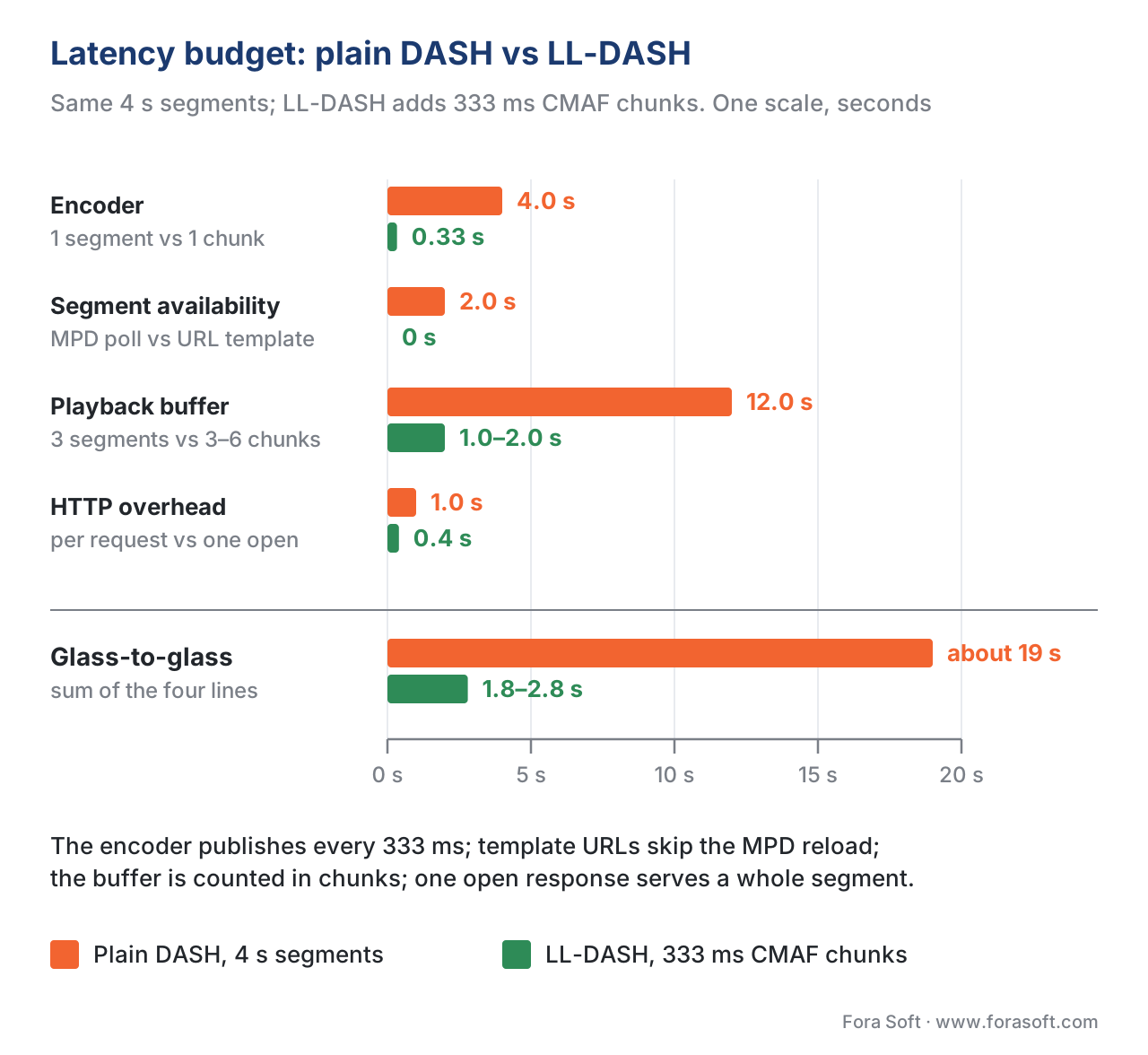 Figure 1. The glass-to-glass latency budget for plain DASH (top bar) vs LL-DASH (bottom bar). Each segment is annotated with its contributor; LL-DASH collapses every line by an order of magnitude.
The four mechanisms, one at a time
LL-DASH is one new packaging idea (the CMAF chunk), one new transport idea (chunked transfer), and two new manifest signals (@availabilityTimeOffset and <ServiceDescription>). The four parts only deliver their full benefit together. Skipping any one of them produces a slower version of LL-DASH that still calls itself LL-DASH in the configuration file.
Mechanism 1 — The CMAF chunk
A CMAF chunk is the smallest independently parseable unit a CMAF segment can be cut into. It is a single moof + mdat pair containing one or more video or audio frames, packaged inside the same fragmented-MP4 wrapper as the parent segment. In a four-second segment with 333 ms chunks, the segment file contains twelve moof/mdat pairs back to back. A CMAF chunk is to a CMAF segment what an #EXT-X-PART is to an HLS segment — the same wire-level unit, with a different name.
Two properties matter for the player. First, a chunk can be parsed and decoded the moment its bytes arrive, without waiting for the segment to finish. The moof box at the front of the chunk carries the sample timing and offsets; the mdat carries the frames; the player's SourceBuffer.appendBuffer() accepts them as a valid fragment. Second, only some chunks are independent — chunks that start with an I-frame (an IDR sample in H.264 / HEVC / AV1 terms). A non-independent chunk (P-frames or B-frames) can only be decoded after the chunks that preceded it. The DASH-IF guidelines require at least one independent chunk per segment; production deployments produce one per second of real time to give the player frequent ABR-switch opportunities.
The chunk duration is the principal latency knob. A 200 ms chunk pushes latency down to the 1.8 s floor at the cost of more frequent moof overhead and more aggressive ABR cadence. A 500 ms chunk relaxes the floor to 2.5 s and reduces packaging overhead. The DASH-IF guidelines recommend 200–500 ms; 333 ms is the production default in 2026 because it lines up neatly with 30 fps content (10 frames per chunk) and 60 fps content (20 frames per chunk).
The arithmetic is direct. A four-second segment with 333 ms chunks is twelve chunks. A five-rendition multivariant stream produces sixty chunk-publish events per segment, but the player does not issue sixty requests — it issues one request per segment and consumes all twelve chunks over a single open chunked-transfer response. The wire load is the same as plain DASH for the player; the load on the packager and origin goes up because both have to produce and stream content twelve times more often.
Mechanism 2 — Chunked HTTP transfer
The wire-level mechanic that makes LL-DASH work is HTTP chunked transfer encoding (HTTP/1.1, RFC 9112 §7.1) and its HTTP/2 and HTTP/3 equivalents. With chunked transfer, the server can start sending a response body before it knows the response's total length; it sends each chunk as it becomes available, terminated by the chunk's length in hex, and signals the end of the body with a zero-length chunk.
For LL-DASH, the request looks unremarkable:
GET /video/720p/segment-42.m4s HTTP/1.1
Host: edge.example.com
The response, however, is unusual: it begins streaming before segment 42 is fully produced.
HTTP/1.1 200 OK
Content-Type: video/mp4
Transfer-Encoding: chunked

10F0                              <- length of first CMAF chunk, in hex
[moof + mdat of chunk 1, ~4 KB]
10C5                              <- length of second CMAF chunk
[moof + mdat of chunk 2, ~4.3 KB]
…
0                                 <- zero-length chunk: end of body
The server keeps writing as the encoder produces; the player consumes as the bytes arrive. The crucial property is that the player's TCP receive buffer (or QUIC stream) never drains to empty between chunks once the response starts — there is no request-response round-trip per CMAF chunk, no per-chunk TLS handshake, no per-chunk DNS lookup, no per-chunk CDN cache lookup. One request opens one response that lasts the duration of one segment, and the bytes flow through it as they appear.
Over HTTP/2 and HTTP/3 the semantics are identical and the wire format is slightly different: the server opens a stream (DATA frames) instead of using Transfer-Encoding: chunked, and writes frames as the encoder produces chunks. Both HTTP/2 and HTTP/3 multiplex multiple segment requests over the same connection, which is a clear win when the player fetches video, audio, and subtitles in parallel; HTTP/3 additionally avoids head-of-line blocking at the QUIC layer, which matters on lossy networks but rarely on the wired or 5G connections where most low-latency content is watched. The 2026 deployed mix is approximately 60% HTTP/1.1 chunked transfer, 25% HTTP/2, 15% HTTP/3, with HTTP/3 growing fastest because the same QUIC stack underpins MoQ.
The most important property to internalise is that chunked transfer and CMAF chunk are independent ideas that happen to share a word. Chunked transfer is an HTTP-level mechanism for streaming a response body. A CMAF chunk is a media-level unit. LL-DASH uses both, and the term "chunk" referring to one or the other depends on context.
Mechanism 3 — @availabilityTimeOffset and @availabilityTimeComplete
The MPD has to tell the player two things that plain DASH doesn't: how far ahead of segment completion a chunk becomes fetchable, and that segments are produced progressively rather than as atomic files. Two attributes on SegmentTemplate (or SegmentBase) carry the contract.
@availabilityTimeOffset is a decimal number of seconds. It declares how many seconds before the nominal segment availability time the first byte of the segment becomes fetchable from the origin. For a 4-second segment with 333 ms chunks, @availabilityTimeOffset="3.667" says "you can start fetching segment N at the moment the encoder finishes its first chunk — which is 3.667 seconds before the nominal segment-N-complete time".
@availabilityTimeComplete="false" declares that the segment is not atomically available at the announced moment — it is built up over @availabilityTimeOffset seconds. A player that doesn't understand @availabilityTimeComplete treats the segment as a normal file and waits until it's complete; an LL-DASH-aware player schedules its request at the early availability time and consumes the chunked-transfer response.
In an MPD this looks like:
<AdaptationSet mimeType="video/mp4" segmentAlignment="true" startWithSAP="1">
  <SegmentTemplate
      timescale="90000"
      duration="360000"
      media="$RepresentationID$/segment-$Number$.m4s"
      initialization="$RepresentationID$/init.mp4"
      startNumber="1"
      availabilityTimeOffset="3.667"
      availabilityTimeComplete="false"/>
  <Representation id="720p" bandwidth="2500000" width="1280" height="720" codecs="avc1.4d401f"/>
  <Representation id="1080p" bandwidth="5000000" width="1920" height="1080" codecs="avc1.640028"/>
</AdaptationSet>
The four-second segment duration is duration / timescale = 360000 / 90000 = 4.0 s. The 333 ms chunk gives an @availabilityTimeOffset = 4.0 - 0.333 = 3.667 because the first chunk becomes available 333 ms after the segment starts encoding. A player computes the segment-N availability time as availabilityStartTime + N × segmentDuration - @availabilityTimeOffset and issues its request the moment its clock crosses that time.
A subtle but important corollary: the @availabilityTimeOffset value is computed relative to the segment duration, not the chunk duration. It is the offset at which the first byte becomes fetchable, not the offset at which the last byte becomes fetchable. The server must honour the contract — if it advertises @availabilityTimeOffset="3.667" and the player requests at that exact moment, the response must begin streaming immediately. Servers that advertise the offset but actually wait for segment completion before responding are the most common LL-DASH misconfiguration; they look compliant in the MPD and behave like plain DASH on the wire.
Mechanism 4 — <ServiceDescription> and target latency
The MPD declares the desired playback latency in a <ServiceDescription> block at the top of the document. The block carries three pieces of information: a target latency in milliseconds, a permissible playback-rate range (the ±5% rate adjustment the player uses to absorb clock skew), and an optional minimum/maximum quality range.
<MPD xmlns="urn:mpeg:dash:schema:mpd:2011"
     profiles="urn:mpeg:dash:profile:isoff-live:2011,urn:mpeg:dash:profile:cmaf-extended:2018"
     type="dynamic"
     availabilityStartTime="2026-05-21T08:00:00Z"
     minimumUpdatePeriod="PT4S"
     timeShiftBufferDepth="PT60S"
     minBufferTime="PT2S"
     suggestedPresentationDelay="PT3S">

  <ServiceDescription id="0">
    <Latency target="3000" max="6000" min="2000" referenceId="0"/>
    <PlaybackRate min="0.95" max="1.05"/>
  </ServiceDescription>

  <Period id="p0" start="PT0S">
    <AdaptationSet ...>...</AdaptationSet>
  </Period>
</MPD>
<Latency target="3000" max="6000" min="2000"/> is the target glass-to-glass latency the producer wants the player to maintain — in this MPD, three seconds, with a hard floor of two seconds (below which the player should rebuffer rather than render) and a soft ceiling of six seconds (above which the player should speed up to catch up). <PlaybackRate min="0.95" max="1.05"/> says the player may nudge playback speed between 95% and 105% to chase the target latency, which is small enough to be inaudible.
suggestedPresentationDelay="PT3S" is the legacy DASH attribute that does part of the same job. The DASH-IF Restricted Timing Model (2025) defines exactly how the player should combine @suggestedPresentationDelay, <Latency target="">, and the actual measured latency to compute its playback-rate adjustment; in production, the <ServiceDescription> block wins for low-latency-aware players, and @suggestedPresentationDelay is the fallback for older players that don't understand the newer signal.
The cmaf-extended:2018 profile URN — listed alongside isoff-live:2011 in the MPD's @profiles attribute — is the explicit declaration that the entire low-latency contract applies. A player that sees the URN and is configured for low-latency mode reads @availabilityTimeOffset, @availabilityTimeComplete, and <ServiceDescription> and switches its scheduling and ABR algorithm accordingly.
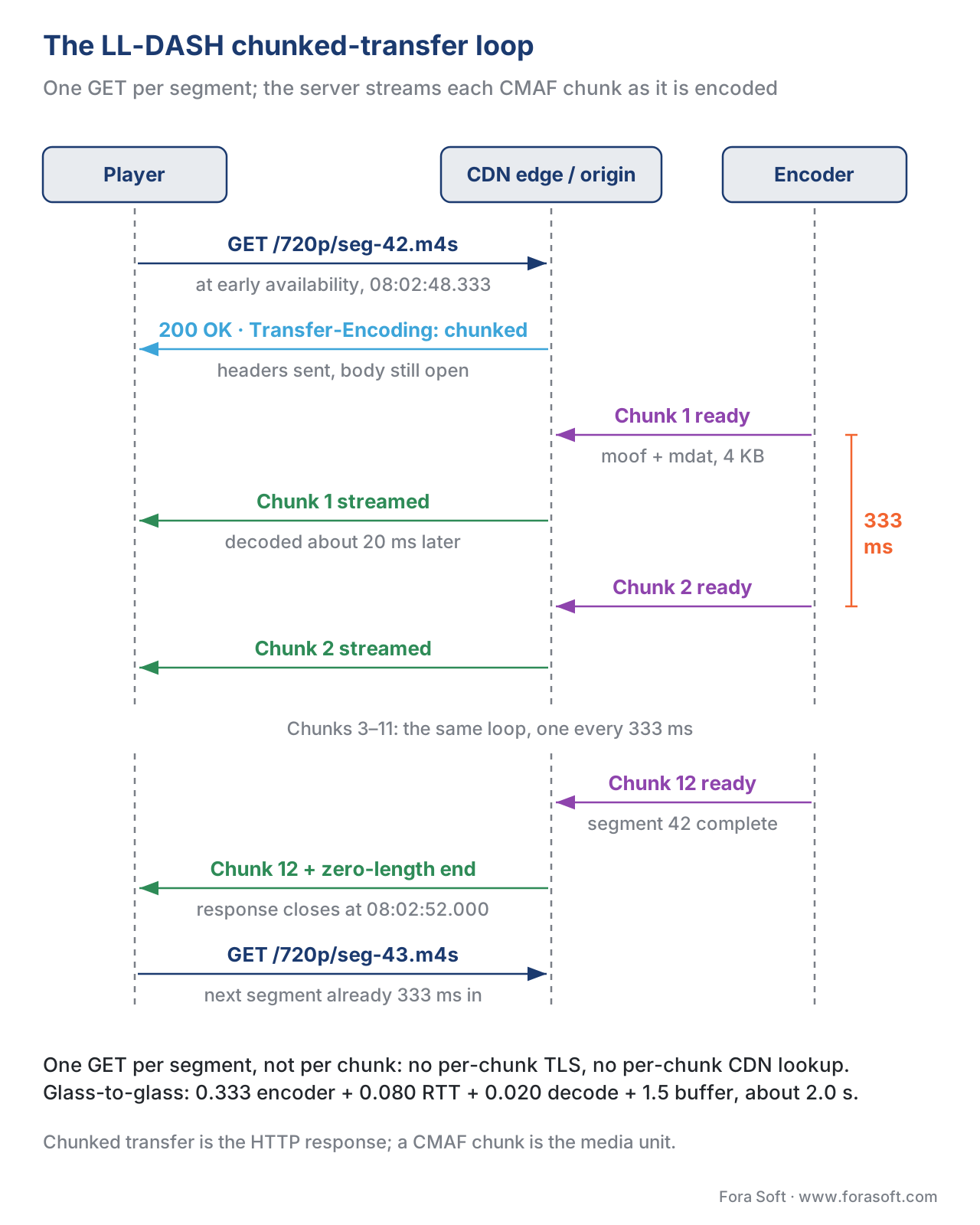 Figure 2. The LL-DASH chunked-transfer loop. The player asks once for segment 42 at the moment
 @availabilityTimeOffset says its first byte is available; the server streams CMAF chunks back over a single open response as the encoder produces them; the response closes when segment 42 finishes. No long-poll, no per-chunk request.
A live LL-DASH manifest, line by line
Here is a realistic LL-DASH MPD for a four-second-segment, 333-ms-chunk live stream with three video renditions and one audio rendition.
<?xml version="1.0" encoding="UTF-8"?>
<MPD xmlns="urn:mpeg:dash:schema:mpd:2011"
     profiles="urn:mpeg:dash:profile:isoff-live:2011,urn:mpeg:dash:profile:cmaf-extended:2018"
     type="dynamic"
     availabilityStartTime="2026-05-21T08:00:00Z"
     publishTime="2026-05-21T08:03:14Z"
     minimumUpdatePeriod="PT4S"
     timeShiftBufferDepth="PT60S"
     minBufferTime="PT2S"
     suggestedPresentationDelay="PT3S">

  <ServiceDescription id="0">
    <Latency target="3000" max="6000" min="2000" referenceId="0"/>
    <PlaybackRate min="0.95" max="1.05"/>
  </ServiceDescription>

  <UTCTiming schemeIdUri="urn:mpeg:dash:utc:http-iso:2014"
             value="https://time.akamai.com/?iso"/>

  <Period id="p0" start="PT0S">

    <AdaptationSet contentType="video" mimeType="video/mp4"
                   segmentAlignment="true" startWithSAP="1">
      <SegmentTemplate
          timescale="90000"
          duration="360000"
          media="$RepresentationID$/seg-$Number$.m4s"
          initialization="$RepresentationID$/init.mp4"
          startNumber="1"
          availabilityTimeOffset="3.667"
          availabilityTimeComplete="false"/>
      <Representation id="360p"  bandwidth="800000"  width="640"  height="360"  codecs="avc1.4d401e" frameRate="30"/>
      <Representation id="720p"  bandwidth="2500000" width="1280" height="720"  codecs="avc1.4d401f" frameRate="30"/>
      <Representation id="1080p" bandwidth="5000000" width="1920" height="1080" codecs="avc1.640028" frameRate="30"/>
    </AdaptationSet>

    <AdaptationSet contentType="audio" mimeType="audio/mp4" lang="en"
                   segmentAlignment="true" startWithSAP="1">
      <SegmentTemplate
          timescale="48000"
          duration="192000"
          media="$RepresentationID$/seg-$Number$.m4s"
          initialization="$RepresentationID$/init.mp4"
          startNumber="1"
          availabilityTimeOffset="3.667"
          availabilityTimeComplete="false"/>
      <Representation id="aac128" bandwidth="128000" codecs="mp4a.40.2" audioSamplingRate="48000"/>
    </AdaptationSet>

  </Period>
</MPD>
Read it from the top. The <MPD> element advertises two profiles: isoff-live:2011 (the base live profile) and cmaf-extended:2018 (the low-latency profile URN). type="dynamic" declares this is a live stream. availabilityStartTime is the wall-clock anchor for segment availability arithmetic. publishTime is when the server generated this MPD; the player can compare it to the current time to detect a stale manifest. minimumUpdatePeriod="PT4S" says the player should refetch the MPD every four seconds — though in steady-state low-latency, template-addressed segments mean the player rarely needs the new MPD. suggestedPresentationDelay="PT3S" is the legacy three-second-from-live-edge target.
<ServiceDescription> carries the modern low-latency signals: target three seconds, hard floor two seconds, soft ceiling six seconds, playback-rate range 0.95–1.05.
<UTCTiming> points the player at an authoritative time source — Akamai's well-known time service in this example. A low-latency player cannot rely on the client device's clock because consumer devices drift by tens of milliseconds and live-edge scheduling depends on a sub-100-ms-accurate wall clock; the player fetches the time service on startup, computes the offset between server time and client time, and uses that offset for every segment-availability calculation. The 2025 Restricted Timing Model standardised this; production LL-DASH deployments without <UTCTiming> are broken on most clients.
The video <AdaptationSet> carries one <SegmentTemplate> shared by all three renditions. timescale="90000" and duration="360000" give a 4-second segment (360000 / 90000 = 4.0). media="$RepresentationID$/seg-$Number$.m4s" is the URL template — segment 42 of the 720p rendition lives at 720p/seg-42.m4s. startNumber="1" says segments are numbered from 1. availabilityTimeOffset="3.667" declares that each segment's first byte is fetchable 3.667 seconds before its nominal availability time — i.e., the moment the encoder produces the first chunk. availabilityTimeComplete="false" declares that the segment is produced progressively.
Each <Representation> declares a rendition with a fixed bitrate, resolution, codec, and frame rate. The player picks one Representation per AdaptationSet at any moment and may switch between them at chunk boundaries (subject to the independent-chunk constraint).
The audio <AdaptationSet> mirrors the video, with one Representation (128 kbps AAC LC at 48 kHz).
When segment 42 is being produced, the player computes:
segment-42-availability-time = availabilityStartTime + 42 × 4.0 - 3.667 = 08:02:48.333 UTC- The player's adjusted wall clock crosses 08:02:48.333.
- The player issues
GET /720p/seg-42.m4sagainst the origin. - The origin begins streaming the chunked-transfer response immediately.
- The first CMAF chunk arrives at the player ~80 ms later (network RTT + origin TTFB).
- The player decodes the chunk and renders the first frame ~20 ms after that.
- Eleven more chunks arrive over the next 3.667 s, one every 333 ms.
- At 08:02:52.000 the response closes, and segment 43 is already 333 ms into production; the player issues
GET /720p/seg-43.m4sand the cycle continues.
The glass-to-glass latency in this loop is approximately:
- 0.333 s encoder (one chunk pipeline)
- 0.080 s network RTT + origin TTFB
- 0.020 s decoder pre-roll
- 1.5 s playback buffer (target latency 3.0 s; suggested presentation delay 3.0 s; the buffer is 4.5 chunks deep)
- ≈ 2.0 s glass-to-glass at the 720p rendition under typical fixed-broadband conditions.
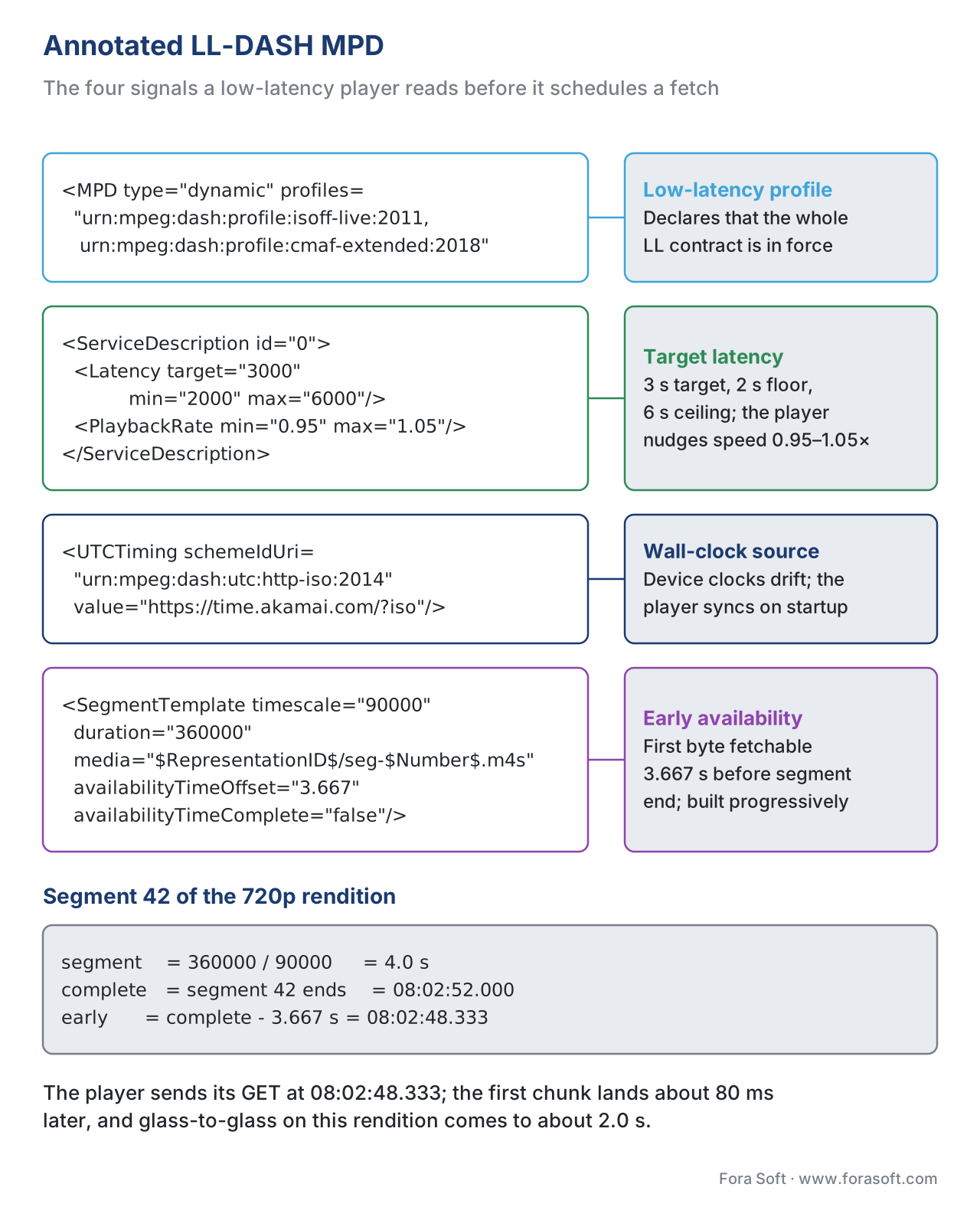 Figure 3. The same MPD, with each low-latency-specific element annotated. Highlighted: the
 cmaf-extended profile, <ServiceDescription>, <UTCTiming>, @availabilityTimeOffset, and @availabilityTimeComplete.
ABR on a chunked-transfer response
Adaptive bitrate switching is where LL-DASH players differ most visibly from plain-DASH players. Plain-DASH ABR is straightforward: download segment N, divide segment-size by download-time to get throughput, pick the highest rendition whose bandwidth is below throughput minus a safety factor, and switch at the next segment boundary. With four-second segments and a one-second safety, the player has good ABR resolution: every four seconds it gets a fresh throughput measurement and a clean switch opportunity.
LL-DASH breaks both halves. The player no longer waits for a segment to complete before computing throughput — by the time segment N is complete, the player is mid-decode and is already ten seconds late on a switch decision. So the player measures throughput on partial responses: bytes received in the last 500 ms or 1 second, divided by elapsed time, gives a continuously-updating throughput estimate. The DASH-IF Low-Latency Modes guidelines call this the low-latency throughput estimator; dash.js v3.0 was the first reference implementation, and the algorithm is now standard across Shaka v3.2+, ExoPlayer 2.16+, and the major commercial players.
The throughput estimator has to be smarter than a moving average because the response itself is paced — the server is writing bytes as fast as the encoder produces them, which is ~1/N of full link capacity for an N-rendition stream at full quality. A naive throughput estimate would conclude "this connection is limited to 1.5 Mbps" and drop to the lowest rendition; in fact the link has plenty of capacity, the encoder just isn't filling it faster than 333 ms × bitrate per chunk. The corrected estimator measures the time between chunk arrivals and computes the effective network throughput from how idle the connection is between chunks — if the player gets a 60 KB chunk every 333 ms and the chunk arrives in 30 ms, the link is idle for 303 ms out of every 333 ms, and the effective link capacity is roughly 60 KB / 30 ms = 2 MB/s. This is the metric the player actually uses for ABR.
The switch logic is also different. In plain DASH, a switch happens at a segment boundary (one segment per 4 seconds, so up to one switch per 4 seconds). In LL-DASH, the player can in principle switch at any independent chunk — every second or so. The trade-off is that switching mid-segment requires the player to download the new rendition's initialisation segment if it hasn't already, drop the rest of the in-flight chunked-transfer response, and start fetching the new rendition's chunks from the next independent boundary. dash.js v5 (the current 2026 reference) implements this with a conservative switch policy: switch only at independent chunks, never within the first half-segment after a previous switch, and never if the latency would dip below the <Latency min=""> floor. Most production deployments simplify by switching only at segment boundaries, accepting the four-second ABR resolution; the deeper mid-segment-switch capability is reserved for the most aggressive low-latency deployments.
Where the latency floor actually is, in 2026
Mux, Bitmovin, Akamai, AWS Elemental, and Wowza all publish LL-DASH benchmark numbers. The consistent finding is a 2–4 second glass-to-glass floor in production, with Mux's published 2024 numbers measuring a 3.6 s average across 38,000 sessions, a 2.9 s median, a 5.5 s p95, and an 8.2 s p99 — directly comparable to LL-HLS in the same conditions. Bitmovin's 2025 deployments report 2.5–4.0 s under normal conditions, with the 1.5 s lower bound reachable only when the encoder pipeline is tuned (no B-frames, GOP at one second, segment duration at two seconds with 200 ms chunks). Akamai's customer base sees an average of 4.0 s with a long tail driven by Wi-Fi jitter and consumer-router buffer-bloat.
The two-second wall is the same wall LL-HLS hits, for the same reasons. LL-DASH cannot make the encoder faster than its pipeline (a 1 GOP buffer for B-frame reference + CABAC entropy + chunk muxing is at least 500 ms of encoder-side delay; reducing the GOP to one second and disabling B-frames is the standard pre-broadcast optimisation), cannot make the decoder pre-roll faster than the device's hardware decoder's intake latency (200–400 ms on modern phones and TVs), cannot make the network RTT smaller than the laws of physics (60–120 ms across a continent over fibre, more over Wi-Fi and mobile), and cannot eliminate the CDN's HTTP overhead (50–200 ms TTFB at the edge). Below two seconds you are no longer in HTTP-based streaming; you are in WebRTC or MoQ territory, and you pay for that with a different scaling profile.
LL-DASH and LL-HLS together — the unified-CMAF stack
The most important 2026 architectural insight is that LL-DASH and LL-HLS share their underlying media files. CMAF chunks are the wire-level unit for both protocols; the only difference is the manifest. A modern packager (Shaka Packager, AWS MediaPackage v2, Unified Streaming, Bitmovin Live, Norsk, Mux Live) emits one set of CMAF chunks and two parallel manifests — an HLS multivariant playlist with #EXT-X-PART tags, and a DASH MPD with @availabilityTimeOffset. The same chunks are referenced by both. The origin serves both. The CDN caches both. DRM is the same (Common Encryption — CENC — defined in ISO/IEC 23001-7, with Widevine PSSH for Chrome / Android, PlayReady PSSH for Edge / Xbox, and FairPlay key delivery for Safari).
The pattern in deployment is:
- iOS / iPadOS / macOS Safari / Apple TV → LL-HLS over chunked-CMAF (because Safari does not support MSE-based DASH playback, and HLS is the only protocol it speaks natively).
- Android (Chrome, ExoPlayer) / Windows (Chrome, Edge) / macOS (Chrome, Firefox) / Linux / Smart TVs (Tizen, webOS, Android TV, Roku in some configurations) → LL-DASH via Shaka Player, dash.js, ExoPlayer, or the device-native DASH stack.
- One set of CMAF chunks underneath both.
This is the "unified CMAF" pattern, and it is what every modern OTT product ships in 2026 — Netflix, Disney+, Prime Video, YouTube TV, Hulu, DAZN, Twitch's HLS-over-CMAF live path, and most live e-commerce stacks. The CMAF format is fully documented in CMAF: the packaging format that unified HLS and DASH; the LL-HLS half is covered in LL-HLS in depth; this article covers the LL-DASH half.
The savings are concrete. One set of CMAF files instead of two sets of segments halves origin storage and CDN cache footprint, simplifies invalidation, and reduces packager CPU. The 2026 DASH-IF and HLS-IF guidance both recommend the unified-CMAF deployment as the default starting point for any new live OTT stack.
Common pitfalls
The four mechanisms describe what LL-DASH is. The pitfalls describe what goes wrong in practice when one of them is misconfigured. Every team that ships LL-DASH hits a subset of these.
Pitfall — server advertises@availabilityTimeOffsetbut waits for segment completion. The MPD says@availabilityTimeOffset="3.667", the player issues the request at the early availability time, but the origin holds the response until segment 42 is fully written to disk. The player sees a 4-second TTFB on every segment and the latency budget collapses to plain-DASH levels. Validate by issuing a request 3.5 s before the segment-complete time and timing how long until the first byte arrives. The first byte should arrive within ~100 ms of the request, not within ~4 seconds.
Pitfall — packager emits a singlemoofper segment instead of onemoofper chunk. A CMAF segment with one largemoofat the front and one largemdatafter it is technically valid CMAF, but it isn't chunked — the player cannot decode anything until the entiremdatarrives. Verify with a CMAF parser (Bento4mp4dump, Shaka Packager's verification mode, orMP4Box -info -diso) that each segment contains multiplemoof + mdatpairs. Production target: one pair per 200–500 ms.
Pitfall —<UTCTiming>missing or pointing at an unreachable server. Without an authoritative time source, the player falls back to the device clock, which drifts by tens of milliseconds and may be off by minutes if NTP is disabled. The player computes the wrong segment-availability time, requests are early (404) or late (latency creeps up), and the deployment looks intermittently broken. Always include<UTCTiming>and validate that the URL returns a sane response.
Pitfall — CDN cache TTL too long on the manifest. The MPD changes every@minimumUpdatePeriod(typically 2–4 seconds in live mode). A CDN that caches the MPD for 60 seconds delivers a stale manifest to new viewers, who compute segment numbers that are minutes out of date and rebuffer until they catch up. SetCache-Control: max-age=2(or evenmax-age=1) on the MPD response and verify the CDN respects it. Origin shielding helps amortise the origin load.
Pitfall — CDN does not honour chunked transfer encoding. Some legacy CDN configurations buffer the entire response at the edge before forwarding it to the client — "store-and-forward" mode — which defeats chunked transfer. The viewer sees one big response after segment completion instead of a stream of chunks. All major CDNs (Akamai, Cloudflare, Fastly, CloudFront, Bunny) support pass-through chunked transfer in 2026, but the configuration is opt-in per property. Verify by capturing the response headers and timing the byte arrival pattern.
Pitfall — <Latency target=""> set too aggressively. A 1.5-second target latency on a 333 ms chunk size leaves the player a 1.0 s playback buffer (3 chunks), which is below the safe rebuffer threshold for most networks. The player chases the live edge by speeding up to 1.05x, rebuffers, falls back to a lower rendition, and the viewer sees visible quality oscillation. Production guidance: target latency ≥ 2.5 s with 333 ms chunks; ≥ 2.0 s with 200 ms chunks.
Pitfall — non-independent chunks too sparse. Same failure mode as LL-HLS. Some encoders default to one independent (I-frame) chunk per segment (one per 4 seconds), which forces ABR switches to wait for a segment boundary. Configure the encoder for one I-frame per second (keyint=fps), verify withffprobe -show_packets, and set the packager to align CMAF chunk boundaries with the I-frame cadence.
Pitfall — fallback for non-low-latency players is broken. Old players that don't understand@availabilityTimeOffsetshould still play the stream — they'll see it as a plain-DASH stream with a slightly higher latency. The fallback works only if the segment file itself is complete and parseable as a non-chunked CMAF segment when the encoder finishes writing it. Some packager configurations leave themoof/mdatboundaries intact but emit a malformedmvexbox that confuses non-low-latency players. Validate with the DASH-IF reference player in non-low-latency mode against the same MPD.
When LL-DASH is the right choice — and when it isn't
LL-DASH is the right protocol when you want HTTP-based delivery, CDN economics, and the 2–5 second latency band, and you ship to non-Apple devices. That covers most of the 2026 live OTT browser-and-Android market: live sports without sub-second betting requirements, breaking news, concert streams, live e-learning, live shopping where the chat is the primary interaction, surveillance review, telemedicine triage where the patient just needs to see the doctor and isn't operating a synchronous tool.
LL-DASH is the wrong choice in three directions. Upward, when latency below two seconds matters — sports betting with real-time wagering, live auctions, real-time gaming, telemedicine consultations with synchronous interactive tools — WebRTC delivery and Media over QUIC are the answers. Downward, when latency above ten seconds is fine — long-form VOD, replays, podcast video, archive — plain MPEG-DASH is simpler, cheaper, and cache-friendlier. Sideways, when you only ship to Apple devices — LL-HLS is what you ship, against the same chunked-CMAF origin.
The interesting recent comparison is LL-DASH versus HESP. HESP achieves a 400 ms latency floor with a two-track architecture (initialization track + continuation track) at the cost of roughly 2x storage. LL-DASH cannot match HESP's latency but matches its CDN compatibility and beats it on storage. For most use cases LL-DASH wins on the cost-vs-latency curve; HESP wins when latency below one second is non-negotiable and WebRTC is operationally too expensive.
Free download: LL-DASH Readiness Checklist (2026)Twenty-four items to verify before you call an LL-DASH deployment production-ready: CMAF chunk emission, chunked-transfer pass-through at the CDN, an @availabilityTimeOffset the origin actually honours, UTCTiming, cache keys and the player's low-latency ABR settings.Where Fora Soft fits in
We have shipped LL-DASH into live e-learning platforms, OTT services on Smart TVs and Android, live shopping platforms, and telemedicine triage systems where browser-based playback is the primary surface. Our streaming engineering team treats LL-DASH and LL-HLS as one system — one packager, one chunked-CMAF origin, two parallel manifests, one DRM stack — because the production failure modes are at the seams between encoder, packager, origin, CDN, and player, and a unified stack collapses the seam count from ten to four. We've also done the inverse: helped clients realise their sub-second use case actually requires WebRTC and avoided shipping LL-DASH for a product where it would never have hit the latency target. The honest scoping conversation up front saves three months of "why is it still buffering" later. Our OTT platform development team ships chunked CMAF to Smart TV and Android players, and our scalable low-latency streaming builds cover the encoder, packager and multi-CDN seams together.
The book
Video Streaming: A Complete Guide to Video Delivery: From Network Protocols and Transport to Ingest, HLS, and MPEG-DASH
This article takes one latency budget from 19 seconds to about 2. Book 2 works through every line of that budget: the glass-to-glass arithmetic, what TCP, QUIC and HTTP/3 do to an open chunked response, CMAF packaging, and the HLS and MPEG-DASH manifests with their low-latency extensions side by side. Book 3 picks up where the manifest ends: low-latency ABR, the CDN that has to pass chunks through, and the players that chase a target latency. Both are part of a seven-volume handbook that runs the whole video stack from the pixel to production, so an engineer who works through it can design and ship a low-latency live pipeline like this one. Written by Nikolay Sapunov, CEO at Fora Soft.
Will LL-DASH hit your latency target, or do you need WebRTC?
Tell us the glass-to-glass number you need, your players and devices, your packager and which CDN sits in front, and we will check whether chunked CMAF gets you there, what breaks between encoder and player, and whether one CMAF origin can serve LL-DASH and LL-HLS together. 250+ video products shipped since 2005.
See our case studies
Case study
Sprii
A Danish live shopping platform with 72,000+ live events and 21 million products sold — the kind of stream where a 20-second delay means the host answers a question the buyer has already forgotten.
Case study
BrainCert
A virtual classroom LMS with 500M+ real-time classroom minutes across 10 datacenters — live e-learning, where the latency target decides whether a student can ask a question and get the answer in the same sentence.
Case study
Worldcast Live
Concert streaming for 10,000 simultaneous viewers at 0.4 to 0.5 seconds on WebRTC — the sub-second case this article warns about, where LL-DASH's 1.8-second floor makes it the wrong tool.
What to read next
Protocols
LL-HLS in Depth: Parts, Preload Hints, Blocking Reload, Rendition Reports
The Apple-ecosystem counterpart for the same 2–5 s band, built on the same CMAF chunks.
Protocols
MPEG-DASH in Depth: MPD, Periods, Adaptation Sets, Representations
The MPD model every LL-DASH signal in this article is attached to.
Protocols
Media over QUIC (MoQ) In Depth: The 2026 Turning Point
What comes after chunked HTTP when the target drops below LL-DASH's 1.8-second floor.
Latency
Latency Budget Calculator: Add Up the Seconds Before You Pick a Protocol
Run the 19-second and 2-second budgets from this article with your own segment and chunk sizes.
References
- ISO/IEC 23009-1:2022 — Information technology — Dynamic adaptive streaming over HTTP (DASH) — Part 1: Media presentation description and segment formats, fifth edition, August 2022. https://www.iso.org/standard/83314.html — Tier 1 (ISO/IEC standard, paywalled). Source for
@availabilityTimeOffset,@availabilityTimeComplete,<ServiceDescription>,<Latency>,<PlaybackRate>,<UTCTiming>, and the cmaf-extended:2018 profile URN. - ISO/IEC 23000-19:2024 — Common Media Application Format (CMAF) for segmented media, third edition, 2024. https://www.iso.org/standard/85673.html — Tier 1 (ISO/IEC standard, paywalled). Source for CMAF chunk and segment definitions; chunk = single
moof + mdatpair as the smallest independently parseable unit. - DASH-IF Implementation Guidelines — Low-Latency Modes for DASH, v1.2, 2024. https://dashif.org/guidelines/ — Tier 1 (DASH-IF implementation guidelines, normative for DASH). Source for the low-latency throughput estimator, chunk-duration recommendation (200–500 ms), and target-latency guidance.
- DASH-IF Implementation Guidelines — Restricted Timing Model, post-community-review release, 2025. https://dashif.org/guidelines/ — Tier 1. Source for the playback-rate-adjustment algorithm that combines
@suggestedPresentationDelay,<Latency target="">, and the measured latency to maintain a stable wall-clock target. - IETF RFC 9112 — Fielding, R., Nottingham, M., Reschke, J., HTTP/1.1, June 2022. https://www.rfc-editor.org/rfc/rfc9112 — Tier 1 (IETF RFC). Source for chunked transfer encoding (§7.1) — the wire-level mechanism LL-DASH uses to stream a response while the segment is still being written.
- IETF RFC 9114 — Bishop, M. (Ed.), HTTP/3, June 2022. https://www.rfc-editor.org/rfc/rfc9114 — Tier 1 (IETF RFC). Source for the HTTP/3 stream-framing semantics that supersede chunked transfer encoding for HTTP/3 transport.
- dash.js v5 — DASH Industry Forum reference player, https://github.com/Dash-Industry-Forum/dash.js — Tier 2 (DASH-IF reference implementation). Source for the production behaviour of the low-latency throughput estimator, the playback-rate controller, and the mid-segment switch policy.
- Akamai — Low-Latency DASH and HLS: A Deep Dive into Chunked CMAF, 2023. https://www.akamai.com/blog/performance/low-latency-streaming-with-chunked-cmaf — Tier 4 (production-deployer engineering blog). Source for the deployed chunked-transfer behaviour at Akamai's edge and the cache-key configuration required to support LL-DASH.
- Bitmovin — Bitmovin Video Developer Report 2025/26. https://bitmovin.com/video-developer-report/ — Tier 4. Source for the 2025/26 LL-DASH adoption numbers across 167 video developers in 34 countries and the production latency averages.
- AWS Elemental — Building a Live Streaming Service with AWS MediaPackage v2 and Low-Latency CMAF, AWS Media Blog, 2024. https://aws.amazon.com/blogs/media/ — Tier 4. Source for the MediaPackage v2 unified-CMAF behaviour serving both LL-HLS and LL-DASH from one chunked-CMAF origin.
- Mux — Latency in Live Streaming, benchmark report, 2024. https://www.mux.com/blog/ — Tier 4. Source for the 35,000-session LL-DASH glass-to-glass measurements (median 2.9 s, p95 5.5 s, p99 8.2 s).
- W3C — Media Source Extensions, Candidate Recommendation Snapshot 2024-11-05. https://www.w3.org/TR/media-source-2/ — Tier 1 (W3C spec). Source for the player-side buffering model that LL-DASH chunks feed into through
SourceBuffer.appendBuffer().
