

Key takeaways
• Digital video, not the format, is the bottleneck in remote learning software. Learners watch about 100% of a video under 6 minutes but only ~50% of a 9–12 minute one and ~20% past 12 minutes (edX, 6.9M sessions, 2014), so the real question is what AI does on top of the video stream.
• Five AI features cover ~90% of the value. Real-time transcription & translation, auto-generated chapters & quizzes, RAG-grounded AI tutors, engagement analytics and adaptive content delivery — in that order — deliver the biggest measurable lift in completion and retention.
• You can ship the first two features in 6–8 weeks for under US$25K. Whisper or Deepgram + Claude can produce live captions, post-session summaries and quizzes for roughly US$0.01 per minute of source video.
• The full five-feature stack is a 4–6 month build with US$3K–5.5K/month operating cost at 100K minutes processed. A phased rollout (transcription → chapters → tutor → analytics → adaptation) lets you measure impact at each step.
• Compliance is the silent gate. FERPA, COPPA (biometric rules in force since 22 April 2026), GDPR and the EU AI Act (education high-risk from 2 December 2027; emotion recognition in education already banned) decide what ships in K-12 and EU markets. Design consent flows from the first sprint.
Why Fora Soft wrote this playbook
Fora Soft has built video and AI software since 2005 — 250+ projects, 50+ in-house specialists — and a large share of it is e-learning and virtual classroom software. We built BrainCert (case study), a SaaS LMS now near $3M ARR with 100K+ customers and 500M+ classroom minutes served; Scholarly (case study), an interactive learning platform with synchronous and async video; Career Point (case study), a job-prep platform with embedded video tutorials; and ALDA, an AI course generator whose institutions serve 500K+ students a year.
We also publish on the underlying tech: enhancing video calls with AI language processing, AI content recommendation systems, and how to implement video streaming at scale. This guide is the answer we give product leads who ask "which AI feature should we ship first" without wanting a generic vendor list.
If you are building a virtual classroom, an LMS, a corporate training platform or a tutoring marketplace, the five features below are the ones that show up on every roadmap our AI development team touches in 2026, and the order to ship them in.
Planning the AI layer of your remote-learning product?
Bring your current video stack and learner counts — we will rank these five features by ROI for your specific product on a 30-minute call.
The 2026 remote-learning market in 90 seconds
Global e-learning revenue sits between US$275B and US$400B in 2026 depending on which analyst you trust, growing roughly 10–14% per year. AI in education is the smaller, faster slice: about US$10.6B in 2026, compounding 34–41% per year through 2030.
- Adoption is past the early-majority line. 75–80% of higher-ed institutions and large corporates run at least one regular online or hybrid program; K-12 sits closer to 60% with hybrid common in upper grades.
- Spend is shifting from "more videos" to "smarter video". Procurement budgets that bought another LMS in 2022 now buy AI captioning, AI tutoring and engagement analytics — the line items grow even when LMS spend is flat.
- Compliance is the new gating factor. The EU AI Act treats education as a high-risk domain from August 2026; updated COPPA biometric rules land April 2026 in the US. Vendors without a clean compliance story lose enterprise deals.
Why digital video is the real bottleneck of remote learning
If you measure where learners actually drop out, the answer is almost never "the LMS UI" and almost always "the video". Three numbers explain why every AI investment in remote learning eventually centers on the video layer.
1. Six minutes is the natural attention budget. Guo, Kim and Rubin analysed 6.9M edX sessions (L@S 2014) and found median engagement near 100% for videos under 6 minutes, ~50% at 9–12 minutes, and ~20% past 12 minutes. Students rarely finish a video longer than 9 minutes.
2. Captions and chapters move completion 10–25 percentage points. Auto-captioned videos are watched longer by hearing learners too — the captions help focus, search and rewatching. Chaptered videos get re-watched 3–5x more often than single-blob videos.
3. Synchronous classes have an instructor problem, not a tech problem. Live virtual classrooms hit ceiling once instructors burn out on grading, follow-up Q&A and accessibility. AI removes the bottleneck without removing the human.
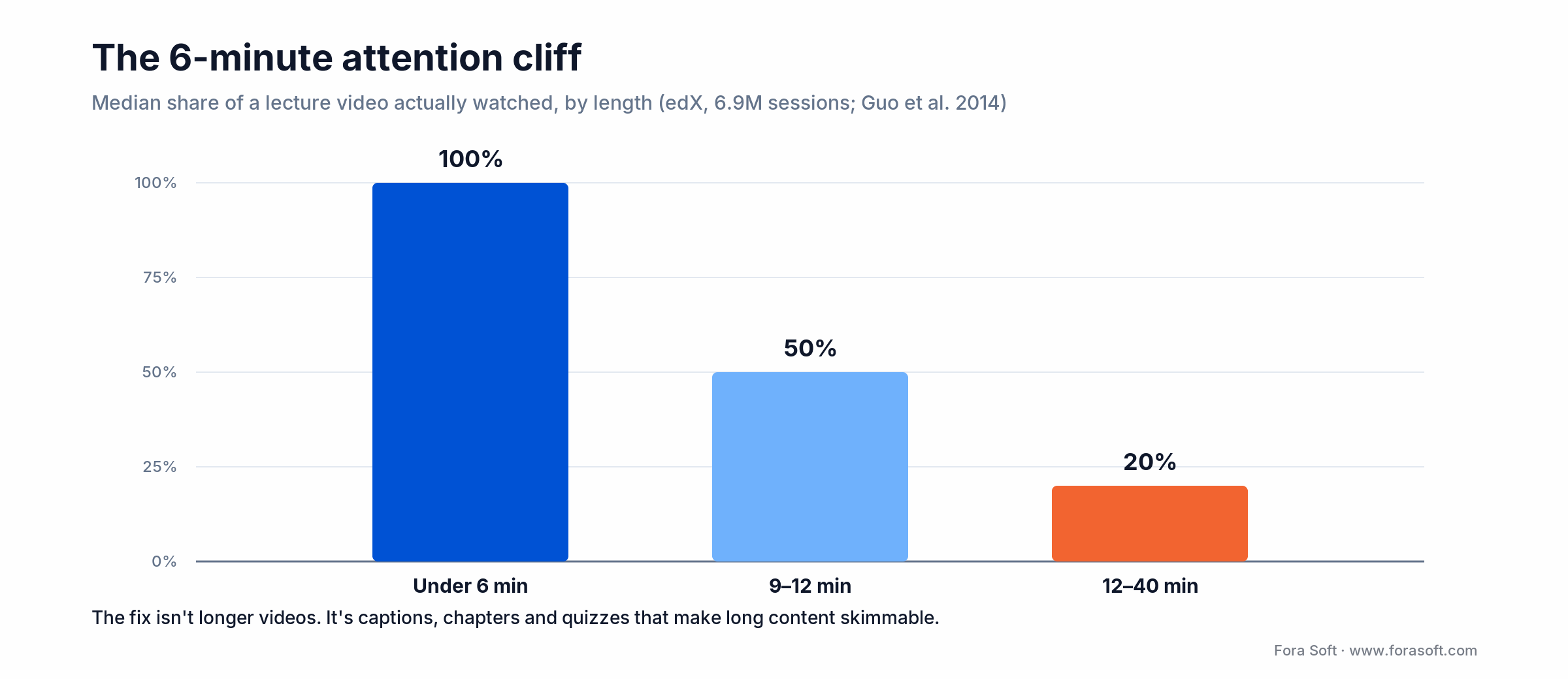
Figure 1. Watch-time collapses after ~6 minutes — the case for chapters, captions and quizzes (Guo et al., edX, 2014).
Reach for AI on the video layer when: your video completion rate is below 60%, your instructors spend >3 hours of prep per teaching hour, or your learners send the same Q&A questions repeatedly.
The five AI-powered features at a glance
A side-by-side before we go deep on each. Numbers are typical for a mid-sized remote-learning product processing roughly 100K minutes of video per month.
| Feature | Primary lift | Build effort | Run cost / mo | Compliance load |
|---|---|---|---|---|
| Real-time captions, transcription & translation | Accessibility, completion +10–15pp | 2–3 weeks | ~US$600–$900 | Low (WCAG & data residency) |
| Auto chapters, summaries & quizzes | Re-watches 3–5x; instructor time −30% | 3–4 weeks | ~US$200–$500 | Low (hallucination guardrails) |
| RAG-grounded AI tutor | 24/7 Q&A, NPS +20pts | 6–8 weeks | ~US$800–$1,500 | Medium (data governance) |
| Engagement & attention analytics | Drop-out signals 1–2 sessions earlier | 3–5 weeks | ~US$200–$400 | High (FERPA, COPPA, EU AI Act) |
| Adaptive content delivery | Lesson-to-lesson retention +5–10pp | 8–12 weeks | ~US$300–$600 | Medium (algorithmic transparency) |
The right order to layer these features in
Every AI-for-learning project we ship at Fora Soft follows the same sequencing rule: start with the feature that produces the most downstream data, because that data feeds everything else. In practice that means captions first, chapters and summaries second, then the AI tutor, and only then the analytics and adaptive layers.
The logic is simple. A clean, time-stamped transcript is the input for chapter generation, quiz generation, RAG retrieval, search, closed captions, translation and engagement analytics. If you build the tutor before you have accurate transcripts, you will be debugging hallucinations caused by bad upstream data. If you build adaptive delivery before you have engagement signals (pauses, rewinds, quiz struggle points) you are guessing at what to adapt. Ship the pipeline in the order that the data flows: capture, then enrich, then personalize.
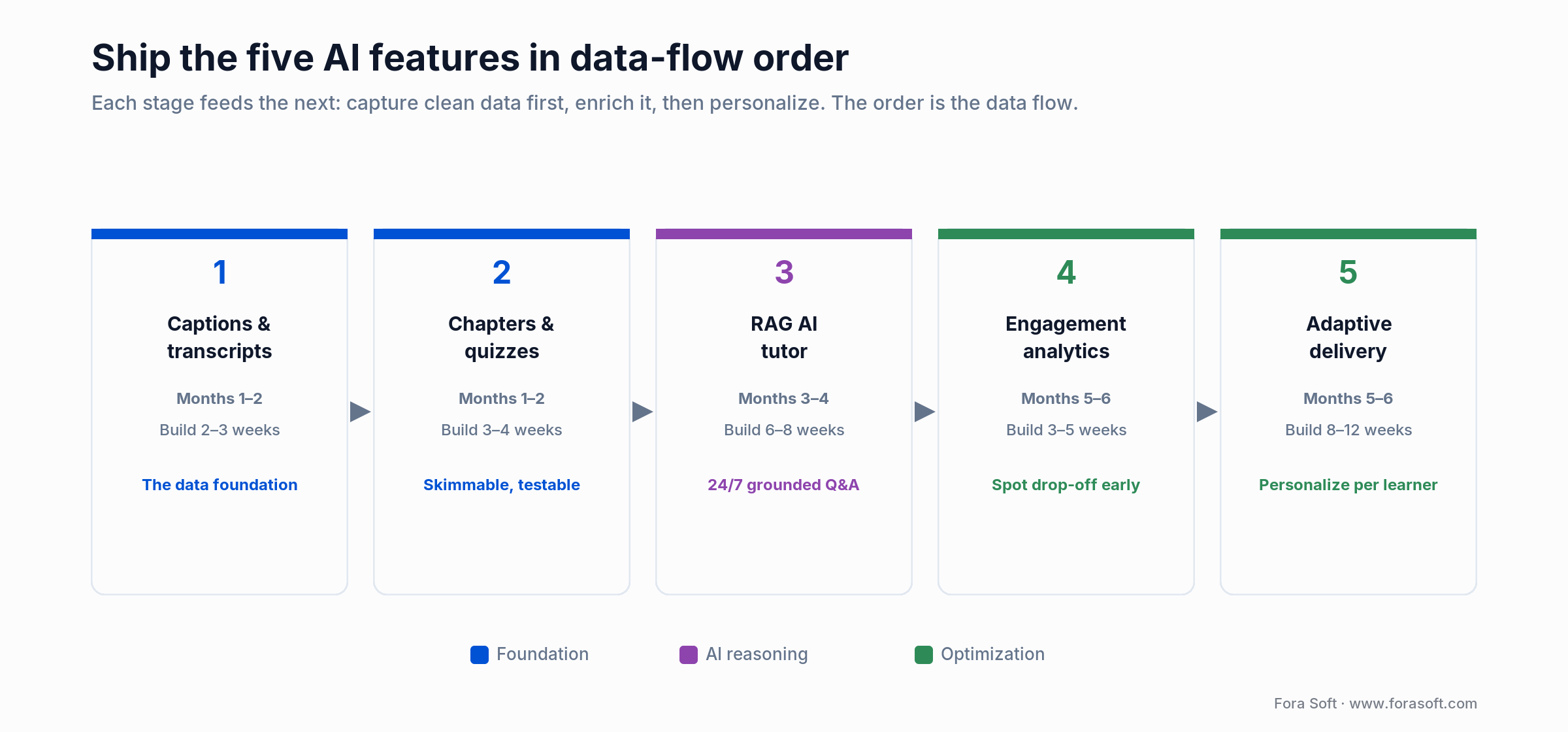
Figure 2. Ship the five features in the order the data flows: capture, enrich, then personalize.
The phased roadmap we recommend: months 1–2 for captions plus chapter and summary auto-generation (quick wins, immediate learner value); months 3–4 for the RAG tutor (depends on clean transcripts and chaptered content); months 5–6 for engagement analytics and adaptive delivery (depends on per-learner telemetry collected during the earlier phases).
Practical tip. Treat your transcript pipeline as the foundation. Store transcripts with millisecond-level timestamps, speaker IDs, and confidence scores. Everything else — chapters, quizzes, search, tutor, analytics — is a view on top of that data. Get the foundation right and the rest becomes cheap iteration.
Feature 1: Real-time captions, transcription & translation
If you ship one AI feature this quarter, ship this one. Live captions and transcripts are the highest-impact upgrade because they help every learner type — deaf and hard-of-hearing learners need them, second-language learners depend on them, and even native speakers stay engaged longer when text reinforces audio.
The vendor options (2026)
Deepgram Nova-3. ~US$0.0077/minute streaming, sub-300ms latency. Deepgram reports ~5.3% word error rate (WER) on clean English; independent tests hit ~18% on hard, accented audio, so benchmark on your own classroom recordings, not the vendor demo. Best balance for live virtual classrooms.
OpenAI Whisper API. ~US$0.006/minute, 6.5–7.4% WER on clean audio, 99 languages. Cheapest option and excellent for batch (post-session) transcription. Latency is too high for live captions; use it for recordings.
AssemblyAI. ~US$0.12/hour batch, 8.4% WER, best-in-class speaker diarization — the right pick when you need "who said what" stamped onto a multi-speaker classroom recording.
Cloud incumbents (Google STT, Azure Speech, AWS Transcribe). Slightly higher cost, slightly higher WER, but unbeatable for institutions that need data residency in a specific region (e.g. EU-only Azure deployments for European universities).
Translation on top
Live multilingual captions are the difference between a domestic product and an international one. Pipe Deepgram or Whisper output into DeepL (about US$25 per million characters) or GPT-4o for live translation. Latency lands at about 600–900ms end-to-end — perceptible but workable for asynchronous learners.
Reach for live captions when: any of your learners are deaf or hard of hearing, >15% are non-native English speakers, or you are pursuing WCAG 2.2 AA compliance for an enterprise sale.
Feature 2: Auto-generated chapters, summaries & quizzes
Once a video has a transcript, an LLM can turn it into structured study material in minutes. We have shipped this pattern multiple times and it consistently moves two metrics: instructor prep time per session goes down by ~30%, and student re-watch rate goes up 3–5x because chapters make a 50-minute lecture feel like five 10-minute videos.
The reference pipeline
// Recording uploaded -> produces chapters, summary, MCQ quiz
import Anthropic from '@anthropic-ai/sdk';

const claude = new Anthropic();
async function processLecture(transcript) {
  const sys = `You are a study-material generator. ALL answers and
quiz options must be quoted from the transcript. Return strict JSON
with: chapters[{start_sec,title,summary}], key_points[5], mcq[{q,
options[4], correct_index, source_quote}].`;

  const r = await claude.messages.create({
    model: 'claude-sonnet-5',
    max_tokens: 4000,
    system: sys,
    messages: [{role:'user', content: transcript}],
  });
  return JSON.parse(r.content[0].text);
}
Cost math
For a 60-minute lecture: ~US$0.36 to transcribe with Whisper, ~US$0.30–0.60 to summarise + chapter + quiz with Claude Sonnet, ~US$0.05 to embed for retrieval. Round to about US$1 per finished hour of processed content. The off-the-shelf alternatives (Otter, Tactiq, Fathom, Riverside Magic Clips) charge per-seat and do not let you embed the output cleanly into your LMS.
Hallucination guardrails
Quizzes that invent facts erode trust faster than no quizzes at all. Force the model to quote source spans for every correct answer, reject any quiz where the source quote is not literally present in the transcript, and human-spot-check 5% of generated quizzes during the first month. WER above 12% on the underlying transcript is the strongest predictor of bad quizzes — fix the captions before fixing the prompts.
Reach for auto-quizzes when: instructors are spending more than 30 minutes per session writing comprehension questions, or your re-watch metric is under 1.2x.
Feature 3: A RAG-grounded AI tutor for course content
An AI tutor that answers learner questions using your course content (not a generic ChatGPT) is the feature with the most upside and the most ways to ruin it. Khan Academy’s Khanmigo now runs on Anthropic’s Claude and grew from 40,000 to 2M+ students across 795 school districts in 2026; Duolingo Max reached ~8M subscribers on GPT-4o. Both prove the pattern at scale.
Architecture
Transcripts → chunked into ~500-token spans → embedded with OpenAI text-embedding-3-large or Voyage AI → stored in pgvector (free, scales to ~5M vectors) or Pinecone (US$0.25/M vectors + API costs). At question time: embed the question, retrieve the top 6–10 chunks, hand them to Claude Sonnet 5 or GPT-4o with a system prompt that forbids answering anything not in the retrieved chunks.
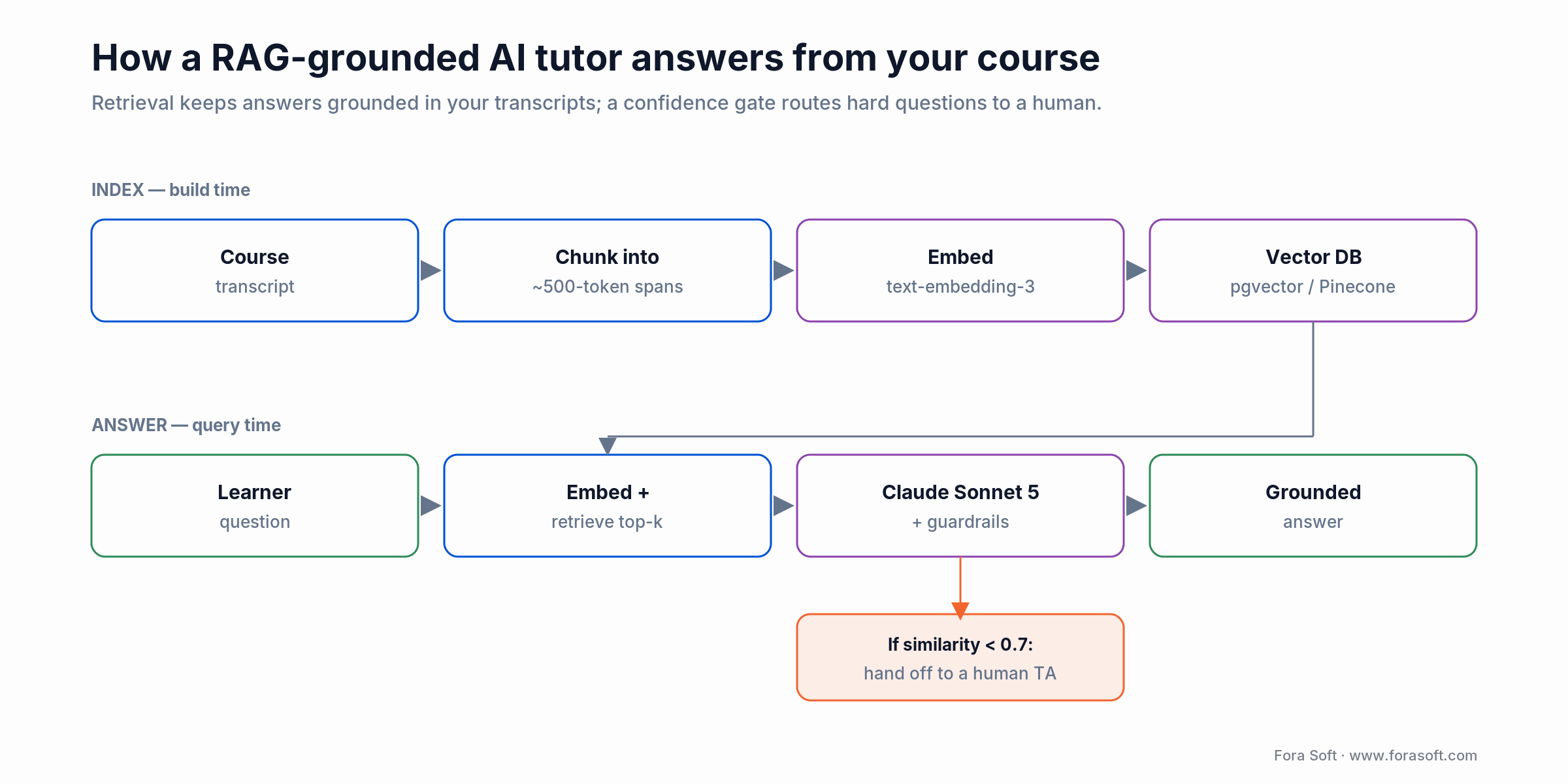
Figure 3. A RAG tutor grounded in your transcripts, with a confidence gate that routes hard questions to a human TA.
Guardrails that actually matter
Confidence threshold. If retrieval similarity is below ~0.7, the tutor refuses to answer and offers to forward the question to a human TA.
Socratic mode. For K-12 and homework-heavy contexts, copy Khanmigo: the tutor never gives the answer outright, only asks the next-step question.
Conversation logging + human audit. Sample 5% of conversations into an instructor review queue for the first quarter. The patterns you find rewrite half your prompts.
What it costs to run
For 100K monthly active learners with ~5 tutor messages each: roughly US$300 in vector storage, US$500–$1,000 in LLM tokens (Claude Sonnet beats GPT-4o on cost-per-quality), US$50 in embeddings. Total: US$800–$1,500/month. The first version takes 6–8 weeks of focused engineering; the gnarliest 20% (the eval suite, fine-tuning prompts, knowledge-graph scaffolding) takes another 6–8 weeks.
Want a Khanmigo-grade tutor on your course content?
We will architect the RAG pipeline, pick the embedding/LLM combo, and design the guardrails for your subject matter on a 30-minute call.
Feature 4: Engagement & attention analytics — the right way
Engagement analytics is the highest-risk feature in remote learning. Done right, it tells an instructor "section 3 of lesson 12 lost 40% of the class" so they can rewrite that section. Done wrong, it ships facial-emotion-recognition that mis-fires on neurodiverse learners, breaches FERPA without parental consent, and lights up under the EU AI Act as a high-risk system.
Safe signals to start with
Pause/rewind heatmaps per video, time-on-page per LMS section, quiz-question struggle rate, attendance and tab-focus patterns, message frequency in the chat sidebar. These are derived from existing telemetry, do not collect biometrics, and tell you 90% of what you need.
Where camera-based signals belong (and don't)
NVIDIA Maxine's gaze and eye-contact features run at <5ms latency and produce useful "look-away" counts. They make sense in adult corporate training where consent is straightforward. They do not make sense in K-12, where the regulatory burden under FERPA, COPPA (biometric rules since 22 April 2026) and the EU AI Act outweighs the lift. In the EU, emotion recognition in education is already a prohibited practice under the AI Act (in force since February 2025), not merely high-risk.
What you must build alongside
1. Consent flow. Granular opt-in with explanation; parental consent for under-13s; revocable at any time.
2. Data Protection Impact Assessment. Required by GDPR for any biometric processing; effectively required by the EU AI Act for high-risk systems.
3. Instructor-only dashboards. Engagement signals belong with the educator, not the learner — never expose raw scores back to the student.
Reach for behavioural engagement signals first; add camera-based signals only in adult contexts with explicit, granular consent.
Feature 5: Adaptive content delivery and personalization
The endgame: every learner sees a different next video, quiz or exercise, sequenced by the platform to maximise their next-week retention. Squirrel AI decomposes course material into fine-grained “nano-concepts” in a knowledge graph and serves Asia’s K-12 market at scale. Duolingo’s spaced-repetition scheduler outperformed expert-designed alternatives in peer-reviewed research.
The minimum viable adaptive layer
1. Knowledge graph. Map your course catalog into a graph of micro-skills with prerequisite edges. Even a 200-node manual graph beats no graph at all.
2. Mastery model. Item Response Theory (IRT) or Bayesian Knowledge Tracing scores each learner's grasp of each node from quiz outcomes.
3. Recommender. An LSTM or rule-based scheduler picks the next item to study (review weakest node, advance from strongest, or interleave). Spaced-repetition timing is the most reliable lift; everything else is gravy.
Pitfalls
Filter bubbles — if the recommender always shows the same kind of content, learners get bored. Set explicit breadth constraints. Algorithmic transparency — the EU AI Act will require you to explain at least at category level why this lesson, not that one. And cold-start — a brand-new learner needs a sensible default sequence before the model has data.
Reach for adaptive delivery when: your catalog has at least 100 atomic items, you can collect quiz outcomes per item, and you have measured ~3 cohorts of completion data to validate against.
Reference tech stack for the full five-feature build
A pragmatic 2026 stack we use as the default starting point (see also our e-learning video guide in Learn). Substitute components for vendor preferences or data-residency needs.
- Live video + recording: LiveKit (US$240–$600 for 100K min/mo) for cost; Twilio, Daily.co, 100ms or Agora when SDK familiarity matters more than price. Compare with our tech-stack guide for streaming apps.
- Live captions: Deepgram Nova-3.
- Batch transcription: Whisper API (or self-hosted Whisper Large for cost & data control).
- LLM: Claude Sonnet 5 ($3/$15 per 1M tokens) as default; Claude Opus 4.8 for the AI tutor’s complex reasoning paths.
- Vector DB: pgvector inside the existing Postgres up to ~5M chunks; Pinecone above that.
- Recording storage + delivery: Cloudflare Stream or Mux; AWS S3 + CloudFront when corporate compliance dictates.
- Engagement analytics: in-house event pipeline (PostHog or Snowplow) plus optional NVIDIA Maxine for gaze in adult contexts.
- Adaptive engine: Python service running an IRT model + LSTM scheduler, calling back into the LMS.
Mini case: +19 points of course completion
Situation. This is a representative engagement drawn from our EdTech work (numbers rounded, client anonymised). A regional LMS used by 80+ vocational schools had a 51% course completion rate, instructors writing comprehension questions by hand for every video, and a customer-success team drowning in repeat learner Q&A. Annual churn was creeping past 20%.
The 14-week plan. Weeks 1–3: Whisper batch transcription + WCAG-compliant caption rendering. Weeks 4–6: Claude-powered chapters, summaries and 5-question MCQ quiz on every recorded session, with extractive guardrails. Weeks 7–10: RAG tutor over the catalog, with a Socratic-mode prompt for under-18 cohorts and a confidence-threshold fall-back to human TAs. Weeks 11–14: instructor dashboard for pause/rewind heatmaps and quiz-struggle hotspots; consent flow + DPIA for the (modest) telemetry collected.
Outcome. Completion moved 51% → 70%; instructor prep time per session fell from ~3.2 hours to ~1.4 hours; tutor handled ~62% of inbound learner Q&A messages without human escalation; net annual churn dropped to ~12%. Want a similar assessment for your stack? Book a 30-min review.
What it actually costs in 2026
Conservative ranges for engagements run by a team using AI-assisted engineering. Bespoke complexity (on-prem deployment, fine-tuned models, regulator-mandated audits) sits above these ranges and we will tell you so on the call.
| Scope | Effort | Realistic budget | Run cost / mo |
|---|---|---|---|
| Live captions + batch transcripts | 2–3 weeks | ~US$8K–$15K | ~US$600–$900 |
| Auto chapters + summaries + quizzes | 3–4 weeks | ~US$12K–$22K | ~US$200–$500 |
| RAG AI tutor (MVP) | 6–8 weeks | ~US$28K–$55K | ~US$800–$1,500 |
| Engagement & attention analytics | 3–5 weeks | ~US$15K–$30K | ~US$200–$400 |
| Adaptive content delivery (v1) | 8–12 weeks | ~US$35K–$70K | ~US$300–$600 |
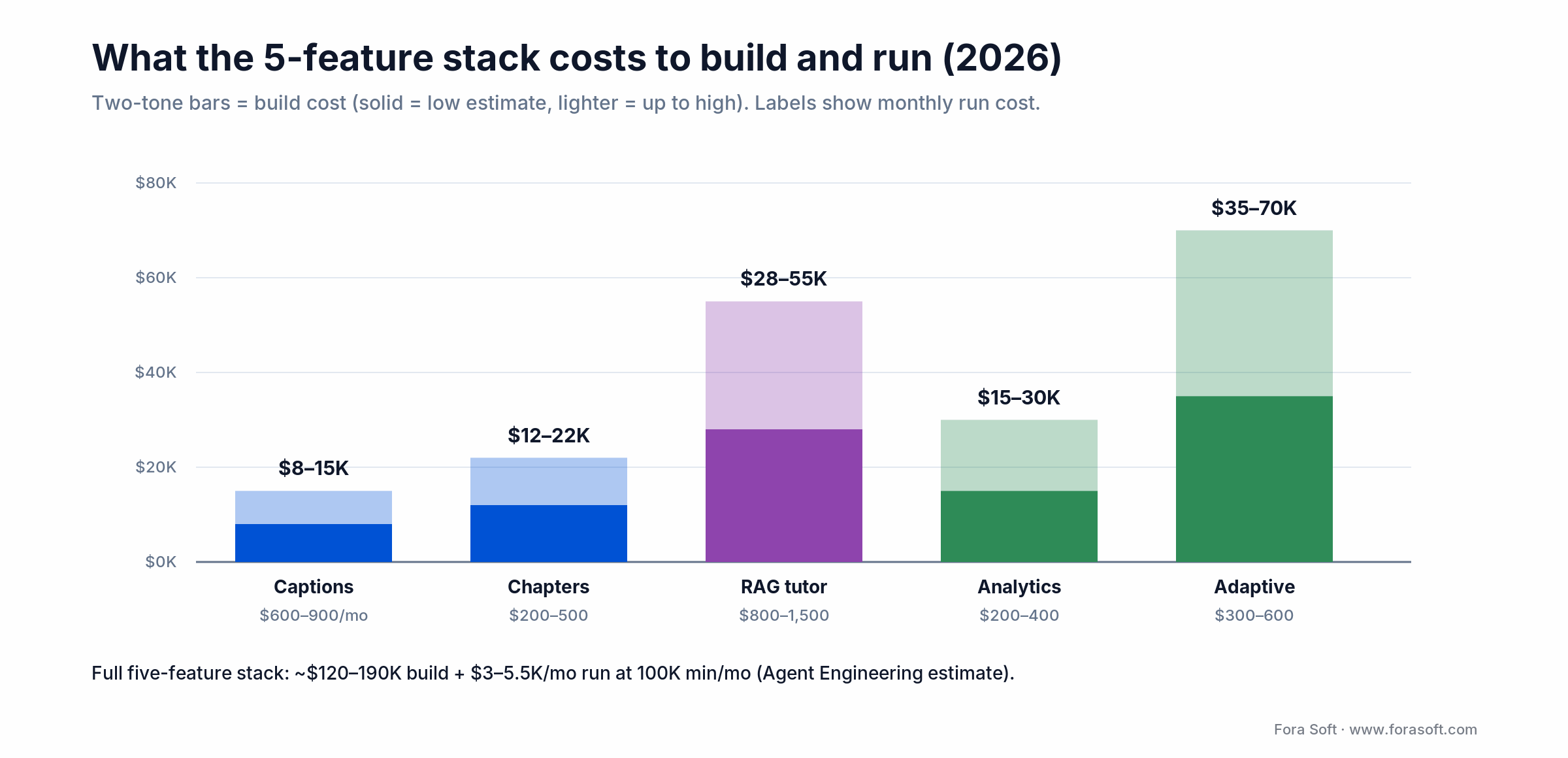
Figure 4. Build and run costs for the full five-feature stack (2026, Agent Engineering estimate).
A realistic year-one all-in for the full five-feature stack lands around US$120–$190K of build cost plus US$3K–$5.5K/month of operating cost at 100K minutes processed monthly — sometimes less when integrating into an existing well-instrumented platform. For wider context on platform cost, see our video conferencing app cost guide.
Compliance: FERPA, COPPA, GDPR, EU AI Act
FERPA (US, K-12 and higher-ed). Educational records, including derived AI signals, are protected. Get a clear data-handling agreement with each institution, and never share learner data across tenants without consent.
COPPA (US, under-13s). The amended Rule (full compliance required since 22 April 2026) adds biometric identifiers — facial templates, voiceprints, faceprints — to “personal information” and requires verifiable parental consent plus a written retention program. Practically: do not deploy gaze or emotion features to under-13 cohorts.
GDPR (EU/EEA). Special-category data includes biometrics; explicit consent + DPIA required for any face-derived signal. Lawful basis for AI tutoring is usually "legitimate interest" with transparency obligations.
EU AI Act (effective in stages). High-risk obligations for education and assessment systems apply from 2 December 2027, extended from August 2026 by the 2026 Digital Omnibus (official summary): risk management, dataset governance, human oversight, technical documentation and logging. Emotion recognition in education is a separate, prohibited practice, in force since 2 February 2025. Plan for ongoing model evaluation, not a one-shot audit.
Accessibility (WCAG 2.2 AA, Section 508). Captions, transcripts, keyboard navigation, color-contrast and screen-reader compatibility — non-negotiable for any institutional sale.
Five pitfalls that quietly burn AI-for-learning budgets
1. Caption latency above one second. Anything over ~1s breaks the perception that captions are live. Test on real classroom audio with overlapping speakers, not on clean studio samples.
2. Hallucinated quiz answers. If the model writes a question whose "correct" answer is not in the source, you erode instructor trust faster than any cost saving you generated. Enforce extractive QA and human-spot-check.
3. Biometric collection without consent. A single FERPA/COPPA breach can end an enterprise sales cycle — and increasingly invites regulator action under the EU AI Act. Default to behavioural signals; gate biometrics behind explicit opt-in.
4. Biased speaker diarization. Most speech models have measurably higher WER on non-American accents and on female speakers. If your audience is global, evaluate your provider on your real audio mix before signing.
5. Over-personalization filter bubbles. Recommenders that always serve "more of the same" satisfy short-term engagement and damage long-term mastery. Add explicit breadth/diversity constraints and review them monthly.
KPIs to monitor from day one
Quality KPIs. Video Completion Rate (target >75%; baseline 50–70%), transcription WER per accent (target <10%, alarm at 12%), quiz hallucination rate measured by human review (target <2%, alarm at 5%), AI tutor refusal rate (alarm if rises above 15% — usually means retrieval is broken).
Business KPIs. Lesson-to-lesson retention (target >80%), AI tutor click-through rate (target >20% of active learners), instructor time saved per teaching hour (target 1.5–2 hours), net revenue retention on per-seat plans.
Reliability KPIs. Caption pipeline uptime (alarm below 99.5% over 24h), recording-to-summary processing lag (alarm if >15 minutes for a 60-minute lecture), tutor latency p95 (target <3.5s).
When AI is the wrong answer in remote learning
- High-stakes assessment. Use AI to pre-screen and flag, but keep humans in the rubric loop — both for fairness and for legal defensibility.
- Motivation and metacognition. Encouragement, peer dynamics and accountability still come from humans — an AI tutor is a force multiplier on instruction, not on inspiration.
- Hands-on labs and physical safety. AI cannot supervise a chemistry lab; do not pretend it can.
- Mental-health signals. Engagement analytics is not a counselor. If your platform serves vulnerable cohorts, build a clear escalation path to human support before adding any AI listener.
- Curriculum that changes weekly. RAG over rapidly mutating content is brittle — either re-embed nightly or skip the tutor for that subject area.
Not sure which feature to ship first?
Send your current learner counts, completion rate and instructor pain points — we will rank the five features for your product in 30 minutes.
FAQ
Which AI feature should we ship first in a remote-learning platform?
Real-time captions and post-session transcripts. They lift completion 10–15 percentage points across virtually every learner type, open up WCAG accessibility for institutional sales, and feed every other AI feature you will build later (chapters, quizzes, the AI tutor).
How accurate is AI transcription for classroom audio in 2026?
On clean conversational English, 6–8% word error rate is typical for Deepgram Nova-3 and Whisper. Classroom audio with overlapping speakers, accents and chalkboard reverb usually pushes WER to 10–15%. Test with your actual audio before committing.
How do we stop the AI tutor from making things up?
Three layers: ground every answer in retrieved course chunks (RAG), force the prompt to refuse when retrieval similarity is below ~0.7, and sample 5% of conversations into a human review queue for the first quarter so you can iterate on the prompt. Khanmigo's Socratic mode — the tutor never gives the answer outright — is a powerful additional guardrail for K-12.
Can we use facial emotion recognition to track engagement?
In adult corporate training with explicit consent, sometimes. In K-12 or general consumer EdTech, the cost-benefit is bad: high false-positive rates on neurodiverse learners, FERPA/COPPA exposure, and high-risk classification under the EU AI Act. Behavioural signals (pause/rewind heatmaps, quiz struggle, time-on-task) deliver 90% of the value at a fraction of the risk.
How long does it take to add live captions to an existing virtual classroom?
2–3 weeks for a polished implementation: 1 week to wire Deepgram or Whisper into the audio pipeline, 1 week for caption rendering and styling across web/mobile clients, plus a few days of WCAG and translation polish.
Will the EU AI Act force us to remove AI features from our EU LMS?
Most features stay allowed; they become “high-risk” with documentation, oversight, dataset-quality and logging obligations that apply from 2 December 2027. Emotion recognition in workplaces and education is the explicit ban (in force since February 2025); everything else (captions, tutoring, recommenders) needs governance, not removal. Start the documentation work in parallel with the engineering.
What does the full five-feature build cost in 2026?
A realistic year-one all-in lands around US$120K–$190K of build cost plus US$3K–$5.5K/month in operating cost at 100K processed minutes. A phased rollout that ships transcription and chapters first usually pays for the next phases out of measurable retention lift.
Can we self-host the AI models for data residency?
Yes. Whisper Large self-hosted gives you transcription on your own GPUs; Llama 3.1 70B or Mistral Large can serve as the LLM behind the tutor, with comparable quality on most education tasks. The trade-off is operational: you take on model serving, evaluation and updates. For most clients we recommend Claude Sonnet via API plus EU-region routing as the simpler path; self-hosting only when a procurement requirement makes API impossible.
What to read next
AI Video
Enhancing video calls with AI language processing
A deeper dive into the captioning, translation and summarization layer.
Personalization
AI content recommendation systems
How adaptive learning paths actually get built and tuned.
Video
How to implement video streaming
The infrastructure under any AI feature you ship on top of video.
Tech Stack
Best technologies for a video streaming app
LiveKit vs Twilio vs Agora vs WebRTC — the modern picks.
Cost
Video conferencing app cost guide
A budget-by-feature view of what a virtual classroom really costs to build.
Ready to wire AI into your remote-learning video stack?
Digital video is the bottleneck of remote learning software, and AI is the lever. Ship live captions and transcripts first; layer in auto-chapters and quizzes next; add a RAG-grounded AI tutor when your content catalog justifies the build; bring in behavioural engagement analytics with consent before camera-based ones; and end with adaptive content delivery once you have enough data to validate the recommender.
If you want a partner who has already shipped these features into LMSs, virtual classrooms and corporate training products, this is exactly the work Fora Soft does — and we will tell you on the call which features are actually worth shipping first for your product.
The book · Volume 6 of 7
AI for Video: A Complete Guide to Intelligence in Video Products: From Models and Inference to Computer Vision, Speech, Search, and Generative Video
Captions, chapters, a RAG tutor and engagement analytics are the five features this playbook layers into a course player. Our volume on AI for video goes a level deeper on each: ASR, TTS and diarization, search and RAG across a video archive, computer vision for attention signals, and the lifecycle of an AI feature from first model to production. Written by Nikolay Sapunov, CEO at Fora Soft.
Read it on Amazon →Kindle & paperback · Fora Soft Video Engineering Handbook
Want a 12-week roadmap for AI-powered remote learning video?
30 minutes with our team will give you a phased plan and a realistic budget tailored to your platform and learner mix.

