


Key takeaways
• “Leading mobile app developer” should mean evidence, not lists. Directory rankings — Clutch, GoodFirms, TopDevelopers, DesignRush — are a useful filter, but the real signal is verifiable shipped products, named clients, retained customers, and a team that has done your specific use case before.
• Pick a specialist over a generalist for video, AI, and real-time apps. A team that has shipped 200+ products in a niche compresses your delivery risk far more than a 1,000-person agency with no portfolio in your space.
• Use a 7-criterion vendor scorecard. Portfolio fit, technical depth, communication cadence, security posture, pricing transparency, retention, and design culture all matter. Score every shortlisted vendor against the same rubric.
• Mobile app development costs in 2026 typically run $25k–$260k for an MVP. Anything quoted above $400k for a single-platform MVP without complex infrastructure deserves a hard second opinion.
• Fora Soft has been a top-ranked mobile app developer since 2020. 250+ shipped products, a client we’ve kept since 2010 (TransLinguist, a real-time interpreter platform we still ship for in 2026), and Agent Engineering that compresses MVP delivery to 6–10 weeks.
Why Fora Soft wrote this playbook
In 2020, TopDevelopers.co listed Fora Soft as one of the leading mobile app development companies. DesignRush followed with rankings in mobile app design and custom software development. Clutch and GoodFirms have continued to feature us through 2026. We are grateful for the recognition — but we have always felt these rankings underdeliver for the buyer who actually has to pick.
A “leading mobile app development company” in 2026 is not the agency with the prettiest landing page or the most reviews. It is the team that has shipped your specific kind of product, that retains its talent and its clients, and that gives you a clear answer about cost, timeline, and risk in a 30-minute conversation. This guide is our honest answer to how to choose a mobile app development company you can trust — the rubric we wish someone had handed every founder we met since 2005.
Our authority on the topic comes from doing the work. Fora Soft has built 250+ full-scale products since 2005, mostly in video, real-time communication, AI, telemedicine, e-learning, video surveillance, and live commerce. We have a public portfolio of named clients and we still work with companies that hired us 10+ years ago. Our AI mobile app development team carries that experience into on-device AI for iOS and Android.
Shopping for a mobile app development partner?
A 30-minute call gives you a vendor-neutral read on your project — including whether Fora Soft is the right fit, or whether someone else is.
What “leading mobile app development company” should actually mean
The phrase gets diluted by every directory that monetizes its rankings. To make it useful, define it from the buyer’s side: a leading mobile app development company is one that has consistently shipped your category of product, retains its clients past the first release, employs a team senior enough to make trade-offs without escalating, and gives you a defensible plan and budget before you sign.
Reframe the search that way and the candidate pool collapses fast. A 1,500-person Indian outsourcing shop that lists 47 industries, 11 platforms, and AI-blockchain-Web3 is not leading. A 150-person team that has shipped video conferencing, telemedicine, and live commerce apps for a decade is.
How the major directories rank vendors — and how to read them
Directories are useful for filtering noise, dangerous if you treat them as the answer. Here is how the major ones work in 2026.
| Directory | Ranking signal | Pay-to-play | How to use it |
|---|---|---|---|
| Clutch | Verified client interviews, focus areas | Partial (sponsored placements clearly marked) | Shortlist + read 5 verified reviews verbatim |
| GoodFirms | Self-reported metrics + reviews | Yes, badge tiers | Cross-reference, do not trust badges |
| DesignRush | Editorial picks + paid placement | Yes | Use for discovery, validate elsewhere |
| TopDevelopers | Editorial vetting + reviews | Limited | Decent shortlist source |
| G2 / Gartner Peer Insights | Peer reviews | Sponsored visibility | Read the negative reviews |
| App Futura / Manifest | Editorial | Limited | Niche discovery |
Use directories the way a recruiter uses LinkedIn: a starting filter, never the final answer. Read at least five verbatim client reviews per shortlisted vendor; reach out to two former clients directly. Twenty minutes of due diligence beats 200 hours of regret.
The 7-criterion vendor scorecard
If you only remember one thing about how to choose a mobile app development company, make it this: score every shortlisted vendor against the same seven criteria. The vendor that wins the scorecard wins the project.
1. Portfolio fit. Have they shipped a product structurally like yours — same platform mix, same problem class, same scale? A team that has launched five video apps will outperform a generalist on your video app every time. Look at three case studies, in writing, with named clients you can verify.
2. Technical depth. Can they answer hard architectural questions in the sales call? Try: “How would you handle 5,000 concurrent viewers in our live commerce app?” or “What is your approach to push notifications on iOS 17+?” If the answer is a slide, move on.
3. Communication cadence. Daily stand-ups, weekly demos, async Slack/Teams. Ask explicitly — bad communication is the #1 cause of failed projects in our industry, more than tech and budget combined.
4. Security and compliance posture. SOC 2, GDPR, HIPAA where relevant. Background-check policy. Source-code escrow option. The questions the vendor cannot answer in their sleep are the questions you cannot afford to skip.
5. Pricing transparency. Time-and-materials with weekly burn-down or fixed-price by milestone — both are fine. Vague hourly rates without a budget cap are a red flag. Ask for a sample SOW.
6. Retention and longevity. What is their average client tenure? At Fora Soft, our oldest active relationship is the founder of TransLinguist, who first hired us in 2010 and still ships with us in 2026. That kind of retention is the strongest possible signal of quality.
7. Design culture. Do they treat UX as a phase or a discipline? Ask to meet the lead designer, not the sales rep. The team without an in-house design culture will ship a product that works but does not delight.
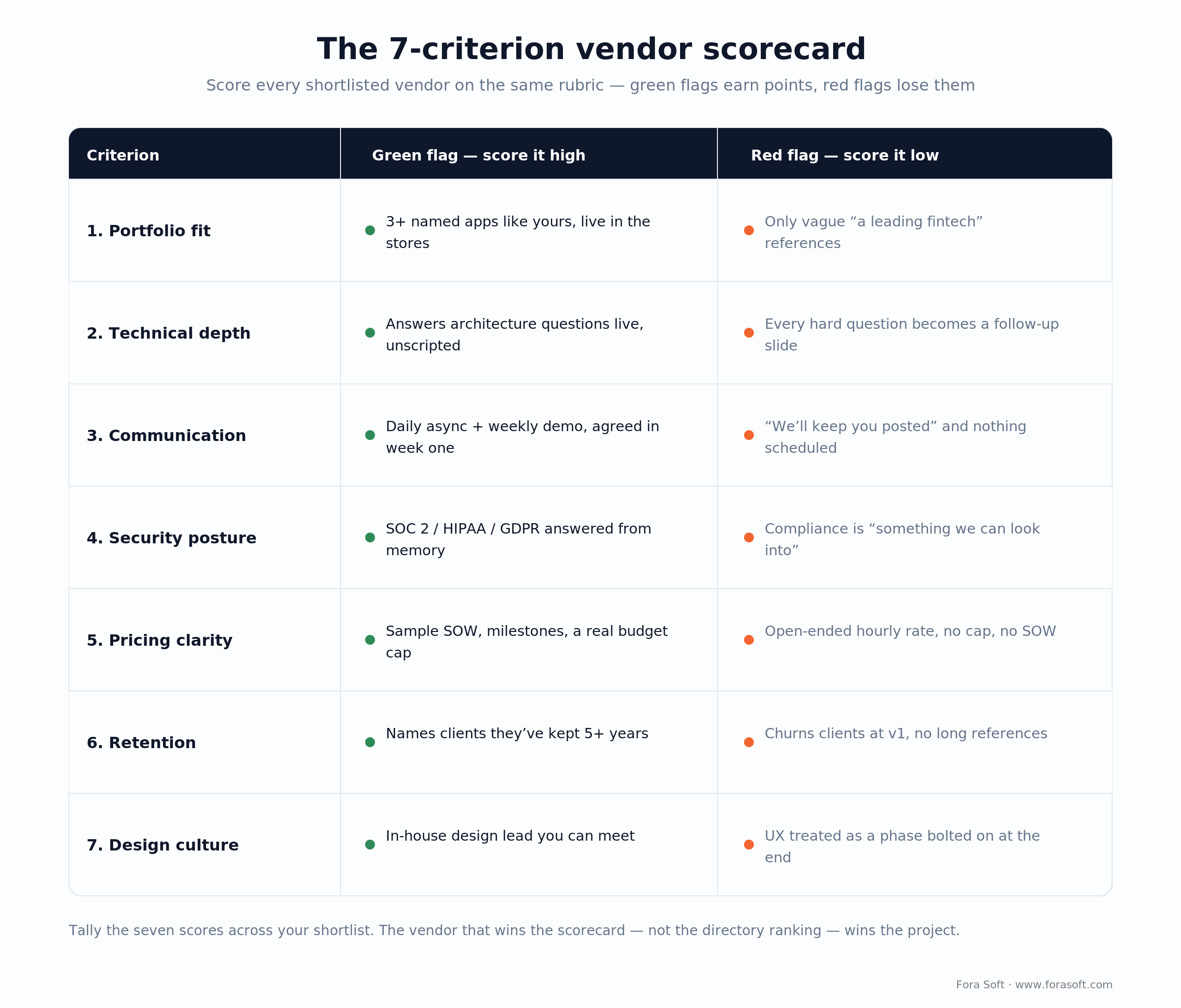
Figure 1. Score every shortlisted vendor on the same seven criteria — the one that wins the scorecard wins the project.
Specialist vs generalist: when each is the right pick
Most agencies position as generalists because that maximizes their pipeline. The right choice depends on what you are building.
Reach for a specialist when: your product depends on real-time video, AI, low-latency networking, hardware integration, or regulated data (HIPAA / GDPR). Domain expertise compresses 4–8 weeks of trial-and-error from your timeline.
Reach for a generalist when: your product is a CRUD app with conventional patterns, your differentiation is in workflow, content, or distribution — not in technical depth.
Reach for an in-house build when: the product is your moat, you have a senior engineering leader on staff, and you can afford 6+ months of ramp before shipping.
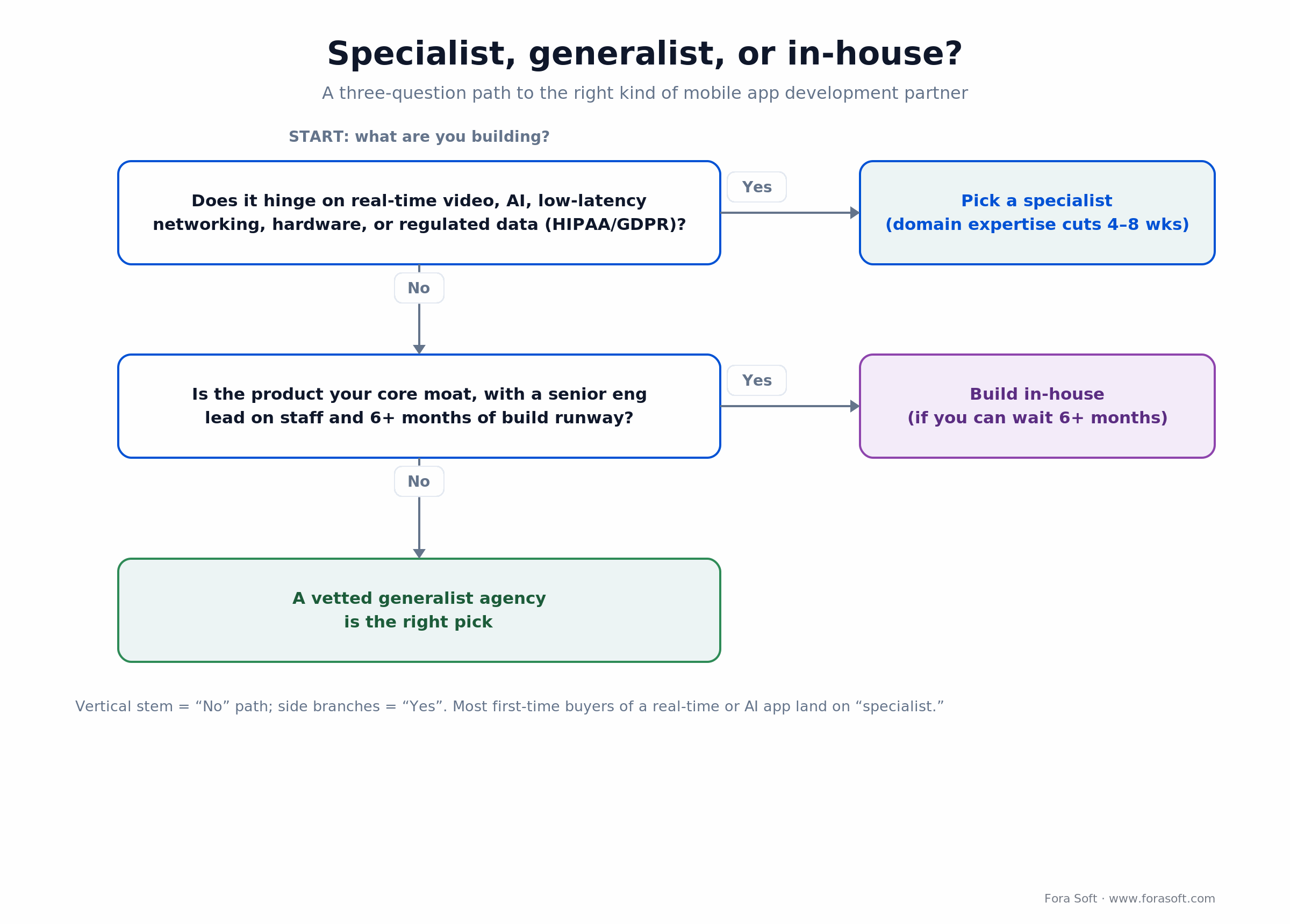
Figure 2. Three questions that route you to a specialist, a vetted generalist, or an in-house build.
How to evaluate a vendor’s portfolio in 20 minutes
Step 1: count the named clients. Real portfolios show client names, logos, and links to public app store listings. Vague language like “a leading fintech” is fine in NDA contexts but should be the exception, not the rule.
Step 2: open three apps in the App Store / Google Play. Read the latest 20 user reviews. The vendor cannot fake a four-year-old app with 50k installs and 4.6 stars.
Step 3: filter for products like yours. Telemedicine apps if you are building telemedicine. Live shopping apps if you are building live commerce. The structural similarity matters more than the headline industry.
Step 4: ask for a metrics-backed case study. “We helped Sprii hit 5,000 concurrent viewers” is better than “We built Sprii.” Real metrics, named clients, hard outcomes.
Examples from our own portfolio: Sprii live video shopping platform, BrainCert virtual classroom, Meetric AI sales video platform, Nucleus on-prem communication platform, Translinguist video interpretation, Vocal Views market research.
Mini case: 15-year retention as a leading-vendor signal
Situation. In 2010, our first non-Russian client — Mitch from a US medical interpretation business — had a problem: interpreters were physically walking to hospitals to translate patient complaints. The latency was hours, not minutes. He needed a video chat app that would let interpreters work from home.
Plan. We built v1 in 2011. Iterated through three major versions and many smaller releases over 10+ years. Added integrations with hospital EHR systems, traffic-police dispatch software, and over time, AI-assisted translation features.
Outcome. That product is now TransLinguist — a marketplace of 30,000+ certified interpreters across 75+ languages, roughly $4.2M in annual revenue, and the winner of the UK NHS national framework for language services. We started in 2010 and still ship for the same client in 2026: a decade and a half of continuous work. That is what real retention looks like, and it is the kind of relationship a leading mobile app development company earns one release at a time.
Mobile app development cost ranges in 2026
A common reason buyers pick the wrong vendor is bad anchoring on price. The numbers below are typical ranges we see in 2026 from our own pipeline and from independent industry surveys.
| App type | MVP cost | Timeline | Production-grade cost |
|---|---|---|---|
| Simple consumer app (single platform) | $25k–$60k | 6–10 weeks | $60k–$140k |
| B2C SaaS, iOS + Android | $60k–$140k | 10–16 weeks | $140k–$300k |
| Real-time video / streaming app | $80k–$180k | 10–16 weeks | $200k–$500k |
| Telemedicine (HIPAA-grade) | $100k–$220k | 14–20 weeks | $250k–$600k |
| AI-driven app with on-device inference | $120k–$260k | 14–22 weeks | $280k–$700k |
A Fora Soft delivery using Agent Engineering typically lands in the lower third of each row. Anything quoted significantly above the “production-grade cost” column for a comparable scope without a clear reason (custom hardware, regulatory complexity, exotic UX) is worth a second opinion. We help with that on the call.
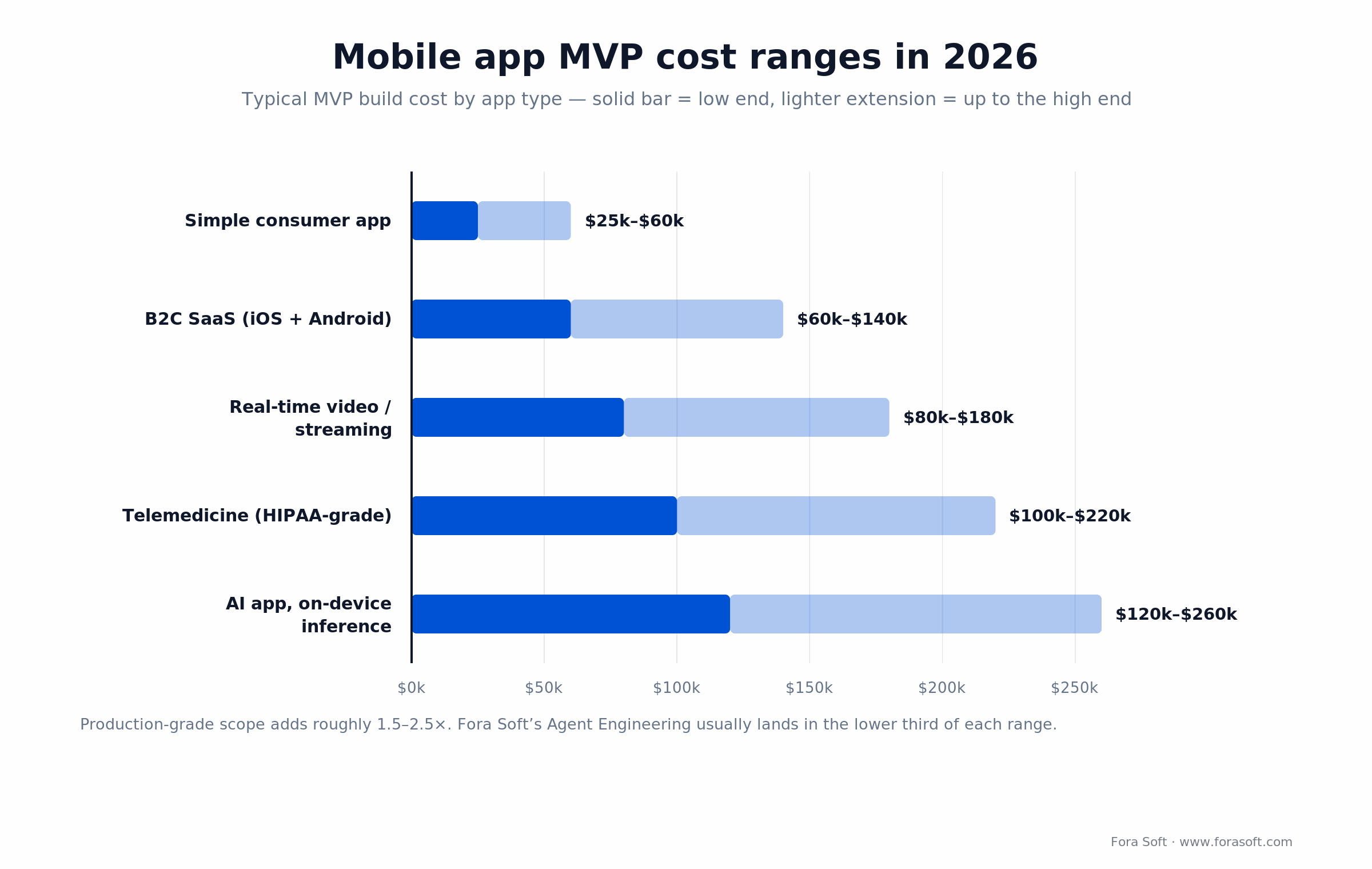
Figure 3. Typical 2026 MVP build cost by app type; the solid bar is the low end, the lighter extension reaches the high end.
Got a quote that feels too high — or too low?
Send it over. We’ll do a 30-min vendor-neutral review of the SOW, flag risks, and tell you what a fair counter looks like.
The technical questions a leading mobile app vendor should answer cold
If a vendor cannot give you a confident, specific answer to these in a 30-minute call, that is the answer about the vendor.
Native vs cross-platform. Swift / Kotlin native, React Native, or Flutter? The right answer depends on your team, your performance needs, and your roadmap. A vendor that only has one answer is selling, not advising.
Backend choices. Node, Go, Python, .NET, Ruby? Hosting on AWS, GCP, Azure, or Hetzner? The vendor should walk you through the trade-offs in your specific context, not give a generic recommendation.
Real-time stack. If your app has real-time video or audio, do they self-host an SFU (LiveKit, mediasoup, Janus) or use managed (Agora, Daily, 100ms, Twilio)? See our deep dive on WebRTC, our primer on digital-video foundations, and when to hire a WebRTC development company.
AI integration. On-device, vendor cloud, or self-hosted? Cost per inference, latency budget, model versioning. The vendor should know the question, not just the buzzword.
CI/CD and observability. What builds run on every PR? What metrics get pushed to your dashboard? Crash-free session rate, P99 cold-start, push delivery rate — expect these as defaults, not extras.
Communication cadence: the silent killer of failed projects
More projects fail on communication than on code. Establish the cadence in week one and audit it monthly.
Daily async update. Three sentences in a shared channel: what shipped yesterday, what’s shipping today, what’s blocked.
Weekly demo. 30 minutes, recorded, with a written summary and decision list. Skipping demos is the moment projects start drifting.
Bi-weekly retro. 30 minutes, focused on what to change about the way the team works. Most agencies skip this; the leading ones do not.
Single source of truth. Linear, Jira, Notion, Asana — pick one and run it disciplined. Two tools is one tool too many.
Security, privacy, and compliance checks before you sign
SOC 2 Type II. Industry baseline for vendors handling production data. Ask for the latest report under NDA.
HIPAA Business Associate Agreement. Required for any US healthcare workflow — see how we handle it in our telemedicine development practice. Confirm scope: storage, transit, dev environments.
GDPR posture. Data residency, DPA terms, sub-processor list. EU customers will not sign without it.
App Store and Play Store compliance. Privacy nutrition labels, ATT, Data Safety form. The vendor should know the latest store policies cold.
Source-code escrow. Optional but valuable for risk-averse buyers. Most leading vendors will sign one.
A realistic delivery timeline for a 2026 mobile app MVP
| Phase | Weeks (Fora Soft) | Output |
|---|---|---|
| Discovery | 1–2 | JTBD interviews, technical risk register, scope-locked SOW |
| Design | 2–3 | User flows, wireframes, prototype, design system |
| Backend skeleton | 2 | Auth, API skeleton, infra, CI |
| Mobile build | 4–6 | iOS + Android (or RN), feature parity |
| QA + UAT | 1–2 | Automated + manual, TestFlight + Play Internal |
| Launch | 1 | Store submission, monitoring, runbook |
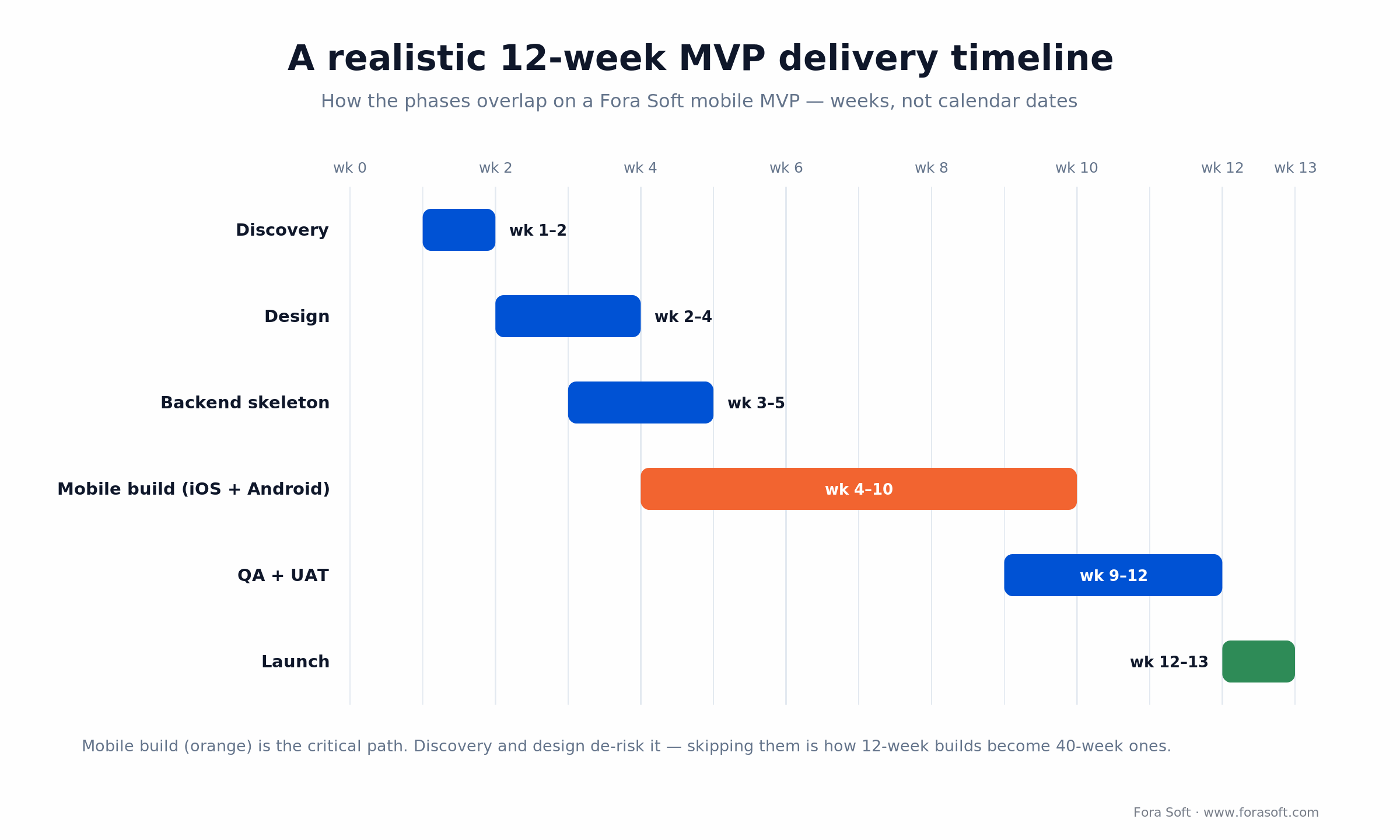
Figure 4. How the phases of a 12-week mobile MVP overlap — the mobile build is the critical path.
A decision framework: pick a leading mobile app developer in five questions
1. Have they shipped three apps structurally like yours, with named clients? If not, move to the next vendor. Domain experience compresses risk and timeline more than any other factor.
2. Will the team that sells the work actually do the work? Bait-and-switch — senior leads in the pitch, juniors on delivery — is the most common bad pattern. Insist on meeting the people who will write the code.
3. Can you talk to two former clients? Leading vendors say yes within 24 hours. Bad ones stall.
4. Is the SOW concrete? Named features, named acceptance criteria, named deliverables. Not “social features” but “follow / unfollow / feed pagination with cursor.”
5. Do you trust them after 60 minutes of conversation? Trust is the hardest factor to fake and the cheapest to verify. If something feels off, it usually is.
Reach for a paid discovery sprint when: you are torn between two finalists. A two-week scoped discovery with each surfaces the real delivery team and de-risks a six-figure build decision for a four-figure spend — the cheapest insurance in the whole process.
Five hiring pitfalls we watch buyers walk into
1. Picking by hourly rate alone. A $25/hr team with no domain experience will burn 3× the hours of a $90/hr specialist. Total cost matters, hourly rate does not.
2. Skipping the design phase. “Just start coding” is how 40-week projects begin. The discovery + design phase is the cheapest time to fail.
3. Letting the vendor own your repository. You should own the code from line one. If the vendor says no, walk.
4. Trusting the directory ranking without verification. See the directories table. Filter, do not decide.
5. Not budgeting for post-launch. Maintenance, OS releases, SDK upgrades, store policy changes. Plan for 15–30% of build cost per year, indefinitely.
KPIs that signal you picked the right vendor
Quality KPIs. Crash-free session rate >99.7%. P99 cold-start <2.5 s on a 3-year-old Android. Build-time on CI <7 minutes. Test coverage >70% on critical paths.
Business KPIs. Time-to-first-deploy on day one. Velocity stable at sprint 4. Defect-escape rate <5% post-release. NPS-of-the-engagement >50 measured monthly.
Reliability KPIs. No release rollback in the first quarter. App store ratings climbing or stable. Push notification delivery >95%. Server P99 response time <500 ms in-region.
When hiring an external mobile app developer is the wrong call
A leading mobile app development company is not always the right answer. Skip outsourcing when your IP is so core that you cannot share it with a vendor at any contractual level (defense, classified, certain proprietary algorithms); when you have a senior engineering leader on staff who can build a team in 90 days; when your product needs continuous tight integration with an in-house design and product organization that cannot run async; when budget is so constrained that any external rate — even ours — is a non-starter and a single in-house contractor is the only option.
Even in those cases, leading vendors can run discovery, design, or technical-due-diligence engagements without taking the build. Ask. The honest answer is more useful than a yes-to-everything pitch.
Red flags that disqualify a vendor on the spot
Unwillingness to share named clients. Real leaders sign clients who let them put their logos in the deck.
Unrealistic timeline promises. “We’ll ship in two weeks” for a HIPAA telemedicine app means they have not understood the brief. Honesty about constraints is the strongest signal.
No mention of testing strategy. If “QA” first appears in the SOW, run.
Pressure to sign in a single call. A 7-figure decision deserves a week of due diligence. Vendors who object are signaling something.
Senior leads disappear after kick-off. Confirm in writing the names of the people who will actually code. Audit weekly.
Have a vendor shortlist you want a second read on?
Forward us the proposals. We’ll send back a vendor-neutral assessment in 48 hours: who is fit, who is risky, who is overpriced.
FAQ
What does “leading mobile app development company” actually mean?
In practice it means: a vendor that has consistently shipped products structurally like yours, retains its clients past v1, employs a senior team, and gives you a clear plan and budget before signing. That definition is also the fastest way to think about how to choose a mobile app development company — start from evidence, not directory rankings.
How much does it cost to develop a mobile app in 2026?
Typical 2026 ranges: $25k–$60k for a simple single-platform MVP, $60k–$140k for a B2C SaaS on iOS + Android, $80k–$180k for a real-time video app, $100k–$220k for HIPAA-grade telemedicine, $120k–$260k for AI-driven apps. Production-grade scope adds another 1.5–2.5×.
How long does mobile app development take?
A typical Fora Soft MVP ships in 6–10 weeks for simple apps and 10–16 weeks for cross-platform B2C SaaS. Real-time video apps add 2–6 weeks for the WebRTC and recording stack. Multiply by 1.5× for teams without prior domain experience.
Should I hire a generalist or a specialist?
Specialist when your product depends on real-time video, AI, low-latency networking, hardware integration, or regulated data. Generalist when the technical surface is conventional and your differentiation lives elsewhere.
Are Clutch and GoodFirms reviews trustworthy?
Clutch verifies by phone interview, which is a reasonable signal. GoodFirms is more self-reported. Use both as filters, then read 5+ verbatim reviews and reach out to two former clients directly. Twenty minutes of cross-reference beats 200 hours of regret.
Native, React Native, or Flutter?
Native (Swift / Kotlin) for performance-critical apps, hardware integration, or platform-specific UX. React Native for 80% of B2C SaaS apps where shared business logic outweighs native polish. Flutter when your team has prior Flutter experience or you want a single codebase across mobile + desktop. A vendor that always answers the same way is selling, not advising.
What ongoing maintenance budget should I plan?
Plan 15–30% of initial build cost per year. OS upgrades, SDK changes, store policy shifts, and small feature work all sit in that envelope. Apps without budgeted maintenance start to bit-rot at month 9.
Is Fora Soft still recognized as a leading mobile app development company in 2026?
Yes. We have been listed on TopDevelopers.co since 2020, on DesignRush across mobile and custom-software categories, and on Clutch with verified client reviews. The recognition is welcome — but we earn it project by project, with named clients we have served for over a decade.
What to Read Next
Hiring
When to Hire a WebRTC Development Company
A specialist’s view on when video and real-time apps demand a domain expert.
Cost
How to Cut Costs on My Software Project
The honest version of where to save money — and where to never cut.
Process
What Happens in the Analytical Stage of Development
The discovery phase that separates leading vendors from generalists.
Strategy
Why You Should Cut Features and Launch Early
The MVP playbook that separates a 12-week launch from a 12-month death march.
Vendor specialism
Why Businesses Choose Agora Custom Development
A worked example of what specialist mobile development looks like in video.
Ready to short-list a leading mobile app developer this quarter?
A leading mobile app development company in 2026 is the team with named-client portfolio fit, a senior bench, transparent pricing, and a 10-year retention story. Directories are filters, not answers. Score every vendor on the same seven criteria, validate with two former clients, and trust the team that gives you a hard answer in the first call.
Fora Soft has been listed by TopDevelopers, DesignRush, and Clutch since 2020, but the recognition matters less than the 250+ products we have shipped, the 15-year clients we still work with, and the Agent Engineering delivery model that ships your MVP in 6–10 weeks. If you are weighing vendors this quarter, let us run the scorecard with you.

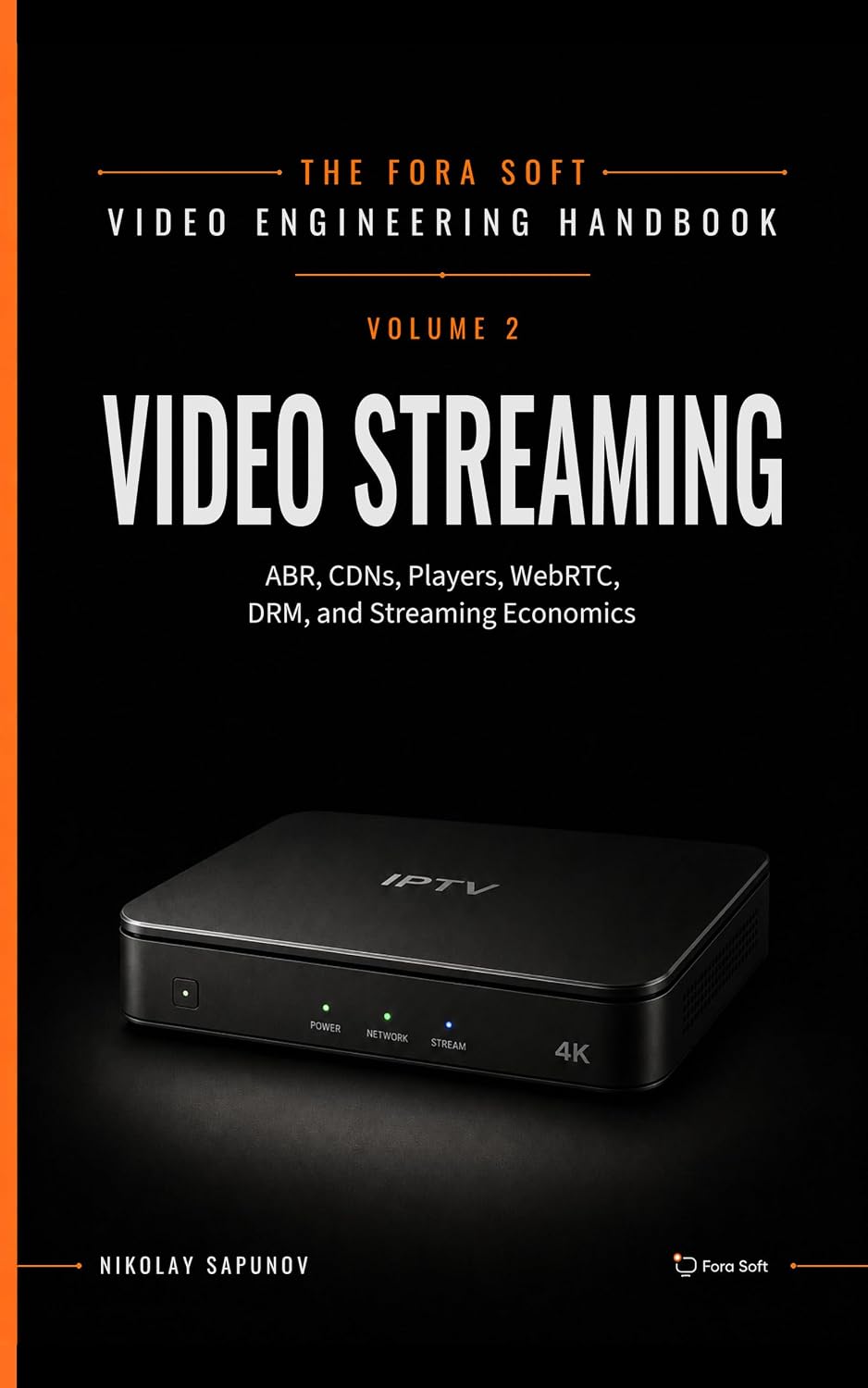

The handbook · 7 volumes
Fora Soft Video Engineering Handbook
A scorecard tells you who to call; the technical questions decide who to hire. We wrote a seven-volume handbook on the video stack behind the apps we ship: encoding, delivery, audio and AI. Start with Volume 3 on WebRTC calls and mobile players, then Volume 6 on running models on the phone and Volume 7 on real-time AI cost and compliance. Written by Nikolay Sapunov, CEO at Fora Soft.
Browse the handbook on Amazon →7 volumes · 9,000+ pages · Kindle & paperback
Let’s scorecard your shortlist together
Send us your three candidate vendors. A 30-minute call gets you a vendor-neutral read, plus a sprint-by-sprint scope estimate from us if it fits.

