


Key takeaways
• Enterprise video analytics software in 2026 is an AI pipeline, not a camera feature. The five video analytics software platforms below all ship object detection, behaviour analytics, anomaly detection and forensic search; they differ on hardware coupling, cloud / on-prem deployment and total cost of ownership.
• The 2026 enterprise shortlist is Avigilon Unity, Genetec Security Center, Milestone XProtect, BriefCam (now folded into Milestone) and Hikvision HikCentral. All five clear large-deployment requirements; the right pick depends on hardware policy, NDAA / banned-vendor rules and integration footprint.
• The unit economics are dominated by storage and AI compute, not licence fees. 90 % of TCO over five years sits in NVR storage, GPU AI inference and the SOC operators reading the alerts. Plan those before you pick a VMS.
• NDAA / Section 889 narrows the choice for US federal and infrastructure projects. Hikvision and Dahua are restricted; Avigilon, Milestone, Genetec and BriefCam are the safe defaults for federal-eligible work.
• Fora Soft has shipped video analytics integrations for 21+ years. Custom VMS frontends, AI anomaly detection, multi-site dashboards and ONVIF integration on top of every major platform. Book a 30-min call.
Why Fora Soft wrote this enterprise video analytics guide
Fora Soft has shipped video surveillance and analytics products since 2005 across NetCam, DSI Drones and a Kazakhstan courtroom recording system using V.A.L.T. We integrate with every major enterprise VMS — Avigilon, Genetec, Milestone, BriefCam, Hikvision — and we ship custom AI analytics on top.
This guide is the conversation we have with security directors and IT leaders deciding which platform to standardise on for the next five years. It is opinionated, vendor-neutral and grounded in the deployments we have actually integrated with at scale.
We use Agent Engineering internally, which is why our integration and AI-pipeline projects ship 30–50 % faster than agencies still doing this by hand. Visit our video surveillance services to see the deployments this playbook is grounded in.
Need to choose between Avigilon, Genetec, Milestone, BriefCam and Hikvision?
We will model 5-year TCO, NDAA exposure, AI feature gaps and integration cost across all five against your real camera count and SOC workflow.
What enterprise video analytics actually is in 2026
Video analytics software is the AI layer between a camera feed and a security operator. It detects, classifies and reasons about what is in the frame — people, vehicles, license plates, behaviour, anomalies — and turns hours of footage into a queryable index. In 2026 every major enterprise VMS ships this layer; the question is no longer “is there AI?” but “how good, how fast, how cheap to operate?”.
A modern video analytics pipeline runs four stages: ingest (RTSP / ONVIF from cameras), inference (object detection, classification, behaviour models on GPU), event handling (alerting, escalation, integrations with access control), forensic search (natural-language and visual search across the archive). Each vendor exposes the same four stages with different defaults.
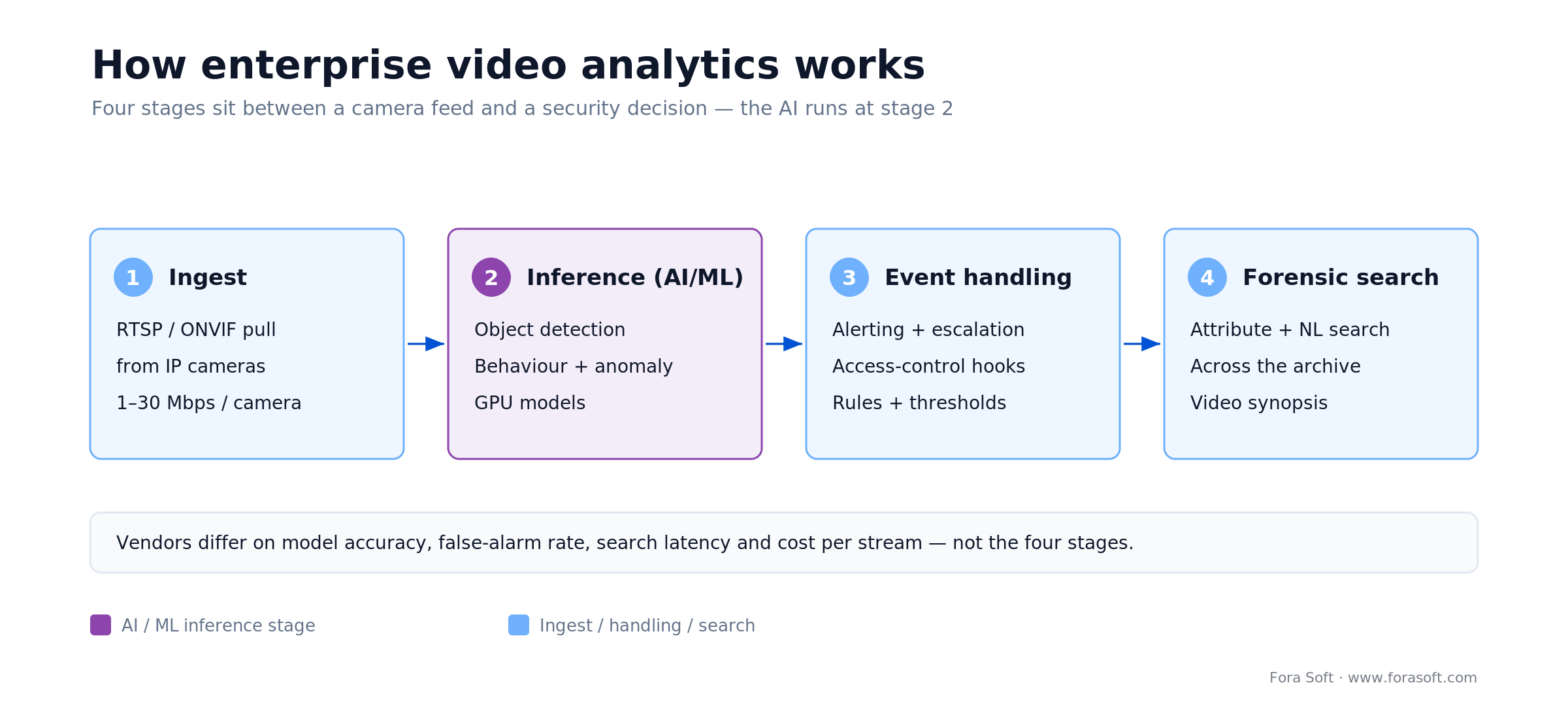
Figure 1. The four-stage video analytics pipeline. The AI runs at stage two; vendors differ on how well each stage performs.
The category is growing fast: analysts put the video management software market near $5.8 billion in 2025, heading past $6.8 billion in 2026 (estimates vary widely by scope), with AI analytics as the main growth driver. That pulls every serious vendor into shipping the same four-stage stack — which is why the buying decision now turns on execution, not feature checklists.
For deeper architecture see our scalable VMS guide and 12 essential features of modern VMS software.
The eight criteria that actually decide enterprise VMS choice
Before vendor names, fix the criteria. The selection conversations we run with clients converge on the following eight, in roughly this order of weight.
| Criterion | Why it matters |
|---|---|
| NDAA / Section 889 compliance | Federal, infrastructure, defence and many enterprise procurements ban Hikvision / Dahua / Hytera |
| Camera independence | Will the VMS lock you to one camera brand? |
| AI feature depth | Object detection, behaviour, search, forensic timeline |
| Cloud / hybrid / on-prem support | Sovereignty, bandwidth, retention |
| Integrations & SDK | Access control, alarm, analytics partners, custom dashboards |
| Storage and bandwidth model | Often the dominant 5-year cost |
| Operator UX | Alarm fatigue, search latency, multi-site context switching |
| 5-year TCO | Hardware, licences, AI compute, SOC labour, integration, upgrades |
Lock NDAA first. If your buyer has any federal, infrastructure or critical-infrastructure exposure, a banned camera brand torpedoes the deal regardless of the rest of the matrix.
Avigilon Unity (Motorola Solutions)
Why pick it
Avigilon Unity is the on-prem half of Motorola Solutions’ 2023 rebrand (Unity on-prem, Alta in the cloud); it carries forward the former Avigilon Control Center (ACC) and ships the deepest hardware-software bundle in the shortlist. Self-Learning Video Analytics, Appearance Search and Unusual Motion Detection have been in production for years; the hardware AI Appliance is purpose-built. Strong fit for federal and large-enterprise customers. Our Avigilon VMS profile has the honest teardown.
Strengths
First-class AI-camera ecosystem, NDAA-compliant by default, mature forensic search (find a person, then find them across cameras and time), strong integration with Motorola radio and access-control products.
Limits
Heaviest when paired with Avigilon cameras; AI feature parity on third-party ONVIF cameras is narrower. Pricing is opaque and skews enterprise; not the path of least resistance for SMB.
Genetec Security Center
Why pick it
Genetec Security Center is the unified-platform leader and, by Omdia’s 2025 market-share database, the world’s number-one VMS — number one in the Americas for 14 straight years. Omnicast (VMS), Synergis (access control), AutoVu (LPR) and Mission Control (SOC) sit under one umbrella; its Streamvault appliances ship pre-hardened. Strong on privacy (KiwiVision Privacy Protector) and one of the cleanest cloud / on-prem hybrid stories in the segment. Our Genetec Security Center profile goes deeper.
Strengths
Unified VMS + access + LPR with a single operator console; mature cybersecurity posture; NDAA-compliant; strong North American and European installer network; Genetec Cloud Services for hybrid retention.
Limits
Premium pricing; the unified bundle becomes complex if you only need one piece. SDK is mature but more conservative than Milestone’s open ecosystem.
Milestone XProtect
Why pick it
Milestone XProtect is the openness leader, and per Milestone’s own marketplace its open platform now spans 1,000+ third-party applications and 16,300+ verified devices (Device Pack 14.1, 2026). The current release is XProtect 2026 R1, and Milestone has announced a generative-AI plug-in, built with NVIDIA, that summarises and searches footage in plain language. Pick it when your differentiation is the integration stack you build on top, not the VMS itself. Our Milestone XProtect profile covers the trade-offs.
Strengths
Largest third-party ecosystem of analytics partners; supports virtually every camera; SDK and REST APIs are mature; XProtect Cloud and federation across sites work at large enterprise scale; NDAA-friendly when paired with compliant cameras.
Limits
First-party AI is shallower than Avigilon; you fill the gap with marketplace partners (Vaidio, Hayden AI and others) or with BriefCam — which, since 2024, is a Milestone stablemate inside the Canon Group rather than an outside vendor. Either way you run a multi-model stack.
Looking at Milestone XProtect for a multi-site rollout?
We integrate Milestone with custom AI analytics, mobile apps and enterprise dashboards across 50–5,000 cameras — usually in 6–10 weeks.
BriefCam (Canon / Milestone)
Why pick it
BriefCam, bought by Canon in 2018, is the analytics-first option that plugs into Milestone, Genetec, Avigilon and others. Here’s the 2026 catch no other comparison flags: since 2024 BriefCam has been folded into Milestone Systems (also a Canon Group company), and its site moves to milestonesys.com on 14 January 2026 — so “BriefCam vs Milestone” is now one corporate roof, even though BriefCam still deploys on third-party VMS. Video Synopsis condenses hours of footage into minutes; Insights and Forensics turn the archive into a queryable database with attribute search (man + red shirt + bicycle, between 14:00 and 16:00). The ROI on forensic-investigation time is the strongest in the field.
Strengths
Best-in-class forensic search and review acceleration; deployed across law enforcement and large enterprise; can sit on top of an existing VMS; strong privacy controls.
Limits
Adds a second platform to manage on top of your VMS; licensing is camera-based and gets expensive at large camera counts; not a full VMS replacement — you pair it with one.
Hikvision HikCentral Professional
Why pick it
HikCentral Professional is the most cost-effective option in the shortlist. Tight integration with Hikvision’s own AI cameras (DeepinView, AcuSense) gives strong out-of-the-box analytics on a hardware bundle. Common in commercial and APAC deployments where price-per-channel dominates the conversation.
Strengths
Lowest hardware-plus-software bundle cost; rich first-party AI camera ecosystem; HikCentral Connect for cloud-managed sites; large global installer base.
Limits
NDAA / Section 889 restrictions in the US. Banned for federal, infrastructure and many enterprise procurements; restricted in the UK’s Procurement Act 2023 government estates. Valid in many commercial / APAC markets, but a non-starter for federally-exposed projects.
If your buyer has any federal exposure — default Genetec, Avigilon or Milestone, and treat HikCentral as commercial-only.
Side-by-side comparison matrix
| Vendor | NDAA | First-party AI | Cloud / hybrid | Best fit |
|---|---|---|---|---|
| Avigilon Unity | Yes | Deep, hardware-coupled | Yes (Cloud Services) | Federal, large enterprise |
| Genetec Security Center | Yes | Strong, privacy-aware | Yes | Unified VMS + access + LPR |
| Milestone XProtect | Compliant w/ proper cameras | Shallower; deep marketplace | Yes (XProtect Cloud) | Best openness / SDK |
| BriefCam (Milestone) | Yes | Best forensic search | Add-on to existing VMS | Investigations & review |
| Hikvision HikCentral | No (US restrictions) | Strong on Hik cameras | Yes (Connect) | Cost-led commercial / APAC |
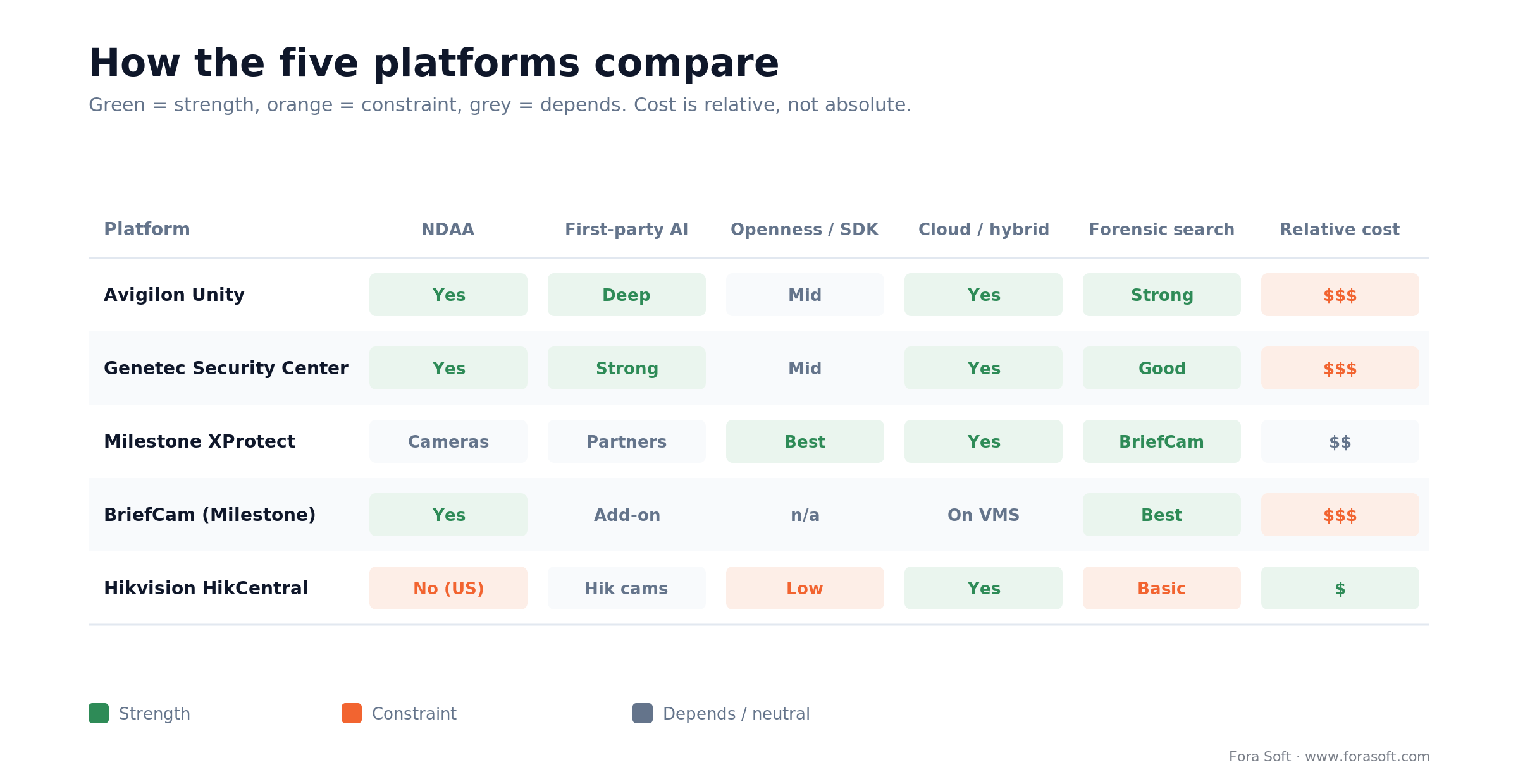
Figure 2. How the five platforms score across NDAA, first-party AI, openness, cloud, forensic search and relative cost.
In short: Avigilon for federal hardware-coupled deployments, Genetec for unified platform, Milestone for openness and integrations, BriefCam for forensic search, Hikvision for low-cost commercial without NDAA constraints.
The AI features that move the needle in 2026
All five vendors ship the same headline AI list. The differentiation is in execution. The features that actually move SOC efficiency:
Object detection and classification. Person, vehicle, license plate, animal, package — all five do this. The bar in 2026 is >95 % precision at <10 % false-alarm rate on real-world footage. Anything below halves SOC efficiency.
Behaviour analytics. Loitering, line-cross, intrusion, fall detection, crowd density. Avigilon’s Self-Learning Video Analytics and Hikvision’s AcuSense are strong; Milestone marketplaces deliver via partners.
Anomaly detection. Detects unusual motion or behaviour without explicit rules. Avigilon Unusual Motion Detection is the canonical example; our anomaly detection guide compares the underlying algorithms.
Forensic and natural-language search. “Find a man in a red shirt with a bicycle, between 14:00 and 16:00, on the north entrance.” BriefCam leads here; Avigilon Appearance Search is close.
Privacy redaction. EU and California privacy law makes face / body redaction mandatory for footage shared outside the SOC. Genetec KiwiVision Privacy Protector is the reference; BriefCam ships an equivalent.
5-year TCO — where the money actually goes
A 500-camera enterprise rollout has roughly the following 5-year cost shape, regardless of vendor.
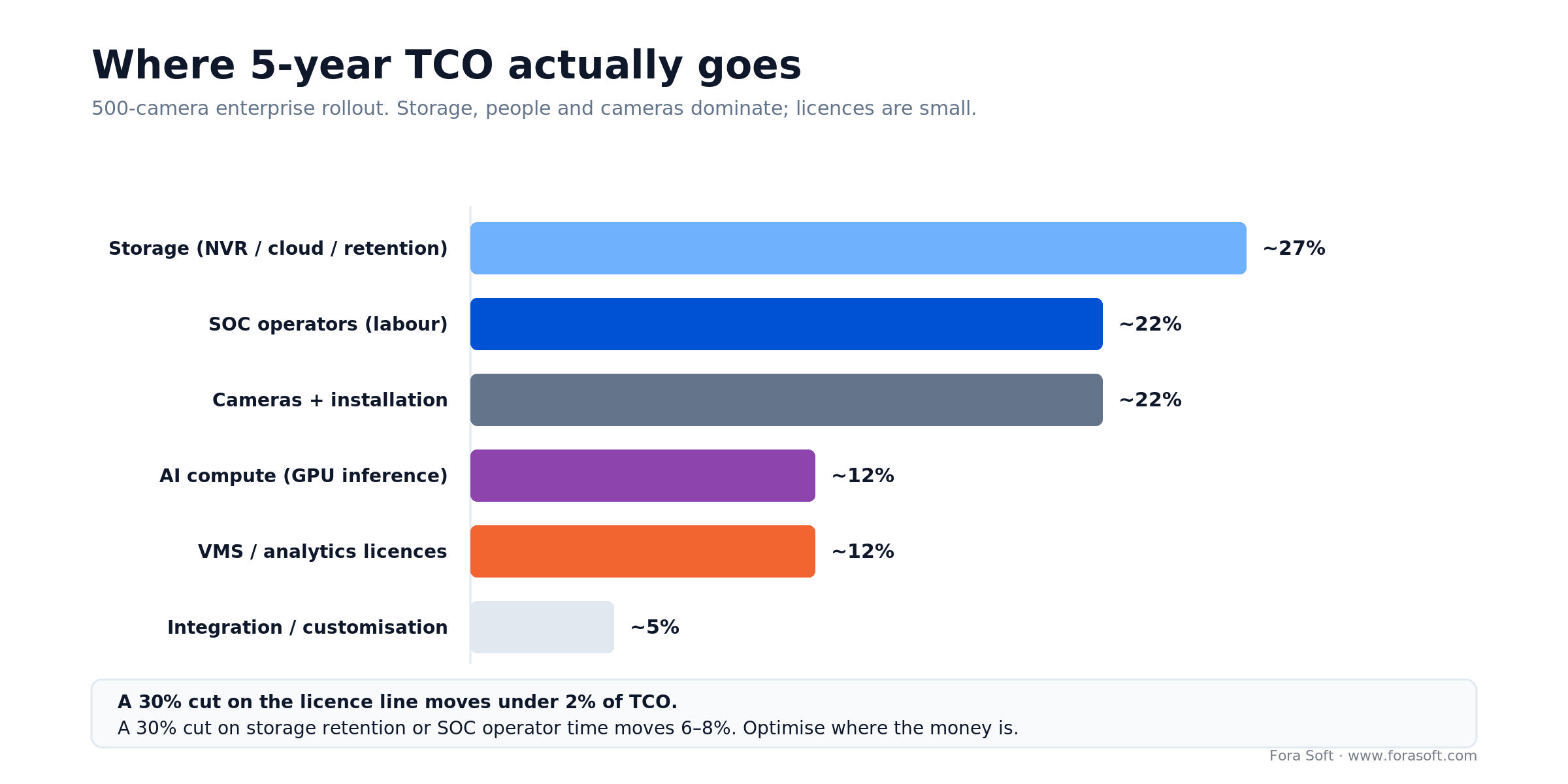
Figure 3. Where five-year TCO actually lands on a 500-camera rollout. Storage, people and cameras dwarf the licence line.
| Cost line | % of 5-year TCO |
|---|---|
| Cameras + installation | ~20–25 % |
| Storage (NVR, cloud, retention) | ~25–30 % |
| AI compute (GPU servers, inference) | ~10–15 % |
| VMS / analytics licences | ~10–15 % |
| SOC operators (labour) | ~20–25 % |
| Integration / customisation | ~5–10 % |
The lesson most security directors learn the hard way: a 30 % saving on the licence line item moves <5 % of TCO. A 30 % saving on storage retention or SOC operator time moves 8–10 %. Optimise where the money actually is.
Worked example — why storage dominates. Take 500 cameras at 4 Mbps of H.265 video, recording around the clock. That is 4 Mbps × 86,400 s = 345,600 Mbit = 43.2 GB per camera per day. Across 500 cameras that is 21.6 TB a day, so a 90-day retention window needs roughly 1.9 PB of raw capacity before RAID and overhead. Halve the bitrate or the retention window and you halve the single largest line on the chart above — no licence negotiation moves numbers that big.
NDAA / Section 889 in 2026 — what it actually means
Section 889 of the 2019 NDAA (implemented for contractors as FAR 52.204-25) prohibits US federal agencies and their contractors from buying or using video surveillance equipment from Hikvision, Dahua, Hytera, Huawei or ZTE. It applies to direct purchases and to systems that “use” the prohibited gear — which has been interpreted broadly.
In practice this means: federal customers, federal contractors, critical-infrastructure operators (utility, transport, defence, healthcare under federal grants) and many state agencies must use NDAA-compliant cameras and software end-to-end. The Departments of Defense, Homeland Security and Energy enforce strictly.
Two updates in the 2020s tightened the screws. In April 2024 a federal appeals court upheld the FCC’s authority to bar new equipment authorizations for Hikvision gear used in critical-infrastructure surveillance, while sending the agency back to narrow an over-broad definition of “critical infrastructure.” Then in its October 2025 order the FCC moved to limit previously granted authorizations — restricting the marketing and import of older covered models, not just newly authorized ones (gear already installed is not swept up). The direction of travel is one-way: the covered list only grows.
UK Procurement Act 2023 extends similar restrictions on Chinese-state-linked surveillance from sensitive government estates. The EU has not yet legislated equivalent, but several member states have moved nationally.
For NDAA-compliant builds, default to Avigilon, Genetec, Milestone or BriefCam paired with Axis, Bosch, Hanwha, i-PRO or Pelco cameras. Verify NDAA status on every component on a fresh procurement.
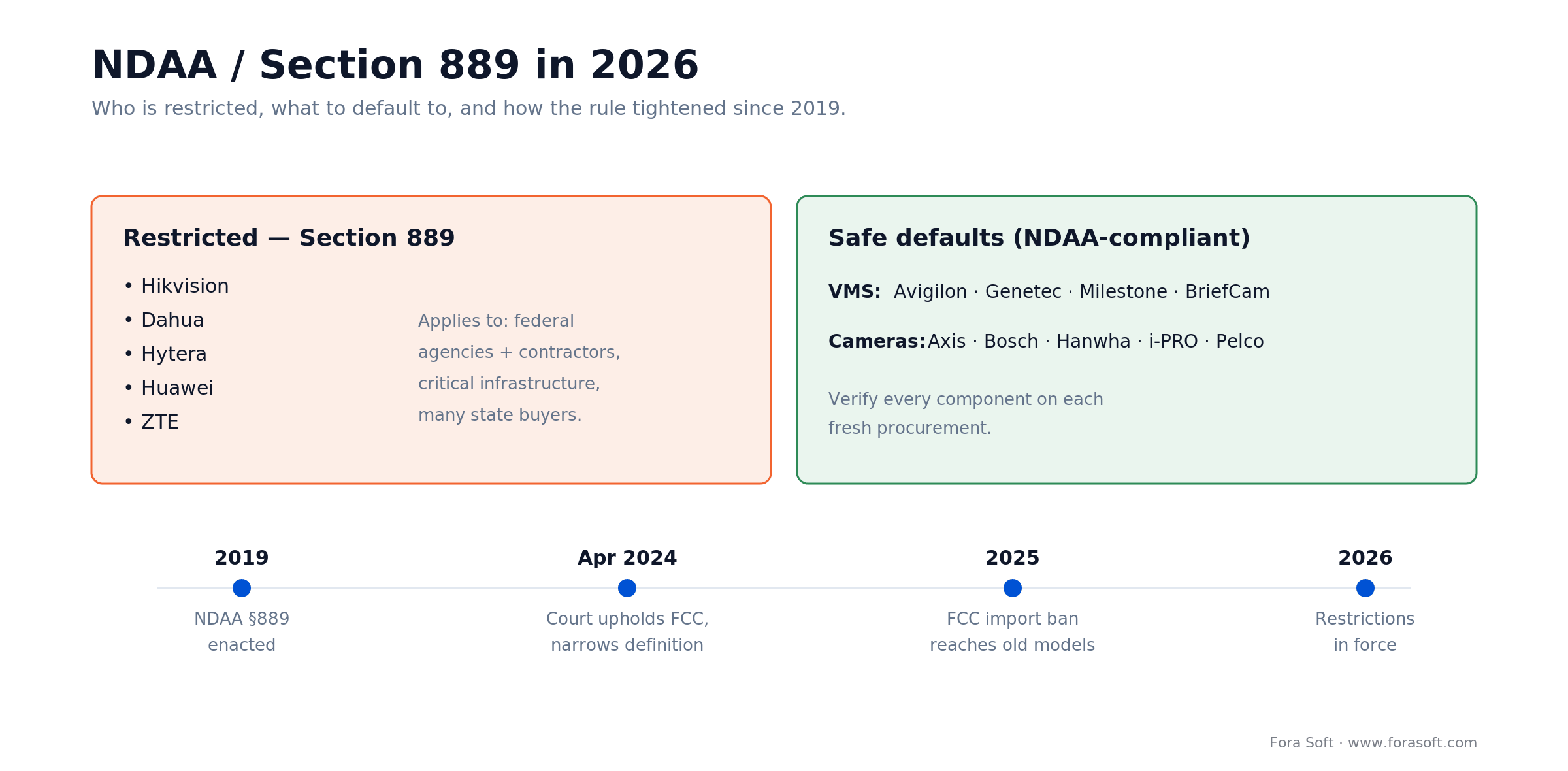
Figure 4. NDAA / Section 889 in 2026: who is restricted, the compliant defaults, and how the rule has tightened since 2019.
If you remember nothing else: retention policy and SOC operator workflow drive 5-year TCO more than the licence sticker on the VMS. Optimise where the money actually is.
Mini case — multi-site VMS rollout with custom AI analytics
Situation. A logistics client running 800 cameras across 23 warehouses needed a unified VMS plus custom AI analytics for loading-bay anomaly detection, license-plate matching against the WMS database, and forensic search over 90-day retention.
Plan. Milestone XProtect federation as the spine, BriefCam for forensic search across the archive, custom AI service in our team for the loading-bay rule (Python, ONNX runtime, GPU servers in two regions), Genetec AutoVu retired and replaced with a self-hosted ALPR pipeline writing to the WMS REST API.
Outcome. SOC investigation time on shipment-anomaly tickets dropped 65 %; integration-only stack swap inside 14 weeks; NDAA-compliant end-to-end with Axis cameras. Want a similar rollout? Book a scoping call.
A decision framework — pick your platform in five questions
Q1. Is NDAA / Section 889 in scope? Yes → Avigilon, Genetec, Milestone or BriefCam. Hikvision is out.
Q2. Do you need a unified platform across video, access and ALPR? Yes → Genetec Security Center.
Q3. Is forensic search and post-event review your top use case? Yes → BriefCam, layered on Milestone or Avigilon.
Q4. Will you extend with custom analytics or third-party integrations? Yes → Milestone XProtect; deep SDK and 600+ marketplace partners.
Q5. Is hardware bundle cost the dominant constraint and you have no NDAA exposure? Yes → Hikvision HikCentral with their AI cameras.
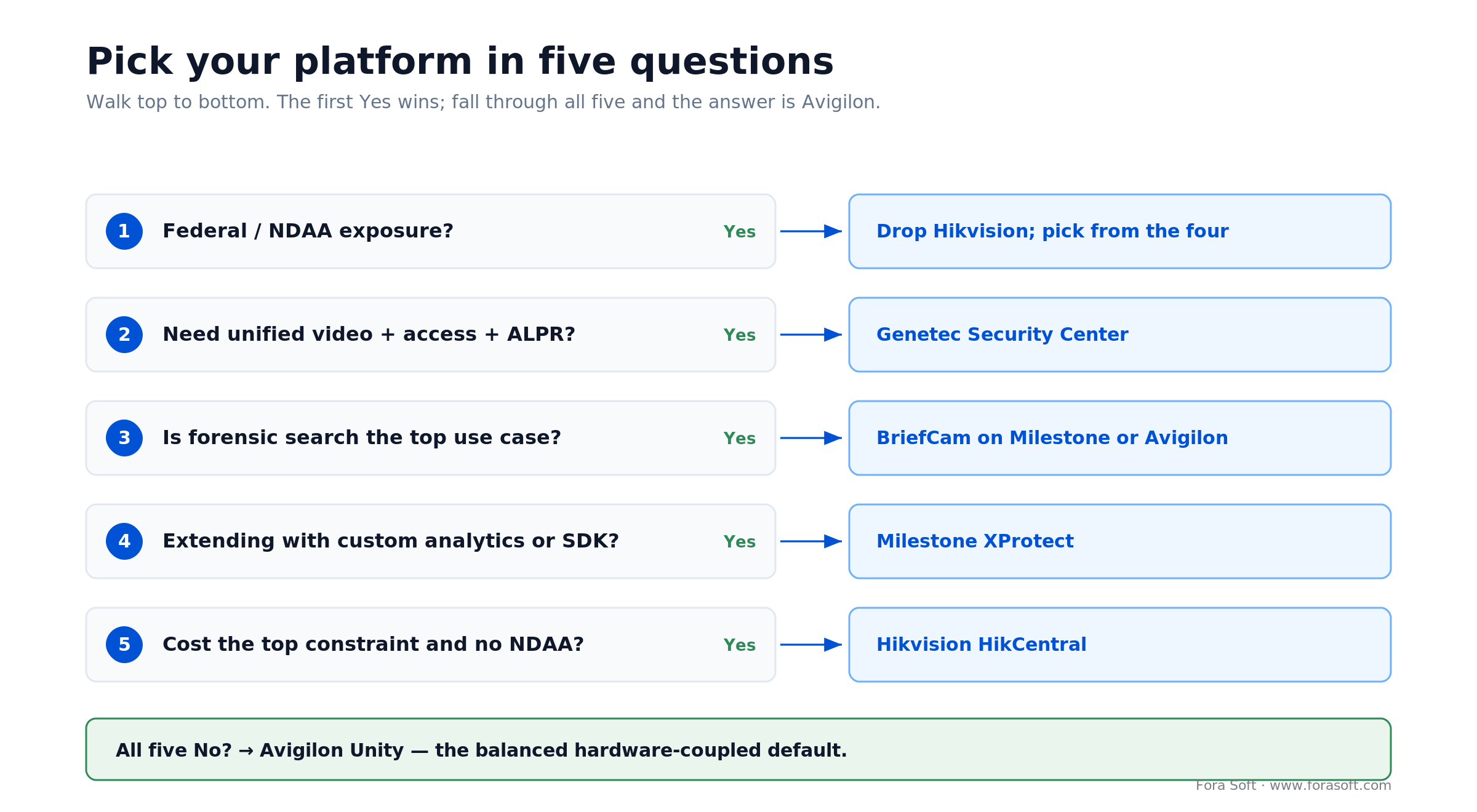
Figure 5. The five-question path from NDAA exposure and use case to a single platform pick.
Need custom AI analytics on top of your VMS?
We build production-grade computer-vision pipelines on top of Milestone, Genetec, Avigilon and Hikvision — usually 6–10 weeks from scoping to first frame in production.
Five pitfalls that derail enterprise video analytics projects
1. Picking on first-party AI demos. Vendor demos run on staged footage. Always run a 30-day pilot on real client traffic before committing.
2. Underspecified retention policy. 90 vs 365 day retention can double or triple your storage line item. Decide before you size NVR.
3. Alarm fatigue. Default thresholds generate so many alerts the SOC stops reading them. Tune thresholds in pilot, not in production.
4. NDAA late in procurement. Cameras already on POs, then federal compliance review torpedoes the build. Fix NDAA on day one.
5. Skipping integration scope. Access control, alarm, WMS, ITSM, ERP — the integrations are where projects overrun. Scope them before signing the VMS contract.
KPIs to track once you ship
Quality KPIs. Detection precision and recall by class, false-alarm rate per camera per day, forensic search response time, system uptime per camera.
Business KPIs. Mean time to investigate, incidents prevented, cost per camera per year (TCO), SOC operator efficiency (alerts handled per shift).
Reliability KPIs. Camera availability, recording continuity, AI-pipeline GPU utilisation, integration health (access control, alarm, WMS, ERP).
When you should not buy enterprise video analytics
Skip enterprise-grade if (a) your camera count is below 50 and you have no SOC; (b) you only need basic motion detection and remote viewing; (c) your buyer is comfortable with a SaaS like Verkada or Eagle Eye Networks. The enterprise vendors here win above ~150 cameras with a real SOC and an integration footprint.
For mid-market consumer-grade, see our Android video surveillance trends and SDK choice for video surveillance apps guides.
Frequently asked questions
Which enterprise video analytics platform is best in 2026?
There is no single “best”. Avigilon Unity wins on hardware-coupled AI; Genetec Security Center wins on unified video + access + ALPR; Milestone XProtect wins on openness and SDK depth; BriefCam wins on forensic search; HikCentral wins on price-per-channel where NDAA does not apply.
Is Hikvision banned in the US?
Hikvision (and Dahua, Hytera, Huawei, ZTE) are restricted under Section 889 of the 2019 NDAA for federal agencies, federal contractors and many critical-infrastructure projects. They remain available in commercial markets, but federally-exposed buyers cannot use them.
Can I add custom AI analytics to my existing VMS?
Yes. Milestone has the deepest SDK; Genetec and Avigilon expose mature APIs; Hikvision integrates via ISAPI / ONVIF events. Most custom analytics workloads (anomaly detection, custom object classes, ALPR variants) sit on a separate GPU service that consumes RTSP and writes back events to the VMS.
How does BriefCam fit alongside an existing VMS?
BriefCam is not a VMS replacement — it sits next to one, pulling camera streams or VMS recordings, indexing them with its analytics layer, and exposing its own forensic, alerting and dashboard surface. Note the 2026 change: BriefCam is now part of Milestone Systems (Canon Group), so a “BriefCam + Milestone” stack is one vendor, while BriefCam on Genetec or Avigilon stays a genuine third-party pairing.
What dominates 5-year TCO on a 500-camera deployment?
Storage and SOC operators each take 20–30 % of TCO; cameras and installation 20–25 %; AI compute and licences 10–15 % each; integration 5–10 %. Optimise storage retention and operator workflow before fighting over licence pricing.
How long does an enterprise VMS rollout take?
A 100–500-camera rollout typically takes 8–16 weeks from kickoff to operational SOC. Multi-site federations (1,000+ cameras) take 6–12 months. AI feature tuning continues for the first 90 days post go-live.
Cloud, on-prem or hybrid?
Hybrid is the 2026 default. On-prem at the edge for ingest, recording and live analytics; cloud for federation, archive retention, mobile access and disaster recovery. Pure cloud is feasible only if bandwidth is plentiful and retention is short; pure on-prem is feasible if disaster recovery is otherwise solved.
Does Fora Soft do enterprise VMS integrations?
Yes. We have shipped integrations and custom AI analytics across Milestone, Genetec, Avigilon, Hikvision and BriefCam since 2010, including bespoke client work on NetCam, DSI Drones and a Kazakhstan courtroom system. Book a call.
What to read next
Architecture
Scalable video management systems in 2026
The five engineering decisions behind a VMS that survives growth.
Features
12 essential features of modern VMS software
The capability checklist to score any VMS in 2026.
AI
7 best machine learning algorithms for surveillance anomaly detection
The algorithms behind the “unusual motion” features your VMS ships.
AI surveillance
AI and anomaly detection in video surveillance
A complete guide to deploying AI on top of your video estate.
Ready to pick the right enterprise video analytics platform?
The 2026 enterprise shortlist is Avigilon Unity, Genetec Security Center, Milestone XProtect, BriefCam (Canon) and Hikvision HikCentral. NDAA exposure narrows the choice for federally-exposed projects; the rest is a question of whether you optimise for unified platform, openness, AI depth, forensic search or hardware-bundle cost.
Plan storage, AI compute and SOC operator workflow before licences — that is where 70 % of 5-year TCO sits. Our video-surveillance engineering team ships these integrations end to end.
Get an enterprise video analytics platform recommendation
A 30-minute call, a written 5-year TCO and platform recommendation within 5 working days, and a fixed-scope integration quote.

