


Why this matters
If you are an L&D director, an EdTech founder, or a product lead, you will spend most of your budget producing and delivering video — and the difference between video people learn from and video people abandon is mostly design, not production value. This article translates the science of learning from video into the handful of decisions your team actually controls: how long a clip runs, where a quiz goes, what the player lets a learner do, and what gets cut. It gives you the vocabulary to brief instructional designers and engineers, and the evidence to push back when someone wants to upload a 45-minute lecture and call it a course.
The one constraint everything follows from: working memory is tiny
Every rule in this article descends from a single fact about how people think. When you learn something new, the information passes through working memory — the small mental workspace where you hold and manipulate ideas right now, before they are filed into long-term storage. Working memory is severe in its limits: it holds only a few items at once and clears in seconds. Long-term memory, by contrast, is effectively unlimited. The whole job of instructional design is to get new material across the narrow bridge of working memory without overloading it.
The framework that names this is cognitive load theory, introduced by educational psychologist John Sweller in the late 1980s [1]. It splits the mental effort of any lesson into three parts. Intrinsic load is the difficulty baked into the subject itself — naming the stages of a process is low; understanding how the process is controlled is high. Extraneous load is effort wasted on bad design — a cluttered screen, background music, confusing instructions — that does nothing for learning. Germane load is the productive effort of actually building understanding: comparing, connecting, and filing the idea into a mental model. The three add up, and working memory has a fixed ceiling. So the design goal is blunt: cut extraneous load to near zero, keep intrinsic load manageable by breaking hard material into pieces, and spend the freed capacity on germane load.
Video has one structural advantage here, and it comes from a second idea: the cognitive theory of multimedia learning, developed by Richard Mayer over more than 200 experiments [2]. Working memory is not one pipe but two — a visual channel for what you see and a verbal channel for what you hear. Use both at once with complementary information and you roughly double the bridge's width. Overload one channel — say, by making someone read on-screen text while also listening to different narration — and you choke it. This split is why a narrated animation teaches better than the same animation with paragraphs of text on screen.
 Figure 1. Working memory is the bottleneck. Good video design shrinks wasted (extraneous) load and feeds both the visual and verbal channels so more capacity goes to real understanding.
Attention: the six-minute cliff
The most replicated finding in video learning is also the most ignored: people stop watching long videos, and they stop sooner than anyone expects. The landmark study comes from a team led by Philip Guo, who analyzed 6.9 million video-watching sessions across four edX massive open online courses — MOOCs, the large free courses that generate huge usage datasets [3]. The result is stark. For videos under six minutes, median engagement was close to 100% — learners watched almost the whole thing. Engagement then fell off a cliff: 9-to-12-minute videos held about 50% of viewers, and 12-to-40-minute videos held roughly 20%. The maximum median engagement time for a video of any length was about six minutes [3].
Read that last point again, because it reframes the whole production question. Filming a 30-minute lecture does not buy you 30 minutes of attention; it buys you about six, the same as a six-minute clip, plus the cost of producing and storing 24 minutes most learners never reach. A separate lab study watching learners through hour-long lectures found the predictable companion effect: self-reported mind-wandering rose steadily and retention of the material fell as the lecture wore on [4].
 Figure 2. Median engagement against video length, from 6.9M MOOC sessions. Attention maxes out around six minutes regardless of how long the video runs.
This is the evidence behind chunking — cutting content into short, single-idea segments — and it is the same effect that powers the microlearning format covered in learning video formats. In research terms it is the segmenting principle: people learn better from material delivered in learner-paced pieces than as one continuous block. A meta-analysis pooling 56 studies found a reliable benefit of segmenting for both retention and the harder test of transfer — applying knowledge to a new problem — alongside lower measured cognitive load [5]. Chunking is not just easier to watch; it measurably improves what learners can do afterward.
Do the arithmetic, because it is the entire business case. Suppose a 40-minute lecture is watched, on average, to the six-minute mark — that is 6 ÷ 40 = 15% of the content actually consumed. Now cut the same material into eight five-minute units. Short units routinely finish near 90%, so average consumption becomes 0.90 × 40 = 36 minutes, or 90% of the content. Same footage, same delivery bill, six times the material absorbed. The lever is editorial, and it costs nothing to pull.
Signal what matters, and weed out what doesn't
Cutting length is necessary but not sufficient. Within each short clip, the brain still has to decide what to pay attention to — and you can make that decision for it. Two of Mayer's principles do most of the work here [2].
Signaling (also called cueing) is the use of on-screen cues to highlight the important parts: a key phrase appearing as the narrator says it, an arrow pointing to the part of a diagram under discussion, a color change marking the step that matters now. Signaling reduces extraneous load because the learner no longer has to hunt for the point, and it can raise germane load by making the structure of the material visible. Studies show signaling improves both retention and transfer from instructional video [6].
Weeding is the opposite move: deleting interesting-but-irrelevant material. Background music, a busy set, decorative animation, the extra fact that does not serve the learning goal — each forces the learner to spend working memory deciding it is safe to ignore. That decision is pure extraneous load. One caution from the research: what counts as "extraneous" shifts with expertise. A detail that distracts a novice may be exactly what an advanced learner needs, so weed for the actual audience, not for an imagined expert [2][6].
A practical accessibility note ties in here. Accurate captions, covered in captions, transcripts, and audio description, are a legal requirement under WCAG 2.1 Level AA for many buyers — but they are also a signaling and attention aid for every learner, not only those who need them. Pedagogy and compliance point the same way.
Retention: watching is not learning
Here is the trap that sinks more courses than any technical bug: video feels easy. Learners report video as more pleasant and more memorable than text, which makes them overestimate how much they have actually learned [7]. A learner who watched attentively and understood in the moment will often fail a test a week later, because understanding-while-watching is not the same as being able to retrieve the idea later, unaided. Passive watching, however polished, tends to produce this illusion of competence.
The fix is one of the best-evidenced findings in all of learning science: the testing effect, or retrieval practice. The act of pulling information out of memory — answering a question, recalling a step — strengthens that memory far more than reviewing the material again. Repeated retrieval produces markedly better long-term recall than the same time spent re-watching or re-reading [8]. Retrieval even helps when the learner gets the answer wrong, because the effort of trying primes the correct answer to stick.
For video, the proven way to trigger retrieval is to interrupt it. In a controlled study, learners who answered short questions between roughly five-minute video segments significantly outperformed learners who did unrelated tasks between the same segments — and they reported less mind-wandering, took more notes, and felt less test anxiety [9]. The questions did three jobs at once: they forced retrieval, they broke the video into segments, and they gave the learner an honest read on what they had not yet grasped. This is why an in-player quiz is a pedagogical instrument, not a decoration — the engineering of which is covered in in-player quizzes and polls.
Two more retention levers belong in any serious learning product. Spacing — revisiting material after a gap rather than cramming it once — produces stronger long-term memory than massed repetition, which means your platform should schedule review, not just deliver content once [8]. And dual coding — pairing a clear visual with the spoken explanation — gives the brain two routes to the same idea, which is the multimedia advantage from earlier put to work for recall.
From pedagogy to product decisions
The reason this matters to a build-vs-buy conversation is that every principle above is a feature decision with a cost. The table below is the translation layer: the science on the left, the thing your engineers and instructional designers actually build on the right.
| Pedagogy principle | What the research says | The product decision it drives |
|---|---|---|
| Segmenting / chunking | Attention maxes ~6 min; segmenting lifts retention and transfer [3][5] | Author content as ≤6-min clips; build chapters and per-segment resume |
| Cognitive load | Working memory is tiny; cut extraneous load [1][2] | Clean player UI, no autoplay clutter, one idea per screen |
| Signaling | On-screen cues improve retention and transfer [6] | Support overlays, callouts, highlighted captions, key-term lower-thirds |
| Modality / dual coding | Visual + verbal beats visual + text [2] | Favor narrated animation; avoid on-screen paragraphs read aloud |
| Retrieval practice | Testing beats re-watching for recall [8][9] | In-player quizzes between segments; track each attempt |
| Spacing | Spaced review beats massed [8] | Scheduled review, reminders, adaptive resurfacing of weak topics |
Notice that the right-hand column is a product roadmap. Chunking implies an authoring workflow and a chapter-aware player. Retrieval implies an interactive layer and a way to record each answer — which is exactly the kind of granular event the xAPI Video Profile, the community standard for tracking video interactions, was built to capture [10]. Pedagogy quietly decides how much platform you need, which is why it belongs in scoping, not in a later "polish" phase.
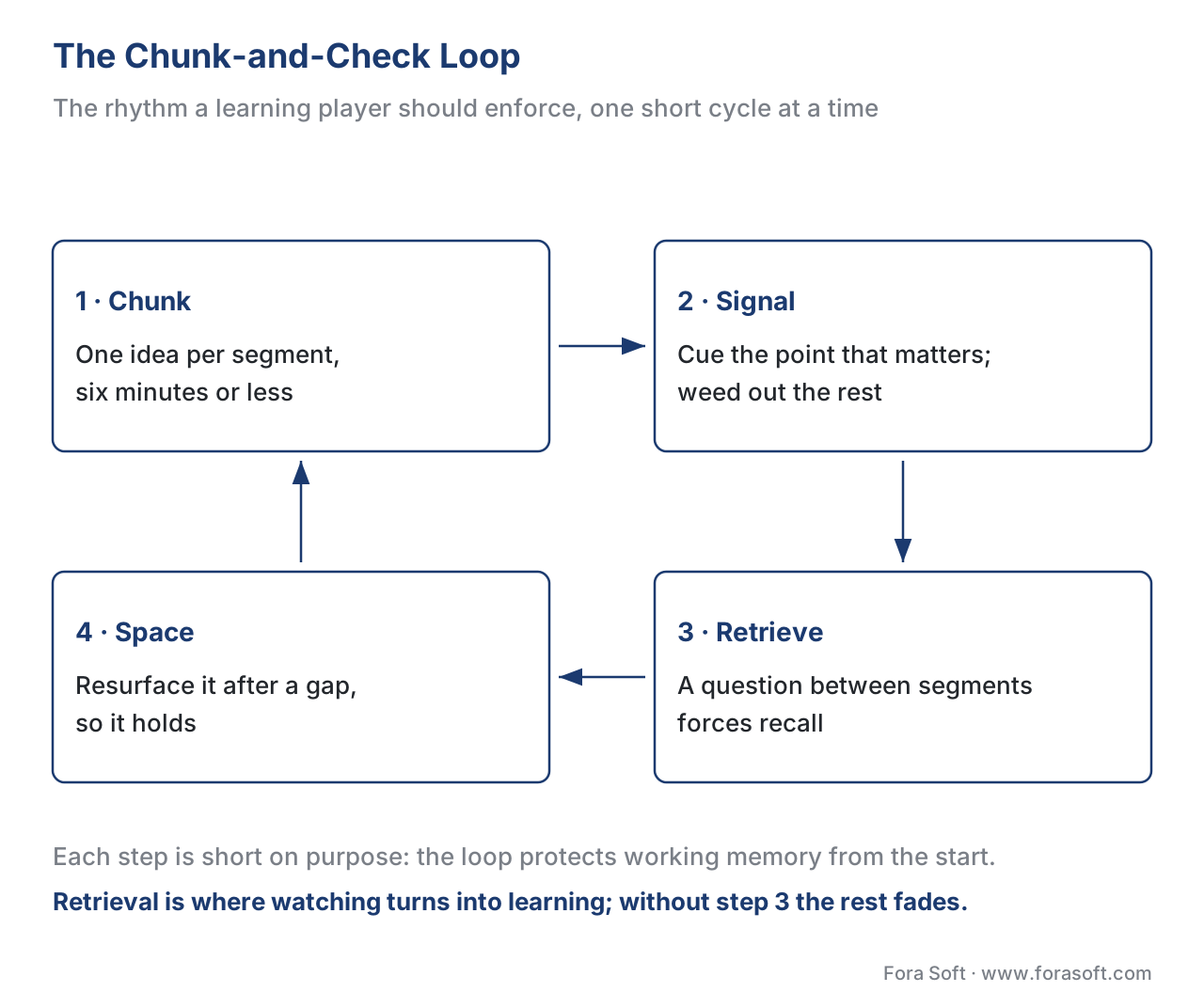 Figure 3. The chunk-and-check loop. Each cycle keeps a segment short, signals what matters, forces a retrieval, then spaces the review — the rhythm a learning player should enforce.
The common mistake: the "talking head wall of video"
The most expensive pedagogical error is also the most common: record the existing classroom lecture end to end, upload it as one long file, and treat the platform as a video host. It fails on every axis at once. The video is too long, so attention dies after six minutes. It is a single block, so there is no segmenting and no place to insert retrieval. It is usually a talking head, so it uses only the verbal channel and wastes the visual one. And because it feels easy to watch, learners leave believing they learned it. Teams then blame "low engagement" and buy analytics to measure a problem that design created. The fix is not a better dashboard; it is shorter clips, complementary visuals, and questions in between — applied before a frame is shot.
Free download: Learning Video Pedagogy Cheat SheetA one-page guide to designing learning video that gets finished and remembered: chunking, signaling, modality, and retrieval, with the product decision each one drives.Where Fora Soft fits in
Fora Soft has built video software since 2005 across e-learning, video conferencing, streaming, OTT, surveillance, and telemedicine — more than 239 shipped projects. The pedagogy in this article is what separates a video player from a learning platform: the chapter-aware player, the in-video quiz layer, the per-segment tracking, and the review scheduling are the features that turn watching into learning. The build-vs-buy conversation we help teams have is rarely "can we stream video" — most tools can. It is "does your player enforce the chunk-and-check loop, and do you build that layer or assemble it." Getting that decision right early is what keeps a course catalog from becoming an expensive archive nobody finishes.
The handbook
Fora Soft Video Engineering Handbook
We wrote a seven-volume series that takes the whole video stack apart across 9,000+ pages — encoding, delivery, audio and AI — so the chapter-aware, quiz-carrying player this article argues for is something you can specify and build rather than shop for. Volume 3 sits closest to the topic: players and chapter navigation, trick play, subtitles, and the delivery economics of a catalog made of six-minute clips. Volume 4 covers the verbal channel that dual coding runs on — narration, loudness, captions and accessibility — and volume 1 explains what a library of short encodes costs to produce and store. Written by Nikolay Sapunov, CEO at Fora Soft.
Does your player enforce the chunk-and-check loop, or just host the files?
Tell us what you teach, how long your current videos run, and what your player already does — and we will come back with what it takes to add chapters and per-segment resume, an in-player quiz layer with xAPI tracking, and scheduled review, plus what each part costs to build. 250+ video products shipped since 2005.
See our case studies
Case study
Scholarly
Sydney's leading selective and scholarship test-prep platform — 15,000+ active users, live classes for up to 2,000 students at once, and video, whiteboard, quizzes, LMS and CRM in one system instead of Zoom plus Discord. It is the right-hand column of this article's table built out: the quiz layer, the on-demand library and the analytics pipeline are one product rather than three tools bolted together.
Case study
BrainCert
The first WebRTC + HTML5 virtual-classroom LMS, built from the architecture up with us and bootstrapped to $3M revenue, 100K+ customers and 500M+ real-time classroom minutes. SCORM/xAPI support, assessments and an analytics dashboard sit inside the platform, which is what per-segment learning data needs to exist at all.
Case study
ALDA
An AI course generator co-designed with 70+ U.S. college educators at institutions serving 500,000+ students a year, now owned by 1EdTech, lifting educator efficiency by 20%. Authoring retrieval practice by hand is the expensive half of this article — ALDA generates the personalized assessments alongside the lectures they test.
What to read next
Formats
Learning Video Formats: Lecture, Microlearning, Interactive, Live Class, Cohort
What chunking turns into once it becomes a production format.
Interactivity
In-Player Quizzes and Polls: Design and Tracking
How the retrieval step gets built, placed, and recorded.
Player
Chaptering, Transcripts, and In-Video Search
The navigation layer that makes a segment findable again later.
Metrics
Completion Rate: Defining, Measuring, and Improving It
The number that moves when the pedagogy is right.
References
- Sweller, J. (1994), "Cognitive load theory, learning difficulty, and instructional design," Learning and Instruction 4(4), 295–312 — origin of intrinsic, extraneous, and germane load and the working-memory limit. https://doi.org/10.1016/0959-4752(94)90003-5 (accessed 2026-06-19). Tier 5 (peer-reviewed).
- Mayer, R. E. (2008), "Applying the science of learning: evidence-based principles for the design of multimedia instruction," and Mayer & Moreno (2003), "Nine ways to reduce cognitive load in multimedia learning," Educational Psychologist 38(1), 43–52 — dual channels, segmenting, signaling, modality, personalization, redundancy. https://doi.org/10.1207/S15326985EP3801_6 (accessed 2026-06-19). Tier 5 (peer-reviewed).
- Guo, P. J., Kim, J., & Rubin, R. (2014), "How video production affects student engagement: an empirical study of MOOC videos," ACM Conference on Learning @ Scale (L@S '14), 41–50 — 6.9M sessions; median engagement maxes at ~6 minutes; falls to ~50% at 9–12 min and ~20% at 12–40 min. https://doi.org/10.1145/2556325.2566239 (accessed 2026-06-19). Tier 5 (peer-reviewed).
- Risko, E. F., Anderson, N., Sarwal, A., Engelhardt, M., & Kingstone, A. (2012), "Everyday attention: variation in mind wandering and memory in a lecture," Applied Cognitive Psychology 26(2), 234–242 — mind-wandering rises and retention falls across a long lecture. https://doi.org/10.1002/acp.1814 (accessed 2026-06-19). Tier 5 (peer-reviewed).
- Rey, G. D., et al. (2019), "A meta-analysis of the segmenting effect," Educational Psychology Review 31, 389–419 — 56 studies, 88 comparisons; small-to-medium benefit for retention and transfer; reduced cognitive load. https://doi.org/10.1007/s10648-018-9456-4 (accessed 2026-06-19). Tier 5 (peer-reviewed).
- Brame, C. J. (2016), "Effective educational videos: principles and guidelines for maximizing student learning from video content," CBE—Life Sciences Education 15(4), es6 — synthesis of cognitive load, engagement, and active learning for video; signaling, segmenting, weeding, modality. https://doi.org/10.1187/cbe.16-03-0125 (accessed 2026-06-19). Tier 5 (peer-reviewed, open access).
- Bjork, R. A., Dunlosky, J., & Kornell, N. (2013), "Self-regulated learning: beliefs, techniques, and illusions," Annual Review of Psychology 64, 417–444 — learners overestimate learning from easy-feeling media; illusions of competence. https://doi.org/10.1146/annurev-psych-113011-143823 (accessed 2026-06-19). Tier 5 (peer-reviewed).
- Roediger, H. L., & Karpicke, J. D. (2006), "The power of testing memory: basic research and implications for educational practice," Perspectives on Psychological Science 1(3), 181–210 — the testing effect; spaced retrieval beats restudy for long-term retention. https://doi.org/10.1111/j.1745-6916.2006.00012.x (accessed 2026-06-19). Tier 5 (peer-reviewed).
- Szpunar, K. K., Khan, N. Y., & Schacter, D. L. (2013), "Interpolated memory tests reduce mind wandering and improve learning of online lectures," PNAS 110(16), 6313–6317 — questions between ~5-min segments improve learning and cut mind-wandering. https://doi.org/10.1073/pnas.1221764110 (accessed 2026-06-19). Tier 5 (peer-reviewed).
- ADL / xAPI community, "xAPI Video Profile" — standardized verbs and extensions for tracking played, paused, seeked, and completed video events; the standard for capturing per-segment interaction data. https://github.com/adlnet/xAPI-Video-Profile (accessed 2026-06-19). Tier 1 (standards body).
Per the source hierarchy, this is a research-grounded article: the pedagogy rests on peer-reviewed cognitive-science and education studies (tier 5), with the one standards claim — how per-segment video interactions are tracked — cited to the ADL xAPI Video Profile (tier 1). Where popular "video tips" listicles assert round numbers without evidence, this article follows the primary studies and gives the measured effect.
