


Why This Matters
Every product manager building a streaming product in 2026 hits the same conversation at some point: "Why does this work on the laptop but not on the customer's TV?" or "Why is our French traffic lighter than market data predicts?" The answer is usually the same — somewhere in the delivery chain, IPv6 is half-supported. The CDN serves both families but the origin only listens on IPv4; the signed-URL token normalises to the IPv4 form so the IPv6 client gets a 403; the WebRTC SFU advertises only IPv4 ICE candidates and a mobile viewer on an IPv6-only network fails to connect. None of these failures look catastrophic on their own, but together they are the difference between a stream that "works on most networks" and one that ships to the world.
What Changed in 2026 — the numbers that matter
The big number is 50.10% IPv6 capability measured by Google's user-facing probe on 28 March 2026 — the first day the global average crossed parity (Google IPv6 Statistics, March 2026). The line did not stay above 50%, but the milestone reset the planning baseline: a 2026 product that treats IPv6 as a minority case is mis-calibrating the audience.
Three measurements anchor the same picture. APNIC Labs — advertising-tag probes — measured 43.13% global IPv6 capability in April 2026. Cloudflare Radar — HTTP requests observed at the Cloudflare edge — recorded 40.1% over IPv6 in April 2026. The methodologies disagree by ~10 points because they count different things, but the order of magnitude is the same: four to five out of every ten requests to a modern streaming endpoint arrive over IPv6.
Regional adoption is uneven and that unevenness matters more than the global average. France reached 86% IPv6 capability in February 2026. India sits around 72%, Germany 71%, Vietnam and Belgium around 60%, the United States around 53%. A streaming product whose long tail of viewers concentrates in any of those high-IPv6 countries will see >70% of its traffic arrive on IPv6 even though the global average is closer to 45%. Markets calibrate to themselves, not to a global mean.
The other 2026-specific shift is mobile carrier networks moving IPv6-only. Major US carriers (T-Mobile, Verizon, AT&T) have run IPv6-only on the mobile data path since 2014–2016, but mobile traffic now dominates streaming demand in a way it did not when those networks first cut over. On these networks the device gets an IPv6 address only; an IPv4-only destination is reached through NAT64 in the carrier and 464XLAT on the client (RFC 6877, April 2013), which works for HTTP-based streaming but is a known source of subtle failures for WebRTC and for any protocol that embeds an IPv4 literal in a payload.
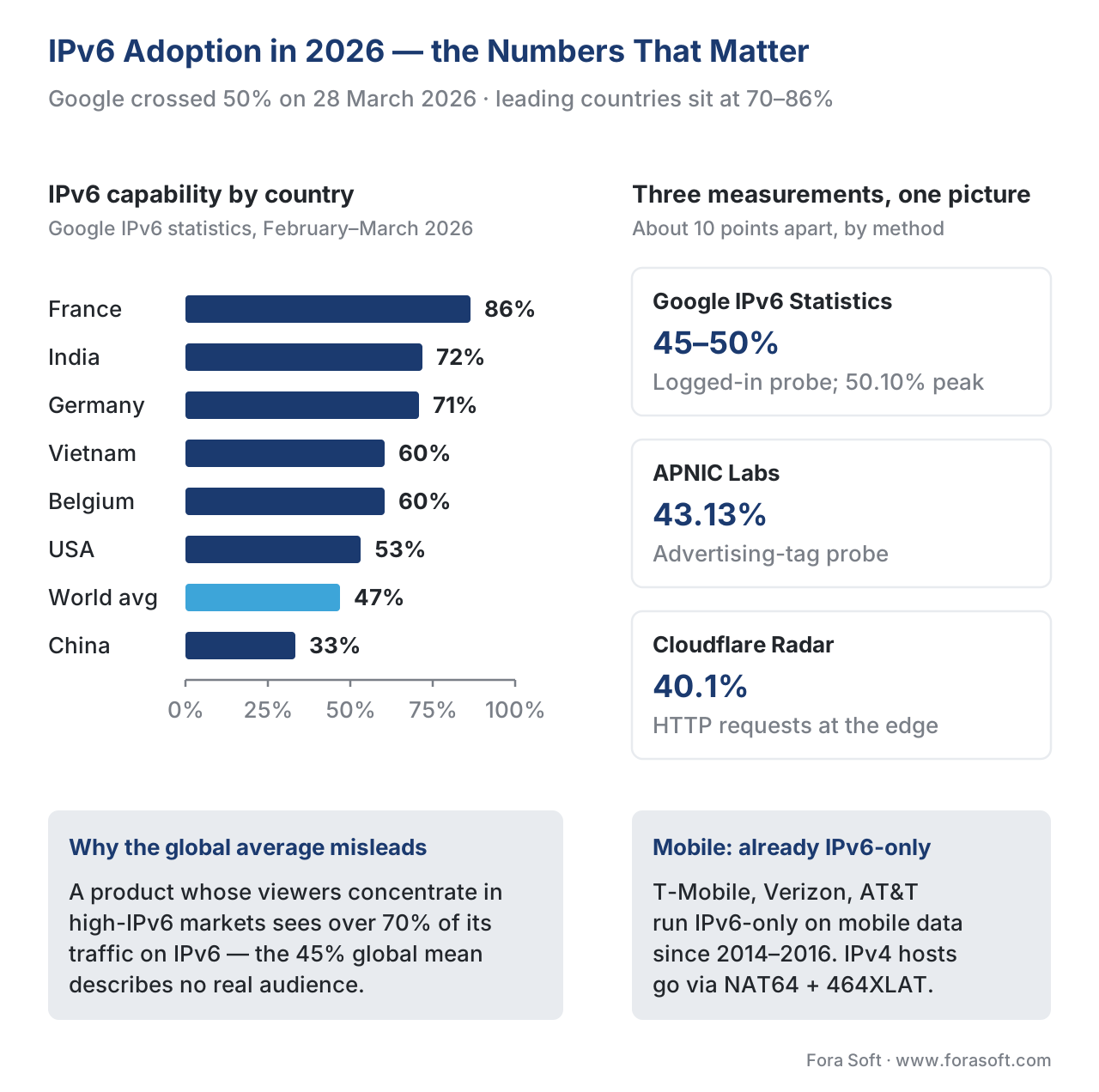 Figure 1. IPv6 adoption in 2026 — Google's user-facing probe crossed 50% on 28 March 2026 and the leading countries sit at 70–86%. The three industry measurements disagree by ~10 points because they count different things, but all three show IPv6 carrying 40–50% of streaming-relevant traffic.
Dual-stack — what it actually means in a streaming pipeline
A dual-stack host runs IPv4 and IPv6 in parallel: it listens on both and speaks to either family. In streaming, dual-stack lives at four layers and you must enable every layer or the chain breaks at its weakest link.
Layer one — DNS. Your authoritative DNS server publishes an A record (IPv4) and an AAAA record (IPv6) for every host the player resolves: origin, CDN edge, signalling, TURN. Missing AAAA records are the single most common dual-stack omission; without them, the player picks IPv4 because IPv6 was never advertised.
Layer two — the CDN edge. Every major CDN (Cloudflare, Akamai, Fastly, CloudFront, Bunny, Google Cloud CDN) serves dual-stack by default but the property still has to opt in. The edge talks to the client over whichever family wins the Happy Eyeballs race.
Layer three — the origin pull. The CDN's pull from origin is a separate choice. CloudFront, Cloudflare, and Fastly support IPv6-to-origin; many custom origins still listen on IPv4 only and force the CDN through an unnecessary IPv4 NAT mapping. If the CDN supports it, enable IPv6 on the origin pull.
Layer four — WebRTC ICE candidates. Every WebRTC media server (mediasoup, Janus, LiveKit, Pion-based SFUs) must advertise both IPv4 and IPv6 host candidates in the SDP, plus IPv6 reflexive candidates from a dual-stack STUN server. Without them, an IPv6-only mobile client has to traverse the carrier's NAT64 to reach the SFU — which for UDP-on-NAT64 fails roughly 5–15% of the time.
Happy Eyeballs — the algorithm that hides the mess
When a dual-stack client connects to a dual-stack server, it runs Happy Eyeballs — an algorithm standardised in RFC 8305 (December 2017, version 2) and currently being updated as draft-ietf-happy-happyeyeballs-v3.
The mechanics in one paragraph. The client resolves AAAA and A records in parallel, starts the IPv6 TCP attempt as soon as the IPv6 address arrives, waits 250 ms (the "Happy Eyeballs Delay"), then starts an IPv4 attempt in parallel. Whichever handshake completes first wins; the loser is abandoned. The 250 ms is small enough to be invisible on a working IPv6 path and large enough to mask a slow path. Modern browsers, curl, Node.js, Python asyncio, Go's net package, and most native mobile stacks ship it by default.
The practical implication is reassuring: you do not choose between IPv4 and IPv6 for the client — the client chooses, picks the faster path, and silently fails over if one family is broken. Your job is to make sure both families actually work. Broken AAAA records, blackholed IPv6 routes, or IPv6-listening servers that quietly drop packets all defeat Happy Eyeballs in ways that surface as "intermittent slow loads" in dashboards.
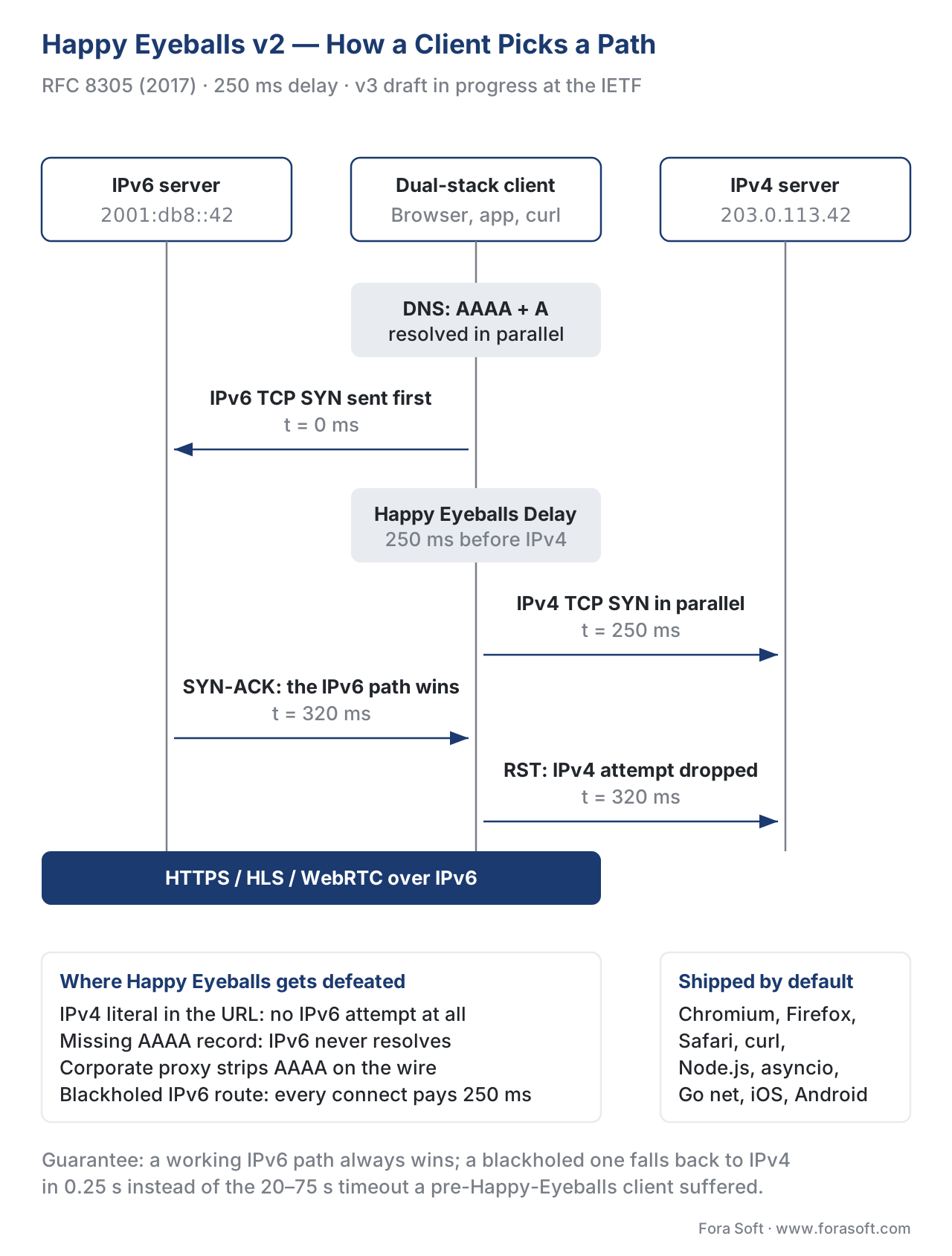 Figure 2. Happy Eyeballs v2 in action. The 250 ms delay between the IPv6 and IPv4 connection attempts is the entire mechanism — it is small enough that working IPv6 paths always win, and large enough that broken IPv6 paths fail over to IPv4 in a quarter of a second rather than the 20–75 seconds a pre-Happy-Eyeballs client would have waited.
Where IPv6 actually breaks in 2026
Four classes of failure still recur.
Older smart TVs. Roku enabled limited IPv6 support in RokuOS 12.0.0-4178 (mid-2024) but rollout has been uneven. Samsung Tizen builds have shipped with IPv6 disabled by default through several generations; OSN+ publishes a documented workaround telling viewers to disable IPv6 on the TV to fix buffering. Vidaa and older webOS behave similarly. Keep IPv4 paths first-class indefinitely for the TV audience.
Corporate networks and proxies. Many enterprise networks deploy outbound HTTP proxies that strip AAAA records or listen on IPv4 only. The device tries IPv6 first per Happy Eyeballs, hits a black hole, falls back to IPv4 after 250 ms — every connection pays the penalty, visible in startup time on low-latency live streams.
Signed URLs and IP-bound tokens. Token systems that bind to the client's IP have to handle both 203.0.113.42 and 2001:db8::42 consistently. A common bug binds on whichever family hit the auth endpoint first, then rejects when the player's CDN request arrives over the other family. Bind to the session, not the IP; or normalise to a /64 IPv6 prefix and a /24 IPv4 prefix.
WebRTC on IPv6-only mobile. An IPv4-only media server forces IPv6-only clients through carrier NAT64; UDP-on-NAT64 fails 5–15% of the time depending on the carrier. Dual-stack the SFU and STUN/TURN servers and list both families in every candidate pool.
The math out loud. Take a streaming product with one million monthly viewers, India-heavy, where ~30% of traffic arrives from IPv6-only mobile networks. With an IPv4-only SFU and a 10% NAT64 failure rate: 1,000,000 × 30% × 10% = 30,000 failed sessions per month. Dual-stacking the SFU recovers all of them at the cost of one configuration change.
Common pitfalls
Pitfall 1: treating "the CDN serves IPv6" as enough. The CDN is the easy part. Your origin, signed-URL service, TURN server, DNS authority, and analytics endpoint all need AAAA records and dual-stack sockets. Run dig AAAA against every host in the player's network waterfall before calling IPv6 done.
Pitfall 2: testing IPv6 only from your office network. Your office probably has clean IPv6; your viewers' networks vary wildly. Use a public IPv6 probe (Test-IPv6.com, an ISC checker, or a synthetic monitor) from at least four geographies that match your traffic.
Pitfall 3: hard-coding IPv4 literals into manifests, ad tags, or beacon URLs. A manifest that embeds http://203.0.113.42/segment-001.ts defeats Happy Eyeballs — the client cannot try IPv6 because the URL never asked for it. Always use hostnames. The same trap exists in VAST ad responses from older ad servers.
Pitfall 4: forgetting the data-channel path for WebRTC. WebRTC media is UDP, which traverses NAT64 imperfectly; data channels run SCTP-over-DTLS-over-UDP, which traverses it worse. Dual-stacking the SFU eliminates the class entirely.
Pitfall 5: disabling IPv6 on your servers because "it's flaky". A tempting fix that quietly drops your IPv6 audience. Investigate the cause, fix the configuration; do not amputate the address family.
Free download: IPv6 Dual-Stack Readiness ChecklistA one-page audit of DNS records, CDN settings, origin pull, signed-URL handling and WebRTC ICE candidates for a 2026 streaming pipeline.Where Fora Soft Fits In
Fora Soft has built video streaming, WebRTC, conferencing, OTT, telemedicine, e-learning, surveillance, and AR/VR software since 2005, with 239+ shipped projects. IPv6 readiness is the kind of work that never shows up in a marketing pitch and always shows up in an operations review: dual-stack TURN clusters for telemedicine clients whose patient base sits behind mobile carrier NAT64; AAAA-aware DNS health checks for OTT clients shipping into IPv6-heavy European markets. We ship products with both address families enabled end to end and instrumented per-family, so a degradation on either path surfaces in the dashboard rather than in a customer email. Our streaming software development team builds dual-stack delivery into new platforms, and our performance troubleshooting service finds the per-family failures in platforms already live.

The book
Video Streaming: A Complete Guide to Video Delivery: From Network Protocols and Transport to Ingest, HLS, and MPEG-DASH
This article settles one question about the network layer: which address family your pipeline speaks. Book 2 carries the same thread through the rest of the transport story — what the network does to a stream, TCP against UDP, congestion control, QUIC and HTTP/3, NAT traversal, and the ingest protocols that push contribution feeds across the same dual-stack paths. If you are auditing a delivery chain hop by hop, it is the volume that explains what each hop is doing and what it costs when it is configured for one family only. Written by Nikolay Sapunov, CEO at Fora Soft.
Is your delivery chain dual-stack end to end?
Send us the host list your player touches — DNS authority, CDN edge, origin, signalling, STUN and TURN — and we will tell you which hops are missing AAAA records, which ones answer on IPv6 but drop packets, and what both cost you in failed sessions per month. 250+ video products shipped since 2005.
See our case studies
Case study
Worldcast Live
0.4–0.5 s glass-to-glass for 10,000 concurrent viewers at 1.5 Gb/s — the scale at which one IPv4-only hop stops looking like a config detail and starts looking like a missing region.
Case study
TransLinguist
WebRTC interpreting on mediasoup for a marketplace of 30,000+ certified interpreters in 75+ languages, won on an NHS national framework — a candidate pool that has to carry both address families for callers on carrier networks.
Case study
Sprii
Danish live shopping with €365M+ in cumulative sales and 72K+ live events, hosted and watched mostly from phones — exactly the mobile-first traffic that arrives IPv6-only through carrier NAT64.
What to read next
Transport
TCP, UDP, and the Choice Every Streaming Protocol Must Make
The layer directly above IP: what each transport costs once the address family is settled.
WebRTC
NAT, Firewalls, STUN, TURN, ICE
Why an IPv4-only SFU pushes IPv6-only phones through carrier NAT64, and how to stop it.
Network
Bandwidth, Throughput, Jitter, Packet Loss
What the path does to a stream once the address family stops being the problem.
Transport
QUIC: The New Transport Layer
The transport that rides on either family and rebuilds connection setup around it.
References
- Google IPv6 Statistics, accessed 2026-05-20. The user-facing measurement of IPv6 capability across Google's logged-in traffic; recorded 50.10% on 28 March 2026 and a per-country breakdown showing France at 86%, India at 72%, Germany at 71%. <https://www.google.com/intl/en/ipv6/statistics.html>
- APNIC Labs IPv6 Capability Measurement, April 2026 snapshot. Advertising-tag-based measurement of IPv6 capability, recorded 43.13% globally. <https://stats.labs.apnic.net/ipv6>
- Cloudflare Radar — IPv6 adoption, April 2026 snapshot. HTTP-request-based measurement at the Cloudflare edge, recorded 40.1% of requests over IPv6. <https://radar.cloudflare.com/adoption-and-usage>
- IETF RFC 8305, Happy Eyeballs Version 2: Better Connectivity Using Concurrency, D. Schinazi, T. Pauly, December 2017. The controlling specification for the dual-stack connection algorithm used by every modern browser and runtime. <https://datatracker.ietf.org/doc/html/rfc8305>
- draft-ietf-happy-happyeyeballs-v3, Happy Eyeballs Version 3: Better Connectivity Using Concurrency, work-in-progress at the IETF Happy WG, 2025–2026. Subject to change before RFC publication; tightens delay parameters and adds QUIC race handling. <https://datatracker.ietf.org/doc/draft-ietf-happy-happyeyeballs-v3/>
- IETF RFC 6877, 464XLAT: Combination of Stateful and Stateless Translation, M. Mawatari, M. Kawashima, C. Byrne, April 2013. The IPv6-only mobile-network architecture that translates IPv4 traffic from IPv6-only clients via in-network NAT64 and on-device CLAT. <https://datatracker.ietf.org/doc/html/rfc6877>
- IETF RFC 6147, DNS64: DNS Extensions for Network Address Translation from IPv6 Clients to IPv4 Servers, M. Bagnulo, A. Sullivan, P. Matthews, I. van Beijnum, April 2011. The DNS-side companion to NAT64 that synthesises AAAA records for IPv4-only destinations. <https://datatracker.ietf.org/doc/html/rfc6147>
- IETF RFC 6052, IPv6 Addressing of IPv4/IPv6 Translators, C. Bao et al., October 2010. The address-synthesis rules used by NAT64 and 464XLAT to embed IPv4 addresses inside IPv6 prefixes. <https://datatracker.ietf.org/doc/html/rfc6052>
- IETF RFC 8925, IPv6-Only Preferred Option for DHCPv4, L. Colitti, J. Linkova, M. Richardson, T. Mrugalski, October 2020. The DHCPv4 option through which a dual-stack-capable host signals it would prefer IPv6-only operation. <https://datatracker.ietf.org/doc/html/rfc8925>
- APNIC Blog — "Google hits 50% IPv6", April 2026. Industry analysis of the 28 March 2026 milestone, including the methodology distinction between Google's logged-in probe and APNIC Labs' ad-based probe. <https://blog.apnic.net/2026/04/28/google-hits-50-ipv6/>
- Internet Society Pulse — "18 Years Later, IPv6 Reaches Majority", April 2026. Independent commentary on the 2026 IPv6 milestone and the per-country adoption picture. <https://pulse.internetsociety.org/en/blog/2026/04/18-years-later-ipv6-reaches-majority/>
- AWS Kinesis Video Streams — IPv6/Dual-Stack endpoints for WebRTC. First-party documentation for dual-stack signalling and media endpoints in a major streaming-platform vendor's WebRTC service. <https://docs.aws.amazon.com/kinesisvideostreams-webrtc-dg/latest/devguide/kvswebrtc-ipv6.html>
Per §4.3.2, the article follows the controlling IETF specifications on every protocol claim; where vendor blogs describe IPv6 deployment behaviours that diverge from the RFC text, the article follows the RFC and notes the divergence. The Internet-Draft (Happy Eyeballs v3) is flagged as subject to change before RFC publication.
