


Why This Matters
If your business sells premium video — a live sports right, an early-window movie, a pay-per-view concert, a 4K Ultra HD title, a corporate training library, a telemedicine consultation recording — forensic watermarking is the single anti-piracy control that turns "DRM was bypassed somewhere" into "subscriber #4,471,002 is the leak, cut the account and serve the cease-and-desist". DRM stops casual copying; watermarking attributes the leak when DRM is bypassed. Without watermarking, a studio's 4K release on a hundred pirate sites is an unsolvable mystery; with watermarking, the same release is a list of compromised accounts ready for termination. That is why the MovieLabs Enhanced Content Protection (ECP) specification — the document studios use to gate 4K Ultra HD release windows — has required forensic watermarking since version 1.0, and why every operator chasing UEFA Champions League, Premier League, NFL, NBA, IPL, or Hollywood early-window rights treats it as table stakes, not as a nice-to-have.
This article is the eighth piece of the nine-article Block 9 (Operations, DRM, Ads, and QoE) inside Fora Soft's Video Streaming Learn corpus. Read it after DRM 101: why three systems and why you ship all three and Common Encryption (CENC) in depth — the encryption layer that watermarking complements, not replaces. A product manager will leave knowing why "we already have Widevine, we don't need watermarking" is wrong, what an "A/B variant" actually is, how detection times of under five minutes are physically possible, and what a watermarking vendor is selling that a CDN already provides. An engineer will leave with the DASH-IF/ETSI A/B integration model, the per-segment storage and cache math, the WMPaceInfo structure, the three insertion points (mezzanine, edge, client), the 2026 vendor landscape (NAGRA NexGuard, Synamedia ContentArmor, Verimatrix, Friend MTS ASiD, Irdeto TraceMark, Stegawave, DoveRunner / PallyCon, BuyDRM, ExpressPlay), and the five production traps (cache poisoning, transmuxer dropping the mark, robust-against-screen-capture claims, false-positive extraction, GDPR personal-data status of session IDs) that will block launch the week before launch.
What Forensic Watermarking Actually Is
Before the protocols, the vocabulary. A forensic watermark is an invisible modification of the video signal that carries a payload — a short binary string — and survives derivative operations an attacker is likely to apply. The three words in bold matter and define the design space.
Invisible means the modification is below the threshold of human perception under normal viewing conditions. The signal is still encoded as H.264, HEVC, or AV1; the bits change, but the picture you see does not. This is the property that separates a forensic watermark from a visible watermark — the burned-in subscriber email a corporate training platform sometimes overlays — and from a fingerprint, which is a hash of the unmodified content used to recognise it later. Fingerprinting answers "is this our content?"; watermarking answers "whose copy is this?". Live-piracy operations run them in a closed loop: a fingerprint-driven monitor finds an illegal stream on a forum, the watermark extractor reads the session ID, the operator kills the subscriber's playback session, and the pirate stream goes dark. The two techniques are complementary, not interchangeable, and a serious deployment ships both.
Payload means the watermark carries information. The information is usually a session ID — a number that the operator's session-management database maps to a single subscriber, device, IP, and timestamp. Typical payloads in 2026 OTT deployments are 32 to 64 bits, large enough to cover every active subscriber a streaming platform has ever signed up (a 32-bit payload covers 4.3 billion sessions; a 64-bit payload covers 18 quintillion) and small enough to be embedded reliably in a few seconds of video. Some studios require a larger payload that includes a title identifier, a quality tier, and a geographic region — pushing the bit count toward 80 or 96 bits with a forward-error-correction overhead — but the dominant deployment shape is "session ID plus checksum, embedded in the first 30 to 60 seconds of playback".
Survives derivative operations means the mark must still be readable after the attacker has done what attackers do: re-encoded the video with a different codec at a different bitrate, downscaled it from 1080p to 720p, cropped the borders, added a logo overlay, point-recorded the screen with a phone camera (analogue capture, the cam-cord attack), uploaded the result to YouTube and let YouTube re-encode it again. The number you see in marketing material — "robust against transcoding", "survives cam-cord", "survives 50% downscaling" — is a claim about the watermark algorithm's robustness curve, and it is the most commonly inflated number in the entire content-protection industry. Independent testing by NorthRow, Intertrust's whitepapers, and the SVTA OTT Streaming Threat Model show robustness varies widely between vendors and content types; the conservative assumption is that any modern A/B variant scheme survives standard CDN transcoding and HLS-to-DASH repackaging, most survive 1080p-to-720p downscaling, and only the pixel-level psychovisual schemes from NAGRA, Verimatrix, and Irdeto reliably survive an iPhone camera pointing at a TV screen.
 Figure 1. The closed loop. Fingerprinting and watermarking are run together: the first answers "where is the leak happening on the open web?", the second answers "which of my subscribers is leaking?". Either alone is a partial solution; the pair is the production stack.
The DRM Question: Why Encryption Is Not Enough
Every product manager who hears about watermarking for the first time asks the same question: "we already pay Widevine, FairPlay, and PlayReady — why do we need a fourth thing?" The answer is in two arithmetic steps.
Step one: assume Widevine or FairPlay or PlayReady is implemented correctly and the device is uncompromised. The encrypted segments travel from origin to player, the player hands them to the Content Decryption Module (CDM), the CDM decrypts and decodes, and the decoded frames go to the screen. Encryption stops everyone in the middle from reading the content — the CDN operator, the ISP, the network sniffer, the local-attacker-on-the-Wi-Fi. So far so good.
Step two: assume the device is compromised, or the human is. A jailbroken Android with a software CDM downgrades from Widevine L1 to L3 and lets the attacker dump decoded frames. A Mac OS Safari session with FairPlay leaks via a screen recorder run as a privileged process. A legitimate subscriber points a phone at a TV and records the screen — no software break, no DRM bypass, just optics. A "premium reseller" pays for a hundred legitimate accounts and re-streams them all through a pirate IPTV service. In every one of these scenarios, DRM did exactly what it was supposed to do — and the content still leaked. The leak is downstream of decryption, and encryption has no answer for it.
This is the gap watermarking fills. The watermark is embedded before encryption or after decryption, depending on the architecture — and the mark survives the very operations DRM does not protect against (analogue capture, frame-grab dumping, post-decode re-encoding). When the pirate stream appears on a forum, the operator's extractor reads the mark, and the leak is attributed. The mark cannot prevent a leak from happening; it makes the leak attributable, which is the single property that turns a piracy problem from a mystery into a list of names.
This is why MovieLabs ECP, the studio-side gating spec for 4K Ultra HD release windows, has required server-and/or-client-side forensic watermarking since version 1.0 in 2013, and why every premium-content rights owner — Hollywood studios, UEFA, NFL, Premier League, Disney, Sony, Warner, Netflix, Amazon Prime — writes watermarking into the rights agreement as a hard requirement. ECP version 1.3, the current revision in 2026, names watermarking alongside DRM, hardware root of trust, and output-link protection as the four pillars of premium content protection. Drop any one of the four and the rights expire.
A/B Variant Watermarking: How It Actually Works
The dominant production technique in 2026 is server-side A/B variant watermarking, standardised by the DASH Industry Forum (DASH-IF) and republished by ETSI as a Publicly Available Specification (PAS) — ETSI TS 104 002 V1.1.1, August 2023. The DASH-IF Content Protection and Security Task Force, including engineers from Nagravision, Synamedia, Irdeto, AWS Elemental, and Unified Streaming, spent four years standardising the integration points before the spec went public. Every major A/B vendor — NAGRA NexGuard, Synamedia ContentArmor, Friend MTS ASiD, Verimatrix, Irdeto TraceMark, DoveRunner (formerly PallyCon) — now claims compliance with the DASH-IF/ETSI integration model.
The mechanism, stripped to its essentials, is in four moves.
Move one — pre-build two variants per segment. The packager takes the encoded mezzanine and produces, for every segment of the stream, two near-identical copies: variant A and variant B. The two variants are visually indistinguishable to a human viewer because the watermarking algorithm modifies the video signal below the threshold of human perception — typically in a perceptually-shaped frequency band, or by toggling a small set of macroblock coefficients the eye cannot resolve. The two variants are not, however, identical at the bit level; an extractor with the right key can tell them apart. The variants are encrypted under CENC (the same Common Encryption you use for DRM) and uploaded to the origin alongside (and instead of) the single set of segments a non-watermarked pipeline would produce. Storage roughly doubles, with caveats on lower-bitrate rungs that I will come back to.
Move two — assign each session a payload. When a subscriber starts a playback session, the operator's session-manager generates a unique payload — a 32- or 64-bit number that the database maps to (subscriber, device, IP, timestamp, title). The payload's binary representation is the watermark: bit 0 is "0", bit 1 is "1", bit 2 is "0", and so on. Every "0" bit means "this segment should be the A variant for this session"; every "1" bit means "this segment should be the B variant". The mapping between bit position and segment index is recorded in the DASH-IF-defined WMPaceInfo structure, which the CDN's watermarking agent reads to know which variant to serve.
Move three — at the CDN edge, pick the variant. When the player asks for segment N, the CDN's watermarking agent looks at the session's payload, finds bit N (or bit N modulo payload-length, if the payload is shorter than the stream), and serves variant A or variant B accordingly. The player has no idea this is happening — it asks for segment-00042.m4s, the edge returns either the A copy or the B copy under that same URL, the player decrypts under the session's content key, and playback continues. There is no extra client SDK, no extra signalling, no per-device code: the entire mechanism lives in the network. This is the property that makes server-side A/B watermarking the right default for CTV, smart TV, and game console deployments — where shipping a client SDK across Tizen, webOS, Roku BrightScript, Vidaa, Comcast Flex, Apple TV, Xbox, and PlayStation is an integration project in itself.
Move four — extract the mark from a leaked stream. When a pirate copy surfaces, the operator (or its watermarking vendor) feeds the stream into an extractor. The extractor walks the video, compares each segment against both variants — A and B — under the algorithm's detection function, and emits a bit. The accumulated bit sequence is the payload. The session-manager database is queried with the payload and the leaking subscriber is identified. The whole pipeline, end to end, runs in five minutes or less in modern deployments: Synamedia's NAB 2026 Edge Watermarking launch claimed under five minutes from leak detection to subscriber identification, half what it was twelve months earlier; Friend MTS regularly publishes detection times in the two-to-eight minute range on live Premier League and UEFA Champions League feeds.
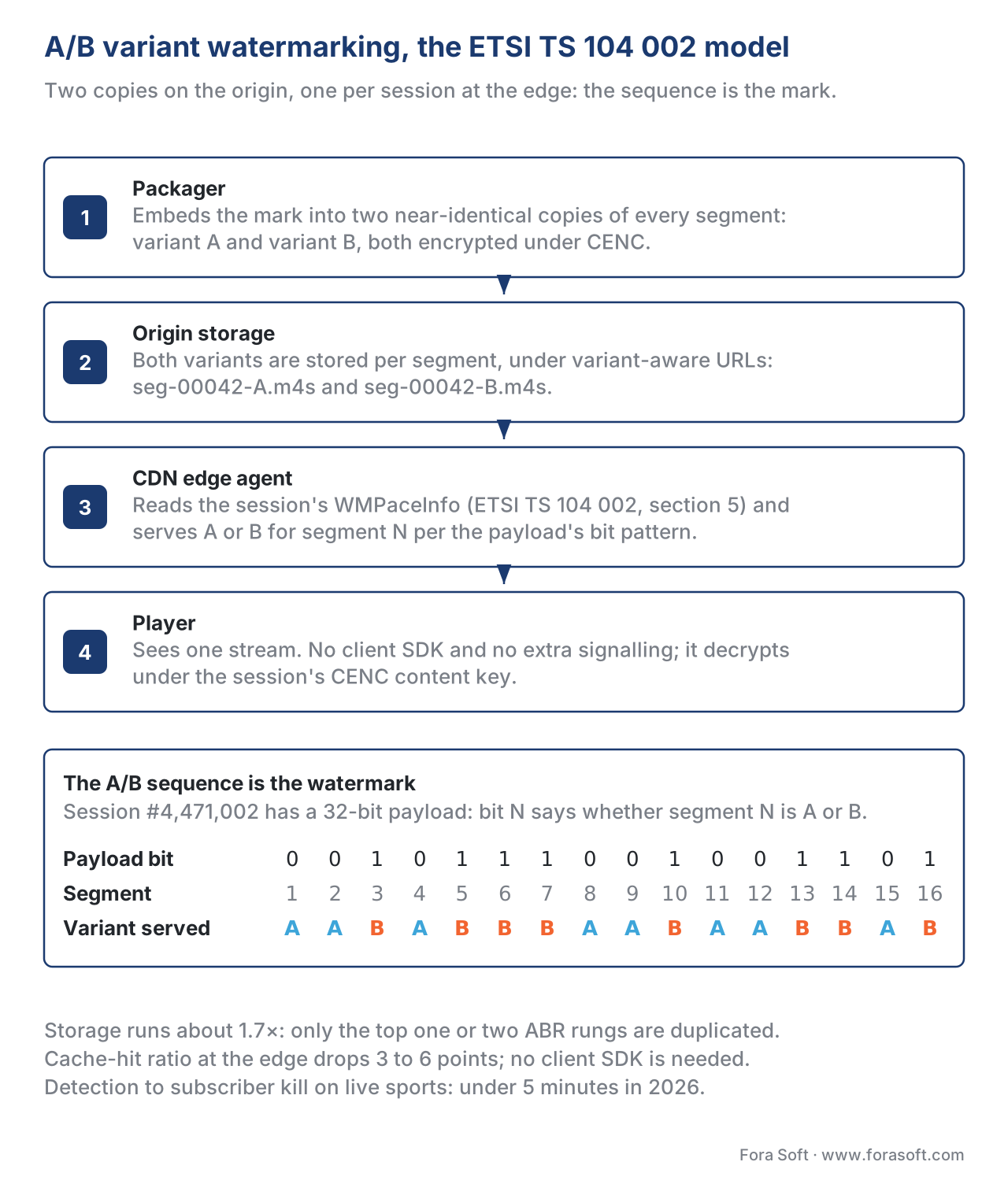 Figure 2. The four-move A/B variant pipeline. Two copies on the origin; one copy per session at the edge; extraction reverses the mapping. The standardised integration points are the WMPaceInfo structure and the CENC-encrypted variant manifest — both defined in ETSI TS 104 002.
The Arithmetic: Storage, Payload Length, and Detection Time
The numbers behind A/B watermarking are small and stubborn, and every operator needs to do them once before signing a contract.
Payload-length math. N bits of payload give 2^N uniquely traceable sessions. Twenty bits give 1.05 million; thirty bits give 1.07 billion; thirty-two bits give 4.29 billion; forty bits give 1.10 trillion; sixty-four bits give 1.84 × 10^19. A streaming platform with five million concurrent sessions and a billion lifetime subscribers is fine on thirty-two bits and comfortable on forty. The argument for sixty-four bits is not session count; it is including title identifier, quality tier, and region into the payload directly, so a single extraction tells you not only who leaked but what they leaked and where. Premium-sports operators with two thousand simultaneous events do bake the event ID into the payload; subscription-VOD operators with one library across a million sessions usually do not.
Embedding-time math. With two-second segments and a one-bit-per-segment density, embedding thirty-two bits requires sixty-four seconds of playback — bit zero from segment one, bit one from segment two, and so on, with each bit duplicated for forward-error-correction. With one-second segments the same payload needs thirty-two seconds. With four-second segments (the LL-HLS default), it needs two minutes eight seconds. Most extractors require the full payload plus an ECC margin, so the extractable "minimum continuous capture" is roughly payload bits × segment seconds × 1.5. Sixty-four bits at two-second segments needs about three minutes twelve seconds. This is the lower bound on a successful extraction — a pirate clip shorter than that cannot be attributed.
Storage math. Pre-building two variants doubles segment storage at the origin. For a 4K HDR title encoded across an eight-rung ABR ladder, a two-hour movie is roughly 25 GB; two copies are 50 GB. For a live channel with 24-hour DVR, the per-channel origin storage roughly doubles too. The actual storage multiplier in production is usually 1.7×, not 2.0×, because operators ship two variants only on the top one or two ABR rungs (where premium piracy actually surfaces) and a single copy on the lower rungs (where mobile and emergency playback live). The 2026 NAGRA NexGuard on AWS deployment guide describes exactly this rung selection as the recommended pattern.
Cache-hit-ratio math. Two variants double the unique URLs in the cache. A CDN that previously served segment-00042.m4s to ten thousand viewers from one cache entry now serves either segment-00042-A.m4s or segment-00042-B.m4s, and the cache holds two entries instead of one. Cache-hit ratio at the edge tier drops; cache-fill traffic from the shield tier roughly doubles. In practice, with origin-shield architecture and tiered caching (see our origin-shield deep dive), the effective hit-ratio drop is three to six percentage points — a real cost, but not a deal-breaker. The DASH-IF interop document recommends content-steering with variant-aware shields to keep the impact below five percentage points.
Detection-time math. Detection time is the wall-clock from "pirate stream visible" to "subscriber identified". It decomposes into: fingerprinting-driven discovery (the monitoring service finds the pirate stream — typically thirty seconds to two minutes for well-known forums); capture (the monitor downloads a buffer of the pirate stream — thirty to ninety seconds to fill the bit-budget); extraction (the algorithm reads the bits — fifteen seconds to two minutes); database lookup (the session-manager query — under one second); and enforcement (the operator's API revokes the subscriber's token). End-to-end, mature 2026 deployments come in under five minutes for live sports and under two minutes for the heaviest fingerprinting-plus-extraction stacks. That is the line that determines whether the leaking subscriber is cut during the first half of a Champions League quarter-final or only after the match has ended — which is the difference between a working anti-piracy programme and a forensic-archaeology service.
Insertion Points: Mezzanine, Packager, Edge, Client
A watermark can live at any of four points in the pipeline, and the choice matters more than vendors usually admit.
Mezzanine watermarking embeds the mark in the high-bitrate mezzanine file the encoder produces, before ABR transcoding. This is the most robust placement — the mark survives every downstream transformation — but it is the most expensive at scale because every per-session mark requires re-transcoding the entire ladder. Mezzanine marks are used for studio-side variant tagging ("which distributor received this copy?"), not for per-subscriber session tagging.
Packager (server-side A/B) watermarking embeds the mark at the packager, producing two CMAF-CTE variants per segment. This is the 2026 OTT default — DASH-IF-standardised, ETSI-republished, vendor-interoperable. The mark is embedded once per title (not per session); the per-session step is "which variant per segment", performed at the edge. This is the architecture this article has been describing.
Edge watermarking embeds the mark at the CDN edge rather than at the packager — the watermarking agent sits in front of the cache and modifies the segment on the way out the door, per session, in real time. This is a 2026 development pushed by Synamedia (ContentArmor Edge Watermarking, launched at NAB 2026) and by NAGRA's Akamai partnership: it pushes the integration point further out, removes the storage doubling on the origin, and reduces the per-leak detection-and-removal window to under five minutes. The trade-off is edge compute cost — the watermarking agent runs per-segment per-session work in the hot path — and a narrower vendor list. The 2026 picture is that edge watermarking is the cutting edge for live sports and premium VOD with strict detection-time SLAs; packager-side A/B is the default for everything else.
Client-side watermarking embeds the mark in the player, either by drawing a perceptually-shaped overlay onto each rendered frame or by modifying the decoded YUV bytes before they reach the GPU. Client-side wins on cost (no origin storage doubling, no edge compute) and loses on threat model: a compromised player can skip the embedding step, and the mark is only as trustworthy as the device's TEE (Trusted Execution Environment). For mobile and PC web playback where the operator already requires a hardware-secured player runtime — for example, hardware-DRM-bound playback on a Widevine L1 device or a FairPlay-protected iOS app — client-side is acceptable and meaningfully cheaper. For the open web (where 95% of attacks land) and for CTV (where shipping client code across nine platforms is its own project) client-side is rarely the right call.
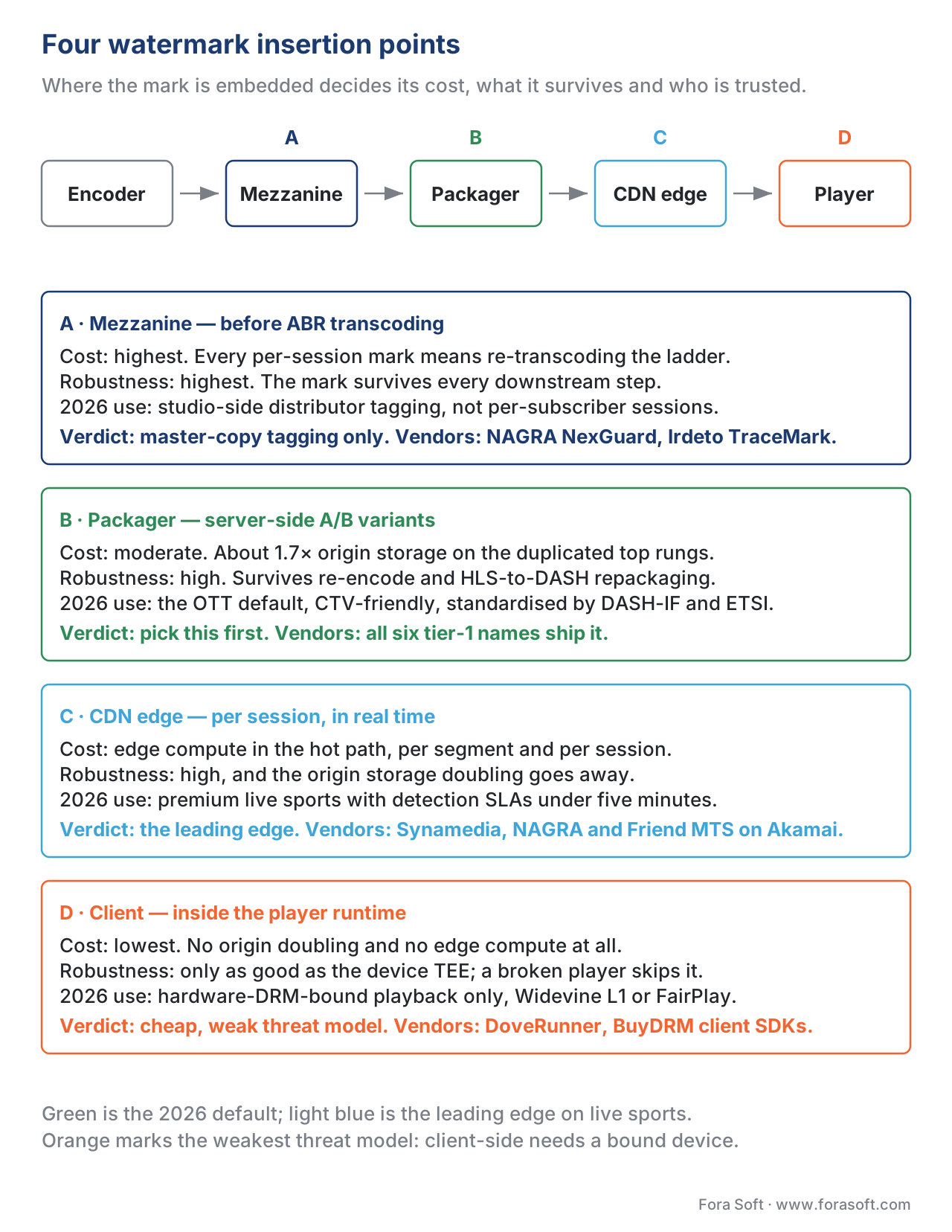 Figure 3. The four insertion points along the pipeline. Server-side A/B at the packager is the 2026 default; edge watermarking is the leading edge for live sports; client-side is acceptable only on hardware-DRM-bound playback paths.
Robustness: What "Survives Cam-Cord" Means in 2026
The single number every watermarking vendor brags about is robustness — the probability that the mark is still readable after the content has been re-encoded, downscaled, cropped, screen-recorded, point-camera-captured, posted to YouTube, and re-encoded again. Robustness is the property that determines whether the mark works in the real world, where pirates apply every transformation they can think of to evade detection.
A practical taxonomy of the attacks the mark must survive, from easiest to hardest:
Transcoding and re-multiplexing. The pirate re-encodes the captured stream at a different bitrate or in a different container. Modern A/B variant watermarks survive this trivially because the mark is embedded in perceptually-shaped frequency coefficients that survive an H.264-to-H.264 re-encode at the same or lower bitrate. Survival rate: ≥ 99% across all major vendors.
Resolution downscaling. The pirate downscales 4K to 1080p, or 1080p to 720p, to save bandwidth. Most modern marks survive this with ECC margin. Survival rate: 90–98% on 1080p-to-720p; 80–95% on 4K-to-1080p.
Cropping and overlay. The pirate crops the borders to remove visible logos, or overlays a graphic on the lower-third. Marks designed to be spatially distributed (not concentrated in one region) survive. Survival rate: 85–95% on edge cropping; lower on heavy overlays.
Cam-cord (analogue capture). A pirate points a phone or a camera at a TV screen and re-records. The mark must survive lens distortion, frame-rate mismatch, ambient light variation, geometric warp, and audio resampling. This is the hardest attack, and the robustness claims diverge sharply between vendors. NAGRA, Verimatrix, and Friend MTS publish independent test results in the 70–85% range on cam-cord; smaller vendors sometimes claim "100% robust to cam-cord" without supporting third-party data, and operators should treat such claims with the scepticism a 100% claim deserves.
Collusion (multiple pirate copies averaged together). A sophisticated attacker collects two or more leaked copies (different subscribers, different per-session marks) and averages the pixel values, hoping to mask each individual mark. A/B watermarking schemes use ECC and segment-level redundancy to survive small-scale collusion (two to four colluders); larger-scale collusion attacks remain an open research problem and are an active area for academic work — the recent work on Tardos codes and finger-printing-resistant watermarks targets exactly this attack class.
Adversarial machine learning. A 2025–2026 development: a generative model trained to "denoise" watermarked frames can erase the mark on some content. Vendor responses include AI-resilient embedding (Stegawave, ScoreDetect) and quantum-resistant payload encryption (an early-2026 research direction). Operators with the highest-value content — Hollywood early windows, World Cup finals — are starting to include adversarial-ML robustness in vendor RFPs.
Common Mistake: Treating Watermarking as a DRM Replacement
The single most common scoping mistake is treating watermarking as a DRM replacement: "we'll skip Widevine on the lower tier because we have watermarking instead". This is wrong on every axis.
DRM prevents unauthorised consumption by encrypting the stream and gating decryption on a license. Watermarking attributes consumption after the fact, but does nothing to prevent the leak from happening. A non-DRM stream is publicly readable by anyone who downloads the manifest; the watermark catches the first subscriber to share the stream, but does not stop the stream from being shared. By the time the extractor identifies subscriber #47, the content is already on a hundred forums.
The right mental model is layered defence: DRM encrypts and gates, hardware root of trust binds the license to the device, output protection (HDCP) prevents capture from the HDMI port, watermarking attributes leaks that survive all of the above. Skip any of the four layers and the threat model has a hole. The MovieLabs ECP specification names all four as required pillars for premium content protection; an operator that ships only watermarking against MovieLabs-grade content is failing the contract.
The corollary trap is treating watermarking as free insurance: "we'll bolt it on for the studio audit and ignore it operationally". A watermarking stack that exists but is not monitored, has no extraction pipeline run weekly, and has no enforcement playbook is a compliance artifact, not a protection control. The operators who get value from watermarking are the ones who run a 24×7 anti-piracy SOC (security operations centre), pipe fingerprinting alerts into the same incident-management system that handles encoder failures, and have a documented playbook for cutting subscriber tokens within five minutes of confirmed extraction.
Detection Time Budget for Live Sports
Live sports is the ultimate watermarking stress test because the value of the content is concentrated into a two-to-four-hour window, and a five-minute delay in subscriber identification is worth real money. Here is a wall-clock budget for a 2026 Champions League quarter-final from kick-off:
- t = 0:00 — Match starts. Fingerprinting service is already monitoring fifty known piracy hubs (forums, Telegram channels, IPTV reseller dashboards, Reddit livethreads).
- t = 1:30 — First pirate stream detected. A "premium reseller" account has begun re-streaming through a Telegram bot. The fingerprint match fires; the monitor begins capturing.
- t = 2:15 — Capture buffer full. The monitor has 45 seconds of pirate content. For a 32-bit payload at 2-second segments, this is on the lower bound of extractable.
- t = 3:30 — Extraction complete. The bit pattern reads
0010 1110 0100 1101 ...; the database lookup returns subscriber #4,471,002, account active for 14 months, country DE, last IP from a known VPN range. - t = 4:00 — Enforcement. The session-manager API revokes the subscriber's playback token; the pirate stream's source player gets a 403 on the next manifest refresh; the stream goes dark within ninety seconds.
- t = 5:30 — Subscriber identified end-to-end. The leaking subscriber's stream is cut before the first half ends; legal team is notified for cease-and-desist; the operator's anti-piracy dashboard logs the kill.
This budget is what a serious 2026 deployment ships. A decade ago the same loop took hours, and the kill was post-match — useful for archive-cleanup but worthless for live revenue protection. The compression of this budget from hours to minutes is the central operational story of forensic watermarking in 2026.
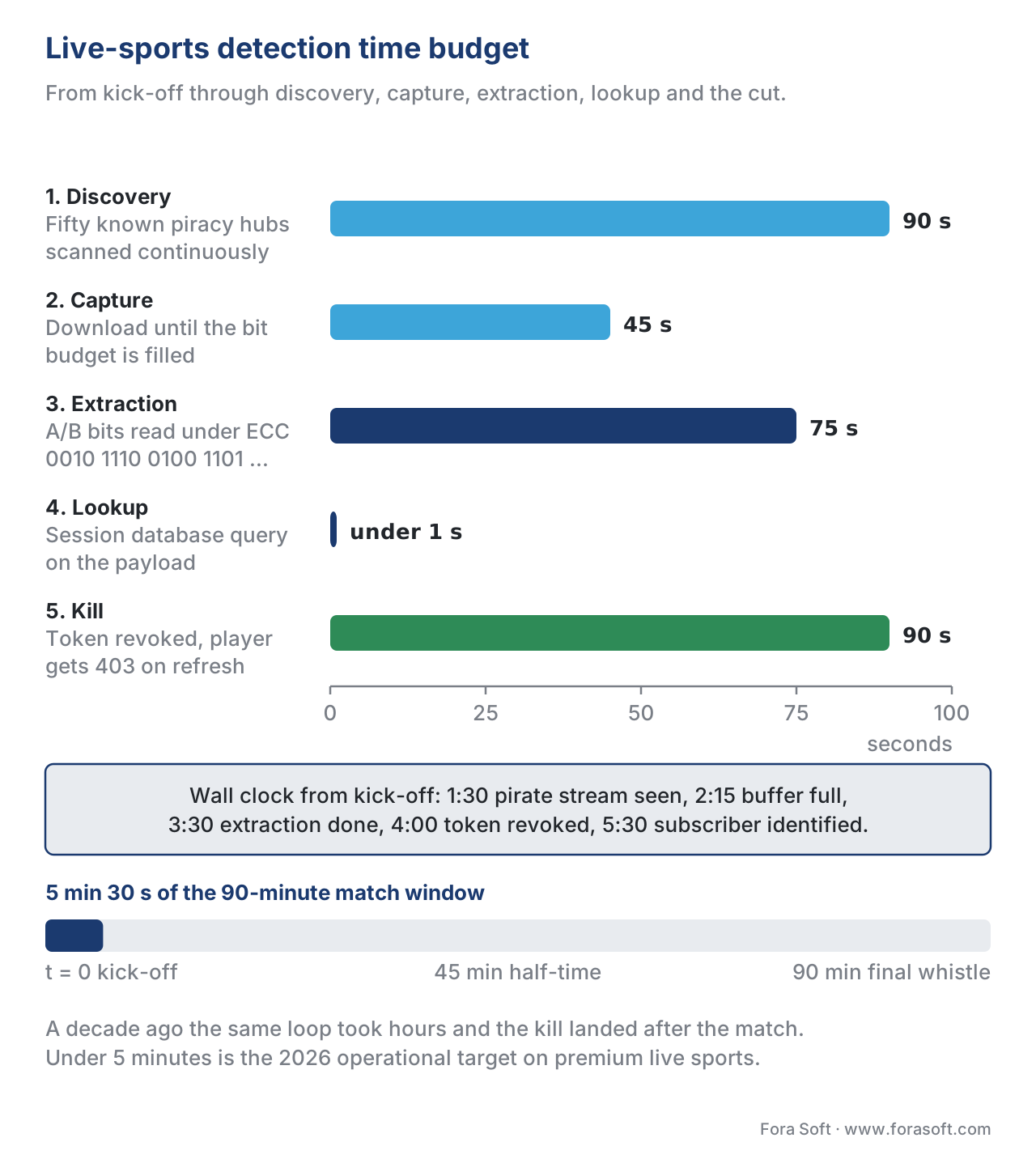 Figure 4. The 2026 live-sports detection budget. Five minutes from match-start to subscriber kill is the operational target; the budget breakdown shows where every second goes and which step still has the most variance.
The 2026 Vendor Landscape
The forensic watermarking market in 2026 has converged on six tier-1 vendors and a longer tail of niche players. The list below is not exhaustive — new entrants like Stegawave (Ireland, real-time live-sports specialist) and ScoreDetect (UK, AI-resilient embedding) are reshaping the lower tier — but the names below cover ≥ 90% of the production OTT and CTV deployments worldwide.
| Vendor | Best for | 2026 highlight |
|---|---|---|
| NAGRA NexGuard | Pay-TV, OTT premium live | NexGuard Streaming on the Akamai edge network; AWS Elemental MediaLive integration; Harmonic partnership for Watermarking-as-a-Service for live events |
| Synamedia ContentArmor | OTT live sports, broadcast | NAB 2026 launch of Edge Watermarking; under-5-minute detection-to-removal; 10-year ContentArmor anniversary |
| Verimatrix | OTT, IPTV, telco TV | VMX Streamkeeper portfolio integration; CENC-compatible per-session marks; Tier-1 telco deployments |
| Friend MTS ASiD | Subscriber-level live and VOD | 4th-generation ASiD (subscriber watermarking + iQ anti-fraud); Akamai server-side A/B partnership; live-sports war-room operations |
| Irdeto TraceMark | Premium movies, sports, distribution | TraceMark for Distribution, OTT, and Sports; AI-resilient embedding research |
| DoveRunner (PallyCon) | OTT, integrated DRM + watermarking | All-in-one PallyCon platform: multi-DRM + forensic watermarking; APAC and EMEA OTT customers |
Where Fora Soft Fits In
We have built piracy-aware streaming and OTT systems for clients in video streaming, OTT/Internet TV, video surveillance, e-learning, telemedicine, and live-events verticals since 2005, including projects where the rights contract required studio-grade content protection. In every recent build, watermarking lives next to multi-DRM, hardware-root-of-trust binding, and HDCP-aware output protection — not in place of any of them — and the integration work centres on the operator's incident-response playbook, not on the watermarking algorithm itself. The hard part is not picking a vendor; it is wiring the extractor pipeline to the session-manager API, the fingerprinting alerts to the SOC dashboard, and the enforcement actions to the customer-care queue so that a five-minute detection budget is actually achievable in production rather than only in the vendor's case-study slide. If you need that wiring in your own service, our custom OTT and IPTV platform builds ship watermarking alongside multi-DRM and session limits, and our scalable video streaming work handles the multi-CDN edge where A/B variants are selected.

The book
Video Streaming: A Complete Guide to Video Delivery: From ABR and CDNs to Players, WebRTC, DRM, and the Economics of Streaming
Watermarking is the fourth pillar beside the three this article keeps pointing at, and volume 3 is where those three live. The DRM chapters walk Widevine, FairPlay and PlayReady down to the key-system strings and the CENC profile your A/B variants ride on; the CDN and cache chapters put numbers on the cache-hit cost of doubling the segment URLs; and the closing chapters on the economics of streaming price the 1.7× origin storage against what a leaked live right is worth. Written by Nikolay Sapunov, CEO at Fora Soft.
Does your rights contract ask for watermarking?
Tell us what you are protecting and we will scope the path from mark to enforcement: which insertion point your device mix and storage budget can carry, how the extractor pipeline reaches your session-manager API, and what it takes to cut a subscriber inside the five-minute window rather than after the final whistle. 250+ video products shipped since 2005.
See our case studies
Case study
Worldcast Live
Pay-per-view concerts at 1.5 Gb/s and 0.4–0.5 s latency for 10,000 simultaneous viewers — the shape of event where a re-streamed session costs real ticket revenue while the show is still on.
Case study
Speed.Space
A remote production platform recording at 1080p/8 Mbps for Netflix, Electronic Arts and HBO productions — pre-release material, the class of content whose rights contract names watermarking before it names a CDN.
Case study
TradeCaster
A subscription streaming platform with 46,000+ users paying $99–$119 a month — where attribution has somewhere to land, because every session already maps to an account the operator can revoke.
What to read next
DRM
DRM 101: why three systems, and why you ship all three
The encryption layer watermarking sits beside, and why neither one replaces the other.
Encryption
Common Encryption (CENC) in depth
The profile both A/B variants are encrypted under before they reach the origin.
DRM
Widevine security levels: L1, L2, L3
The device-side trust that decides whether client-side marking is even an option.
Operations
Incident response for streaming: the playbook
The on-call machinery a five-minute detection budget actually runs on.
References
- ETSI TS 104 002 V1.1.1 (2023-08) — DASH-IF Forensic A/B Watermarking — An interoperable watermarking integration schema. ETSI Publicly Available Specification, published 28 August 2023. The normative integration schema for server-side A/B variant watermarking; WMPaceInfo structure (§5), variant identification scheme (§4), CENC interaction (§7). Primary source for every claim in this article about the A/B integration model. Tier 1.
- DASH-IF IOP Watermarking — DASH Industry Forum, DASH-IF Interoperability Guidelines: OTT Watermarking (dashif.org/docs/DASH-IF-IOP_OTT-Watermarking.pdf). Companion document to ETSI TS 104 002; defines the server-side OTT delivery architecture and the security boundary. Tier 1.
- MovieLabs Specification for Enhanced Content Protection (ECP) v1.3 — MovieLabs (2024). The studio-side gating spec for 4K UHD; §5 names forensic watermarking alongside DRM, hardware root of trust, and output protection as the four required pillars. Tier 1 (industry-standards consortium owned by Disney, Paramount, Sony, Universal, Warner Bros.).
- DASH-IF Candidate Specification: Watermarking API for Encoder Integration (2024) — dashif.org/news/cr-watermarking-api/. Companion API spec for the encoder side; public comment closed January 15, 2025; contributors include AWS Elemental, Irdeto, Nagravision, Synamedia. Tier 1.
- Roberto Ramos-Chavez (Unified Streaming), Standards-based OTT A/B Watermarking at Scale — Proceedings of the 3rd Mile-High Video Conference (MHV 2024), ACM. Engineering treatment of A/B at production scale; storage and CHR math. Tier 3 (vendor whitepaper, peer-reviewed proceedings). Used for the storage and cache math in this article.
- NAGRA — NAGRA launches NexGuard forensic watermarking on Akamai edge network to protect high value live and VOD OTT content — press release, nagra.com (2025). Edge deployment model and Akamai integration. Tier 4 (vendor announcement); used for vendor-landscape claims only.
- Synamedia — ContentArmor Edge Watermarking launch at NAB 2026 — Sports Video Group, NAB 2026: Synamedia Launches Edge Watermarking Solution, Marks 10 Years of ContentArmor, sportsvideo.org (25 March 2026). Under-5-minute detection-to-removal claim. Tier 4 (vendor announcement reported by industry press).
- AWS Media Blog — Protecting pre- and early-release content with NAGRA NexGuard forensic watermarking — aws.amazon.com/blogs/media. AWS Elemental MediaLive + NAGRA integration; rung-selection guidance (top one or two ABR rungs for variant duplication). Tier 4 (vendor blog), useful for production deployment patterns; the rung-selection recommendation matches what we have seen in production projects.
- Friend MTS — 4th Generation ASiD (2021) and Friend MTS Collaborates with Akamai to Tackle Real-World Piracy with New Server-Side A/B Variant Watermarking Solution — friendmts.com. Subscriber-level A/B model and detection-time SLAs on live sports. Tier 4 (vendor); used for vendor-landscape and detection-time-budget claims, cross-checked against Synamedia and NAGRA figures.
- MwareTV — Forensic Watermarking for Video Streaming Guide 2026 — mwaretv.com/en/blog/forensic-watermarking-guide. Industry overview of the 2026 landscape; useful for cross-referencing hybrid deployment patterns. Tier 6 (educational content site); included only for orientation, all protocol-level claims have been re-verified against the ETSI/DASH-IF documents above.
- Promwad — Next-Gen Content Protection: AI Watermarks and Modern Anti-Piracy Technology — promwad.com/news/next-gen-content-protection-ai-watermarks-anti-piracy. Adversarial-ML and AI-resilient embedding directions for 2026 and beyond. Tier 6; included for the AI-resilience claim.
- Ultra HD Forum — New guidelines for forensic watermarking to enable the release of premium UHD content — dtv.nagra.com (Ultra HD Forum guidelines). Industry-consortium framing of the UHD-watermarking requirements and the studio-side gating logic. Tier 3.
Discrepancy note: vendor blogs sometimes describe the A/B watermarking system as fully proprietary; the ETSI/DASH-IF spec is the controlling document and the article has followed the spec wherever vendor framing differs.
