


Why This Matters
If you are picking an ingest path for a product that needs sub-second latency from a browser, the choice in 2026 is no longer "WebRTC or wait." WebTransport gives the browser a clean, low-level pipe to your server, with the same QUIC plumbing that powers HTTP/3, and pairs naturally with the WebCodecs API to ship raw H.264, HEVC, AV1, or Opus frames you encoded yourself. That is a fundamentally different model from the WebRTC model — no SDP, no Interactive Connectivity Establishment (the technique for finding a network path through Network Address Translation), no negotiated codecs, no built-in jitter buffer — and it is the model the next generation of streaming protocols, Media over QUIC chief among them, has chosen.
This article is for the product manager, the founder, and the streaming engineer who has heard "WebTransport," "WHIP-over-WebTransport," and "Media over QUIC" used in the same sentence and wants to know which of those phrases describes a real standards document, which describes a working group's direction of travel, and which describes a tactical bet a vendor is making this quarter. You will leave with a clear mental model of what WebTransport is, how it differs from WebRTC and WebSockets, and a defensible answer to the question "should we build on it now."
What WebTransport Is — In One Page
WebTransport is a Web API and a wire protocol that lets a web page open a multiplexed, secure, low-latency connection to a server using HTTP/3 as the carrier. The Web API — defined by the W3C WebTransport Working Draft of 25 March 2026 — exposes a single JavaScript class called WebTransport. You construct it with an https:// URL, await its ready promise, and then either open reliable byte streams (createBidirectionalStream(), createUnidirectionalStream()) or send unreliable datagrams through its datagrams attribute. Everything beneath that is QUIC, the encrypted transport defined by IETF RFC 9000 that already carries the world's HTTP/3 traffic.
The wire is WebTransport over HTTP/3, defined by draft-ietf-webtrans-http3-15 (2 March 2026, IETF, in Working Group Last Call). The client opens an HTTP/3 extended CONNECT request — a request with :protocol = "webtransport-h3" — and a 2xx response from the server establishes a WebTransport "session" inside the existing HTTP/3 connection. From that point, the session can open as many bidirectional and unidirectional QUIC streams as it likes, and can send and receive QUIC datagrams (per RFC 9221). All of the streams and datagrams for a session are demultiplexed by a Session ID — which is, concretely, the QUIC stream ID of the CONNECT stream that established the session.
Three SETTINGS values must line up before a server even appears to support the protocol: SETTINGS_WT_ENABLED greater than zero, SETTINGS_ENABLE_CONNECT_PROTOCOL set to one (from RFC 9220), and SETTINGS_H3_DATAGRAM set to one (from the HTTP-Datagram extension). The server's QUIC layer must additionally advertise max_datagram_frame_size > 0 (RFC 9221) and an empty reset_stream_at transport parameter. A browser that fails to see any of those will refuse to even attempt a session. This is why "we ship WebTransport" is not a one-line server change.
The thing that makes WebTransport interesting for streaming is the simultaneous availability of two delivery modes on the same connection. Reliable streams behave like Transmission Control Protocol (the protocol that guarantees in-order delivery and retransmits losses), except that each stream is independent — a packet lost on stream 7 cannot stall stream 8 the way it would on a single TCP connection. Unreliable datagrams behave like User Datagram Protocol (the protocol that fires packets and forgets them) — they may be reordered or dropped, and the application chooses what to do about it. A live video application uses datagrams for media frames where freshness matters more than completeness, and reliable streams for control messages where loss is unacceptable. That same split is what WebRTC has always done with RTP and Stream Control Transmission Protocol; the difference is that WebTransport exposes both as named JavaScript primitives instead of hiding them inside a RTCPeerConnection.
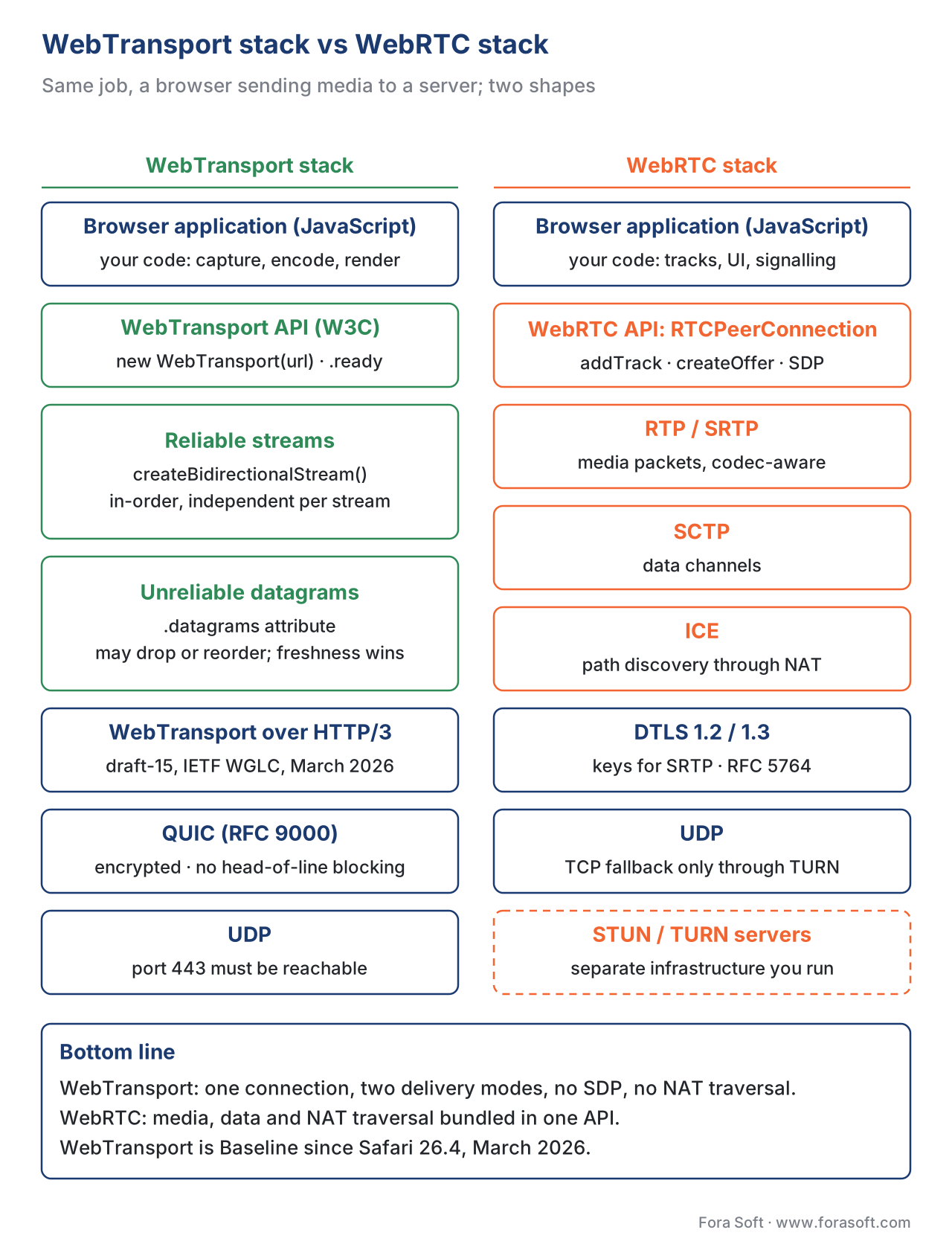 Figure 1. The WebTransport stack next to the WebRTC stack. WebTransport keeps the transport and the application clean of session-description and Interactive Connectivity Establishment plumbing; WebRTC bundles all of it.
What WebTransport Is Not
WebTransport is not peer-to-peer. There is no Interactive Connectivity Establishment, no Session Traversal Utilities for Network Address Translation server, no Traversal Using Relays around Network Address Translation server, no candidate gathering, no Session Description Protocol exchange. It is strictly client to server — the browser opens an https:// URL the way it would for a regular HTTP/3 request. That is a feature, not a limitation: removing all of the Network Address Translation traversal machinery removes the single most expensive operational headache of WebRTC.
WebTransport is also not a media protocol. The WebTransport specification defines a transport — bytes in, bytes out — and says nothing about codecs, packetization, jitter buffers, retransmission policy, or how to map a video frame onto streams or datagrams. That work has to happen on top, either inside your own application code (the WebTransport plus WebCodecs path) or inside a higher-level media transport that you build on WebTransport (the Media over QUIC path).
Finally, WebTransport is not finished. The W3C document is still a Working Draft and the HTTP/3 mapping draft is still in Working Group Last Call as of March 2026, which means small, breaking changes can still land before either reaches Recommendation or RFC status. Server libraries occasionally lag a draft revision behind Chromium or Firefox and produce handshake failures; the W3C "explainer" explicitly warns that "both the protocol and API are likely to change."
Browser Support In 2026 — Why Baseline Changed The Math
Until 2025, WebTransport ran in Chrome and Edge from version 97, Firefox from version 114, and nowhere else. Safari was the missing piece — the entire iOS surface area, plus desktop Safari, plus every WKWebView app on macOS. A protocol that does not work in Safari is a protocol you cannot ship to a general audience. That is why every honest "should we use WebTransport" answer between 2022 and 2025 was "not yet."
Safari 26.4 shipped in March 2026 with WebTransport on by default. That single release shifted WebTransport from a Chromium-plus-Firefox preview to Baseline — the Web Platform's term for "works in every major browser without a polyfill." From a product-decision point of view, the moment a Web API becomes Baseline is the moment its capabilities are something you can promise to a customer rather than something you A/B test for. The Baseline transition for WebTransport happened in March 2026; that is the cleanest single date to mark as the "production-ready" line for a browser-first ingest stack built on WebTransport.
Numbers, refreshed against caniuse.com and the W3C Working Group publications page as of May 2026: Chrome 97+ (since January 2022), Edge 98+ (February 2022), Firefox 114+ (June 2023), Safari 26.4+ (March 2026), Opera 83+ (February 2022), Samsung Internet 18+ (mid-2022). On mobile, that translates to Chrome on Android 97+, Firefox on Android 114+, and Safari on iOS 26.4+.
How WebTransport Compares To WebRTC And WebSockets
The clearest way to position WebTransport is against the two protocols a JavaScript developer would have reached for before WebTransport existed. Remember, WebSockets is the older browser-to-server primitive that runs over Transmission Control Protocol and supports text and binary messages with strict in-order, reliable delivery. WebRTC is the browser primitive for media — audio, video, and data channels — designed for peer-to-peer use with Network Address Translation traversal built in.
| Criterion | WebTransport | WebRTC | WebSockets |
|---|---|---|---|
| Transport layer | QUIC (UDP) | UDP for media, optionally TCP fallback | TCP, soon HTTP/2/3 |
| Delivery modes | Reliable streams + unreliable datagrams | RTP for media (unreliable), SCTP for data (reliable) | Reliable, in-order |
| Head-of-line blocking | None across streams | None across SSRCs | Yes — single TCP stream |
| NAT traversal needed? | No (client-to-server) | Yes (ICE/STUN/TURN) | No |
| 0-RTT resumption | Yes (QUIC) | No | No |
| Connection migration | Yes (QUIC connection IDs) | No (renegotiation needed) | No |
| Glass-to-glass latency floor | 300 – 500 ms typical | 200 – 500 ms typical | 800 ms – 2 s typical |
| Media built in? | No (use WebCodecs or MoQ) | Yes (RTP packetisation, jitter buffer, codec negotiation) | No |
| Specification status (May 2026) | W3C WD + IETF WGLC | W3C CR + RFCs 8825–8866 | RFC 6455 + HTTP/2 mapping |
| Baseline browser support | Yes since March 2026 | Yes since 2019 | Yes since 2012 |
Numeric Example: A WebTransport Ingest Pipeline
Imagine you want to take a webcam stream from a browser and ingest it into a server with the smallest possible glass-to-glass latency, using only modern Web APIs. Here is the latency budget, line by line.
You capture the camera at 30 frames per second, which gives a frame interval of one second divided by thirty, equals 33.3 milliseconds.
You encode each frame with WebCodecs using H.264 at a target of 2.5 megabits per second; modern hardware encoders complete a key-frame in 8 to 12 milliseconds and a P-frame in 4 to 8 milliseconds. Call the encoder average 8 milliseconds.
You send each encoded frame as a single WebTransport datagram — frames over the 1200-byte safe Maximum Transmission Unit are fragmented across multiple datagrams with an application-layer sequence number. Wire time on a 100 megabit residential uplink for a 10 kilobyte frame is 10,000 bytes times 8 bits per byte divided by 100 million bits per second, equals 800 microseconds, plus one round-trip-time on the QUIC layer for ack-eliciting frames. With a 20 millisecond round-trip-time to your nearest edge, call it 20 milliseconds wire.
Server-side decode-and-forward in Go using a WebTransport server library takes 3 to 5 milliseconds. Call it 4 milliseconds.
Total contribution latency, camera-frame-arrives to server-has-frame: 33.3 + 8 + 20 + 4 = 65.3 milliseconds, or about one frame at 30 frames per second.
A WebRTC pipeline doing the same job sits at 80 to 120 milliseconds on the contribution side because the RTCPeerConnection adds an Interactive Connectivity Establishment connectivity check (10 to 50 milliseconds, paid once at session start) and a jitter buffer pre-warm (40 to 80 milliseconds, paid every restart). WebTransport's steady-state contribution latency is essentially the same as WebRTC's; its setup latency is lower because there is no Interactive Connectivity Establishment to perform.
What "WHIP-Over-WebTransport" Actually Means In 2026
This is the section where the topic stops being clean. There is no IETF document called "WHIP-over-WebTransport." A search of the IETF datatracker as of May 2026 returns no draft by that name in the WISH working group or anywhere else. The WISH working group's two outputs are RFC 9725 — the WHIP protocol over plain HTTP — and draft-ietf-wish-whep-03 — the WHEP egress protocol over plain HTTP. WebTransport is not in either's text.
What people mean by "WHIP-over-WebTransport," in practice, is one of two adjacent things.
The first thing they mean is a WHIP variant where the SDP exchange happens over a WebTransport bidirectional stream instead of an HTTP POST. The motivation is that a browser-based WHIP client today has to open one HTTP/1.1 or HTTP/2 connection for the POST, then bring up an entirely separate WebRTC PeerConnection for the media — two connections, two handshakes, two paths through the network. A WHIP-over-WebTransport variant would let a browser open one HTTP/3 connection, use a control stream inside it to do the SDP exchange, and use datagrams or unidirectional streams on the same connection to carry the media. Several vendor prototypes exist; none have been adopted as an IETF document.
The second thing they mean — and this is the more important interpretation in 2026 — is the Media over QUIC Transport (MOQT) project, currently draft-ietf-moq-transport-17 of 2 March 2026. Media over QUIC is the IETF working group chartered in 2022 to build a new media transport that runs natively on QUIC and WebTransport, with publish-subscribe semantics, optional intermediate relays for content-distribution-network-style fan-out, and a clear separation between the transport (MOQT) and the media containers (Low Overhead Media Container, WARP, and others on top). MOQT is what "WHIP-over-WebTransport" was always going to evolve into; it is the explicit answer to "what does a clean WebRTC-replacement contribution protocol look like, if we build it from scratch on QUIC."
Media over QUIC Transport draft 17, §1.1, names the transport options explicitly: "MOQT runs over QUIC and WebTransport, which have similar functionality." That sentence is what every "WebTransport for streaming" conversation in 2026 is actually about. The browser-side answer to "how do I push live media into a relay network in 2026" is no longer WHIP — it is MOQT-over-WebTransport. The native answer is MOQT-over-QUIC.
We cover MOQT in depth in Media over QUIC (MoQ) in depth: the 2026 turning point and the broader delivery-protocol family tree. For ingest-protocol selection generally, see Picking an ingest protocol in 2026: a decision tree.
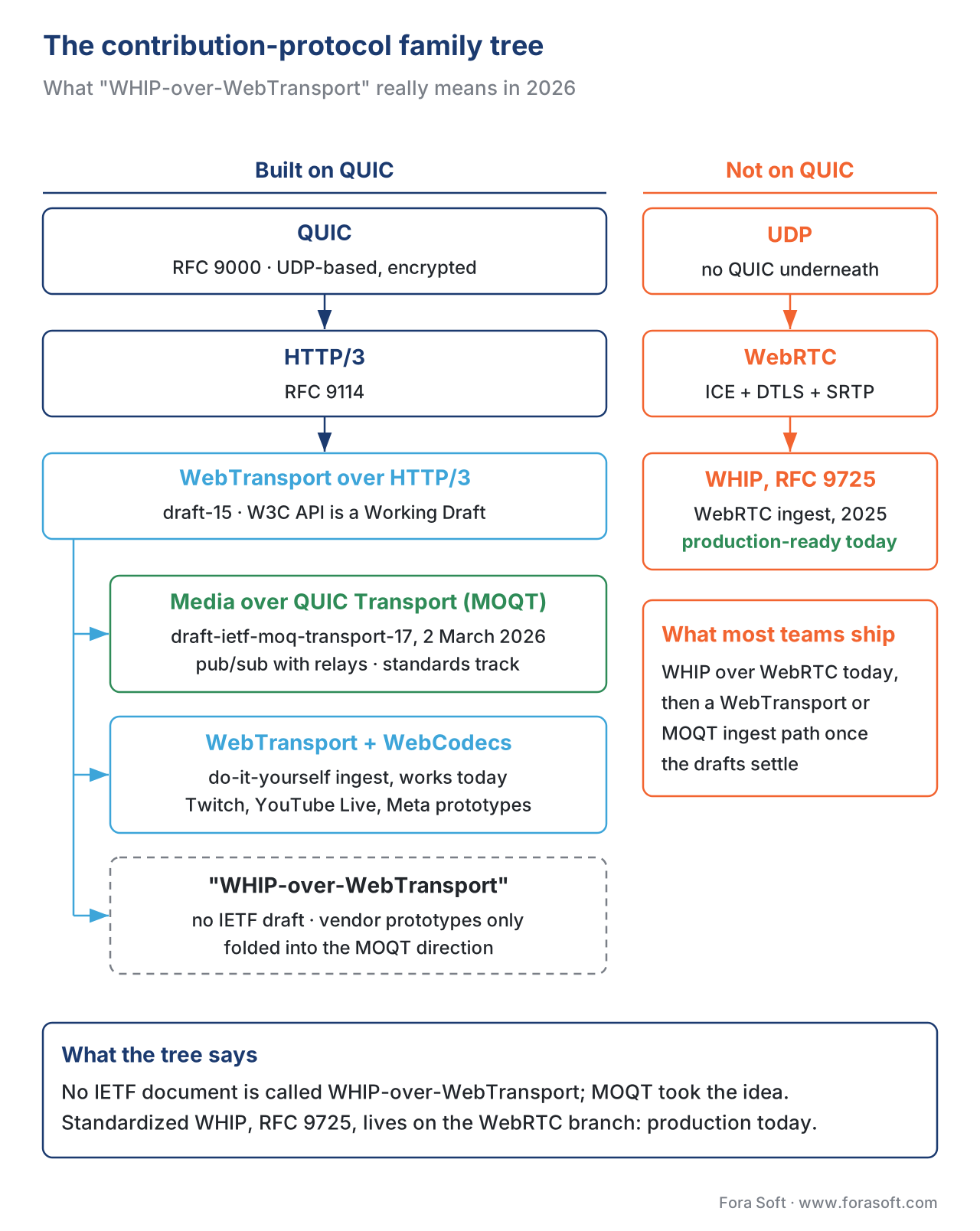 Figure 2. The family tree of contribution protocols on QUIC. WebTransport is the carrier; Media over QUIC Transport is the standardized media protocol on top; "WHIP-over-WebTransport" lives on a prototype branch that the working group has effectively folded into MOQT.
Building With WebTransport Today — Three Patterns That Ship
Pattern one: WebTransport plus WebCodecs, do it yourself. You capture from getUserMedia, convert the resulting MediaStreamTrack into raw VideoFrame and AudioData via MediaStreamTrackProcessor, encode each frame with VideoEncoder, send the encoded chunks over a WebTransport datagram or unidirectional stream, and decode on the server. Meta's facebookexperimental/webcodecs-capture-play and facebookexperimental/go-media-webtransport-server repositories are the public reference implementations. Twitch and YouTube Live have shipped prototypes on this pattern that quote sub-1-second glass-to-glass numbers. The pattern works today; the work to ship it is application code, not browser support.
Pattern two: WHIP today, WHIP-over-WebTransport tomorrow. Use the WHIP standardized in RFC 9725 now — it works, it is interoperable, every modern encoder speaks it — and plan to add WebTransport as a parallel ingest path once a draft exists and Safari has shipped a year of stable WebTransport behaviour. This is the conservative choice. Most production streaming platforms in 2026 sit on this path.
Pattern three: MOQT over WebTransport, ride the wave. Pick an early MOQT relay implementation (Cloudflare's Rust stack cloudflare/moq-rs, Ant Media's MOQT support added in 2025, the reference mengelbart/moqtransport Go implementation), build the browser side on the W3C WebTransport API plus WebCodecs, and accept the draft-changes risk in exchange for being on the protocol that the next-generation content delivery networks are deliberately built around. This is the aggressive choice; it suits projects with a 12 to 24 month build window and a team that can keep up with draft revisions.
Common Mistake: Treating WebTransport As "A Faster WebSocket"
The single most common mistake we see when teams start with WebTransport is the assumption that it is "WebSocket but on QUIC." Architecturally it is not. WebSockets give you one reliable, in-order message channel; WebTransport gives you many independent reliable byte-streams plus unreliable datagrams on the same connection. If you port a WebSocket protocol straight onto a single WebTransport bidirectional stream, you have built a WebSocket-over-QUIC, and you have left the whole point of WebTransport — independent streams plus unreliable datagrams — on the table.
The right port is to redesign the message types. Map control messages onto a control stream. Map state updates that need to arrive in order onto independent reliable streams (one per logical sub-channel, so a slow channel cannot block a fast one). Map media frames and other "stale data is worse than no data" messages onto datagrams. The data layer becomes wider and shallower than the WebSocket equivalent, and the latency-under-loss behaviour improves dramatically.
Security And Operations Notes Worth Knowing
WebTransport requires Transport Layer Security 1.3 — there is no plain-text mode and no downgrade. The default trust model uses the same Web Public Key Infrastructure that every https:// page does, so a normal TLS certificate from any browser-trusted certificate authority works. The Working Draft also defines a serverCertificateHashes option that lets a page explicitly accept a server by certificate fingerprint, which is useful for prototype work against ad-hoc servers without a publicly trusted certificate; it is mutually exclusive with allowPooling, and the certificate must satisfy the spec's "custom certificate requirements" (notably a maximum validity period).
On the operational side, WebTransport servers must speak HTTP/3, which means User Datagram Protocol port 443 must be reachable from your audience. In environments where UDP/443 is filtered — a non-trivial fraction of enterprise networks and some mobile carriers — WebTransport will fail to connect with no automatic fallback to TCP. That is a real-world constraint that affects WebTransport's reachability ceiling versus WebSockets-over-TCP, which goes anywhere HTTPS goes. A production deployment of WebTransport in 2026 should plan a fallback path — typically WebSockets or WebRTC — and instrument the share of users whose WebTransport connection attempt fails.
The QUIC connection-migration feature, where a connection survives an Internet Protocol address change (a phone moving from Wi-Fi to cellular, for example), is supported transparently on the server side. The Web API does not expose a migration hook — your application code does not need to know that the underlying connection just moved between networks.
Free download: WebTransport vs WHIP vs MoQ, the 2026 cheat sheetA one-page printable summary of when each protocol wins in 2026: WebTransport (W3C WD, IETF draft-15), WHIP (RFC 9725) and Media over QUIC Transport (draft-17).Where Fora Soft Fits In
Fora Soft has built live-video products on every contribution protocol from RTMP to SRT to WHIP to WebTransport prototypes. Our work spans video streaming platforms, e-learning, telemedicine, video surveillance, OTT, conferencing, and augmented and virtual reality video. We track the WebTransport, WHIP, and Media over QUIC drafts continuously because the right answer for a customer with a five-year roadmap is different from the right answer for a customer who needs to ship next quarter. When a project's latency requirements drop below one second and the audience is browser-first, we tend to recommend WHIP-over-WebRTC today with a planned MOQT-over-WebTransport migration path; we are happy to walk through the trade-offs against your specific deployment. Our Media over QUIC and WebTransport development team builds those prototypes on quic-go and quiche, and our WebRTC developers ship the WHIP ingest that runs in production today.
The book
Video Streaming: A Complete Guide to Video Delivery: From Network Protocols and Transport to Ingest, HLS, and MPEG-DASH
Volume 2 takes apart the layers this article stacks up: what UDP, QUIC and HTTP/3 each do to a live stream under loss, why independent streams remove head-of-line blocking, and how RTMP, SRT and WHIP compare as contribution protocols inside a real latency budget. Volume 3 picks up the WebRTC side, from ICE and the SFU to the player, so you can price the WHIP-today, MOQT-tomorrow path this article recommends. Written by Nikolay Sapunov, CEO at Fora Soft.
WHIP now or WebTransport now: which ingest path fits your roadmap?
Tell us your latency target, audience networks and release date. We will map your contribution leg onto WHIP, WebTransport with WebCodecs or MOQT, check how much of your audience can reach UDP/443, and send you a short plan with the fallback path. 250+ video products shipped since 2005.
See our case studies
Case study
Worldcast Live
HD concert streaming at 0.4–0.5 s latency to 10,000 concurrent viewers, with full-duplex streams for remote performers.
Case study
TradeCaster
Browser-based live desktop streaming for 46,000+ traders, built on WebRTC and auto-scaling through market-hour spikes.
Case study
Speed.Space
Remote production from the browser at 1080p and 8 Mbps, used on Netflix, Electronic Arts and HBO shoots.
What to read next
MoQ
Media over QUIC (MoQ) In Depth: The 2026 Turning Point
The standards-track protocol that WHIP-over-WebTransport folded into.
Transport
QUIC: The New Transport Layer
The streams, datagrams and connection IDs WebTransport inherits.
Ingest
Picking an Ingest Protocol in 2026: A Decision Tree
Where WebTransport sits next to RTMP, SRT and WHIP for your first mile.
WebRTC
WHEP: HTTP-Based Egress For WebRTC
The playback half of the WHIP pair, and what it changes for viewers.
References
- W3C, WebTransport, Working Draft 25 March 2026. Editors: N. Jaju, V. Vasiliev, J.-I. Bruaroey. https://www.w3.org/TR/webtransport/ — defines the
WebTransportJavaScript interface, theWebTransportOptionsdictionary, theserverCertificateHashessecurity model, the reliable-stream and datagram primitives, and the pooling/congestion-control hints quoted in §"What WebTransport Is — In One Page" and §"Security And Operations Notes." - IETF, WebTransport over HTTP/3, draft-ietf-webtrans-http3-15, 2 March 2026. Authors: A. Frindell, E. Kinnear, V. Vasiliev. https://datatracker.ietf.org/doc/draft-ietf-webtrans-http3/ — defines the extended-CONNECT handshake, the SETTINGS_WT_ENABLED / SETTINGS_ENABLE_CONNECT_PROTOCOL / SETTINGS_H3_DATAGRAM negotiation, the WebTransport unidirectional stream type 0x54, the bidirectional WT_STREAM signal value 0x41, and the Session-ID demultiplexing model quoted in §"What WebTransport Is."
- IETF, The WebTransport Protocol Framework, draft-ietf-webtrans-overview-12, January 2026. https://datatracker.ietf.org/doc/draft-ietf-webtrans-overview/ — the umbrella document for the WebTransport family; cited for the explicit "subject to change" warning quoted in §"What WebTransport Is Not."
- IETF, Media over QUIC Transport, draft-ietf-moq-transport-17, 2 March 2026. https://datatracker.ietf.org/doc/draft-ietf-moq-transport/ — the canonical MOQT specification. Cited in §"What WHIP-Over-WebTransport Actually Means" for the §1.1 statement that "MOQT runs over QUIC and WebTransport." Internet-Draft; subject to change before RFC publication.
- IETF, WebRTC-HTTP Ingestion Protocol (WHIP), RFC 9725, March 2025. Authors: S. Garcia Murillo, A. Gouaillard. https://www.rfc-editor.org/rfc/rfc9725 — the standardized WHIP protocol whose lack of a WebTransport variant is the entire subject of §"What WHIP-Over-WebTransport Actually Means."
- IETF, QUIC: A UDP-Based Multiplexed and Secure Transport, RFC 9000, May 2021. https://www.rfc-editor.org/rfc/rfc9000 — the QUIC transport underneath WebTransport. Cited for stream-ID and variable-length-integer behaviour referenced in §"What WebTransport Is."
- IETF, HTTP/3, RFC 9114, June 2022. https://www.rfc-editor.org/rfc/rfc9114 — the HTTP/3 protocol over which WebTransport is layered.
- IETF, Bootstrapping WebSockets with HTTP/3, RFC 9220, June 2022. https://www.rfc-editor.org/rfc/rfc9220 — defines the extended-CONNECT pseudo-header and the
:protocolmechanism that WebTransport uses to open its sessions. - IETF, An Unreliable Datagram Extension to QUIC, RFC 9221, March 2022. https://www.rfc-editor.org/rfc/rfc9221 — the QUIC datagram extension that WebTransport datagrams build on.
- MDN Web Docs, WebTransport API, accessed May 2026. https://developer.mozilla.org/en-US/docs/Web/API/WebTransport_API — interoperability reference for the JavaScript API; cited for the Baseline status and the cross-browser support matrix in §"Browser Support In 2026."
- WebKit, Release Notes for Safari Technology Preview / Safari 26.4, March 2026. https://webkit.org/blog/ — the release that brought WebTransport to Safari and triggered the Baseline transition.
- webrtc.ventures, WebTransport Is Now Baseline. Here's What That Means for Real-Time Media, April 2026. https://webrtc.ventures/2026/04/webtransport-is-now-baseline-what-it-means-for-real-time-media/ — third-party analysis of the Baseline transition.
- Cloudflare, MoQ: Refactoring the Internet's real-time media stack, 2024. https://blog.cloudflare.com/moq/ — first-party engineering blog from a MOQT working-group participant; positions MOQT-over-WebTransport as the long-term contribution path.
- Meta, go-media-webtransport-server and webcodecs-capture-play reference implementations, GitHub, updated through 2026. https://github.com/facebookexperimental/ — open-source reference for the WebTransport-plus-WebCodecs ingest pattern in §"Building With WebTransport Today."
- Mile-High Video Conference, A WebTransport-based System for Cloud Streaming, ACM Digital Library, 2026. https://dl.acm.org/doi/10.1145/3715675.3715820 — peer-reviewed measurement work on WebTransport-based contribution pipelines; cited for the 300 to 500 millisecond latency-floor claim in the comparison table.
- WebRTC.org, State of WebRTC 2026, accessed May 2026. https://webrtc.org/ — used as the comparison-point reference for the WebRTC column in the table.
