


Why This Matters
Every video product on the public internet — a Zoom call, a Netflix episode, a Twitch stream, a telemedicine consultation — picks a transport layer at the bottom of its stack, and that pick decides how the product behaves on a 4G handover, on a coffee-shop Wi-Fi, on a satellite link in the back of a moving vehicle. For three decades the pick was TCP, and the cost was head-of-line blocking, three-handshake startup latency, and a connection that died the moment the user changed networks. QUIC replaces every one of those losses with a different design. The reason this matters in 2026 is timing: HTTP/3 is now the default on every major CDN, the iOS and Android native media stacks negotiate it automatically, and the IETF's Media over QUIC working group is producing the first protocol since RTMP that was designed for live video transport from a blank page. A product manager, a founder, or an engineering lead who does not understand QUIC at the level of "what it does, what it costs, where it wins" will pick the wrong transport for a 2027–2030 product. This article gives you that understanding in 24 minutes of reading.
What QUIC actually is, in one paragraph
QUIC is a transport protocol — the same layer of the network stack that TCP and UDP occupy. A transport protocol's job is to move bytes between two computers reliably enough for the application above it. TCP, the dominant transport since the 1980s, gives you a single ordered byte stream, end-to-end reliability, and congestion control; UDP, its sibling, gives you an unreliable best-effort datagram and nothing else. QUIC sits in a third position: it runs on top of UDP (so it does not need kernel changes to deploy), it is encrypted from the first byte (TLS 1.3 is mandatory, not optional), it offers multiple independent streams inside a single connection (so a lost packet on one stream does not block another), and it gives the application its own unreliable datagram channel (RFC 9221) when the use case is real-time media. The whole thing is identified by a 64-bit Connection ID rather than an IP-and-port tuple, which is the property that lets a QUIC connection survive when a phone walks out of Wi-Fi range and onto 5G.
If that paragraph reads like a checklist of TCP's pain points, it is, deliberately. QUIC was designed by Google between 2012 and 2018 from one observation: the internet evolved, TCP did not, and the cost showed up everywhere video and web performance mattered. The IETF picked up the design, rewrote it, and shipped it as RFC 9000 in May 2021. By 2026 it is no longer experimental.
The four pain points QUIC was built to fix
Before naming features, the problems they solve. Every QUIC feature you will read about below is a direct response to a TCP behaviour that hurt streaming, web, or mobile.
The first problem is handshake latency. To open an encrypted TCP connection — the kind that carries every modern web request — the client and server exchange a TCP three-way handshake (1 round trip) and then a TLS handshake (1 more round trip, sometimes 2 in TLS 1.2). On a transcontinental 200 ms link, that is 400 ms of latency before a single byte of useful data flows. On a 4G phone with 80 ms RTT, it is 240 ms. Every product manager who has timed a video player's "time to first frame" has felt this cost.
The second problem is head-of-line blocking. TCP delivers bytes in order. If packet 47 of a stream is lost, every packet after it waits in the receiver's buffer until packet 47 is retransmitted and arrives, even if packets 48 through 100 are sitting there ready. For a web page that multiplexes ten requests over HTTP/2, a single lost packet in one image's response stalls the entire connection. For a video player downloading two segments in parallel, the same dynamic applies.
The third problem is connection death on network change. A TCP connection is identified by the four-tuple (client IP, client port, server IP, server port). The moment any of those four numbers changes — a phone walks from Wi-Fi to cellular, a laptop docks at a different desk — the connection breaks. The application has to detect the break, retry the connection, redo the TLS handshake, and resume from where it failed. For a live video stream this is a 2–5 second freeze, minimum.
The fourth problem is protocol ossification. TCP is implemented in the operating system kernel and in network middleboxes (firewalls, load balancers, NATs). The result is that every TCP improvement of the last 25 years — SACK, ECN, fast open, BBR-style pacing — took 10–15 years to deploy because every node in the path had to be updated. The internet's middleboxes "remember" what TCP looks like and silently break anything they do not recognise as classic TCP.
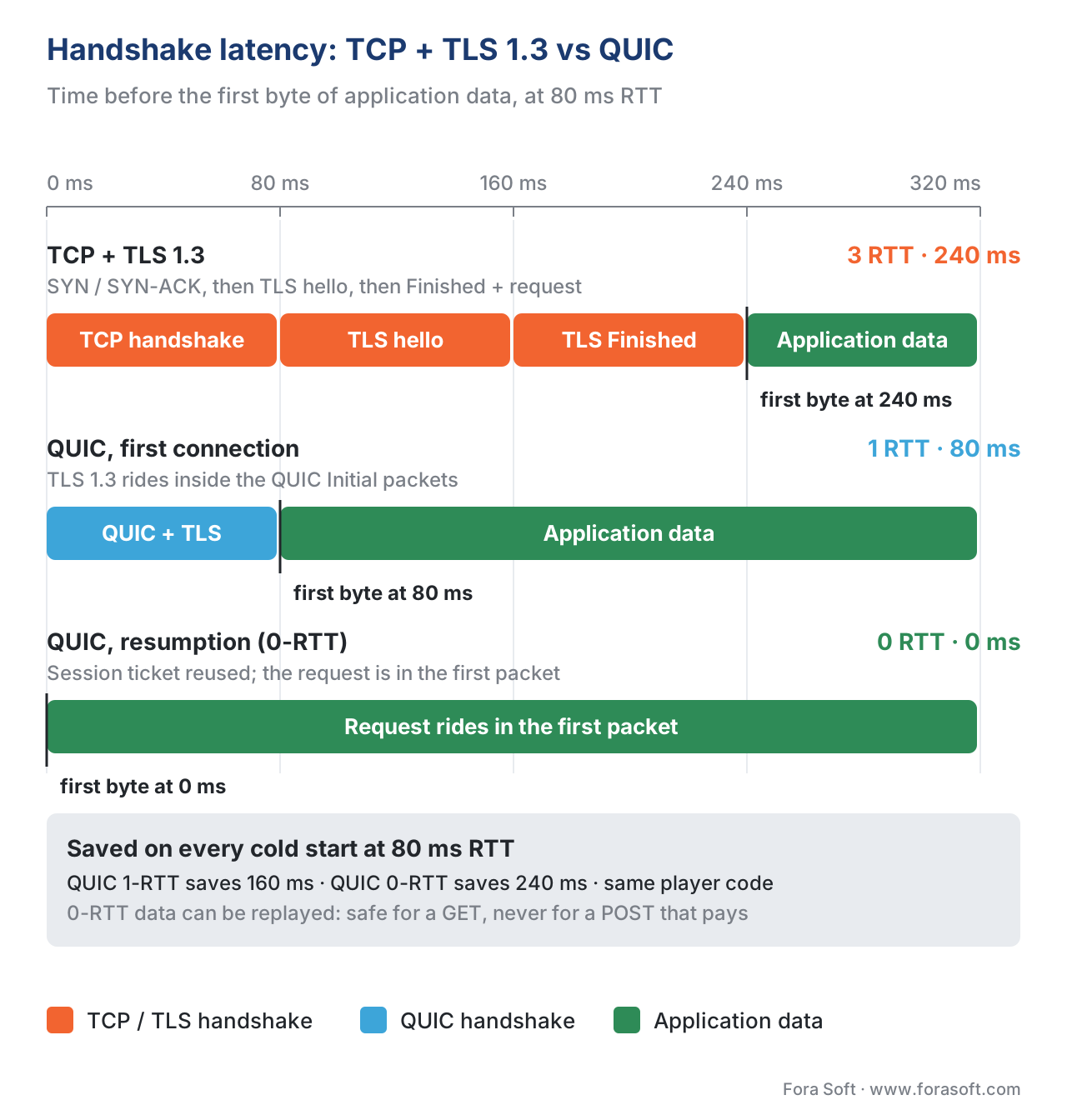 Figure 1. The handshake difference. TCP plus TLS 1.3 needs three round trips before the first byte of data; QUIC needs one round trip on first connection and zero on resumption. At 80 ms RTT that is 240 ms saved on a cold start.
Feature 1 — The 1-RTT handshake and the 0-RTT resumption
QUIC's first design decision is to merge the transport handshake and the cryptographic handshake. There is no "TCP three-way handshake, then TLS handshake on top". The QUIC handshake is the cryptographic handshake. TLS 1.3 is the only protocol allowed (RFC 9001 makes this normative), and the CRYPTO frames that carry TLS handshake records ride inside the very first QUIC packets the client sends.
The arithmetic works like this. The client sends an Initial packet (containing a TLS ClientHello, plus enough padding to defeat amplification attacks — at least 1200 bytes). The server responds with an Initial packet (containing the TLS ServerHello) and immediately follows with one or more Handshake packets (the rest of the TLS handshake — certificate, certificate verify, finished). After one full round trip, both sides have derived 1-RTT keys, and the client can send encrypted application data in its next packet. Total round trips before the first byte of application data: one.
For a returning client — one that has connected to this server before — QUIC supports 0-RTT. The client remembers the server's TLS session ticket and the QUIC transport parameters from the previous connection. On reconnect, it sends an Initial packet plus encrypted application data in the very same UDP datagram, before the server has even acknowledged it exists. The server validates the resumption token, decrypts the 0-RTT data, and starts serving the response. Total round trips before the first byte of application data: zero.
The math on an 80 ms RTT link, by the numbers. TCP + TLS 1.3 cold start: TCP SYN (1 RTT) + TLS handshake (1 RTT) + TLS Finished + first request = 3 × 80 ms = 240 ms before the response can start streaming. QUIC cold start: 1 × 80 ms = 80 ms. QUIC 0-RTT resumption: 0 ms — the request rides inside the first packet. For a player issuing a manifest fetch, a key fetch, and the first segment fetch in serial, that is the difference between a 720 ms time-to-first-frame and a 80 ms one. The 0-RTT design has a security caveat — it offers forward secrecy only after the 1-RTT keys are derived, so 0-RTT data can be replayed by an attacker who captured the first packet, and the application must treat 0-RTT requests as replayable (a GET is fine; a POST that buys something is not). RFC 9001 §5.6 spells this out.
Feature 2 — Streams without head-of-line blocking
Inside a single QUIC connection the application can open as many streams as it wants. Each stream is an independent, ordered, reliable byte flow. The transport schedules frames from every active stream into outgoing UDP packets, and the receiver reassembles each stream's frames in order — but only within that stream.
The consequence is the feature that gives QUIC its single most important advantage over TCP for video: a packet loss on stream A delays stream A and only stream A. Stream B continues to deliver. The receiver's QUIC implementation puts stream B's bytes into the application's read buffer the moment they arrive, even if stream A has a gap waiting for retransmission.
Consider a player fetching three video segments in parallel over a single connection. Over TCP/HTTP/2, the three responses are framed over one ordered byte stream. A single 1500-byte packet loss anywhere in the connection stalls every response until that packet is retransmitted — typically one RTT later. Over QUIC, the three responses are on three different streams; the loss stalls one segment by one RTT and the other two carry on. On a 1 % loss link, this is the difference between a buffer that wobbles every few seconds and a buffer that holds steady.
There is a fine print. QUIC has connection-level flow control as well as per-stream flow control. If a receiver gets behind processing data on every stream, the connection-level flow control window will eventually fill and back-pressure the sender. And QUIC still uses one shared congestion controller across all streams (RFC 9002), which is correct — you want a single view of the path's available capacity. But within those bounds, the per-stream independence is the real win, and it is the win that makes QUIC the natural transport for HTTP/3 and for Media over QUIC.
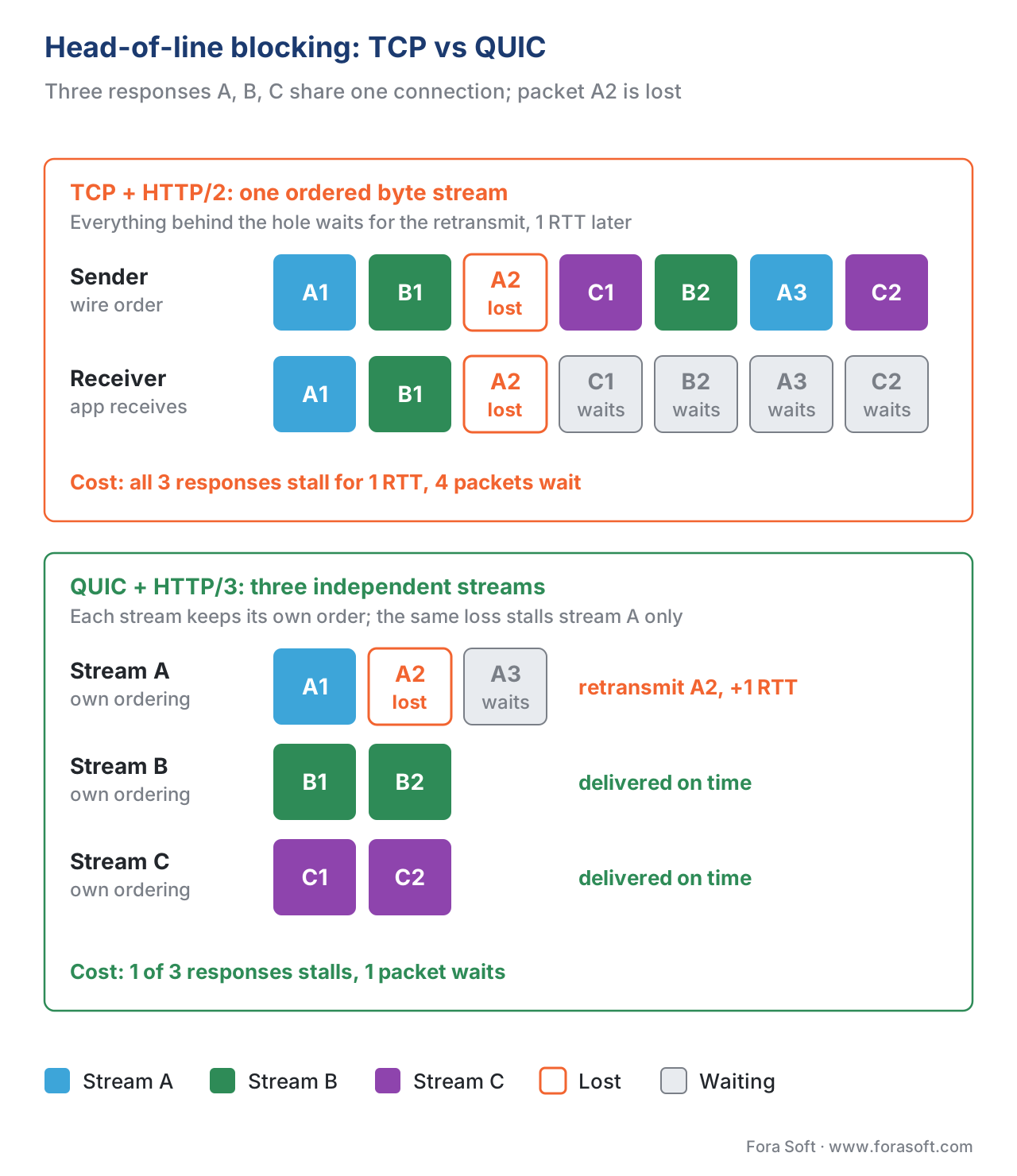 Figure 2. The head-of-line blocking difference. TCP serialises everything onto one ordered byte stream; QUIC schedules each stream independently. The same packet loss costs three segments on TCP and one segment on QUIC.
Feature 3 — Connection migration and the Connection ID
A TCP connection is named by (client IP, client port, server IP, server port). Change any number, lose the connection. A QUIC connection is named by an opaque 64-bit identifier called the Connection ID (technically a Source Connection ID and a Destination Connection ID, but the principle is the same). The Connection ID lives in the QUIC long-header packet during the handshake and in every short-header packet afterwards. The four-tuple is metadata; the Connection ID is identity.
The consequence is that a QUIC endpoint can move. A phone's IP address changes when it leaves Wi-Fi and joins 5G. Over TCP, the connection dies and the application must reconnect. Over QUIC, the phone keeps the Connection ID and sends its next packet from the new IP. The server sees an unknown four-tuple but a recognised Connection ID, validates the new path with a brief PATH_CHALLENGE / PATH_RESPONSE exchange (RFC 9000 §9), and continues to deliver to the new address. The application's stream of bytes is uninterrupted.
For a streaming product, this turns a five-second buffer pause into a non-event. A user watching a live esports match on a phone walks from the apartment Wi-Fi into the elevator (network change to 5G), and the QUIC connection migrates without dropping a frame. The player never sees the change. The CDN edge sees it as a path migration. The Connection ID is the same throughout.
Three caveats. First, the server has to support migration — it is optional in RFC 9000, and some early CDN deployments did not enable it. By 2026 the major CDNs (Cloudflare, Fastly, Akamai, AWS CloudFront) all support migration. Second, migration leaks privacy: an observer watching both the old and the new network paths can correlate the Connection IDs and learn that "this user just moved from Wi-Fi to cellular". RFC 9000 §9.5 mandates Connection ID rotation to mitigate this. Third, NAT rebinding (the same client keeping the same IP but getting a new port) is a special, common case — QUIC handles it inside the same migration machinery.
Feature 4 — Unreliable datagrams (RFC 9221) and why this changes real-time video
QUIC's default service is reliable, ordered streams. But for real-time media — video calls, live ingest, interactive broadcasts — reliability is the wrong primitive. A frame that arrives 200 ms late is useless. Retransmitting it costs network capacity that would be better spent on the next frame.
For 35 years the answer to this was UDP plus RTP. UDP gives you unreliable datagrams; RTP layers timestamps and sequence numbers on top; the application implements its own loss recovery via FEC, NACK, or simply by skipping the lost frame. The cost is that the application now runs its own crypto stack (DTLS-SRTP), its own congestion control, and its own NAT traversal — and it does not share any of that with the reliable side of its protocol.
RFC 9221 (March 2022, Proposed Standard) adds an unreliable datagram extension to QUIC. The DATAGRAM frame carries application data with no retransmission, no flow control window, and no in-order delivery. The application gets the QUIC datagram interface: send a payload, the network either delivers it or drops it, and the QUIC stack does not retry. Crucially, the datagrams ride on the same QUIC connection as any reliable streams the application is also using — so they share the same TLS 1.3 encryption context, the same Connection ID, the same congestion controller, the same path.
For a video conferencing product this means the signalling channel (reliable: who is in the call, who is muted) and the media channel (unreliable: audio and video frames) share one encrypted, NAT-traversed, congestion-controlled connection. For a Media over QUIC publisher this means audio and video objects can use either reliable streams (for elastic-latency replay) or datagrams (for tight-latency real-time) on the same connection. For a cloud-gaming product this means the input channel and the rendered-frame channel share one transport.
QUIC datagrams are the feature that lets the next decade's real-time stack converge on one transport instead of two. WebTransport (W3C Working Draft) exposes the datagram interface to browsers; iOS 17+ exposes it via Apple's QUICDatagram API. The application no longer has to choose between "reliable TLS-over-TCP" and "unreliable UDP plus DIY everything".
Feature 5 — TLS 1.3 by design
This one is shorter because it is simple: there is no unencrypted QUIC. RFC 9001 makes TLS 1.3 mandatory. The QUIC handshake is a TLS handshake. The transport itself is encrypted, including the packet number, including the header fields needed for connection identification (header protection, per RFC 9001 §5.4). Middleboxes cannot inspect QUIC the way they inspect TCP, which is the design goal — it removes the ossification problem that froze TCP's evolution for two decades.
There are operational consequences. Inspection-heavy enterprise networks that strip TLS to do DPI cannot trivially do the same for QUIC; they either tunnel QUIC, MITM the TLS, or block UDP/443 entirely (which is why many enterprise networks still see HTTP/3 fail back to HTTP/2). For a streaming product, the relevant takeaway is that the privacy story is strictly better than TCP-with-optional-TLS, and the encryption is not something the application can opt out of for performance — it is the substrate.
How QUIC packets look on the wire
For the curious developer or the engineer about to debug a packet capture: QUIC packets come in two header shapes. Long-header packets are used during the handshake and for version negotiation — they carry the QUIC version, the Destination Connection ID, the Source Connection ID, and a packet-type field (Initial, 0-RTT, Handshake, Retry). Short-header packets are used after the handshake completes for all application data — they carry only a Destination Connection ID and an encrypted packet number, and they are the bulk of every QUIC connection by byte count.
Inside the packet, payloads are made of frames. A frame is the unit of QUIC's application-protocol vocabulary. The relevant frame types for a streaming engineer:
STREAM— carries application data for a specific stream.CRYPTO— carries TLS handshake records.ACK— acknowledges received packets.DATAGRAM(RFC 9221) — carries unreliable datagram payload.PATH_CHALLENGE/PATH_RESPONSE— verifies a path during connection migration.CONNECTION_CLOSE— terminates the connection.MAX_DATA/MAX_STREAM_DATA— flow-control updates.
Multiple frames can ride in a single packet; multiple packets can be coalesced into a single UDP datagram. The "thing on the wire" is a UDP datagram with one or more QUIC packets in it, each packet carrying one or more frames. This is why QUIC traces look denser than TCP traces — there is more structure per datagram, because everything the connection does (acks, flow control, data, crypto) is multiplexed into the same packet shape.
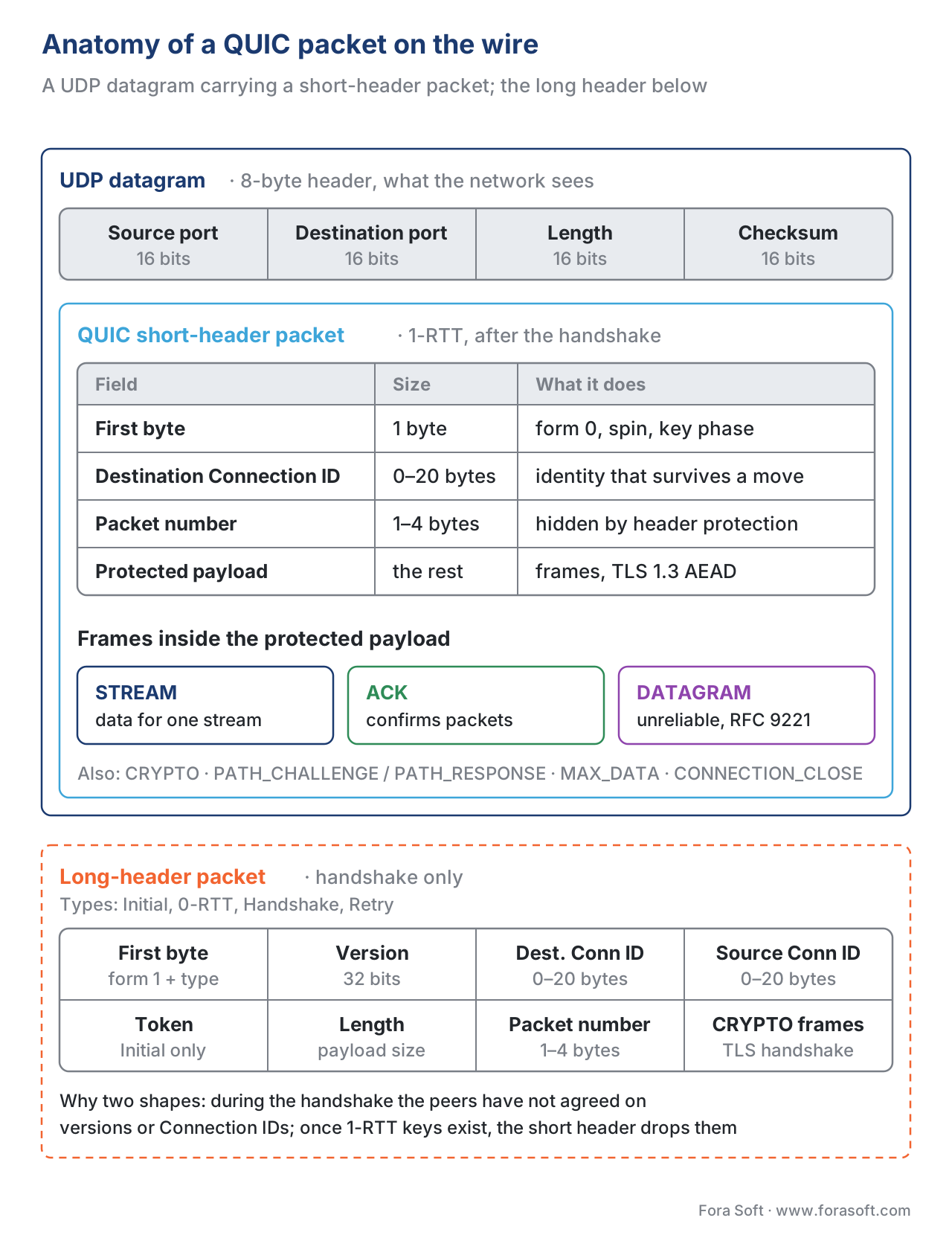 Figure 3. The anatomy of a QUIC packet. Most application traffic uses the short-header form. Long-header packets appear during the handshake.
QUIC, HTTP/3, WebTransport, MoQ — how the pieces fit
QUIC is the transport. Several application protocols ride on top of it. For a streaming engineer, the four that matter are HTTP/3, WebTransport, Media over QUIC (MoQ), and QUIC-native protocols like the IETF's experimental work on QUIC-based RTP.
HTTP/3 (RFC 9114, June 2022) is HTTP semantics over QUIC. Every request becomes a bidirectional QUIC stream. The header-compression scheme is QPACK (RFC 9204), redesigned from HTTP/2's HPACK to remove the cross-stream blocking that HPACK caused on a lossy link. HTTP/3 inherits QUIC's 0-RTT, stream independence, and connection migration. Any 2026 video product served from a modern CDN gets HTTP/3 by default — manifest fetches, segment fetches, key fetches, all of it.
WebTransport (W3C Working Draft as of 2026) is a browser API that exposes QUIC's streams and datagrams to JavaScript. Where WebSocket gives the web a reliable bidirectional channel and nothing else, WebTransport gives the web a QUIC connection with all the trimmings. Adoption in 2026: Chrome, Edge, and Firefox have shipped it; Safari has the underlying QUIC stack and a WebTransport implementation in development. For a browser-side video product, WebTransport is the modern alternative to a WebSocket-plus-WebRTC stack.
Media over QUIC (MoQ) is the IETF working group producing the first protocol designed from scratch for live video transport over QUIC. The transport draft (draft-ietf-moq-transport-17, January 2026) defines a publish-subscribe model where a publisher emits tracks of objects (audio frames, video frames, captions), relays cache and forward them, and subscribers receive only the objects they need. It runs over raw QUIC for native clients and over WebTransport for browser clients. The QUIC DATAGRAM extension (RFC 9221) is mandatory. MoQ is the protocol most likely to replace RTMP for contribution and to compete with LL-HLS / LL-DASH for delivery; the major adopters in 2026 are Twitch (publicly committed), YouTube (experimenting), Meta (mvfst-based experiments), and Cloudflare (the moq-rs reference implementation).
The architectural picture: at the bottom, QUIC and TLS 1.3. Above it, HTTP/3 for traditional segmented streaming, WebTransport for browser real-time, MoQ for low-latency live, and direct QUIC for specialised native applications. The same TLS context, the same congestion controller, the same connection migration story underneath all of them. This is the convergence story that justifies the cost of learning QUIC: one transport, one security model, four application protocols, the whole modern streaming stack on top.
Performance: what QUIC actually gives you in 2026
The benchmarks below are the headline numbers from production measurements published in 2024–2026. They are useful as orders of magnitude, not as absolute promises — the gain on your link depends on RTT, loss rate, and the application protocol layered on top.
| Metric | TCP + TLS 1.3 + HTTP/2 | QUIC + HTTP/3 | Source |
|---|---|---|---|
| Cold-start handshake (1 RTT = 80 ms) | 240 ms | 80 ms | RFC 9000 §4 (architectural); confirmed by Cloudflare measurements |
| Warm-start handshake (resumption) | 80 ms (TLS session resumption) | 0 ms (0-RTT) | RFC 9001 §5.6 |
| Time-to-first-byte on 4G (median, global) | 380 ms | 180 ms | Cloudflare HTTP/3 deployment report, 2023 |
| Throughput on 1 % random loss, 80 ms RTT, 100 Mbps link | Capped near 5 Mbps (Mathis on CUBIC) | 80+ Mbps (BBR over QUIC) | derived from RFC 9438, draft-ietf-ccwg-bbr-05 |
| Connection survival across Wi-Fi-to-5G handover | No (connection drops) | Yes (migration) | RFC 9000 §9 |
| Browser support | All browsers (HTTP/2) | All major browsers (HTTP/3 since 2022) | W3C / browser release notes |
| Share of public-internet HTTP traffic (April 2026) | HTTP/2: ~51 % | HTTP/3: ~21 % | Internet Society Pulse, 2026 |
| Share of Meta's own traffic (2024+) | ~25 % | ~75 % | Meta engineering blog |
A worked example: time-to-first-frame on a phone
A founder asks why a streaming MVP's time-to-first-frame on a 4G phone in Mexico City is 1.8 seconds, when the same player on a wired desktop in the same building shows 600 ms. The phone's link reports 90 ms RTT to the CDN edge and a 1.5 % loss rate during peak.
Step one: enumerate the handshake cost. The player fetches the manifest (m3u8 or mpd), one decryption key (license.acquire), and the first media segment. On HTTPS/HTTP/2 over TCP: 3 RTTs × 90 ms = 270 ms for the connection setup, then 1 RTT for the manifest, 1 RTT for the key, 2 RTTs for the segment (HTTP/2 has head-of-line blocking on a single connection over TCP, so the three responses serialise on a loss event). Roughly 270 + 90 + 90 + 180 = 630 ms of round-trip cost on a clean link, and the 1.5 % loss adds approximately 1 retransmission × 90 ms = 90 ms per stalled response. Order of magnitude: 700–900 ms before the segment can be decoded.
Step two: enumerate the same path over QUIC/HTTP/3. Connection setup: 1 RTT × 90 ms = 90 ms (0-RTT if the player has been there before — call it 0–90 ms). Manifest, key, and segment fetched on three QUIC streams in parallel: bounded by the slowest fetch, so 1 RTT × 90 ms = 90 ms each, with parallel scheduling. The 1.5 % loss touches one of the three streams; the other two finish on schedule. Order of magnitude: 200–300 ms before the segment can be decoded.
Step three: the difference is 400–600 ms in the player's measured time-to-first-frame. The player code does not change. The CDN's HTTP/3 endpoint is one config flag. The phone's QUIC support is built into iOS 15+ and Android 10+ media stacks.
This is the kind of win that does not require a rewrite. The decision is "do we serve HTTP/3 from our CDN edge", not "do we rewrite our player".
Common mistakes and pitfalls
- Treating QUIC as "HTTP/3 only". QUIC is a transport. HTTP/3 is one application that uses it. WebTransport, MoQ, and direct-QUIC applications use the same transport without HTTP/3 in the picture. A product team that conflates the two will miss the WebTransport and MoQ stories.
- Forgetting the UDP/443 blocking problem. Enterprise networks that block UDP outbound on port 443 will silently fall back to HTTP/2 over TCP. For consumer-facing products this is rarely a problem; for B2B SaaS with corporate-network audiences it is. Test from inside a representative customer's network before claiming HTTP/3 in your SLA.
- Using 0-RTT for non-idempotent requests. RFC 9001 §5.6 is explicit: 0-RTT data can be replayed by an attacker who captured the first packet. A GET that fetches a manifest is safe; a POST that buys something or starts a payment is not. The application must annotate which requests can use 0-RTT.
- Believing that connection migration is automatic on every stack. Migration is optional in RFC 9000 §9. Some early CDN deployments and some library versions did not enable it. Test in production by changing networks mid-stream and verifying the connection survives.
- Ignoring the congestion-control coupling. QUIC's congestion controller (per RFC 9002) is a separate setting from the host's TCP congestion controller. Picking BBR for TCP does nothing for QUIC; you have to also pick BBR (or whatever) in the QUIC application library (mvfst, quiche, ngtcp2, msquic). The two must match the use case independently.
- Assuming Safari ships everything on day one. Safari shipped HTTP/3 across iOS 17 / macOS Sonoma. WebTransport, MoQ, and the full QUIC datagram API have varying degrees of Safari support in 2026; on iOS 17–18 some features are still in beta or behind a flag. Read each feature's caniuse table before promising browser support.
- Reading a QUIC trace as if it were TCP. Packet captures look different. Wireshark needs the TLS keys (logged via
SSLKEYLOGFILE) to decrypt the payload. Without the keys the trace is encrypted noise. Plan for that during incident-response training.
How to roll out QUIC on a streaming product in 2026
A pragmatic three-step roll-out for a team that already runs an HTTP/2-over-TCP stack.
- Turn on HTTP/3 at the CDN edge. Every major CDN (Cloudflare, Fastly, Akamai, AWS CloudFront, Google Cloud CDN, Azure Front Door, KeyCDN, BunnyCDN) supports HTTP/3 with a single config flag in 2026. Enable it for the entire site; the CDN will negotiate HTTP/3 with clients that support it and fall back to HTTP/2 with clients that do not. Capture before/after metrics for time-to-first-frame, rebuffer rate, and segment-download P95.
- Pair the QUIC stack with BBR. Whether you run a managed CDN or a self-hosted origin, ensure the QUIC implementation underneath uses BBR (or BBRv3) as the congestion controller. On mvfst, quiche, ngtcp2, and msquic this is a configuration string. The wins from QUIC's transport features are amplified by BBR's loss-tolerance.
- Build a WebTransport / MoQ pilot for the lowest-latency use case. Pick the single use case where sub-second glass-to-glass latency matters most — sports betting, esports, interactive auction, telemedicine consultation. Prototype a MoQ-based ingest and delivery path on a non-production audience. Use Cloudflare's
moq-rsor Meta'smvfst-moqas the reference implementation. The goal is not production traffic in 2026; it is to know how the protocol behaves on your real network by the time MoQ ships as a Proposed Standard (expected 2027).
The full roll-out checklist is in the downloadable QUIC Adoption Checklist.
Free download: QUIC Adoption ChecklistOne printable page for deciding on QUIC, HTTP/3, WebTransport and MoQ in a 2026 streaming product: the three-step CDN roll-out, the BBR pairing, the WebTransport and MoQ pilot, and the seven pitfalls from this article.Where Fora Soft fits in
We have shipped 239+ projects since 2005 across video streaming, WebRTC conferencing, OTT, telemedicine, e-learning, video surveillance, and AR/VR — and the transport-layer choice shows up in every one. On OTT and live-streaming products we run HTTP/3 on the CDN edge for any audience that converts in mobile-heavy regions, and we pair BBR-over-QUIC for congestion control so the wins on lossy 4G/5G links stack. On WebRTC video conferencing products we are tracking the Media over QUIC working group closely; for clients building greenfield real-time products in 2026, we evaluate WebTransport plus MoQ alongside the established SFU stack, and we have prototyped MoQ relays on internal pilots. On telemedicine and e-learning products we treat connection migration as a clinical-grade requirement: a consultation that drops because a patient's phone changed networks is a billable failure, and QUIC turns it into a non-event. The pattern is not "QUIC everywhere"; it is "QUIC wherever a network change, a lossy link, or a tight first-frame budget matters — and TCP only where there is a concrete reason to stay". Our Media over QUIC and QUIC development team builds sub-second MoQ and WebTransport delivery, and our video streaming developers roll HTTP/3 into existing HLS and DASH stacks.
The book
Video Streaming: A Complete Guide to Video Delivery: From Network Protocols and Transport to Ingest, HLS, and MPEG-DASH
This article covers QUIC in 24 minutes. Book 2 puts it in its place in the transport stack: what TCP and UDP each give a video stream, how BBR and CUBIC decide your throughput on a lossy 4G link, how QUIC and HTTP/3 change the handshake and the segment fetch, and what that means for HLS, MPEG-DASH and CMAF delivery. Book 3 continues with ABR, CDNs, players and WebRTC at scale. Written by Nikolay Sapunov, CEO at Fora Soft.
Will HTTP/3 cut your time-to-first-frame?
Tell us where your viewers are, what share watch on mobile and which CDN you run today. We will estimate the handshake and loss savings for your RTT, check who in your audience blocks UDP/443, and plan the HTTP/3, BBR and MoQ steps in order. 250+ video products shipped since 2005.
See our case studies
Case study
Worldcast Live
HD concerts at 0.4–0.5 s glass-to-glass for 10,000 simultaneous viewers at 1.5 Gb/s: the latency class where every round trip in the handshake shows up on screen.
Case study
Sprii
Sellers stream from iOS and Android phones over RTMP or WebRTC, delivered through Cloudflare to web stores: 72,000+ live events where lossy mobile links are the norm.
Case study
CirrusMed
HIPAA-compliant browser video visits for 20+ physicians across 48 US states: a consultation that drops when a patient's phone changes networks is a failed visit.
What to read next
Transport
TCP, UDP, and the Choice Every Streaming Protocol Must Make
The two transports QUIC was built on top of and around.
Delivery
Media over QUIC (MoQ) In Depth: The 2026 Turning Point
The live-video protocol designed from scratch on QUIC.
Browser
WebTransport and WHIP-over-WebTransport
QUIC streams and datagrams exposed to JavaScript.
Network
Last Mile Reality: Mobile, Satellite (Starlink), 5G, Wi-Fi 6/7
The handovers and loss that connection migration answers.
References
- IETF RFC 9000, "QUIC: A UDP-Based Multiplexed and Secure Transport", May 2021 — Standards Track. Primary normative source for QUIC v1 including the handshake, streams, connection IDs, and migration. https://datatracker.ietf.org/doc/html/rfc9000
- IETF RFC 9001, "Using TLS to Secure QUIC", May 2021 — Standards Track. Defines mandatory TLS 1.3 integration, the CRYPTO frame, header protection, and the 0-RTT replay caveat. https://datatracker.ietf.org/doc/html/rfc9001
- IETF RFC 9002, "QUIC Loss Detection and Congestion Control", May 2021 — Standards Track. Reference loss-detection and congestion-control behaviour. https://datatracker.ietf.org/doc/html/rfc9002
- IETF RFC 8999, "Version-Independent Properties of QUIC", May 2021 — Standards Track. The invariants that any future QUIC version must preserve. https://datatracker.ietf.org/doc/html/rfc8999
- IETF RFC 9221, "An Unreliable Datagram Extension to QUIC", March 2022 — Proposed Standard. Adds the DATAGRAM frame and the transport-parameter negotiation. https://datatracker.ietf.org/doc/html/rfc9221
- IETF RFC 9114, "HTTP/3", June 2022 — Standards Track. HTTP semantics over QUIC, including QPACK and the new framing layer. https://datatracker.ietf.org/doc/html/rfc9114
- IETF RFC 9204, "QPACK: Field Compression for HTTP/3", June 2022 — Standards Track. The HTTP/3 header-compression scheme designed to avoid HTTP/2's HPACK head-of-line blocking. https://datatracker.ietf.org/doc/html/rfc9204
- IETF draft-ietf-moq-transport-17, "Media over QUIC Transport", January 2026 — Internet-Draft, subject to revision before RFC publication. The publish-subscribe protocol designed for live media on QUIC; mandates RFC 9221 datagrams. https://datatracker.ietf.org/doc/draft-ietf-moq-transport/
- W3C, "WebTransport", Working Draft 2025 (most recent revision tracked at https://www.w3.org/TR/webtransport/). Browser API exposing QUIC streams and datagrams to JavaScript.
- IETF draft-ietf-ccwg-bbr-05, "BBR Congestion Control", March 2026 — Internet-Draft. BBRv3, the de-facto congestion controller of choice for QUIC in production. https://datatracker.ietf.org/doc/draft-ietf-ccwg-bbr/
- Fastly Engineering, "QUIC is now RFC 9000", May 2021. Vendor confirmation and commentary on RFC publication; tier-3 source used for adoption context only. https://www.fastly.com/blog/quic-is-now-rfc-9000
- Cloudflare Engineering, "Examining HTTP/3 usage one year on" (2023) and "MoQ: Refactoring the Internet's real-time media stack" (2024). Tier-3 deployment data for HTTP/3 share and Media over QUIC progress. https://blog.cloudflare.com/http3-usage-one-year-on/ and https://blog.cloudflare.com/moq/
- Meta Engineering, "How Meta uses HTTP/3 and QUIC for video delivery" (mvfst documentation and engineering blog). Tier-3 source for Meta's ~75 % QUIC traffic share. https://engineering.fb.com/2023/04/24/networking-traffic/quic-meta-traffic-rollout/
- Internet Society Pulse, "HTTP protocol share, monthly snapshots 2024–2026". Tier-4 measurement of the global HTTP/2 vs HTTP/3 mix. https://pulse.internetsociety.org/
