


Why This Matters
Video over the public internet is, almost without exception, video over HTTP. A live HLS stream is a series of HTTP GETs for .m3u8 playlists and .ts or .m4s segments. A Netflix episode is a series of HTTP GETs for DASH .mpd and CMAF segments. A telemedicine session that records to cloud storage uploads the recording with HTTP PUTs. A WebRTC product still uses HTTP for the signalling channel, for the TURN credentials API, for analytics. The version of HTTP underneath all of that — 1.1, 2, or 3 — sets the floor on how fast your player starts, how often it rebuffers, and how it behaves when a phone walks from Wi-Fi to 5G. A product manager, a founder, or an engineering lead who picks the wrong default in 2026 will ship a player that is 400–800 milliseconds slower to first frame than it needs to be on mobile. That is the difference between a launch metric the board congratulates and one the board questions. This article explains what each version actually does, where each one wins and loses, and how to pick the right defaults for a streaming product in 2026.
What HTTP is, in one paragraph
HTTP — Hypertext Transfer Protocol — is the application protocol that defines how a client (a browser, a video player, a mobile app) asks a server for a resource and how the server replies. It sits at the top of the network stack: above the transport (TCP or QUIC), above the security layer (TLS), above the network (IP). Every HTTP request has a method (GET, POST, PUT, DELETE), a URL, and a set of headers; every HTTP response has a status code (200, 304, 404), a set of headers, and a body. The semantics — what the request means, what the status codes mean — have not changed since the 1990s and are now codified in a single document, RFC 9110 (June 2022). What has changed is how that semantic conversation is encoded on the wire and how requests are multiplexed when there are many of them at once. That on-the-wire encoding is what we mean by "HTTP/1.1", "HTTP/2", or "HTTP/3". For a streaming product, the encoding decides the time-to-first-frame, the rebuffer rate, and the cost of every additional concurrent stream a player opens.
A 30-second history of HTTP versions
HTTP/0.9 (1991) was a one-line protocol: GET /index.html and the server returned the document. HTTP/1.0 (RFC 1945, May 1996) added headers, status codes, and content types — the conversation became negotiable. HTTP/1.1 (RFC 2068, January 1997; revised through RFC 2616 in 1999, then RFC 7230–7235 in 2014, then RFC 9112 in June 2022) added persistent connections, request pipelining (largely abandoned in practice), virtual hosting via the Host header, chunked transfer encoding, range requests (the feature that makes HTTP-based streaming possible), and caching semantics. HTTP/2 (RFC 7540, May 2015; revised in RFC 9113, June 2022) is HTTP/1.1's semantics over a new binary framing layer, with multiplexed streams over a single TCP connection, header compression (HPACK), and an ill-fated server push feature. HTTP/3 (RFC 9114, June 2022) moves the same semantics onto QUIC (RFC 9000, May 2021) — a UDP-based, TLS-1.3-encrypted transport with independent streams that do not suffer from TCP's head-of-line blocking. Four versions, three of them still in production. The streaming engineer's job is to know what each one costs and what each one gives.
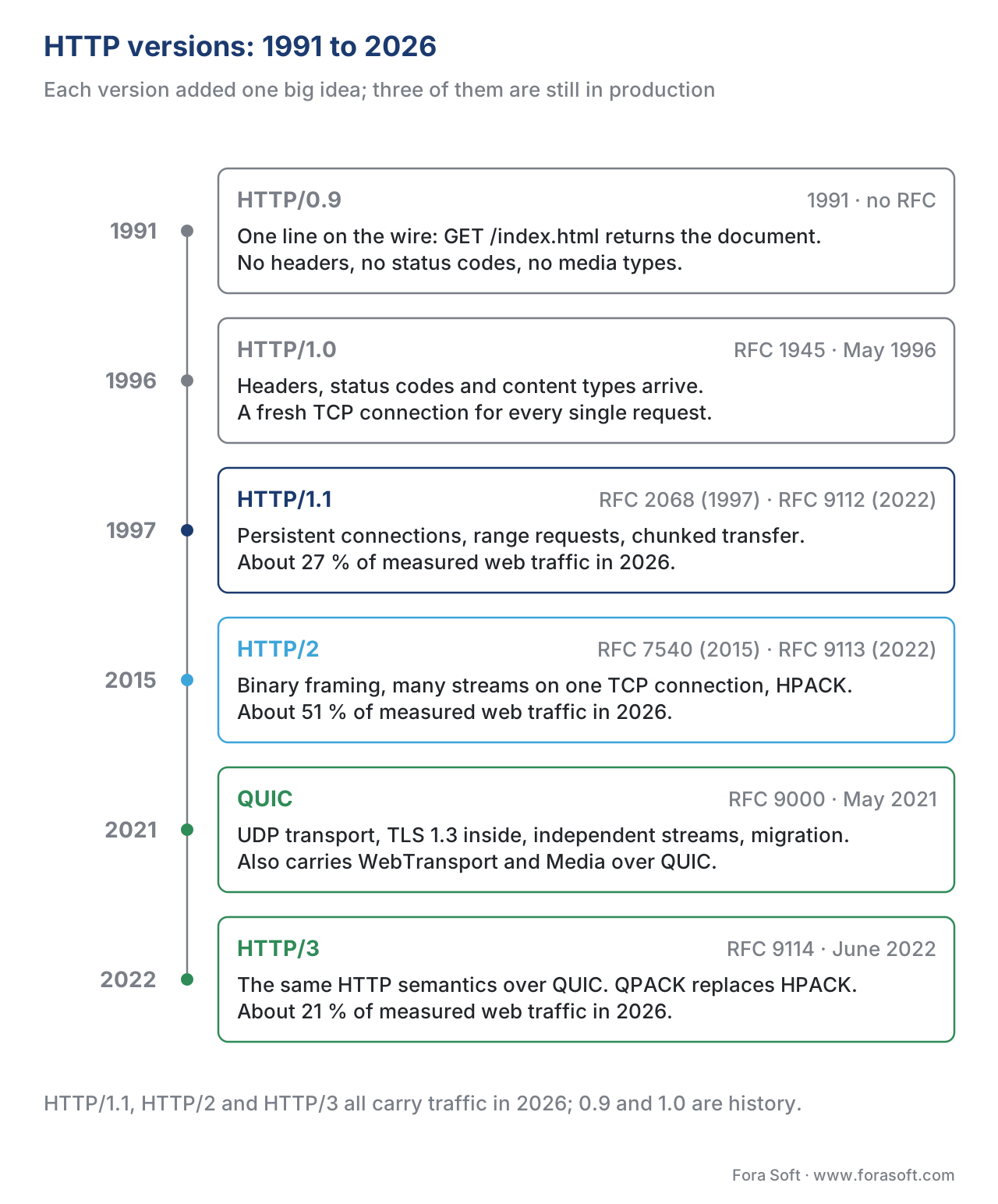 Figure 1. Thirty-five years of HTTP. Each version added one big idea: 1.0 added headers; 1.1 added persistent connections and ranges; 2 added multiplexing and binary framing; 3 swapped TCP for QUIC.
HTTP/1.1 in depth — and why it still matters in 2026
The thing to remember about HTTP/1.1, the version that still serves about 27 % of measured website traffic in 2026, is that the protocol moves one request at a time per connection. The TCP connection stays open between requests — that is what "persistent connection" means, and as of RFC 9112 it is the default behaviour with no Connection: Keep-Alive header required — but the request-and-response cycle is serial. The client sends a request, waits for the server to send the full response, then sends the next request. Browsers worked around the serial limit by opening multiple parallel TCP connections to the same host, six per origin in most desktop browsers, four per origin on mobile.
There is a feature called pipelining — the client sends multiple requests back-to-back without waiting for the first response, and the server replies in the same order. RFC 9112 still defines it, but in practice every major browser disabled pipelining a decade ago and never re-enabled it. The reason: HTTP/1.1 pipelining is constrained by request-response ordering, which means a single slow response stalls every later response on the same connection. This is called application-layer head-of-line blocking, and it is the original sin that HTTP/2 was designed to fix.
For a video player, the implications are concrete. A typical adaptive-bitrate session over HTTP/1.1 opens six TCP connections to the CDN edge and reuses them across the manifest, key, and segment fetches. The first frame's wall-clock time is dominated by three round trips of TCP and TLS handshake before the first manifest can be requested, plus the round trip to fetch the manifest, plus the round trip to fetch the first segment. On an 80 ms RTT link that is a 320–400 ms floor before the decoder sees a byte. Loss recovery happens at the TCP layer, transparently to HTTP. Range requests (the Range: bytes=… header) make byte-range segment download work, which is what every modern HLS and DASH player uses for byte-range addressing inside a fragmented MP4.
HTTP/1.1's strengths in 2026 are simplicity and ubiquity. Every load balancer, every reverse proxy, every CDN, every embedded device speaks it. Its weaknesses are the six-connection limit per origin and the serial request-response cycle. For a video player downloading a dozen manifest, key, audio, and video resources in the first second of playback, those six connections become a bottleneck.
HTTP/2 in depth — multiplexing, HPACK, and the server-push graveyard
HTTP/2, standardised in RFC 7540 in May 2015 and superseded by RFC 9113 in June 2022, kept HTTP's semantics and replaced the wire format. The text-based "headers, blank line, body" of HTTP/1.1 became a binary stream of frames. Each frame carries a stream identifier and a frame type — HEADERS, DATA, SETTINGS, WINDOW_UPDATE, RST_STREAM, PRIORITY, PING, GOAWAY, PUSH_PROMISE. Multiple streams ride over the same TCP connection at the same time. The single biggest practical win: a player can issue dozens of concurrent requests over one connection with no head-of-line blocking at the application layer.
The header-compression story is its own chapter. HPACK (RFC 7541) compresses HTTP headers using a static table of common header names and values, plus a dynamic table that learns from the actual headers the connection has seen. The compression rate is high — many segment requests differ only in the URL — but HPACK has a known weakness: because the dynamic table is shared across all streams, an HPACK update on one stream can stall the decoding of every later stream until the update is delivered. This is application-layer head-of-line blocking sneaking back in through the header-compression door. HTTP/3 fixed it with QPACK; we get to that below.
HTTP/2 also introduced server push. The server could pre-emptively send resources the client had not yet asked for — the canonical example being the CSS and JavaScript a server knew the HTML it had just sent would request next. For streaming, server push was briefly the foundation of Low-Latency HLS: Apple's original 2019 LL-HLS specification required HTTP/2 push so that partial-segment delivery could happen without an extra round trip. In September 2023 Apple removed the HTTP/2 push requirement from the HLS Authoring Specification and replaced it with the #EXT-X-PRELOAD-HINT mechanism, because the browsers stopped supporting push. Chrome 106 (October 2022) disabled server push by default. Firefox 132 (October 2024) removed support entirely. By 2026 server push is dead in every mainstream browser. If you read an article that lists HTTP/2 push as a low-latency streaming feature, the article is out of date — check the publication date.
The harder limit of HTTP/2 is the one it could not fix because the fix lived below the protocol: TCP head-of-line blocking. HTTP/2's many streams ride over a single TCP byte stream. TCP delivers bytes in order. If packet 47 of any stream is lost, the receiver's TCP buffer holds every later packet — across every stream — until packet 47 arrives. On a clean wired link with 0.01 % loss this is invisible. On a 4G phone with 1 % loss this is the difference between a buffer that wobbles every few seconds and a buffer that holds steady. Every academic paper on HTTP/2-over-cellular flagged this from 2016 onwards. The fix required moving off TCP. The fix is HTTP/3.
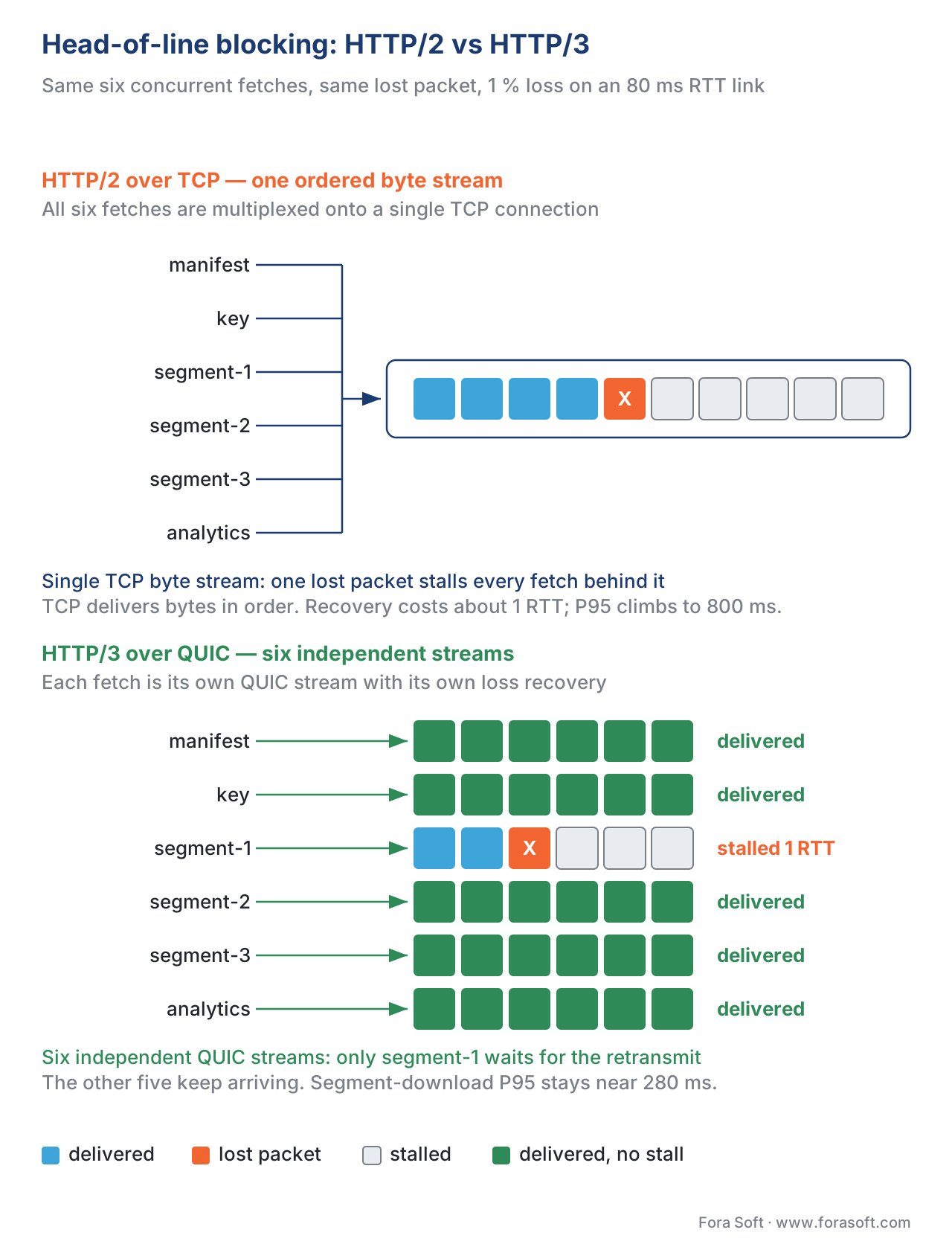 Figure 2. The transport-level head-of-line blocking that HTTP/2 cannot fix and HTTP/3 does. HTTP/2 multiplexes streams onto one ordered TCP byte stream; HTTP/3 multiplexes streams onto independent QUIC streams. The same loss costs every concurrent stream on HTTP/2 and one stream on HTTP/3.
HTTP/3 in depth — HTTP semantics over QUIC, without the TCP tax
HTTP/3 (RFC 9114, June 2022) keeps HTTP's semantics, keeps the binary-frame design that HTTP/2 introduced, and changes one thing underneath: the transport. Where HTTP/2 ran on TCP + TLS, HTTP/3 runs on QUIC (RFC 9000, May 2021). QUIC is a UDP-based transport that integrates TLS 1.3, multiplexes independent streams without TCP's ordering constraint, and survives a change in the client's IP address. We have a whole article on the QUIC transport at QUIC: The New Transport Layer; this section focuses on what changes when HTTP rides on top of QUIC instead of on top of TCP.
Three changes matter for a streaming product.
First, the handshake gets cheaper. HTTP/2 + TLS 1.3 over TCP needs three round trips before the first byte of application data — TCP handshake (1 RTT), TLS handshake (1 RTT in TLS 1.3), and the first request itself (1 RTT). HTTP/3 over QUIC merges the transport and cryptographic handshakes into a single 1-RTT exchange, and on resumption can use QUIC's 0-RTT to send the first request in the very first packet. On an 80 ms mobile link the cold-start saving is 160 ms; the warm-start saving is the full 240 ms.
Second, the head-of-line blocking is fixed at the transport. Each HTTP/3 request is a single bidirectional QUIC stream. A lost packet on stream A delays stream A and only stream A. A player downloading three segments in parallel sees one of them stall for one RTT and the other two continue uninterrupted. On a 1 % loss link, this is the difference between a P95 segment-download time of 800 ms and 280 ms.
Third, the connection survives a network change. A TCP connection dies the moment any of (client IP, client port, server IP, server port) changes. A QUIC connection is identified by an opaque 64-bit Connection ID, and the client can move to a new IP and the server validates the new path with a brief PATH_CHALLENGE / PATH_RESPONSE exchange. A user walks from Wi-Fi into the elevator and onto 5G, and the player never sees a buffer event. On HTTP/2 over TCP, that same migration is a 2–5 second reconnection.
The header-compression story also improved. HTTP/3 uses QPACK (RFC 9204), the successor to HPACK that was specifically designed to avoid the dynamic-table head-of-line blocking. QPACK runs its compression-state updates on dedicated unidirectional streams, separating them from the request-and-response data streams, so a stalled state update never holds up a response. The trade-off is a slightly lower compression ratio, but the head-of-line blocking risk is gone.
What does not change is the HTTP semantics. The same GET on /manifest.m3u8 returns the same playlist, with the same headers, the same status codes, the same caching behaviour. A player that already knows HTTP/2 needs no logic changes to consume HTTP/3 — the underlying library negotiates the version with the server and the application sees the same response object. This is the operational story that lets every major CDN enable HTTP/3 with a single config flag.
Where HTTP versions actually sit in a streaming session
The HTTP version is negotiated at the start of a connection. The client offers what it supports; the server picks the highest version both can speak. On a modern browser-to-CDN connection in 2026, the negotiation is:
- The client opens an HTTPS connection. It sends a TLS ClientHello that advertises ALPN identifiers —
h3,h2,http/1.1. ALPN (Application-Layer Protocol Negotiation, RFC 7301) is the TLS extension that lets the parties pick the HTTP version inside the TLS handshake itself, without an extra round trip. - If the client advertised
h3and the server returned anAlt-Svcheader on a previous connection telling the client which UDP port to try, the client opens a QUIC connection in parallel on UDP/443 and races it against the TCP/TLS connection. Whichever completes first wins; the other is dropped. - The server replies with the ALPN identifier it picked. The HTTP version is now locked for the lifetime of the connection.
For a streaming session this means the first connection a fresh client makes to a CDN edge may downgrade to HTTP/2 because the client has not yet learned the Alt-Svc hint. Subsequent connections — and they happen quickly, because every manifest, key, segment, and analytics beacon goes through the CDN — use HTTP/3. Browsers cache Alt-Svc hints for the lifetime of the browser session, sometimes longer. CDNs that want HTTP/3 to "stick" set long Alt-Svc ma= (max-age) values; Cloudflare, Fastly, and Akamai all default to multi-week caching.
The other detail that matters: HTTP/3 on UDP/443 is sometimes blocked by enterprise firewalls and middleboxes that only allow TCP/443. The browser silently falls back to HTTP/2 over TCP in that case. For a streaming product whose audience is consumers on home networks and mobile carriers, HTTP/3 reaches almost everyone. For a B2B SaaS product whose audience is enterprise office networks, plan for HTTP/2 over TCP to be the working version. Test from inside a representative customer network before promising HTTP/3 in your SLA.
Comparison table — HTTP/1.1 vs HTTP/2 vs HTTP/3 for streaming
| Criterion | HTTP/1.1 (RFC 9112) | HTTP/2 (RFC 9113) | HTTP/3 (RFC 9114) |
|---|---|---|---|
| Transport | TCP | TCP | QUIC over UDP |
| Encryption | Optional TLS 1.2/1.3 | Effectively required TLS 1.2/1.3 | Mandatory TLS 1.3 (built into QUIC) |
| Wire format | Text, line-oriented | Binary frames | Binary frames |
| Concurrency model | Multiple TCP connections (6/origin typical) | Multiplexed streams over one TCP connection | Multiplexed streams over one QUIC connection |
| Application-layer head-of-line blocking | Yes (pipelining stalls) | No (multiplexing fixes it) | No |
| Transport-layer head-of-line blocking | Yes (TCP ordering) | Yes (TCP ordering) | No (per-stream loss recovery) |
| Header compression | None | HPACK (RFC 7541) | QPACK (RFC 9204) |
| Server push | No | Yes (deprecated; gone from Chrome 106 / Firefox 132) | No (intentionally not included) |
| Handshake cost (cold start, 80 ms RTT) | TCP 1 + TLS 1.3 1 = 2 RTT before first request | TCP 1 + TLS 1.3 1 = 2 RTT before first request | QUIC handshake = 1 RTT |
| Handshake cost (warm resumption) | TCP 1 + TLS resumption 1 = 1 RTT | TCP 1 + TLS resumption 1 = 1 RTT | QUIC 0-RTT = 0 RTT |
| Connection migration across network change | No (connection dies) | No (connection dies) | Yes (Connection ID survives) |
| Adoption share of web traffic (April 2026, W3Techs / Cloudflare Radar) | ~27 % | ~51 % | ~21 % |
| Browser support (2026) | Universal | Universal since 2016 | Chrome, Edge, Firefox since 2022; Safari since iOS 17 / macOS Sonoma |
| Used by HLS / DASH players | Yes (default fallback) | Yes (default in 2022–2024) | Yes (default on major CDNs in 2026) |
| Used by LL-HLS | Yes (post-2023, with preload hints) | Yes (post-2023, with preload hints) | Yes |
| WebTransport / MoQ available? | No | No | Yes (both run on QUIC, alongside HTTP/3) |
A worked example — time-to-first-frame on a 4G phone
A founder asks why a streaming MVP's time-to-first-frame on a 4G phone in São Paulo is 1.4 seconds while the same player on a wired desktop in the same building shows 480 ms. The phone link reports 90 ms RTT to the CDN edge and a 1.2 % loss rate during peak.
Step one: enumerate the cost over HTTP/2 + TLS 1.3 over TCP. The player has to (1) open a TCP connection to the CDN edge (1 RTT = 90 ms), (2) complete a TLS 1.3 handshake (1 RTT = 90 ms), (3) fetch the manifest (1 RTT = 90 ms), (4) fetch the decryption key (1 RTT = 90 ms — could in principle be parallel, but the key URL is in the manifest, so it cannot start until step 3 completes), (5) fetch the first segment (1 RTT = 90 ms). Pure round-trip cost: 5 × 90 = 450 ms. Add packet-loss recovery: roughly one 1.2 % loss event on the longest fetch (segment), one TCP retransmission timeout of approximately 90 ms. Add server-side processing of around 50 ms. Add player decode setup of around 150 ms. Total: 450 + 90 + 50 + 150 = 740 ms — and the player is reporting 1.4 s, which means there is a second segment fetch or an initial buffer fill we are not accounting for. Order of magnitude: 800–1500 ms is consistent with the phone's experience.
Step two: enumerate the same path over HTTP/3 + QUIC. (1) QUIC handshake folds the transport and the TLS handshake into one round trip (1 RTT = 90 ms; 0 RTT if the player has been here before and has a session ticket — call it 0–90 ms). (2) Manifest, key, and first segment fetches use QUIC streams; with the manifest fetched first, the key and the segment fetches can start in parallel on two QUIC streams once the manifest is parsed. Bounded by the slowest fetch: 1 RTT + 1 RTT = 180 ms. (3) The 1.2 % loss event touches one of the three fetches; the other two complete unaffected. Total: 90 + 180 + 50 + 150 = 470 ms cold start; 0 + 180 + 50 + 150 = 380 ms warm start.
Step three: the difference is 320–1000 ms in time-to-first-frame. The player code does not change. The CDN's HTTP/3 endpoint is one configuration flag. The phone's QUIC support is built into iOS 15+ and Android 10+ media stacks.
This is the kind of win that does not require a player rewrite — the decision is "do we serve HTTP/3 from our CDN edge", not "do we rebuild our streaming stack".
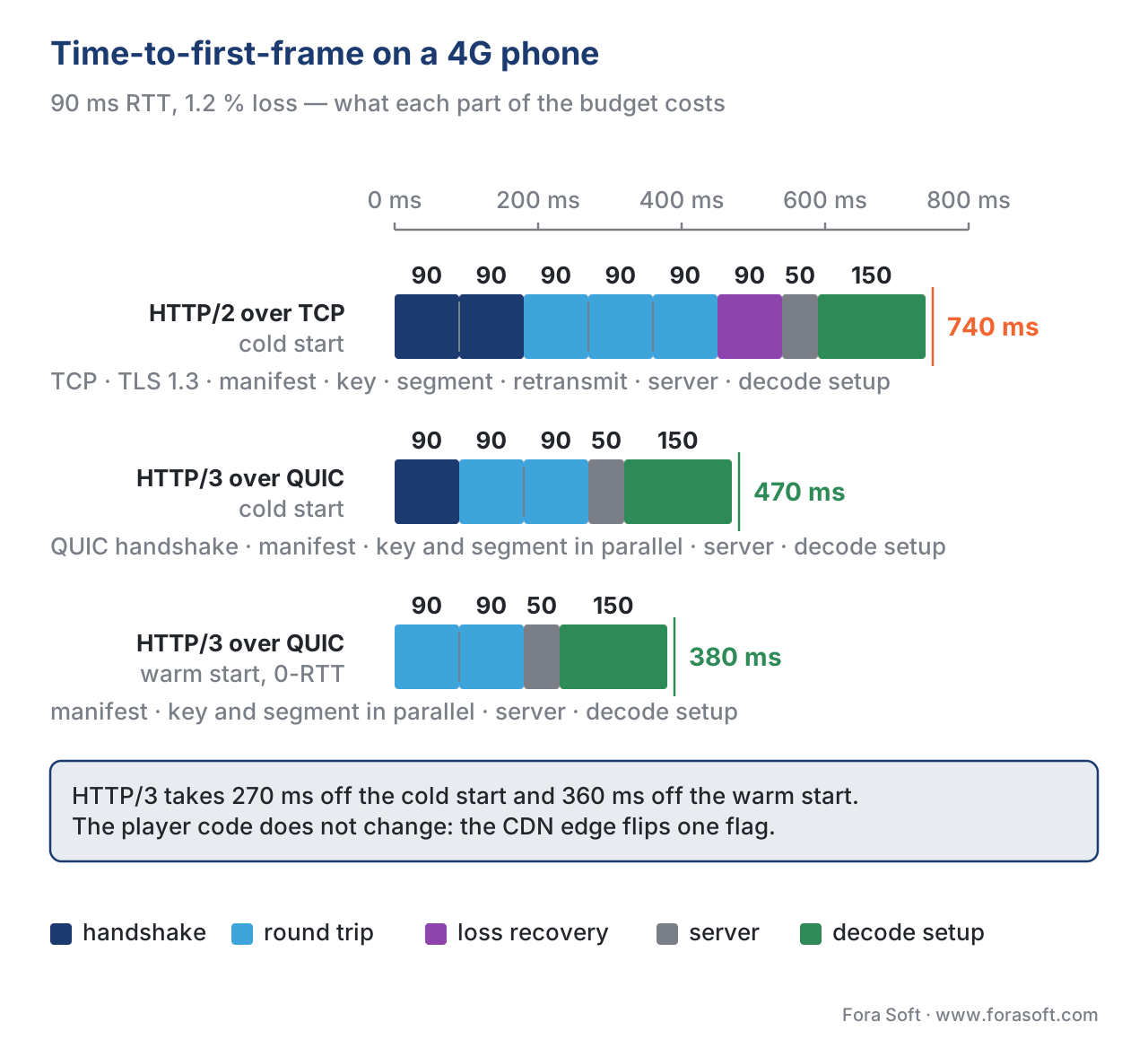 Figure 3. Time-to-first-frame for an HLS player on a 4G phone with 90 ms RTT and 1.2 % loss. HTTP/3 cuts the cold-start cost by ~270 ms and the warm-start cost by ~360 ms versus HTTP/2 over TCP.
What HTTP/3 does NOT fix
It is worth being explicit about the limits of HTTP/3, because the marketing tends to oversell them.
HTTP/3 does not fix throughput on high-bandwidth, low-loss links. A 2024 ACM Web Conference paper measured QUIC implementations losing up to 45 % of their throughput versus HTTP/2 once link capacity climbed above 500 Mbps, because the QUIC packet-processing path runs in userspace and pays a per-packet syscall cost that the kernel-based TCP stack does not. On gigabit fibre to a single client, HTTP/2 over TCP can outpace HTTP/3 today. The QUIC stacks are getting faster — io_uring, kernel-bypass paths, and GSO/GRO offload are closing the gap — but the gap is not zero in 2026.
HTTP/3 does not fix middlebox-induced UDP blocking. Enterprise networks that strip TLS to do DPI, schools that block non-port-80/443 traffic, hotel Wi-Fi that mishandles UDP — every one of these silently downgrades the client to HTTP/2 over TCP. The downgrade is graceful, but the wins are gone for that segment of the audience.
HTTP/3 does not fix the latency of a single segment fetch on a clean link. If the RTT is 80 ms and the segment is 4 seconds long, the minimum end-to-end latency from origin to player is still bounded by the segment duration, not by the HTTP version. The HTTP version improves the overhead — handshake, header compression, multiplexing, loss recovery — but it does not shrink the segment. Low-latency HLS, LL-DASH, and Media over QUIC are the protocols that attack the segment-duration floor; HTTP/3 is the transport they ride on.
HTTP/3 does not fix the cost of a slow origin. A player downloading a manifest from a CDN whose origin takes 800 ms to respond will see an 800 ms server-side cost no matter which HTTP version is in play. HTTP/3's wins are network-side; origin-side wins come from CDN architecture, origin shielding, and just-in-time packaging, which are covered in Origin shielding and tiered caching and Just-in-time packaging vs pre-packaged origin.
Adoption in 2026 — the numbers without the hype
The adoption picture in 2026 is more nuanced than the press releases suggest. The headline numbers from Cloudflare Radar and W3Techs snapshots taken in April–May 2026:
- HTTP/2 share of measured web traffic: approximately 51 %.
- HTTP/3 share of measured web traffic: approximately 21 %.
- HTTP/1.1 share of measured web traffic: approximately 27 %.
- HTTP/3 share peaked at 22 % in January 2026 and has been slowly declining since, as some traffic moves back to HTTP/2 on high-capacity links.
- HTTP/3 adoption is highest in mobile-dominant markets — Italy 30 %, Brazil 29 %, India 29 % — where CDN edges push HTTP/3 aggressively because it wins on high-RTT, lossy links.
- Meta serves approximately 75 % of its own traffic over QUIC/HTTP/3 (Meta engineering blog, 2024–2026).
- Every major CDN — Cloudflare, Fastly, Akamai, AWS CloudFront, Google Cloud CDN, Azure Front Door, BunnyCDN, KeyCDN — supports HTTP/3 by default in 2026 with a single config flag.
- Every major browser shipped HTTP/3 by 2022 except Safari, which shipped it across iOS 17 / macOS Sonoma in 2023.
Two reads on the same data. The optimist reads HTTP/3 as the default of the modern internet — every major CDN, every major browser, every mobile-first market. The pessimist reads the 21 % adoption plateau as evidence that HTTP/2 over TCP is "good enough" for most traffic, that enterprise-network UDP blocking is a real ceiling, and that the throughput regression on high-capacity links is a real cost. Both reads are correct; the article's job is to give you the numbers you can repeat in a planning meeting without overclaiming.
How streaming protocols actually use HTTP
The headline streaming protocols all use HTTP as the carrier, but they use different combinations of HTTP features.
HLS (HTTP Live Streaming, RFC 8216, plus Apple's HLS Authoring Specification) uses HTTP GET for the master playlist (.m3u8), the variant playlists, the segments (.ts or .m4s), and any encryption keys. Range requests are used for byte-range addressing inside CMAF fragments. Caching is controlled with standard Cache-Control headers. LL-HLS adds the #EXT-X-PRELOAD-HINT tag, the _HLS_msn (media-segment number) and _HLS_part query parameters for blocking playlist reloads, and the rendition-report mechanism. None of these are HTTP/2- or HTTP/3-specific; they are HTTP semantics that work on any version of the wire format. We cover this in detail in HLS in Depth: m3u8, segments, multi-variant playlists.
DASH (ISO/IEC 23009-1) uses HTTP GET for the manifest (.mpd), the initialization segments, and the media segments. Byte-range requests are used for the CMAF profile, full-segment requests for the segment-list profile. LL-DASH adds chunked transfer encoding for sub-segment delivery — the server starts streaming a segment as it is produced, using HTTP/1.1's Transfer-Encoding: chunked or HTTP/2's equivalent framing. We cover this in MPEG-DASH in depth: MPD, periods, adaptation sets, representations.
Web players (hls.js, Shaka Player, dash.js, Video.js v10) issue every fetch through the browser's fetch() API. The browser negotiates the HTTP version on each connection. The player code does not change between HTTP/2 and HTTP/3; the browser handles the underlying transport. The player can, however, observe stream multiplexing behaviour through performance timings — PerformanceResourceTiming.nextHopProtocol reports h3, h2, or http/1.1 per resource.
WebTransport and Media over QUIC are not HTTP/3 — they are sibling protocols that ride on QUIC directly. They share the underlying transport with HTTP/3 (same QUIC stack, same TLS 1.3, same connection migration), but they speak their own wire protocols on top. A 2026 streaming product that uses MoQ for ingest and HTTP/3 for delivery is running both on the same QUIC connection to the edge.
Common mistakes and pitfalls
- Treating "HTTP/3 enabled" as a binary switch. Many CDNs let you toggle HTTP/3 at the global account level, the zone level, or the path level. Make sure the toggle covers every hostname in your streaming pipeline — manifest origin, segment origin, key server, analytics endpoint, beacon endpoint. A single HTTP/2-only hostname in the chain undoes the wins.
- Forgetting
Alt-Svccaching. The first connection a fresh client makes will not use HTTP/3 because the client has not yet learned theAlt-Svchint. Subsequent connections do. If your players reuse connections aggressively, this is invisible; if your players open a new connection per segment, the first-segment latency stays on HTTP/2. SetAlt-Svc: h3=":443"; ma=2592000(30 days) at the edge. - Relying on HTTP/2 server push for low-latency streaming. Chrome 106 (October 2022) disabled it. Firefox 132 (October 2024) removed it. Safari never fully shipped it. Apple removed the push requirement from LL-HLS in September 2023 and replaced it with preload hints. If your low-latency stack still uses push, it is shipping a dead feature.
- Confusing HTTP/3 with QUIC. HTTP/3 is one protocol over QUIC. WebTransport and Media over QUIC are different protocols over the same QUIC. A team that conflates them will plan an HTTP/3 rollout but miss the WebTransport and MoQ opportunities.
- Assuming HTTP/3 always wins. On gigabit-fibre wired clients, HTTP/2 over TCP can outperform HTTP/3 in 2026 because of the userspace-vs-kernel processing cost of QUIC. The win is real on mobile and on lossy links; on a clean wired link, the win is small or negative. Measure your own audience before claiming a global improvement.
- Misreading the global HTTP/3 share. 21 % is the share of all measured web traffic — including long-tail static sites that have no incentive to upgrade. The share among major video destinations (Meta, Twitch, Cloudflare-served video, modern CDNs) is much higher, often above 60 %. Use the right benchmark for the right comparison.
- Ignoring middlebox UDP blocking. Enterprise corporate networks, school networks, government networks, and some hotel Wi-Fi block UDP/443. For consumer streaming products this is rarely a problem; for B2B SaaS and enterprise-facing telemedicine or e-learning products it is. Test from inside a representative customer's network.
How to roll out HTTP/3 on a streaming product in 2026
A pragmatic three-step rollout for a team that already runs HTTP/2 over TCP.
- Turn on HTTP/3 at the CDN edge. Every major CDN — Cloudflare, Fastly, Akamai, AWS CloudFront, Google Cloud CDN, Azure Front Door, BunnyCDN, KeyCDN — supports HTTP/3 with one config flag. Enable it for every hostname in the streaming pipeline. Confirm the edge is sending the
Alt-Svc: h3header. Capture before/after metrics for time-to-first-frame, rebuffer rate, and segment-download P95.
- Verify the player observes HTTP/3. In web players, read
PerformanceResourceTiming.nextHopProtocolon each fetch and log the distribution. In native players, read the equivalent —HTTPURLResponseexposes the negotiated protocol on iOS;HttpURLConnectionexposes it via the response headers on Android. A healthy rollout showsh3on 60–80 % of fetches within a week of edge enablement.
- Audit your fallback path. Some clients (enterprise networks, older OS versions, restrictive Wi-Fi) will silently fall back to HTTP/2 or HTTP/1.1. Confirm the fallback works end-to-end. The single best test is an isolated lab network with UDP/443 blocked at the firewall — connect, play a stream, verify it plays at all and that the quality metrics are within tolerance. If the fallback is broken, you have just discovered an outage waiting for your first corporate customer.
The full rollout checklist is in the downloadable HTTP/3 Streaming Rollout Checklist.
Free download: HTTP/3 Streaming Rollout ChecklistOne page for enabling HTTP/3 on every hostname in the pipeline, confirming the player really negotiates h3 in the field, and auditing the HTTP/2 fallback for the networks that block UDP/443.Where Fora Soft fits in
We have shipped 239+ projects since 2005 across video streaming, WebRTC conferencing, OTT/Internet TV, telemedicine, e-learning, video surveillance, and AR/VR — and the HTTP-version choice shows up in every one. On consumer-facing OTT and live-streaming products we run HTTP/3 on the CDN edge by default, with HTTP/2 fallback, and we measure the h3-vs-h2-vs-http/1.1 split as a release-gate metric. On WebRTC video conferencing products the signalling and analytics channels ride on HTTP/3 alongside the media; the wins on a mobile handover from Wi-Fi to 5G are particularly visible. On telemedicine and e-learning products we treat the fallback to HTTP/2 over TCP as a clinical-grade requirement — a consultation that fails because an enterprise hospital network blocks UDP/443 is a billable failure, and we test for that explicitly in the lab. The pattern is "HTTP/3 first with thorough fallback testing", not "HTTP/3 everywhere with fingers crossed". Our QUIC and Media over QUIC development team builds HTTP/3 and WebTransport delivery with tested fallbacks, and our streaming software engineers tune HLS and DASH delivery over whichever protocol your viewers actually get.
The book
Video Streaming: A Complete Guide to Video Delivery: From Network Protocols and Transport to Ingest, HLS, and MPEG-DASH
This article stops where the HTTP version gets chosen. Volume 2 starts there and works through the transport half of a streaming stack: TCP against UDP, congestion control, QUIC and HTTP/3, NAT traversal, then ingest and the segment protocols that ride on top. It is where the 90 ms round trips in the budget above come from, and what you can do about them on a real mobile network. Written by Nikolay Sapunov, CEO at Fora Soft.
Will HTTP/3 actually buy your audience anything?
Tell us where your viewers watch from and what your CDN edge does today, and we will tell you what h3 is worth in milliseconds for that audience and what your fallback path needs before you ship it. 250+ video products shipped since 2005.
See our case studies
Case study
Worldcast Live
Sub-second concert streaming at 0.4–0.5 s for 10,000 simultaneous viewers on a 1.5 Gb/s feed. At that budget the 160 ms a QUIC handshake saves is a visible share of the whole number.
Case study
Sprii
72,000+ live shopping events for 3,000+ European brands, watched on web, iOS and Android. That is the mobile, lossy link where HTTP/3 takes 270 ms off time-to-first-frame.
Case study
TransLinguist
Interpretation for NHS trusts, councils, police forces and schools — the corporate networks that block UDP/443, where the HTTP/2 fallback has to be tested rather than assumed.
What to read next
Transport
QUIC: The New Transport Layer
The transport underneath HTTP/3, WebTransport and Media over QUIC.
Transport
TCP, UDP, and the Choice Every Protocol Makes
One layer down: why the ordering guarantee costs what it costs.
Delivery
HLS in Depth: m3u8, Segments, Playlists
The protocol that turns all those HTTP GETs into a stream.
Networks
Last Mile Reality: Mobile, 5G, Starlink, Wi-Fi 6/7
Where the 90 ms RTT and the 1.2 % loss in the worked example come from.
References
- IETF RFC 9112, "HTTP/1.1", June 2022 — Standards Track. The current normative specification for HTTP/1.1 message syntax, persistent connections, pipelining, chunked transfer encoding, and range requests. https://datatracker.ietf.org/doc/html/rfc9112
- IETF RFC 9113, "HTTP/2", June 2022 — Standards Track. The current normative specification for HTTP/2, obsoleting RFC 7540 and RFC 8740. Defines binary framing, streams, HPACK use, server push (still defined but deprecated in practice), and flow control. https://datatracker.ietf.org/doc/html/rfc9113
- IETF RFC 9114, "HTTP/3", June 2022 — Standards Track. Defines HTTP semantics over QUIC v1, the QPACK header-compression interaction, and the absence of server push. https://datatracker.ietf.org/doc/html/rfc9114
- IETF RFC 9110, "HTTP Semantics", June 2022 — Standards Track. The version-independent HTTP semantics (methods, status codes, headers) shared by HTTP/1.1, HTTP/2, and HTTP/3. https://datatracker.ietf.org/doc/html/rfc9110
- IETF RFC 9204, "QPACK: Field Compression for HTTP/3", June 2022 — Standards Track. The HTTP/3 header-compression scheme designed to avoid HPACK's dynamic-table head-of-line blocking. https://datatracker.ietf.org/doc/html/rfc9204
- IETF RFC 7541, "HPACK: Header Compression for HTTP/2", May 2015 — Standards Track. The HTTP/2 header-compression scheme and the dynamic-table mechanism that HTTP/3's QPACK was designed to improve upon. https://datatracker.ietf.org/doc/html/rfc7541
- IETF RFC 9000, "QUIC: A UDP-Based Multiplexed and Secure Transport", May 2021 — Standards Track. The transport underneath HTTP/3, with TLS 1.3 integration, independent streams, and connection migration. https://datatracker.ietf.org/doc/html/rfc9000
- IETF RFC 7301, "Transport Layer Security (TLS) Application-Layer Protocol Negotiation Extension", July 2014 — Standards Track. ALPN, the mechanism by which TLS clients and servers negotiate HTTP/1.1, HTTP/2, or HTTP/3 inside the TLS handshake. https://datatracker.ietf.org/doc/html/rfc7301
- Apple, "HTTP Live Streaming (HLS) Authoring Specification", revision 2025-09. Section on LL-HLS that removed the HTTP/2 server-push requirement in September 2023 and replaced it with
#EXT-X-PRELOAD-HINT. https://developer.apple.com/documentation/http-live-streaming/hls-authoring-specification-for-apple-devices - Cloudflare Radar, "Adoption and Usage" dashboard, snapshot April 2026. Public-internet HTTP/2 vs HTTP/3 vs HTTP/1.1 share. Tier-4 source used for adoption context only. https://radar.cloudflare.com/adoption-and-usage
- W3Techs, "Usage Statistics of HTTP/3 for Websites, May 2026". Independent measurement of HTTP/3 adoption across the top-10-million websites. Tier-4 source. https://w3techs.com/technologies/details/ce-http3
- Dolby OptiView, "The Impact of Apple's Update of LL-HLS: Removing HTTP/2 Push Requirements" (2020 / updated through 2023). Tier-3 vendor commentary used for chronology of Apple's LL-HLS push removal. https://optiview.dolby.com/resources/blog/streaming/impact-of-apple-ll-hls-update-2020/
- Meta Engineering, "How Meta uses HTTP/3 and QUIC for video delivery" (mvfst documentation and engineering blog, 2023–2026). Tier-3 source for Meta's ~75 % QUIC traffic share. https://engineering.fb.com/2023/04/24/networking-traffic/quic-meta-traffic-rollout/
- Cloudflare Engineering, "Examining HTTP/3 usage one year on" (2023). Tier-3 deployment data for HTTP/3 share and time-to-first-byte improvements on 4G. https://blog.cloudflare.com/http3-usage-one-year-on/
