


Key takeaways
• An AI IVR replaces the press-1 menu, not the phone line. Callers say what they want in plain speech; the system detects intent, resolves it or transfers to a human with context. Your carrier and contact-center platform stay in place.
• Containment rate is the number that pays for the project. On a 40,000-call-a-month line, each 10 points of self-service is worth roughly $432,000 a year at $9 per human-handled call.
• The pause is the product. Humans take a new turn about 200 ms after the last one ends (Stivers et al., PNAS 2009). Past ~800 ms of round-trip delay, callers start talking over the agent.
• Four paths, not one. Buy a CCaaS add-on, rent a managed voice API, adopt a platform, or build custom. The right answer depends on call volume, integrations, and how regulated your data is.
• Compliance is not optional on the phone. The FCC classes AI-generated voices as “artificial” under the TCPA (Feb 2024), and PCI DSS v4.0.1 (mandatory since March 2025) pushes card capture to DTMF masking or self-service.
Why Fora Soft wrote this guide
We build real-time voice and AI systems for a living. On Nucleus — an on-premise communication platform for the Canadian telecom Fibernetics — the AI phone agents we helped ship handle more than 600 million call minutes a month across 5,000+ businesses, wired into CRMs and scheduling systems, running under SOC 2, GDPR, and HIPAA. That is contact-center-grade phone automation, not a demo. Fora Soft has shipped 250+ projects since 2005 with a 99% job success score on Upwork, and a lot of that work lives on the phone, which is why AI call agent development is now one of our core services.
So this is a builder’s guide to AI IVR: replacing a legacy touch-tone phone tree with conversational AI. Most of what ranks for this topic is a vendor product page or a definition. Useful, but none of it tells you the parts that decide whether the project works: the latency budget, the telephony stack you’re actually plugging into, how containment gets measured, and when it’s smarter to buy than build. We’ll be honest about where AI IVR wins and where it breaks, because a senior engineer sees through the other kind of article in about ten seconds.
If you already know you want a partner to scope this, the fastest path is a short call. Otherwise, read on, and you’ll leave knowing exactly what to ask for.
Stuck with a phone tree callers hate?
Tell us your call volume and the top three reasons people phone in. We’ll map a realistic containment target and the shortest path to it.
What is an AI IVR, and how is it different from a phone tree?
An AI IVR is an interactive voice response system that lets callers speak naturally instead of pressing menu keys. It uses speech recognition and a language model to work out what the caller wants, then either resolves the request or transfers to a human with context attached. The old system asked you to press 1, 2, or 3. The AI version asks “How can I help?” and understands the answer.
The difference that matters isn’t the voice — it’s the goal. Traditional IVR was designed to route a call to the right queue. AI IVR is designed to resolve the call. As the team at Intercom’s Fin puts it, an AI IVR that only improves routing is still just routing. When a caller says “I need to move my delivery to Friday,” a phone tree hands them to a human. A well-built AI IVR looks up the order, changes the date, and confirms — no menu, no hold.
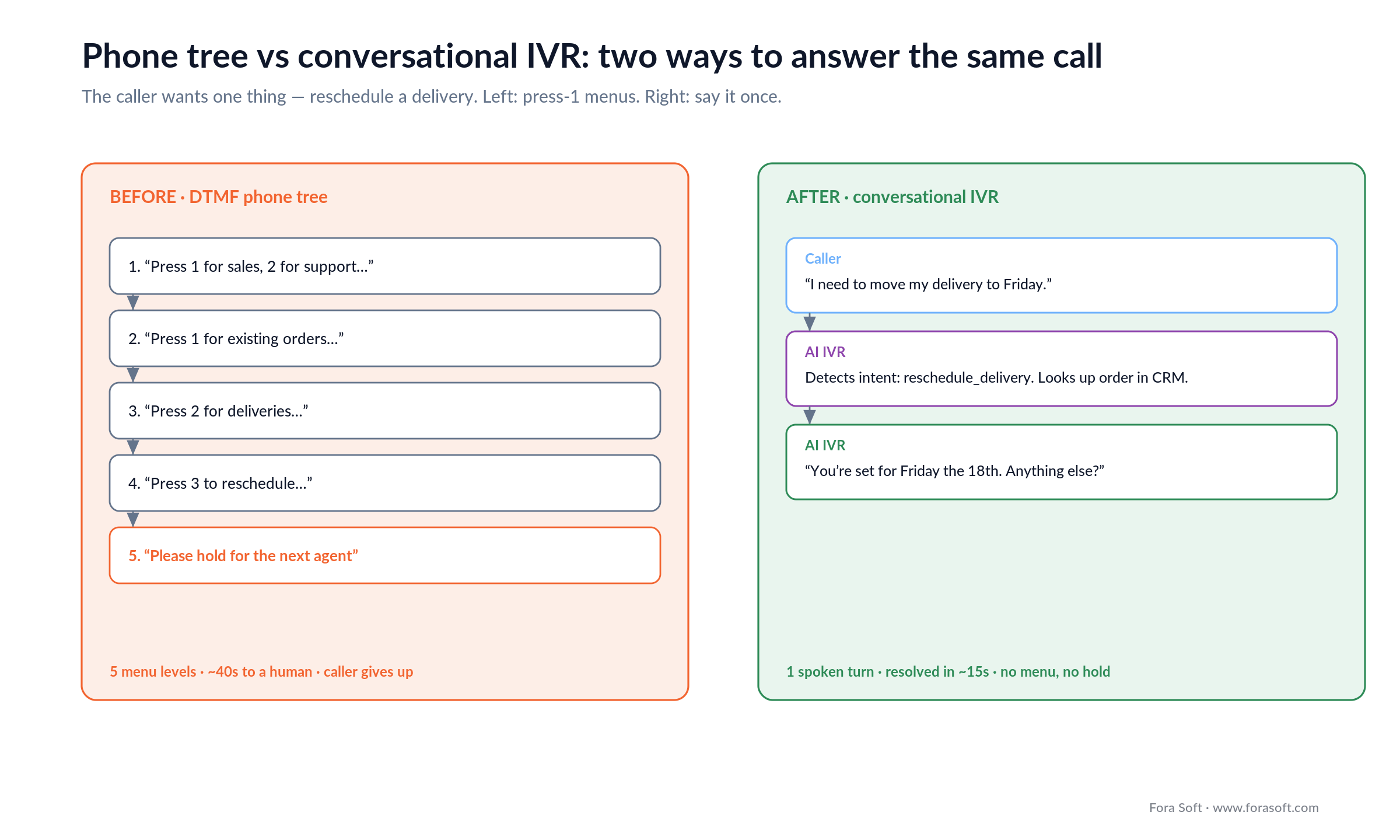
Figure 1. Same request, two systems. The DTMF tree makes the caller work; the conversational IVR does the work.
You’ll see this capability sold under several names: conversational IVR, AI powered IVR, AI based IVR, conversational AI IVR. They point at the same thing: replace the fixed menu with intent understanding. “IVR modernization” and “AI phone tree” are the same idea framed as an upgrade rather than a product. What all of them share is a shift from a rigid decision tree to a model that maps spoken language onto the actions your business can actually perform.
AI IVR vs AI voice agent vs receptionist: where the lines are
The short version: they sit on a spectrum from “understands speech” to “completes tasks.” A speech-enabled IVR recognizes a fixed keyword list. A conversational IVR maps free speech onto a defined intent list and escalates when nothing matches. A full AI voice agent adds LLM reasoning, so it can handle follow-ups, unexpected phrasing, and multi-step tasks end to end. In practice, a well-built AI IVR and a voice agent are the same engine tuned for different jobs.
Where does a receptionist fit? We drew that line deliberately. Our guide to building an AI receptionist is about the small-business front desk: answer the phone, book the appointment, take a message for one location. This guide is about the contact-center problem: a high-volume line, often behind a multi-level menu, integrated with CRM and CCaaS, where the win is measured in containment across tens of thousands of calls. Same voice technology, different scale and different economics.
Two more siblings worth a look, because they cover the plumbing this article rides on. Our AI call assistants API guide covers the assistant layer, and the OpenAI Realtime + SIP integration walkthrough shows how the audio actually gets into the model.
Reach for “AI IVR” framing when: you have an existing phone number and menu, high call volume, and a self-service goal, where the job is to modernize a channel, not launch a new receptionist from scratch.
Why legacy phone trees still frustrate callers in 2026
Because a menu forces every caller to translate their problem into someone else’s categories before they can get help. A caller with a simple question has to guess which of eight options hides it, then do it again one level down. Get it wrong and you start over. The design hasn’t changed much since IVR arrived in the 1970s to manage call volume, and it was built to sort calls, not solve them.
The cost shows up as abandoned calls, repeat callers, and the “press 0 for an operator” reflex that dumps everything onto human agents anyway. Some vendors quote dramatic abandonment numbers; we’d treat the round ones with caution. What’s better documented is the direction of travel: patient comfort with non-human call centers in healthcare rose from 19% to 35% in a single year (Bain & Company, 2025). People are warming to automation, at least when it actually resolves their issue rather than looping them.
Here’s the catch that trips up modernization projects: callers don’t hate automation because it’s automated. They hate it because it fails. Transparency about being an AI doesn’t sink satisfaction; unresolved loops do. That reframes the whole project — the goal isn’t to hide the machine, it’s to make the machine finish the job.
How an AI IVR call actually works
A call flows through four stages, in milliseconds, on a loop until the caller hangs up. Audio arrives over a SIP trunk. Automatic speech recognition (ASR) turns speech into text as the caller talks. A natural-language layer — increasingly an LLM — works out intent and decides what to do. An orchestration layer looks things up in your CRM or EHR and applies your business rules. Text-to-speech (TTS) streams the reply back. Then the system decides: resolve, or transfer.
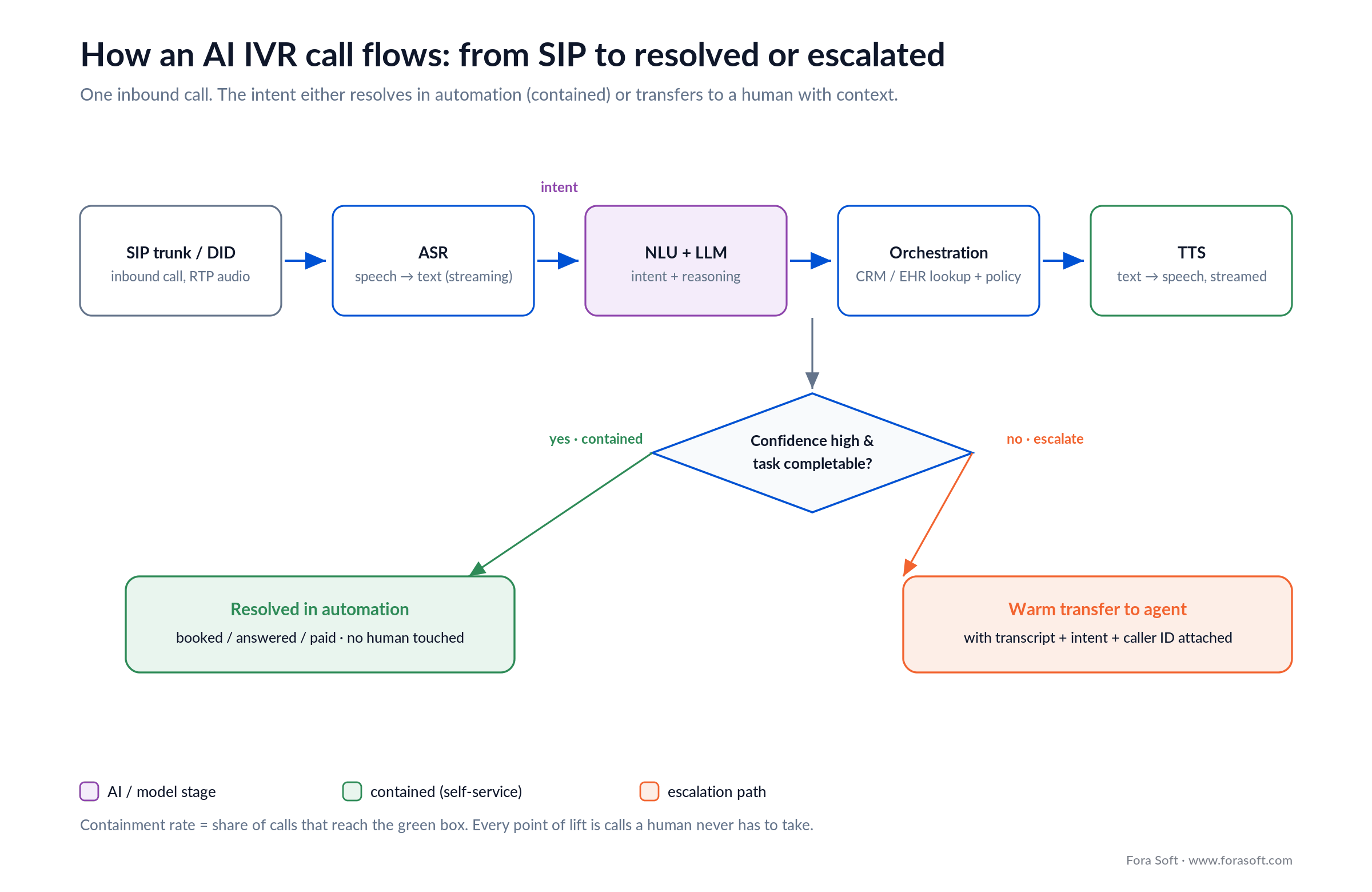
Figure 2. The pipeline, plus the decision every turn hinges on: is confidence high enough to act, or does this go to a human with context attached?
Two design choices sit inside that pipeline. The first is cascade vs speech-to-speech. A cascade runs ASR, then the LLM, then TTS as separate steps, with more moving parts, but you can log the transcript, tune each stage, and enforce policy between them. A speech-to-speech model collapses those into one, which cuts latency but gives you less to inspect. For regulated call flows we usually favor the cascade, because “show me the transcript” is a real requirement in audits.
The second is confidence and fallback. Every intent match carries a score. Set a threshold (say, act only above 70% confidence) and define what happens below it: re-prompt once, then transfer. The teams that skip this ship an AI IVR that guesses, and a confident wrong answer erodes trust faster than a phone tree ever did.
The latency budget: why the pause is the product
In natural conversation, a new turn starts about 200 ms after the previous one ends — a pattern that holds across ten languages (Stivers et al., PNAS, 2009). That number is the floor your AI IVR is measured against. You can’t hit 200 ms round trip in production, but you can aim for a reply that feels immediate: roughly half a second of total round-trip delay reads as natural. Past about 800 ms, callers assume the line dropped and start talking over the agent.
The delay stacks up across the pipeline: network and telephony, then endpointing (the wait to be sure the caller actually stopped talking), then ASR, then the model’s time-to-first-token, then TTS time-to-first-byte. Endpointing is usually the biggest and most tunable slice: wait too long and every reply feels sluggish; cut it too short and you interrupt people. Getting it right is most of the perceived-quality battle.
One more piece callers notice instantly: barge-in. When someone interrupts mid-prompt, the agent has to stop talking and start listening almost immediately. A stack that ignores barge-in feels like arguing with a recording. If you want the measured version of all this across real vendors, our LiveKit voice-agents guide walks through building the pipeline that keeps these numbers down.
Reach for a cascade design when: you need transcripts for compliance, per-stage tuning, or policy checks between understanding and action — and you can afford the extra ~100–200 ms it adds versus speech-to-speech.
The legacy stack you’re replacing: VoiceXML, MRCP, DTMF
If your current IVR predates the AI wave, it’s almost certainly built on VoiceXML. VoiceXML is an XML markup for voice dialogs (prompts, DTMF and speech input, call control) that became a W3C Recommendation on March 16, 2004. For two decades it was how phone menus got authored. Underneath it, a protocol called MRCP (Media Resource Control Protocol, IETF RFC 6787) let the VoiceXML app drive separate speech-recognition and text-to-speech engines.
That era is closing. The VoiceXML Forum dissolved on May 31, 2022, and planned work on VoiceXML 3.0 was scrapped. VoiceXML still runs in plenty of production systems and isn’t going to vanish, but it’s legacy, and few teams start new dialog design there. The modern replacement is an LLM-orchestrated flow: instead of hand-authoring every branch of the tree in markup, you define intents, tools, and guardrails, and let the model handle the phrasing it wasn’t explicitly told about.
DTMF, the touch tones themselves, doesn’t disappear, and that’s deliberate. Keep a “press or say your account number” path for noisy environments and for card entry (more on that in the compliance section). The migration isn’t rip-and-replace; it’s wrapping intent understanding around a phone line that still speaks SIP and DTMF the way it always has.
Containment: the number that pays for the project
Containment rate is the share of calls fully resolved in automation without a human. It’s the number that turns an AI IVR into an investment rather than a cost. A related term, deflection, describes calls kept out of the human queue before they get there; containment counts the ones that entered automation and finished there. Track containment, and track it honestly — a “contained” call that made the customer call back tomorrow isn’t contained.
What’s realistic? Industry data on automation containment tends to start in the 20–40% range and climb to 70–90% for mature, well-tuned deployments — though voice usually lands lower than chat, and it depends heavily on your call mix. Simple, high-frequency requests (hours, balances, order status, rescheduling) contain well. Messy, emotional, or exception-heavy calls should escalate fast. Fin reports effective AI IVR deployments resolving roughly 20–40% of calls end to end; treat vendor figures as directional and measure your own.
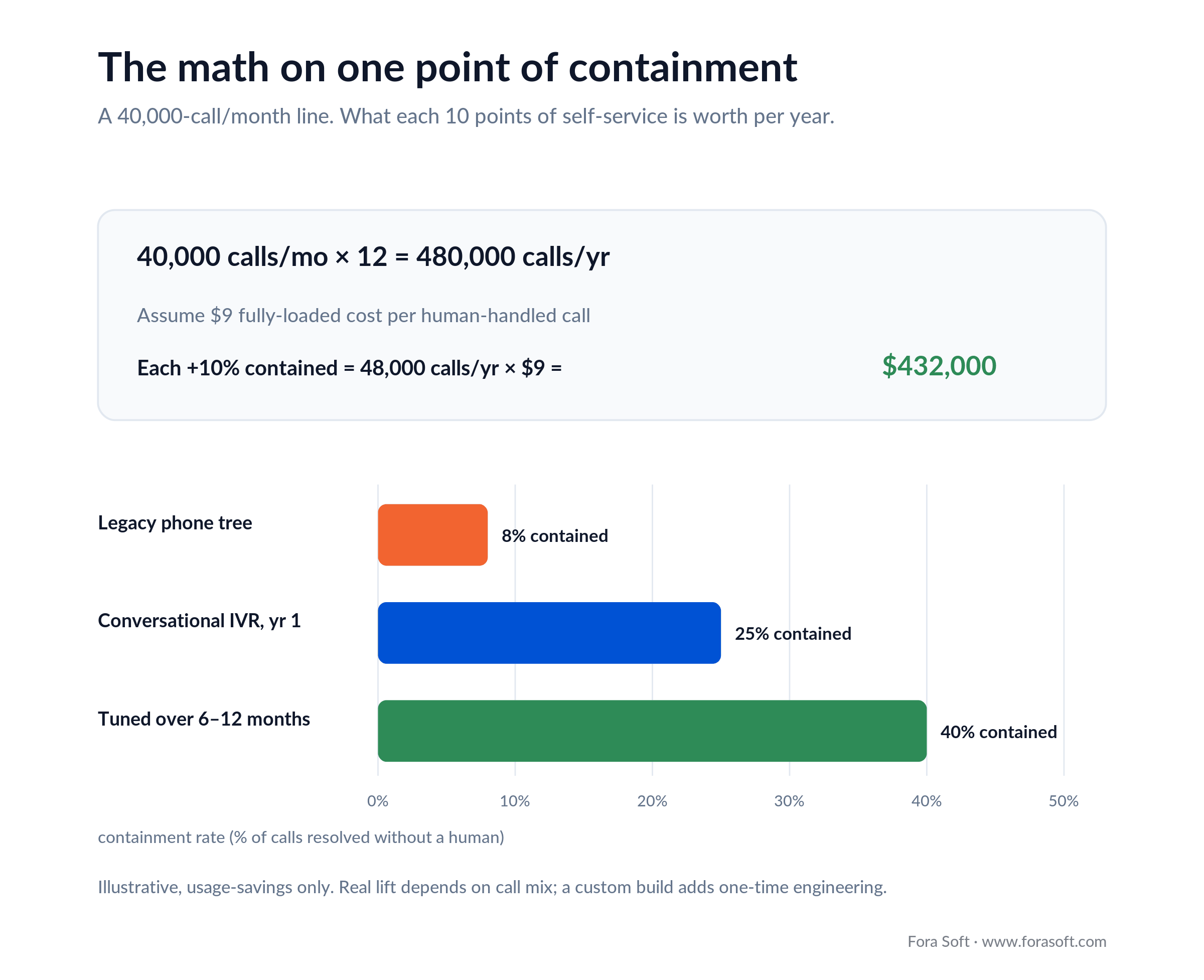
Figure 3. Worked example on a 40,000-call-a-month line. The arithmetic, not the adjectives, is what gets a project funded.
Here’s the math in words. Take 40,000 calls a month, 480,000 a year. Assume a fully-loaded cost of $9 per human-handled call, a conservative mid-range figure for many contact centers. Every 10 percentage points you move into automation is 48,000 calls a year, or about $432,000. Move from a legacy tree’s single-digit containment to 25% in year one, then tune toward 40%, and the annual saving runs from roughly $734,000 to $1.38 million. Those are usage savings only; a build adds one-time engineering, which we’ll price next.
Want a containment estimate for your call mix?
Send us your top intents and monthly volume. We’ll model a realistic year-one containment target and the payback, with no hand-waving.
Where an AI IVR plugs into your phone stack
You rarely rip anything out. The AI IVR is a new brain that rides on top of the phone system you already run. Your SIP trunk or carrier keeps carrying calls. Your contact-center platform — Genesys, Five9, NICE, Amazon Connect — keeps queueing and reporting. The agent slots in between, integrating through APIs to your systems of record.
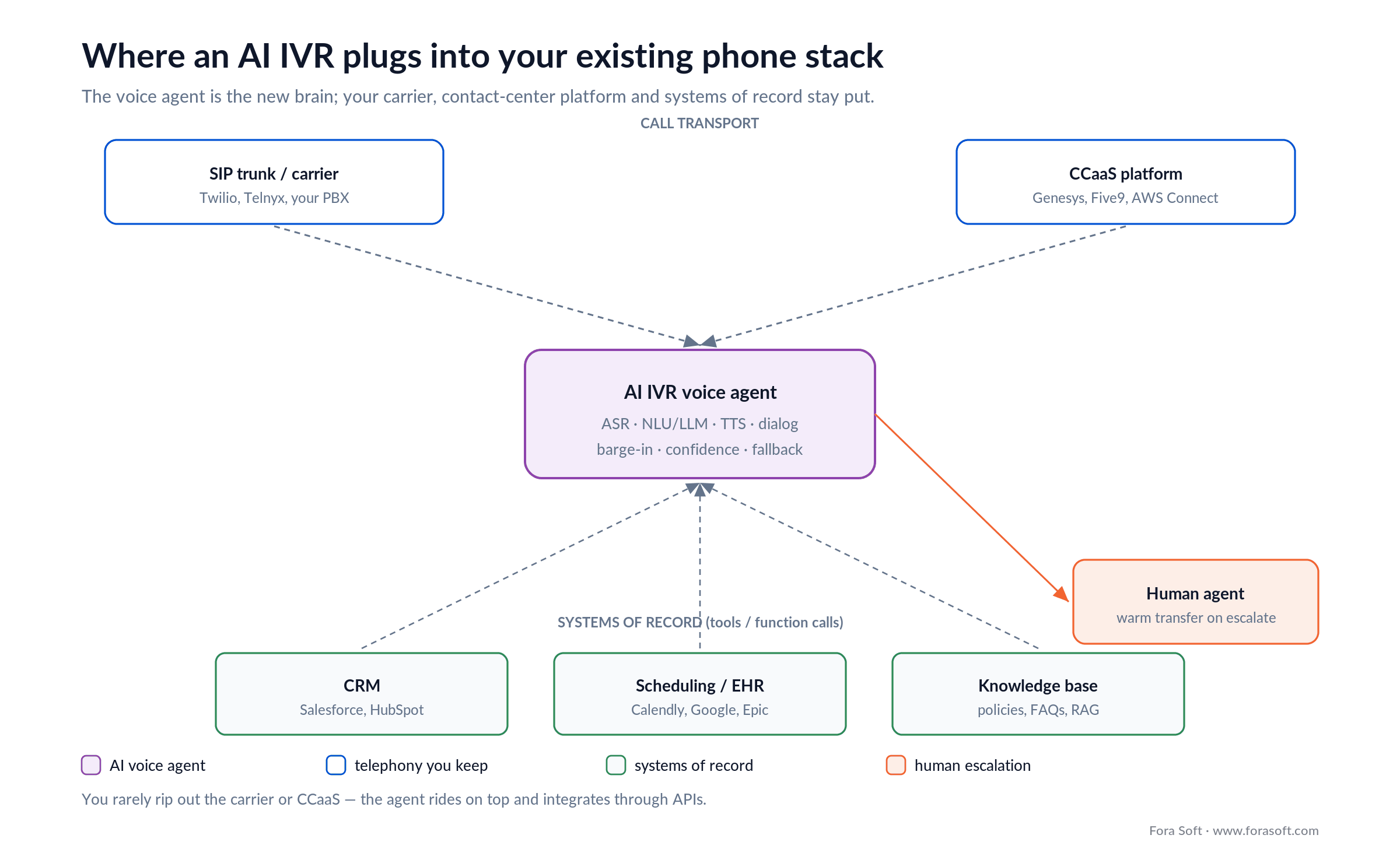
Figure 4. The agent is the new layer. Carrier, CCaaS, and systems of record stay where they are.
The integrations are what make it resolve calls instead of just answering them. A CRM lookup identifies the caller and their history. A write-back changes the record: reschedules the delivery, updates the address. A scheduling or EHR connection books the slot. A knowledge base (often via retrieval-augmented generation) answers policy questions from your own documents rather than the model’s guesses. And a warm-transfer path hands the call to a human with the transcript, detected intent, and caller ID already attached, so the customer doesn’t repeat themselves.
Two integration realities to plan for. First, legacy PBX and older CCaaS setups expose SIP and little else, so a BYOC (bring-your-own-carrier) trunk is often how the agent joins the call. Second, write-backs are where projects stall — reading from a CRM is easy; safely writing to it, with the right permissions and audit trail, is the real work. If your voice stack leans on WebRTC or Telnyx, our Telnyx development guide covers that transport layer.
Four ways to modernize your IVR
There isn’t one right architecture — there are four, and they trade off cost, control, and effort. Here’s how we’d frame each, with where it wins and where it breaks.
1. Buy a CCaaS add-on
If you already run Amazon Connect, Genesys, or a similar platform, the fastest route is their built-in conversational layer. On Amazon Connect, that’s Amazon Lex handling intents at $0.004 per speech request, with the newer AI-tier voice usage listed at $0.038 per voice minute (aws.amazon.com pricing, accessed July 2026). Where it wins: nothing new to host, reporting you already know. Where it breaks: you inherit the platform’s NLU ceiling and its roadmap, and deep custom logic can be awkward.
Reach for a CCaaS add-on when: you’re already on the platform, your use cases are standard, and time-to-live matters more than owning the model.
2. Rent a managed voice API
Managed orchestration layers give you voice-agent building blocks without running the media plumbing yourself. Twilio’s ConversationRelay, for example, is listed at $0.07 per minute on top of telephony (twilio.com pricing, July 2026); platforms like Vapi and Retell bundle the pipeline for an all-in per-minute rate. Where it wins: fast to prototype, carrier and scaling handled. Where it breaks: the per-minute fee stops being cheap at high volume, and you’re a tenant on someone else’s platform. We compare these head-to-head in Vapi vs Retell vs custom.
Reach for a managed voice API when: you want a working AI IVR in weeks, volume is moderate, and you’d rather validate the use case before owning infrastructure.
3. Adopt a conversational-AI platform
Dedicated conversational-IVR products (Nextiva, Synthflow, Vonage and peers) sell a fuller package: flow builders, analytics, compliance badges, prebuilt connectors. Pricing is often quote-based: Nextiva, for instance, lists conversational AI as custom pricing with no public per-minute rate. Where it wins: business teams can manage flows without engineers. Where it breaks: you flex within the product’s limits, and truly bespoke integrations or margin control at scale push you elsewhere.
Reach for a platform when: non-technical staff need to own the call flows day to day and your requirements sit inside the product’s feature set.
Our Solution: a custom build
When the call flows are unusual, the data is regulated, or the per-minute fees on a rented platform have outgrown a custom stack, we build it. You own the pipeline — ASR, model, TTS, orchestration — pick best-of-breed components, self-host where compliance demands it, and pay compute instead of a platform margin. Where it wins: control, unit economics at scale, and integrations no product supports. Where it breaks: there’s a real one-time engineering cost, and you own reliability — which is exactly the work we do. This is the path behind Nucleus’s 600M+ monthly call minutes.
Reach for a custom build when: you handle HIPAA or PCI data, need integrations no vendor offers, or your volume makes per-minute platform fees the most expensive line on the invoice.
The four paths compared
Prices are read from vendor pages in July 2026 and will drift, so check the current rate before you commit. The table is for shape, not a quote.
| Path | Cost shape | Time to live | Control | Best fit |
|---|---|---|---|---|
| CCaaS add-on | Per-minute + per-request (e.g. $0.038/min + $0.004/req) | Days–weeks | Low | Already on the platform |
| Managed voice API | All-in per minute (e.g. ~$0.07–0.18/min) | Weeks | Medium | Fast validation, moderate volume |
| Conversational-AI platform | Subscription / quote-based | Weeks | Medium | Non-technical flow ownership |
| Custom build | Compute (~$0.04–0.05/min) + one-time engineering | Weeks–months | High | Regulated data, scale, bespoke integrations |
What it costs: a worked per-minute model
A custom cascade IVR costs roughly $0.04–0.05 per minute in components; a managed voice API runs about two to four times that; a CCaaS add-on lands in between. Here’s the buildup for a self-hosted cascade, using published July 2026 rates: telephony via SIP/BYOC ~$0.01/min (Twilio SIP interface $0.004/min, inbound local $0.0085/min), streaming ASR ~$0.006/min, a small LLM ~$0.01/min at moderate token use, and TTS ~$0.015/min. That’s about $0.045 a minute you control end to end.
Now price a real line. Take 40,000 calls a month at 3 minutes each, i.e. 120,000 talk-minutes. A custom cascade at $0.045 runs about $5,400 a month in usage. A managed API around $0.12 all-in runs about $14,400. That $9,000-a-month gap — roughly $108,000 a year — is what funds the one-time build. As a conservative planning figure, a focused first production version is an 8–12 week engineering effort in the low-six-figures; our Agent Engineering approach compresses that, and we’ll quote the specific number against your integrations rather than a generic range.
The decision rule is simple. Below a few thousand calls a month, rent: the platform fee is noise and the build never pays back. As volume climbs into the tens of thousands, the per-minute margin on a rented platform starts to dwarf what a custom stack would cost to run, and owning it wins. Regulated data can flip that calculus at any volume, because some things you simply can’t send to a shared platform.
What we learned building phone automation at scale
On Nucleus, the on-premise communication platform for Fibernetics, the brief wasn’t “add a chatbot” — it was to run AI phone agents at carrier scale. Fibernetics serves 300,000+ customers and processes 2 billion+ calls a year on its Canadian network, so the automation layer had to sit on real SIP infrastructure, integrate with CRMs and ERPs to actually complete sales, support, and scheduling tasks, and clear SOC 2, GDPR, and HIPAA. A rented per-minute platform was a non-starter at that volume and under those controls.
We built it as a custom stack: SIP and WebRTC transport over both cellular and online networks, an orchestration layer with write-back into the systems of record, real-time voice-to-voice handling, and human handoff wired in from day one. The platform now serves 5,000+ businesses, and the AI phone agents handle more than 600 million call minutes a month. The lesson that generalizes: the model was never the hard part — the integrations and the escalation logic were. Getting a write-back to a CRM right, with permissions and an audit trail, took more engineering than the conversation itself.
The second lesson: start narrow. The systems that work contain a handful of high-volume intents cleanly and escalate everything else, then expand once the numbers hold. Want a similar assessment of your line? Book a 30-minute scoping call and we’ll tell you which intents to automate first. For the healthcare-specific version of this work, our CirrusMED telehealth project and TransLinguist interpreter platform show the compliance and multilingual sides.
Compliance: TCPA, PCI-DSS, and disclosure
Automating the phone puts you under rules that don’t apply to a web form. Three matter most for an AI IVR. First, the TCPA. On February 8, 2024, the FCC ruled that calls using AI-generated or cloned voices count as “artificial” under the TCPA (FCC 24-17), which means outbound AI-voice calls need prior express consent. Inbound calls the customer places to you are a different footing, but any outbound campaign built on the same stack lands squarely in TCPA territory.
Second, payments. If callers ever read out a card number, PCI DSS v4.0.1 applies, mandatory since March 31, 2025. The old “pause-and-resume” recording trick is now treated as only a partial control, because a missed pause is a breach. The reliable pattern is DTMF masking or IVR self-service, where the caller keys card digits as tones that never reach the agent or the recording. This is one reason DTMF stays in a modern AI IVR: it keeps card data out of scope.
Third, disclosure. A growing set of jurisdictions require the system to identify itself as AI at the start of the call, and several require it in specific sectors like healthcare. The good news from the frustration research: telling callers they’re talking to an AI doesn’t hurt satisfaction — failed resolution does. Disclose plainly, then resolve the call, and you’re both compliant and well-liked.
Handling regulated calls — HIPAA, PCI, TCPA?
We’ve shipped voice automation under SOC 2, HIPAA, and GDPR. Let’s scope an AI IVR that resolves calls without putting your compliance posture at risk.
A decision framework in five questions
Run your situation through these five, in order. They’ll point you at one of the four paths faster than any feature matrix.
1. What’s your monthly call volume? Under a few thousand, rent, since a build won’t pay back. Tens of thousands and up, custom economics start to win.
2. How regulated is the data? HIPAA, PCI, or strict data-residency needs push you toward self-hosting or a build, regardless of volume.
3. Do your integrations exist off the shelf? If your CRM and scheduling system have prebuilt connectors on a platform, buy. If you need write-backs no vendor supports, build.
4. Who owns the call flows day to day? If business staff must edit flows without engineers, a platform earns its keep. If engineering owns it, a custom stack gives more room.
5. How fast do you need to prove it works? Rent a managed API to validate the use case in weeks, then re-platform onto a build once the containment numbers justify it. That’s the sequence we most often recommend — and the one we’re happy to run with you.
Five ways IVR modernization goes wrong
1. Chasing latency you can’t feel while ignoring the pause you can. Teams optimize model speed and forget endpointing, so replies land late and callers talk over the agent. Tune the turn-taking first.
2. Shipping without a confidence threshold. An AI IVR that always acts will confidently do the wrong thing. Set a threshold, re-prompt once, then escalate — a graceful transfer beats a wrong resolution every time.
3. Automating the hard calls first. The instinct is to prove the system on your thorniest cases. Do the opposite: contain the boring, high-volume intents and escalate the rest, then expand.
4. Read-only integrations. An IVR that can look up an order but not change it just tees the call up for a human. The value is in the write-back — and the write-back is the part that needs real engineering and an audit trail.
5. Treating compliance as a launch-day checkbox. TCPA, PCI, and disclosure rules shape the architecture, not the release notes. Retrofitting DTMF masking or consent flows after launch is far more expensive than designing for them.
When NOT to replace your IVR
Sometimes the phone tree is fine. If your call volume is low and your menu is one or two shallow options that route cleanly, an AI IVR is a solution looking for a problem — the containment savings won’t cover the effort. A single “press 1 for hours, press 2 to leave a message” menu doesn’t need a language model.
Skip it, too, when almost every call genuinely needs a human: crisis lines, complex sales negotiations, high-empathy support. There, the right move is to make the human faster (screen-pop the caller’s history, cut the menu, route smartly) rather than to insert automation that will just escalate anyway. And if you can’t commit to measuring and tuning containment for a few months after launch, don’t start — an untuned AI IVR drifts toward the same frustration you were trying to escape. Honesty here saves everyone money.
FAQ
What is an AI IVR?
An AI IVR is an interactive voice response system that lets callers speak naturally instead of pressing menu keys. It uses speech recognition and a language model to detect intent, then resolves the request or transfers to a human with context. Unlike a touch-tone phone tree built to route calls, an AI IVR is built to resolve them.
How is an AI IVR different from a traditional IVR?
A traditional IVR uses fixed touch-tone or keyword menus and is designed to route a call to a queue. An AI IVR understands free speech, maps it to intent, and completes the task (booking, rescheduling, answering) without a menu. The measurable difference is containment: the share of calls resolved without a human.
How much does an AI IVR cost?
Usage runs roughly $0.04–0.05 per minute for a self-hosted custom cascade, about $0.07–0.18 per minute for a managed voice API, and per-request-plus-per-minute on a CCaaS add-on (for example, Amazon Connect at $0.038/voice-minute plus Lex at $0.004/request, July 2026). A custom build adds a one-time engineering cost that pays back at higher volumes.
What is a good containment rate for an AI IVR?
Automation containment typically starts at 20–40% and climbs toward 70–90% for mature, well-tuned deployments, though voice usually lands lower than chat and depends on your call mix. A realistic year-one target for a well-built AI IVR is often in the 20–40% range, rising as you tune intents over six to twelve months.
How do you replace an IVR with AI without downtime?
You run the AI IVR alongside the legacy tree, route a slice of traffic (or specific intents) to it, and expand as containment holds. The carrier, SIP trunk, and CCaaS stay in place; the agent rides on top through APIs. DTMF paths remain for card entry and noisy environments, so nothing the caller relies on disappears at cutover.
Is an AI IVR legal for automated phone calls?
Inbound calls a customer places to you are generally fine, but outbound campaigns using AI-generated voices need prior express consent: the FCC ruled in February 2024 that such voices are “artificial” under the TCPA. If callers read card numbers, PCI DSS v4.0.1 (mandatory since March 2025) requires DTMF masking or self-service so card data never reaches the recording. Many jurisdictions also require an AI disclosure at call start.
Do I have to replace my phone system to add an AI IVR?
No. An AI IVR plugs on top of your existing carrier and contact-center platform, usually via a SIP or BYOC trunk, and integrates with your CRM, scheduling, and knowledge base through APIs. You keep the number, the queues, and the reporting; the agent is a new layer, not a rip-and-replace.
What latency does an AI IVR need to feel natural?
Humans start a new conversational turn about 200 ms after the last ends (PNAS, 2009). Production voice AI can’t hit that, but a round-trip around half a second reads as natural; past roughly 800 ms callers start talking over the agent. Endpointing, the wait to confirm the caller finished, is usually the biggest tunable slice, along with barge-in handling.
What to read next
Voice AI
How to Build an AI Receptionist
The small-business front desk version: stack, latency budget, and build vs buy.
Build vs buy
Vapi vs Retell vs Custom
When managed voice platforms stop scaling and a custom stack wins.
Integration
OpenAI Realtime + SIP + WebRTC
How the audio actually gets from a phone call into the model.
Services
AI Integration Services
How we scope and ship voice AI and IVR modernization projects.
Learn
AI for Video & Real-Time Engineering
The deeper engineering track behind our real-time AI work.
Ready to retire the phone tree?
An AI IVR replaces the menu, not the phone line: it understands what callers say, resolves what it can, and hands the rest to a human with context. The pause is the product — get turn-taking under control and the rest follows. Containment is the number that funds the work, and on a busy line every ten points is worth hundreds of thousands a year. Pick your path by volume, integrations, and how regulated your data is, and design for TCPA, PCI, and disclosure from the start rather than after launch.
We’ve built this at carrier scale and under real compliance, and our voice assistant development team handles the STT, LLM and TTS layers behind the menu. If you want a straight assessment of what to automate first and whether to rent or build, that’s a 30-minute conversation.
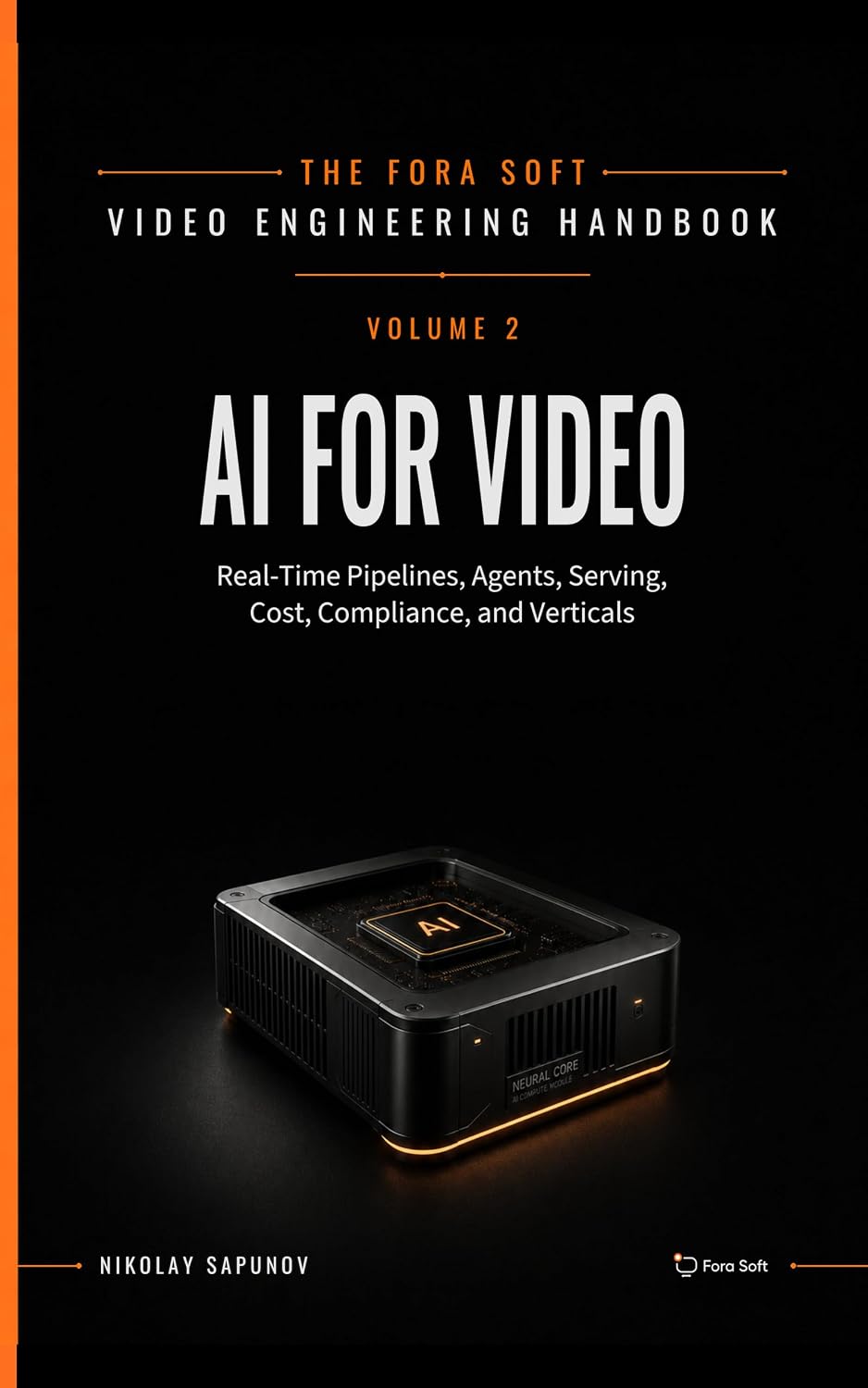
The book · Volume 7 of 7
AI for Video: A Complete Guide to Intelligence in Video Products: From Real-Time Pipelines and Agents to Serving, Cost, Compliance, and Verticals
Replacing the phone tree is mostly a latency and containment problem, and both depend on how the agent is engineered. Volume 7 treats voice agents as engineering: the agent loop, memory and tools, turn-taking under a real-time budget, model serving, cost per stream-hour and the compliance rules for automated calls, the parts that decide whether an AI IVR holds up at volume. Written by Nikolay Sapunov, CEO at Fora Soft.
Read it on Amazon →Kindle & paperback · Fora Soft Video Engineering Handbook
Let’s scope your AI IVR
Bring your call volume and top intents. We’ll come back with a containment target, a build-vs-buy call, and a realistic timeline.