

Key takeaways
• Match the tool to the job, not the demo reel. Synthesia and Colossyan win at training video, Creatify at UGC-style ads, D-ID and Tavus at avatar APIs, Elai at predictable per-minute pricing, and open-source at data control.
• Compare per-usable-minute, not sticker price. HeyGen’s $29 Creator plan buys 600 credits — 30 minutes of Avatar IV video a month (July 2026 rates). Most rivals cap minutes the same way; the caps, not the subscriptions, are the real price.
• APIs price by output. HeyGen’s API bills $1–$4 per generated minute depending on engine, Tavus bills $1 per generated minute and $0.37 per real-time conversation minute. At 500 minutes a month those rates decide your architecture.
• Custom breaks even around 300–500 minutes a month. A first avatar feature ships for $15k–$50k on API-first architecture; rented-GPU rendering then runs at cents per minute. Below that volume, stay managed.
• Sometimes the answer is: don’t switch. If you generate under 30 minutes a month and your marketers live in the studio UI, HeyGen remains a fair deal — we say so below, with the math.
Avatars, video APIs, voice agents — all vendor comparisons, in one place.
Why Fora Soft wrote this playbook
Every vendor on the first page of Google for “heygen alternative” ranks itself first. Synthesia’s list crowns Synthesia, D-ID’s crowns D-ID, and the pattern repeats seven more times down the results. Nobody in that top ten compares API rates, counts real-time latency, or prices the option every CTO quietly considers: building the pipeline yourself. That gap costs buyers real money: picking the wrong lane at 500 minutes a month is a five-figure annual mistake.
We’re Fora Soft, a 50-person team building video, real-time and AI software since 2005 (250+ shipped projects). We don’t sell an avatar SaaS, so we have no horse in this race. What we do sell is AI integration work: we’ve put six AI feature patterns into production products (voice assistants, real-time speech translation, computer vision, generative content, recommendations, moderation) and documented the stacks and outcomes in our AI features playbook.
So this review does what the vendor lists won’t: every price below was pulled from the vendor’s own pricing page on July 12, 2026, every quality judgment names its source, and the “build custom” option gets the same honest treatment as the tools — including when it’s a bad idea.
HeyGen alternatives at a glance
The best HeyGen alternative in 2026 depends on what you make: Synthesia for enterprise training and localization, Colossyan for training on a smaller budget, Creatify for UGC-style performance ads, D-ID for talking-photo APIs and visual agents, Tavus for real-time conversational avatars, Elai.io for predictable per-minute pricing with an API, and an open-source stack (Duix-Avatar, MuseTalk, EchoMimicV2) when data must stay on your hardware. Past roughly 300–500 minutes a month, or when the avatar is your product, a custom pipeline beats all of them on unit cost and control. If instead you need to generate whole scenes from a prompt rather than a talking presenter, that’s a different capability — our text-to-video API comparison covers Sora, Veo and Runway for that job.
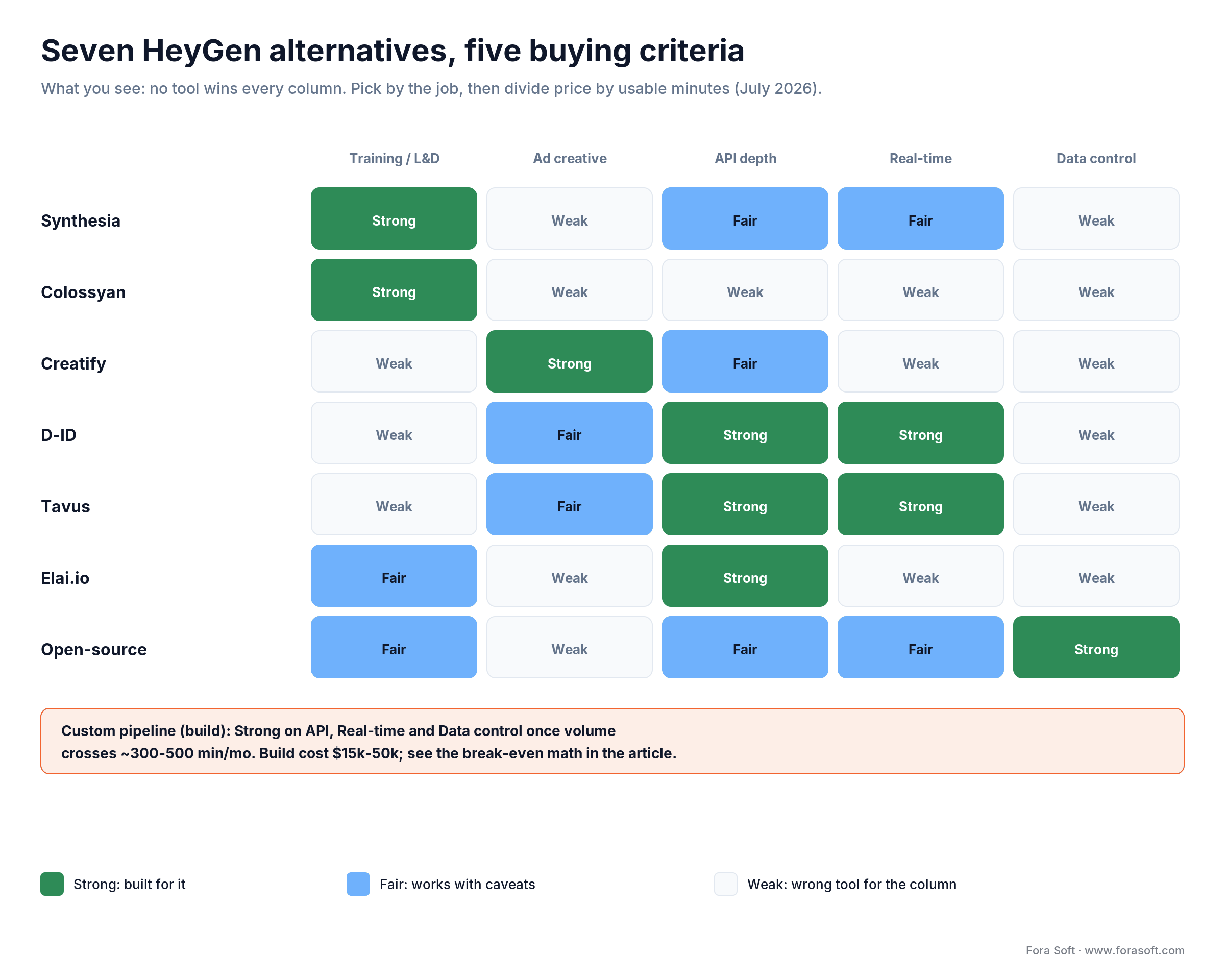
Figure 1. Seven alternatives, five buying criteria: no tool scores green everywhere, which is exactly why sticker-price comparisons mislead.
Why teams leave HeyGen
Three reasons come up in nearly every migration conversation we have. First, credit math. HeyGen’s $29 Creator plan includes 600 credits a month, and the flagship Avatar IV engine burns 20 credits per minute. That is 30 minutes of top-engine video, after which you upgrade tiers ($49 Pro buys 1,000 credits, and the Pro ladder runs to $4,300 for 100,000). Edits and re-renders spend credits too, so teams routinely hit the wall mid-month. Drafts are free; rendered minutes are what the meter counts.
Second, reliability at volume. Public reviews through 2026 describe renders stuck near completion for 30–60 minutes and failed renders that still consumed credits. The review-site split tells the story (counts as of July 2026): HeyGen holds 4.8/5 on G2 across ~1,478 reviews while sitting at 2.4/5 on Trustpilot across ~1,613: enthusiasts on one side, billing and support complaints on the other.
Third, the ceiling problem. HeyGen’s studio is built for humans clicking buttons. Once you want avatars inside your product (personalized onboarding, an interactive kiosk, a support agent that answers on camera), you’re in API territory, where HeyGen charges $4 per 1080p minute for a Digital Twin on Avatar IV (its own published API rates, July 2026) and the build-vs-buy question stops being hypothetical.
How we evaluated the tools
Honesty first: we’re not a review farm rendering the same script through 20 tools. We’re an engineering shop that integrates these platforms into client products and gets paged when they misbehave. Our lens is a buyer’s lens, weighted accordingly: pricing transparency and per-usable-minute cost (from vendor pricing pages, July 12, 2026), API depth and documented rates, real-time capability and its latency budget, custom-avatar terms including who owns the training footage, and output quality, where we cite published side-by-side tests rather than pretend we re-ran them.
One caveat worth stating: avatar engines update monthly, and quality judgments age fast. Prices below carry their pull date, and anything we couldn’t verify on a vendor’s own page is flagged as such. Where we haven’t operated a tool in production, we say so instead of inventing an anecdote.
Paying HeyGen more each month than the feature earns back?
Send us your usage numbers and we’ll map them against every option in this article and tell you which lane is cheapest, in one call.
1. Synthesia: enterprise training
Synthesia is the closest like-for-like swap and the incumbent in corporate learning: 240+ stock avatars, 160+ languages, SCORM export, interactive branching video, SOC 2 Type II and ISO 42001 certifications, and a claim that over 90% of the Fortune 100 use it. Its avatar realism edged out HeyGen’s in the most-cited public side-by-side of 2026 (Synthesia’s own May 2026 test; grain of salt included, though independent reviewers broadly agree on the training-video verdict).
Pricing (synthesia.io, July 12, 2026). Free plan: 1,200 credits ≈ 10 video minutes a month. Starter: $29/month ($18 annual) for 10 minutes a month and 3 personal avatars. Creator: $89/month ($64 annual) for 30 minutes and API access. A studio-grade Express-1 custom avatar is a $1,000/year add-on. Enterprise (unlimited minutes) typically lands at $25k–$40k a year on Vendr benchmark data.
Where it wins: governance, one-click translation (70+ languages self-serve, 140+ on enterprise), LMS workflows, and avatars whose controlled delivery suits compliance content. Where it breaks: the same 10–30 minute monthly caps as HeyGen until you sign enterprise; deliberately corporate expressiveness that reads flat in ads; no Safari support in the editor; render times reviewers describe as slower than peers.
Reach for Synthesia when: you produce structured training at enterprise scale, need SCORM/SSO/audit trails, and can justify a five-figure annual contract once volume outgrows 30 minutes a month.
2. Colossyan: training on a budget
Colossyan chases the same L&D buyer as Synthesia with branching scenarios, quizzes, SCORM export and LMS integrations built in, and in 2026 it made an aggressive move: the entry tier went free. For a training team that lives in PowerPoint, its slide-style editor is the shortest path from deck to video.
Pricing (colossyan.com, July 12, 2026). Colossyan restructured its plans in 2026. Starter is now free (formerly $27/month): 20 NEO-engine minutes a month plus a 0.5-minute taste of the newer NEO2, with watermarked exports. Professional: $59/month annual for 30 NEO minutes plus 10 NEO2 minutes, watermark removal, 5 SCORM exports a month and API access (360 minutes a year). Unlimited generation moved to Enterprise, where NEO2 stays a custom line item; 600 extra NEO2 minutes run $1,500/year on Professional.
Where it wins: the most generous managed free tier in the category and a clean price-to-feature ratio for structured learning content. Where it breaks: avatar realism trails the top tier (the May 2026 side-by-side rated its body movement rigid, and reviewers report renders stalling), 4K export sits behind Enterprise, and NEO2, the engine you actually want, stays tightly capped below Enterprise.
Reach for Colossyan when: you need SCORM-ready training video for $59 a month or less and can accept last-generation avatar realism as the trade for the discount.
3. Creatify: UGC-style video ads
Creatify targets one job: performance ads that look like a creator filmed them on a phone. Its avatars carry more emotional range than the corporate platforms. The same May 2026 test that favored Synthesia for training called Creatify’s UGC realism “borderline indistinguishable” from real creator content, and the platform wraps batch generation, A/B testing, ad analytics and direct publishing to Meta and TikTok around them.
Pricing: plans start around $19/month (July 2026), with custom-avatar creation from a photo and short audio sample included in paid tiers. Where it wins: volume ad creative, hook testing, e-commerce product videos. Where it breaks: everything that isn’t a vertical short-form ad: long scripts, training structure, SCORM, brand-safe corporate delivery. Ad teams also tend to pair it with post-production tooling; our comparison of AI video editing platforms covers that half of the stack.
Reach for Creatify when: you ship dozens of ad variants a week and the avatar’s job is to look like a customer, not a compliance officer.
4. D-ID: API-first talking photos
D-ID has run a developer-facing avatar API since before HeyGen offered one, and it shows in the surface area: REST endpoints for animating a single photo, streaming endpoints for live agents, and a 2026-era Visual AI Agents product for two-way website conversations. If your input is a face photo rather than studio footage, D-ID remains the reference implementation.
Pricing (d-id.com published rates, July 2026). Studio subscriptions start at $5.90/month (watermarked Lite). API access starts at $18/month on the Build tier, which covers roughly 16 minutes of generated video or about double that in streaming minutes, an effective $1+ per generated minute that undercuts HeyGen’s $3/minute photo-avatar API rate. A 14-day trial ships 20 credits.
Where it wins: fastest path from one photo to a talking head, mature docs, real-time agents without building transport yourself. Where it breaks: photo-driven animation has a realism ceiling below studio-avatar engines on long scripts (hands, shoulders and hair stay mostly frozen), and per-minute costs climb steeply at content-library scale.
Reach for D-ID when: you need talking-photo generation or an embeddable visual agent behind an API this week, and your renders are short-form.
5. Tavus: real-time conversation
Tavus builds for developers who want an avatar that listens and answers, not just reads a script. Its Conversational Video Interface (CVI) bundles speech recognition, turn-taking, an LLM slot and avatar rendering into one WebRTC stream, and replicas train from two minutes of footage. Of every managed option here, it prices real-time interaction most honestly. If you’d rather build that real-time loop yourself, our guide to interactive AI avatar development covers the pipeline, rendering options, and build-vs-buy math.
Pricing (tavus.io, July 12, 2026). Free tier: 25 conversation minutes. Starter: $59/month for 100 CVI minutes, 3 replica trainings a month and 3 concurrent streams. Growth: $397/month for 1,250 minutes and 10 concurrent streams. Overage runs $0.37 per conversation minute (falling to $0.32 at scale), generated video $1 per minute, extra replicas $65 falling to $40.
Where it wins: conversational latency out of the box, transparent usage pricing, developer experience. Where it breaks: there’s no marketer-friendly studio to hand your content team, concurrency stays capped until enterprise, and every conversational minute carries LLM and speech costs on top, so budget the whole stack, not the rendering line alone.
Reach for Tavus when: the product spec says “user talks to the avatar” and you’d rather pay $0.37 a minute than assemble ASR, LLM, TTS and rendering yourself.
6. Elai.io: per-minute simplicity
Elai is the pick when you want boring, predictable economics. Minutes are the only currency: no credit multipliers per engine, no surprise burn on re-renders to model-switch around. It ships URL-to-video and PPTX-to-video automation, 80+ avatars, 75+ languages, and (unusually at this price) a public API from the $29 tier.
Pricing (elai.io, July 12, 2026). Free: 1 minute. Creator: $29/month ($23 annual) for 15 minutes, about $1.93 per minute. Team: $125/month ($100 annual) for 50 minutes with 4K export plus one selfie avatar and one voice clone on annual billing. Top-ups: $2 per extra minute. Custom avatars are annual add-ons: selfie $199/year, studio $500/year, voice clone $200/year. SCORM and SSO sit behind Enterprise.
Where it wins: transparent cost per minute, document-to-video automation, cheap API experiments. Where it breaks: avatar realism and voice naturalness sit mid-pack: the May 2026 side-by-side flagged compositing artifacts and flat delivery — and re-rendering an edited video deducts minutes again, which their own FAQ confirms.
Reach for Elai.io when: you need forecastable per-minute costs and API access under $30 a month, and photoreal delivery matters less than shipping volume.
7. Open-source: HeyGem and friends
The self-hosted lane matured fast. Duix-Avatar (the project formerly promoted as HeyGem, an explicit open-source answer to HeyGen) clones a digital human from a short video clip and renders offline on an NVIDIA card: an RTX 4070-class GPU is the documented floor, deployment is Windows or Docker, and its license permits commercial use, with a carve-out: companies past 100,000 users or $10M annual revenue need a signed commercial agreement. MuseTalk, from Tencent Music’s Lyra Lab, delivers 30 fps real-time lip-sync on datacenter GPUs, and Ant Group’s EchoMimicV2 animates half-body gestures from audio on consumer hardware.
The economics flip here. Rendering stops being metered: a rented RTX 4090 costs $0.34–$0.69 an hour and an L40S $0.99 (RunPod, July 2026), which puts raw GPU cost per finished minute in the cents. What you pay instead is engineering time: pipeline glue, retries, QA on lip-sync drift — plus the pieces the SaaS bundled: text-to-speech licensing (our voice cloning guide walks through those options), consent workflow, and content moderation.
Where it wins: footage never leaves your infrastructure (decisive for healthcare, banking and government), zero marginal cost per minute, and full control of the model roadmap. Where it breaks: out-of-the-box quality trails HeyGen’s Avatar IV/V on expressive full-body delivery, hands and hair remain the classic failure zones, and when a render breaks at 2 a.m. the vendor on call is you.
Reach for open-source when: data residency or per-minute cost is the blocker, you have GPU access and an engineering owner, and “very good” realism is acceptable where “flagship” isn’t required.
Comparison matrix
All prices pulled from vendor pricing pages on July 12, 2026. “Usable minutes” means top-engine rendered minutes on the named plan, because that’s the number that empties first.
| Tool | Entry paid plan | Usable minutes | API rate | Real-time | Best for |
|---|---|---|---|---|---|
| HeyGen (baseline) | $29/mo Creator | 30 min Avatar IV (600 credits) | $1–$4/min by engine | $3/min (720p) | General marketing video |
| Synthesia | $29/mo ($18 annual) | 10 min/mo; 30 on $89 Creator | On Creator+ plans | Interactive avatars (beta) | Enterprise training |
| Colossyan | Free; $59/mo Pro annual | 20 NEO min free; NEO2 10/mo on Pro | 360 min/yr on Pro | No | Budget L&D + SCORM |
| Creatify | ~$19/mo | Credit-based, ad-length clips | Yes (ads API) | No | UGC-style ad creative |
| D-ID | $5.90/mo Studio Lite | ~16 min video on $18 API tier | From $18/mo (~$1+/min) | Streaming agents | Talking-photo APIs |
| Tavus | $59/mo Starter | 100 CVI min, 3 streams | $1/min gen; $0.37/min CVI | Core product | Conversational avatars |
| Elai.io | $29/mo ($23 annual) | 15 min; $2 per extra minute | From Creator plan | No | Predictable per-minute |
| Open-source (Duix, MuseTalk) | $0 + GPU ($0.34–0.99/hr) | Unmetered | Self-built | MuseTalk 30 fps | Data control, on-prem |
| Custom pipeline (Fora Soft) | $15k–$50k build | Unmetered, cents/min GPU | Yours, any shape | WebRTC, sub-second | Avatar as core product |
Not sure which of the seven fits your stack?
Thirty minutes with our engineers: we map your use case, volume and compliance constraints to a shortlist, and tell you if staying put is the right call.
The per-minute math that decides
Take a concrete workload: a product team generating 500 finished avatar-minutes a month (personalized onboarding clips plus a support library) at 1080p with one digital twin. Here’s what that costs in each lane at July 2026 rates.
HeyGen API, flagship engine: 500 min × $4/min (Avatar IV Digital Twin) = $2,000/month, $24,000/year. Drop to the older Avatar III engine and it’s 500 × $1 = $500/month, a real option if its quality clears your bar. Tavus: $59 plan + 490 × $1 (Starter bundles 10 generation minutes) = $549/month. Elai self-serve: the 50-minute Team plan plus 450 top-up minutes = $125 + 450 × $2 = $1,025/month, though at this volume they’d push you to enterprise pricing.
Custom pipeline: a MuseTalk-class renderer runs at roughly 2–3× real-time once retries and pre/post steps are counted, so 500 finished minutes ≈ 17–25 GPU-hours. On a secure-tier L40S at $0.99/hour that’s $17–$25/month of GPU, call it under $100 all-in with storage, egress and monitoring. The money moved upfront: a first production feature runs $15k–$50k to build on API-first architecture (our published estimate range, which we stand behind because Agent Engineering keeps our builds in weeks, not quarters).
The break-even formula is one line: months = build_cost ÷ (SaaS_monthly − custom_run_monthly). Against HeyGen’s flagship API rate: $15,000 ÷ ($2,000 − $100) ≈ 8 months. Against the same workload at 100 minutes a month: $15,000 ÷ ($400 − $60) ≈ 44 months. Three and a half years is longer than most product roadmaps, so at that volume you should not build. Volume decides, not ideology.

Figure 2. The same 500-minute workload priced four ways, and the break-even line that turns a build cost into a payback date.
Real-time avatars change the rules
Async rendering forgives everything; a stuck render is an annoyance. Live conversation forgives nothing: the full loop of hearing the user, thinking, speaking and moving lips has to land in well under a second or the illusion dies. That’s a speech pipeline problem before it’s an avatar problem, and it’s the half the studio-first vendors quietly skip.
The managed rates as of July 2026: HeyGen’s Avatar Realtime streams at $0.05/second — $3 per minute, 720p only. Tavus CVI overage is $0.37 per minute with the conversation stack included. D-ID prices streaming minutes at roughly half its render rate. Those numbers diverge so widely because they bundle different things, which is why we wrote a separate breakdown of how video AI agents actually work and build the transport layer on LiveKit, as covered in our LiveKit AI agents guide.
Rule of thumb from our real-time work: reserve ~300 ms for speech recognition, ~200–400 ms for the language model’s first token, ~150 ms for speech synthesis onset, and whatever remains of your 800 ms budget for rendering and network. An avatar layer that adds more than ~200 ms of onset latency will feel laggy no matter how good the face looks.
Our Solution: a custom pipeline
We deliberately kept Fora Soft out of the numbered ranking: we’re not an avatar SaaS and it would be dishonest to pretend otherwise. What we build is the eighth option: a pipeline you own, assembled from the best current parts. Text-to-speech from ElevenLabs, OpenAI or Cartesia with cloned-voice licensing handled properly. A rendering core that starts on a vendor avatar API for speed and swaps to MuseTalk- or EchoMimic-class open models when volume justifies it. WebRTC delivery on LiveKit for interactive scenarios. Consent capture, watermarking and moderation baked in, because likeness misuse is a lawsuit, not an edge case.
The two-phase pattern matters more than any single component: start managed, instrument everything, replace the metered stage first. Your first version calls a vendor API and ships in weeks. Metering data then tells you exactly which stage burns money (almost always rendering), and that’s the one you take in-house. Teams that skip phase one build the wrong pipeline; teams that never leave phase one donate margin to their vendor forever. A voice-assistant-class feature takes us 3–5 weeks; a first avatar feature lands in the $15k–$50k range we publish for AI integration projects, and the same architecture carries our video AI agent work.
Post-render, the same pipeline picks up enhancement (upscaling, denoising, frame interpolation), which we compared tool-by-tool in our AI video enhancement review. If you want the deeper engineering context first, our free AI for video engineering course covers the model families this whole market is built on.

Figure 3. The pipeline you actually own: batch and real-time branches share TTS and rendering, and every metered stage is swappable.
Mini-case: TransLinguist
TransLinguist isn’t an avatar product; it’s a speech platform serving live interpretation across 62 languages — but it’s our clearest proof of the buy-then-build pattern this article recommends, on the exact same pipeline stages (speech in, AI in the middle, media out). The team started where we tell avatar teams to start: on managed vendor APIs, with a cascade across Deepgram, Google and Speechmatics doing recognition.
Volume exposed the metered bottleneck. Interpretation sessions punish delay, and the all-vendor chain ran around 900 ms end-to-end. We rebuilt the latency-critical path (streaming architecture, model routing per language pair, aggressive turn-detection) and kept vendors only where they earned their per-minute fee. Result: latency down from ~900 ms to ~380 ms, word error rate held under 6%, and per-minute platform economics that survive scaling. The full architecture is in our real-time video translation guide, and the adjacent interpretation product line is on our Video Interpretations project page.
Swap “speech recognition” for “avatar rendering” and the playbook transfers one-to-one: instrument the vendor stage, find the line item that scales against you, replace that stage and only that stage. Want the same assessment run on your avatar stack? Book a 30-minute architecture call and we’ll tell you which stage to keep buying.
Decision framework: five questions
1. How many finished minutes a month, honestly? Under 30: stay on HeyGen Creator or Synthesia Starter. 30–300: pick the specialist that matches your use case from the seven above. Past 300–500, run the break-even formula from the cost section — custom starts winning.
2. Is the avatar a content tool or a product feature? Content for humans to watch: managed SaaS every time. A feature inside your app (personalized, interactive, branded) means APIs at minimum, and probably a pipeline you control before your unit economics meet your investors.
3. Does the footage have somewhere it can’t go? Healthcare intake videos, bank client comms, courtroom material: if recordings can’t transit a third-party cloud, the open-source lane stops being optional and becomes the requirement.
4. Do you need live conversation? If users talk back, shortlist collapses to Tavus, D-ID agents, or a custom LiveKit build. Compare at your concurrency: managed real-time caps streams until enterprise tiers, and $0.37–$3 per live minute compounds fast at contact-center scale.
5. Who owns it when it breaks? No engineering owner: stay managed, full stop. An owner but no team: an agency-built pipeline with a support contract splits the difference; that’s the shape most of our avatar engagements take, and it’s a 30-minute conversation to scope.

Figure 4. Four questions, five exits: most teams discover they need two lanes: a studio for marketing and an API or pipeline for product.
Want the break-even math run on your real numbers?
Bring your monthly minutes and use case; we’ll model SaaS vs API vs custom for your workload and hand you the spreadsheet either way.
When NOT to leave HeyGen
A comparison article that never says “stay put” is an ad. So: stay on HeyGen if you render under 30 minutes a month. The $29 Creator plan covers that on the flagship engine, and no migration on earth pays back a problem you don’t have.
Stay if the studio UI is the product for your team. HeyGen’s editor, template library and 175-language translation flow are genuinely strong for marketers working solo. Every alternative with better economics assumes somebody on your side writes code.
Stay if Avatar IV/V expressiveness is your differentiator. The open models are impressive and closing the gap, but on full-body gesture and emotional range the flagship engines still lead as of mid-2026. If your audience notices (ads, executive comms), the premium is defensible.
And stay if there’s no engineering owner. A custom pipeline without an owner rots into the most expensive SaaS you’ve ever run. That’s not a hypothetical; it’s the rescue project we get called into twice a year.
Five pitfalls when switching
1. Comparing subscriptions instead of per-usable-minute cost. $29 at HeyGen buys 30 flagship minutes; $29 at Synthesia buys 10; $29 at Elai buys 15. Same sticker, 3× spread. Always divide by top-engine minutes before deciding anything.
2. Forgetting that edits re-bill. HeyGen credits and Elai minutes are consumed again on every re-render; Elai’s FAQ states it outright. Budget 1.5–2× your script length in practice, because nobody ships take one.
3. Assuming your digital twin migrates. It doesn’t. Every platform trains its own proprietary avatar from your footage, and none exports a portable model. What is portable is the consent footage itself: keep the raw studio recording, re-train anywhere, and read the likeness clauses before your CEO’s face is locked into a vendor.
4. Underestimating open-source QA. Self-hosted models fail differently: lip-sync drift on long takes, hand artifacts, hair shimmer against busy backgrounds. Plan an automated review pass and a human spot-check ratio from day one, or the savings evaporate into re-renders.
5. Building real-time before async earns its keep. Live avatars cost 3–10× more per minute and 10× more engineering than batch rendering. Prove the avatar moves your metrics asynchronously first; the upgrade path is straightforward, the downgrade path is a write-off.
What to measure after the switch
Quality KPIs. Lip-sync offset (keep it under ~120 ms; viewers notice past that), viewer completion rate against your pre-avatar baseline, and a small human panel scoring naturalness monthly — engines update; your scores should too.
Business KPIs. Cost per finished minute (the number this whole article optimizes), time from script to published video, and localization cost per language, the metric that usually justifies the entire program, since dubbing at $2–4 per minute replaces per-language reshoots.
Reliability KPIs. Render success rate (alert under 98%), p95 render time per finished minute, and for live scenarios p95 end-to-end latency with an 800 ms ceiling. If you can’t chart these, you haven’t left the demo phase yet.
FAQ
What is the best free HeyGen alternative?
Colossyan’s free Starter tier is the most generous managed option at 20 NEO-engine minutes a month, ahead of Synthesia’s roughly 10 minutes and HeyGen’s 3 one-minute videos (July 2026). For unlimited free generation, open-source Duix-Avatar or EchoMimicV2 on your own NVIDIA GPU is the only real answer: free in license fees, paid in setup time.
What is the best open-source HeyGen alternative?
Duix-Avatar (formerly HeyGem) is the most complete packaged option: offline digital-human cloning and rendering on an RTX 4070-class GPU, Windows or Docker, commercial use permitted below an enterprise-scale carve-out. For components, MuseTalk (Tencent Music’s Lyra Lab) handles real-time lip-sync at 30 fps and Ant Group’s EchoMimicV2 adds audio-driven half-body animation.
Which HeyGen alternative is cheapest per minute?
Among managed tools at July 2026 rates: Tavus generates video at $1/minute pay-as-you-go, HeyGen’s own API drops to $1/minute on the older Avatar III engine, and Elai’s Creator plan works out to about $1.53/minute on annual billing ($1.93 on monthly). Self-hosted open-source rendering costs cents per minute in GPU time but adds engineering overhead.
How much does HeyGen’s API cost per minute?
HeyGen’s pay-as-you-go API bills $1–$4 per generated minute depending on engine (published rates, July 2026): $1/minute for an Avatar III digital twin, $3/minute for an Avatar IV photo avatar, $4/minute for an Avatar IV/V digital twin at 720/1080p, and $3/minute for real-time streaming at 720p.
Is Synthesia better than HeyGen?
For enterprise training, localization governance and SCORM workflows: yes, Synthesia is the stronger platform. For expressive marketing video, faster iteration and a bigger credit-per-dollar allowance on entry plans, HeyGen holds the edge. They overlap most on video translation, where both are credible.
What is the best HeyGen alternative for real-time interactive avatars?
Tavus, if you want conversation as a managed service ($0.37/minute overage, concurrency-capped by plan). D-ID, if your entry point is an embeddable web agent. A custom LiveKit-based pipeline, if you need branded UX, higher concurrency or sub-500 ms latency targets; HeyGen’s own Realtime API at $3/minute is the benchmark to beat.
How much does a custom avatar pipeline cost to build?
A first production feature typically lands at $15k–$50k on API-first architecture (TTS, rendering, delivery and consent workflow included), with rented-GPU run costs under $100/month for a 500-minute workload. Break-even against HeyGen’s $4/minute flagship API arrives around month 8 at that volume; below ~300 minutes a month it rarely pays.
Can I export my HeyGen avatar to another platform?
No. Digital twins are trained per platform and no vendor exports a portable model. Keep your raw consent footage (the studio recording of the person) and you can re-train an equivalent avatar on any platform, or on an open model you host yourself, in days.
What is the best HeyGen talking-photo alternative?
D-ID remains the strongest managed option for animating a single photo, with API plans from $18/month against HeyGen’s $3/minute photo-avatar API rate. If you’d rather self-host, EchoMimicV2 produces audio-driven portrait animation on consumer GPUs at no per-minute cost.
What to Read Next
AI Video
AI Video Enhancement Tools
The post-render half of the pipeline: upscaling, denoising and frame interpolation compared.
Audio AI
Voice Cloning & Synthesis
Every avatar needs a voice: cloning tech, vendor options and the licensing traps.
Real-Time AI
Real-Time Video Translation
The TransLinguist architecture in full: latency budgets, model routing, vendor cascades.
AI Agents
How Video AI Agents Work
The perception-reasoning-action loop behind interactive avatars, explained for buyers.
Playbook
Six AI Features That Ship
The patterns, stacks and real budgets behind the AI features we’ve put in production.
Ready to outgrow per-minute pricing?
The short version: pick Synthesia or Colossyan for training, Creatify for ads, D-ID or Tavus when you need an API, Elai when you need boring predictable minutes, and open-source when the data can’t leave home. Divide every subscription by its top-engine minutes before comparing anything, keep your consent footage portable, and re-run the numbers at every volume doubling.
And when the avatar stops being content and becomes product, or the monthly invoice crosses the break-even line, that’s the moment to own the pipeline. We’ve built that exact transition for speech platforms and AI features across 250+ projects since 2005; the avatar version is the same architecture with a face on it.
The book · Volume 6 of 7
AI for Video: A Complete Guide to Intelligence in Video Products: From Models and Inference to Computer Vision, Speech, Search, and Generative Video
Whether you stay on an avatar API or build the custom pipeline above, the hard parts are the same models: lip-synced generation, speech synthesis and the inference that runs them. Our AI capabilities volume covers generative video, TTS and ASR, model artifacts and deployment topologies, the pieces that decide what a minute of avatar video really costs you to produce. Written by Nikolay Sapunov, CEO at Fora Soft.
Read it on Amazon →Kindle & paperback · Fora Soft Video Engineering Handbook
Ready to own your avatar pipeline?
Thirty minutes with our CTO: we’ll pressure-test your use case, price the build honestly, and tell you if staying managed is the smarter play.