


Why this matters
Piracy is not a rare emergency; it is a constant background condition you operate against. In 2024, monitoring firm MUSO counted about 216 billion visits to piracy sites worldwide, and during the 2024/25 season the English Premier League alone detected more than 645,000 infringing live streams. Encryption and digital rights management keep honest devices honest, and a forensic watermark can name the leaker, but neither does anything on its own — somebody has to watch for the leak, read the evidence, and pull the lever that removes it. This article is for the founder, product manager, or streaming engineer who needs to understand what an anti-piracy operation actually consists of, what each enforcement path can and cannot do, how fast each one moves, and where the realistic ceiling sits — so you can budget the function, talk to content owners about it, and avoid being sold the fantasy that any product "stops piracy."
Protection is a loop, not a wall
Most teams picture content protection as a wall: build it high enough and the content is safe. That picture is wrong, and it leads to overspending on one layer while the actual leaks go unattended. Protection is better understood as a loop with three jobs, and this article is about the third.
The first job is prevention — keeping content from being accessed without permission. That is the work of encryption and digital rights management (DRM), the system that scrambles the video and hands out decryption keys under rules, covered in Why DRM Exists and What It Actually Protects and applied across every device through the pattern in Multi-DRM: One Workflow, Every Device. The second job is attribution — making a leak traceable after it happens, which is the work of forensic watermarking, the invisible per-viewer identifier explained in Forensic Watermarking: Tracing the Leak. The third job is operations: continuously finding leaked content in the wild, reading the attribution evidence, and acting to remove or cut it off. Prevention and attribution are technology you install once. Operations is a function you run, every day, with people and process behind it.
The reason the loop framing matters is that the first two jobs are worthless without the third. A watermark that no one extracts traces nothing. An encrypted catalogue still leaks the moment a subscriber points a phone at the screen. The operational loop is what converts a pile of protection technology into actual enforcement, and it is the part vendors are least honest about, because it is work, not a product you can simply buy and forget.
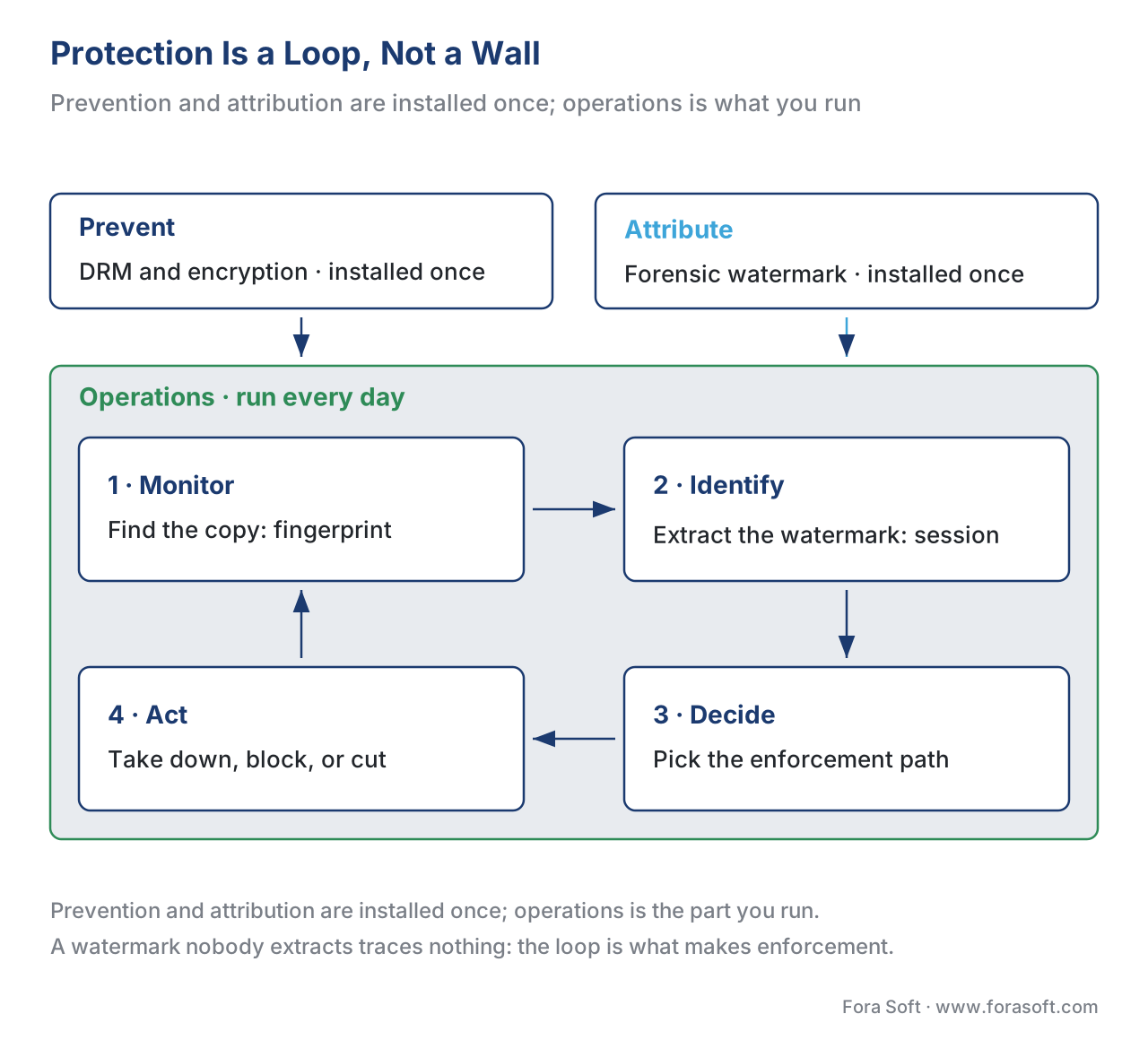 Figure 1. Prevention and attribution are installed once; operations is the running loop — monitor, identify, decide, act — that turns them into enforcement.
The monitoring half: finding your content in the wild
You cannot take down what you have not found, so every anti-piracy operation starts with monitoring: continuously scanning the places stolen video shows up. Those places are predictable — dedicated pirate streaming sites, illegal IPTV services that resell channels for a few dollars a month, social platforms where clips and full matches get re-uploaded, file lockers, and link-aggregator pages that index all of the above. The scale is the problem. No human team can watch hundreds of thousands of streams, so monitoring is automated, and it leans on the same recognition technology in two different roles.
The first role is finding the content, and the tool for that is a content fingerprint — a compact mathematical summary computed from what the video looks and sounds like, so a system can recognize "this is our Cup final" even after the pirate re-compressed and rescaled it. A monitoring service holds fingerprints of your catalogue and your live feeds, crawls the suspect sites, and flags matches. This is the same fingerprinting introduced in the watermarking article, and the distinction is worth repeating because people constantly blur it: a fingerprint is computed from content to find it; a watermark is deliberately added to blame the source. Fingerprint to locate the stream, watermark to identify who leaked it.
The second role is reading the evidence, and it only happens once a stream is found. When monitoring flags a live pirate re-stream of your match, the operation captures a sample and runs watermark extraction — the reverse of embedding — to recover the hidden session identifier from the pixels. That identifier maps, in your back-end, to a session and a subscriber. Now you know not just that a stream is being stolen, but whose legitimate session it was pulled from, which lets you cut that session directly and feeds the legal process with evidence. The full embed-and-extract mechanism lives in the watermarking article; here it is one input to the operational loop.
Monitoring is where you decide your coverage, and coverage is a budget choice, not a binary. A premium catalogue with a studio contract and a live-sports rights deal justifies always-on monitoring of the major sites and real-time fingerprint matching on the live feed. A smaller library might justify periodic crawls of the top piracy destinations and nothing more. The honest framing for a content owner is that monitoring finds a large share of the high-traffic infringement — the sites pirates actually use — and never finds all of it. You are mapping the visible market, not achieving omniscience.
The takedown half: the legal machinery
Once you have found a copy and, where possible, identified its source, you act. For hosted content — a file or stream sitting on a server somewhere — the primary tool in the United States is the copyright takedown notice, and its rules are worth knowing precisely because a defective notice does nothing.
In U.S. law, the takedown system is defined by the Digital Millennium Copyright Act, specifically Section 512 of the Copyright Act (17 U.S.C. § 512). It works as a bargain: an online service that merely hosts what its users upload gets a "safe harbor" from liability for their infringement, on the condition that it promptly removes infringing material when a copyright owner sends a proper notice. The required contents of that notice are spelled out in § 512(c)(3), and missing any of them means the host has no obligation to act. A valid notice must carry a physical or electronic signature; identify the copyrighted work; identify the infringing material precisely enough to locate it, in practice a URL; give the sender's contact details; state a good-faith belief that the use is unauthorized; and state, under penalty of perjury, that the sender is authorized to act for the rights holder. Get one element wrong and you have sent a letter, not a takedown.
Two more parts of the same law shape the operation. The person whose content was removed can file a counter-notice under § 512(g); if they do, the host may restore the material after a waiting period of ten to fourteen business days unless the rights holder files suit, which is why a single notice is rarely the end of the story. And § 512(f) makes misrepresentation — knowingly sending a false takedown — actionable, so an operation that fires notices indiscriminately at fair-use clips or content it does not own is taking on real legal risk. There is also a deterrent layer in § 1201, which makes it illegal to circumvent DRM in the first place; it does not help you remove a specific stream, but it is the statutory hook behind actions against the tools and services that break encryption.
The European Union runs a parallel but differently shaped system under the Digital Services Act (Regulation (EU) 2022/2065). Its Article 16 requires hosting platforms to operate a "notice and action" mechanism that any user can use to report illegal content, including copyright infringement, with the location of the material and a good-faith statement — the EU analogue to a DMCA notice. Article 22 adds something the DMCA lacks: the trusted flagger. An entity that a national regulator certifies as expert, independent, and accurate — an anti-piracy body or rights-holder coalition can qualify — gets its notices processed with priority and without undue delay. For a rights holder sending a high volume of accurate notices, trusted-flagger status turns a slow queue into a fast lane.
When a takedown is too slow: live and dynamic blocking
Both the DMCA notice and the DSA notice share a fatal weakness for live content: they depend on the host acting, and the host is often slow, offshore, or deliberately unreachable. A notice that a server operator actions in twenty-four hours is fine for a film that will be valuable for years. It is useless for a football match — the delivery challenge covered in Live Event Delivery and the Premiere Spike — whose entire value lives in the roughly two hours it is being played and evaporates at the final whistle, and whose pirate stream, by industry measurement, is often online within about ninety seconds of kickoff. The arithmetic is brutal: a takedown that lands after the event is not enforcement, it is paperwork.
So live enforcement uses a different lever entirely: the dynamic blocking injunction. Instead of asking a faraway host to remove a file, a rights holder gets a court or regulator to order the internet service providers in a country to block access to the pirate stream's network address, and — this is the "dynamic" part — to keep blocking the new addresses that pop up the instant the old one is cut, without going back to court for each one. This defeats the pirate's main trick, the mirror site, which is just the same stream at a fresh address. Several jurisdictions now run this in near-real-time. Italy's regulator operates a platform, Piracy Shield, that obliges ISPs to block flagged live-sports addresses within thirty minutes; it has been aggressive enough to fine a major network-services company for failing to block in time. Spain's LaLiga runs court-ordered dynamic blocks during matches, and French courts have ordered blocking that reaches DNS resolvers and VPN providers, overseen by the audiovisual regulator ARCOM.
The European Commission encouraged exactly this approach in its Recommendation (EU) 2023/1018 of 4 May 2023 on combating online piracy of sports and other live events, which calls on member states to make prompt notice-handling and dynamic injunctions available for live content. The honest caveat, which the Commission itself flagged in its 2025 follow-up, is that this power cuts both ways: rushed, address-based blocking has produced over-blocking complaints, where legitimate sites sharing an address with a pirate get caught in the net. Speed and collateral damage are the trade-off of live enforcement, and an operation that uses it has to expect both.
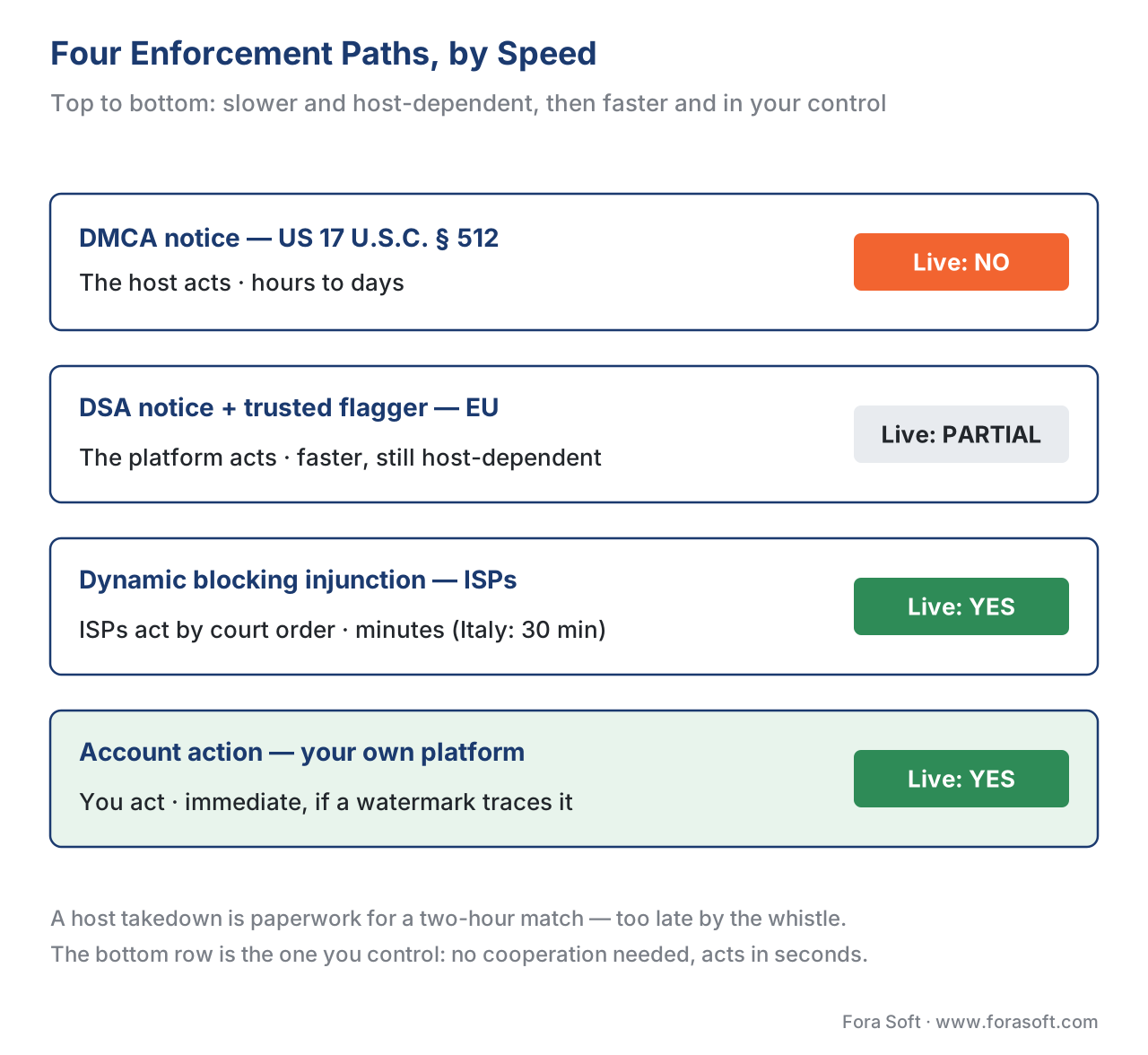 Figure 2. The slower, host-dependent notice paths fit on-demand catalogues; only dynamic ISP blocking moves fast enough for a live match.
The table sharpens the choice. The column that matters most for a sports platform is the last one — whether the path is fast enough to matter while the content is still valuable.
| Enforcement path | What it targets | Who acts | Typical speed | Fit for live? |
|---|---|---|---|---|
| DMCA notice (US, 17 U.S.C. § 512) | A hosted file or stream | The host / platform | Hours to days | No — too slow for a match |
| DSA notice + trusted flagger (EU, Reg. 2022/2065) | A hosted item of illegal content | The platform (priority for trusted flaggers) | Faster, still host-dependent | Partial |
| Dynamic blocking injunction | The network route to the stream (IP / DNS) | ISPs, by court or regulator order | Minutes (Italy: 30 min) | Yes — built for live |
| Account action (your own platform) | The leaking subscriber session | You, directly | Immediate | Yes — if a watermark traces it |
Read the bottom row as the one you fully control. When a watermark traces a live re-stream to a specific session, you do not need anyone's cooperation to act — you terminate that session and suspend the account yourself, in seconds. That is why the attribution layer and the operational layer are built together: the watermark is what makes the fastest enforcement path, your own, possible.
Inside your own walls: concurrent streams and credential sharing
Not all leakage comes from a capture card and a pirate site. A large, quiet share of it is ordinary account sharing — one subscription's login passed around a dozen friends, or resold. This is the piracy you have the most direct control over, because it happens inside your own platform, and the tools are operational, not legal.
The first tool is the concurrent-stream limit: a cap on how many devices can play from one account at the same time. The plumbing behind it is a heartbeat — while a device is streaming, the player quietly checks in with your entitlement service every few minutes, and the service counts how many live sessions an account has. The entitlement service is the same gatekeeper that decides who is allowed to watch what, covered in Subscription Billing and Entitlement; the concurrency cap is one rule it enforces, alongside the playback rules a content owner's license sets out in License Policy: Rentals, Offline, Output Control, and Rights. Cross the cap and the newest stream is refused. A limit of two or three concurrent streams barely touches a real household but makes wholesale password-resale impractical.
The second tool is credential-sharing detection, which is smarter than a raw count. By looking at the pattern of where and when an account is used — how many distinct locations, how many devices, whether two streams are playing in different cities at once — software can distinguish a normal family (a holiday home, a commuting teenager) from an account being used as a shared service by people who never met. Vendors such as Synamedia sell exactly this as a managed capability. The decisive insight, proven at the largest scale, is that the right response is usually not to punish but to convert. When Netflix moved sharers onto either their own membership or a paid add-on in 2023, it did not lose the audience — it added on the order of fifty million paid memberships over the following stretch. Account sharing, handled well, is a sales pipeline wearing a piracy costume.
A worked example: the recoverable revenue in credential sharing
Numbers make the case concrete, so price out the sharing inside a mid-sized service. Keep the percentages illustrative — your real ones come from your own detection data — and watch which line is the prize.
Start with the base. Say you run a subscription service with one million paying accounts at twelve dollars a month. Suppose your detection data shows that fifteen percent of accounts are regularly streaming from outside the household — shared credentials, not a second home:
shared accounts = 1,000,000 × 15% = 150,000 accounts
You do not try to convert all of them, and you certainly do not ban them — you offer the sharer their own access, either a fresh membership or a low-priced "extra member" add-on, and some say yes. Suppose a careful, non-punitive prompt converts twenty percent of the sharing accounts into a new paid relationship at six dollars a month:
conversions     = 150,000 × 20% = 30,000 new paid relationships
monthly uplift  = 30,000 × $6   = $180,000 per month
annual uplift   = $180,000 × 12 = $2.16 million per year
Two and a bit million dollars a year, recovered not by catching pirates but by turning quiet sharing into paid access — and the same heartbeat-and-detection machinery that produced the number is what makes wholesale credential resale impractical in the first place. This is the rare anti-piracy line that shows up as revenue rather than cost, which is exactly why it is usually the first one a platform should build.
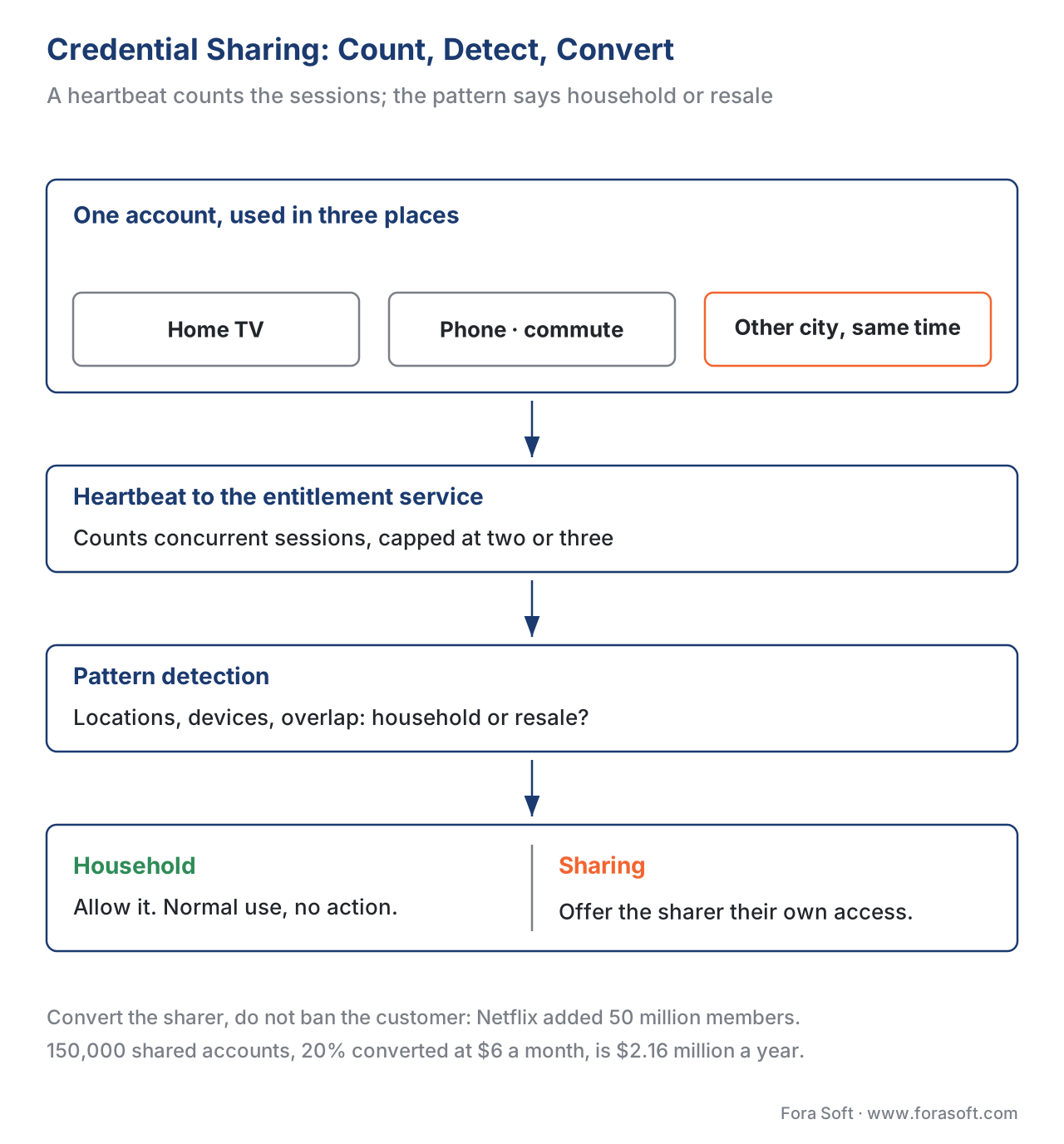 Figure 3. A heartbeat counts concurrent sessions; pattern detection separates a real household from wholesale sharing; the policy upsells the sharer rather than punishing the customer.
Common mistakes
The failures cluster into a short list, and each maps to a decision above.
- Treating takedown as the whole strategy. Operations is the third job in the loop, not a substitute for prevention and attribution. A takedown team with no DRM and no watermark is mopping a floor while the tap runs.
- Using host takedowns for live. A notice the host actions tomorrow is worthless for a match that ends today. Live needs dynamic ISP blocking and watermark-driven session cuts, not paperwork.
- Sending defective notices. A DMCA notice missing a § 512(c)(3) element creates no obligation, and a knowingly false one invites § 512(f) liability. Sloppy enforcement is both ineffective and risky.
- Forgetting you may be a host too. If your platform carries user uploads, you are on the receiving end of § 512 — you need a designated agent, a counter-notice process, and a repeat-infringer policy to keep your own safe harbor.
- Treating credential sharing as pure theft. The proven move is conversion, not punishment. Banning sharers burns customers; upselling them books revenue.
- Believing a product "stops piracy." No monitoring suite, DRM, or watermark eliminates it. Anyone who says otherwise is selling. Set the goal as friction and conversion, measured, not a war you expect to win.
- Over-blocking in the rush. Address-based live blocking can catch innocent sites sharing an IP. Build in a check, because the legal and reputational blowback is real.
The realistic ceiling: what operations can and cannot achieve
The most useful thing an honest article can give you is the ceiling, because budgeting against a fantasy is how money gets wasted. Here it is, plainly: you will not eliminate piracy, and the people with the most resources and the strongest laws have not. In November 2025 the European Commission reviewed its own 2023 anti-piracy recommendation and concluded that overall piracy levels had remained largely unchanged despite broader use of dynamic injunctions and tighter cooperation between authorities. That is the candid verdict from the body most motivated to claim victory.
The reason is structural. Piracy is a whack-a-mole problem: cut one stream and a mirror appears at a new address; shut one site and its audience migrates. The operations that get taken down are enormous — the Streameast network that the Alliance for Creativity and Entertainment, the major studios' enforcement coalition, helped Egyptian authorities dismantle in September 2025 had logged around 1.6 billion visits across some eighty domains in a year — and yet clones and successors follow. Enforcement removes specific infrastructure; it does not remove demand.
So what is the win? It is a shift in the equilibrium, and that shift is worth real money. Effective operations make piracy slower, less reliable, and lower-quality for the casual viewer, which pushes a meaningful share of them back to the legitimate, convenient, high-definition product — the same dynamic that let Netflix convert sharers into fifty million memberships. They protect the two windows where value is concentrated and a leak hurts most: the early release window of a new film and the live duration of a sports event. And they satisfy the contractual obligations that come with premium content, because a studio or a league will not license to a platform that cannot show it runs the loop. The goal is not a piracy-free internet. It is a platform where stealing your content is enough trouble that most people would rather pay, and where the high-value moments are defended fast enough to matter.
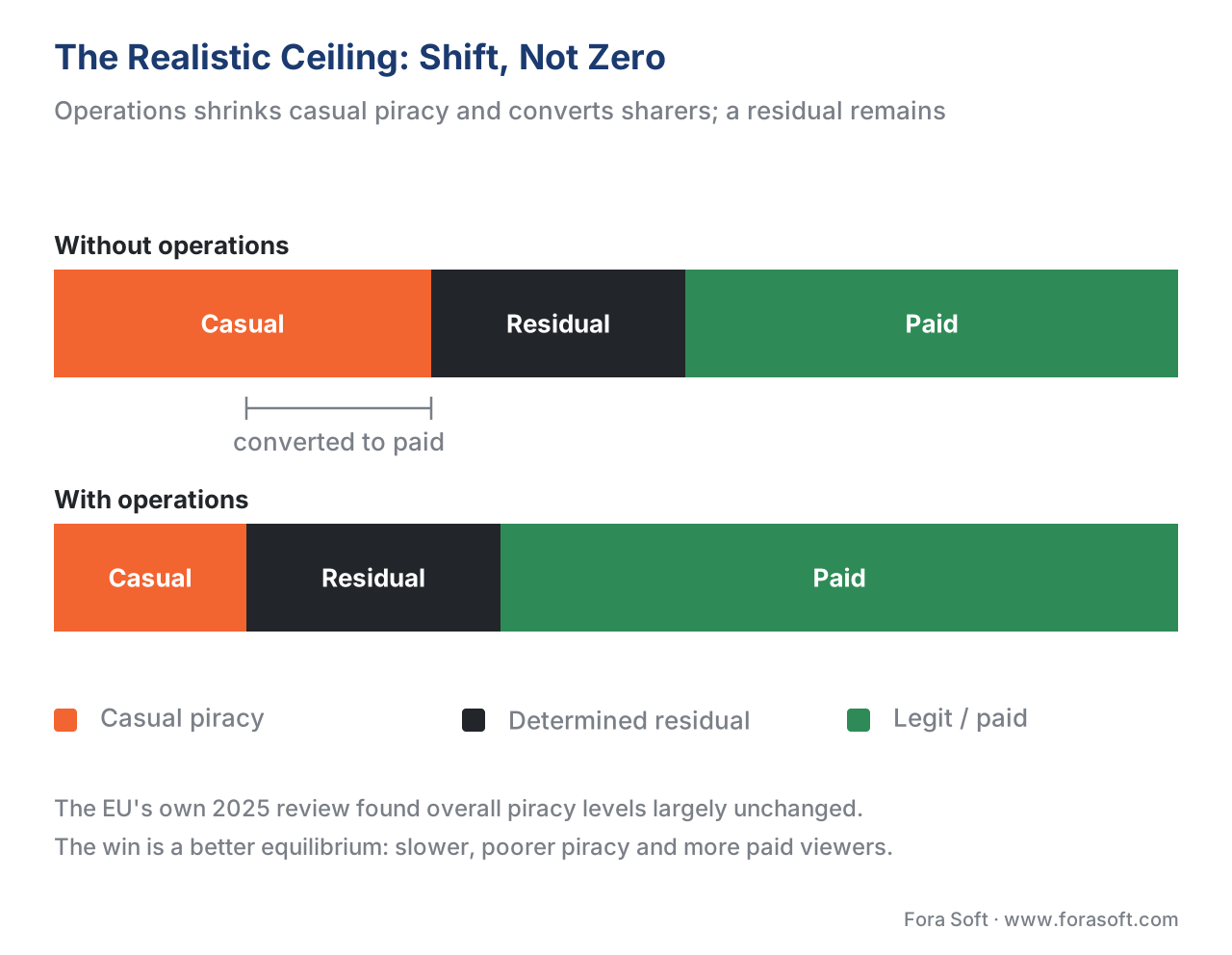 Figure 4. Operations shrinks casual piracy and converts sharers, and defends the high-value window — but a determined residual always remains. The goal is a better equilibrium, not zero.
Where Fora Soft fits in
The platforms that need this most are the ones carrying a studio catalogue or live rights to a large, multi-device audience, where the anti-piracy loop has to run continuously without a wall of manual effort and without false positives that cut off paying customers. Fora Soft has built video streaming, OTT and Internet-TV, live-sport, and video-surveillance systems since 2005 — more than 625 projects for 400-plus clients across 20-plus years — and the engineering that matters here is the integration: wiring a monitoring and fingerprint feed into your operations, closing the watermark-extraction result into the account and session systems so a traced leak becomes an instant session cut, building the concurrent-stream and credential-sharing controls into your entitlement service, and connecting the takedown and blocking workflows to the right legal path for on-demand versus live. We are vendor-neutral about which monitoring or watermarking service you license; the value is an operational loop that meets the content owner's requirements and that your paying viewers never feel.


The handbook
Fora Soft Video Engineering Handbook
We wrote a seven-volume series that covers the whole video stack from the pixel to production — encoding, delivery, sound, and AI. Volume 3 works through DRM, the players that consume the licence, and the delivery economics that decide what a leaked stream costs you; volume 2 covers the ingest, packaging, and manifests a pirate re-streams from; and volume 1 covers the encoding that produces the mezzanine and renditions a forensic watermark is embedded into. Work through them and you can design and build the protected platform this article describes. Written by Nikolay Sapunov, CEO at Fora Soft.
Running the loop, or just paying for protection?
Tell us what you carry — a studio catalogue, live rights, or both — what you monitor today, and how your entitlement service counts sessions, and we will map the watermark-extraction, concurrent-stream, and takedown wiring that turns installed protection into enforcement your paying viewers never feel. 250+ video products shipped since 2005.
See our case studies
Case study
Worldcast Live
Sub-second concert streaming — 0.4–0.5 s latency at 1.5 Gb/s for 10,000 simultaneous viewers, sold as pay-per-view tickets with donations and ad placement. This is the window the loop defends: the stream is worth money for two hours, and a notice the host actions tomorrow is worth nothing.
Case study
Smart STB
A white-label IPTV app on Android set-top boxes for a Swiss operator: 3,000+ live channels through Stalker middleware, EPG, 12-hour time-shift, and video on demand from a standard remote. The operator side of the wall, where the entitlement service counts sessions and the concurrency rule is actually enforced.
Case study
TradeCaster
A live streaming platform for stock traders with 46,000+ users on $99–$119 monthly subscriptions. Exactly the shape where one login passed around is measurable revenue, and where offering the sharer their own seat pays better than banning them.
What to read next
Attribution
Forensic Watermarking: How to Trace a Stream Leak
The per-viewer mark the loop extracts to name whose session the leak came from.
Prevention
What Is DRM? Why It Exists and What It Protects
The layer underneath operations, and the honest limits of what encryption stops.
Entitlement
Subscription Billing and Entitlement: the SVOD Engine
The gatekeeper that counts concurrent sessions and cuts the one a watermark traced.
Live delivery
Live Event Streaming at Scale: The Premiere Spike
The two-hour window that makes every host-dependent takedown path too slow.
References
- 17 U.S.C. § 512 — Limitations on liability relating to material online (DMCA notice-and-takedown). The controlling U.S. statute for hosted-content takedown: the safe-harbor bargain, the § 512(c)(3) notice elements (signature, identification of the work, identification and location of the infringing material, contact information, good-faith statement, statement under penalty of perjury), the § 512(g) counter-notice and put-back window, the § 512(i) repeat-infringer-policy condition, and § 512(f) misrepresentation liability. Read directly from the U.S. Copyright Office's Section 512 resource. Tier 1 (official statute). https://www.copyright.gov/512/ — accessed 2026-06-17.
- Regulation (EU) 2022/2065 — Digital Services Act. The EU statute governing platform handling of illegal content: Article 16 (notice-and-action mechanism — the EU analogue to a DMCA notice) and Article 22 (trusted flaggers, whose notices platforms must process with priority and without undue delay). The basis for the EU enforcement path and the trusted-flagger fast lane. Tier 1 (official regulation). https://eur-lex.europa.eu/eli/reg/2022/2065/oj — accessed 2026-06-17.
- Commission Recommendation (EU) 2023/1018 of 4 May 2023 on combating online piracy of sports and other live events. The official EU instrument encouraging prompt notice-handling and dynamic blocking injunctions for live content, and the source for the live-enforcement framing. Read alongside the Commission's November 2025 assessment that overall piracy levels remained largely unchanged and that over-blocking complaints arose. Tier 1 (official recommendation). https://eur-lex.europa.eu/legal-content/EN/TXT/?uri=CELEX:32023H1018 — accessed 2026-06-17.
- U.S. Copyright Office — Section 512 Study and resource hub. The issuing body's plain-language explanation of how notice-and-takedown, counter-notices, designated agents, and repeat-infringer policies operate in practice, used to corroborate the statutory reading in ref. 1. Tier 2 (issuing-body guidance). https://www.copyright.gov/512/ — accessed 2026-06-17.
- European Commission — "Commission takes stock of the progress made… 2023 Recommendation on combatting online piracy of sports and other live events" (2025). The Commission's own follow-up describing broader use of dynamic injunctions, stronger authority cooperation, persistent over-blocking complaints, and overall piracy levels largely unchanged. The source for the realistic-ceiling verdict. Tier 2 (issuing-body assessment). https://digital-strategy.ec.europa.eu/en/news/commission-takes-stock-progress-made-take-measures-its-2023-recommendation-combatting-online-piracy — accessed 2026-06-17.
- MUSO — "2024 Piracy Trends and Insights" (May 2025). Institutional monitoring data: ~216.3 billion visits to piracy sites in 2024 (down ~5.7% year over year), the streaming-site share of TV/film piracy, and the top-country breakdown. The source for the scale-of-the-problem figures. Tier 5 (institutional/analyst). https://www.muso.com/2024-piracy-trends-and-insights — accessed 2026-06-17.
- Premier League / enforcement reporting — 2024/25 season anti-piracy figures. The league's detection of more than 645,000 infringing live online streams and nearly 900,000 unauthorized recorded clips in the 2024/25 season, illustrating live-monitoring scale. Tier 5 (institutional/industry reporting). https://www.svgeurope.org/blog/headlines/piracy-in-live-sports-how-broadcasters-leagues-platforms-and-federations-are-fighting-back/ — accessed 2026-06-17.
- Alliance for Creativity and Entertainment / Sports Video Group — Streameast takedown (September 2025). Reporting on the dismantling, with Egyptian authorities, of the largest live-sports piracy network — ~1.6 billion visits across ~80 domains over a year, an investigation running July 2024–June 2025, and two arrests — the enforcement-context anchor and the whack-a-mole illustration. Tier 5 (institutional/news). https://www.sportsvideo.org/2025/09/04/egyptian-authorities-alliance-for-creativity-and-entertainment-shut-down-streameast-piracy-site/ — accessed 2026-06-17.
- AGCOM Piracy Shield / TorrentFreak reporting — Italy's 30-minute live-blocking regime. The Italian regulator's platform obliging ISPs to block flagged live-sports addresses within thirty minutes, including enforcement against a major network-services provider for non-compliance, plus LaLiga (Spain) and ARCOM (France) dynamic-blocking actions. The source for the dynamic-blocking speed and over-blocking trade-off. Tier 5 (institutional/news). https://torrentfreak.com/live-sports-piracy-eu-commission-admits-that-anti-piracy-advice-had-limited-impact-251124/ — accessed 2026-06-17.
- Synamedia — Credentials Sharing Insight and OTT ServiceGuard. First-party vendor engineering source for credential-sharing detection and concurrent-stream control: the heartbeat/concurrency mechanism, distinguishing a real household from wholesale sharing by usage pattern, and the convert-don't-punish model. Tier 4 (vendor engineering). https://www.synamedia.com/blog/ott-service-theft-why-your-tokens-are-a-pirates-best-friend/ — accessed 2026-06-17.
- CNN Business — Netflix paid-sharing results (2023–2024). Institutional reporting that Netflix's 2023 paid-sharing rollout drove tens of millions of new memberships (on the order of fifty million across the following period), the proof point for credential-sharing as a conversion opportunity. Tier 5 (institutional/news). https://www.cnn.com/2024/04/18/business/netflix-earnings-first-quarter/index.html — accessed 2026-06-17.
Per the section's source hierarchy, the enforcement mechanics trace to tier-1 primary law: U.S. DMCA 17 U.S.C. § 512 (ref. 1) for host takedown, EU DSA Reg. 2022/2065 Articles 16 and 22 (ref. 2) for the EU path and trusted flaggers, and Commission Recommendation (EU) 2023/1018 (ref. 3) for dynamic live-event injunctions — read alongside the issuing bodies' own guidance and 2025 assessment (refs. 4–5). Scale and operational facts are corroborated by institutional monitoring (refs. 6–9) and first-party vendor engineering (ref. 10), with the conversion result from institutional reporting (ref. 11). One common error is corrected against the primaries and the Commission's own review: "anti-piracy stops piracy." It does not — per ref. 5 the EU found levels largely unchanged; operations shifts the equilibrium and converts, and is deployed with prevention (DRM) and attribution (watermarking), never instead. DRM and content protection are this section's unique core; every internal link stays in-section (articles-ott).
