


Why this matters
If your product plays video to viewers, your transcoding bill, your content delivery network bill, and your codec licensing bill all live downstream of one decision: which cloud transcoding service runs your encodes. Pick wrong and you overpay by 3–5× on the unit cost of every minute encoded, lock yourself into a codec your audience cannot decode, or inherit royalty risk you did not budget for. Pick right and the same dollar buys 50% more bandwidth savings and a clean migration path to the next codec generation. This article is for product managers and founders who need to talk to engineers about cloud transcoding without sitting through a six-month proof of concept, and for engineers who want a single reference that ties pricing, codecs, and 2026 market shifts together. The numbers are concrete, the sources are official, and the recommendations are honest about which service wins which job.
What "Cloud Transcoding" Actually Means
Before we compare vendors, let's nail down the term. Transcoding is the act of taking a video file or a live signal and converting it into another format — usually several other formats — so it can be played on the devices your audience owns. A 4K mezzanine file at 200 megabits per second (Mbps) that your editorial team produced gets converted into nine renditions ranging from 145 kilobits per second (kbps) for the phone on a train to 8 Mbps for the smart TV on fibre. That conversion is transcoding. Cloud transcoding means the conversion happens on rented compute — virtual machines, container services, or dedicated hardware — managed by someone else, billed per minute or per output.
The job sits between two more familiar pieces. Upstream is ingest: your camera, your editor, or your live encoder hands the source over to the cloud. Downstream is the content delivery network (CDN): the renditions the transcoder produced get cached at edge locations and streamed to viewers. The transcoder itself does the heavy lifting in the middle — decode the source, scale it to each target resolution, re-encode it with the right codec at the right bitrate, package the segments into Adaptive Bitrate (ABR) streaming formats like HLS or DASH, and write the results back to object storage. (For the upstream and downstream context, see our containers article and the related streaming guides in the Streaming knowledge base.)
The reason it lives in the cloud is economics. A 90-minute film at 4K source runs roughly 130 gigabytes; a six-rendition ladder takes between 20 minutes and 4 hours of compute depending on codec choice and quality target. Buying a server that idles between titles costs more than renting compute by the minute, and you cannot easily buy a server with twelve specialised AV1 encoding chips on it. Cloud transcoding amortises both the hardware and the operational engineering across thousands of customers.
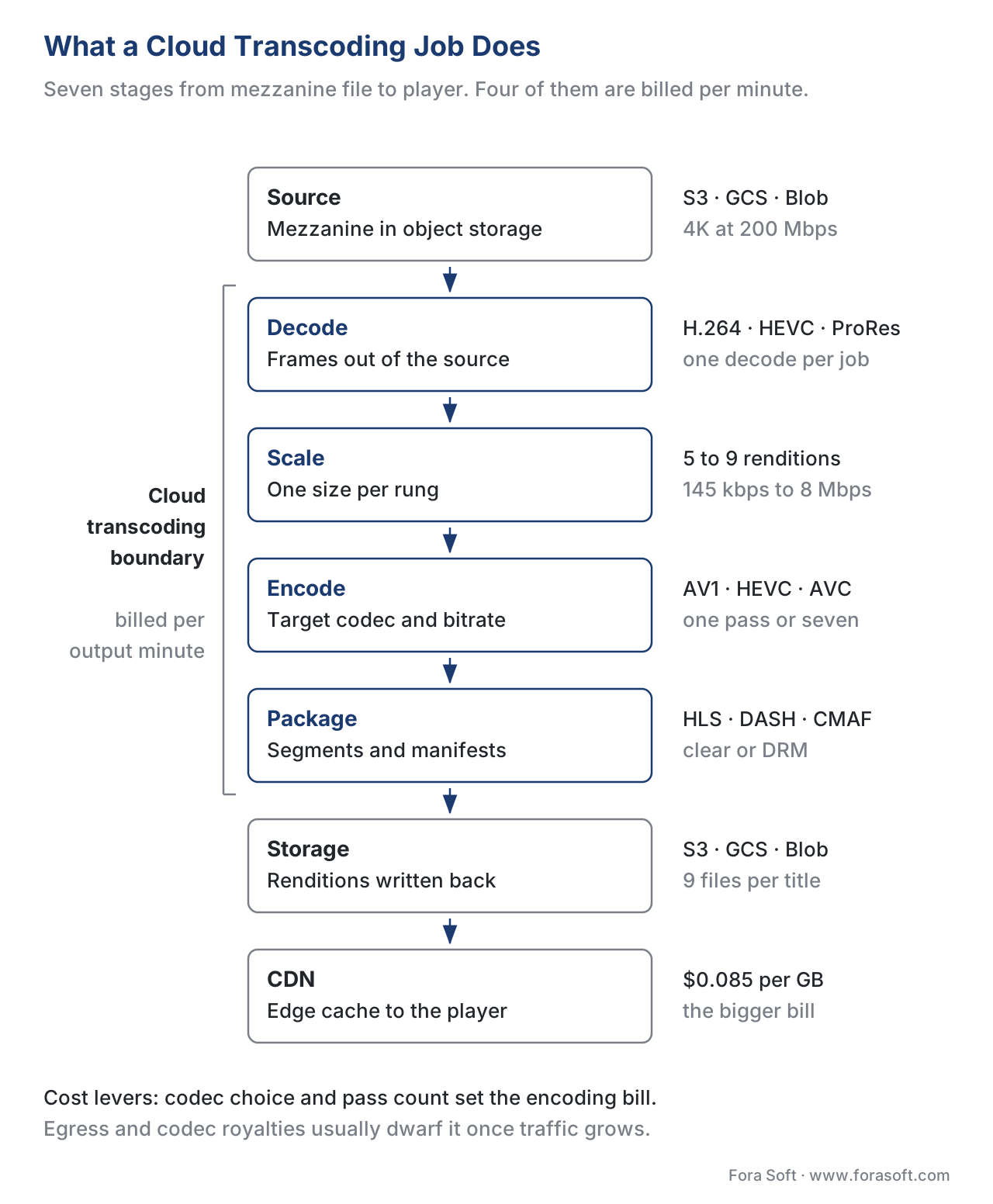 Figure 1. A typical cloud transcoding job: source lands in object storage, the service decodes it, scales it to each target resolution, re-encodes with the chosen codec, packages segments into HLS or DASH, and writes the renditions back for the CDN to pick up.
The Four Buckets of 2026
The cloud transcoding market in 2026 splits into four practical groups. Each one has a different shape of pricing, a different codec roadmap, and a different ideal customer. Understanding the buckets first makes the vendor-by-vendor comparison shorter.
Hyperscaler media services. AWS Elemental MediaConvert (file-based) and MediaLive (live), Google Cloud Transcoder API. Tightly integrated with their cloud's storage, identity, and networking; pay per output minute by tier; broadest catalogue of formats and broadcast features (audio descriptions, SCTE markers, Dolby Vision); learning curve is steep because the cloud's other primitives intrude into every workflow. Microsoft Azure used to compete here with Azure Media Services until it retired the service on June 30, 2024 — that retirement reshaped the market and pushed many workloads to Bitmovin or AWS.
Specialist transcoding platforms. Bitmovin Encoding, AWS Elemental Server (on-prem appliance), Telestream Vantage Cloud, Hybrik (now part of Dolby). Built by teams who treat video as the product, not a checkbox in a wider cloud. Better defaults, more aggressive support for new codecs, smarter per-title encoding, often friendlier pricing for the second and third encoding passes. Bitmovin is Microsoft's recommended migration partner from the retired Azure Media Services.
Developer APIs. Coconut, Mux Video, Cloudinary Video, api.video. Three to five method calls, predictable per-minute billing, JSON in and JSON out, no broadcast features you do not need. Best for product teams shipping a video feature inside an app rather than running a streaming service. Coconut's headline price of $0.015 per output minute is the cheapest mainstream tier in 2026.
VPU clouds. Akamai Cloud Accelerated Compute Instances, powered by NETINT Quadra video processing units. A VPU is a specialised chip that does only one job — encode and decode video — and does it with one fifth the power draw of a server-grade GPU. Akamai went live with NETINT VPUs in March 2025, the first public cloud to do so. This bucket is the one to watch: hyperscalers will follow, and the unit economics for high-volume video producers shift materially in this direction.
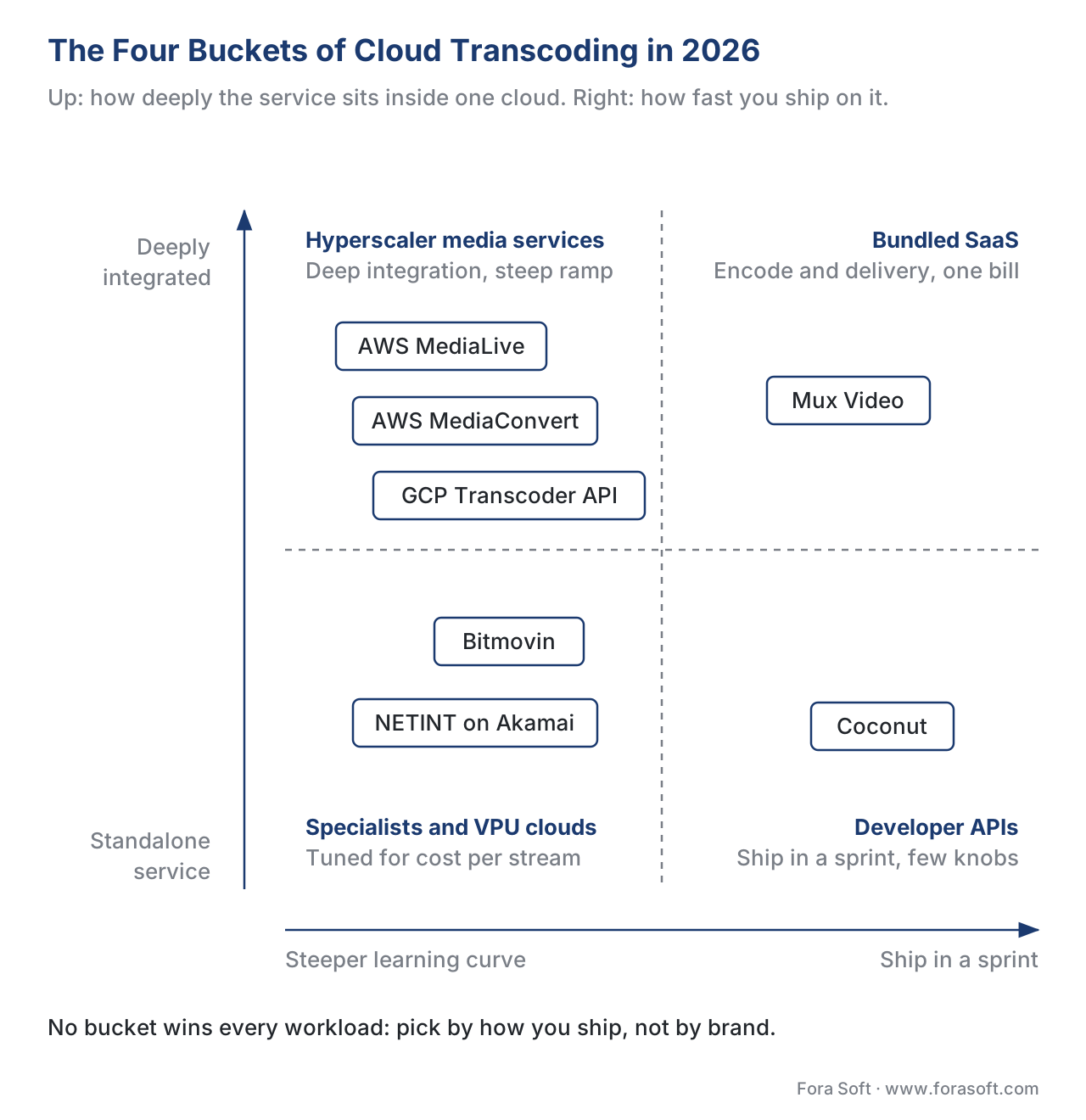 Figure 2. The 2026 cloud transcoding landscape across two axes — how deeply integrated the service is with a wider cloud (vertical) versus how quickly a developer can ship a working pipeline (horizontal). No single bucket wins every workload.
AWS Elemental MediaConvert: The File-Based Workhorse
MediaConvert is the file-based service inside the AWS Elemental media suite. Drop a source into Amazon Simple Storage Service (S3), submit a job, and MediaConvert decodes, transcodes, packages, and writes the outputs back to S3. It supports H.264 (Advanced Video Coding, AVC), H.265 (High Efficiency Video Coding, HEVC), AV1, VP8, VP9, and the broadcast codecs MPEG-2 and Apple ProRes, plus Dolby Vision and HDR10+ as packaging metadata.
Pricing is tiered. The Basic tier covers simple web outputs — H.264 in MP4 or HLS, VP8, VP9 — at a starting rate of about $0.0075 per output minute on the lowest setting. The Professional tier covers everything else: HEVC at any resolution above 1080p, AV1 in any configuration, 8K outputs, Dolby Vision, statistical multiplexing. The tier is auto-selected per output, so a job that produces one H.264 rendition and one HEVC rendition pays Basic for the first and Professional for the second.
Two pricing levers matter more than the headline number. First, one-pass versus multi-pass: MediaConvert charges roughly seven times the one-pass rate for two-pass quality-optimised mode. That premium is the single biggest pricing gotcha in MediaConvert and the lever most often skipped in vendor comparisons. Second, single-pipeline versus redundant: MediaLive (the live counterpart) charges 2× for a redundant pipeline.
The killer feature is Quality-defined Variable Bitrate (QVBR). You set a target perceived quality on a 1–10 scale and a bitrate cap; the encoder spends bits where the eye needs them and saves bits where it does not. QVBR is functionally a capped-VBR mode with a perceptual target instead of a numeric average. For a typical mid-complexity catalogue it cuts payload by 15–30% versus a fixed average-bitrate ladder at the same VMAF score. (For background on VMAF, see our quality metrics article.)
# QVBR job — H.264 1080p with quality 8 and 5 Mbps cap (one rendition)
# MediaConvert calls this Quality-defined VBR; it lets the encoder spend bits where the eye needs them.
aws mediaconvert create-job --queue $QUEUE --role $ROLE --settings file://qvbr-settings.json
In 2025 MediaConvert added Multi-View HEVC (MV-HEVC for stereoscopic VR), clear-lead common media application format (CMAF) HLS, Dolby AC-4 audio, and non-Dolby-Vision-to-Dolby-Vision frame rate conversion. Those additions are broadcast and premium OTT features — they tell you who AWS is selling to.
The headline 2026 disruption: in February 2026 AWS removed third-party patent infringement indemnification for customers using its video encoding, decoding, and transcoding services. That means if a HEVC patent pool decides to sue your service for unlicensed use, AWS no longer defends you or pays the bill. The change pushes more enterprise customers towards royalty-free codecs (AV1, VP9) and explains why Bitmovin's "we will indemnify you" positioning got louder in 2026.
AWS Elemental MediaLive: The Live Counterpart
MediaLive is the live ingest and transcoding service. You point a Real-Time Messaging Protocol (RTMP) or Secure Reliable Transport (SRT) source at it, set up a channel with a list of outputs, and MediaLive runs continuous transcoding for as long as the channel is on. Pricing is by channel-hour: a single-pipeline HD channel with three outputs (1080p, 720p, 480p) in us-east-1 runs roughly $1.55 per hour on demand including the AWS Elemental Link physical ingest device, dropping by up to 75% on a 12-month reservation. MediaLive bills with a 10-minute minimum and rounds running resources up to the nearest minute, which bites short test channels harder than expected.
Live transcoding is meaningfully different from file-based transcoding because the encoder has no future to look at. There is no second pass; the encoder cannot decide to spend more bits on a hard scene it has not yet seen. Modern live services like MediaLive partially work around this with chunk-level lookahead — a short buffer (often 2–6 seconds) of frames before the encoder must commit — and with content-adaptive encoding models trained on past streams. (For a deeper look at this trade-off, see our per-title encoding article.)
Bitmovin: The Specialist with Per-Title Built In
Bitmovin started as a research spinoff from Alpen-Adria-Universität Klagenfurt in 2013 and built its reputation by shipping the first commercial implementation of MPEG-DASH. By 2026 it is the largest video-first cloud transcoding service that is not part of a hyperscaler. Two things drive its market position: per-title encoding as a default and very aggressive support for new codecs.
Per-title encoding is the practice of computing a custom bitrate ladder for each video based on its content, rather than reusing a fixed ladder for every title in your catalogue. Bitmovin's published numbers show roughly 10% total monthly cost savings on full streaming workloads, most of which comes from reduced CDN egress on simple content. The savings concentrate on dialogue-heavy material — talking heads at half the bitrate look the same — and shrink on busy action.
# Bitmovin per-title encode — Python SDK
# Bitmovin builds the ladder from a per-title analysis pass; you set quality target, not bitrates.
encoding.start(
    streams=[h264_stream, av1_stream],
    per_title_configuration=PerTitleConfiguration(
        autoRepresentations=AutoRepresentation(),
    )
)
Pricing is per encoded minute by codec, resolution, and number of passes, with a much milder pass premium than AWS: 1.25× for two passes, 1.5× for three. That is the single biggest reason quality-sensitive workloads end up at Bitmovin even when their backend lives on AWS — the bill for a multi-pass AV1 ladder at 1.25× is far smaller than the same ladder at 7×. Bitmovin's published AV1 list price runs $0.40 per minute in standard definition and $0.80 per minute in high definition on the three-pass tier.
Codec breadth is the other lever. Bitmovin reports that its AV1 encoder hits the same VMAF as H.264 at roughly 50% lower bitrate and HEVC at roughly 30% lower bitrate. Those numbers are vendor-claimed best cases but they line up with what Netflix has independently published. Bitmovin also supports the new Versatile Video Coding (H.266 / VVC) for premium 8K workloads, low-complexity enhancement video coding (LCEVC) for layered delivery, and Dolby Vision Profile 5 and Profile 8.1.
Coconut: The Simple Developer API
Coconut is what cloud transcoding looks like for a developer who wants four method calls and a webhook. The pricing is one number: $0.015 per output minute, with no minimum, no per-job charge, no separate charge for thumbnails, and no charge for the API calls themselves. That is roughly half of MediaConvert's lowest Basic rate and a quarter of Mux Video's Plus tier on the encoding line. The trade-off is feature breadth — Coconut does not do Dolby Vision, does not do statistical multiplexing across channels, does not do live, and offers fewer knobs on codec configuration. What it does, it does cleanly: H.264, HEVC, VP9, AV1 file outputs; HLS and DASH packaging; thumbnails; storyboards; transcript-ready audio extraction.
The differentiator beyond price is the "Ultrafast" mode, where Coconut parallelises a single source across many encoding workers and chunks the output back together. Coconut claims up to 5× real-time for 4K, which matters when you have a backlog of long files and need them online before tomorrow's launch. The mechanism is straightforward: split the source into 30-second chunks, encode them in parallel on separate workers, and stitch the segments at the next keyframe. The cost is that some encoder features that need global context (two-pass rate control, scene-cut detection across the whole title) get downgraded inside each chunk.
For founders shipping a video feature inside an app — a learning platform, a fitness service, a marketplace where sellers post product videos — Coconut is the right starting point. You ship in a weekend, you pay $0.015 per minute, and you migrate to MediaConvert or Bitmovin only if your scale or feature needs demand it.
NETINT and the VPU Wave
A video processing unit (VPU) is a single-purpose chip designed to encode and decode video and nothing else. Compared to a server CPU, a VPU does the same job at roughly 1/40th the operating cost and 1/80th the carbon footprint, by NETINT's own figures. Compared to a GPU — the chip many cloud transcoders use today — a Quadra VPU draws about 20 watts versus 70-plus watts for comparable video throughput. The VPU is to transcoding what the network processor was to packet routing in the 2000s: a specialised piece of silicon that displaces a general-purpose alternative once it becomes available at scale.
NETINT is the most-deployed VPU vendor in 2026. Its Quadra family — T1A (one Codensity G5 ASIC), T1U (USB-C form factor), T2A (dual G5, handles 8K AV1 at 60 frames per second), and the rack-scale Logan box — encodes H.264, HEVC, AV1, and decodes VP9, with hardware AV1 encode being the standout capability for 2026. A single Quadra T1U handles 30 concurrent encoded streams; a typical CPU server tops out around 4.
The market shift happened in March 2025, when Akamai launched Cloud Accelerated Compute Instances powered by NETINT VPUs. Before that, VPUs were an on-premises story — broadcasters and large live producers bought NETINT cards and ran them in their own racks. After Akamai's launch, VPUs became a public cloud line item: you rent a VPU-backed instance by the hour, you pay roughly the same as a GPU instance, and you get four to ten times the encoding throughput.
The NETINT 2026 trends survey reports 32% of video infrastructure teams have ASIC or VPU encoding in production today, with 49% planning to evaluate VPUs that year. GPUs still lead at 72%. The honest read for product managers: VPUs are not yet the default cloud transcoding answer, but they are the line item your engineering team will quote at next year's budget review.
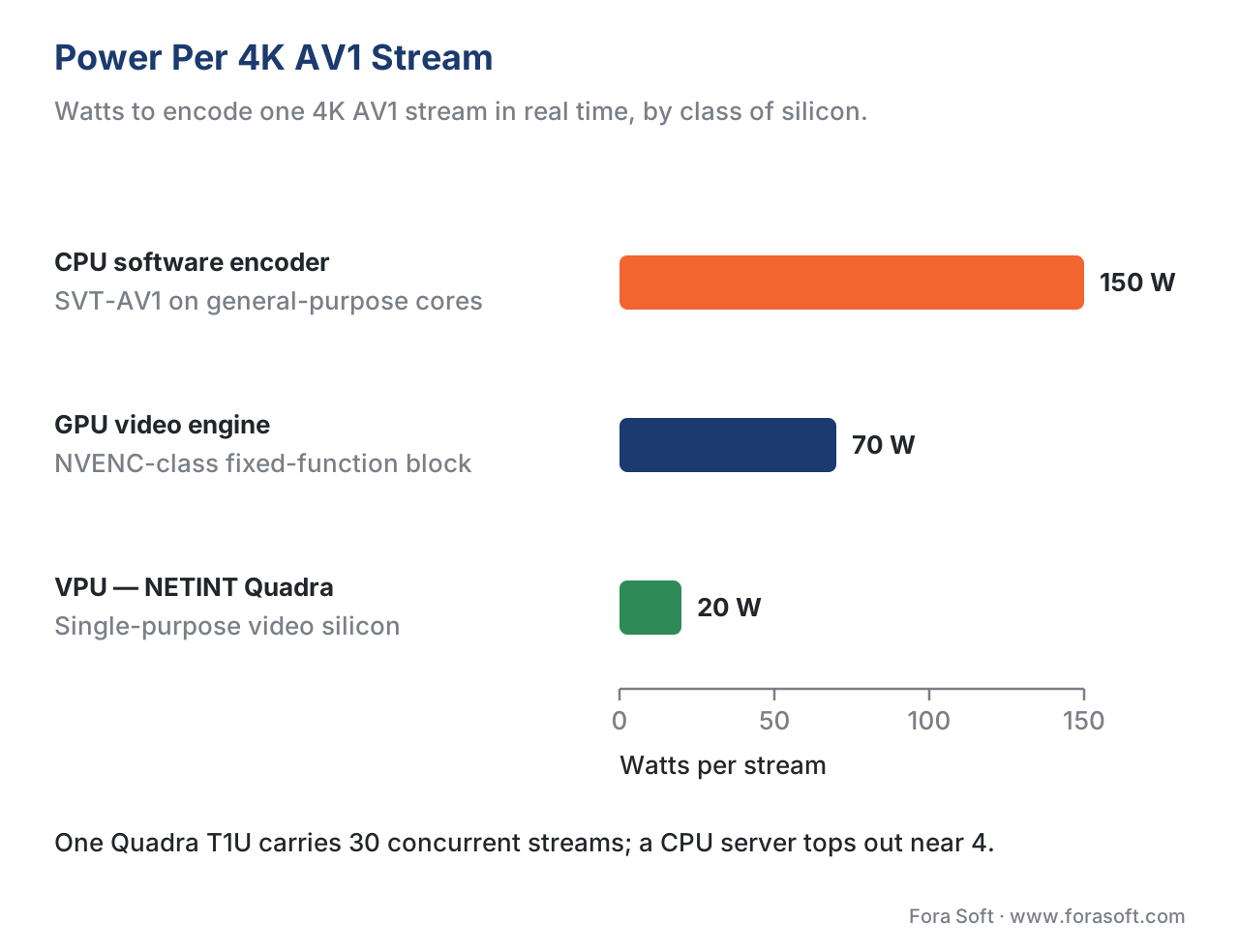 Figure 3. Power draw per 4K AV1 stream across CPU software encoding, GPU encoding (NVENC class), and VPU encoding (NETINT Quadra). The VPU's 20-watt envelope is the structural reason cloud providers are adding VPU instances to their lineups.
A Common Mistake: Confusing GPU NVENC With ASIC VPU
Engineers new to hardware encoding often treat NVIDIA NVENC and NETINT Quadra as the same thing — "they're both not CPU encoders, so they're equivalent". They are not. NVENC is a fixed-function block inside a GPU that was designed primarily for screen capture and game streaming; its quality at low bitrates lags x264 software by a noticeable margin and the bitstream features are a subset of what software encoders produce. A Quadra VPU is a single-purpose video encoder built to broadcast-grade quality targets; its outputs compete with x264 and x265 on visual quality at the same bitrate. The two devices belong in different conversations.
Pricing Math: Putting Numbers Together
Numbers without a worked example are noise. Take a service that produces 2,000 hours of HD 1080p video-on-demand content per month, with a five-rendition ladder per title and an average view count of 10,000 per title delivered through a content delivery network at $0.085 per gigabyte (CloudFront's first-tier rate). Per-title encoding shaves 25% off the average bitrate at the same quality, taking the top rendition from 5 Mbps to 3.75 Mbps. We will compare three of the four buckets on the encoding line and let the CDN line speak for itself.
inputs
   monthly_source_hours = 2,000 h
   renditions_per_title  = 5
   monthly_encoded_min   = 2,000 × 60 × 5 = 600,000 min
AWS MediaConvert (Professional tier, HEVC, one-pass)
   est. rate         = $0.024 per output minute
   monthly_bill      = 600,000 × $0.024
                     = $14,400 per month
Bitmovin (HEVC, two-pass on the more-aggressive tier)
   est. rate         = $0.025 per output minute (HD HEVC two-pass)
   monthly_bill      = 600,000 × $0.025
                     = $15,000 per month
Coconut (flat rate, HEVC HD, one-pass)
   est. rate         = $0.015 per output minute
   monthly_bill      = 600,000 × $0.015
                     = $9,000 per month
NETINT-backed Akamai instance (12 Quadra VPUs at 30 streams each)
   est. rate         = ~$0.011 per output minute (rented instance amortised over typical 70% utilisation)
   monthly_bill      ≈ 600,000 × $0.011
                     = $6,600 per month
The arithmetic surfaces three messages. First, the headline rate gaps between vendors are real and consequential at this scale — a difference of 2× on the encoding line is $90,000 per year. Second, the encoding bill is rarely the largest item in the streaming spend at high traffic; the CDN line for this same workload is on the order of $250,000 to $400,000 per month depending on rendition mix and viewer geography. Third, VPU-backed instances win the price-per-minute race when you have enough volume to keep them busy.
| Service | Codec breadth | Pricing knob | Live | Standout feature | Best fit |
|---|---|---|---|---|---|
| AWS MediaConvert | AVC, HEVC, AV1, ProRes, MPEG-2 | Basic vs Professional + 7× for 2-pass | Via MediaLive | QVBR rate control, AWS-native | Broadcast OTT services already on AWS |
| AWS MediaLive | AVC, HEVC | Channel-hour, reservation discount | Yes | SCTE-35 ad insertion, redundant pipelines | 24/7 live channels |
| Bitmovin | AVC, HEVC, AV1, VP9, VVC, LCEVC | Per-minute + 1.25× for 2-pass | Yes | Per-title encoding as default, AV1 maturity | Premium VOD, AMS migrators |
| Coconut | AVC, HEVC, AV1, VP9 | Flat $0.015/min | No | Simplicity, Ultrafast mode | App-embedded video features |
| Mux Video | AVC, HEVC, AV1 (limited) | Per-min encode + per-min delivery | Yes (with delivery) | Product-grade developer experience | SaaS apps that bundle encode + deliver |
| Google Transcoder API | AVC, HEVC, VP9 | Per-min by resolution | No | GCP-native, audio-only $0.005/min | GCP-anchored shops, no AV1 needed |
| NETINT on Akamai | AVC, HEVC, AV1 (VP9 decode) | Instance-hour | Yes | 20-watt VPU, AV1 hardware encode | High-volume producers, sustainability targets |
For deeper context on the codecs in the matrix, see the codec comparison table, the AV1 state of play in 2026, and the hardware acceleration article.
The 2024–2026 Disruptors You Cannot Ignore
Four events between mid-2024 and early 2026 reshaped the cloud transcoding market. None of them appears in a vendor brochure, all of them matter when you choose a service.
Azure Media Services retired on June 30, 2024. Microsoft did not ship a first-party replacement. Bitmovin became one of three Microsoft-recommended migration partners and absorbed a large fraction of the migrating workload. If you are still running Azure Media Services workflows in 2026 you are on borrowed infrastructure; migrate.
AWS Elastic Transcoder reached end of life on November 13, 2025. AWS pushed customers towards MediaConvert and used the migration as an opportunity to pitch the $0.0075 per minute Basic rate against Elastic Transcoder's old $0.015. If you have a forgotten Elastic Transcoder pipeline still pumping bits, it stopped being supported six months before this article was published.
AWS removed patent indemnification for video encoding services in February 2026. Customers using MediaConvert, MediaLive, MediaPackage, and related services no longer have AWS's third-party patent protection covering their HEVC, AVC, or VVC outputs. If your service is large enough that a patent pool would notice you, this changes your risk register. Bitmovin and several other vendors continue to indemnify customers; that contractual difference is worth real money once your view count crosses a few million.
Akamai launched VPUs in the cloud in March 2025. The first public-cloud VPU offering opened a price-per-stream gap against GPU-backed encoding that hyperscalers are still racing to close. NETINT's market visibility roughly doubled in the twelve months that followed.
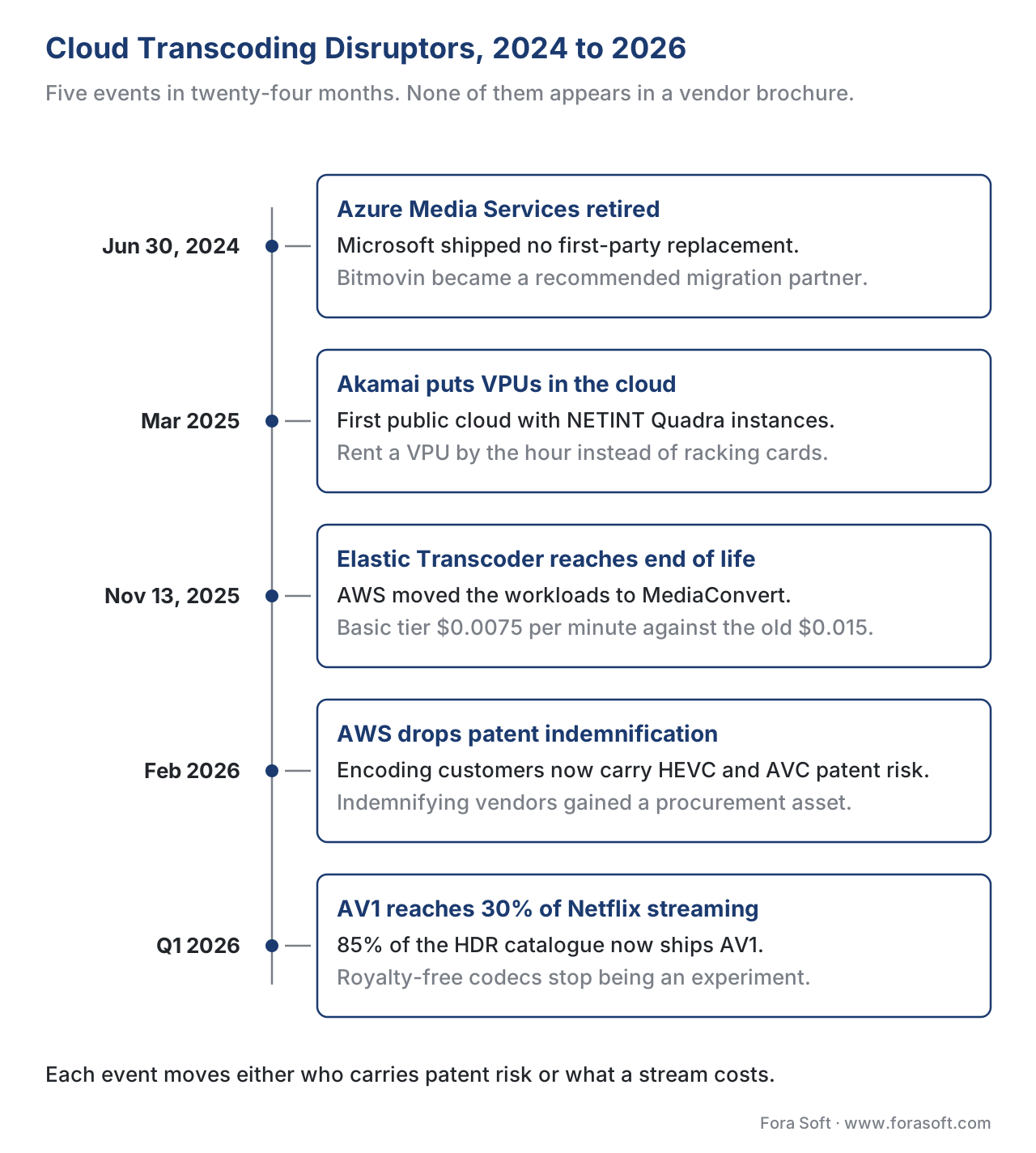 Figure 4. Five events in twenty-four months reshaped cloud transcoding economics. Vendor brochures rarely string them together; we did.
The CDN Math You Were Not Supposed to See
Cloud transcoding bills are often the line in the streaming budget that engineers fixate on, but for high-traffic services they are not the largest line. AWS CloudFront charges roughly $0.085 per gigabyte for the first 10 terabytes of egress per month in North America and Europe; direct internet egress out of S3 runs $0.05 to $0.09 per gigabyte depending on volume tier. The free tier was raised to 100 gigabytes per month in 2025, which helps developer experiments more than production workloads.
Take the same 2,000-hour workload from the pricing section. A 3 Mbps average across renditions at 10,000 average views per title implies about 130 terabytes of egress per month, which on CloudFront runs roughly $11,000 per month at the standard regional rate before any commit discounts. If the same workload runs at the un-optimised 4 Mbps average, the egress climbs to about $14,500. The 25% bitrate saving per-title encoding produced on the encode line ($3,000–$5,000 saved depending on vendor) is matched by another $3,500 saved on the CDN line. The full bill of the savings is the two added together, which is the point most vendor case studies make.
There are also hidden AWS line items that catch first-time pipeline builders. Network Address Translation (NAT) gateway processing runs $0.045 per gigabyte. Cross-availability-zone traffic costs $0.01 per gigabyte each direction. Application load balancer processing runs $0.008 per gigabyte. None of these line items shows up on the transcoding vendor's invoice but each one taxes a multi-availability-zone pipeline silently.
Codec Licensing: The Invisible Tax
Every codec your cloud transcoder produces is governed by patents. H.264 (AVC) royalties run through MPEG LA — the cap on annual end-user royalties is around 6.5 million dollars per company globally and most large producers pay close to the cap. H.265 (HEVC) is split across three patent pools (MPEG LA, Access Advance, and Velos Media); the dominant pool is Access Advance, which sets cloud-service royalties on a per-authorised-user-per-year basis rather than per stream. Access Advance announced in July 2025 that its HEVC Advance and VVC Advance rates and caps are locked through 2030 for licensees that joined the pool by December 31, 2025. AV1 is royalty free under the Alliance for Open Media patent license. VP9 has no royalty.
Your cloud transcoding vendor does not pay these royalties on your behalf. They produce the output; you serve it; you owe the royalty if the pool decides you do. Two operational consequences follow. First, the headline rate gap between AV1 and HEVC on a vendor's price sheet may be smaller than the all-in cost difference, because the HEVC stream owes a royalty that AV1 does not. Second, the disappearance of AWS's patent indemnification in February 2026 means the indemnification line on your vendor contract is now worth something on its own — Bitmovin's indemnification is a procurement asset, not boilerplate.
For larger streaming distributors, Access Advance launched a Video Distribution Platform Pool that bundles HEVC and VVC royalties for content distributors specifically. If your service has tens of millions of authorised users and ships HEVC, the VDP Pool is the licensing route you want your legal team to evaluate.
A Decision Tree for 2026
Enough analysis. Here is the short version that I use when product teams ask me what to pick.
Start at the top:
- Are you shipping a video feature inside an app and need to be live in a sprint? → Coconut, with a migration plan to MediaConvert or Bitmovin if you cross 500 hours per month.
- Is your backend already on AWS and do you serve OTT-style premium content with Dolby audio or HDR? → AWS MediaConvert + MediaLive, paying the 7× two-pass premium only on the renditions that need it.
- Are you migrating off Azure Media Services or do you need aggressive per-title encoding and AV1 at premium quality? → Bitmovin, with their indemnification clause priced into the contract.
- Are you a high-volume producer (more than 5,000 hours per month) chasing the lowest per-stream cost? → A VPU instance on Akamai with NETINT Quadra, with Bitmovin or Coconut as the fallback for codec features the VPU does not yet cover.
- Do you need a single bill for encoding plus delivery from one vendor? → Mux Video, accepting that your encoding rate is higher than a specialist's.
- Are you GCP-anchored and do not need AV1? → Google Cloud Transcoder API, with a watchful eye on whether AV1 lands in 2027.
For the matching tooling questions — what FFmpeg recipes to use, how to bench your encoders — see the FFmpeg cheat sheet and the hardware acceleration article.
Download the Cloud Transcoding 2026 Vendor Comparison Cheat Sheet — one printable page with rates, codec matrix, and the disruptor timeline.
Free download: Cloud Transcoding 2026 — Vendor Comparison Cheat SheetOne-page printable comparison of AWS Elemental, Bitmovin, Coconut, NETINT, Mux and GCP — pricing, codec support, live vs file, the best-fit decision tree, and the 2024–2026 disruptor timeline.Where Fora Soft Fits In
Fora Soft has built video pipelines since 2005 across video streaming, video conferencing, OTT, video surveillance, e-learning, and telemedicine. Picking the right cloud transcoder is part of every one of those engagements. We have moved customers from Azure Media Services to Bitmovin, from Elastic Transcoder to MediaConvert, and from GPU-backed self-hosted encoders to VPU instances when their volume justified the migration. We benchmark vendors on real catalogue samples, not on vendor slides, and the answer is often "your second vendor for the long tail, your first vendor for the head" rather than a single-service monoculture. The Streaming knowledge base in Learn covers the downstream pieces — packaging, low-latency delivery, ABR — that close the loop after the transcoder ships its renditions.

The book
Video Encoding: A Complete Guide to Video Compression — From Pixels and Color to H.264, HEVC, AV1, Quality Metrics, and AI
A vendor invoice is a codec choice, a pass count and a rate-control mode with a price tag attached — which is why the $0.0075 and the 7× two-pass premium on the same page are the same decision. The book spends 1,522 pages on what sits behind those line items: what a second pass actually buys, why AV1 costs more per minute and less per gigabyte, and how to prove with VMAF that the cheaper ladder does not look cheaper. It is volume one of the seven-volume Fora Soft Video Engineering Handbook, written by Nikolay Sapunov, CEO at Fora Soft.
Not sure which transcoder your catalogue actually needs?
Send us a sample of your sources, your rendition ladder and last month’s encoding and CDN invoices, and we will tell you what MediaConvert, Bitmovin, Coconut or a VPU instance costs on your real workload, which codecs your audience can decode, and what the patent-indemnification clause is worth in your contract — 250+ video products shipped since 2005.
See our case studies
Case study
Worldcast Live
Concert streaming at 1.5 Gb/s with 0.4 to 0.5 s of latency for 10,000 simultaneous viewers — the live side of the bill, where you rent channel-hours and the encoder never gets a second pass.
Case study
Sprii
A Danish live shopping platform with 72,000+ events hosted and 12.3 million products sold in 2024, streaming out to Cloudflare, Mux, Facebook and Instagram at once — one source, several destinations, and a separate encode bill behind each.
Case study
Perspire.tv
Live fitness classes that become an on-demand library the next morning: the file-based half of the workload, where per-minute rates and rendition count decide what the catalogue costs to keep online.
What to read next
Pipeline
Transcoding Pipeline in Depth: Decode, Filter, Encode, Mux
What the service you just picked actually runs for every minute it bills you for.
Hardware
Hardware Acceleration: GPU, VPU, ASIC
The silicon behind the 20-watt bar: NVENC, QuickSync, VideoToolbox, AMF and NETINT compared.
Encoders
Encoder Implementations: x264, x265, SVT-AV1, libaom, vvenc
Every vendor above wraps one of these; the wrapper sets the price, the encoder sets the quality.
Codecs
AV1: The New Internet Standard and Where It Stands in 2026
Royalty-free, 30% of Netflix traffic, and the codec that makes a VPU worth renting.
References
- AWS Elemental MediaConvert — Pricing. https://aws.amazon.com/mediaconvert/pricing/ (accessed 2026-05-17).
- AWS Elemental MediaLive — Pricing. https://aws.amazon.com/medialive/pricing/ (accessed 2026-05-17).
- AWS Blog — Migrating Workflows from Amazon Elastic Transcoder to AWS Elemental MediaConvert. https://aws.amazon.com/blogs/media/migrating-workflows-from-amazon-elastic-transcoder-to-aws-elemental-mediaconvert/ (2025).
- AWS Blog — Support for Amazon Elastic Transcoder Ending Soon. https://aws.amazon.com/blogs/media/support-for-amazon-elastic-transcoder-ending-soon/ (2025).
- AWS Elemental MediaConvert Documentation — QVBR. https://docs.aws.amazon.com/mediaconvert/latest/ug/cbr-vbr-qvbr.html (accessed 2026-05-17).
- AWS Elemental MediaConvert Documentation — Supported Containers and Codecs. https://docs.aws.amazon.com/mediaconvert/latest/ug/supported-containers-codecs-details.html (accessed 2026-05-17).
- Dolby Cloud Media Processing — Cloud Pricing Comparison. https://professional.dolby.com/siteassets/technologies/cloud-media-processing/cloud_pricing_comparison.pdf (2024).
- Bitmovin Blog — Per-Title Encoding Savings. https://bitmovin.com/blog/per-title-encoding-savings/ (2024).
- Bitmovin Blog — Bitmovin Improves AV1 Video Encoding. https://bitmovin.com/blog/bitmovin-improves-av1-video-encoding/ (2024).
- Bitmovin — VOD Encoding Pricing. https://bitmovin.com/encoding-service/vod-encoding-pricing/ (accessed 2026-05-17).
- Bitmovin — Azure Media Services Migration. https://bitmovin.com/ams-migration/ (2024).
- Bitmovin — 8th Video Developer Report 2024/2025. https://bitmovin.com/downloads/assets/bitmovin-8th-video-developer-report-2024-2025.pdf (2025).
- Streaming Learning Center — Bitmovin Report Reveals Streaming in 2025. https://streaminglearningcenter.com/learning/bitmovin-report-reveals-streaming-in-2025-incremental-growth-over-innovation.html (2025).
- Coconut — Pricing. https://www.coconut.co/pricing (accessed 2026-05-17).
- Coconut — Features. https://www.coconut.co/features/video-transcoding (accessed 2026-05-17).
- NETINT — Quadra T2A Product Page. https://netint.com/products/quadra-t2a-video-processing-unit/ (accessed 2026-05-17).
- NETINT — Video Encoding Trends 2026. https://netint.com/video-encoding-trends-2026/ (2026).
- Akamai Blog — NETINT VPU Plans. https://www.akamai.com/blog/developers/2025/apr/new-accelerated-compute-netint-vpu-plans (2025).
- Akamai Newsroom — First to Offer VPUs in the Cloud. https://www.akamai.com/newsroom/press-release/akamai-first-to-offer-vpus-in-the-cloud (2025).
- Mux — Pricing. https://www.mux.com/pricing (accessed 2026-05-17).
- Google Cloud — Transcoder API Pricing. https://cloud.google.com/transcoder/pricing (accessed 2026-05-17).
- Microsoft Q&A — Replacement for Azure Media Services. https://learn.microsoft.com/en-us/answers/questions/1336637/is-there-a-replacement-for-azure-media-services-or (2024).
- Netflix Tech Blog — AV1 Now Powering 30% of Netflix Streaming. https://netflixtechblog.com/av1-now-powering-30-of-netflix-streaming-02f592242d80 (2025).
- Streaming Media — The State of Streaming Codecs 2026. https://www.streamingmedia.com/Articles/Editorial/Featured-Articles/The-State-of-Streaming-Codecs-2026-173838.aspx (2026).
- InfoQ — AWS Drops Patent Protection for Video Services. https://www.infoq.com/news/2026/02/aws-drops-patent-protection/ (2026).
- Access Advance — HEVC Advance and VVC Advance Pricing Through 2030. https://accessadvance.com/2025/07/21/access-advance-announces-hevc-advance-and-vvc-advance-pricing-through-2030/ (2025).
- Egresscost.com — AWS Data Transfer Costs. https://egresscost.com/aws/ (2025-2026).
- nOps — AWS Egress Costs Guide. https://www.nops.io/blog/aws-egress-costs-and-how-to-avoid/ (2025).
- Niche Research — Video Encoding and Transcoding Market. https://thenicheresearch.com/report/video-encoding-and-transcoding-market (2025-2026).
