


Why this matters
If you build a video product, the decision between a hybrid algorithm like MPC and a neural one like Pensieve is rarely a research question — it is a quarterly engineering and finance question that touches rebuffer ratio on your dashboards, bits-per-viewer-minute on your CDN invoice, and the size of the platform team you have to keep around to maintain the model. The neural family promises measurably better quality of experience and the freedom to retrain rather than re-tune when the access network changes; it asks for a trace corpus, a training pipeline, an A/B framework that can detect single-digit-percent shifts, and people who know reinforcement learning. Product managers, CTOs, OTT operators and streaming engineers all need a clear picture of where the wins are real, where they evaporate at scale, and which production-deployed systems (Facebook ABRL, Puffer Fugu, Amazon SODA) actually back the claim before they spend the budget. This article is that picture, with the underlying papers and trial data cited directly.
What "neural ABR" actually means
A classical adaptive bitrate algorithm uses a hand-written rule to map a small set of measurements — most often the recent network throughput and the player's buffer depth — onto a choice of rung from the bitrate ladder. The map is written once, by an engineer, in a few hundred lines of code. A neural adaptive bitrate algorithm replaces that hand-written rule with a neural network whose weights are tuned by an automated training process that observes thousands or millions of streaming sessions and gradually learns which rung to pick in which situation. The neural network reads more inputs than a classical rule typically reads — every recent throughput sample, every buffer-depth sample, the byte sizes of every candidate chunk on the ladder, the previous action — and produces one output: which rung to download next.
The promise is straightforward. A hand-written rule encodes one engineer's best guess about how throughput and buffer should combine. A trained network discovers the combination from data, including parts of the input space the engineer never thought to examine. When the data the network was trained on matches the network the viewer is on, the trained policy outperforms hand-written rules by single-digit to double-digit QoE percentages. When the data does not match, the trained policy can underperform a simple rule built on the same year's understanding of the network.
Calling the family "neural" is convenient shorthand for a wider truth: it is the learned-policy family of ABR. The defining test is the same as it was for the hybrid family — pause the player, look inside the rule that picks the next rung, and ask where it came from. If the rule was written by an engineer, you have a classical or hybrid algorithm. If the rule's parameters were learned from a corpus of streaming traces using gradient descent or a related optimisation, you have a neural algorithm.
A tiny example before the math
Imagine the same six-rung ladder the hybrid article used — 300, 750, 1500, 2500, 4000, 6000 kbps, 4-second segments, a 30-second buffer. The viewer is on a network whose throughput drifts between 2 Mbps and 6 Mbps in a pattern the operator has never characterised but has captured in tens of thousands of recorded session traces. Buffer is at 12 seconds.
A hybrid algorithm like MPC would predict the next four throughput samples with a harmonic mean, enumerate rung sequences over a four-segment horizon, and pick the sequence that maximises a hand-tuned quality-of-experience function. The horizon, the predictor, and the function weights were chosen by an engineer.
Pensieve solves the same problem differently. Years before the viewer ever started watching, the system fed thousands of recorded throughput traces into a network simulator, and let a neural network play the part of the ABR rule. Whenever the network's choice of rung produced a good outcome — higher quality without a stall — a reinforcement-learning algorithm nudged the network's weights to make that choice more likely the next time it saw similar inputs. After roughly a hundred thousand simulated streaming sessions, the weights had converged. At runtime the network reads the same inputs MPC reads — throughput history, buffer depth, chunk sizes, last action, segments remaining — and outputs a probability distribution over the six rungs. The player downloads the rung with the highest probability, here rung 4 (2500 kbps). No horizon. No QoE function. No enumeration. Just a forward pass through a trained network.
The viewer never sees the difference; the dashboard sometimes does.
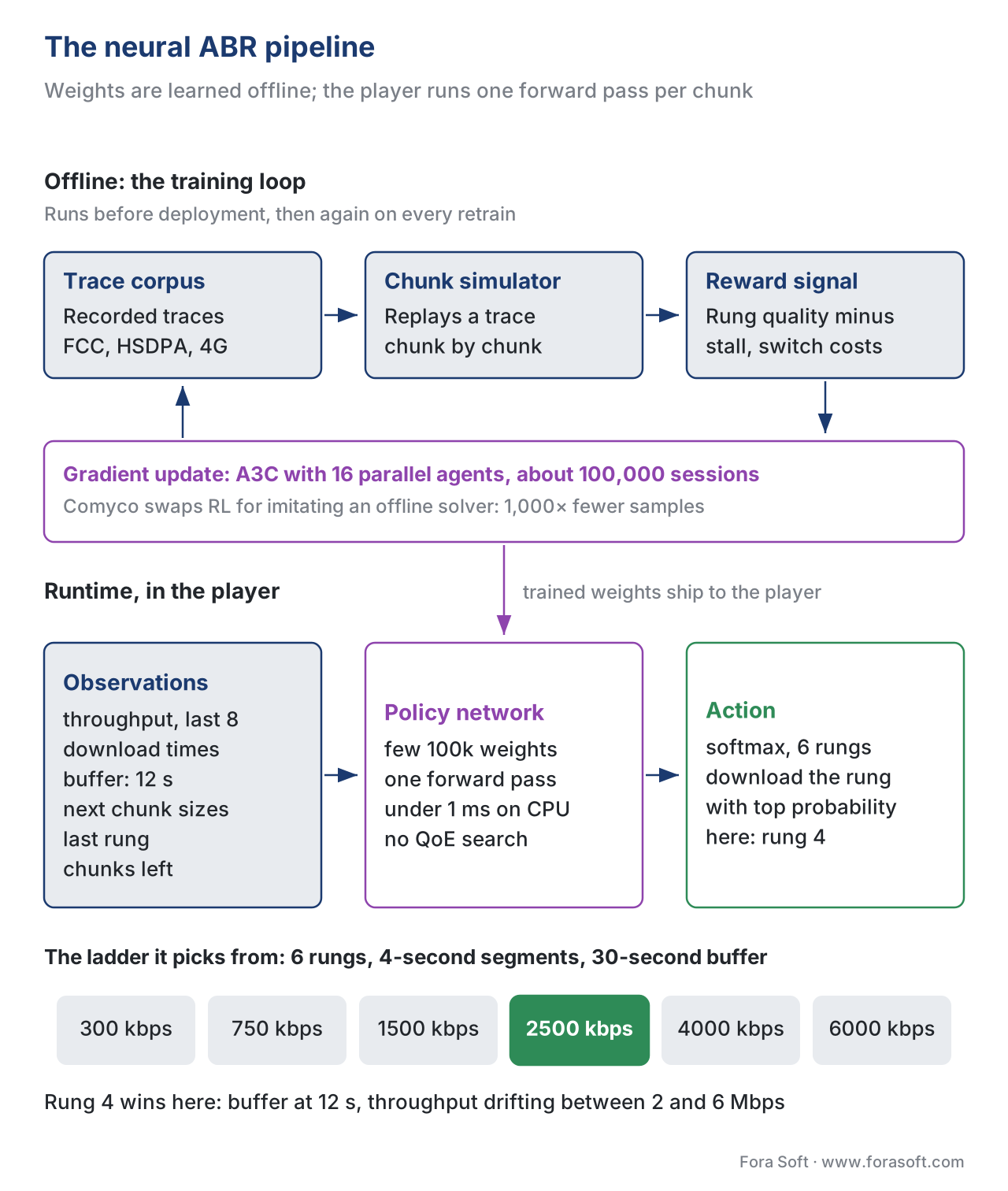 Figure 1. The neural ABR pipeline. The trained network reads raw observations and outputs a rung choice; the training loop, run offline against a network simulator or trace corpus, shaped the weights from a reward signal that rewards quality and penalises stalls and switches.
Where neural ABR sits in ABR history
ABR research moved through three phases before the learned policies arrived. The first phase, from Apple's 2009 HLS reference implementation to roughly 2014, was throughput-only — pick the highest rung the measured download rate can support. The second phase, anchored by BBA in 2014 and BOLA in 2016, was buffer-only — let the depth of pre-loaded video drive the choice. The third phase, defined by Festive (CoNEXT 2012), MPC (SIGCOMM 2015) and CS2P (SIGCOMM 2016), was hybrid — combine throughput and buffer inside an explicit optimisation objective. That phase is covered in Hybrid ABR: MPC, Festive, CS2P, the Real-World Defaults.
The neural phase began in August 2017 when Hongzi Mao, Ravi Netravali, and Mohammad Alizadeh published Neural Adaptive Video Streaming with Pensieve at SIGCOMM. The paper made one fundamentally new move: it argued that the hand-written rules at the heart of every prior ABR algorithm encoded assumptions about the deployment environment, and those assumptions broke as soon as the environment changed. Replace the rule with a neural network trained from observations, and the algorithm could adapt — automatically — to network conditions and viewer quality metrics it had never been told to care about.
Pensieve trained an asynchronous advantage actor-critic (A3C) network against a faithful chunk-by-chunk simulator fed with recorded throughput traces. The network's input was a six-element state: the last K throughput samples, the last K chunk download times, the byte sizes of the candidate chunks on the ladder, the current buffer level, the number of remaining segments, and the previous action. The output was a probability distribution over the rungs. The reward was a quality-of-experience term identical to the one MPC used — viewer-perceived quality minus a switching penalty minus a rebuffer penalty. After roughly 100,000 simulated episodes the network beat the strongest hand-engineered baselines, including a tuned MPC, by 12 to 25% on the paper's QoE metrics across a corpus of recorded FCC and Norway HSDPA traces, and generalised to traces it had not been trained against.
Two years later, Comyco (Tianchi Huang et al. at ACM MM 2019) attacked Pensieve's two weakest spots: its reinforcement-learning training was sample-inefficient, and its reward function used bitrate as a proxy for quality even though viewers respond to perceptual quality. Comyco used imitation learning — train a network to mimic the choices of an offline "instant solver" that has full knowledge of future throughputs and computes the optimal rung sequence directly. The teacher provides a stream of (state, optimal-action) pairs; the student learns by behaviour cloning. With perceptual quality (a VMAF-derived metric) in the reward instead of raw bitrate, and lifelong learning over fresh user traces, Comyco improved average video quality by 7.37% over Pensieve at matched rebuffer time, using one to two orders of magnitude fewer training samples.
The Pensieve→Comyco arc opened a six-year stretch in which dozens of variants appeared in academic conferences: TIYUNTSONG (self-play training), PRIOR (attention-based predictors), federated and offline-RL variants, Pensieve 5G (5G-specific retraining), and many others. The 2025 state of the art is Kairos (Zhengxu Meng et al., NOSSDAV 2025), which sits at the boundary between the hybrid and neural families: it keeps the MPC controller of the hybrid family and replaces only the throughput predictor with a multi-time attention network whose uncertainty estimate is gated by the player's current buffer level. Kairos outperformed prior neural and classical schemes by 6.42 to 29.45% on diverse network conditions in the paper's evaluation. The result reads, in retrospect, like the lesson CS2P first articulated in 2016: better prediction matters more than fancier control.
How Pensieve actually picks a rung
Skip this section if you only need the engineering picture. Read it if you intend to train or debug a neural ABR.
The state and the action
At every chunk boundary, Pensieve's policy network reads a fixed-length state vector composed of six features. The throughput history is the bandwidth of the last K downloads. The download-time history is the wall-clock time each of those downloads took. The next-chunk-sizes vector is the byte size of the candidate chunk at every rung on the ladder. The buffer level is the current buffer occupancy in seconds. The remaining-segments count is the number of chunks left in the video. The last-action one-hot encoding is the rung chosen for the previous chunk. K = 8 in the original paper, which is a deliberately small window that keeps the model size modest while capturing the recent network trend.
The action is one of the rungs on the ladder. For a six-rung ladder, the output of the network is a six-element softmax distribution; the player downloads the rung with the highest probability, or samples from the distribution during training to encourage exploration.
The reward
The reward at every step is the paper's QoE formula, which is structurally identical to MPC's:
reward = q(b_k) − λ_s · |q(b_k) − q(b_{k−1})| − λ_r · rebuffer_seconds_k
Where q(b_k) is the perceived quality of the rung downloaded at step k (the original paper uses linear, log, and HD-aware variants), λ_s is the switching weight (set to 1 in the paper), and λ_r is the rebuffer weight (set to 4.3, the same value MPC's authors used). Pensieve does not invent a new objective; it inherits the hybrid family's objective and learns the policy that maximises it.
The training loop
Pensieve uses A3C — asynchronous advantage actor-critic — to train two coupled networks. The actor maps the state to a distribution over actions. The critic estimates the expected future reward from a state, which the training loop uses to compute the advantage of each action relative to the critic's baseline. Sixteen agents run in parallel against the simulator; each agent feeds gradients back to a shared model. Training takes on the order of hours on a single GPU and converges around the 100,000-episode mark. The simulator runs faster than real time because it consumes recorded throughput traces directly; a single simulated session takes milliseconds.
The simulator and the trace corpus
Pensieve's training depends on a faithful simulator. The simulator implements the streaming pipeline as a sequence of chunk downloads, computes download time from chunk_bytes / instantaneous_throughput, updates the buffer by segment_duration − download_time, and emits a rebuffer event when the buffer falls to zero. The throughput series comes from public corpora: FCC Measuring Broadband America wired traces and the Norway HSDPA mobile traces. The published paper trained primarily on the FCC and HSDPA corpora and tested generalisation against held-out traces from both, plus the Belgium 4G traces. Reproducibility studies later confirmed that the published numbers replicate on the public code base; the reproducibility CS244 2018 study at Stanford reproduced Pensieve's headline gains without requiring secret tuning.
The compute cost
The trained Pensieve model is small — roughly a few hundred thousand parameters — and a single forward pass on a CPU takes well under a millisecond on modern devices. Training cost dominates the lifecycle cost. The published model trains in a few hours on a single GPU; a production retraining loop that ingests fresh traces weekly is feasible on commodity hardware. The 2025 production state of the art trades training time for accuracy by orders of magnitude — Kairos's attention-based predictor takes longer to train but pays back in tighter throughput forecasts.
How Comyco changes the picture
Comyco's contribution is methodological. Pensieve trains by trial and error in an RL loop; Comyco trains by watching an offline expert. The expert is an "instant solver" that, given full knowledge of every future throughput sample in the trace, computes the rung sequence that maximises the QoE objective directly (a small dynamic-programming search). The student network is trained to imitate the expert's choices using straightforward supervised learning on (state, optimal-action) pairs. Behaviour cloning is dramatically more sample-efficient than reinforcement learning when an expert is available — Comyco reports convergence in roughly 1,700 samples per training step versus the tens of thousands an RL agent needs to see for comparable improvement.
The second change is the reward. Pensieve's reward used bitrate as a proxy for quality. Comyco swaps in perceptual quality measured against a video-quality assessment metric — a VMAF-like score on each rung. The two changes compound: a more sample-efficient training method targeted at a perceptually grounded reward. The reported improvement on average video quality at matched rebuffer time is 7.37% over Pensieve, with 1,000× fewer training samples.
The third change is operational. Comyco's authors layered lifelong learning on top of the imitation pipeline, so the model updates incrementally as new user traces arrive in production. The lifelong-learning variant is the algorithm's commercially relevant form — the published version that streamers can actually maintain — and the Quality-Aware Neural Adaptive Video Streaming with Lifelong Imitation Learning paper in IEEE JSAC 2020 documents the production-relevant variant in detail.
How Kairos changes the picture again
Kairos sits structurally closer to the hybrid family than to Pensieve. The bitrate selector is an MPC controller of the same shape as the 2015 algorithm — predict throughput, enumerate rung sequences over a horizon, pick the sequence that maximises QoE, replan every segment. The neural network appears in the predictor, not the selector. Two ideas distinguish the predictor from CS2P's earlier HMM approach.
The first is a multi-time attention network. Real streaming sessions produce throughput samples at irregular intervals — one sample per chunk download, and chunks have different sizes and download times. Classical predictors that assume regular sampling (moving averages, harmonic means, ARIMA) blur the temporal structure. The multi-time attention network handles irregular sampling natively by attending to the time gaps between samples, producing percentile forecasts at multiple future horizons.
The second is buffer-aware uncertainty control. Instead of using the predictor's median forecast, Kairos selects a throughput percentile based on the current buffer state. When the buffer is deep, the controller can afford an aggressive (higher) percentile forecast — if the network underperforms the forecast, the buffer absorbs the shortfall without a stall. When the buffer is shallow, the controller switches to a conservative (lower) percentile — anticipating bad outcomes before they bite. This is a clean expression of the safety-first principle production teams already apply by hand, encoded as a deterministic gating rule rather than a hand-tuned constant.
Kairos also adds a smoothness regulariser to fight QoE switching penalties without flattening the controller's responsiveness. The paper reports 6.42% to 29.45% QoE improvement over a portfolio of baselines including BOLA, MPC, and Pensieve on diverse network conditions and real-world experiments.
What the production trials actually show
Academic benchmarks alone do not justify shipping a neural ABR. The serious evidence comes from large-scale randomised trials and real production rollouts. Three are worth knowing about.
Stanford's Puffer (NSDI 2020 and later updates). Francis Yan and colleagues built Puffer, a publicly running live-TV streaming service with thousands of real viewers, and used it to run a long-term randomised controlled trial of ABR algorithms. The trial included BBA, BOLA, MPC, RobustMPC, Pensieve, and a new algorithm called Fugu — a hybrid that keeps an MPC controller but trains a chunk-transmission-time predictor with a deep neural network in situ, on real Puffer traces. After 8,131 hours of streaming to 3,719 unique users, Fugu cut the stall ratio to 0.13% versus 0.17–0.22% for the alternatives, improved SSIM by 0.6 to 1.6 dB depending on baseline, and — critically — viewers watched Fugu sessions longer before quitting. Pensieve, the most-cited neural algorithm in academic papers, ranked behind Fugu on real users. The lesson Puffer's authors drew was that in-situ training on the deployment's own traces matters more than algorithm sophistication.
Facebook's ABRL (2020). Meta deployed a reinforcement-learning ABR module called ABRL into a production Facebook video stack and reported the results in Real-world Video Adaptation with Reinforcement Learning (arXiv 2008.12858, August 2020). The deployment served over 30 million video sessions a week worldwide for a week, with ABRL replacing a heuristic baseline on a randomised subset. ABRL beat the heuristic by 1.6% on average bitrate and reduced stalls by 0.4%. The wins were single-digit percent but real, statistically significant, and durable across geographies. The paper is also one of the clearest write-ups of the deployment plumbing — how the team collected experiences, simulated buffer dynamics in the backend, and packaged the trained model for the front-end player.
Amazon Prime Video's SODA (SIGCOMM 2024). Amazon's SODA is not a pure neural algorithm — the controller has theoretical QoE guarantees rather than learned weights — but it represents the production state of the art in 2024 and it pulled production lessons from the neural era into a hand-engineered controller. SODA optimises for smoothness (fewer quality switches) using a dynamic-programming controller. It shipped at scale on a wide range of devices on the Amazon Prime Video network. In production it cut bitrate switching by up to 88.8% and lifted average stream viewing duration by up to 5.91% over a fine-tuned baseline. SODA's authors made the case that switch suppression — which neural training tends to under-weight unless the reward function is carefully shaped — is the deployment-level lever that moves viewer engagement, more than the marginal QoE numbers most papers report.
Together, the three trials show a consistent pattern. Neural ABR can ship in production at internet scale; the wins are real but smaller than benchmark numbers suggest; the algorithms that win in the wild are the ones whose training data matches the deployment's own traces; and the most durable production lever is reducing switches, not chasing the last 5% of average bitrate.
 Figure 2. Academic timeline of the neural ABR family (Pensieve, Comyco, Kairos) versus the three production trials that actually deployed at scale (Facebook ABRL, Puffer Fugu, Amazon SODA).
Where neural ABR wins
Four deployment shapes match the neural family's strengths.
Shape 1 — Operators with a large trace corpus. Neural ABR is data-hungry by design. If you have hundreds of thousands of real-user session traces with throughput, buffer, and rung-choice samples — Netflix, YouTube, Disney+, Amazon, Facebook, large MVPDs — the learned policy or learned predictor has enough data to find structure a hand-written rule cannot. Smaller operators rarely meet the data bar without partnering with a vendor that does.
Shape 2 — Networks with characterisable patterns. Neural ABR generalises within the distribution it was trained on and degrades outside. Wired residential broadband, fixed wireless, and characterised mobile networks produce distributions a model can learn. Highly heterogeneous mobility — satellite, hand-offs across 4G and 5G with frequent technology changes, public Wi-Fi at venues — produces distributions a model struggles to generalise across. The 2025 Pensieve 5G paper exists precisely because a Pensieve trained on broadband traces does not transfer to 5G UHD content out of the box.
Shape 3 — Apps where switch suppression is a tracked metric. SODA's deployment showed that reducing switching by 88.8% is the largest single move on viewer engagement. Neural ABRs that include a switch penalty in their reward (Comyco, Kairos, and Pensieve under the right reward shaping) all suppress switches more aggressively than simple throughput-based rules. Apps where the product team measures switches per minute as a brand quality benefit disproportionately.
Shape 4 — Operators with the team to maintain the model. A neural ABR is not write-once. The trace distribution drifts as the network evolves, the device fleet evolves, and the codec ladder evolves. A production deployment needs a retraining pipeline, A/B infrastructure that can detect single-digit-percent shifts, an on-call rotation that knows how to debug a policy that misbehaves, and a fallback plan if the model breaks. Operators with a data-platform team and an ML platform team can afford this; operators without one usually cannot.
Where neural ABR loses
Four failure modes account for most production complaints.
Failure 1 — Trace distribution mismatch. The single biggest neural-ABR failure mode in the field is a policy trained on one network distribution running on another. The Puffer trial saw Pensieve underperform a simple hybrid because Pensieve was trained on FCC and Norway HSDPA traces while Puffer's live-TV viewers were on a different distribution. Fix: retrain on traces from the deployment itself, in situ, which is exactly what Fugu did.
Failure 2 — Training cost and operational drag. Reinforcement-learning training is brittle. Hyperparameters interact non-linearly; reward shaping is an art; a fresh trace corpus can require thousands of GPU-hours to retrain. Imitation-learning training (Comyco, Fugu's predictor) is dramatically cheaper but still requires an expert source and a maintained pipeline. For small teams, the lifecycle cost dwarfs the QoE gain.
Failure 3 — Opacity in production debugging. A hand-written rule is debuggable by an engineer reading the source. A neural policy is a black box whose decisions can be reproduced but not easily explained. When a customer reports a quality drop, the on-call engineer cannot point at a line of code; they have to reason about the input distribution, the weights, and the output. Production teams that ship neural ABRs invariably build observability tooling — saliency maps, decision logging, counterfactual replays — to keep operations sane.
Failure 4 — Reward-function misalignment. A neural policy maximises the reward you train it on. If the reward overweights average bitrate and underweights switching, the trained policy will switch aggressively. SODA's paper makes the case that production reward functions need to be shaped to match viewer-engagement levers — switch count, time-to-first-frame, time-to-1080p — and not just the QoE formula academic benchmarks use. Getting the reward wrong is the failure mode that looks like everything is fine in the benchmark and like a regression in the live A/B.
Tuning levers — the knobs that actually matter
Five levers do most of the work in a production neural-ABR deployment.
Lever 1 — Choice of training method. Reinforcement learning (Pensieve, ABRL) when no offline expert is available and the simulator is faithful. Imitation learning (Comyco, Fugu) when an expert exists — an instant solver, an MPC controller with full future knowledge, or a hand-written rule the team trusts. Imitation learning is the practical default in 2026.
Lever 2 — Choice of where the model sits. Pure policy (Pensieve, ABRL, Comyco) when the team can absorb the operational complexity and the trace corpus is large. Learned predictor inside an MPC controller (Kairos, Fugu) when the team wants the production-debugging benefits of a deterministic controller with the prediction quality of a neural network. The hybrid framing is the production default in 2026.
Lever 3 — Reward shaping. A reward of quality − λ_s · switches − λ_r · rebuffer is the academic default. Add a time-to-first-frame penalty, a time-to-1080p penalty, a viewing-duration term, and any other engagement-level metric your product team cares about. SODA's deployment makes the case that engagement-shaped rewards beat QoE-shaped rewards in production. Re-train when reward weights change.
Lever 4 — Retraining cadence. Stale models drift as the network evolves. Monthly retraining is a reasonable starting cadence for stable wired networks; weekly is appropriate for fast-evolving mobile networks; lifelong-learning variants (Comyco's L-Comyco) update incrementally and avoid the staleness problem at the cost of a continuous training pipeline.
Lever 5 — Fallback strategy. A neural ABR must have a fallback. The standard pattern: if the policy returns an action that triggers a rebuffer or a long stall, the player switches to a conservative buffer-based rule for the rest of the session and logs the incident for offline analysis. The fallback is not optional; it is the difference between a deployment that survives a bad-trace day and one that does not.
| Deployment | Training method | Where the model sits | Retraining cadence | Fallback |
|---|---|---|---|---|
| Large OTT with R&D team | RL or imitation | Pure policy | Weekly | BOLA |
| Mid-size OTT with data team | Imitation | Learned predictor + MPC | Monthly | MPC with harmonic mean |
| Mobile-first social video | RL (lifelong) | Pure policy | Continuous | Throughput-based |
| Live broadcaster | Imitation | Learned predictor + L2A | Monthly | L2A or LoL+ |
How the neural family compares with the other ABR families
Four families, one table. The neural family sits beside throughput-based, buffer-based, and hybrid algorithms.
| Family | Primary signals | Strengths | Weaknesses | Where it ships |
|---|---|---|---|---|
| Throughput-based | Recent download rate | Simple, fast start, low compute | Jittery on bursty networks, blind to buffer | hls.js, iOS native, older dash.js, most smart TVs |
| Buffer-based (BOLA) | Buffer depth in seconds | Smooth, robust to jitter, mathematically grounded | Slow cold start, blind to bandwidth, needs deep buffer | dash.js default since 2017, Shaka Player option |
| Hybrid (MPC, Festive, CS2P) | Throughput + buffer + QoE | Best aggregate QoE among hand-engineered rules | Hard to tune, compute heavier, sensitive to predictor | Netflix, YouTube, premium streamers, dash.js DYNAMIC |
| Neural (Pensieve, Comyco, Kairos) | Learned policy or learned predictor | Best when training data matches deployment, lifelong improvement | Trace-distribution drift, training infrastructure, opacity | Facebook ABRL, Puffer Fugu, Amazon SODA, Pensieve 5G |
A worked example with numbers
To make the difference between an RL policy and an imitation-trained policy concrete, here is a back-of-envelope comparison of the training cost the two paradigms incur on a 100,000-trace corpus.
Reinforcement learning (Pensieve baseline). Each training episode plays one trace from start to finish through the simulator, then updates the network weights. Pensieve's published model trains over 100,000 episodes. On a corpus of 100,000 traces, that is roughly one full pass through the corpus. Each simulated session takes about 50 ms on commodity hardware; 100,000 episodes × 50 ms = 5,000 seconds = 1.4 hours of simulation, plus the gradient updates, which the paper measured at 8 hours of wall-clock training on a single GPU.
Imitation learning (Comyco). Each training step consumes a batch of (state, optimal-action) pairs. The instant solver produces one optimal action per chunk of one trace. A trace of 64 chunks produces 64 training pairs; 100,000 traces produce 6.4 million training pairs. Comyco reports convergence at roughly 1,700 sample-steps per training step, with the total training budget under one hour on a single GPU. The 1,000× speedup the paper reports comes from this difference: the RL agent has to discover good actions by trial; the imitation agent is told the good action directly.
Both methods have running-cost characteristics dominated by the trace corpus, not the model. The trade-off is between operational simplicity (RL needs the simulator only; imitation needs the simulator plus the expert solver) and sample efficiency (imitation wins by 2–3 orders of magnitude).
Common mistakes when shipping a neural-ABR player
Pitfall 1 — Training in a simulator that lies. Pensieve's reproducibility study found that simulator fidelity drove most of the visible accuracy gap between published results and replications. Realistic chunk-transmission-time modelling, realistic rebuffer behaviour, and realistic startup delays must match the production player exactly. If the simulator computes download time differently from the player, the trained policy is solving the wrong problem.
Pitfall 2 — Skipping the A/B test before deployment. The neural-vs-hybrid choice is empirical, not theoretical. Both Puffer and Facebook ABRL gated production rollouts behind randomised trials that compared the candidate against the existing baseline across millions of sessions. A trial with fewer than ~100,000 sessions cannot detect single-digit-percent QoE shifts at conventional significance. Operators without that scale should rely on Puffer-style published results, not on internal-only experiments.
Pitfall 3 — Treating the reward function as a black box. The reward you train against determines the policy you ship. A reward that overweights average bitrate produces a policy that switches aggressively; a reward that underweights startup time produces a policy with a slow cold start. Reward weights should be derived from the product team's engagement metrics, not lifted from the academic paper.
Pitfall 4 — Forgetting to update the model. Trace distributions drift. A model trained on Q1 traces underperforms on Q4 traces when the access network has rolled out new infrastructure. Set a retraining cadence at the start of the project and respect it. Lifelong-learning variants (Comyco L-Comyco) make this less of a chore but do not eliminate the need for periodic full retraining.
Pitfall 5 — Skipping the fallback. A neural policy will, eventually, produce a pathological decision on an unseen trace. The player must have a deterministic fallback rule it can switch to mid-session, and the engineering team must have observability to detect when the fallback fires. Deployments without a fallback are fragile in ways that take a single bad night to expose.Free download: Neural ABR Deployment Decision SheetOne page with the four neural-ABR deployment shapes, the four production failure modes, the five tuning levers, and what Facebook ABRL, Puffer Fugu and Amazon SODA measured at scale.
Where Fora Soft fits in
We have built video products since 2005, and we have shipped both classical and learned-policy ABRs in OTT, e-learning, telemedicine, video conferencing, surveillance, and AR/VR stacks. In OTT we default to a hybrid algorithm (MPC or dash.js DYNAMIC) with a learned throughput predictor when the operator has the trace corpus to train one; we move to a pure neural policy only when the operator's team can maintain it. In e-learning we default to BOLA for lectures and switch to a hybrid for live class sessions. In telemedicine and live conferencing we stay off neural policies entirely and use L2A or LoL+ — the latency budget makes a four-segment planning horizon meaningless and a neural policy's debugging cost prohibitive. In surveillance we use simple throughput-based rules; the cost of a wrong decision is a recorded frame, not a billed viewer-minute. The right algorithm depends on the operational budget for ML, the trace corpus available, and the use case's tolerance for opacity — not on what the latest paper claims. Our scalable AI video streaming work covers ABR and multi-CDN delivery at 500M+ minutes a month, and our streaming software developers tune the player logic per platform.
The book
Video Streaming: A Complete Guide to Video Delivery: From ABR and CDNs to Players, WebRTC, DRM, and the Economics of Streaming
This article weighs learned policies against hand-written rules. Book 3 covers everything a rung-selection rule depends on: the bitrate ladder it picks from, the throughput, buffer and hybrid families it has to beat, the players where the rule actually ships, and the QoE telemetry you need to train a policy on your own traces and to catch the night it misbehaves. Written by Nikolay Sapunov, CEO at Fora Soft.
Is a neural ABR worth it for your player, or will a tuned hybrid do?
Send us your ladder, your player stack and a week of QoE traces, and we will tell you whether you have the data to train a policy, which rule to keep as the fallback, and which change is most likely to cut stalls and switches first. 250+ video products shipped since 2005.
See our case studies
Case study
Scholarly
DASH and HLS for 15,000 active users and up to 2,000 students in one live class — buffer-based rules for recorded lectures, a hybrid for the live sessions.
Case study
Worldcast Live
0.4–0.5 s glass-to-glass for 10,000 concurrent viewers at 1.5 Gb/s — a latency budget where a multi-segment planning horizon, learned or not, has nothing to plan with.
Case study
CirrusMed
HIPAA-compliant WebRTC video visits for 20+ physicians licensed in 48+ US states — the kind of call where we keep adaptation simple and predictable instead of opaque.
What to read next
ABR
Hybrid ABR: MPC, Festive, CS2P
The family neural ABR grew out of, and the MPC controller Kairos and Fugu still keep.
ABR
Buffer-Based ABR: BOLA in Depth
The deterministic fallback most neural deployments keep for the bad-trace nights.
QoE
QoE Metrics: What Every Dashboard Should Show
Stall ratio, switches and startup time: the numbers a reward function and an A/B test both read.
Observability
Player Observability and the Metrics That Ship in Production
How to collect the in-situ traces a learned policy needs, and see when its fallback fires.
References
- H. Mao, R. Netravali, M. Alizadeh — Neural Adaptive Video Streaming with Pensieve, ACM SIGCOMM 2017, pp. 197–210. The Pensieve paper, the entry point to the family. https://dl.acm.org/doi/10.1145/3098822.3098843
- H. Mao, R. Netravali, M. Alizadeh — Pensieve project site (MIT). Code, traces, and tutorials. https://web.mit.edu/pensieve/
- T. Huang, R.-X. Zhang, C. Zhou, L. Sun — Comyco: Quality-Aware Adaptive Video Streaming via Imitation Learning, ACM Multimedia 2019. The imitation-learning successor to Pensieve. https://arxiv.org/abs/1908.02270
- T. Huang, C. Zhou, X. Yao, R.-X. Zhang, C. Wu, B. Yu, L. Sun — Quality-Aware Neural Adaptive Video Streaming with Lifelong Imitation Learning, IEEE Journal on Selected Areas in Communications, 2020. The lifelong-learning extension to Comyco. https://ieeexplore.ieee.org/document/9109427
- Z. Meng, Y. Sun, T. Lyu, B. Hua, Z. Lin et al. — Video Streaming with Kairos: An MPC-Based ABR with Streaming-Aware Throughput Prediction, NOSSDAV 2025 (ACM Workshop on Network and Operating System Support for Digital Audio and Video, March 2025). The 2025 state of the art for MPC + learned predictor. https://arxiv.org/abs/2503.14271
- F. Y. Yan, H. Ayers, C. Zhu, S. Fouladi, J. Hong, K. Zhang, P. Levis, K. Winstein — Learning in situ: a randomized experiment in video streaming, USENIX NSDI 2020. The Puffer paper documenting the multi-year randomised trial in which Fugu beat Pensieve. https://www.usenix.org/system/files/nsdi20-paper-yan.pdf
- H. Mao, S. Chen, D. Dimmery, S. Singh, D. Blaisdell, Y. Tian, M. Alizadeh, E. Bakshy — Real-world Video Adaptation with Reinforcement Learning, arXiv 2008.12858, August 2020. The Facebook ABRL deployment paper. https://arxiv.org/pdf/2008.12858
- Z. Akhtar, Y. K. Nam, R. Govindan, S. Rao, J. Chen, E. Katz-Bassett, B. Ribeiro, J. Zhan, H. Zhang — Oboe: Auto-tuning Video ABR Algorithms to Network Conditions, ACM SIGCOMM 2018. Auto-tuning rather than learned policy; useful context. https://dl.acm.org/doi/10.1145/3230543.3230558
- K. Spiteri, R. Urgaonkar, R. K. Sitaraman — BOLA: Near-Optimal Bitrate Adaptation for Online Videos, IEEE INFOCOM 2016. The buffer-based fallback most neural deployments keep around. https://arxiv.org/abs/1601.06748
- X. Yin, A. Jindal, V. Sekar, B. Sinopoli — A Control-Theoretic Approach for Dynamic Adaptive Video Streaming over HTTP, ACM SIGCOMM 2015. The MPC paper Kairos and Fugu build on. https://conferences.sigcomm.org/sigcomm/2015/pdf/papers/p325.pdf
- Y. Sun, X. Yin, J. Jiang, V. Sekar, F. Lin, N. Wang, T. Liu, B. Sinopoli — CS2P: Improving Video Bitrate Selection and Adaptation with Data-Driven Throughput Prediction, ACM SIGCOMM 2016. The first learned-predictor paper. https://dl.acm.org/doi/10.1145/2934872.2934898
- Z. Wang, X. Zhang, Z. Liu, J. Zhao, B. Liu, B. Y. Zhao — SODA: An Adaptive Bitrate Controller for Consistent High-Quality Video Streaming, ACM SIGCOMM 2024. The Amazon Prime Video deployment that pulled production lessons from the neural era into a hand-engineered controller. https://dl.acm.org/doi/10.1145/3651890.3672260
- ISO/IEC 23009-1:2022 — Information technology — Dynamic adaptive streaming over HTTP (DASH) — Part 1: Media presentation description and segment formats. Fifth edition. The controlling DASH standard the neural algorithms consume. https://www.iso.org/standard/83314.html
- IETF RFC 8216 — HTTP Live Streaming, R. Pantos and W. May, May 2017. The HLS spec; neural rules can be layered on hls.js for HLS players. https://www.rfc-editor.org/rfc/rfc8216
- Apple — HTTP Live Streaming (HLS) Authoring Specification for Apple Devices, revision 2025-09. §2 rendition-ladder guidance defines the rung structure neural policies select from. https://developer.apple.com/documentation/http-live-streaming/hls-authoring-specification-for-apple-devices
- H. Mao et al. — hongzimao/pensieve (GitHub repository). The reference Pensieve code base, Tensorflow v1.1.0 and TFLearn. https://github.com/hongzimao/pensieve
- T. Huang — thu-media/Comyco (GitHub repository). The Comyco code base. https://github.com/thu-media/Comyco
- P. Crews, H. Ayers — Recreating and Extending Pensieve, Stanford CS244 reproducibility study, 2018. Independent reproduction of Pensieve's published gains. https://reproducingnetworkresearch.wordpress.com/wp-content/uploads/2018/07/recreating_pensieve.pdf
