


Updated October 2026: corrected the xHE-AAC status on Android 17, added the IVAS immersive voice codec, a table of what changed in 2026 (Opus 1.6, Eclipsa Audio, AC-4 on Peacock, MPEG-H in Brazil) and a best-codec FAQ.
What is the best audio codec in 2026?
There is no single best audio codec in 2026; the best one is the codec your delivery target decodes natively for the job: Opus for calls and the open web, AAC-LC for video-on-demand and live HLS/DASH, xHE-AAC for low-bitrate mobile streaming, E-AC-3 for surround and Dolby Atmos on TVs, LC3 for Bluetooth earbuds, and FLAC for lossless masters. If you need one default for a mass-market video product, ship AAC-LC, because every browser, phone and TV decodes it; add Opus for anything real-time.
- Best for video calls and WebRTC: Opus, royalty-free, frames from 2.5 ms (IETF RFC 6716).
- Best for movies and series: AAC-LC for stereo; E-AC-3 (Dolby Digital Plus) for 5.1 and Atmos, which is how Netflix, Disney+ and Apple TV+ deliver it.
- Most efficient at low bitrates: xHE-AAC, which stays usable from about 12 kbit/s, and Opus, which covers speech at 16 kbit/s and music at 64–128 kbit/s.
- Best for Bluetooth: LC3, the mandatory codec of Bluetooth LE Audio and Auracast.
- Best for archives and hi-res music tiers: FLAC (IETF RFC 9639, 2024) or ALAC on Apple platforms.
Why this matters
Pick the wrong audio codec and you will discover it the worst way: a customer's browser plays silence, an iPhone refuses your stream, or a conference call burns mobile data it didn't need to. This article is a consolidated 2026 reference — a set of source-cited tables covering nineteen codecs across every axis that affects a real product decision. It is written for a product manager, founder, or operations lead who has to choose a codec, brief an engineer, or sanity-check a vendor's claim, with no audio background assumed. Every number here traces back to its controlling standard — an IETF RFC, an ISO/IEC document, an ETSI specification, an ITU-T Recommendation — not to a secondhand blog summary, because in any disagreement the standard is the only source that settles it.
How to read a codec comparison
A codec — short for coder-decoder — is an agreed method for shrinking sound on one end of a link and rebuilding it on the other. Every codec below does that job; what separates them is the trade-offs each one makes, and those trade-offs are what the columns in the table measure. Before the table itself, here is what each column means and why it changes your decision. If you skip everything else, read this section — it turns the table from a wall of numbers into a tool you can actually use.
Release year tells you maturity and reach. An older codec like AAC-LC (1997) is decoded by literally every device made since the iPod; a newer one like LC3 (2020) sounds better per bit but is only now arriving in hardware. Age is not a flaw — for a default codec, ubiquity beats efficiency.
Lossy or lossless. A lossy codec permanently throws away sound it judges you won't notice, trading fidelity for size; AAC, Opus, and MP3 are lossy. A lossless codec — FLAC, ALAC — keeps every bit and decodes to a perfect copy, at roughly five to seven times the size. The principles behind both live in how audio compression works.
Bitrate sweet spot is the data rate, in kilobits per second (kbit/s), where the codec sounds good without waste. It is the single number that most affects your bandwidth and storage bill. Lower is cheaper; the codecs that sound transparent at low bitrates are the efficient ones.
Latency is the unavoidable delay the codec's own framing adds, measured in milliseconds (ms). It matters enormously for a live conversation — anything over about 150 ms mouth-to-ear (the ITU-T G.114 target) feels like a bad phone line — and not at all for a film you watch after it is fully encoded. This is why a real-time codec and a streaming codec are different animals.
Channels is how many separate audio feeds the codec carries — one for mono, two for stereo, six for 5.1 surround, and up to dozens for immersive object-based formats. The channel model behind these numbers is covered in channels and channel layouts.
Container support is which file wrappers — MP4, WebM, MPEG-TS, Ogg — can carry the codec. A codec your platform decodes is useless if it can't ride in the container your pipeline produces; the relationship is explained in audio in containers.
Browser and hardware decode decide whether playback "just works". Browser decode means a <video> or <audio> tag plays it with no plugin; hardware decode means a dedicated chip does the work, saving battery on phones. A codec with neither forces you into a software fallback or a different codec entirely.
Licensing and royalty path is the legal and financial cost of using the codec. Some are royalty-free (Opus, FLAC); some carry patent-pool fees you pay per device or per stream (the AAC family, the Dolby family). For a product shipping at scale, this column can outweigh every other.
A note on the most important column: "what it's for"
The last column is the one that should drive your decision, because the others mostly fall out of it. Audio codecs are not ranked best to worst on a single ladder — they are specialists. Ask "what is this audio for?" first: a phone call, a film, a surround mix, a Bluetooth earbud, a music master. The answer points at a row, and the row tells you the rest.
The 2026 audio codec comparison table
The tables below cover the nineteen codecs a video product realistically encounters in 2026. It is dense by design — this is the artifact the article exists to deliver. Read it in two passes: first scan the "What it's for" column to find your use case, then read across that row. A downloadable one-page version is linked at the end.
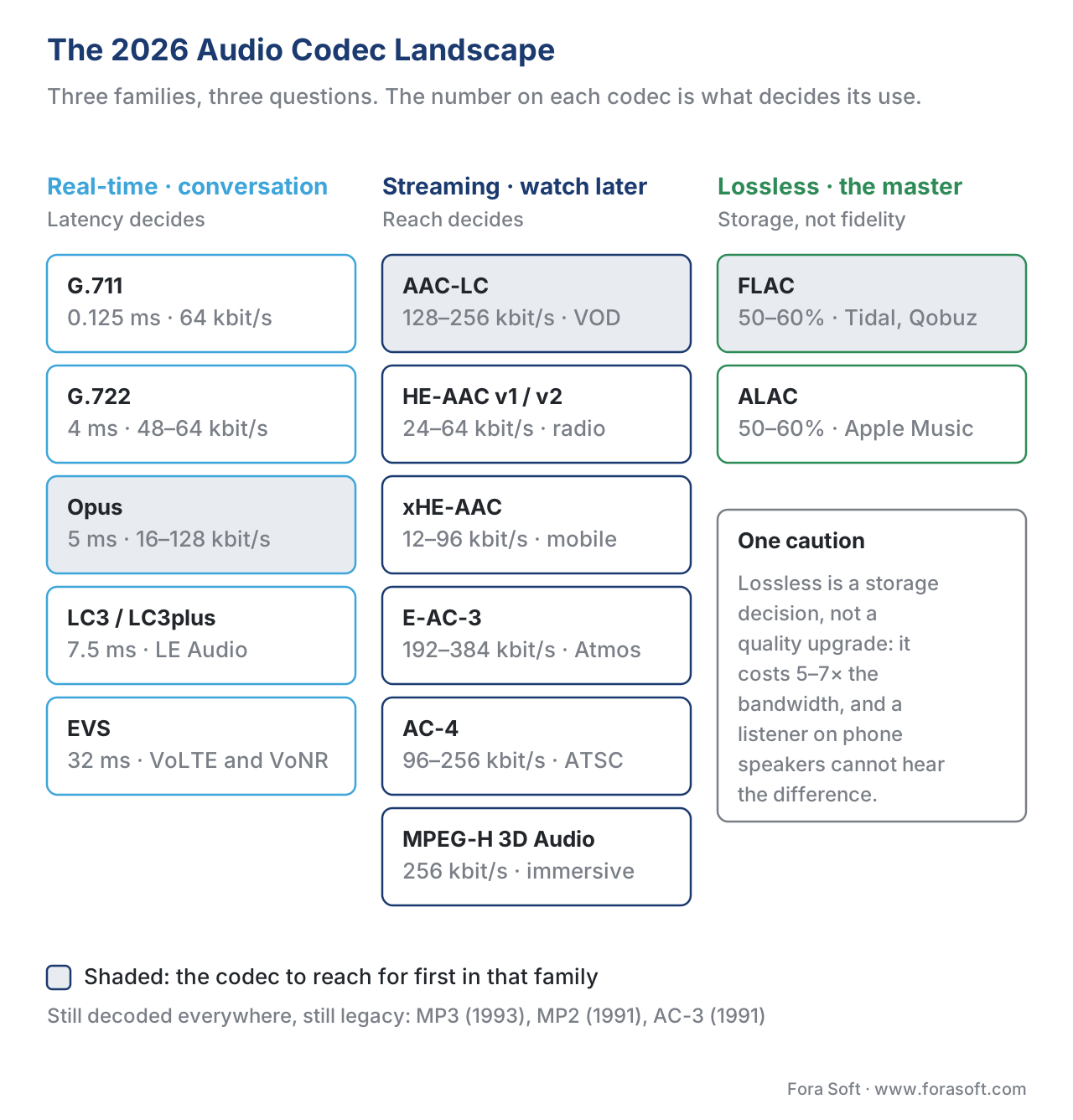 Figure 1. The 2026 landscape at a glance: where each codec lives on the latency-versus-purpose map before you read the detailed table.
Lossy codecs — streaming, broadcast, and real-time
| Codec | Year | Bitrate sweet spot | Latency | Channels | Containers | Browser decode | Hardware decode | Licensing | What it's for |
|---|---|---|---|---|---|---|---|---|---|
| Opus | 2012 | 16–128 kbit/s | as low as 5 ms (2.5–60 ms frames) | up to 255 | WebM, Ogg, MP4, MKV, CMAF | All major browsers | Mostly software | Royalty-free (RFC 6716) | Real-time (WebRTC), open-web streaming |
| AAC-LC | 1997 | 128–256 kbit/s | ~20–40 ms | up to 48 | MP4, MPEG-TS, CMAF | All major browsers | Yes, universal | Patent pool (Via LA) | The default for video-on-demand |
| HE-AAC v1 | 2003 | 32–64 kbit/s | ~40–130 ms | up to 48 | MP4, MPEG-TS, CMAF | Most browsers | Common | Patent pool (Via LA) | Low-bitrate streaming, radio |
| HE-AAC v2 | 2006 | 24–48 kbit/s | ~40–130 ms | stereo focus | MP4, MPEG-TS | Most browsers | Common | Patent pool (Via LA) | Stereo at very low bitrate |
| xHE-AAC (USAC) | 2012 | 12–96 kbit/s adaptive | ~40 ms+ | up to 48 | MP4, CMAF, fMP4 | Safari; elsewhere depends on the OS decoder | Android, iOS, Windows | Patent pool (Via LA) | Adaptive-bitrate streaming, mobile |
| MP3 | 1993 | 128–192 kbit/s | ~25 ms+ | up to 2 (5.1 rare) | MP3, MP4, MKV | All major browsers | Yes, universal | Royalty-free since 2017 | Legacy interchange, podcasts |
| MP2 | 1991 | 192–256 kbit/s | ~24 ms | up to 5.1 | MPEG-TS, MPEG-PS | Limited | Broadcast chips | Royalty-free | Legacy: DVB-T, DAB radio |
| AC-3 (Dolby Digital) | 1991 | 384–448 kbit/s (5.1) | ~32 ms framing | up to 5.1 | MP4, MPEG-TS, MKV | Limited (no Chrome) | TV / AVR chips | Dolby license | Legacy surround: DVD, broadcast |
| E-AC-3 (Dolby Digital Plus) | 2004 | 192–384 kbit/s (5.1) | ~32 ms framing | up to 15.1; Atmos via JOC | MP4, MPEG-TS, CMAF | Safari, Edge | TV / mobile / AVR chips | Dolby license | Streaming surround + Atmos |
| AC-4 | 2015 | ~96–256 kbit/s (immersive) | low (broadcast-tuned) | immersive (objects) | MP4, MPEG-TS, CMAF | Limited | ATSC 3.0 TVs, newer mobile | Dolby license | Next-gen broadcast, Atmos streaming |
| MPEG-H 3D Audio | 2015 | ~256 kbit/s (immersive) | low | up to 64 speakers / 128 core | MP4, MPEG-TS | Limited | ATSC 3.0 (Korea), TV 3.0 (Brazil), some TVs | Patent pool (Via LA) | Immersive broadcast, 360 Reality Audio |
| LC3 / LC3plus | 2020 | 64–160 kbit/s (stereo) | 7.5 / 10 ms frames | up to 2 per stream | Bluetooth LE Audio | N/A (Bluetooth link) | LE Audio chips | Royalty-free (LC3 core) | Bluetooth LE Audio, Auracast, hearing aids |
Speech codecs — the telephony and cellular lineage
| Codec | Year | Bitrate | Latency | Bandwidth | Where it lives in 2026 | Standard |
|---|---|---|---|---|---|---|
| G.711 | 1972 | 64 kbit/s | very low (~0.125 ms) | narrowband (3.4 kHz) | Every SIP trunk, PSTN fallback | ITU-T G.711 |
| G.722 | 1988 | 48 / 56 / 64 kbit/s | low (~4 ms) | wideband (7 kHz) | HD Voice, SIP wideband | ITU-T G.722 |
| AMR / AMR-WB | 1999 / 2001 | 4.75–23.85 kbit/s | ~25 ms | narrow / wideband | 3G and VoLTE fallback | 3GPP TS 26.071 / 26.171 |
| EVS | 2014 | 5.9–128 kbit/s | ~32 ms | up to 20 kHz (fullband) | 4G/5G VoLTE and VoNR | 3GPP TS 26.441 |
| IVAS | 2024 | 13.2–512 kbit/s | ≤ 38 ms | fullband, stereo to immersive scenes | 5G immersive calls, first IMS deployments in 2026 | 3GPP TS 26.250 / 26.253 (EVS-compatible) |
Lossless codecs — masters and music tiers
| Codec | Year | Compression | Container | Where it lives in 2026 | Standard |
|---|---|---|---|---|---|
| FLAC | 2001 | ~50–60% of original, exact | .flac, fMP4 |
Tidal, Qobuz, Amazon Music | IETF RFC 9639 |
| ALAC | 2004 | ~50–60% of original, exact | MP4 / .m4a |
Apple Music Lossless | Apache 2.0 (open source) |
A fuller treatment of the lossless three — FLAC, ALAC, and WavPack — lives in FLAC, ALAC, WavPack: lossless audio. They are not lossy competitors to the codecs above; they answer a different question, which is how to store a perfect master.
What changed in audio codecs in 2026
The table above is stable at the level of standards; what moved in the last twelve months is deployment. These are the changes that affect a codec decision made in October 2026.
| Change | When | What it means for your product |
|---|---|---|
| libopus 1.6: 96 kHz audio, bandwidth extension (rebuilds the treble of narrower speech) and stronger Deep Redundancy, which hides lost packets | December 15, 2025; 1.6.1 on January 14, 2026 | Opus now covers hi-res audio and keeps speech intelligible on worse networks; ask your team which libopus version your product runs. |
| xHE-AAC encoding on Android 17 | Announced March 30, 2026; fully working in the Android 17 QPR1 update (API level 37.1) | Phones can record and send xHE-AAC at 12–400 kbit/s; the first use is voice messages in RCS, the successor to SMS. Playback has been in Android since Android 9 (2018). Not every device ships the encoder, so check per device. |
| IVAS ready for deployment | Standardized in 3GPP Release 18 (2024); first calls over live 5G operator voice networks (IMS) shown at MWC 2026 | The successor to EVS brings spatial voice to phone calls at 13.2–512 kbit/s with ≤ 38 ms delay, and keeps bit-exact EVS for mono. |
| Eclipsa Audio (IAMF) spreads beyond YouTube | July 2026: Samsung TV Plus; Samsung TVs and soundbars from the 2025 line-up | Eclipsa Audio is Google and Samsung's open, royalty-free 3D-sound format, built on the Alliance for Open Media IAMF standard; it wraps Opus, AAC, FLAC or uncompressed PCM audio and is a real alternative to Atmos for open-web delivery. |
| AC-4 comes to streaming | Peacock commitment at CES, January 2026; launch planned for later in 2026 | AC-4 is no longer broadcast-only; TIDAL already streams Atmos music in AC-4. Keep E-AC-3 as the device-wide Atmos baseline. |
| MPEG-H Audio on air in Brazil | June 2026: Globo starts 24/7 DTV+ (TV 3.0) in Rio de Janeiro, São Paulo and Brasília | MPEG-H is now a live broadcast codec in South Korea and Brazil, with viewer-adjustable dialogue and commentary. |
| Apple Positional Audio Codec (APAC) | Presented with WWDC25, June 2025 | Apple's delivery codec for its Spatial Audio Format in immersive video; relevant only if you build for visionOS and Apple Immersive Video. |
Reading the table by use case
The table is a reference; this section is the shortcut. Find the sentence that matches your product and you have your codec.
"I'm building a video call or live conferencing"
Use Opus. It is the codec every browser ships for WebRTC, it is royalty-free, and it switches internally between a speech mode and a music mode so it handles both a talking head and shared music without you changing anything. Its frames can be as short as 2.5 ms, giving an algorithmic delay as low as 5 ms — far below the roughly 150 ms mouth-to-ear budget a natural conversation needs. The full story is in Opus: the codec that ate WebRTC. When a call drops down to a phone network, it falls back to G.711 or EVS; you don't choose those, the network does, but the table tells you what they are when you see them in a log. If you build on libopus, use 1.6 or later: the December 2025 release added bandwidth extension, 96 kHz support and better Deep Redundancy for lossy networks.
"I'm building video-on-demand — a course platform, an OTT app, a media library"
Use AAC-LC as your baseline and you will never hit a device that can't play it. Every browser, every phone, every smart TV decodes AAC-LC in hardware; it is the audio default for YouTube, Netflix, Apple, and Disney+. If your audience is heavily mobile and on variable networks, add xHE-AAC as a second rendition: it adapts its bitrate smoothly from about 12 kbit/s upward and Android has decoded it since Android 9 (2018), alongside support on iOS, macOS and Windows. Android 17 (2026) adds platform encoding, with seek-safe MP4 recording from Android 17 QPR1, so phones can now produce xHE-AAC as well as play it. In browsers, Safari plays it through the Apple decoder; elsewhere support depends on the operating system, so test before you rely on it.
"I need surround sound or Dolby Atmos on TVs"
Use E-AC-3 (Dolby Digital Plus) for streaming. It carries up to 15.1 channels and, through a technique called Joint Object Coding (JOC), packs a full Dolby Atmos mix inside a 5.1-compatible bitstream — which is exactly how Netflix, Disney+, and Apple TV+ deliver Atmos today. The deep dive is in AC-3 and E-AC-3. For over-the-air next-generation broadcast, the codec is AC-4 (or MPEG-H 3D Audio in South Korea), both specified for ATSC 3.0 in ATSC A/342; Brazil also chose MPEG-H for its TV 3.0 system, on air since June 2026. AC-4 is now reaching streaming too: TIDAL already delivers Dolby Atmos music in AC-4, and Peacock committed at CES in January 2026 to become the first TV and movie streamer to support it, with the launch planned for later in 2026. See AC-4 explained.
"I care about my customer's Bluetooth earbuds and call quality"
You don't encode for Bluetooth yourself — the phone's operating system does — but LC3 is the codec inside Bluetooth LE Audio, and it matters to your product because it sets the latency and quality of the last wireless hop to the listener. LC3 delivers better quality than the old SBC codec at roughly half the bitrate, with 7.5 ms or 10 ms frames. It is also the codec behind Auracast broadcast audio and the new generation of LE Audio hearing aids, which moved from promise to real venue installations through 2025 and 2026. The full picture is in LC3 and LC3plus.
"I need to store perfect master files or build a music-quality tier"
Use FLAC for an open, cross-platform catalog, or ALAC if you live in the Apple ecosystem. Both are lossless — they decode to a bit-for-bit copy of the original — so they sound identical to each other and to the source. The choice is platform, not quality: FLAC powers Tidal, Qobuz, and Amazon Music; ALAC powers Apple Music Lossless. Do not stream lossless to ordinary listeners on phone speakers — they cannot hear the difference, and you pay five to seven times the bandwidth for nothing.
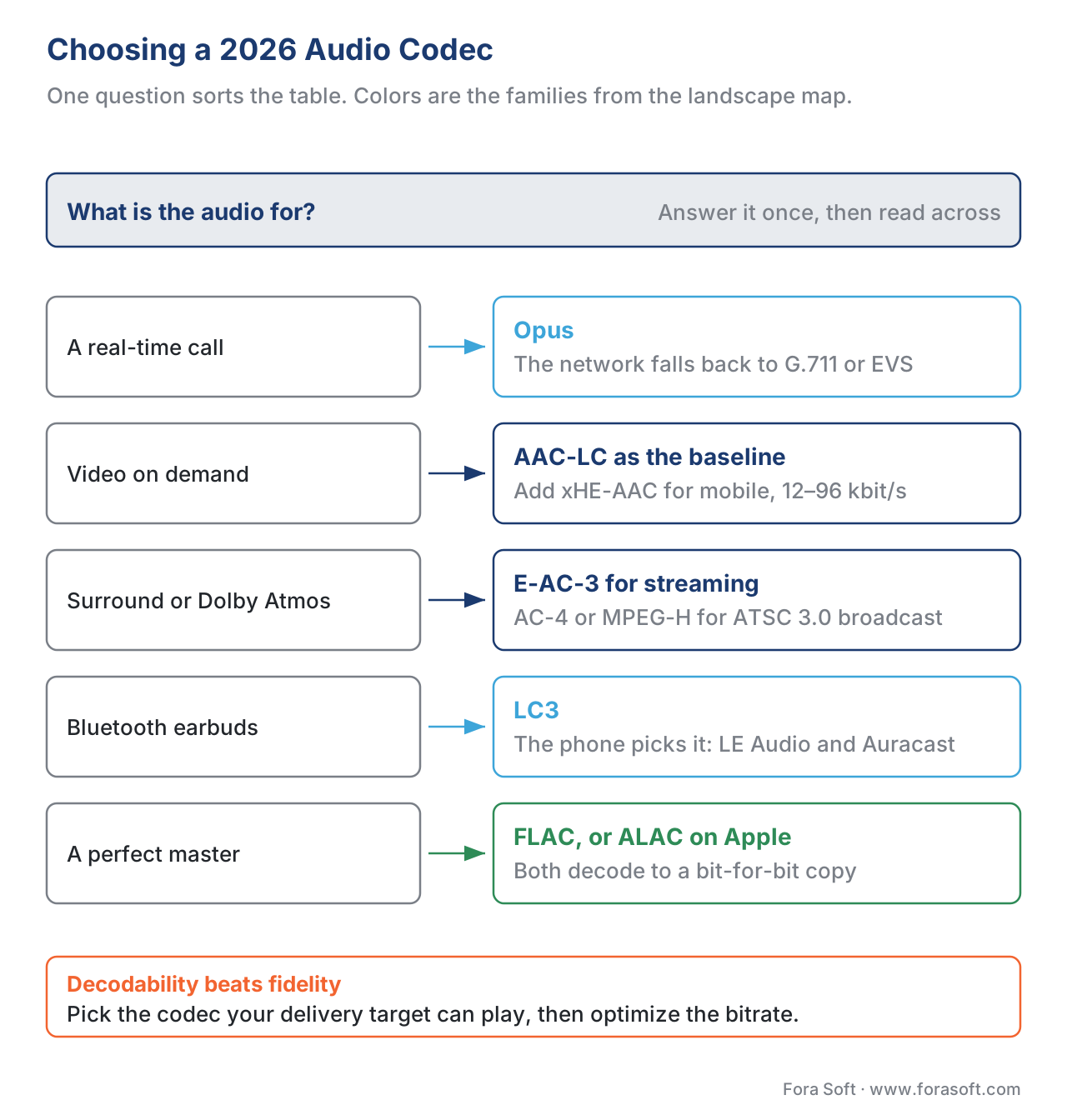 Figure 2. The decision tree the table compresses into one question: what is the audio for?
The math that decides bandwidth: a worked example
The table lists bitrate sweet spots; here is why those numbers control your bill. Suppose you run a course platform streaming a one-hour lecture to 10,000 learners, stereo audio only, and you are choosing between AAC-LC at 128 kbit/s and xHE-AAC at 48 kbit/s.
Data per stream for the hour is the bitrate times the duration:
AAC-LC:   128 kbit/s × 3,600 s = 460,800 kbit = 57.6 megabytes
xHE-AAC:   48 kbit/s × 3,600 s = 172,800 kbit = 21.6 megabytes
Across 10,000 learners, AAC-LC moves 576 gigabytes and xHE-AAC moves 216 gigabytes for the same hour of audio. That is a 63% reduction in audio egress for a codec most of your mobile audience can already decode. On a content delivery network that bills per gigabyte, the saving is real money every month — and the listeners on phones cannot tell the two apart. The catch, and the reason you ship both, is the long tail of older devices that decode AAC-LC but not xHE-AAC; you serve them the AAC-LC rendition and let modern devices pick the efficient one. The storage and delivery side of this trade is explored in audio adaptive bitrate ladders.
Common mistake: choosing a codec by "which sounds best"
The single most expensive codec error is treating the decision as a quality contest. Teams run a listening test at one bitrate, declare a winner, and ship it — then discover a third of their audience gets silence because the winning codec has no decoder on the target device. Decodability beats fidelity. A codec that sounds 5% better but plays on 80% of devices is worse, for a mass-market product, than a codec that sounds adequate and plays everywhere.
The second trap is ignoring the licensing column until legal review. Opus and FLAC are royalty-free; the entire AAC family carries patent-pool fees administered through Via LA; the Dolby codecs (AC-3, E-AC-3, AC-4) require a Dolby license. At a few thousand devices the cost is noise; at ten million units shipped it is a line item that can change which codec you pick. Read that column at the start of the project, not the end.
The third is forgetting that real-time and streaming are different problems. A codec tuned for a film you watch later — high efficiency, tens of milliseconds of framing latency — is the wrong tool for a live call, where you need 5 to 20 ms and graceful behavior when packets are lost. Opus exists precisely because it does both well; most codecs do not.
Audio codec FAQ
What is the best audio codec?
There is no universal best: Opus is best for real-time calls and WebRTC, AAC-LC is the best default for streaming video because every device decodes it, E-AC-3 is best for surround and Atmos, LC3 for Bluetooth, and FLAC for lossless storage.
What is the best audio codec for movies?
For streaming movies, use E-AC-3 (Dolby Digital Plus) for 5.1 and Dolby Atmos, with an AAC-LC stereo track as the fallback every device can play. For Blu-ray-style lossless masters, the industry uses Dolby TrueHD or PCM rather than a streaming codec.
What is the most efficient audio codec today?
In 2026, xHE-AAC and Opus are the most efficient general-purpose codecs: xHE-AAC stays listenable down to about 12 kbit/s stereo, and Opus covers wideband speech at 16 kbit/s, with algorithmic delay as low as 5 ms on its shortest frames (about 26.5 ms at the default 20 ms frames).
What are the main audio codecs in 2026?
The main audio codecs in 2026 are Opus, AAC-LC, HE-AAC v1 and v2, xHE-AAC, MP3, MP2, AC-3, E-AC-3, AC-4, MPEG-H 3D Audio and LC3 (lossy); G.711, G.722, AMR, EVS and IVAS (speech); and FLAC and ALAC (lossless).
Which audio codecs should a video product support?
Most video products need three: AAC-LC for on-demand and live streaming, Opus for anything real-time, and E-AC-3 if you deliver surround to TVs. Add xHE-AAC for low-bandwidth mobile audiences and FLAC only for a lossless music tier.
Who leads audio codec standardization?
Five bodies set the standards: ISO/IEC MPEG (AAC, xHE-AAC, MPEG-H), the IETF (Opus, FLAC), 3GPP (AMR, EVS, IVAS), ITU-T (G.711, G.722) and the Bluetooth SIG (LC3); ETSI publishes Dolby's AC-3, E-AC-3 and AC-4, and the Alliance for Open Media publishes IAMF.
Which codec do video conferencing apps use?
Browser-based and WebRTC conferencing uses Opus almost universally, because it is royalty-free, runs at 6–510 kbit/s and adapts to packet loss; G.722 is the common wideband codec on desk phones and SIP rooms, and calls that bridge to phone networks drop to G.711, AMR-WB or EVS at the gateway, which caps the audio quality of that leg.
What should I know about audio codec support for high-quality streaming?
Check decode support before quality: AAC-LC plays everywhere, Opus plays in every major browser, E-AC-3 needs a TV, set-top box or Dolby-licensed device, and xHE-AAC needs a recent OS. Ship a universal AAC-LC track and add the efficient or immersive codec as a second rendition.
Free download: 2026 audio codec cheat sheetOne page: every codec in the table with its year, bitrate sweet spot, latency, channels, containers, browser and hardware decode and licensing, plus the use-case shortcuts and the decodability-beats-fidelity rule.
Where Fora Soft fits in
We have built audio into video products since 2005 — video conferencing, OTT and Internet TV, e-learning, telemedicine, video surveillance, and AR/VR — and the codec table above is the cheat sheet our engineers reach for at the start of every one. In the real-time products our WebRTC development team builds, we standardize on Opus with the right network fallbacks; in streaming products we ship an AAC-LC baseline and layer xHE-AAC or Dolby surround where the audience and the catalog justify it. The recurring lesson from shipped projects is the one this article opens with: the codec that matches your delivery target and your licensing budget beats the codec that wins a bitrate shoot-out. When a product needs surround on living-room TVs and clear speech on a phone in the same session, the answer is usually two codecs, not one. Our audio processing developers build that dual-codec pipeline, and our OTT platform development team tests it on Smart TVs, soundbars and phones before launch.
The book
Audio for Video: A Complete Guide to Sound in Video Products: From PCM and Codecs to Loudness, Accessibility, and Real-Time Voice Processing
Every codec in the table above gets a chapter of its own in this volume — Opus, the AAC family, the Dolby line, the speech codecs and the lossless pair — with the container, decode and licensing detail a table has only room to name. It builds that on the sampling, bit-depth and channel-layout material that decides what a codec is allowed to carry in the first place, then carries on into loudness, accessibility and the real-time voice processing that runs before the encoder ever sees a sample. Written by Nikolay Sapunov, CEO at Fora Soft.
Which codecs does your product actually need?
Tell us where your audio has to land — a browser, an iPhone, a living-room TV, a phone network — and we will map which codecs cover that set, what the licensing costs at your shipping volume, and where a second rendition pays for itself. 250+ video products shipped since 2005.
See our case studies
Case study
WorldCast Live
Five channels of audio inside 1.5 Gb/s at 0.4–0.5 s latency for 10,000 concurrent viewers — the left-hand column of the map, where the framing latency of the codec is the whole argument.
Case study
Speed.Space
Recording at 1080p and 8 Mbit/s for Netflix, Electronic Arts and HBO productions, with the crew choosing resolution, fps, codec and bitrate per session — the streaming column, picked deliberately.
Case study
TransLinguist
Interpreting for the NHS national framework in 75+ languages with captions in 22 — every leg that touches a phone network is capped by G.711 or EVS, whatever the conference side encodes.
What to read next
Codecs
Opus: The Open Codec That Ate WebRTC
The whole left column in one article: why one codec covers 5 ms speech and music.
Codecs
AAC Family: AAC-LC, HE-AAC v1, HE-AAC v2, xHE-AAC
Four rows of the table that share a name and behave very differently at 48 kbit/s.
Surround
AC-3 and E-AC-3 (Dolby Digital Plus)
How Joint Object Coding packs an Atmos mix into a 5.1-compatible bitstream.
Streaming
Audio in HLS, DASH and CMAF
What the player does with the codec you picked, and how it chooses a track.
References
- IETF RFC 6716, Definition of the Opus Audio Codec, September 2012 — controlling specification for Opus, including the 2.5–60 ms frame range and 6–510 kbit/s bitrate range. https://www.rfc-editor.org/rfc/rfc6716 (Tier 1). Updated by RFC 8251 (errata and low-delay clarifications), 2017 — https://www.rfc-editor.org/rfc/rfc8251.
- IETF RFC 9639, Free Lossless Audio Codec (FLAC), Standards Track, December 2024 — the formal standard defining FLAC; channel, sample-rate, and bit-depth limits. https://www.rfc-editor.org/rfc/rfc9639 (Tier 1).
- ISO/IEC 14496-3 (current edition), Coding of audio-visual objects — Part 3: Audio — the controlling standard for the AAC family (AAC-LC, HE-AAC v1/v2). Cited for channel counts and profile definitions. https://www.iso.org/standard/76383.html (Tier 1; full text paywalled — facts confirmed against the published abstract and Fraunhofer IIS profile documentation).
- ISO/IEC 23003-3, MPEG-D Part 3: Unified Speech and Audio Coding (USAC) — the standard underlying xHE-AAC. https://www.iso.org/standard/79143.html (Tier 1; paywalled).
- ISO/IEC 23008-3, MPEG-H Part 3: 3D Audio — controlling standard for MPEG-H 3D Audio; up to 64 loudspeaker channels / 128 core channels. https://www.iso.org/standard/83525.html (Tier 1; paywalled — channel figures confirmed against the MPEG-H academy and Fraunhofer documentation).
- ETSI TS 102 366 (current revision), Digital Audio Compression (AC-3, Enhanced AC-3) — the controlling specification for AC-3 and E-AC-3, including channel limits. https://www.etsi.org/standards (Tier 1).
- ETSI TS 103 190-1 and 103 190-2, Digital Audio Compression (AC-4) — controlling specification for AC-4 immersive and object-based audio. https://www.etsi.org/standards (Tier 1).
- ETSI TS 103 634, Low Complexity Communication Codec Plus (LC3plus) — controlling specification for LC3plus; LC3 itself is defined in the Bluetooth SIG LC3 Specification (2020); LE Audio requires Core Specification 5.2+. https://www.bluetooth.com/specifications/le-audio/ (Tier 1).
- ITU-T Recommendations G.711, G.722 — controlling specifications for the legacy and wideband telephony codecs (64 kbit/s narrowband; 48/56/64 kbit/s wideband). https://www.itu.int/rec/T-REC-G.711 and https://www.itu.int/rec/T-REC-G.722 (Tier 1).
- 3GPP TS 26.441, Codec for Enhanced Voice Services (EVS) — controlling specification for EVS; bitrate set and 20 kHz fullband support. https://www.3gpp.org/dynareport/26441.htm (Tier 1).
- Fraunhofer IIS Audio Blog, xHE-AAC Audio Encoding becomes a Standard Feature in Android 17, 2026 — first-party deployment source from the codec's maker for the Android 17 encoding announcement (March 30, 2026). https://www.audioblog.iis.fraunhofer.com/xhe-aac-android-17 (Tier 4 — vendor deployment; used only for adoption status, not for codec definition).
- Dolby Professional, AC-4 Audio — first-party deployment documentation; Atmos via JOC carriage and ATSC 3.0 adoption. https://professional.dolby.com/technologies/ac-4/ (Tier 4 — vendor; the codec definition itself defers to ETSI TS 103 190).
- Bluetooth Technology Website, LE Audio and Auracast deployment updates, 2025–2026 — first-party adoption status for LC3 and Auracast. https://www.bluetooth.com/learn-about-bluetooth/feature-enhancements/le-audio/ (Tier 4 — vendor; codec definition defers to the Core Specification).
- Opus project, libopus 1.6 and 1.6.1 release notes, December 15, 2025 and January 14, 2026 — https://opus-codec.org/news/ (Tier 2 — reference implementation).
- Android Developers, Record high-quality, low-bitrate audio with xHE-AAC (Android 17 QPR1, API 37.1), 2026 — https://developer.android.com/media/platform/xhe-aac-encoding (Tier 2 — platform documentation).
- 3GPP, IVAS low-delay immersive audio communication ready for deployment, June 2026 (updated August 2026) — https://www.3gpp.org/technologies/ivas-06-2026 (Tier 1).
- Dolby, NBCUniversal's Peacock to be first streamer to integrate Dolby's full suite, January 5, 2026 — https://www.nasdaq.com/press-release/nbcuniversals-peacock-be-first-streamer-integrate-dolbys-full-suite-premium-picture (Tier 4 — vendor press release, also on news.dolby.com).
- Fraunhofer IIS Audio Blog, MPEG-H Audio and Brazil's DTV+ launch, June 15, 2026 — https://www.audioblog.iis.fraunhofer.com/?p=9801 (Tier 4 — vendor deployment).
- SamMobile, Samsung TV Plus adds Eclipsa Audio, July 10, 2026 — https://www.sammobile.com/news/samsung-tv-plus-eclipsa-audio-launch/ (Tier 5 — trade press, adoption only).
Discrepancy notes (per §4.3.2): many online comparison articles name a single "best" codec as universal; this article instead anchors every claim to the controlling standard and treats vendor blogs (Fraunhofer, Dolby, Bluetooth SIG) as adoption evidence only, never as the source of a codec definition. Where a vendor's shipped behavior differs from the spec — e.g., Dolby's Atmos-via-JOC carriage layered on E-AC-3 — the table notes the deployment fact and the reference points to the ETSI specification as the controlling document.
