


This is engineering guidance, not legal advice. Confirm specifics with qualified counsel.
Why This Matters
If you own a learning product or a corporate training program, you are being pushed to add AI — a tutor, a synthetic presenter, automatic captions, generated quizzes — and every vendor and every engineer will tell you a different "obvious" answer about how to get it. This article gives you the decision framework and the real 2026 numbers so the choice is yours, not the loudest person's: the three ways to add any AI feature, the four drivers that actually decide between them, the cost-per-learner math with worked examples, and the learner-data privacy and lock-in questions that sink build-vs-buy decisions after the contract is signed. It is the decision capstone for where AI fits in a learning product and the AI-specific companion to build vs buy vs extend an LMS. It will not tell you which vendor to pick; it will tell you how to decide.
The Three Ways to Add Any AI Feature
Before any cost talk, fix the vocabulary, because "build vs buy" hides three distinct options, not two.
The first is buy a finished product: you license a vendor that already does the whole feature — for example a synthetic-presenter tool that turns a script into a talking-head video, like the avatar products covered in AI avatars for courses. You get a working feature in days, configure it, and pay a subscription. You write almost no AI code.
The second is call a managed model through an API: the model lives on someone else's servers — a large language model behind a chat tutor, or a speech-to-text service for captions — and your product sends it a request and gets a result back. The vendor that hosts the application programming interface, or API (the doorway one program uses to ask another for something), runs and updates the model; you build the feature around it. You write integration code, not model code.
The third is self-host an open model: you take an openly available model — Llama, Whisper, an open speech model — and run it on hardware you rent or own. Nothing leaves your infrastructure, you can fine-tune it, and there is no per-request vendor fee. In exchange you buy or rent the graphics processing units, or GPUs (the specialized chips that run AI models), and you own the engineering, the scaling, the monitoring, and the 2 a.m. page when it breaks.
The plain analogy: buying a product is eating at a restaurant; calling an API is meal-kit delivery — you assemble, they source; self-hosting is buying the farm. Each can be the right call. Most teams should start at the restaurant or the meal kit and only buy the farm when they are cooking the same dish thousands of times a day.
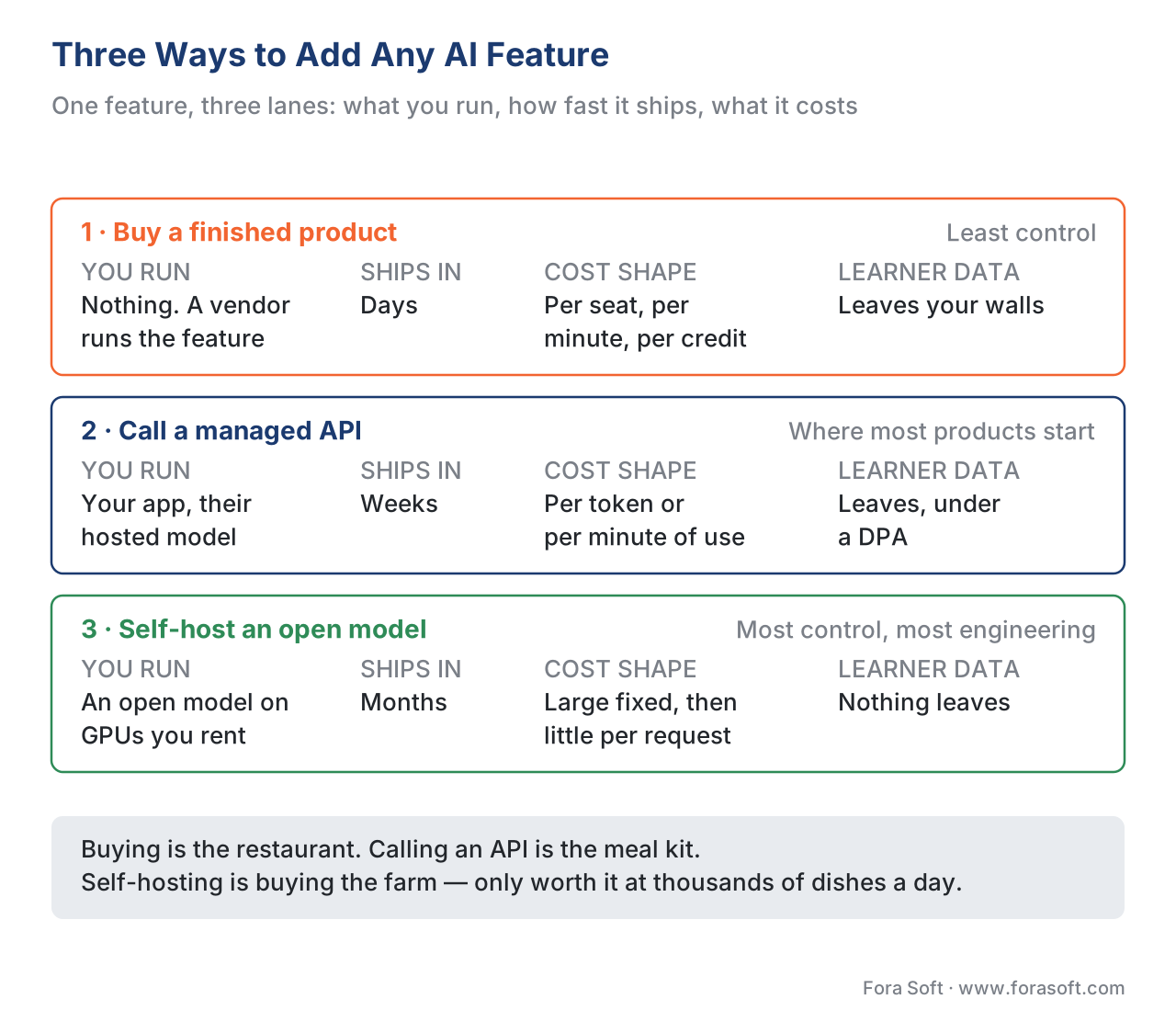 Figure 1. The three ways to add any AI feature, from fastest-to-ship to most-control. Buying a product ships in days but offers least control; self-hosting offers most control but the most engineering. Calling a managed API sits in the middle, and is where most learning products should start.
The Four Drivers That Actually Decide
The choice is not "which model scores highest." It is a trade-off across four drivers, and naming them stops a benchmark or a sales deck from making the decision for you.
The first driver is usage volume — how many learners, how many minutes of video, how many tutor messages per month. Volume is the single biggest cost lever, because managed APIs charge per use while self-hosting charges a large fixed amount regardless of use. The second is the accuracy bar — how wrong the feature is allowed to be. Auto-captions on an internal lunch-and-learn can tolerate errors; captions on a compliance course that a regulator may audit cannot, and the higher bar usually favors a specialized vendor or a larger model. The third is data sensitivity — whether the learner data the feature touches can legally and safely leave your walls, which we treat in full below. The fourth is lock-in tolerance — how painful it would be to switch providers later, and how much you will pay now to keep that door open.
Hold all four at once. A high-volume, low-sensitivity, accuracy-tolerant feature (say, draft captions for thousands of internal videos) points toward self-hosting an open model. A low-volume, high-sensitivity, high-accuracy feature (an AI tutor handling named student records for a few hundred learners) points toward a vendor with a strong data-protection contract. The drivers, not the model leaderboard, pick the lane.
The Cost That Matters: Per Learner, Per Month
Translate every option into the same unit — cost per active learner per month — or you cannot compare them. Vendors quote per seat, per credit, per minute, and per million tokens precisely because those units do not line up; convert them all to per-learner and the picture clears.
Start with a managed language model behind an AI tutor. Pricing is per token — a token is roughly three-quarters of a word, the unit models read and write in. Suppose each tutor exchange averages 1,500 tokens in and 500 out, and an active learner has 40 exchanges a month:
Per learner per month:
  in:  1,500 tokens × 40 = 60,000 tokens
  out:   500 tokens × 40 = 20,000 tokens

At a mid-range 2026 API rate of ~$0.30 per million input
and ~$1.20 per million output tokens:
  in:  60,000  / 1,000,000 × $0.30 = $0.018
  out: 20,000  / 1,000,000 × $1.20 = $0.024
  total ≈ $0.042 per learner per month
Four cents per learner. At 5,000 active learners that is about $210 a month — far below the cost of one engineer-week spent standing up your own model. This is why, for most learning products in 2026, calling an API wins: the per-learner cost is tiny and the build cost of self-hosting is not. It helps that API prices fell roughly 80% between early 2025 and early 2026, so the same feature keeps getting cheaper without any work on your side.
Now captions. Speech-to-text is billed per minute: 2026 rates run from about $0.003 per minute for the cheapest managed model to about $0.006 for a mainstream one. A 30-minute lecture costs nine to eighteen cents to caption once. Avatars are the expensive end — synthetic-presenter video runs roughly $2 to $5 per finished minute on the major vendors, so a 10-minute lesson is $20 to $50 of generated video, which is fine for a polished core lesson and ruinous if you tried to render every learner's feed. The lesson is not a single price; it is that each feature has its own unit, and you must reduce them all to per-learner before deciding.
Build vs Buy vs Self-Host: The Comparison
| Option | Time to ship | Cost shape | Accuracy ceiling | Data control | Lock-in | Standards / tracking |
|---|---|---|---|---|---|---|
| Buy a finished product | Days | Per seat / per minute / per credit | Vendor-set, often high | Lowest — data leaves your walls | Highest — their format, their roadmap | Emit xAPI/cmi5 from your side; vendor may not |
| Call a managed API | Weeks | Per token / per minute, scales with use | High — pick the model | Medium — depends on the contract | Medium — swappable behind an abstraction | You wrap results as xAPI statements |
| Self-host an open model | Months | Large fixed (GPU + engineering) + low marginal | You own tuning; effort-bound | Highest — nothing leaves | Lowest — you own the weights | Full control of the tracking pipeline |
The tracking column matters because an AI feature that does not emit a record is invisible to your learning analytics. Whichever option you pick, the AI-generated quiz, the tutor session, or the watched avatar lesson should still produce an xAPI statement so it lands in your reporting — the wiring is in tracking video with xAPI. A bought product that cannot emit a statement leaves a hole in your data.
The Privacy Question: Where Does the Learner Data Go?
This is the question that sinks build-vs-buy decisions after signing, and it is sharper for learning products because learner data is personal data and sometimes protected student records.
When you call a vendor API or buy a product, learner data — names, answers, questions typed to a tutor, faces in a video — leaves your systems and enters theirs. Under the EU's data-protection law, the General Data Protection Regulation (GDPR), Article 28(3), any vendor that processes personal data on your behalf must be bound by a written data processing agreement, or DPA — the contract that says what they may and may not do with the data. No DPA means the processing is unlawful. The single most important clause is whether the vendor uses your data to train its models; the safe answer for a learning product is an explicit contractual "no," with retention limits and named sub-processors. Where US student records are involved, the Family Educational Rights and Privacy Act (FERPA) adds its own constraints on disclosure to third parties.
There is a second, newer trap specific to education. Under the EU Artificial Intelligence Act, an AI system that evaluates learning outcomes, assigns learners to programs, or monitors them during tests is classified as high-risk (Annex III) — and that classification follows the function, not the vendor, so buying the feature does not offload the obligation. A pure AI tutor that gives feedback without affecting grades is generally not high-risk; an AI that scores a final exam is. The high-risk obligations under Annex III now apply from 2 December 2027, which is time to prepare, not time to ignore. This is exactly where build-vs-buy meets compliance: self-hosting keeps the data inside your conformance boundary, while buying shifts data out and makes the DPA your main control — neither removes the high-risk duties if the feature evaluates learners.
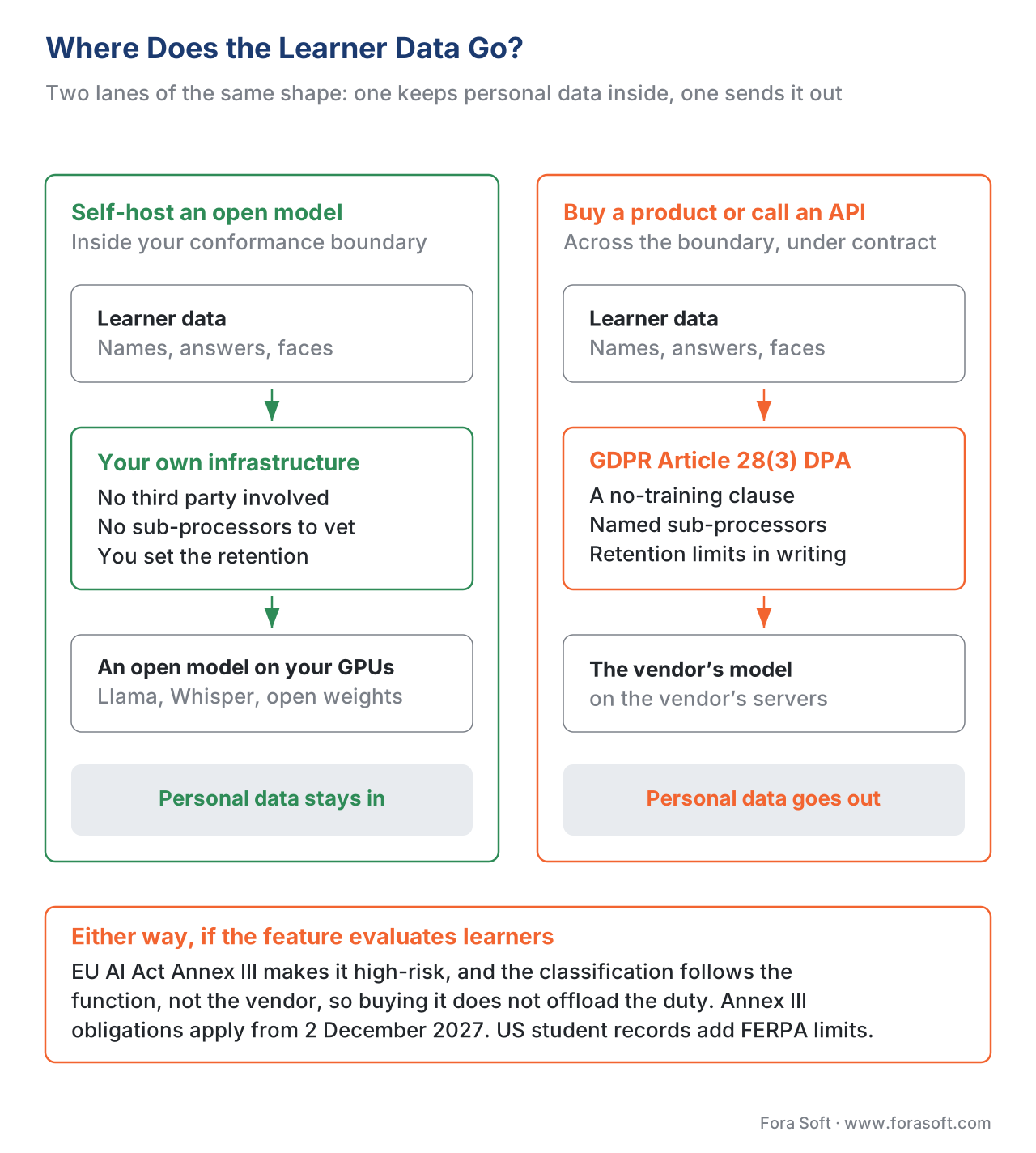 Figure 2. Where the learner data goes. Self-hosting keeps personal data inside your conformance boundary; calling a vendor sends it across that boundary, where a GDPR data processing agreement is your main control. If the feature evaluates learners, EU AI Act high-risk duties apply either way.
A Common Mistake: Self-Hosting to "Save Money" Too Early
The failure we see most is a team that self-hosts an open model to avoid API fees, then discovers the fees were never the real cost. They rent GPUs that sit idle most of the day, hire or divert engineers to run inference, monitoring, and scaling, and end up paying far more per learner than the API would have cost — while shipping months later. Industry figures put even a minimal internal self-hosted deployment in the low-to-mid six figures a year once you count infrastructure, talent, and maintenance, so the "free" open model is only free of license fees.
The mirror-image mistake is buying a slick vendor demo without reading the data clauses, then learning at security review that learner data trains the vendor's model, the sub-processors are undisclosed, or there is no DPA — and the deal dies after engineering is already built around it. The third mistake is forgetting tracking: a bought feature that cannot emit an xAPI statement looks great in the demo and leaves your analytics blind.
The fixes are simple to state. For a new feature, start with a managed API to validate that learners use it and it helps; you are testing the product, not optimizing the plumbing. Put a thin abstraction layer between your code and the provider so you can switch later. Read the DPA before the demo dazzles you. And consider self-hosting only when steady volume, a hard data-residency requirement, or a need to fine-tune on your own content makes the fixed cost pay for itself.
The Math: When Self-Hosting Actually Pays Off
Self-hosting has a clean breakeven, and seeing it stops the argument. A managed API costs roughly (volume × price-per-unit) and almost nothing when idle. Self-hosting costs a large fixed amount — GPUs plus the engineering to run them — and very little per extra request. The crossover is where the API's growing bill passes the self-host's flat cost:
Self-host fixed cost (illustrative):
  one capable GPU rented ≈ $2,500/month
  + part-time ML/infra engineering ≈ $6,000/month
  ≈ $8,500/month, roughly flat

Managed API at the tutor rate above (~$0.042/learner/mo):
  break-even ≈ $8,500 / $0.042 ≈ ~200,000 active learners

For heavier per-learner AI use the break-even comes sooner;
for light use it may never arrive.
The exact number depends entirely on how heavily each learner uses the feature, but the shape is universal: below the crossover the API is cheaper and faster; above it, and only if the volume is steady, self-hosting wins on marginal cost. Note what the breakeven hides — the fixed cost includes scarce ML engineering time, the hardest line item to staff. For the full platform build-and-run picture, see the learning-platform cost model; for the broader non-AI version of this decision, see build vs buy vs hybrid for learning video.
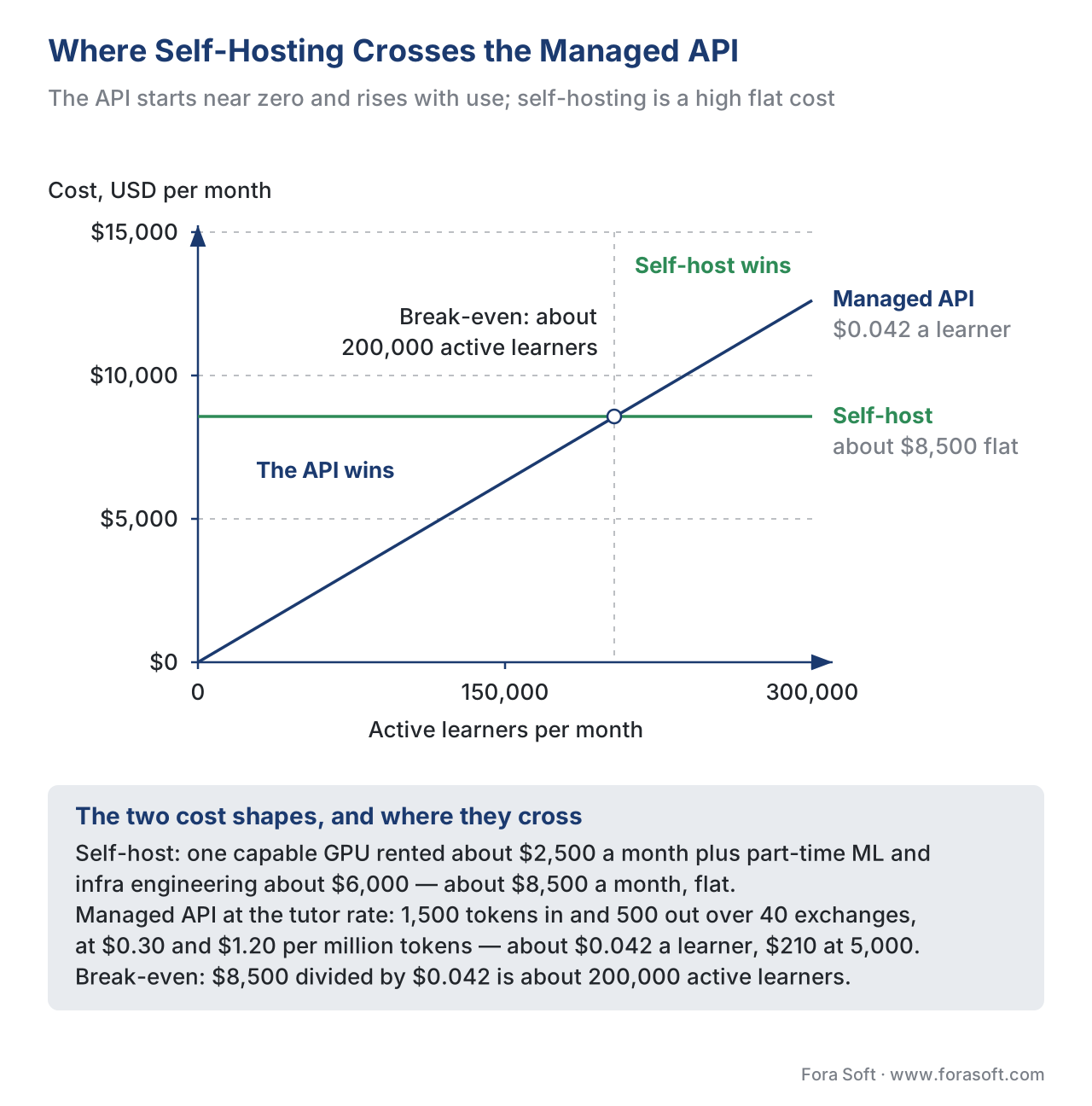 Figure 3. Cost versus monthly volume. The managed API rises with use but starts near zero; self-hosting is a high flat cost that barely moves. Below the crossover the API is cheaper; only past it, and only at steady volume, does self-hosting win.
The Decision, in One Pass
Most teams can decide with four questions. Is this a new, unproven feature? Start with a managed API — validate before you optimize. Does the feature touch sensitive or regulated learner data that cannot leave your walls? Favor self-hosting, or a vendor with strict residency and a hard no-training DPA. Is the volume both high and steady, with the per-learner cost adding up past the crossover? Self-hosting starts to pay. Is the feature a complete, polished capability you do not want to engineer — synthetic avatars, a turnkey tutor? Buy the product and wire your tracking around it. The hybrid answer — buy or call now, self-host the one high-volume feature later — is not a compromise; it is the mature default.
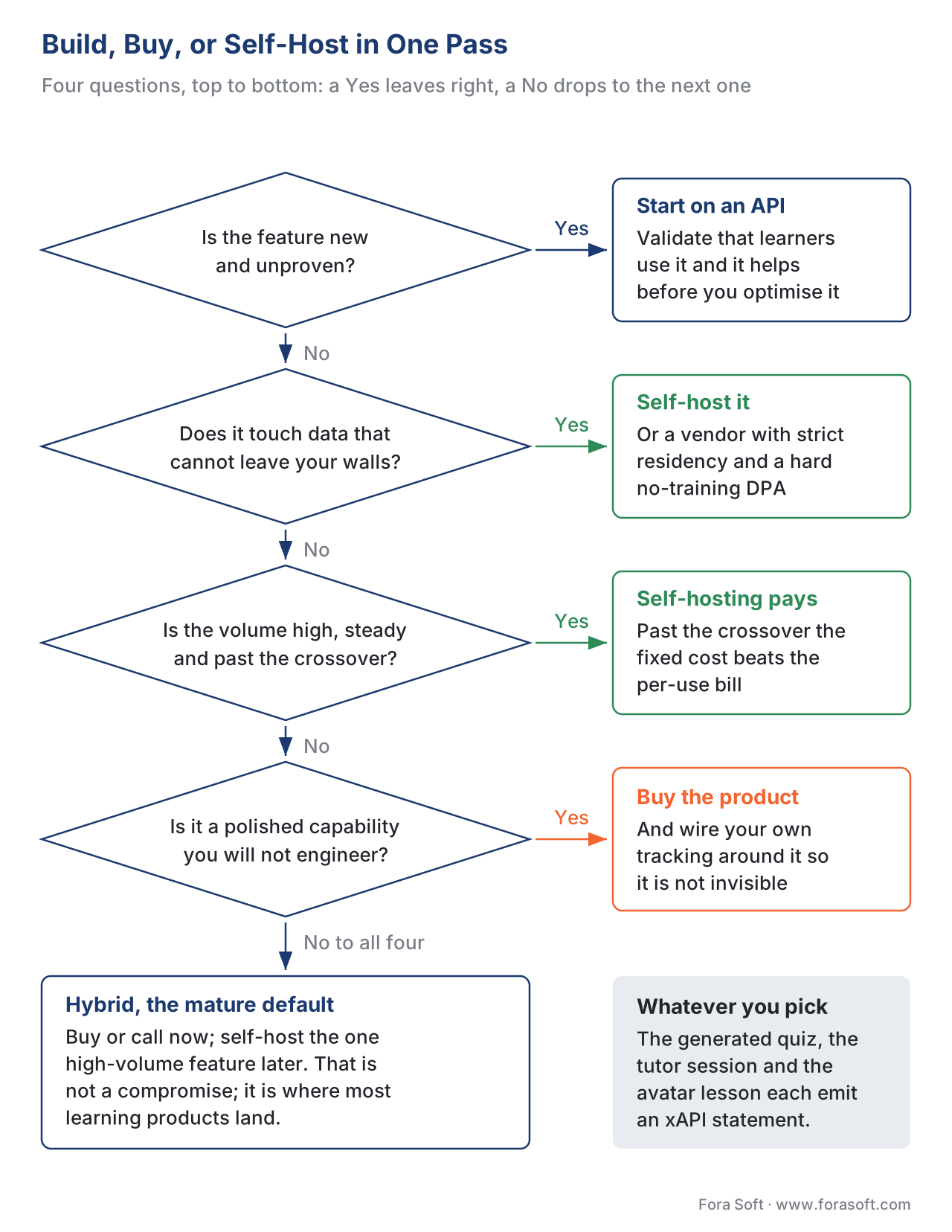 Figure 4. Build, buy, or self-host in one pass. New and unproven routes to a managed API; sensitive data or high steady volume routes to self-hosting; a complete polished capability routes to buying a product. Most products end up hybrid.
Where Fora Soft Fits In
We start this conversation at build-vs-buy, not at the model, because that is where the money and the risk live. Fora Soft has shipped video conferencing, streaming, e-learning, and AI-driven video features since 2005, so when a client wants an AI tutor, synthetic avatars, automatic captions, or generated assessments, we map each feature to the right lane — buy, API, or self-host — against its volume, accuracy bar, learner-data sensitivity, and lock-in, and we put a thin abstraction layer in so today's choice is not a cage tomorrow. For most features we recommend a managed API first because it ships fast and the per-learner cost is small, and we reserve self-hosting for the high-volume or data-residency cases where the fixed cost genuinely pays back. Throughout, we wire every AI feature into your tracking and analytics so it is visible, and we read the data-processing terms before the demo, because the cheapest feature to ship is worthless if it cannot pass a security and privacy review.



The handbook
Fora Soft Video Engineering Handbook
We wrote a seven-volume series that takes the whole video stack apart across 9,000+ pages — encoding, delivery, audio and AI — and someone who works through it can design and build a learning product like the one this article is about. Volume 7 is the closest to this decision: serving and inference infrastructure, the cost per stream-hour of actually running a model, and the regulatory surface — the EU AI Act, biometrics, what a system may collect and keep — that decides whether self-hosting is a line item or a liability. Volume 6 covers the capabilities themselves, the AI-feature lifecycle and the deployment topologies the three lanes above come from, and volume 3 the players, delivery and economics the feature has to sit inside. Written by Nikolay Sapunov, CEO at Fora Soft.
Which of your AI features actually belongs on your own GPUs?
Send us the feature list, the learner data each one touches, and the volume you expect in a year — and we will come back with the lane for each, the cost per learner per month for both options, and the DPA clauses to hold out for before anything is signed. 250+ video products shipped since 2005.
See our case studies
Case study
TransLinguist
AI speech-to-speech translation in 16+ languages and captions in 22, built on managed APIs — Google Cloud Speech-to-Text, Deepgram, Speechmatics and Google TTS behind one abstraction, so the provider is a configuration choice rather than a rewrite. 75+ languages and 30,000+ certified interpreters on the platform.
Case study
BrainCert
A WebRTC and HTML5 virtual-classroom LMS with AI course creation, SCORM and xAPI tracking and an analytics dashboard, serving 100K+ customers and 500M+ classroom minutes — and carrying SOC 2 Type II, ISO/IEC 27001:2022, HIPAA and GDPR, the review that decides which lane an AI feature is allowed to use.
Case study
Scholarly
Sydney’s selective-test prep platform: 15,000+ active users and live classes for up to 2,000 students at once, on Kubernetes with ClickHouse, Grafana and Prometheus — the kind of measured, steady volume that tells you whether a fixed GPU bill would ever beat a per-use one.
What to read next
AI map
Where AI Fits in a Learning Product
Which AI features are worth having at all, before you decide how to buy them.
Platform
Build vs Buy vs Extend an LMS
The same decision one level up, for the platform the AI feature plugs into.
Decision
Build vs Buy vs Hybrid for Learning Video
Which layers of a learning product are worth building, layer by layer.
Cost
The Learning-Platform Cost Model
Where the AI line sits next to video, storage, delivery and people.
References
- EU Artificial Intelligence Act — Annex III, "High-Risk AI Systems Referred to in Article 6(2)" — European Union, 2024 (Regulation (EU) 2024/1689). Classifies AI used in education to evaluate learning outcomes, assign learners, or monitor tests as high-risk; the classification follows the function, not the vendor. Tier 1. https://artificialintelligenceact.eu/annex/3/
- EU Artificial Intelligence Act — Article 6, "Classification Rules for High-Risk AI Systems" — European Union, 2024. The rule that an Annex III system is high-risk unless it does not materially influence the outcome of decision-making. Tier 1. https://artificialintelligenceact.eu/article/6/
- General Data Protection Regulation (GDPR), Article 28 — "Processor" — Regulation (EU) 2016/679. Requires a binding data processing agreement with any processor (vendor) handling personal data on the controller's behalf; the legal basis for the DPA and no-training clauses. Tier 1. https://gdpr-info.eu/art-28-gdpr/
- Family Educational Rights and Privacy Act (FERPA), 20 U.S.C. § 1232g; 34 CFR Part 99 — U.S. Department of Education. Governs disclosure of US student education records to third parties, including AI vendors. Tier 1. https://www.ecfr.gov/current/title-34/subtitle-A/part-99
- Experience API (xAPI) Specification, version 1.0.3 — Advanced Distributed Learning (ADL) Initiative. The standard for emitting AI-feature activity (tutor sessions, generated quizzes, watched avatar lessons) as trackable statements to a Learning Record Store. Tier 1. https://github.com/adlnet/xAPI-Spec/blob/master/xAPI-Data.md
- "LLM API Pricing Comparison 2026: Every Major Model, Ranked by Cost" — CloudZero, 2026. Source for the ~80% API price drop between early 2025 and early 2026 and mid-range per-million-token rates. Tier 4. https://www.cloudzero.com/blog/llm-api-pricing-comparison/
- "Self-Hosted LLM vs API: Breakeven Cost, GPU Math & When It's Worth It [2026]" — Braincuber, 2026. Source for the self-host fixed-cost shape, GPU throughput, and the volume-dependent breakeven against managed APIs. Tier 4. https://www.braincuber.com/blog/self-hosted-llms-vs-api-based-llms-cost-performance-analysis
- "Open Source LLM Cost: Hidden Expenses in 2026" — AI Superior, 2026. Source for minimal self-hosted deployments in the low-to-mid six figures per year and enterprise figures, the hidden cost of "free" open models. Tier 4. https://aisuperior.com/open-source-llm-cost/
- "Best Speech-to-Text APIs in 2026" and OpenAI Whisper API pricing 2026 — Deepgram / DIY AI, 2026. Source for $0.003–$0.006 per-minute managed speech-to-text rates used in the captions math. Tier 4. https://deepgram.com/learn/best-speech-to-text-apis-2026
- "HeyGen vs Synthesia (2026): Features, Pricing" — Colossyan / Synthesia, 2026. Source for the ~$2–$5 per finished minute synthetic-avatar video cost used in the avatar math. Tier 6. https://www.colossyan.com/posts/heygen-vs-synthesia/
Where sources disagreed, the standards and law win: vendor marketing claims that an AI feature is "compliant out of the box" were overridden by the EU AI Act's function-based high-risk classification (refs 1, 2) and GDPR's processor obligations (ref 3), which bind the buyer regardless of vendor claims; and the popular "self-hosting is cheaper" framing was tempered by the full-cost analyses (refs 7, 8) showing managed APIs win below a high, steady-volume crossover.
