


Why This Matters
If you run learning and development, build courses, or own a training product, AI video synthesis is the feature that changes your content budget more than any other in 2026. A course library that used to take a film crew and a quarter to refresh can now be re-rendered in an afternoon, which makes "keep every course current" go from impossible to routine. But the same tools let you put words in a synthetic presenter's mouth, clone a real instructor's voice, and ship it with no label — and a learner who later discovers the "instructor" was never real loses trust in the whole program. This article gives you the cost arithmetic, the honest effectiveness picture, and the legal line so you can decide where synthetic video belongs in your courses and talk to your engineers and instructional designers without being sold a demo. It is the production-side companion to where AI fits in a learning product.
What "Video Synthesis" Actually Means
Start with the plain definition. Video synthesis is the use of software to generate moving pictures and a matching voice from a written script, instead of recording a person with a camera and microphone. The output looks like an ordinary lesson video; the difference is that no camera ever rolled.
The analogy that holds up: a traditional training video is a stage play — you book the actor, the studio, and the crew, and every change means calling everyone back. A synthetic video is a printed document — you edit the words and press "print" again. That single shift, from performance to document, is the whole story of why this matters for a course library that has to stay current.
It helps to separate three different things that get lumped together under "AI video," because they carry different costs, risks, and laws.
The first is the synthetic presenter, usually called an avatar: a lifelike digital human that appears on screen and speaks your script, lip-synced to a generated or cloned voice. This is what platforms like Synthesia and HeyGen sell, and it is the workhorse of synthetic training video.
The second is text-to-video footage: software that generates the b-roll, scenes, or illustrative clips themselves from a text description — a factory floor, a chemical reaction, a city street — without filming anything. This is newer, less predictable, and better for illustration than for a presenter.
The third is voice synthesis, including voice cloning: generating narration in a synthetic voice, or in a copy of a specific real person's voice trained from samples. Voice can be paired with an avatar or laid over slides and screen recordings with no face at all.
This article is about the learning decision — when to use each, what it costs, and how to ship it responsibly. The model internals live in our AI for Video Engineering section: see avatar and lip-sync video synthesis in production for how the presenters are built, the 2026 text-to-video model comparison for the generators, and voice cloning and the NO FAKES Act for the audio side.
The Production Shift: Where the Money Actually Goes
Lead with the business case, because it is the reason anyone opens this door.
Filming a training video is expensive in a way that compounds. A basic talking-head corporate video — one camera, an internal expert, simple lighting — runs about \$1,000 to \$1,500 per finished minute in 2026. A professional production with a hired presenter, studio lighting, motion graphics, and licensed music runs \$1,500 to \$5,000 per finished minute. Those numbers are per finished minute, and a finished minute can take a day to produce once you count scripting, shooting, and editing.
Synthetic video collapses that line. A talking-head avatar video, generated from a script, costs on the order of a few dollars per finished minute on a subscription platform — for example, a mainstream avatar tool priced around \$89 a month for 30 minutes of video works out to roughly \$3 per finished minute — and renders in minutes, not days. Independent benchmarks put the saving at 70–90% versus traditional production.
Walk the arithmetic out loud once, because the gap is larger than people expect. Take a 10-minute compliance course:
Traditional, professional talking-head:
  10 min × $1,500/min  = $15,000   (plus 4–8 weeks)

Synthetic avatar, subscription platform:
  10 min × ~$3/min     = $30 in render minutes
  + script + QA review  ≈ $400 of internal time
  ----------------------------------------------
  ≈ $430 total          (plus 1–2 days)
That is roughly a 97% cut on the production line item, and the timeline drops from weeks to days. But the saving that actually changes behavior is not the first render — it is the re-render. When a regulation changes one sentence of that course, the traditional path means booking the studio and the presenter again for another four-figure reshoot. The synthetic path means editing one line of script and pressing render: a few dollars and a few minutes. A course library that costs almost nothing to update is a course library that stays current, and "always current" is worth more to most training programs than the headline production saving.
 Figure 1. The production-cost gap. Synthetic video's decisive advantage is the near-zero cost of re-rendering when content changes — not just the first build.
Does a Synthetic Presenter Actually Teach?
Here is where an honest guide separates from a sales page. Cheaper is only better if learners still learn. The evidence in 2026 is encouraging on one measure and cautionary on another, and you need both halves to make the call.
On outcomes, the news is good: learners taught by an AI-generated instructor score about the same on tests as learners taught by a human on video. A study published in the International Review of Research in Open and Distributed Learning compared video lectures delivered by a real instructor against the identical lectures delivered by an AI-generated instructor and found no significant difference in academic performance. Other comparisons reach the same conclusion — for straightforward knowledge transfer, a competent synthetic presenter is not measurably worse than a filmed one.
On engagement, the news is a warning: in that same study, learners engaged less with the AI instructor's videos and reported that the synthetic presenter felt distracting, uncomfortable, or disconnected. The small imperfections — facial expressions slightly off, speech rhythm not quite human — register with some learners even when they cannot name what is wrong. Equivalent test scores, lower watch-time and lower warmth. That is the trade-off in one line.
There is a deeper pedagogical point about the voice specifically. Decades of multimedia-learning research, summarized in Richard Mayer's principles, include a "voice principle": people learn better from a friendly human-sounding voice than from a flat machine voice. Modern synthetic voices have closed much of that gap, but not all of it, and a robotic or mismatched voice measurably depresses learning. The practical reading: invest in the voice. A natural voice over simple visuals often teaches better than a stiff avatar with a stiff voice.
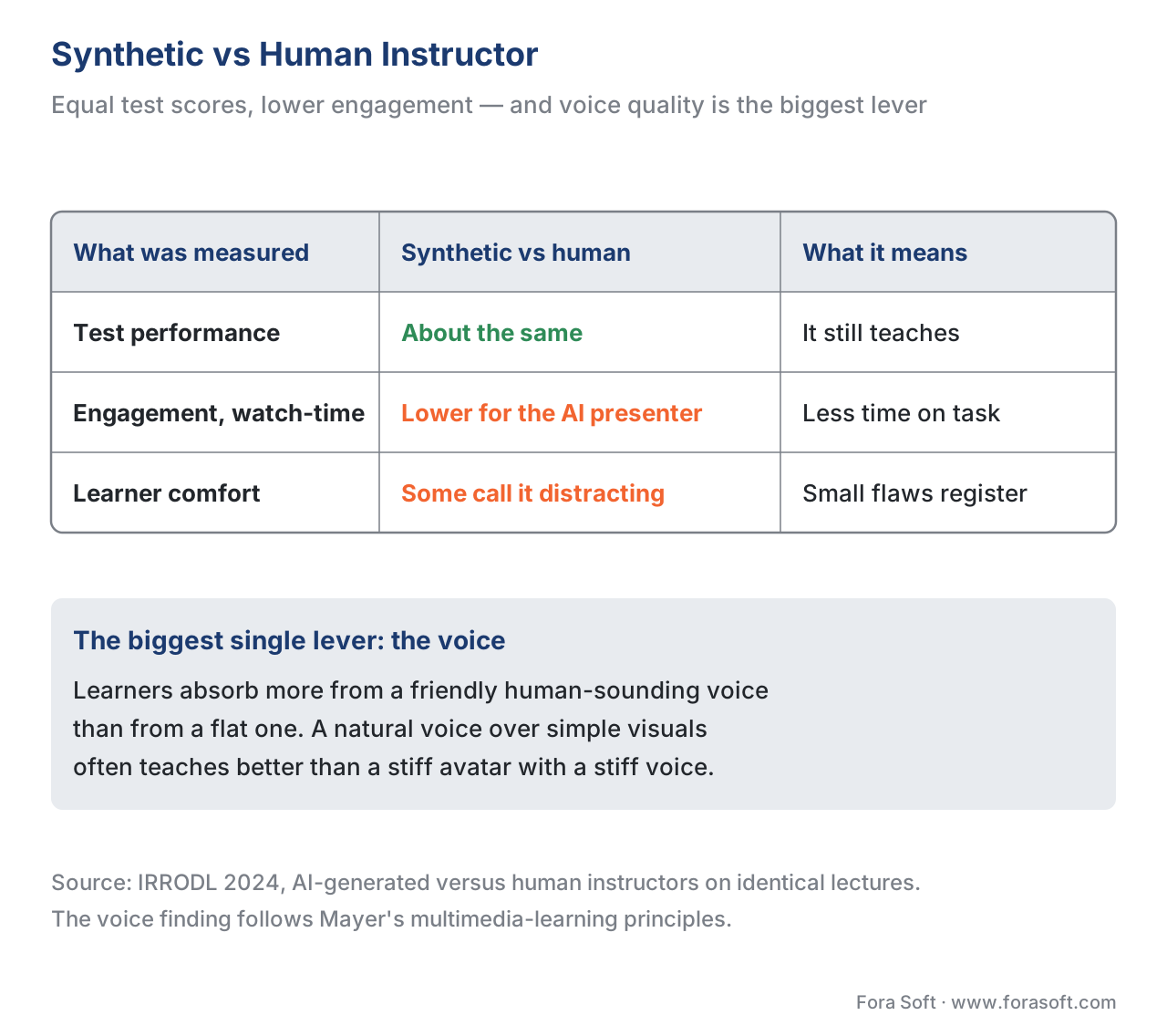 Figure 2. The teaching trade-off. Synthetic presenters match human ones on test outcomes but lag on engagement; voice quality is the biggest single lever on whether learners absorb the material.
When Synthetic Video Is the Right Call — and When It Isn't
The effectiveness picture turns into a simple rule of thumb. Synthetic video earns its keep where content is high-volume, frequently updated, and low on emotional weight, and it underperforms where the human matters as much as the message.
It fits compliance modules, software walkthroughs, product-knowledge updates, standardized onboarding, and multilingual versions of the same course — content that has to exist, has to stay current, and rarely benefits from a charismatic on-screen human. A policy refresher does not need warmth; it needs to be correct and current, which is exactly where synthetic video is strong.
It struggles where engagement, trust, and emotion carry the lesson: a founder's welcome, leadership and culture training, sensitive topics like harassment or mental health, sales and persuasion skills, and any flagship course that represents the brand. Here the lower-engagement, lower-warmth finding bites, and a real human on camera is worth the cost.
A middle path is common and underrated: keep a real human for the moments that need a human, and use synthetic video for the bulk. Film the founder's two-minute introduction; synthesize the forty minutes of procedure that follow. The decision is per-segment, not per-course.
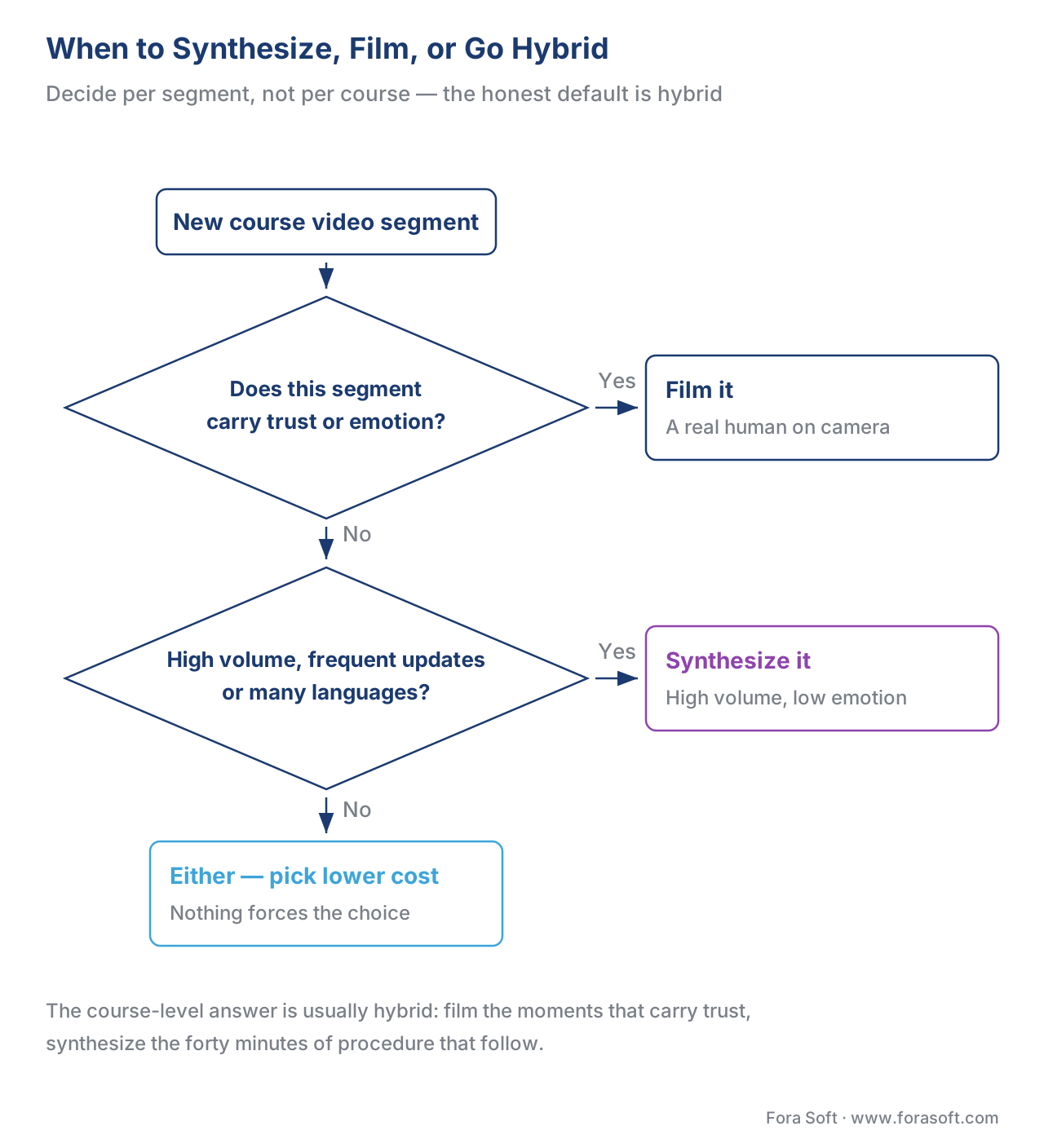 Figure 3. A decision tree for synthetic versus filmed video. The honest default is hybrid: synthesize the volume, film the moments that carry trust or emotion.
How a Synthetic Course Video Is Made — and Where It Plugs In
Walk the pipeline once, because the synthesis is only the middle of it, and the parts on either side are where a learning product is won or lost.
It starts with a script. Synthetic video is unforgiving here in a useful way: there is no improvising presenter to paper over a vague outline, so the script is the lesson. Many teams generate a first draft with an AI writing tool, then have a human subject-matter expert correct and approve it — the same human-review gate that every AI learning feature needs.
Next comes synthesis: the script and a chosen avatar and voice go into the platform, which renders a video with the presenter lip-synced to the narration. If the course ships in eight languages, the same script is translated and re-rendered with the same avatar speaking each language — the feature that makes synthetic video transformative for multilingual courses.
Then comes the step teams skip and regret: human review and disclosure. Someone watches the output for errors the model introduced — a mispronounced technical term, a wrong on-screen number, an awkward gesture — and the video is labeled as AI-generated before it ships. We return to why the label is now mandatory below.
Only then does the video enter your learning platform, and here it is an ordinary lesson video — which is the point. A synthetic video is tracked exactly like any other: completion, watch-time, and in-video interactions flow through the same standard, the Experience API (xAPI, version 1.0.3, published by the Advanced Distributed Learning Initiative) and its video profile, into your learning analytics. The fact that a machine produced the pixels changes nothing about how you measure whether it taught.
And it must still be accessible. A synthetic presenter does not exempt you from captions and, where required, audio description: the Web Content Accessibility Guidelines (WCAG) 2.1 Level AA still apply, the same as for filmed video (see WCAG 2.1 AA for educational video). A common shortcut — assuming a "perfect" AI voice needs no captions — fails both the law and the deaf learner.
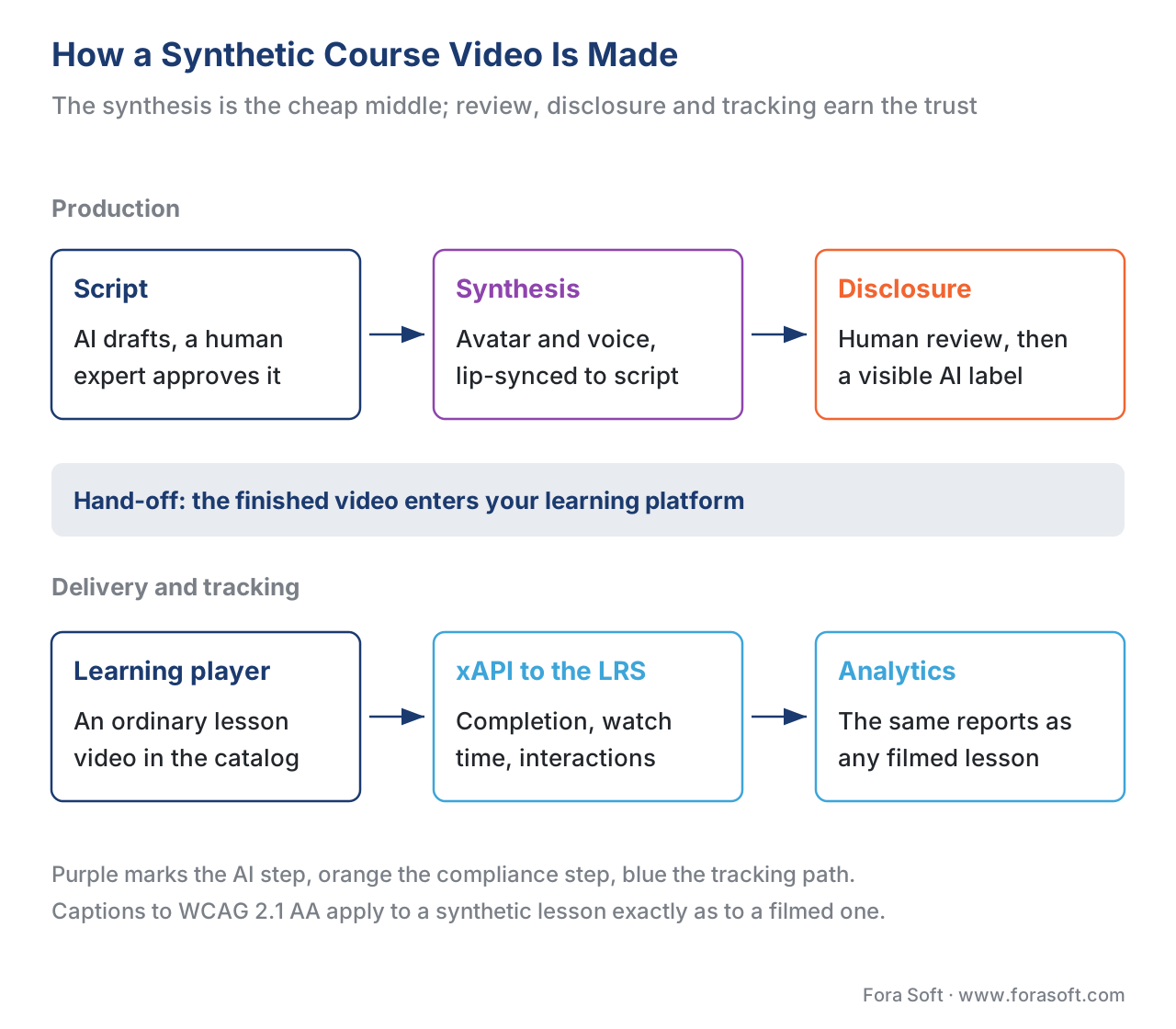 Figure 4. The synthetic-video pipeline end to end. The synthesis is the cheap middle; the human-review, disclosure, tracking, and accessibility steps on either side are where a learning product earns trust.
The Consent Problem: Whose Face and Voice Is That?
Synthetic video introduces a question filmed video never raised: the presenter on screen, or the voice in the headphones, may be a real person — and that person has rights.
Avatar platforms offer two kinds of presenter. Stock avatars are licensed digital humans the vendor created and cleared for commercial use; using them is generally safe. Custom avatars and cloned voices are built from a real person — your instructor, your CEO, a hired actor — and that is where consent becomes a hard requirement, not a courtesy. Cloning an instructor's voice so "they" can narrate a hundred courses they never recorded is powerful and entirely reasonable with their informed, written, revocable consent — and a serious wrong without it.
The wrong is not hypothetical, and the law is catching up fast. In the United States, the proposed federal NO FAKES Act (S.1837 / H.R.2794, 119th Congress) would create a property-style right against unauthorized AI replicas of a person's voice or likeness; it passed the Senate by unanimous consent in January 2026 and is pending in the House as of mid-2026. Several US states already have biometric and likeness statutes that bite today. In the European Union, a person's face and voice are personal data — and biometric data when used to identify them — protected under the General Data Protection Regulation (GDPR, Regulation (EU) 2016/679), so cloning them needs a lawful basis and explicit handling.
The engineering consequence is concrete. Treat every custom avatar and cloned voice as a consented asset with a paper trail: who agreed, to what uses, for how long, and how they revoke it. When the actor who voiced your library leaves or withdraws consent, you need to know which courses to re-render. Build the consent record before you build the avatar.
The Law You Cannot Skip: Disclosure and Marking
The single most important new rule for synthetic course video in 2026 is disclosure, and it is no longer optional in the European Union.
Under the EU AI Act (Regulation (EU) 2024/1689), Article 50 sets transparency obligations whose relevant parts apply from 2 August 2026. Two of them hit synthetic course video directly. Article 50(2) requires providers of AI systems that generate synthetic audio, image, or video to mark the output in a machine-readable format, detectable as artificially generated. Article 50(4) requires deployers — that is you, the company publishing the course — to disclose that deepfake-style generated or manipulated video content is artificial. In plain terms: the tool must embed an invisible "made by AI" marker, and you must tell the viewer.
What disclosure looks like in practice is modest and worth getting right: a visible label or short opening note that the presenter is AI-generated, provided clearly and at the first moment the learner is exposed to it. That is a small design task with a large trust payoff — and the penalty for skipping it is both regulatory and reputational.
The machine-readable side is converging on a standard worth knowing by name. C2PA Content Credentials (Coalition for Content Provenance and Authenticity, specification version 2.3, February 2026) attach cryptographically signed metadata to a file recording that it was AI-generated and by what tool — the "nutrition label" that satisfies the machine-readable half of Article 50(2). Major model providers have committed to emitting these credentials. One honest caveat: many platforms strip metadata on upload, so the embedded marker can be lost in distribution, which is exactly why the visible learner-facing disclosure is the part you control and must not omit.
This is engineering guidance, not legal advice. Confirm specifics with qualified counsel before deploying synthetic-presenter or voice-cloned content, especially in the EU or where US student records or state biometric laws apply.
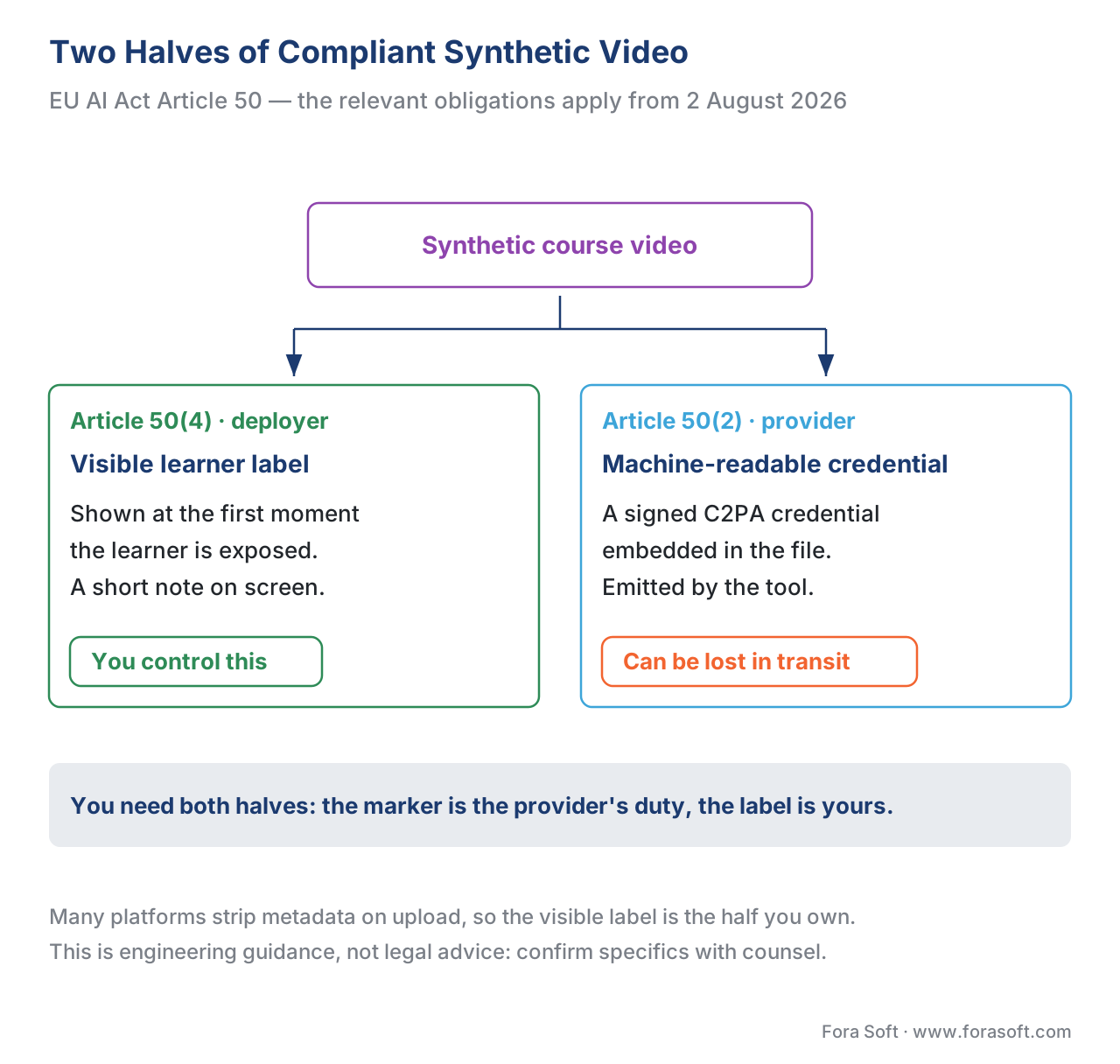 Figure 5. The two halves of compliant synthetic video. The visible label (Article 50(4)) is the one you control end to end; the machine-readable credential (Article 50(2), via C2PA) can be stripped in distribution.
Build vs Buy: the Trade-off and the Real Cost
Now the decision that consumes the budget. You have three broad paths, and the right one depends on volume, control, and how sensitive your presenters and content are.
Buy a hosted avatar platform. Synthesia, HeyGen, Colossyan, and similar tools launch fastest: you write a script, pick an avatar, and render. Cost is a recurring subscription priced by finished minutes or credits, and the avatars, voices, and disclosure markers come built in. For most training teams producing standardized content, this is the right first move — and often the permanent one.
Build a pipeline on synthesis APIs. You wire avatar, voice, and text-to-video APIs into your own authoring and learning platform, so course updates trigger re-renders automatically and the video flows straight into your tracking and catalog. This wins when you produce at high volume, want synthesis embedded in an existing workflow, or need control over where the content and consent records live.
Self-host open models. You run open avatar and voice models on your own infrastructure. Engineering and GPU cost go up; per-video cost and data exposure go down. This is for organizations whose presenters' likenesses or course content cannot leave their walls, or whose volume makes per-minute platform fees expensive.
Here is the trade-off as a table, with the tracking-and-compliance column this section always includes — because a synthetic video that cannot be tracked, captioned, and disclosed is not finished.
| Option | Time to launch | Cost shape | Likeness / data control | Effort | Tracking & compliance |
|---|---|---|---|---|---|
| Buy hosted avatar platform | Fastest | Recurring per-minute / credits | Vendor holds avatars & voices | Lowest | xAPI export; built-in AI marking |
| Build on synthesis APIs | Medium | Per-render API fees | You control flow & consent records | Medium | xAPI native; you add disclosure |
| Self-host open models | Slowest | Up-front GPU + ops | Stays in-house | Highest | xAPI native; you add disclosure |
The full cost treatment, including the build-vs-buy break-even, lives in building vs buying AI features, and the cost and the learning-platform cost model.
A Common Mistake: the Silent Clone
The failure we see most is a team that clones a real instructor's voice or likeness, ships a library of synthetic courses with no label and no consent paper trail, and treats the saving as pure win. It demos beautifully and detonates later. The instructor objects that "they" said things they never recorded; a learner discovers the presenter was never real and stops trusting the program; and an EU compliance review finds undisclosed deepfake content in breach of Article 50. The three rules in this article — consent it, disclose it, track it — exist precisely to prevent this. Synthetic video that skips them is not a cost saving; it is a deferred liability with a friendly face.
Free download: Synthetic Course Video Readiness ChecklistA one-page consent-it / disclose-it / track-it check before you publish an AI-generated lesson: pick the right content, get presenter consent, set the human-review gate, disclose and mark per EU AI Act Article 50, wire xAPI tracking and WCAG captions, and choose build vs buy.Where Fora Soft Fits In
We build the learning product around the synthesis, not a render farm around a model. Fora Soft has shipped video conferencing, streaming, e-learning, and AI-driven video features since 2005, so when a client wants synthetic course video we start from the build-vs-buy trade-off: a hosted avatar platform is fastest and bills per minute, while a pipeline on synthesis APIs or self-hosted models costs engineering up front but keeps the avatar, the voice, the consent records, and the learner data in-house. We wire the human-review gate, the AI disclosure, the C2PA-style marking, captions to WCAG 2.1 AA, and an xAPI statement for every view, so synthetic video enters your catalog as a tracked, accessible, compliant lesson rather than an unlabeled clone. We are candid about the engagement trade-off and about which courses should keep a real human on camera.
The handbook
Fora Soft Video Engineering Handbook
We wrote a seven-volume series that takes the whole video stack apart across 9,000+ pages — encoding, delivery, audio and AI. Volume 6 covers the generative video, text-to-speech and voice cloning a synthetic lesson is made of; volume 7 covers serving those models at a known cost per stream-hour, along with the EU AI Act and C2PA duties that come with them; volume 3 covers the players and delivery that carry the finished lesson to a learner. Work through the series and you can build a synthetic-course pipeline like this one yourself, not only buy one. Written by Nikolay Sapunov, CEO at Fora Soft.
Not sure which lessons you should synthesize and which you should film?
Tell us how often your catalog changes, how many languages it ships in, and which lessons carry the brand, and we will tell you which segments are worth synthesizing, what the consent and disclosure trail has to hold, and how the finished video gets tracked once it lands in your platform. 250+ video products shipped since 2005.
See our case studies
Case study
BrainCert
A WebRTC and HTML5 virtual-classroom LMS at $3M annual revenue and 100K+ customers, with AI course creation, SCORM and xAPI support and proctored exams — the catalog a synthetic lesson has to enter as an ordinary, tracked video.
Case study
TransLinguist
75+ languages, AI speech-to-speech translation in 16+ and closed captioning in 22, on the NHS national framework — the multilingual pressure that makes re-rendering one script in eight languages worth more than the first build’s saving.
Case study
Scholarly
15,000+ active users and live classes up to 2,000 students at once, with VOD, homework and analytics in one system — where a synthesized lesson sits next to a filmed one and both report through the same pipeline.
What to read next
AI map
Where AI Fits in a Learning Product — the Map
The whole surface, so you can see which parts synthesis touches and which it leaves alone.
Localization
Automatic Translation and Multilingual Courses
The language count that pushes a course past the point where filming it again makes sense.
Build vs buy
Building vs Buying AI Features, and the Cost
The break-even behind a hosted platform, synthesis APIs, or open models on your own GPUs.
Tracking
Tracking Video With xAPI: The Video Profile and What to Capture
What the player has to send for a synthetic lesson to be measured like any other.
References
- Regulation (EU) 2024/1689 (the AI Act), Article 50(2) and 50(4) — Transparency obligations — European Union. Providers must mark synthetic audio/image/video as machine-readable and detectable; deployers must disclose deepfake-style content. Relevant obligations apply from 2 August 2026 (Article 113). Tier 1. https://artificialintelligenceact.eu/article/50/
- Regulation (EU) 2016/679 (GDPR) — European Union. A presenter's face and voice are personal data, and biometric data when used to identify; cloning a real person needs a lawful basis. Tier 1. https://eur-lex.europa.eu/eli/reg/2016/679/oj
- Experience API (xAPI) Specification, version 1.0.3, Part 2: Statements — Advanced Distributed Learning (ADL) Initiative. The standard for recording video views and interactions, synthetic or filmed, to a Learning Record Store. Tier 1. https://github.com/adlnet/xAPI-Spec
- xAPI Video Profile — ADL Initiative / xAPI community profile. Verbs and extensions for tracking video playback and interaction; applies to synthetic course video unchanged. Tier 1. https://github.com/adlnet/xAPI-Video-Profile
- Web Content Accessibility Guidelines (WCAG) 2.1, Level AA — Success Criteria 1.2.2 (Captions) and 1.2.5 (Audio Description) — World Wide Web Consortium (W3C). Captions and audio description requirements apply to synthetic video as to filmed video. Tier 1. https://www.w3.org/TR/WCAG21/
- NO FAKES Act of 2025 (S.1837 / H.R.2794, 119th Congress) — United States Congress. Proposed federal right against unauthorized AI digital replicas of voice and likeness; passed the Senate January 2026, pending in the House. Tier 1 (draft legislation — not yet law). https://www.congress.gov/bill/119th-congress/house-bill/2794/text
- C2PA Content Credentials, specification version 2.3 (February 2026) — Coalition for Content Provenance and Authenticity. Cryptographically signed provenance metadata marking content as AI-generated; the machine-readable half of EU AI Act Article 50(2). Tier 1. https://c2pa.org/specifications/
- "Video Lectures With AI-Generated Instructors: Low Video Engagement, Same Performance as Human Instructors" — International Review of Research in Open and Distributed Learning (IRRODL), 2024. Found equivalent academic performance but lower learner engagement with AI-generated instructors. Tier 5. https://www.irrodl.org/index.php/irrodl/article/view/7815
- "Principles of Multimedia Learning" (the voice principle) — Richard E. Mayer, multimedia-learning research. Learners benefit from a friendly human-sounding voice over a machine voice; basis for the "invest in the voice" guidance. Tier 5. https://www.cambridge.org/core/books/cambridge-handbook-of-multimedia-learning/
- "Video Production Costs in 2026: Traditional vs AI" and per-minute training-video benchmarks — Colossyan / industry 2026 benchmarks. Traditional talking-head \$1,000–\$5,000 per finished minute; AI synthesis 70–90% cheaper. Tier 4. https://www.colossyan.com/posts/video-production-costs
- "Synthesia Pricing in 2026" and "HeyGen Pricing in 2026" — Arcade Blog, 2026. Mainstream avatar platforms priced ~\$29–\$89/month, roughly \$3 per finished minute at the Creator tier. Tier 4. https://www.arcade.software/post/synthesia-pricing
Where sources disagreed, the standards and primary research win: vendor marketing that frames synthetic presenters as equal or superior to human instructors was tempered by the IRRODL engagement finding (ref 8) — equivalent test scores, but lower engagement — and the legal framing follows the EU AI Act text (ref 1), not vendor "compliance-ready" claims.
