


Why This Matters
If you run learning and development, found an EdTech company, or manage a course product, you are being pitched an "AI feature" every week, and most pitches blur where the value actually is. The cost, the risk, and the regulatory exposure of each AI feature are wildly different — an automatic caption is cheap and safe; an AI that decides who passes an exam is a regulated, high-stakes system. You need one map that shows where each feature plugs in, what it costs to run, what its failure mode is, and whether it is mature or still risky in 2026. That is what this article gives you, so you can have a grounded build-vs-buy conversation with your engineers and instructional designers instead of buying hype.
First, What "AI in a Learning Product" Actually Means
A learning product is a pipeline. Content is authored, stored, delivered as video or interactive lessons, played in front of a learner, tracked as the learner interacts, and reported as analytics. (If that pipeline is new to you, start with the anatomy of a learning-video platform.) Artificial intelligence — software that performs tasks that normally need human judgment, such as understanding speech, writing text, or recognizing patterns — does not replace that pipeline. It attaches to specific stages of it.
Think of the pipeline as a building and AI as a set of appliances. You do not rebuild the house to add a dishwasher; you plug it into an existing outlet. The skill is knowing which outlets exist, which appliances are reliable today, and which are still prototypes that flood the kitchen if you leave them running unattended.
There are seven outlets. We will name each one, give it a plain-language analogy, say what it costs and what breaks, and rate how mature it is in 2026.
The Seven Places AI Plugs In
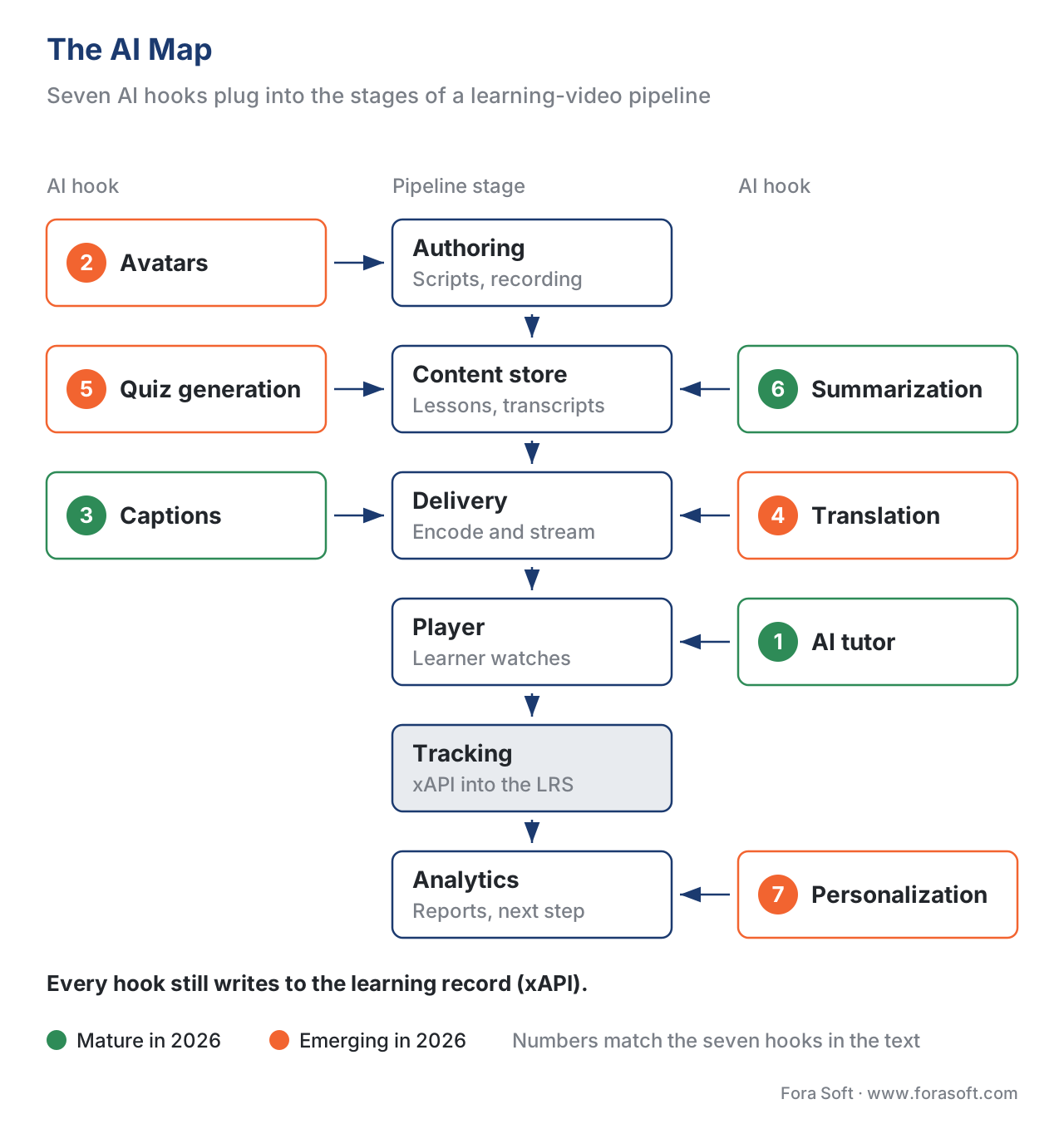 Figure 1. The AI map: seven hooks attached to the stages of a learning-video pipeline. Each hook is a separate feature with its own cost and risk.
1. The AI tutor. A conversational assistant that answers a learner's questions in the context of the course. The analogy: a teaching assistant who has read the whole syllabus and is available at 2 a.m. Its failure mode is the one that matters most — a tutor that confidently states a wrong fact (a "hallucination") is worse than no tutor, because the learner trusts it. The fix is to ground the tutor in the course material so it answers only from approved content; the technique is called retrieval-augmented generation, where the model is forced to retrieve the relevant lesson text before it writes an answer. Deep-dive: AI tutors and conversational learning assistants.
2. AI avatars and video synthesis. Software that generates a talking presenter, or a whole narrated video, from a script. The analogy: a stand-in actor you can re-shoot for free by editing the script. It is useful for updating a single sentence in a course without re-filming, but it carries a consent line — if the avatar resembles a real instructor or clones a real voice, you need explicit rights. The model internals (text-to-video, voice cloning) belong to our AI section: see talking-head and avatar video synthesis. The learning decision — when a synthetic presenter helps and when it cheapens the course — is covered in AI avatars and video synthesis for course content.
3. Automatic captions. Speech-to-text that turns a lecture's audio into synchronized on-screen text. The analogy: a stenographer who never gets tired but occasionally mishears a technical term. Captions are both an engagement lever and a legal requirement, which is why they sit near the top of the maturity scale. Deep-dive: automatic captions for learning video; the speech-recognition engine itself is covered in streaming ASR.
4. Automatic translation and dubbing. Turning a course's captions, or its narration audio, into another language. The analogy: a simultaneous interpreter for your whole catalog. The quality bar for education is higher than for casual video — a mistranslated instruction teaches the wrong thing. Deep-dive: automatic translation and multilingual courses.
5. Automatic quiz and assessment generation. Generating practice questions from a transcript or lesson. The analogy: a teaching assistant who drafts a quiz you then review. The risk is question quality — plausible-looking but wrong "distractor" answers, or questions that test recall of a typo. The generated question must still emit a tracked interaction, which connects this hook to the standards layer (more below). Deep-dive: automatic quiz and assessment generation.
6. Lecture summarization and study aids. Auto-generated summaries, key-point lists, chapter markers, and flashcards. The analogy: a classmate's tidy notes. Mature and low-risk, because the learner can always check the summary against the source — provided the source is shown. Deep-dive: lecture summarization and study aids.
7. Personalization and adaptive paths. An engine that picks the next lesson based on how the learner is doing. The analogy: a coach who skips what you already know and drills what you don't. This is the hook most often oversold: genuine adaptivity that responds to performance data is different from a pre-authored branching script that only looks adaptive. Deep-dive: personalization and adaptive learning paths.
Mature, Emerging, or Risky in 2026
Not every hook is ready to ship unsupervised. Here is the honest maturity read for 2026.
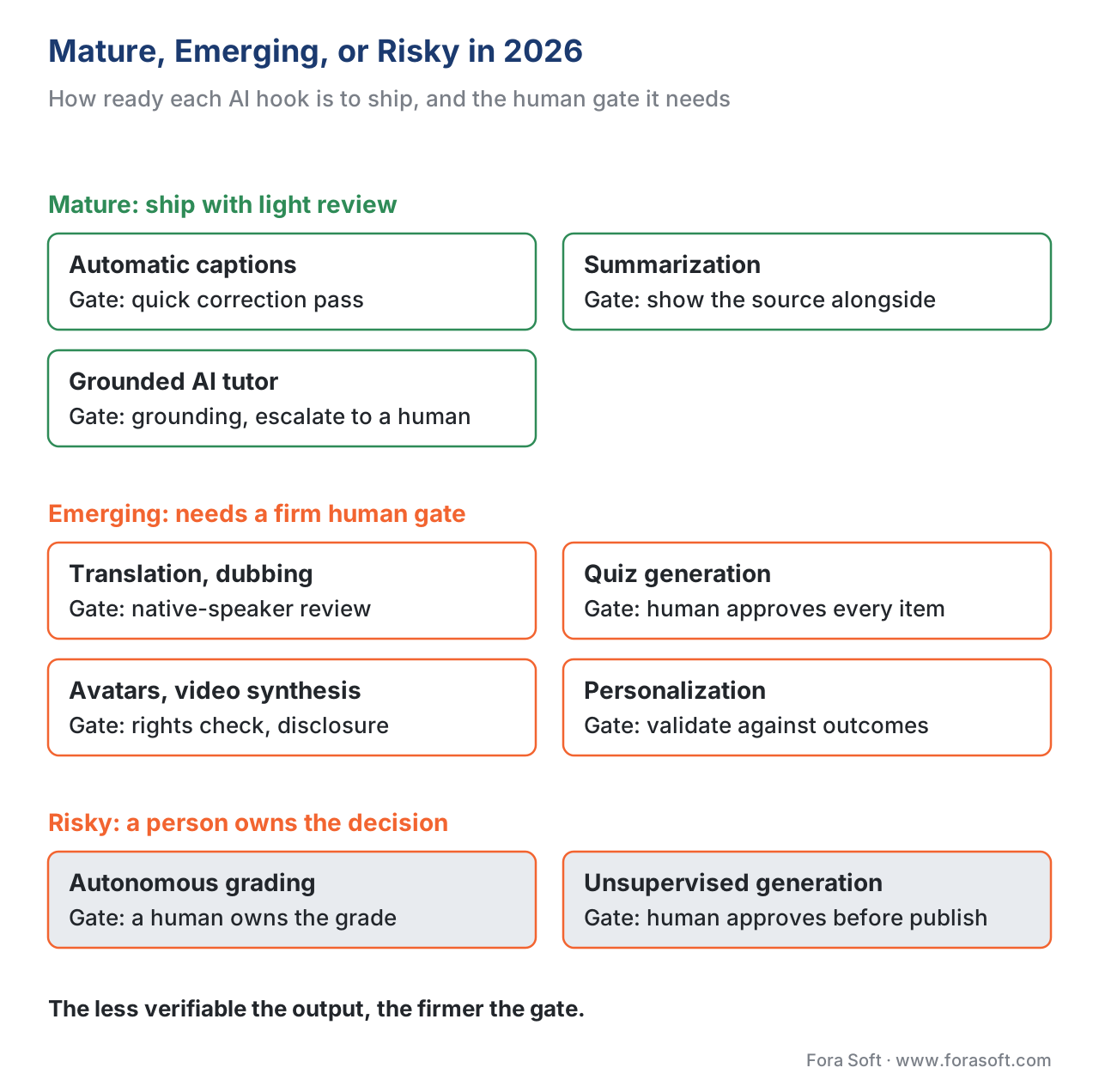 Figure 2. The 2026 maturity spectrum. Green is shippable with light review; orange needs a firm human gate; red still needs a person to own the decision.
| AI hook | Maturity (2026) | Main failure mode | Required review gate | Tracking |
|---|---|---|---|---|
| Automatic captions | Mature | Mistakes on technical terms | Quick human correction pass | xAPI |
| Summarization / study aids | Mature | Subtle omissions | Show source alongside summary | xAPI |
| Tutor (retrieval-grounded) | Mostly mature | Hallucination if not grounded | Grounding + escalate-to-human | xAPI |
| Translation / dubbing | Emerging | Wrong instruction in target language | Native-speaker review | xAPI |
| Quiz generation | Emerging | Bad distractors, trivial questions | Human approves every item | xAPI / cmi5 |
| Avatars / video synthesis | Emerging | Consent and "uncanny" trust loss | Rights check + disclosure | xAPI |
| Personalization / adaptivity | Emerging | "Branching illusion", thin data | Validate against outcomes | xAPI / Caliper |
| Autonomous grading | Risky | Unfair, opaque, regulated | Human owns the grade | xAPI |
| Unsupervised content generation | Risky | Wrong facts shipped at scale | Human approves before publish | n/a |
Cells marked "Mature" are tinted in the live diagram; the table is the at-a-glance version of Figure 2.
The pattern is clear. The mature hooks share one property: the learner or the author can verify the output cheaply. A caption can be skimmed against the audio; a summary can be checked against the lecture. The risky hooks share the opposite property: the output is a high-stakes decision that is hard to verify after the fact, like a grade or a fact stated as truth. The more consequential and less verifiable the output, the firmer the human gate must be.
The Rule That Ties the Map Together: a Review Gate
Every AI feature in a learning product needs a place where a human can catch a mistake before it reaches a learner. This is the review gate, and skipping it is the single most common way AI features fail in education.
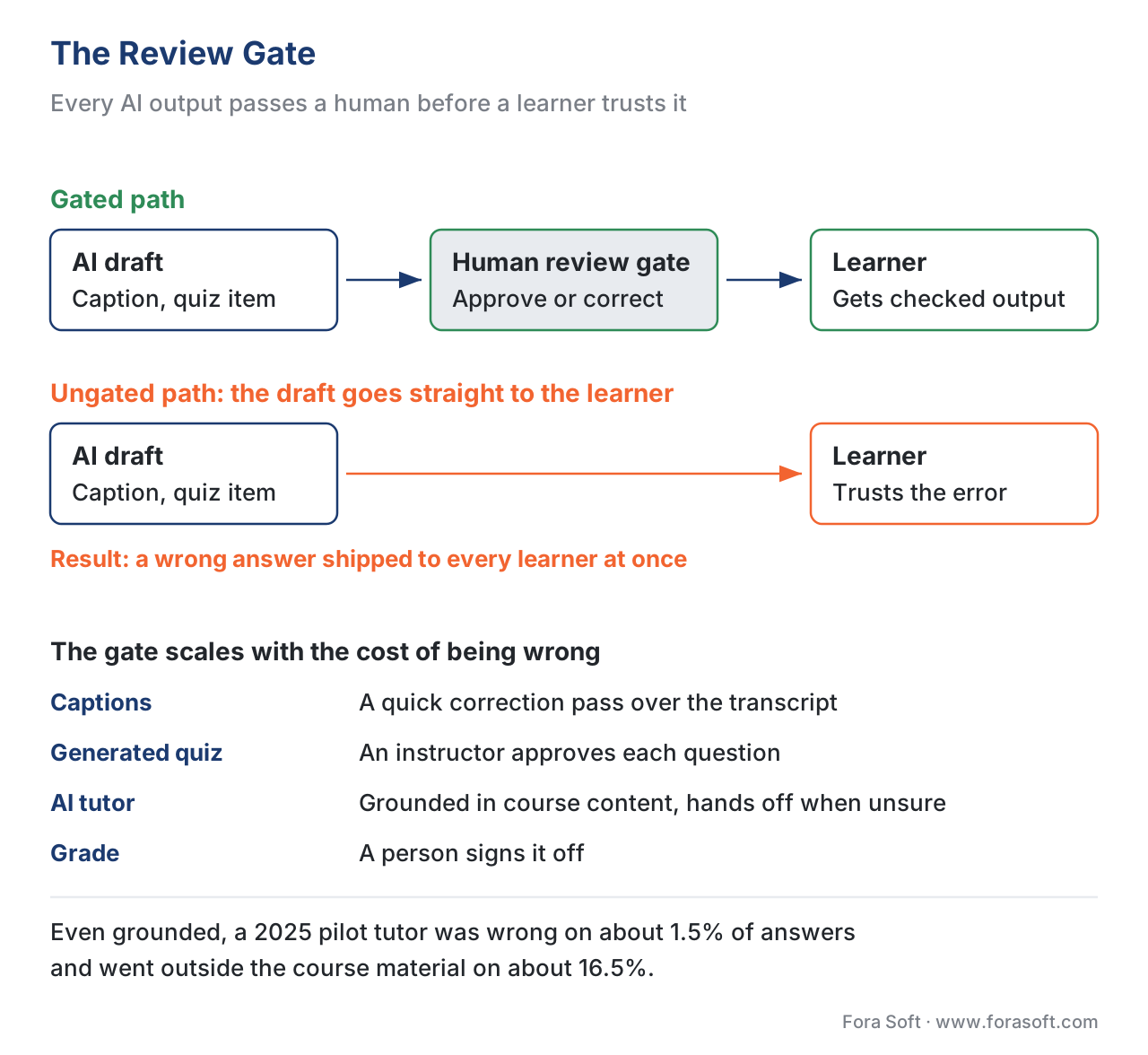 Figure 3. The review-gate pattern. The gate can be a quick correction pass (captions) or a full sign-off (a grade), but it is never skipped for output a learner will trust.
The gate is not always heavy. For captions, the gate is a quick correction pass over the auto-transcript. For a generated quiz, the gate is an instructor approving each question. For an AI tutor, the gate is built into the architecture: ground it in approved content so it cannot invent, and give it an "I am not sure — here is your instructor" escape hatch. The size of the gate scales with the cost of being wrong.
There is evidence for why this matters. A 2025 pilot of a course-grounded AI tutor found that even with retrieval grounding, about 1.5% of answers were outright incorrect and roughly 16.5% drew on information outside the material the model was given. Grounding cuts the error rate sharply, but it does not reach zero — so the product still needs an escalation path to a human. Ungated, those same errors ship to every learner at once.
The Spine Under Every Hook: Tracking
A learning product earns its name by keeping a record of what each learner did. That record is what separates it from a video site. So a hard rule follows: an AI feature that produces a learning interaction must still write that interaction into the learning record, using the same standards as everything else.
The standard that records learning events is the Experience API, called xAPI. An xAPI statement is a short sentence — "Maria answered question 3 correctly" — written into a store called a Learning Record Store, or LRS. (If that is new, read tracking video with the xAPI Video Profile.) The point for AI is this: when your AI generates a quiz question and a learner answers it, the result is not special because a machine wrote the question — it is an ordinary xAPI statement, and it flows into the same learning analytics as a human-authored quiz.
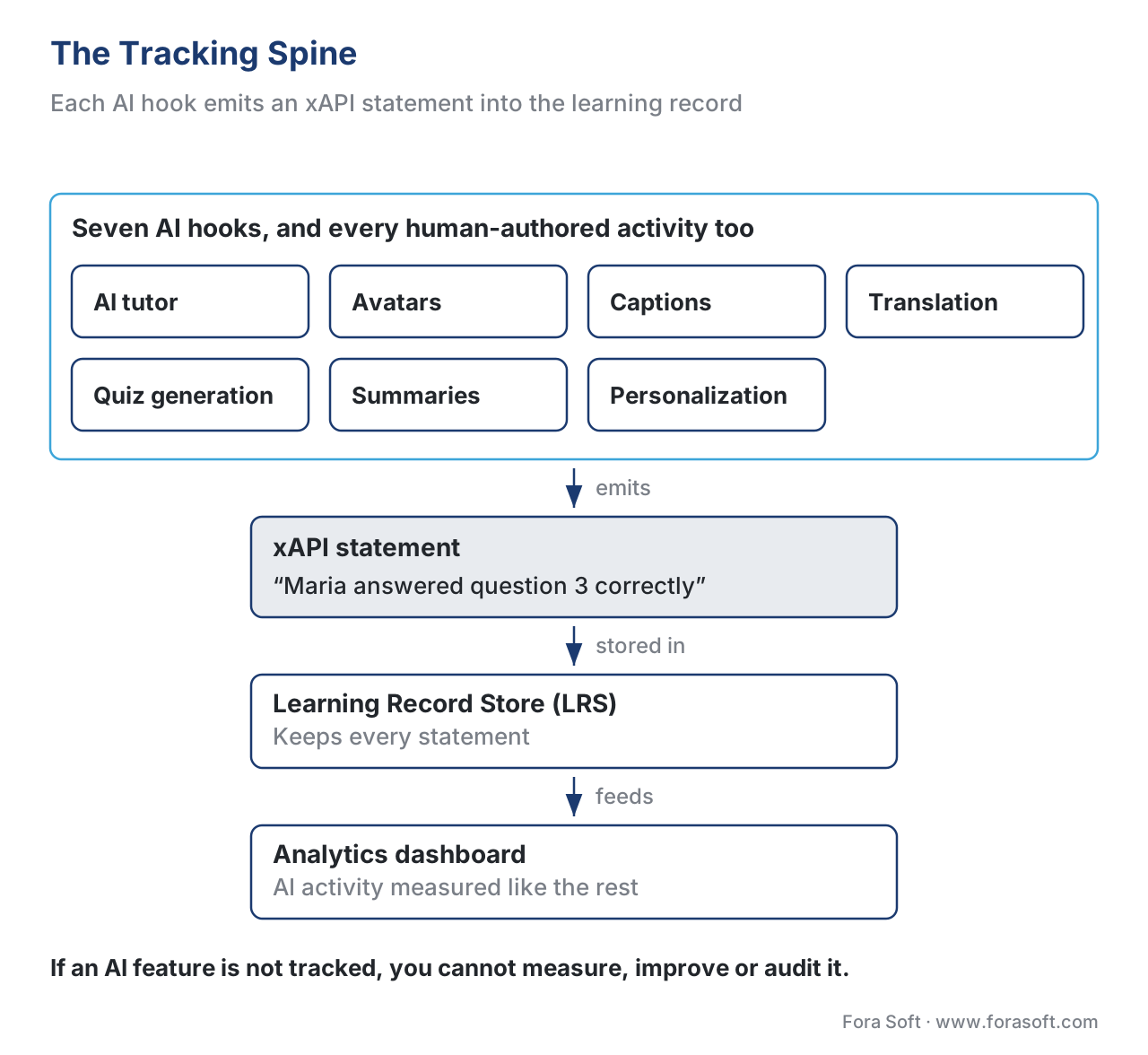 Figure 4. The tracking spine. Every hook, AI or not, emits an xAPI statement to the LRS and shows up in analytics.
This is why the map is not seven separate products. Captions, the tutor's hints, the generated quiz, and the adaptive engine's choices all write to the same record. An AI feature that cannot be tracked is an AI feature you cannot measure, improve, or defend — and in a regulated setting, one you cannot audit.
The Governance Layer: What Makes a Hook "Risky"
Two outside forces decide how heavy a hook's gate must be: accessibility law and AI regulation.
Accessibility is not optional. Captions are a named legal requirement, not a nice-to-have. Under the Web Content Accessibility Guidelines (WCAG) 2.1, Success Criterion 1.2.2 requires captions for all prerecorded video at Level A, and Success Criterion 1.2.4 requires captions for live video at Level AA. Here is the trap: an automatic caption is a draft, not a compliant caption. WCAG requires captions that identify speakers and meaningful sounds and are accurate — which an uncorrected machine transcript with a 5–10% error rate is not. The math is worth showing once.
A 30-minute lecture has roughly 4,500 spoken words. At a real-world speech-recognition error rate of 8%, that is about 360 wrong words — 4,500 × 0.08 = 360. In a technical course, those errors cluster on exactly the terms that matter. So the caption hook is "mature" only with its correction gate; without it, you have shipped an inaccessible course.
AI in education is increasingly regulated. The European Union's AI Act (Regulation (EU) 2024/1689) classifies several education uses as "high-risk" in its Annex III: AI that decides admission or access to a school, AI that evaluates learning outcomes, AI that assigns learners to programs, and AI that monitors for prohibited behavior during tests (proctoring). High-risk systems carry obligations — accuracy, robustness, human oversight, and registration — before they can be placed on the market. This is precisely why autonomous grading sits in the red band: it is not just bad practice, it is a regulated decision.
This is engineering guidance, not legal advice. Confirm specifics with qualified counsel, especially before deploying grading or proctoring AI in the EU.
A Common Mistake: "We Added AI" With No Gate and No Record
The most frequent failure we see is a team that ships an AI feature as a standalone widget: a chatbot bolted to the course page that is not grounded in the content, gives no escalation path, and writes nothing to the learning record. It demos well and fails in production. The tutor hallucinates because it was never grounded; the auto-captions are wrong on the terms that matter because no one corrected them; and none of it shows up in analytics, so when a learner complains, there is no trace of what the AI told them. The map's two rules — a review gate and a tracked record — exist to prevent exactly this.
Free download: AI-in-Learning Readiness ChecklistA one-page gate-and-tracking check for every AI feature before you ship: pick the hook, confirm maturity, set the human review gate, wire xAPI tracking, and clear the governance line (WCAG, EU AI Act, consent and disclosure).Where Fora Soft Fits In
We build the learning product around the AI, not the other way around. Fora Soft has shipped video conferencing, streaming, e-learning, and AI-driven video features since 2005, so when a client wants an AI tutor or auto-captions, we start from the build-vs-buy trade-off: a hosted captioning or tutoring API is fast and a recurring per-learner cost, while open models on your own infrastructure cost engineering up front but keep learner data in-house and avoid lock-in. We wire each AI hook into the tracking and review-gate spine described above so the feature is measurable and defensible, and we are candid about which hooks are production-ready and which still need a person in the loop.
The handbook
Fora Soft Video Engineering Handbook
We wrote a seven-volume handbook that works through the whole video stack, from the pixel to production, so that an engineer who finishes it can design and build a learning product with AI wired in properly. Volume 6 maps where AI sits in a video product and goes deep on the capabilities behind this article’s hooks — speech recognition, search, summarization and generative video. Volume 7 covers what happens in production: serving, cost per learner, human oversight and the compliance rules that put grading in the red band, and Volume 4 explains the audio and accessibility side of captions. Written by Nikolay Sapunov, CEO at Fora Soft.
Which AI features belong in your learning product first?
Tell us about your courses, your learners and your LMS, and we will map the AI hooks worth shipping now — captions, summaries, a grounded tutor — to a review gate, an xAPI tracking plan and a build-vs-buy estimate, and flag which ones still need a person in the loop. 250+ video products shipped since 2005.
See our case studies
Case study
VOLO
The captions and translation hooks in production: attendees scan a QR code, pick a language and get AI subtitles or voiceover in the browser — deployed at Black Hat 2025 for 22,000+ participants.
Case study
Meetric
AI speech analysis and coaching on top of video calls, with automated post-call reports and 80–100% of CRM data entry automated — the summarization and feedback hooks, tracked into a record.
Case study
Scholarly
The learning pipeline the hooks plug into: live classes for up to 2,000 students at once, recorded lessons over DASH/HLS, homework and review for 15,000+ active users.
What to read next
AI features
Automatic Captions for Learning Video
The most mature hook on the map, and the correction pass that makes it compliant.
AI features
Automatic Quiz and Assessment Generation
Drafting questions from a transcript, with an instructor approving every item.
Economics
Building vs Buying AI Features, and the Cost
Hosted APIs against open models on your own infrastructure, priced per learner.
Standards
Tracking Video With xAPI
The statements every AI hook should write into the learning record.
References
- Web Content Accessibility Guidelines (WCAG) 2.1, Success Criterion 1.2.2 Captions (Prerecorded), Level A — World Wide Web Consortium (W3C). Captions required for all prerecorded synchronized media. Tier 1. https://www.w3.org/WAI/WCAG21/Understanding/captions-prerecorded.html
- WCAG 2.1, Success Criterion 1.2.4 Captions (Live), Level AA — W3C. Captions required for live synchronized media. Tier 1. https://www.w3.org/WAI/WCAG21/Understanding/captions-live.html
- Regulation (EU) 2024/1689 (the AI Act), Annex III, point 3 — Education and vocational training — European Union. Classifies admission, learning-outcome evaluation, programme assignment, and test-monitoring AI as high-risk. Tier 1. https://artificialintelligenceact.eu/annex/3/
- Experience API (xAPI) Specification, version 1.0.3 — Advanced Distributed Learning (ADL) Initiative. Statements (actor-verb-object) written to a Learning Record Store. Tier 1. https://github.com/adlnet/xAPI-Spec
- xAPI Video Profile — ADL Initiative / xAPI community profile. Verbs and extensions for tracking video interactions; the basis for tracking AI-driven video activity. Tier 1. https://github.com/adlnet/xAPI-Video-Profile
- "Exploring the use of retrieval-augmented generation models in higher education: A pilot study on AI-based tutoring" — ScienceDirect, 2025. Found ~1.5% of grounded-tutor answers incorrect and ~16.5% outside the provided context. Tier 5. https://www.sciencedirect.com/science/article/pii/S2590291125004796
- "Best open-source speech-to-text models in 2026 (with benchmarks)" — Northflank. Whisper large-v3 ≈2.7% WER on benchmark conditions, 8–12% in real-world audio. Tier 4. https://northflank.com/blog/best-open-source-speech-to-text-stt-model-in-2026-benchmarks
- "The 2 Sigma Problem" — Benjamin S. Bloom, Educational Researcher, 1984. One-to-one tutoring raised average performance by about two standard deviations. Tier 5. https://journals.sagepub.com/doi/10.3102/0013189X013006004
- Multimedia Learning, the Personalization Principle — Richard E. Mayer, Cambridge University Press. Conversational-style narration improves transfer — relevant to AI tutor and avatar voice. Tier 5. https://www.cambridge.org/core/books/multimedia-learning/
- "Generative AI in Learning and Development Market Report 2026" — Research and Markets / TBRC. GenAI in L&D ≈ $1.01B (2025) → $1.36B (2026), CAGR ≈34.8%. Tier 6. https://www.researchandmarkets.com/reports/6226963/generative-ai-in-learning-development-market
- Khanmigo overview (Khan Academy AI tutor) — built on GPT-4, Socratic prompting, grounded in Khan Academy content. Used as a real-world grounded-tutor example. Tier 4. https://www.khanmigo.ai/
Where sources disagreed, the standards win: vendor blogs that call raw machine captions "WCAG-ready" were overridden by the WCAG 2.1 text, which requires accurate, speaker-identified captions (refs 1–2).
