


Why This Matters
If you build a learning product, run a training program, or own a course catalog, a recorded lecture is a wall of video that learners must watch linearly, and most never rewatch it. Study aids turn that wall into something a learner can skim before class, review the night before an exam, and search months later — which is why nearly every learning platform shipped an "AI summary" button in 2025 and 2026. Automatic generation changes the economics: a model drafts the summary, key points, chapters, and flashcards from the transcript you already have, and your instructional designers shift from writing to reviewing. This article gives you the quality reality, the grounding techniques that hold hallucination down, the review workflow, the evidence on which aids actually improve learning, and the cost math, so you can decide how far to lean on AI here and brief your engineers without buying a demo. It builds on where AI fits in a learning product and sits next to automatic quiz and assessment generation.
What "Lecture Summarization and Study Aids" Actually Means
"Have the AI summarize the lecture" hides a pipeline, and mistaking the pipeline for a single model call is the first error. The model is only the middle of it.
One term up front, in plain language: a large language model, or LLM, is the AI software — the same family that powers chat assistants — that reads text and writes text. Feed it the words of a lecture and it can write you a summary, pull out the main points, propose chapter titles, or draft flashcards. That is the part everyone pictures. But a usable study aid is more than a model call: it is a transcript that has been cleaned, a model prompted for a specific aid, a draft in a known structure, a human who checks it against the source, and a publishing step that places the aid in the player and records when a learner uses it.
The useful analogy: the LLM is a fast, well-read teaching assistant who has watched the lecture once and will happily write you the notes in a minute. They are quick and tireless, but they sometimes misremember a detail and state it with total confidence, and they will smooth over a point the lecturer left deliberately rough. You would not hand their notes straight to students without reading them. The pipeline is how you turn the draft into a study aid a learner can trust.
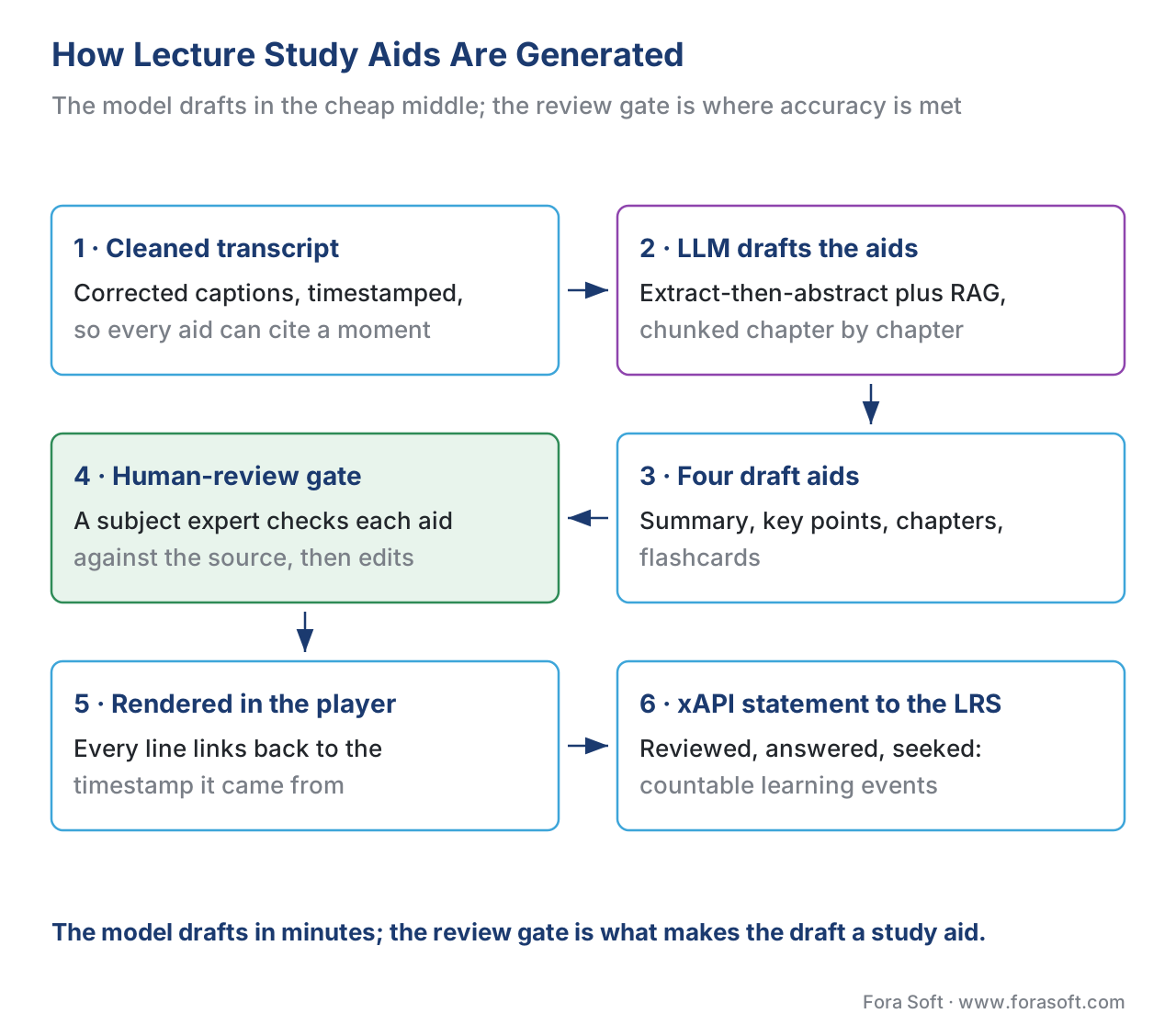 Figure 1. The study-aid pipeline end to end. The model drafts in the cheap middle; the human-review gate is where accuracy is met, and publishing makes each aid usable in the player and trackable in analytics.
How Generation Works, From a Transcript
Walk the pipeline once, because each stage caps what the next can do.
It begins with a source transcript: the corrected caption file or transcript of the video. Study-aid quality is capped by this input — a model cannot summarize a sentence the transcript got wrong, and a misheard technical term becomes a confident, wrong key point. If you are working from automatic captions, finish the human-edit pass first; this is the same source-quality rule that governs automatic captions for learning video. A transcript that carries timestamps is worth far more than a flat block of text, because timestamps let every study aid point back to the exact moment in the video it came from — the single most useful grounding feature you can have.
Next, the transcript and a set of instructions go to the language model. A good prompt does three things: it names the aid wanted (a 150-word summary, five key points, chapter titles, ten flashcards), it pins the aid to the lecture's learning objectives so the model emphasizes what matters rather than what was said most often, and it often feeds the model the transcript in chunks tied to chapters rather than as one giant block — because a summary written chapter-by-chapter is more faithful than one squeezed from an hour of text in a single pass. The model internals — how the LLM compresses text and how the summarization architecture works — live in our AI for Video Engineering section; this article covers the learning wiring and the product decision, not the model design. See the AI video summarizer guide for the closest model-side treatment.
The model emits draft study aids. Then comes the step that separates a study aid from a liability: the human-review gate, where a subject expert checks each aid against the source for accuracy, completeness, and emphasis, then accepts, edits, or rejects it. Only then does the result become a published, trackable aid: rendered in the player or course page, linked back to its timestamps, and emitted as a statement your analytics can count when a learner opens or completes it. We come back to grounding, review, and tracking in detail below.
The Core Fork: Extractive vs Abstractive
Here is the distinction that decides your hallucination risk, and most teams never make it consciously. There are two ways to summarize, and they fail differently.
Extractive summarization selects the most important sentences from the transcript and stitches them together unchanged. Because every word in the output came verbatim from the lecture, an extractive summary cannot invent a fact — it is faithful by construction. Its weakness is style: it can read like a list of disconnected quotes, and it cannot smooth a rambling lecture into clean prose.
Abstractive summarization reads the transcript and writes a fresh, condensed version in new words — the way a person would. It reads far better and can reorganize a messy lecture into a clear arc. Its weakness is the defining risk of all generative AI: hallucination, the model stating something fluent and false. In a summary this is dangerous precisely because it is fluent — a learner has no way to tell an invented sentence from a real one, and a wrong "key takeaway" is taught to everyone who reads it. The research literature on summarization (the standard reference is Maynez and colleagues' 2020 study on faithfulness in abstractive summarization) found that abstractive models routinely produce content not supported by the source, while extractive output stays faithful — the trade-off is readability against fidelity.
The practical answer is not to pick one but to combine them and to ground the output. Extract-then-abstract first pulls the relevant sentences, then rewrites only those — keeping the model anchored to real material. Retrieval-augmented generation, or RAG, does the same at scale by retrieving the exact transcript passages before the model writes, so it composes from the lecture rather than from memory. Neither removes the need for review, but both cut the chance of an invented fact sharply. The discipline that makes this trustworthy is citation: make every summary sentence and every flashcard link back to the timestamp it came from, so a reviewer — and a curious learner — can jump to the source and confirm it in one click.
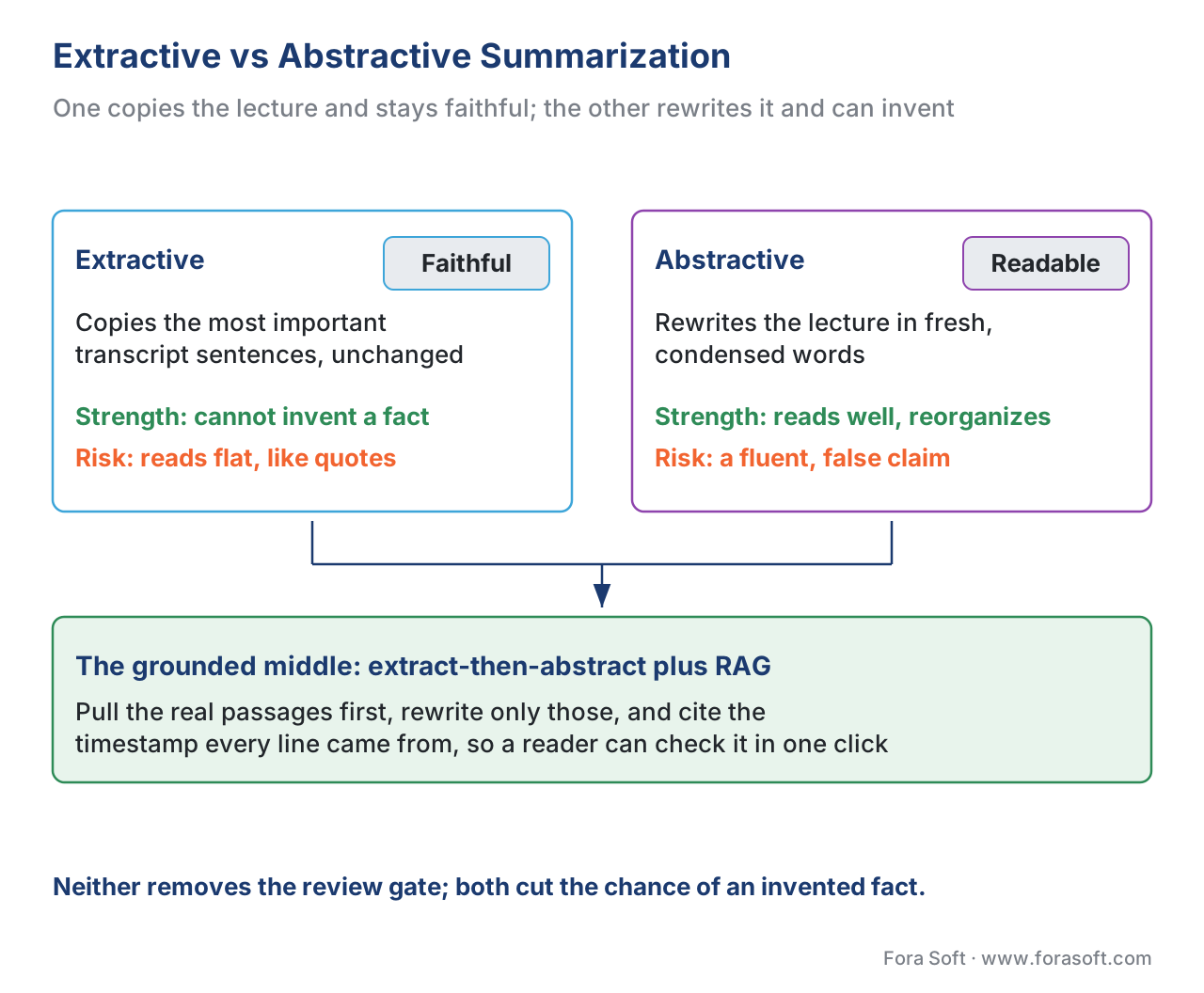 Figure 2. The summarization fork. Extractive output is faithful but flat; abstractive output is readable but can hallucinate. Extract-then-abstract and retrieval-augmented generation, with timestamp citations, sit in the grounded middle the section recommends.
The Study-Aid Family
"Summarization" is shorthand for a family of aids, and each one does a different job for the learner. Treating them as one feature is how teams ship a summary and call the course "enhanced."
A summary is a short paragraph — typically 100 to 200 words — that tells a learner what the lecture covered before they watch or after they finish. It is a navigation and review aid, not a substitute for the lecture; its risk is an abstractive hallucination, so it benefits most from grounding and review.
Key points (or takeaways) are a bulleted list of the lecture's main claims. They are more extractive in spirit than a prose summary and so are a little safer, and they double as the seed for assessment — the same main points that make good takeaways make good quiz questions, which is why this aid pairs naturally with automatic quiz generation.
Chapters and notes break the video into titled segments with a sentence each, so a learner can jump to "Setting up the environment" without scrubbing. This is the highest-value aid for a long lecture and the one that ties most directly to the video itself — it is the AI auto-generation counterpart to the manual mechanics covered in chaptering, transcripts, and in-video search, and the same step that post-processes a recorded live class in recording live classes and post-processing.
Flashcards are question-and-answer pairs generated from the content, meant for self-testing and spaced review. They are the most pedagogically powerful aid in the family — and, as the next section explains, the reason is that they make the learner do something rather than read something.
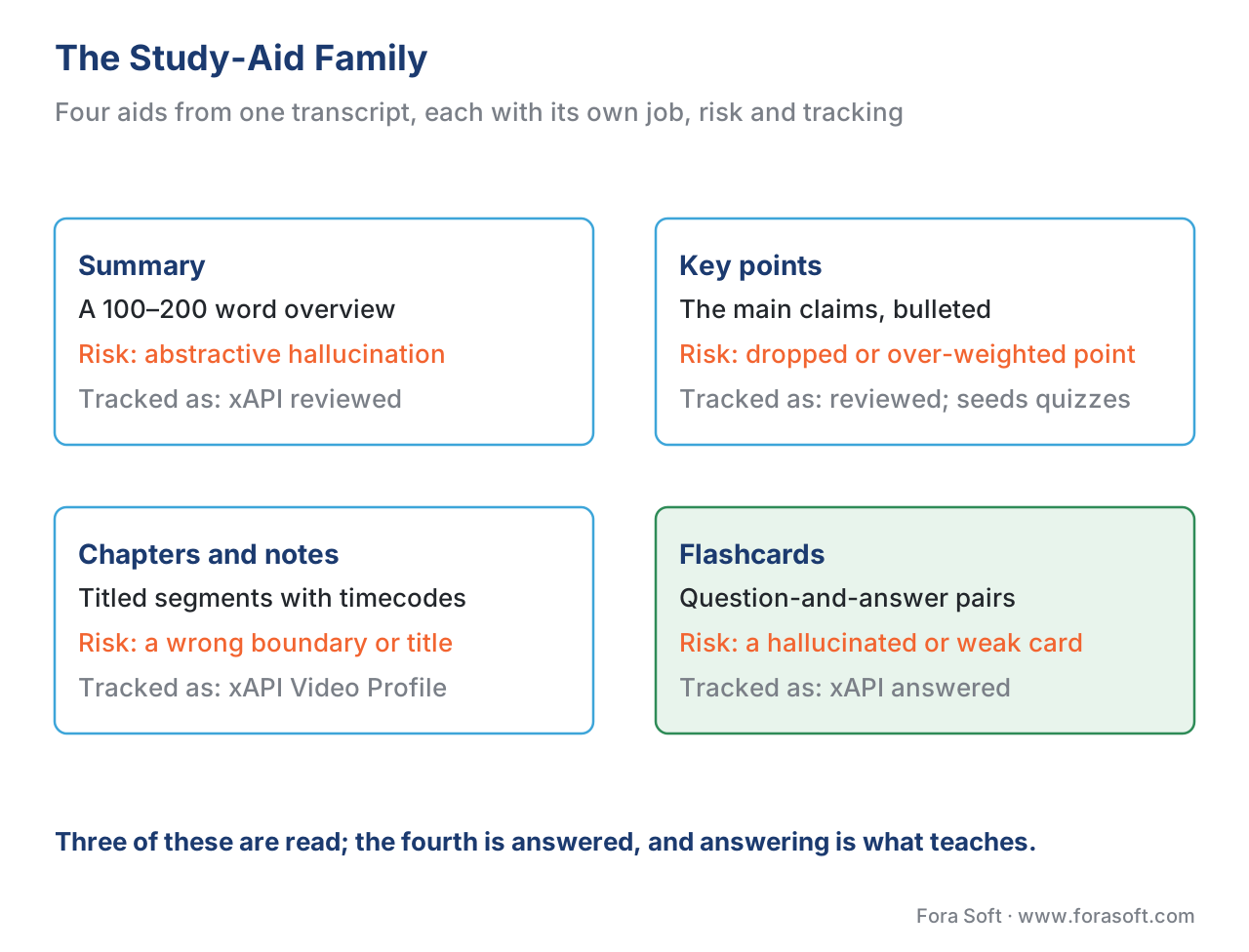 Figure 3. The four study aids generated from one transcript. Each does a different job — navigation, review, jump-to-moment, and self-testing — and each carries a different hallucination risk and tracking shape.
What Actually Helps Learning: The Evidence
Lead with the uncomfortable finding, because it should shape your product. The study aid that is easiest to generate and ship — a passive summary the learner reads — is one of the weakest ways to learn, while the harder-to-design aid — self-testing — is one of the strongest.
A landmark 2013 review of study techniques (Dunlosky and colleagues, "Improving Students' Learning With Effective Learning Techniques") rated ten common methods by how well evidence supports them. Practice testing and distributed practice (spacing study over time) earned the highest-utility rating. Summarization — having the learner read or write summaries — earned a low-utility rating, useful mainly as a first pass. The lesson for an AI study-aid feature is direct: a summary helps a learner orient and review, but it does not build durable memory on its own, and you should not present it as if it does.
Two well-established effects explain why flashcards win. The testing effect (also called retrieval practice; the standard reference is Roediger and Karpicke's 2006 work) is that recalling an answer strengthens memory far more than re-reading the material — the act of retrieval is itself the learning. The spacing effect (documented since Ebbinghaus and confirmed in modern meta-analyses such as Cepeda and colleagues, 2006) is that the same study time spread across days beats one cramming session. A flashcard system delivers both: each card is a retrieval attempt, and a spaced-repetition scheduler shows a card again just before the learner would forget it. There is also the generation effect — material a learner produces or actively works through is remembered better than material handed to them — which is one more reason an interactive flashcard beats a paragraph.
So the product conclusion is not "generate summaries." It is: generate the full family, but design the experience so the learner ends up testing themselves, not just reading. The summary is the on-ramp; the flashcards with spaced review are where the learning happens. Tracking each — covered below — lets you see whether learners actually reach the part that works.
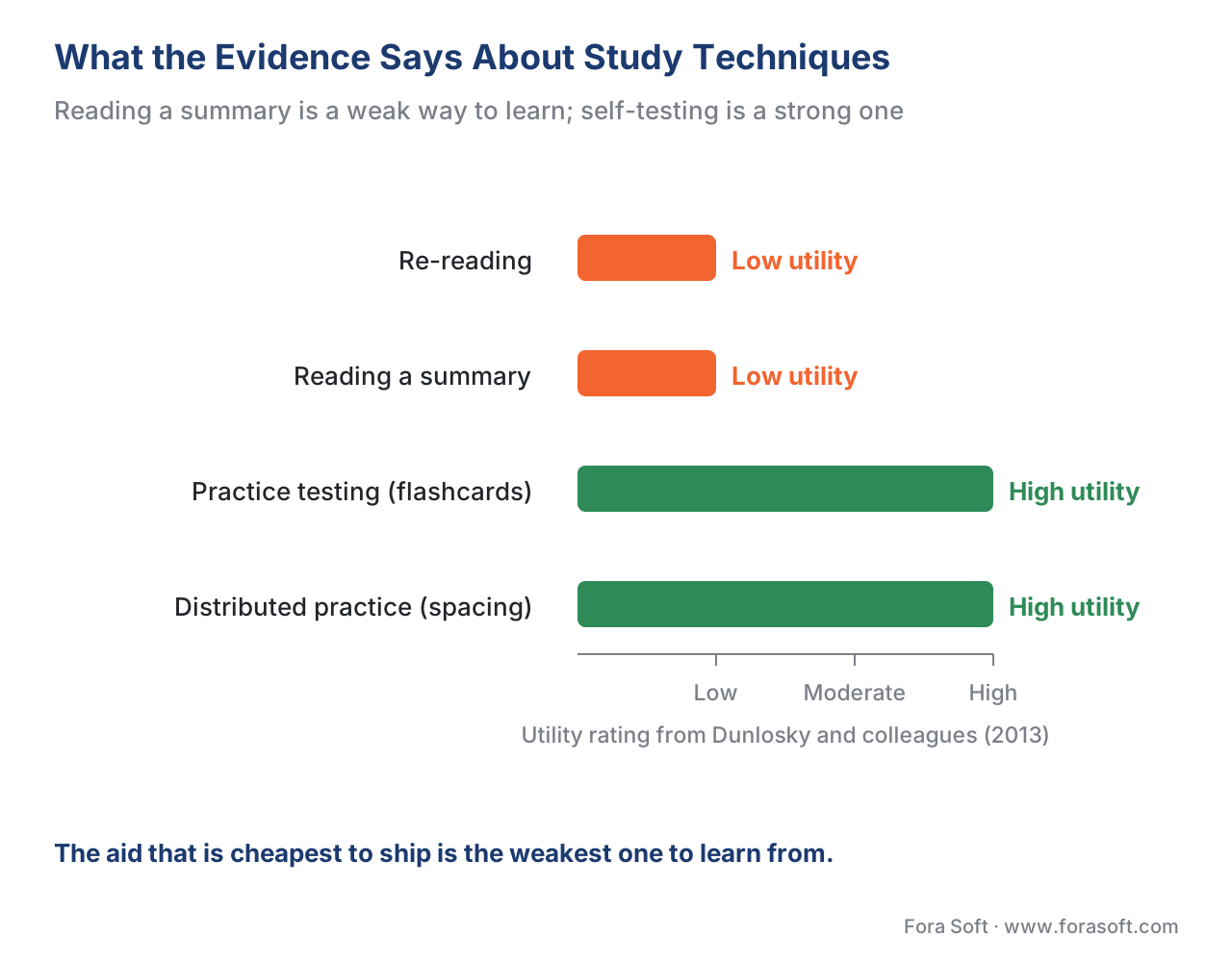 Figure 4. What the learning-science evidence says. Reading a summary is a weak way to learn; self-testing with flashcards and spaced repetition is a strong one. Design the study-aid experience to move the learner from reading toward retrieval.
The Human-Review Gate
Because abstractive output can be fluent and wrong, the review gate is not optional polish — it is the step that produces a trustworthy study aid. Make it a defined workflow, not a glance.
A reviewer asks four questions of every generated aid. Is it accurate — does every claim trace to the transcript, with no invented facts or numbers? Is it complete — did the model drop a point the lecturer treated as essential, or over-weight a long tangent? Is the emphasis right — does the summary foreground the learning objectives rather than whatever was repeated most? And is it clear and unbiased — free of confusing phrasing and of loaded examples? An aid passes only when all four hold; otherwise the reviewer edits or rejects it. Timestamp citations make this fast: the reviewer clicks a claim and lands on the moment in the video that should support it.
1EdTech (the standards body behind QTI and LTI) published AI-Generated Content Best Practices (v1.0, 2024) precisely because this workflow needs guardrails: it recommends human oversight of AI-generated learning content, transparency about what was machine-generated, and attention to bias and accessibility. Treat that document as the policy spine for your review gate, and label AI-generated study aids as such so learners know what they are reading. The reframe to give stakeholders: AI does not remove the expert from authoring study aids; it moves the expert from writing to reviewing and editing, which is several times faster per lecture and produces a fuller set of aids than a course would otherwise ship.
Making Study Aids Count: Tracking
A study aid that no system can see a learner use is invisible to your analytics — you cannot tell whether it helped, and you cannot improve it. The standard that fixes this is xAPI — the Experience API, the specification (version 1.0.3, from the Advanced Distributed Learning Initiative) that records learning as short statements like "Maria reviewed the Module 3 summary" or "Maria answered a flashcard correctly," written to a Learning Record Store, the database those statements live in.
xAPI is well suited to study aids because, unlike the older SCORM standard that tracks a fixed completion-and-score model inside an LMS launch, xAPI lets you define your own verbs and objects — so "viewed summary," "completed flashcard deck," and "jumped to chapter" all become countable events. For the statement design in depth, see tracking video with xAPI; for how this rolls into completion and progress, see learning metrics 101. When a study aid points into the video — a chapter marker or a "rewatch this" link — the xAPI Video Profile (the community profile for video tracking) carries the played, paused, and seeked events with timecodes, so a chapter jump is a real, analyzable signal rather than an untracked click.
A minimal xAPI statement for a learner reviewing a generated summary, with obviously fake data:
{
  "actor": { "name": "Test Learner", "mbox": "mailto:learner@example.org" },
  "verb": { "id": "http://id.tincanapi.com/verb/reviewed",
            "display": { "en-US": "reviewed" } },
  "object": {
    "id": "https://example.org/course/safety/lecture3/summary",
    "definition": {
      "type": "http://adlnet.gov/expapi/activities/media",
      "name": { "en-US": "Lecture 3 AI summary (human-reviewed)" }
    }
  },
  "result": { "duration": "PT45S" }
}
The point of the example is the shape, not the syntax: because the aid has a stable id and a consistent verb, "reviewed the summary" becomes one metric across every learner and every language, and you can finally answer whether the learners who used the study aids did better — and which aid moved the needle.
| Study aid | What it carries | Main risk | How to track it (standards support) |
|---|---|---|---|
| Summary | 100–200 word overview | Abstractive hallucination | xAPI custom verb ("reviewed"); not a completion gate |
| Key points | Bulleted main claims | Dropped or over-weighted point | xAPI ("reviewed"); seeds quiz items (QTI / xAPI interactions) |
| Chapters + notes | Titled segments, timecodes | Wrong boundary or title | xAPI Video Profile (seeked, played) with timecodes |
| Flashcards | Q&A pairs for self-test | Hallucinated answer; weak card | xAPI interaction ("answered"); pairs with spaced-repetition state |
A Common Mistake: The Confident Summary
The failure we see most is a team that wires the transcript to a model, gets a fluent summary, renders it under the video, and ships. It demos beautifully. Then an abstractive model states a number the lecturer never gave, or flips a "do not" into a "do," and because the prose is smooth, no learner doubts it — the wrong fact is now in the official course notes. The quieter version of the same mistake is presenting the summary as a replacement for the lecture, so learners read 150 words, skip the video, and the course quietly stops teaching. And the third is the analytics gap: study aids shipped as plain text with no xAPI statement and no stable id, so you can never tell whether anyone used them or whether they helped.
The fixes map one-to-one. Ground the generation (extract-then-abstract or RAG) and run the human-review gate against the source to kill the confident-wrong summary. Frame the summary as a navigation-and-review aid and push the learner toward the flashcards for the actual learning, so the aid supplements rather than replaces the lecture. And emit every aid as a tracked xAPI statement with a durable id from the start, so the feature produces data instead of decoration. Automatic summarization is a draft. Shipping the draft as authoritative notes is not a study aid — it is a confident-sounding liability, at the expense of the learners who trusted it.
The Math: Study Aids for a 20-Lecture Course
Lead with the business trade-off, because study-aid authoring is the cost that scales with every lecture and every course update.
Take a 20-lecture course, where each lecture needs a summary, key points, chapter markers, and a small flashcard deck. Author it the traditional way, with an instructional designer writing the aids from the transcript:
Manual authoring:
  ~2 hours per lecture for the full set of aids
  20 lectures × 2 hours = 40 hours of designer time
  40 hours × $70/hour = $2,800 per course
Now author it AI-assisted — the model drafts every aid, the designer reviews and edits against the source:
AI-assisted (generate, then review):
  Generation pass: minutes of compute ≈ negligible
  Review and edit at ~30 minutes per lecture
  20 lectures × 0.5 hours = 10 hours of designer time
  10 hours × $70/hour = $700 per course
The review path costs roughly a quarter as much and finishes in a fraction of the time — and it scales: regenerating the aids after a lecture is re-recorded is a cheap model pass plus a short review, not a fresh 40-hour project. But read what the saving is not: it is not "free notes." The review is the part that buys trust, and cutting it is the false economy that ships a confident-wrong summary across twenty lectures at once. The realistic claim is a three-to-four-times speed-up per lecture with the expert kept firmly in the loop — and a fuller, fresher set of aids than the course would otherwise carry. For the broader build-and-run picture, see the learning-platform cost model and building vs buying AI features, and the cost.
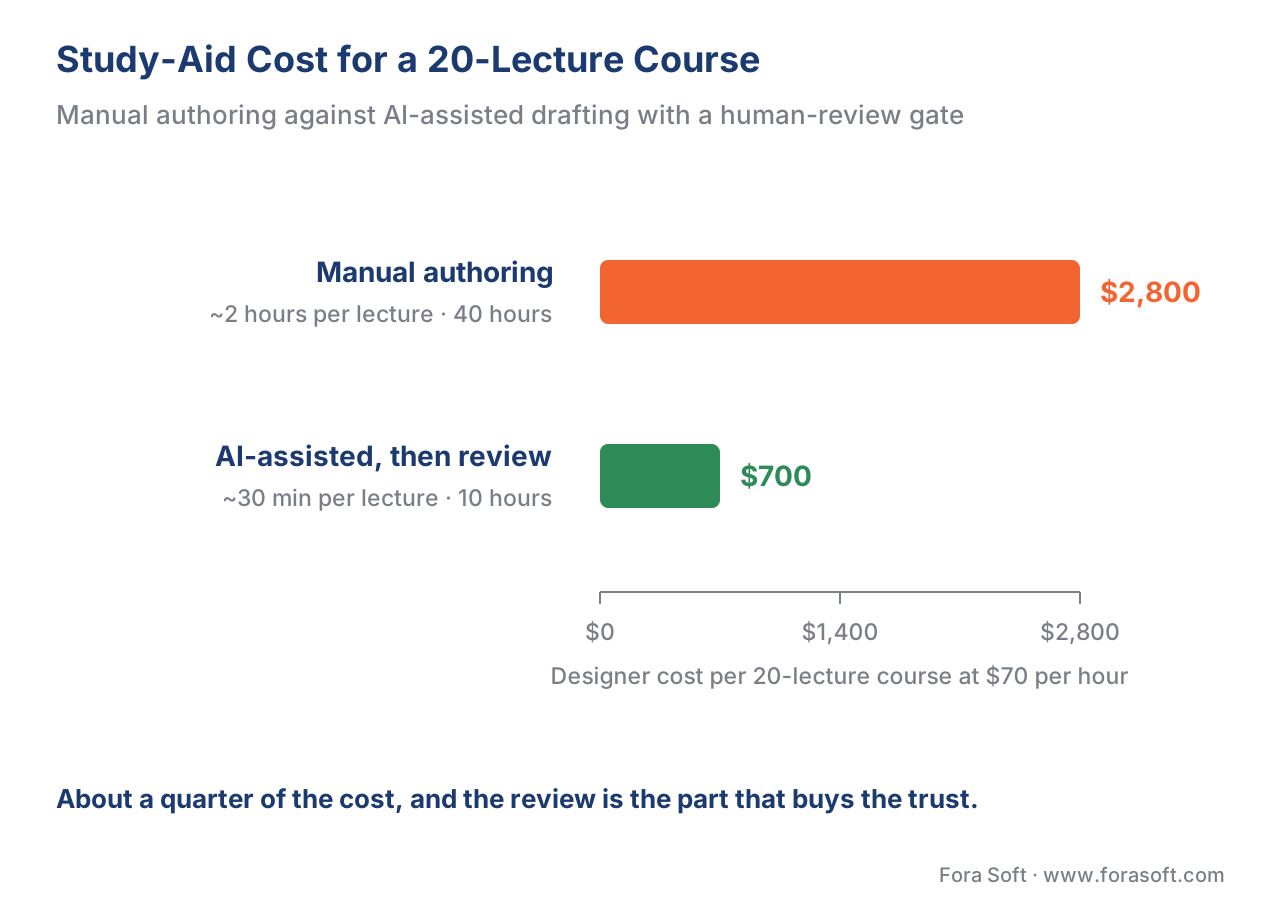 Figure 5. The authoring cost trade-off. AI-assisted generation with a human-review gate costs roughly a quarter of manual authoring for a 20-lecture course's study aids — and the review step is the part that buys trust.
Where Fora Soft Fits In
We build study aids into the learning product, not as a bolt-on that emits orphaned text under the player. Fora Soft has shipped video conferencing, streaming, e-learning, and AI-driven video features since 2005, so when a client wants AI summaries and flashcards we start from the build-vs-buy trade-off: a study-aid vendor or an off-the-shelf API is fastest to a working demo and bills per minute or per seat, while a generation pipeline wired into your own player and course store costs engineering up front but keeps the transcripts, the corrected aids, and the learner-usage data in-house. We wire the cleaned-transcript input, the grounded extract-then-abstract generation, the timestamp citations, the human-review queue, and output the summary, key points, chapters, and flashcards as player-rendered, xAPI-tracked assets that point back into the video. We are candid that the review gate is the part that buys trust, and that the highest-value design move is steering learners from the summary they read toward the flashcards they test themselves on — because that is where the evidence says the learning is.

The handbook
Fora Soft Video Engineering Handbook
We wrote a seven-volume series that takes the whole video stack apart across 9,000+ pages — encoding, delivery, audio and AI — so a study-aid pipeline like the one above is something you design on purpose instead of assembling from vendor demos. Volume 6 sits closest to this article: speech recognition and the transcript it produces, retrieval and RAG over a video archive, and what a generative model does and does not guarantee. Volume 7 carries the same capabilities into production — serving, cost per stream-hour, and the compliance rules around labelling machine-generated content — and volume 3 covers the player side, where chapters, subtitles and timestamp links actually reach the learner. Written by Nikolay Sapunov, CEO at Fora Soft.
Would a learner be able to tell which line of your AI summary was invented?
Tell us what your transcripts look like, how much review time your subject experts actually have, and what your analytics need to count — and we will come back with the grounding, the review queue and the xAPI design that fit, and what each part costs to build. 250+ video products shipped since 2005.
See our case studies
Case study
BrainCert
A WebRTC and HTML5 virtual-classroom LMS with 100K+ customers and 500M+ real-time classroom minutes delivered, shipping AI-powered course creation alongside SCORM and xAPI support. That pairing is this article in production: aids a model drafts, and statements an LRS can count.
Case study
VocalViews
A market-research platform with 1M+ participants and 5K+ completed studies, running speech recognition in 30+ languages and automatic transcription on AWS Transcribe. It is the first box in the pipeline above: everything a model can write about a recording is capped by how good that transcript is.
Case study
Scholarly
Sydney’s selective-test prep platform for 15,000+ active users, with live classes for up to 2,000 students and a recorded catalogue served over DASH and HLS. At that catalogue size, hand-writing a summary and a flashcard deck per lecture is the 40-hour project the cost math above is about.
What to read next
Assessment
Automatic Quiz and Assessment Generation
The same key points, turned into questions a learner has to answer.
Transcripts
Automatic Captions and Subtitles for Learning Video
Where the transcript comes from, and why its errors travel downstream.
Navigation
Chaptering, Transcripts, and In-Video Search
The hand-built version of the chapter markers a model drafts here.
Tracking
Tracking Video With xAPI: The Video Profile
The statement design that makes every aid above a countable event.
References
- Experience API (xAPI) Specification, version 1.0.3 — Advanced Distributed Learning (ADL) Initiative. Defines statements (actor–verb–object), custom verbs and activity types, and the Learning Record Store, the basis for tracking "reviewed summary," "completed flashcard deck," and chapter-jump events. Tier 1. https://github.com/adlnet/xAPI-Spec/blob/master/xAPI-Data.md
- xAPI Video Profile — ADL / xAPI community profile. The video-tracking profile (played, paused, seeked with timecodes) that turns a chapter jump or "rewatch this" link into an analyzable signal. Tier 1. https://github.com/adlnet/xapi-authored-profiles/tree/master/video
- cmi5 Specification — Advanced Distributed Learning (ADL). The xAPI profile that carries course-level launch and pass/fail, into which study-aid usage statements roll up. Tier 1. https://github.com/AICC/CMI-5_Spec_Current
- Web Content Accessibility Guidelines (WCAG) 2.1, Level AA — World Wide Web Consortium (W3C), 2018. Transcripts and text summaries support Success Criteria 1.2.x; generated study aids must meet the same contrast and structure bar. Tier 1. https://www.w3.org/TR/WCAG21/
- AI-Generated Content Best Practices, v1.0 — 1EdTech Consortium, 2024. Guidance for AI-generated learning content: human oversight, transparency about machine-generated material, bias and accessibility attention; the policy spine for the review gate. Tier 1. https://www.imsglobal.org/resource/AI-Generated_Content_Best_Practices/v1p0
- Maynez, J., Narayan, S., Bohnet, B., McDonald, R. — "On Faithfulness and Factuality in Abstractive Summarization" — ACL, 2020. Evidence that abstractive models produce content unsupported by the source (hallucination), while extractive output stays faithful; the basis for the extractive-versus-abstractive trade-off. Tier 5. https://aclanthology.org/2020.acl-main.173/
- Dunlosky, J., Rawson, K. A., Marsh, E. J., Nathan, M. J., Willingham, D. T. — "Improving Students' Learning With Effective Learning Techniques" — Psychological Science in the Public Interest, 2013. Rates practice testing and distributed practice high-utility and summarization low-utility; the basis for "reading a summary is weak, self-testing is strong." Tier 5. https://doi.org/10.1177/1529100612453266
- Roediger, H. L., & Karpicke, J. D. — "Test-Enhanced Learning: Taking Memory Tests Improves Long-Term Retention" — Psychological Science, 2006. The testing effect / retrieval practice — recalling an answer beats re-reading; why flashcards are the strongest study aid. Tier 5. https://doi.org/10.1111/j.1467-9280.2006.01693.x
- Cepeda, N. J., Pashler, H., Vul, E., Wixted, J. T., Rohrer, D. — "Distributed Practice in Verbal Recall Tasks: A Review and Quantitative Synthesis" — Psychological Bulletin, 2006. The spacing effect meta-analysis behind spaced-repetition flashcard scheduling. Tier 5. https://doi.org/10.1037/0033-2909.132.3.354
- Vendor documentation on retrieval-augmented generation and grounding — OpenAI / Anthropic engineering documentation, 2024–2026. The mechanism by which RAG and extract-then-abstract anchor generation to source text and reduce, but do not eliminate, fabricated summary content. Tier 4. https://platform.openai.com/docs/guides/retrieval
Where sources disagreed, the standards and evidence win: vendor claims that AI "instantly turns any lecture into perfect study notes" were overridden by the abstractive-summarization faithfulness literature (ref 6) and the 1EdTech AI-Generated Content Best Practices (ref 5), which together establish that generated aids require human review against the source; and the implicit "a summary is enough to learn from" framing was overridden by the learning-science evidence (refs 7–8) that ranks passive summarization well below self-testing.
