


Why This Matters
If you run a course catalog, build a learning product, or own a corporate training program, "personalized, adaptive learning" is the phrase every vendor now puts on the box — and the adaptive-learning software market is forecast at roughly $5.26 billion in 2026, growing near 20% a year, so the pressure to buy or build it is real. But adaptivity is expensive: it needs more content, more assessment items, more data plumbing, and more evaluation than a linear course, and a lot of teams pay for all of that and ship something that only looks adaptive. This article gives you the vocabulary to tell genuine adaptivity from authored branching, the engineering reality of each approach, the data prerequisites that decide whether adaptivity is even possible on your platform, and the build-vs-buy framing — so you can brief engineers and instructional designers, challenge a vendor demo, and spend the budget where it changes outcomes. It builds on where AI fits in a learning product and draws the sharp line against authored branching scenarios.
What "Personalization" and "Adaptive" Actually Mean
The two words are used interchangeably, and that blur causes bad decisions, so separate them first.
Personalized learning is the outcome: a learner gets an experience shaped to their needs, goals, prior knowledge, and pace, rather than the one-size course everyone else gets. It does not say how the shaping happens. A human mentor personalizes. A learner who picks their own electives personalizes. A menu of optional tracks personalizes. The defining feature is fit, not technology.
Adaptive learning is one method for producing that fit: software that observes a learner's behavior and performance and automatically adjusts the next step — the next question, the next video, the next difficulty level — in real time, without the learner having to choose. The defining feature is the automatic, data-driven adjustment. Every adaptive system is personalized; not every personalized system is adaptive.
The plain analogy: personalization is "the suit fits you." Adaptive learning is "a tailor measures you as you move and re-cuts the suit on the spot." A rack of three sizes is also personalization — you pick the one that fits — but it is not adaptive, because nothing is measuring you and re-cutting. Hold that distinction; the rest of the article depends on it.
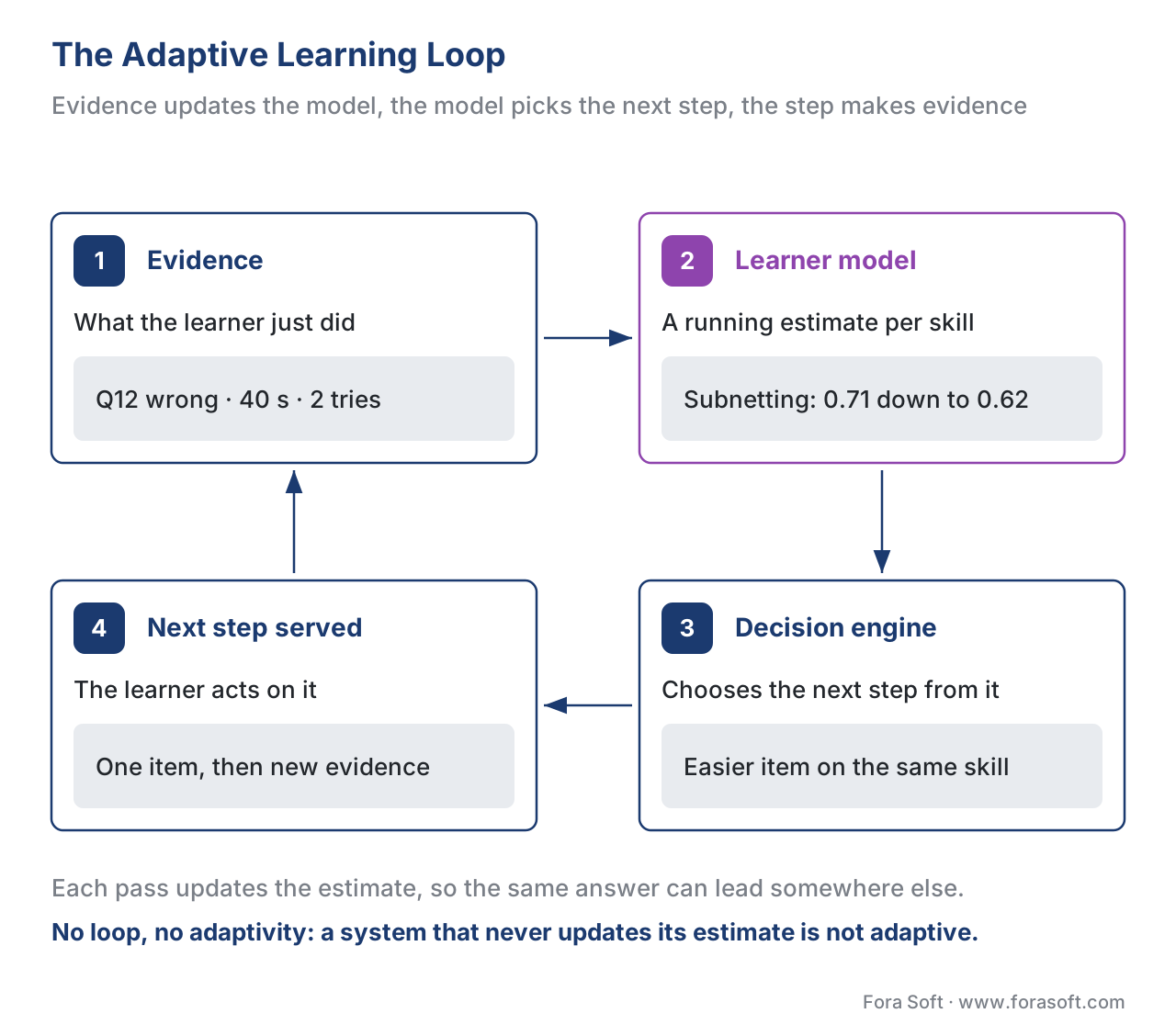 Figure 1. The adaptive loop. Evidence about what the learner did updates a running estimate of what they know (the learner model); a decision engine uses that estimate to choose the next step; the learner acts; the new evidence updates the model again. No loop, no adaptivity.
What Can Actually Adapt: The Five Levers
When a system "adapts," it is turning one or more of five dials. Naming them stops a vague promise from passing for a feature, because a vendor should be able to tell you exactly which dials they turn.
The first lever is pace — letting a learner who has mastered a topic move on while a struggling learner gets more time, instead of locking everyone to the same schedule. The second is path or sequence — changing the order of topics, skipping what a learner already knows, or inserting a prerequisite they are missing. The third is difficulty — serving harder or easier items based on recent performance, the dial behind adaptive testing. The fourth is content or modality — offering the same concept as a video, a text explainer, or a worked example, and favoring the form a learner engages with. The fifth is support — adding hints, scaffolding, or a nudge to review when the data says a learner is stuck.
Most real products turn one or two of these dials well. A system that claims to turn all five, fully automatically, is either very mature or overselling — and you find out which by asking what data drives each dial. A dial with no evidence behind it is decoration.
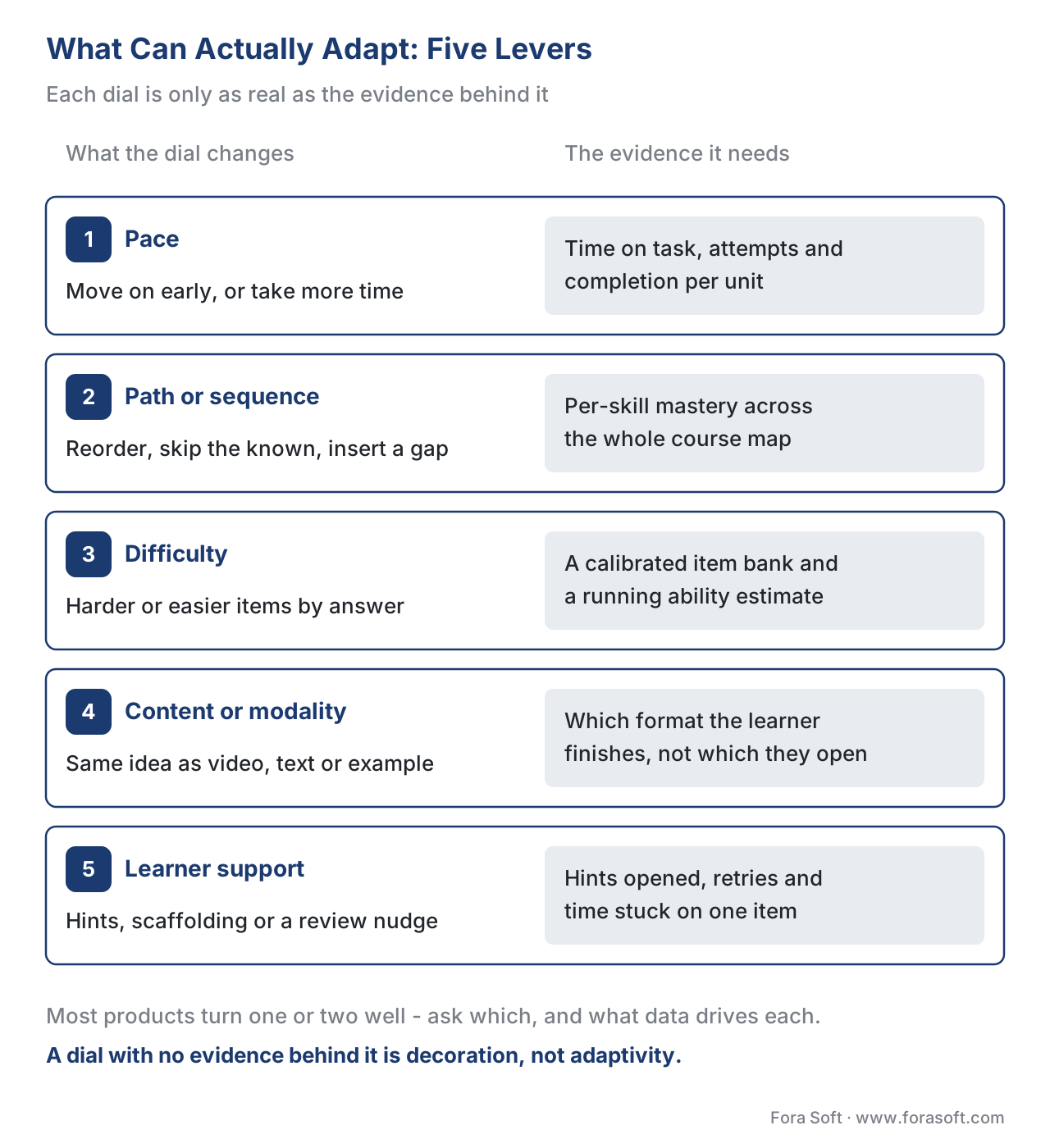 Figure 2. The five levers a system can turn to personalize. Most products adjust one or two well. Ask a vendor which dials they turn and what data drives each — a dial with no evidence behind it is decoration, not adaptivity.
The Branching Illusion: Authored Paths vs Genuine Adaptivity
Here is the distinction that separates a real adaptive product from a marketing claim, and most teams never make it out loud.
An authored branching scenario is a decision tree a designer draws in advance: answer A sends the learner down branch 1, answer B down branch 2, and so on. It is genuinely useful — it powers the choose-your-path simulations covered in branching scenarios — and to a learner it can feel responsive. But the paths are finite and fixed. The designer decided every route ahead of time, and the system is just following the rule the answer triggered. There is no model of the learner; there is a flowchart, and the learner is walking through it.
Genuine adaptivity keeps a continuous, updating estimate of what the learner knows — the learner model — and selects the next step from that estimate, not from a pre-drawn branch. Two learners who clicked the same answer can get different next steps because their underlying models differ: one has a strong history on the topic and a single slip, the other a pattern of errors. The system is not following a flowchart; it is reasoning, however simply, about this specific learner. That is the line. A branch reacts to your last click; an adaptive engine reacts to your whole history.
Why this matters in dollars: authored branching scales with the number of branches a team can design and maintain, and the count explodes fast — a clean tree five decisions deep with two choices each is already 32 leaf paths to write and test. Genuine adaptivity scales with content granularity and data, not hand-drawn paths, but it demands the learner model and the evidence to feed it. Buying "adaptive" and getting branching means you pay the adaptivity price and get the branching ceiling. Always ask: is there a learner model, or is there a tree?
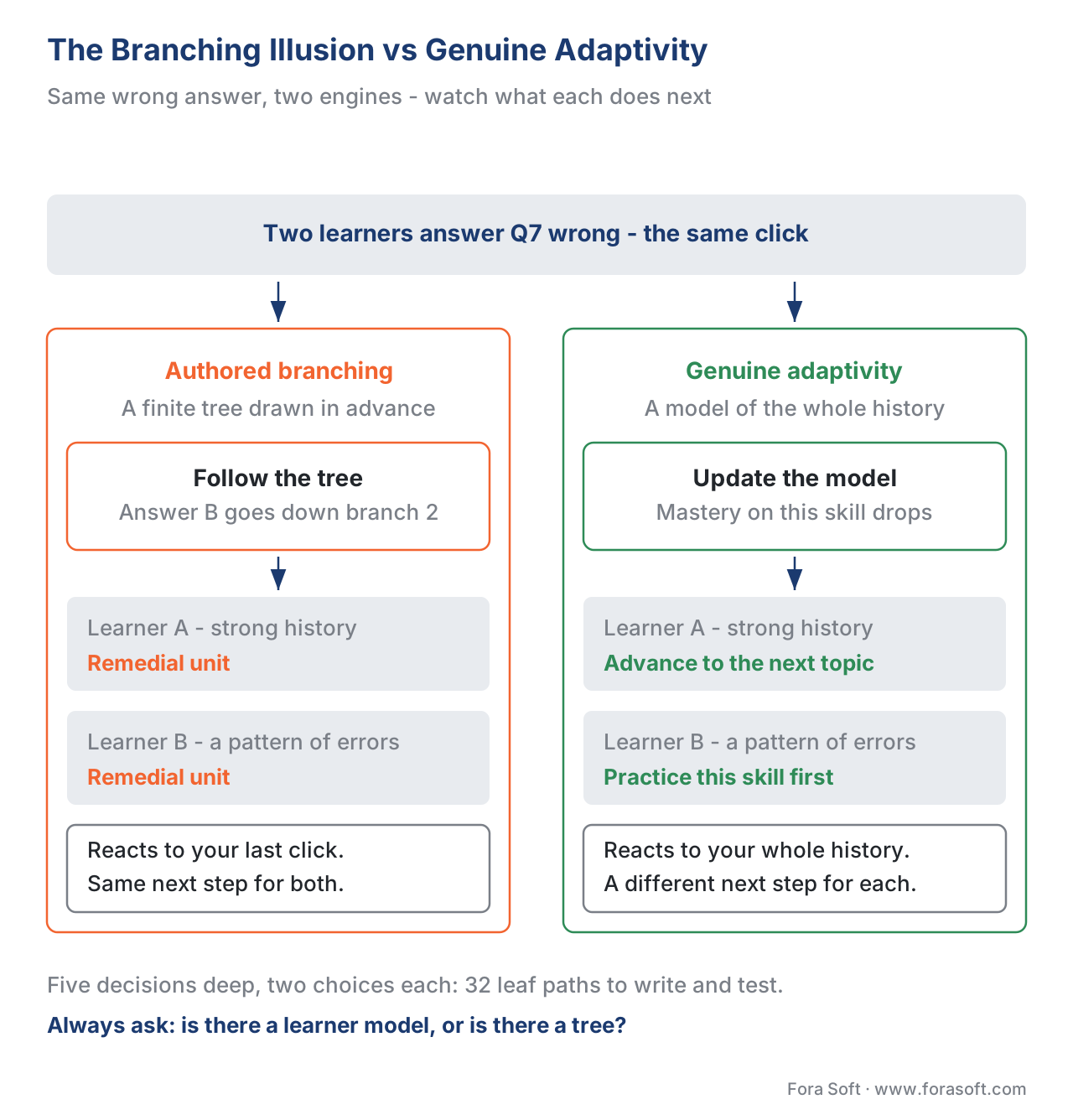 Figure 3. The branching illusion. Authored branching follows a finite tree a designer drew in advance and reacts to the last click. Genuine adaptivity selects from a continuously updated learner model and reacts to the whole history. Confusing the two is the costly mistake.
How the Learner Model Is Built: Four Approaches
The learner model is the engine. There are four ways teams build it, from a weekend of rules to a research-grade neural network, and they trade simplicity against accuracy and data hunger.
The first is rule-based: an instructional designer writes "if score on the quiz is below 70%, assign the remedial module." It is transparent, cheap, and easy to debug, and for many corporate-training needs it is enough. Its limit is that a human wrote every rule, so it cannot capture patterns nobody anticipated, and the rule set gets brittle as it grows.
The second is item response theory, or IRT — the statistical foundation of computerized adaptive testing, or CAT, the technique behind adaptive exams like the GRE. IRT estimates a learner's ability on a hidden scale and rates every question by difficulty; the system then serves the item that tells it the most about this learner's current ability, gets the answer, re-estimates the ability, and repeats. It is well understood, mathematically grounded, and standard for assessment, but it models a single ability dimension and needs questions that have been calibrated on many prior test-takers.
The third is knowledge tracing — the approach behind intelligent tutoring systems. Bayesian Knowledge Tracing, introduced by Corbett and Anderson in 1995, keeps a running probability that the learner has mastered each individual skill, updating it after every answer. Deep Knowledge Tracing, introduced in 2015, replaces the hand-built model with a neural network that learns patterns across thousands of learners and can capture how skills relate. Deep models often predict more accurately on large datasets; Bayesian models are simpler, need less data, and are easier to explain to a teacher — a real trade-off, not a strict upgrade.
The fourth, newest approach is the large language model, or LLM — the AI behind chat assistants — used as a flexible tutor and sequencer that reasons over a learner's history in plain language. It is fast to prototype and can personalize feedback richly, but it does not maintain a rigorous knowledge estimate by default, it can be confidently wrong, and it is the hardest to audit. In 2026 the credible pattern is hybrid: an LLM for the conversational surface and explanations, a structured model (IRT or knowledge tracing) underneath for the decisions that need to be trustworthy. The model internals — how these networks are trained — sit in our AI for Video Engineering section; here we cover the learning wiring and the product decision.
| Approach | What it models | Data it needs | Transparency | Standards / tracking |
|---|---|---|---|---|
| Rule-based | Designer-written conditions | Low — a few scores | High — readable rules | xAPI / cmi5 statements feed the rules |
| IRT / CAT | One ability scale | Calibrated item bank, many prior takers | High — psychometric | xAPI results; QTI item bank |
| Knowledge tracing (BKT/DKT) | Per-skill mastery probability | Many tagged interactions per skill | Medium (BKT) / Low (DKT) | xAPI per-skill statements → LRS |
| Large language model | Flexible, implicit | Course content + history; no calibration | Low — hard to audit | xAPI + retrieval over course store |
The Data the Engine Needs
Adaptivity is a data problem before it is an algorithm problem, and this is where most build attempts fail. An engine can only adapt on evidence it can see, and "the learner watched the video and clicked next" is almost no evidence at all.
To turn any of the four dials with confidence, the platform has to capture fine-grained, skill-tagged events: which question was answered, right or wrong, how long it took, how many tries, which video segments were watched, paused, or rewatched, and which hint was opened. The standard built for exactly this is xAPI — the Experience API, version 1.0.3 from the Advanced Distributed Learning Initiative — which records learning as short statements like "Maria answered question 12 incorrectly" written to a Learning Record Store, the database those statements live in. Unlike the older SCORM standard, which tracks a fixed completion-and-score model inside one LMS launch, xAPI lets you define the verbs and objects an adaptive engine needs. The companion standard cmi5 carries the course-level launch and pass/fail into which those statements roll up, and IMS Caliper Analytics (1EdTech, version 1.2) offers a parallel event vocabulary many institutional platforms already emit. For the statement design in depth, see tracking video with xAPI and xAPI explained.
Two prerequisites follow, and they are the ones teams underestimate. First, content has to be granular and tagged: an engine cannot route a learner to "the part about subnetting" unless that part exists as a discrete, labeled unit tied to a skill. A single hour-long video tagged only "Networking 101" is unadaptable. Second, you need enough content and items per skill to have somewhere to route the learner — adapting across five difficulty levels and ten topics implies on the order of fifty content units plus a calibrated bank of assessment items, not the single linear path a normal course ships. Before any algorithm, ask whether your content and your tracking can even support a decision. If they cannot, the honest first project is instrumentation and content granularity, not an adaptive engine.
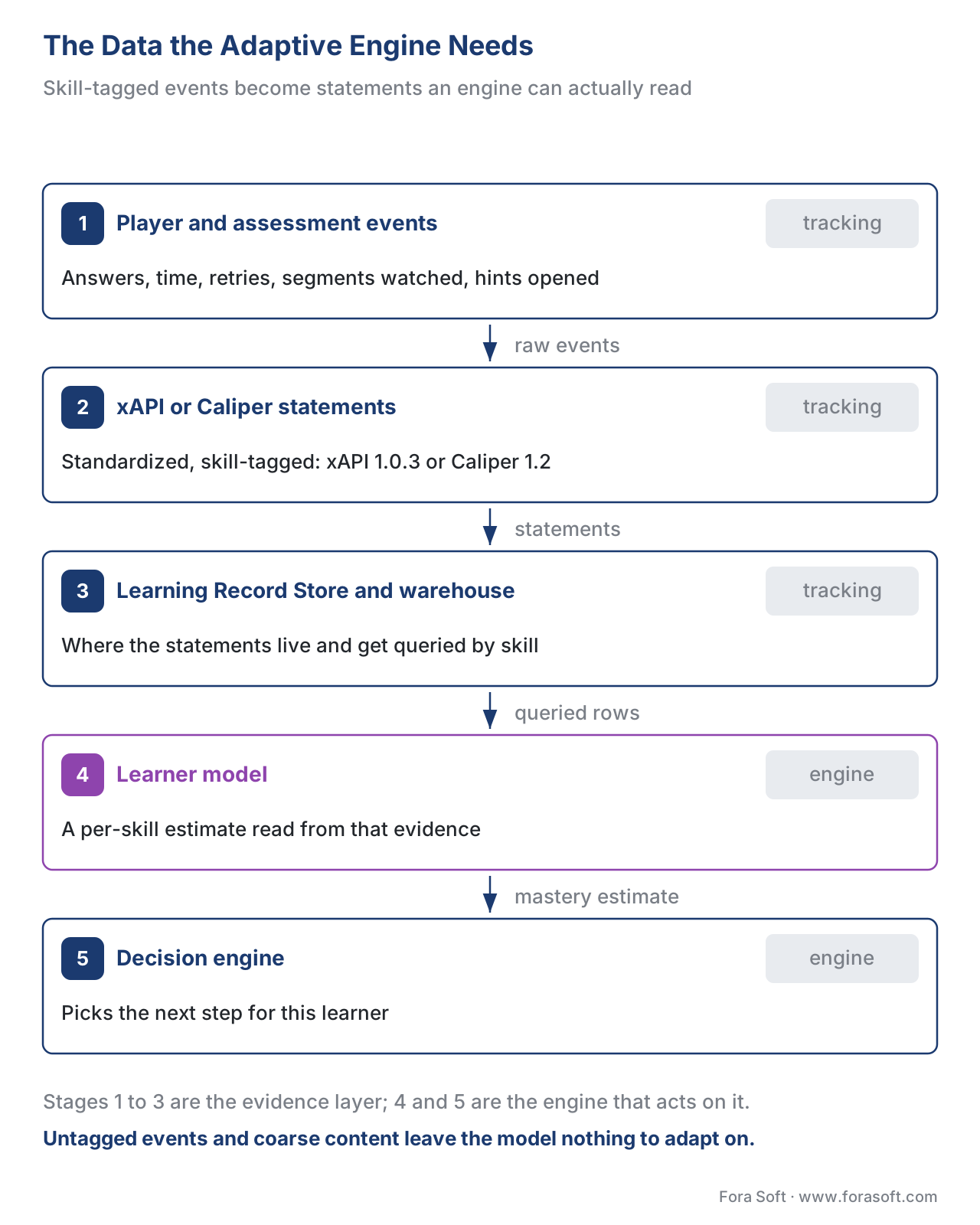 Figure 4. The data the engine needs. Skill-tagged events from the player and assessments become xAPI or Caliper statements in a Learning Record Store and warehouse; the learner model reads them and the decision engine acts. Without fine-grained, skill-tagged evidence, there is nothing to adapt on.
A Common Mistake: "Adaptive" That Adapts on Nothing
The failure we see most is a product that branches on a single end-of-module quiz score and calls itself adaptive. A learner scores 65%, the system assigns the remedial unit, and the marketing says "personalized learning path." That is a one-rule branch, not a learner model — it cannot tell a careless slip from a genuine gap, it forgets everything by the next module, and two learners with identical scores and opposite histories get the identical next step. It demos well and teaches no better than a linear course with a quiz gate.
The quieter version is building real machinery with no data to feed it: a team licenses a knowledge-tracing engine, but the content is coarse and the events are not skill-tagged, so the model has nothing to estimate and falls back to near-random routing that learners quickly distrust. The third version is the opposite over-reach — handing all sequencing to an LLM with no structured model underneath, which personalizes the wording of feedback beautifully while making routing decisions no one can audit or defend to an instructor.
The fixes map directly. Decide honestly whether you need genuine adaptivity or whether authored branching and good prerequisites are enough — many programs are well served by the simpler thing. If you do need adaptivity, instrument first: capture skill-tagged xAPI events and make content granular before buying an engine. And keep a structured, auditable learner model under any LLM layer, so the decisions that affect a learner's path can be explained. Adaptivity sold without a learner model and the data to feed it is the branching illusion with a bigger invoice.
The Math: When Adaptive Testing Pays Off
Lead with the one place adaptivity has a clean, proven payoff — assessment length — because the arithmetic is concrete.
A fixed test gives every learner the same items, so to measure a wide range of abilities precisely it must include easy, medium, and hard questions for everyone — often 40 or more items. Computerized adaptive testing, built on IRT, instead homes in on each learner's ability and stops when it has measured precisely enough:
Fixed linear test:
  40 items × ~1.5 min = 60 minutes per learner, same for all

Adaptive test (CAT) for equal precision:
  ~20 items × ~1.5 min = 30 minutes per learner
  Reduction ≈ 50% fewer items for the same measurement precision
Research on CAT consistently shows it reaches comparable measurement precision with roughly half the items of a fixed test, because it stops asking a strong learner easy questions and a weak learner impossible ones. Across 1,000 learners that is about 500 hours of seat time saved, plus less fatigue and less item exposure. But note the prerequisite the saving hides: CAT needs an item bank calibrated on many prior test-takers, which is real psychometric work up front. The lesson generalizes — adaptivity pays when you have the data and content to support it, and costs without returning when you do not. For the broader build-and-run economics, see the learning-platform cost model and building vs buying AI features, and the cost.
Does the Personalization Help? Measure It
A personalized path that no one evaluates is a belief, not a result. Because adaptivity is expensive, hold it to evidence: compare outcomes — completion, mastery, time-to-competence, retention on a later test — for adapted versus non-adapted cohorts, ideally with a holdout group that gets the linear course. The pedagogy backs the ambition: Benjamin Bloom's 1984 "2 Sigma" work found one-to-one tutoring lifted average performance dramatically over group instruction, and adaptive learning is the attempt to approximate that tutor at scale. But the attempt only counts if your numbers move. Wire the same xAPI and Caliper signals that feed the engine into your analytics so you can read the effect; this is the measurement discipline covered in learning analytics and learning metrics 101. And respect the learning science that holds regardless of the engine — spacing review over time and testing for retrieval, the durable effects behind any good sequencing, described in the pedagogy of video.
Free download: Adaptive Learning Readiness ChecklistA one-page gate to run before you build an adaptive path: the goal-versus-method question, the skill-tagged xAPI or Caliper evidence you have to capture, how granular the content and item bank must be, which learner model to pick and how to audit it, and how to prove the path moved outcomes.Where Fora Soft Fits In
We build personalization at the level a client actually needs, and that conversation starts with build-vs-buy, not with an algorithm. Fora Soft has shipped video conferencing, streaming, e-learning, and AI-driven video features since 2005, so when a client asks for "adaptive learning" we first separate the goal (a path that fits each learner) from the method (automatic, data-driven adjustment) and ask whether authored branching with solid prerequisites already meets the need — for many corporate programs it does, faster and cheaper. When genuine adaptivity is warranted, we treat it as a data project first: instrument the player and assessments with skill-tagged xAPI, make the content granular and routable, stand up the Learning Record Store, and only then wire the learner model — rule-based, IRT, knowledge tracing, or a hybrid LLM layer over a structured core — with the analytics to prove the path moved outcomes. The honest framing we give every client is that adaptivity sold without the data to feed it is a branching illusion with a bigger invoice.
The handbook
Fora Soft Video Engineering Handbook
We wrote a seven-volume series that takes the whole video stack apart across 9,000+ pages — encoding, delivery, audio and AI — so the learner model and the pipeline that feeds it are something you can specify and build rather than shop for. Volume 6 sits closest to this article: what a model actually is, the artifacts it ships as, the ML minimum a product decision needs, and the speech and retrieval machinery an LLM tutor layer runs on. Volume 7 carries the same capabilities into production — serving, agent loops, cost per stream-hour, and the audit and compliance questions any automated decision about a learner has to answer — while volume 3 covers the player and QoE telemetry the skill-tagged evidence is collected from. Written by Nikolay Sapunov, CEO at Fora Soft.
Is there a learner model under your adaptive roadmap, or a tree?
Tell us what you teach, what your player and assessments already record, and how your content is tagged — and we will come back with whether authored branching already covers the need, what instrumentation genuine adaptivity would take first, and what each part costs to build. 250+ video products shipped since 2005.
See our case studies
Case study
ALDA
An AI course generator co-designed with 70+ U.S. college educators at institutions serving 500,000+ students a year, now owned by 1EdTech, lifting educator efficiency by 20%. It builds the half this article says teams underestimate: syllabi, lectures and personalized assessments generated together, so there is enough tagged content and enough items per skill for an engine to have somewhere to route a learner.
Case study
BrainCert
The first WebRTC + HTML5 virtual-classroom LMS, built from the architecture up with us and bootstrapped to $3M revenue, 100K+ customers and 500M+ real-time classroom minutes across 10 datacenters. SCORM and xAPI support, proctored exams and an analytics dashboard sit inside the platform — the standards-grade evidence layer that has to exist before any learner model can read anything.
Case study
Scholarly
Sydney's selective and scholarship test-prep platform — 15,000+ active users, live classes for up to 2,000 students at once, and video, whiteboard, quizzes, LMS and CRM in one system on PostgreSQL, ClickHouse and Grafana. Test prep is where per-skill estimates earn their keep, and the data plumbing this article asks for is the platform itself rather than a bolt-on.
What to read next
Interactive video
Branching Scenarios: Building Choose-Your-Path Video
The authored tree this article draws the line against, built well and on purpose.
Standards
Tracking Video With xAPI: The Video Profile and What to Capture
How the skill-tagged statements an engine reads are actually designed.
AI features
Automatic Quiz and Assessment Generation
Where the item bank an adaptive engine routes into comes from.
Analytics
Learning Analytics: The Metrics That Matter and the Ones That Mislead
How to tell whether the personalized path moved anything at all.
References
- Experience API (xAPI) Specification, version 1.0.3 — Advanced Distributed Learning (ADL) Initiative. Defines actor–verb–object statements, custom verbs and activity types, and the Learning Record Store — the fine-grained, skill-tagged evidence an adaptive engine reads. Tier 1. https://github.com/adlnet/xAPI-Spec/blob/master/xAPI-Data.md
- cmi5 Specification — Advanced Distributed Learning (ADL). The xAPI profile carrying course-level launch and pass/fail into which per-skill adaptive statements roll up. Tier 1. https://github.com/AICC/CMI-5_Spec_Current
- Caliper Analytics Specification, version 1.2 — 1EdTech (formerly IMS Global). A standard event/entity vocabulary and Sensor API for capturing learning activity, a parallel evidence source many institutional platforms emit for the learner model. Tier 1. https://www.imsglobal.org/spec/caliper/v1p2
- Question and Test Interoperability (QTI), 1EdTech — the standard for portable, interoperable assessment items and banks, the calibrated content an IRT/CAT engine selects from. Tier 1. https://www.imsglobal.org/question/index.html
- Corbett, A. T., & Anderson, J. R. — "Knowledge Tracing: Modeling the Acquisition of Procedural Knowledge" — User Modeling and User-Adapted Interaction, vol. 4, pp. 253–278, 1995. The foundational Bayesian Knowledge Tracing model: a running per-skill mastery probability updated after each answer. Tier 5. https://link.springer.com/article/10.1007/BF01099821
- Piech, C., et al. — "Deep Knowledge Tracing" — Advances in Neural Information Processing Systems (NeurIPS), 2015. Introduces the recurrent-neural-network approach to knowledge tracing that learns skill relations from large interaction datasets. Tier 5. https://papers.nips.cc/paper/2015/hash/bac9162b47c56fc8a4d2a519803d51b3-Abstract.html
- Bloom, B. S. — "The 2 Sigma Problem: The Search for Methods of Group Instruction as Effective as One-to-One Tutoring" — Educational Researcher, vol. 13(6), 1984. The benchmark that one-to-one tutoring far outperforms group instruction; the outcome adaptive learning tries to approximate at scale. Tier 5. https://doi.org/10.3102/0013189X013006004
- Wainer, H., et al. — "Computerized Adaptive Testing: A Primer" (2nd ed.), Routledge, 2000. Standard reference on IRT-based CAT: item-information selection, ability re-estimation, and stopping rules; the basis for the ~50% item-reduction claim. Tier 5. https://www.routledge.com/Computerized-Adaptive-Testing-A-Primer/Wainer-Dorans-Eignor-Flaugher-Green-Mislevy-Steinberg-Thissen/p/book/9780805835113
- The Business Research Company — "Adaptive Learning Global Market Report 2026" — market size of roughly $5.26 billion in 2026 at ~19.9% CAGR. Used only as a labelled market-size figure. Tier 7. https://www.thebusinessresearchcompany.com/report/adaptive-learning-global-market-report
- Gervet, T., et al. — "When is Deep Learning the Best Approach to Knowledge Tracing?" — Journal of Educational Data Mining, 2020. Compares BKT, logistic regression, and deep models, showing no strict winner — the basis for the simplicity-vs-accuracy trade-off in the methods table. Tier 5. https://jedm.educationaldatamining.org/index.php/JEDM/article/view/427
Where sources disagreed, the standards and evidence win: vendor claims that an LLM or a single quiz score delivers "fully adaptive personalized learning" were overridden by the knowledge-tracing literature (refs 5, 6, 10), which establishes that genuine adaptivity requires a maintained per-skill learner model fed by fine-grained evidence (refs 1, 3); and the implicit "more adaptivity is always better" framing was tempered by the CAT and BKT/DKT trade-off evidence (refs 8, 10) that adaptivity pays only when the data and content support it.
