


How to use this glossary
This is the reference card for the rest of the Knowledge Base. Fifty terms grouped by category, each explained in one or two sentences, with a pointer to the article where the concept is unpacked in depth. The terms are the ones that come up over and over in video product work — in encoder configurations, codec specifications, player log files, and customer support tickets. If a term shows up in a meeting and you have a moment of "wait, what exactly does that mean again?", this is the page to keep open.
The glossary is alphabetical within each section. Sections are grouped by topic: signal fundamentals, colour, brightness, time, metadata, codecs, delivery, and quality. Where a term has a precise standards-body definition, the standard is cited.
A live glossary in 2026 has to assume the reader is a smart non-engineer who has to talk fluently to engineers. Definitions are deliberately written for that reader — short enough to scan, precise enough to use in a product spec.
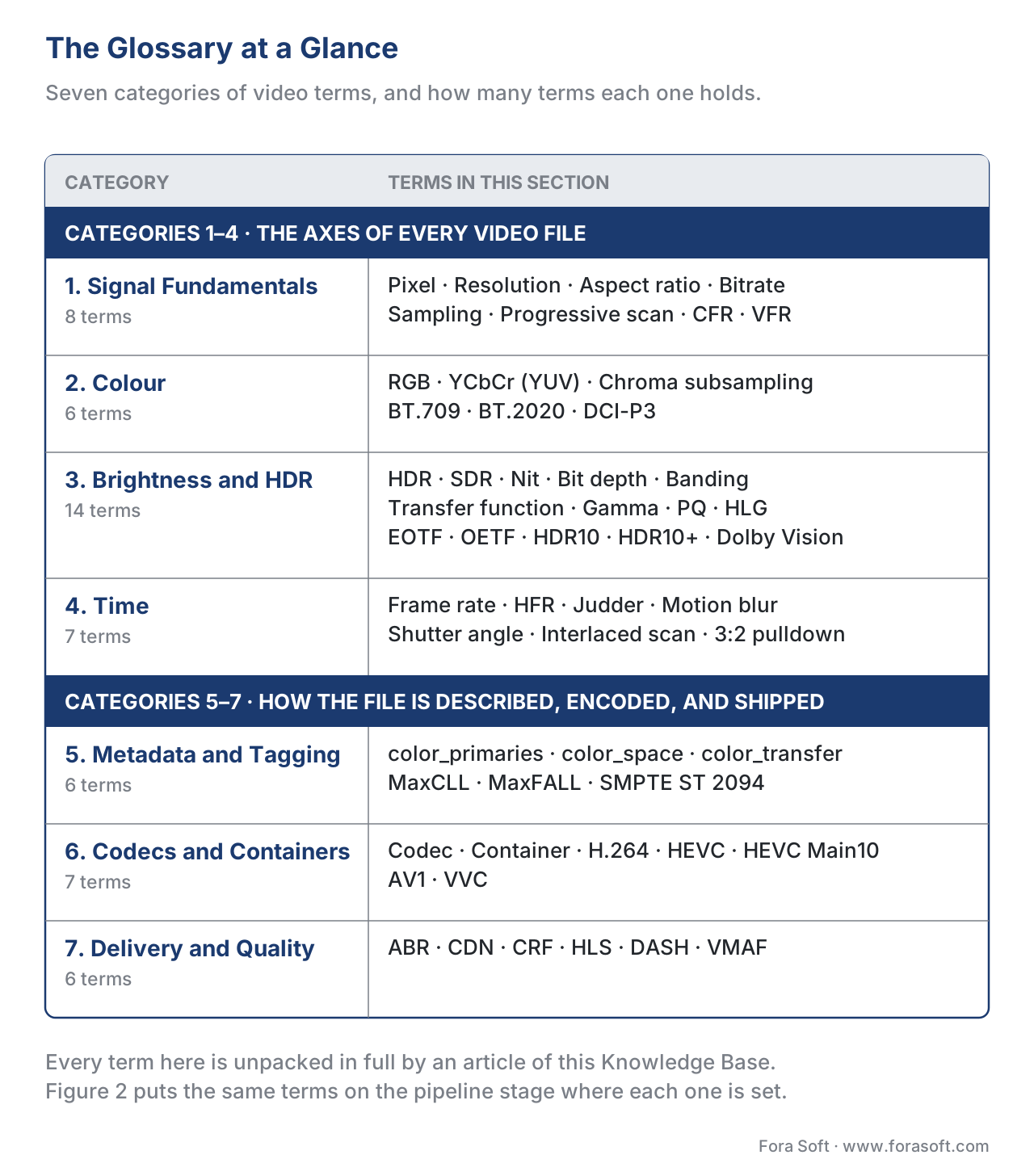
1. Signal Fundamentals
Aspect ratio. The width-to-height proportion of a frame, written as width:height. Cinema is 2.39:1 (CinemaScope) or 1.85:1 (Academy). TV and most streaming is 16:9. Phone-vertical is 9:16. Mismatches between source and target produce black bars (letterboxing/pillarboxing) or cropping.
Bitrate. Amount of data per second of video, in bits per second (bps) or megabits per second (Mbps). Higher bitrate at a given resolution and codec means higher quality. A 4K HDR stream on Netflix is around 15-25 Mbps; a 1080p YouTube stream is 5-8 Mbps. See Why we compress video.
CFR (Constant Frame Rate). A video file in which every frame is the same time interval apart. The opposite of VFR. Required by most professional editing and delivery pipelines. See Frame rate.
Pixel. The smallest indivisible unit of a digital image — one coloured dot. A 4K frame is 3,840 × 2,160 pixels. See What is digital video.
Progressive scan. A video in which every frame contains every line of the image, top to bottom. Modern default. Contrast with interlaced. See Progressive vs interlaced.
Resolution. The number of pixels in each frame, given as width × height. 1080p is 1,920 × 1,080. 4K (UHD-1) is 3,840 × 2,160. 8K is 7,680 × 4,320. Higher resolution needs more pixels per frame and more bandwidth.
Sampling. The act of taking discrete measurements of a continuous signal — turning real-world light into pixel values, or real-world sound into audio samples. Governed by the Nyquist theorem. See Sampling and Nyquist.
VFR (Variable Frame Rate). A video file in which the time between frames varies. Phones often produce VFR to handle low light. Causes problems in editing — usually converted to CFR at ingest.
2. Colour
BT.709 (Rec. 709). The colour space of HDTV and most SDR streaming. Covers about 35% of the colours the human eye can see. The default for "normal" video. See Color spaces.
BT.2020 (Rec. 2020). The colour space of UHD and HDR. Covers about 76% of the visible gamut. Required for HDR delivery. Wide gamut, larger than DCI-P3.
Chroma subsampling. Compression technique that stores colour information at lower resolution than brightness. Written as 4:4:4 (no subsampling), 4:2:2 (half horizontal colour resolution), or 4:2:0 (half horizontal AND vertical). Streaming defaults to 4:2:0.
DCI-P3. A cinema-industry colour space, wider than Rec. 709 but narrower than Rec. 2020. Standard for Apple devices and most HDR mastering monitors. Around 53% of the visible gamut.
RGB. Red, green, blue — the colour model where each pixel is described by its red, green, and blue components. Used inside cameras, displays, and editing software. Converted to YCbCr for storage and streaming.
YCbCr (YUV). The colour model used by virtually every video codec — splits the signal into one brightness channel (Y) and two colour-difference channels (Cb, Cr). Allows chroma subsampling. Y handles the heavy lifting; Cb/Cr add the colour.
3. Brightness and HDR
Banding. Visible discrete steps in what should be a smooth gradient — usually in skies, walls, or skin tones. Caused by insufficient bit depth. The classic 8-bit symptom. See Bit depth and banding.
Bit depth. Number of bits used to describe each colour channel per pixel. 8-bit (256 steps per channel), 10-bit (1,024 steps), 12-bit (4,096 steps). Higher bit depth = smoother gradients, no banding. HDR requires 10-bit minimum.
Dolby Vision. Premium HDR format with 12-bit colour and dynamic metadata. Licensed by Dolby. Used by Netflix, Apple TV+, Disney+. Not supported on Samsung TVs. See HDR complete guide.
EOTF (Electro-Optical Transfer Function). The display-side curve that maps signal values to physical screen brightness. PQ for HDR, gamma for SDR.
Gamma. SDR transfer function. Maps signal values to brightness using a power curve. BT.1886 formalises gamma 2.4. The "normal" curve every non-HDR display uses.
HDR (High Dynamic Range). Video that can describe much wider brightness ranges than SDR — 1,000 to 10,000 nits instead of 100 nits. Combines wide colour gamut (Rec. 2020), 10-bit minimum, and a new transfer function (PQ or HLG).
HDR10. The open, royalty-free HDR baseline format. PQ transfer, 10-bit, Rec. 2020, static MaxCLL/MaxFALL metadata. Required by every HDR-capable device.
HDR10+. Royalty-free HDR format from Samsung with dynamic metadata (SMPTE ST 2094-40). Used by Amazon Prime Video. Not on LG OLEDs.
HLG (Hybrid Log-Gamma). HDR transfer function from BBC and NHK designed for live broadcast. Backward-compatible with SDR sets. No metadata required.
Nit. Unit of brightness — one candela per square metre. SDR ceiling is 100 nits; modern HDR TVs reach 1,000-4,000 nits.
OETF (Opto-Electronic Transfer Function). The camera-side curve that maps real-world light to signal values. The inverse partner of EOTF.
PQ (Perceptual Quantizer). HDR transfer function (SMPTE ST 2084) from Dolby. Maps signal values to absolute brightness up to 10,000 nits. Used by HDR10, HDR10+, Dolby Vision.
SDR (Standard Dynamic Range). The pre-HDR brightness standard — 100-nit peak, gamma transfer, Rec. 709 colour. The vast majority of streaming and broadcast content.
Transfer function. The math curve that translates between physical light and digital signal values. The three families: gamma (SDR), PQ (HDR absolute), HLG (HDR relative). See Transfer functions.
4. Time
3:2 pulldown. The technique of showing 24-fps content on a 60-Hz display by holding alternating frames for 3 and 2 refreshes. Produces visible judder on slow pans.
Frame rate. Number of frames per second (fps). 24 fps is cinema, 25/50 is European broadcast, 30/60 is North American broadcast, 120 fps is premium/slow-mo. See Frame rate.
HFR (High Frame Rate). Cinema delivery above 24 fps — 48 fps (The Hobbit), 60 fps, 120 fps (Ang Lee experiments). Controversial; audiences associate higher rates with "video" rather than "film".
Interlaced scan. A legacy scan method that splits each frame into two fields — odd-numbered and even-numbered lines, displayed alternately. Marked with i (e.g., 1080i). Largely obsolete.
Judder. Visible stutter in motion, especially horizontal pans. Caused by mismatch between source frame rate and display refresh rate.
Motion blur. The natural smear of moving objects within a single frame, caused by the shutter being open during exposure. Crucial for low-frame-rate content to look smooth.
Shutter angle. The proportion of each frame's duration the shutter is open, expressed in degrees. 180° (half) is the cinema default — gives natural motion blur. 45° produces sharp staccato motion (Saving Private Ryan); 360° produces dreamy maximum blur.
5. Metadata and Tagging
color_primaries. The video file metadata field that identifies which colour space the file uses. bt709 for SDR, bt2020 for HDR. Must match the actual content or colours shift visibly.
color_space (color_matrix). The metadata field describing how RGB maps to YCbCr for this file. bt709 for SDR, bt2020nc for HDR.
color_transfer. The metadata field identifying the transfer function. bt709 for SDR gamma, smpte2084 for PQ HDR, arib-std-b67 for HLG. Mismatch produces colour-shifted, oversaturated playback.
MaxCLL (Maximum Content Light Level). HDR10 static metadata — the brightest single pixel in the entire content, in nits. Used by displays for tone-mapping.
MaxFALL (Maximum Frame Average Light Level). HDR10 static metadata — the brightest average frame across the entire content, in nits.
SMPTE ST 2094. Family of dynamic-metadata standards. ST 2094-10 is Dolby Vision; ST 2094-40 is HDR10+. The standards define per-scene tone-mapping instructions.
6. Codecs and Containers
AV1. Open, royalty-free modern codec from the Alliance for Open Media (Google, Amazon, Netflix, etc.). About 30-50% more efficient than HEVC; slow to encode but free.
Codec. The algorithm that compresses and decompresses video — H.264, HEVC, AV1, VP9, VVC. The "engine" doing the compression work.
Container. The file format that wraps the codec output — MP4, MOV, MKV, WebM, TS. Containers can hold multiple codecs and tracks; the container is not the codec.
H.264 (AVC). The most widely supported video codec, ratified in 2003. Plays on every device made in the last 20 years. Less efficient than newer codecs.
HEVC (H.265). Successor to H.264, about 50% more efficient. Required for 4K UHD Blu-ray. Patent-encumbered, which slowed its adoption.
HEVC Main10. The HEVC profile with 10-bit support — required for HDR delivery. Distinct from regular Main (8-bit only).
VVC (H.266). Next-generation codec after HEVC, ratified in 2020. About 30-50% more efficient than HEVC. Encoding cost is significant; mostly used by broadcasters for 8K.
7. Delivery and Quality
ABR (Adaptive Bitrate Streaming). The streaming technique where the player switches between encoded bitrate ladders based on network speed. Used by HLS, DASH.
CDN (Content Delivery Network). Network of edge servers that cache video close to end users — Akamai, CloudFront, Fastly, Cloudflare. Reduces latency and origin load.
CRF (Constant Rate Factor). An encoder setting (in x264, x265, AV1) that targets visual quality instead of bitrate. Lower CRF = higher quality, bigger file. Default 23 (x264) or 28 (x265).
DASH (Dynamic Adaptive Streaming over HTTP). The non-Apple ABR standard. Used everywhere except where HLS is mandated. Manifest format is MPD.
HLS (HTTP Live Streaming). Apple's ABR protocol. The default on iOS and Safari, supported everywhere. Manifest format is M3U8.
VMAF (Video Multi-method Assessment Fusion). Netflix's open-source perceptual quality metric. Scores video on a 0-100 scale by predicting how human viewers rate it. The industry standard for objective quality.
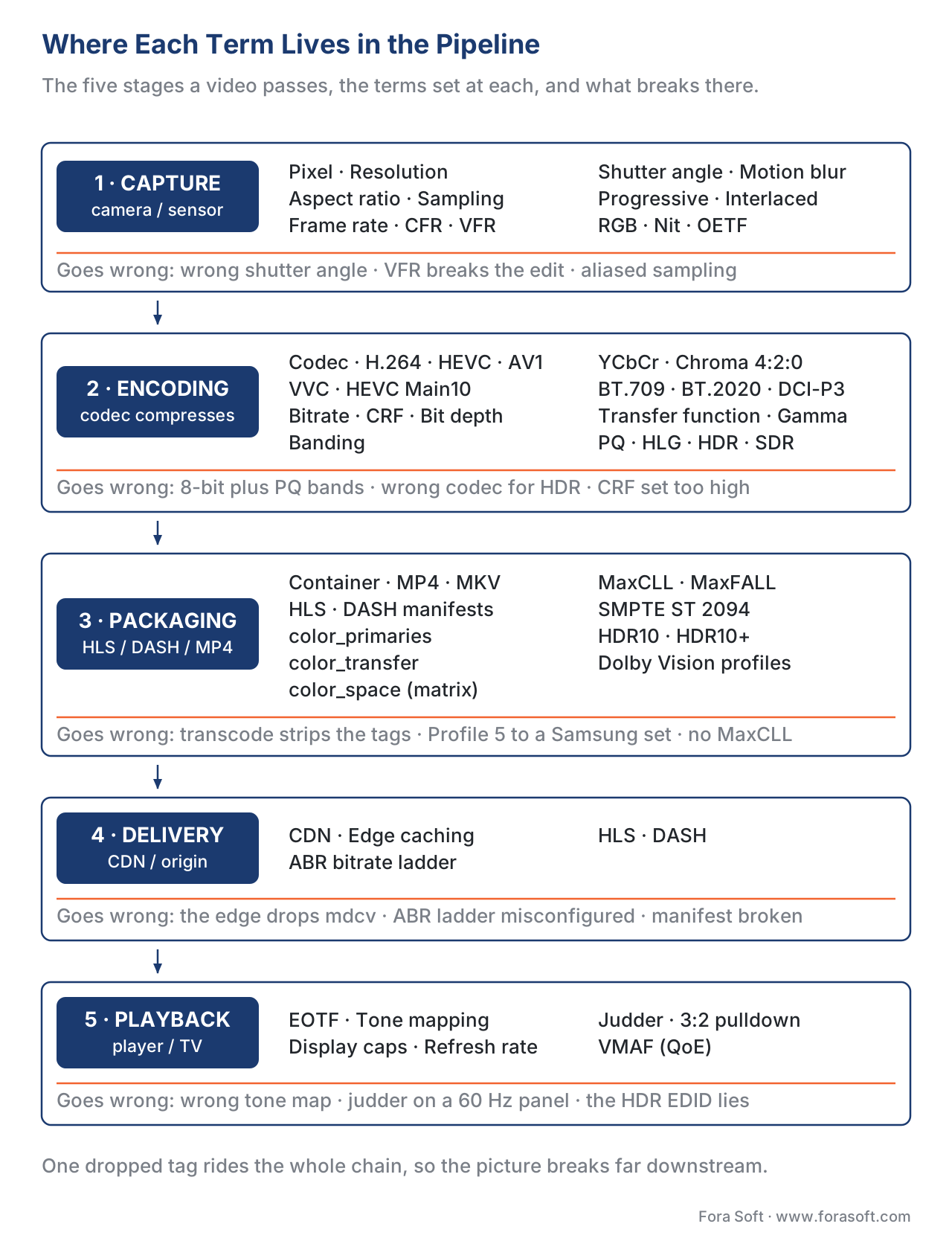
How this Knowledge Base fits together
Block 1 of the Knowledge Base unpacks every term above in detail. The first article (What is digital video) covers the foundation. The middle articles work through one axis at a time — progressive vs interlaced, sampling, colour spaces, bit depth, transfer functions, HDR, and frame rate.
Block 2 turns to compression — how codecs actually work, how bitrate ladders are built, how to evaluate quality. Block 3 covers the modern codec landscape. Blocks 4 and 5 dive into codec architecture and streaming infrastructure. Block 6 handles AI, ML, and the new quality frontiers.
Free download: Video Glossary 50 TermsSingle-page A4 two-column reference card with all 50 terms grouped by category.Building video products and want experienced help? See our work — Fora Soft has been shipping video products since 2005.
The book
Video Encoding: A Complete Guide to Video Compression
A definition gets you through the meeting; the book gets you through the build. It takes the same terms you just read — chroma subsampling, bit depth, PQ and HLG, CRF and rate control, MaxCLL, VMAF — and spends 1,500+ pages on what each one does to the picture, what it costs in bitrate, and which value to actually set. Written by Nikolay Sapunov, CEO at Fora Soft, out of 20 years of shipping video products.
Stuck on which of these settings your product actually needs?
Tell us what you capture, encode and deliver, and we will tell you which of these terms are decisions you have to make, which ones your pipeline is already making for you, and where a dropped tag is costing you picture quality. 250+ video products shipped since 2005.
See our case studies
Case study
Speed.Space
Remote production used on Netflix, EA and HBO shoots, where the crew sets resolution, frame rate, codec and bitrate per shoot and records 1080p at 8 Mbps — the capture end of the glossary, where shutter angle and frame rate stop being definitions.
Case study
Mindbox
AI video management in 50+ deployments, pulling RTSP from cameras of every vintage and normalising them through FFmpeg before HLS delivery — the ingest step where VFR, colour tags and containers have to be made consistent.
Case study
Worldcast Live
Concert feeds reaching 10,000 simultaneous viewers at 1.5 Gb/s with 0.4–0.5 s latency — the delivery end, where ABR, CDN and the manifest decide what the viewer actually sees.
What to read next
Foundations
What is Digital Video: From Analog Signal to Bits
Where pixel, resolution and bitrate come from, in one pass from light to file.
Colour
Colour Spaces: RGB, YCbCr, BT.709, BT.2020, DCI-P3
Category 2 in full: why 35%, 53% and 76% of the visible gamut are different jobs.
Codecs
Comparison Table: MPEG-2, H.264, H.265, VP9, AV1, VVC
Category 6 side by side, with the efficiency and licensing numbers behind each name.
Quality
Objective Quality Metrics: PSNR, SSIM, MS-SSIM, VMAF
What a VMAF score is actually measuring, and where PSNR still misleads you.
