


This is engineering guidance, not legal advice. Confirm specifics with qualified counsel.
Why this matters
If you secure a power substation, a water-treatment plant, an oil terminal, a factory floor, a mine, a data centre, or any of the sixteen sectors a government calls "critical infrastructure" — or you build the software that runs those cameras — the brief you get is different from a shop or an office. The system has to run for years, unattended, in a place that is hot, cold, wet, dusty, corrosive, vibrating, or explosive, on a network that is also running the plant, under a regulator that may fine you for getting it wrong. This article is the vendor-neutral reference design for that job: how to make the system reliable enough that "is it still recording?" is never in doubt, how to choose cameras that survive the environment (and, where required, do not cause an explosion), how to keep surveillance from becoming the weak point in the plant's cyber-defences, which analytics earn their place on a safety-critical site, and which regulations decide what you must build. The goal is that you can scope a build, read a vendor's "industrial-grade" claim critically, and avoid the install that looks fine in the showroom and fails on the first cold, wet, high-vibration night.
The frame: reliability is the product
Every reference design in this section has one organising idea. In retail it is the analytics; on a perimeter it is early detection; in a city it is scale and privacy law; in a building it is integration. On an industrial or critical-infrastructure site, the organising idea is reliability. The job is not "see clearly." The job is "never stop seeing," through the failures that a harsh, always-on, safety-critical site throws at the system every week.
Here is why that reframing matters in consequences, not just uptime percentages. In an office, an hour of lost recording is an inconvenience. At a substation that feeds a city, a chemical plant, or a pipeline pumping station, the footage you lose is the footage of the one incident the whole system exists to capture — the intrusion, the safety violation, the equipment failure that started a fire. A surveillance system that is offline during the event might as well never have been installed. So the thing you are really designing is not a camera network with good resolution. It is an always-recording system that degrades gracefully: when one part fails, the picture keeps being captured somewhere, and an operator is told what broke.
Hold that test for the rest of the article. Every camera choice, every network decision, every storage layer below earns its place only if it raises the odds that the footage of the next incident actually exists.
What "reliable" means, in numbers
"Reliable" is a feeling until you attach a number to it. The number is availability — the fraction of time the system is actually doing its job. It is worth doing the arithmetic out loud once, because the gap between "sounds reliable" and "is reliable" is larger than people expect.
Availability is usually written as a string of nines. Start from the hours in a year:
365 days × 24 hours = 8,760 hours per year
Now apply the target:
99%    available → 1% downtime  → 0.01 × 8,760 = 87.6 hours offline per year (~3.65 days)
99.9%  available → 0.1% downtime → 0.001 × 8,760 = 8.76 hours offline per year
99.99% available → 0.01% downtime → 0.0001 × 8,760 = 0.876 hours = ~52.6 minutes per year
The jump from "two nines" to "four nines" is the difference between three and a half days of blindness a year and under an hour. On a critical site, those lost hours are not spread out as harmless minutes; they cluster exactly when something is going wrong — a storm, a power event, an attack — because that is when components fail together. Designing for high availability is designing for the bad day, not the average one. The international video-surveillance standard family IEC 62676 (video surveillance systems for security applications) even defines availability classes for exactly this reason, so a buyer can specify the grade rather than hope for it.
You reach those nines by removing single points of failure — any one component whose death takes the whole system down. That is the engineering core of this whole article, and it has a name in every layer.
Redundancy at every layer: the system that degrades gracefully
A reliable industrial system is not one expensive unbreakable box. It is ordinary components arranged so that no single failure is fatal. Walk the path that video takes, from the camera to the storage, and add a fallback at each step.
Record at the edge, so a cut network does not lose footage. The most important reliability feature on an industrial site is the least glamorous: many cameras and the local recorder can keep recording to a card or local disk on the camera or in the cabinet even when the link back to the central system is down. The software that records and manages many camera streams — the video management system, or VMS — then back-fills the missing footage when the link returns. On a remote substation reached by one fragile fibre run, edge recording is the difference between losing the incident and merely seeing it late. We cover the edge-versus-central trade-off in depth in edge vs cloud video analytics; here the point is narrow — local recording is a reliability feature first.
Give the network two paths. A single switch or a single cable is a single point of failure. Industrial networks are usually built as a ring rather than a line, so that if any one segment breaks, traffic flows the other way around the ring and nothing goes dark; the recovery is automatic and fast. Cameras that matter most get two network connections, and the recording servers get two network cards into two switches.
Run more recording servers than you strictly need. The recording servers — the machines that take in camera streams and write them to disk — are sized so that if one dies, the others carry its cameras. The shorthand is N+1: if it takes four servers to handle the load, you install five, and any one can fail without losing a camera. We work the server-sizing math (recording servers are sized by sustained write throughput, not by camera count) in scaling a VMS: capacity planning.
Protect the disks from a disk failure. Storage uses RAID — a way of spreading recorded video across several drives with enough redundancy that one or two drives can fail without losing footage — usually RAID 6 plus a hot spare that rebuilds automatically. The mechanics of on-premises storage (RAID, NAS, SAN) are in on-prem storage: NVR, SAN, NAS, RAID, and the bitrate-times-cameras-times-retention storage arithmetic is in surveillance storage and retention math.
Assume the power will fail. Cameras, switches, and recorders all run through an uninterruptible power supply (UPS) that bridges short outages, with a generator behind it for long ones. On a critical site this is not optional decoration; it is the reason the system survives the storm that knocks out the grid — which is precisely the event you most want recorded.
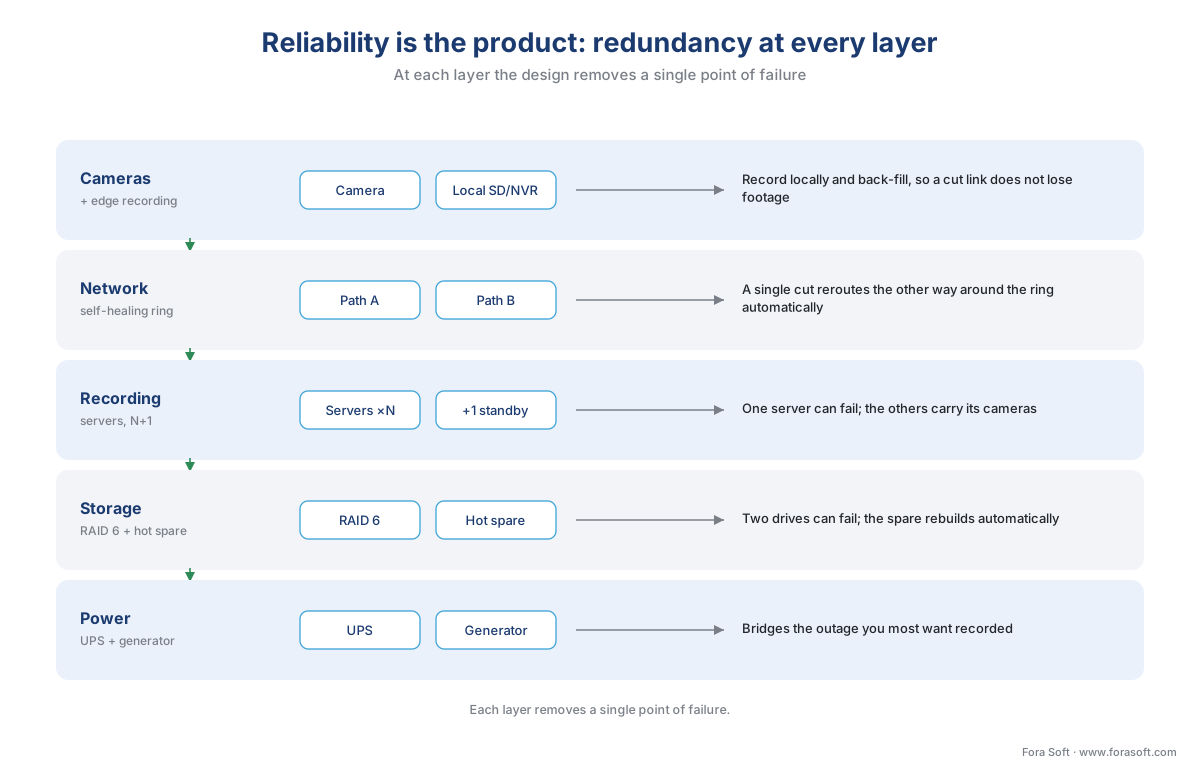 Figure 1. Reliability is the product. At each layer — camera, network, recording server, storage, power — the design removes a single point of failure: cameras record locally and back-fill, the network is a self-healing ring, recording servers run N+1 so one can fail, storage is RAID 6 with a hot spare, and everything rides a UPS with a generator behind it. No single component's death stops the system from recording.
Common mistake: sizing for picture quality instead of uptime. It is easy to spend the budget on higher-resolution cameras and a beautiful video wall, and leave one recording server, one switch, and one power feed behind them. The result demos brilliantly and fails on the first bad night. On a critical site, spend the marginal dollar on the second power path and the N+1 server before the extra megapixels.
The environment is hostile: choosing a camera that survives
An office camera dropped into a steel mill, a coastal substation, a cold store, or a flour mill will not last. Industrial cameras are chosen first for survival and second for image quality, and survival is specified with a small set of standardised ratings. Learn to read them and most of the camera-selection argument disappears.
Dust and water: the IP rating. The IP (Ingress Protection) code, defined by the international standard IEC 60529, is two digits. The first is protection against solids and dust (the scale tops out at 6, "dust-tight"); the second is protection against water (the scale runs up through powerful jets and immersion). For outdoor and most industrial use you want IP66 — dust-tight and able to take powerful water jets. IP67 adds survival of temporary immersion. IP69K (from the German standard DIN 40050-9, now in ISO 20653) is the highest washdown grade: high-pressure, high-temperature steam cleaning at roughly 80 °C and 80–100 bar — the grade a food-processing plant or a vehicle wash needs because the cleaning is as brutal as the operation.
Impact and vandalism: the IK rating. The IK code (standard IEC 62262) measures resistance to physical impact in joules. IK10, the top common grade, withstands a 20-joule strike — a serious swing with a hammer. On a factory floor with forklifts and flying debris, or anywhere a camera is within reach, IK10 is the difference between a dome that survives a knock and one that cracks.
Corrosion and the North American label: NEMA. In the United States the NEMA enclosure rating overlaps with IP but adds corrosion resistance explicitly. NEMA 4X means protection against windblown dust and water plus corrosion — the grade for coastal salt air, water treatment, and chemical exposure, often built as a 316-grade stainless-steel housing.
Temperature and vibration. Industrial cameras carry a rated operating range — commonly something like −40 °C to +60 °C — and sites with constant machinery vibration need cameras and mounts rated for it, or the picture shakes and the housing fatigues. These are spec-sheet numbers; the discipline is simply to match them to the site's real extremes, not its average day.
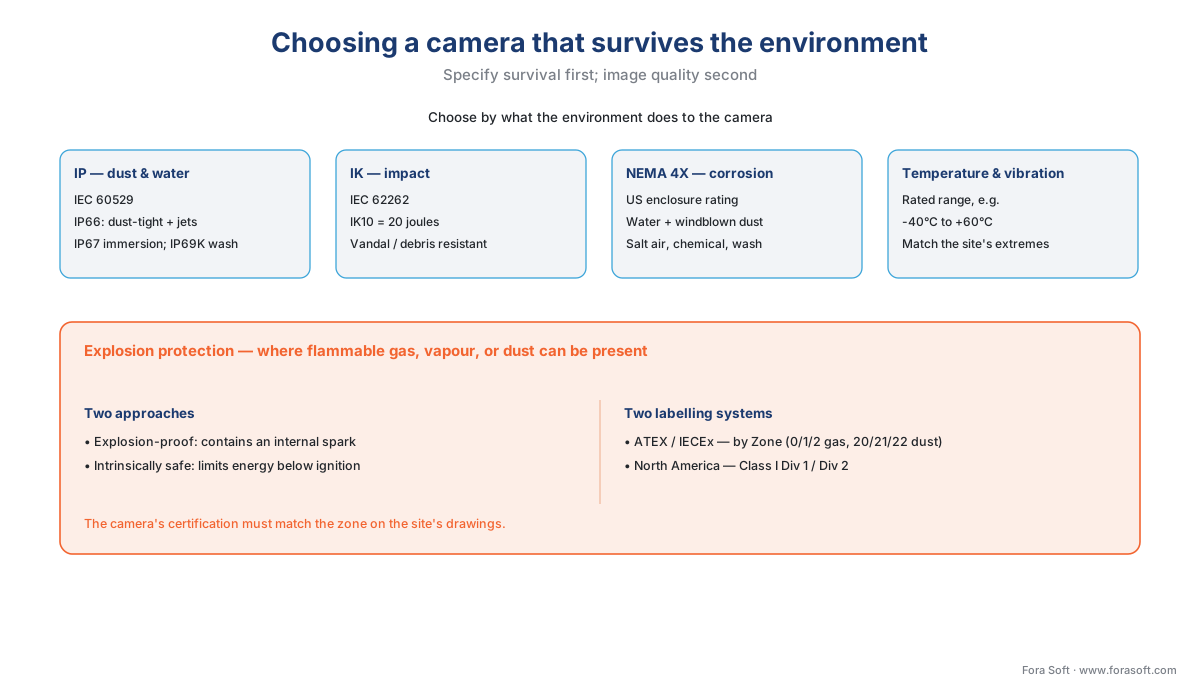 Figure 2. Choosing a camera by what the environment will do to it. The four everyday ratings — IP (dust and water), IK (impact), NEMA 4X (corrosion), and operating temperature — cover most industrial sites. The orange branch is the one that is not optional where it applies: in an explosive atmosphere the camera must be explosion-protected or intrinsically safe, certified to ATEX/IECEx (rest of world) or the Class/Division system (North America).
The branch that is not optional: explosion protection
There is one environmental requirement that is in a category of its own, because getting it wrong does not just break a camera — it can cause the disaster. In places where flammable gas, vapour, or combustible dust can be in the air — oil and gas, petrochemical, mining, grain handling, some pharmaceutical and paint operations — an ordinary camera's internal electronics could produce a spark that ignites the atmosphere. Those areas need a camera built so it cannot be the ignition source.
Two engineering approaches and two labelling systems govern this, and they are worth keeping straight. The two approaches: an explosion-proof (flameproof) camera is built in a heavy enclosure strong enough to contain an internal explosion so it cannot spread to the surrounding atmosphere; an intrinsically safe camera limits its internal energy so low that an ignition cannot occur in the first place. The two labelling systems: most of the world classifies hazardous areas using the IECEx scheme (and the European ATEX directive) by Zone — Zone 0/1/2 for gases, Zone 20/21/22 for dusts, by how often the hazard is present. North America uses the Class/Division system — Class I Division 1 is an area where flammable gas is present under normal operation; Division 2 is an area where it is present only abnormally, such as after a leak.
The practical rule: the area classification is set by the site's safety engineers, not the camera vendor, and the camera's certification must match the zone it sits in. A camera rated for Division 2 must not be installed in a Division 1 area. This is the rare surveillance decision where the cost of a mistake is measured in lives, so the certification is a hard gate, checked against the site's hazardous-area drawings before anything is mounted.
Thermal: seeing heat, not light
One more camera type earns its keep on industrial and critical sites more than anywhere else: the thermal camera, which forms a picture from heat rather than visible light. Because it needs no illumination, it sees in total darkness, through smoke, and through many obscurants — which is why it is the workhorse of long perimeters at night, a topic we treat in perimeter and intrusion detection. But on an industrial site thermal does a second job that visible cameras cannot: it sees heat itself, before there is any flame to see.
A thermal camera watching a transformer, a motor, a conveyor bearing, an electrical cabinet, or a pile of self-heating material can flag a rising temperature long before it becomes a fire — early enough to send a crew, not a fire brigade. Continuous thermal monitoring turns surveillance into part of the plant's fire-prevention and predictive-maintenance system, not just its security. A specialised cousin, the optical-gas-imaging camera, makes otherwise invisible hydrocarbon and methane leaks visible. The accuracy caveat from the rest of this section applies: a temperature alarm has a tuned threshold and a false-alarm rate like any analytic, and it is set to the asset and the ambient conditions, not left at a factory default.
It is an OT system, not an IT one
Here is the design difference that separates industrial surveillance from every other reference design in this section, and the one that most often goes wrong. On a factory or utility site, the surveillance system shares the world with operational technology (OT) — the programmable controllers, sensors, and actuators that physically run the plant: the pumps, valves, breakers, and motors. OT is not ordinary office IT. When office IT fails you lose email; when OT fails a turbine trips or a valve slams. So OT networks are guarded far more tightly, and a surveillance system that lands on the same site has to respect that world rather than barge into it.
The danger is concrete. A modern IP camera is a small networked computer running an operating system, and like any computer it can be compromised. If cameras, recorders, and the control system all sit on one flat network, a single hijacked camera becomes a doorway from the outside world into the controllers that run the plant. Surveillance, the system meant to protect the site, becomes the softest way to attack it.
The discipline that prevents this is network segmentation, and the controlling standard is IEC 62443 (the international cybersecurity standard for industrial automation and control systems, developed with the ISA). Its central idea is to divide the whole system into zones — groups of equipment that share a security level — connected only through tightly controlled conduits, the monitored, filtered links between zones. The surveillance system lives in its own zone; the control system lives in another; the only traffic between them passes through a conduit with a firewall that allows the few specific flows that are needed and blocks everything else. IEC 62443 assigns each zone a security level (SL 1–4) so the protection matches the consequence of a breach. The older Purdue model describes the same idea as numbered levels from the plant floor up to the business network, with the surveillance and OT systems kept on separate levels rather than mixed.
 Figure 3. Surveillance on an OT site, segmented under IEC 62443. Cameras and the VMS sit in their own zone on isolated network segments; the control system that runs the plant sits in its own zone; the only path between them is a monitored, firewalled conduit carrying just the flows that are needed. The orange path is the failure mode the design exists to prevent: a flat network where a hijacked camera becomes the doorway into the controllers.
In practice this means cameras on isolated network segments (VLANs) of their own, default passwords changed and device certificates managed across the whole fleet, firmware kept current, and only an explicit, firewalled link to anything on the OT side. It also means a procurement screen: in the United States, Section 889 of the 2019 National Defense Authorization Act and the implementing FAR 52.204-25 bar federal agencies, their contractors, and grant recipients from buying video-surveillance equipment from several named manufacturers, so critical-infrastructure buyers confirm supply-chain constraints before choosing hardware. The reliability theme returns here in a different guise: a system you cannot trust is not a reliable system, however many nines its hardware promises.
Common mistake: the flat plant network. The most common and most dangerous industrial-surveillance error is to put the cameras on the same network as the controllers because it is cheaper and easier to wire. It works perfectly until the day a camera with an unpatched flaw and a factory-default password becomes the entry point into the control system. Segment first; the conduit and the firewall are not where you save money.
Safety and security fused: the analytics that earn their place
On most sites, surveillance analytics are about security — intrusion, theft, loitering. On an industrial site, the same cameras do a second job that is often the one that pays for the system: worker safety. The analytics that matter here detect conditions that hurt people and stop production, and they run best at the edge, close to the camera, so a hazard is flagged in the moment rather than after a round trip to a server.
The common industrial analytics are recognisable from a safety officer's daily worries. Personal-protective-equipment (PPE) detection flags a worker without a hard hat, high-visibility vest, or safety glasses entering an area that requires them. Exclusion-zone or restricted-area detection flags a person who steps inside the swing radius of a crane, the path of automated machinery, or a roped-off hazard. Vehicle-and-pedestrian-proximity analytics warn when a forklift and a person get dangerously close. Slip, trip, fall, and lone-worker detection flags a person down in an area where no one may notice. And thermal fire and overheat detection, from the thermal cameras above, catches the hazard before it ignites.
Two honesty rules govern all of these, and they are the heart of this section's editorial stance. First, the model internals belong to another discipline. How a detector is trained and how it decides are covered in our AI for Video Engineering section; this article covers how the analytic plugs into the cameras, the VMS, and the response — not how the neural network works. Second, there is no perfect number. Published PPE-detection research reports a wide spread — mean average precision often in the low-to-mid 90s percent under good conditions, with precision and recall that drop in glare, distance, odd angles, or partial occlusion. A real deployment lands inside a precision/recall range that depends on the scene, the lighting, the camera placement, and how well the model was tuned to this site — not on the single headline accuracy a vendor quotes. Treat any "99%" or "100% accurate" claim as marketing, set the system's sensitivity to keep nuisance alarms low enough that people still trust the alerts, and tune it against the site's own footage. We work through that tuning discipline — the trade-off between catching everything and crying wolf — in perimeter and intrusion detection.
 Figure 4. The analytics that earn their place on an industrial site, and where each runs. Safety analytics (PPE, exclusion-zone, vehicle-pedestrian proximity, fall/lone-worker) sit alongside security analytics (perimeter, intrusion) and thermal fire/overheat detection. Each carries a realistic precision/recall range, not a single number; the detection models themselves are covered in the AI for Video Engineering section, while this design covers how the analytic feeds the VMS and the response.
A worked example: a redundant plant-perimeter design
Make it concrete with a modest critical site — say a water-treatment plant or a substation compound — needing 48 cameras: a thermal-and-visible perimeter, gate cameras with licence-plate capture, and process-area cameras including a few thermal units watching key electrical assets.
Start with the storage, because it sets the hardware. Using the arithmetic from surveillance storage and retention math, take an average sustained 4 Mbps per camera with modern H.265 encoding and continuous recording:
1 Mbps of video = 0.125 MB/s × 86,400 s/day = 10,800 MB/day ≈ 10.8 GB/day
4 Mbps per camera × 10.8 GB = 43.2 GB per camera per day
48 cameras × 43.2 GB = 2,074 GB ≈ 2.07 TB per day
90 days of retention × 2.07 TB = ~187 TB usable
After the RAID 6 redundancy overhead and headroom, that rounds up to roughly 230–260 TB of raw disk — and crucially it is provisioned as RAID 6 with a hot spare, not a single stack of disks. The cameras are IP66/IK10 as standard, NEMA 4X where there is corrosive exposure, and any unit inside a hazardous area is explosion-protected to the zone on the site's drawings. The network is a fibre ring so a single cut does not blind a segment. Recording is handled by N+1 servers — if two servers would carry the load, install three — and every camera also records locally so a network event back-fills rather than loses footage. Power runs through a UPS with a generator behind it. The analytics run at the edge: perimeter detection on the thermal cameras, PPE and exclusion-zone detection in the process areas, plate capture at the gate. The result is not the highest-resolution system money can buy; it is one that is still recording during the storm, the power event, or the intrusion — which is the only specification that matters here.
This is also where you connect the design to a budget. The full cost model — cameras, servers, storage, network, power, and the labour to install and maintain it — lives in the surveillance cost model, and turning a site like this into a scoped number is the subject of estimating a surveillance project.
Regulation depends on which sector you are in
"Critical infrastructure" is not a vibe; it is a defined list with named rules. In the United States, National Security Memorandum 22 (NSM-22), issued in April 2024, replaced the decade-old Presidential Policy Directive 21 and reaffirmed the sixteen critical-infrastructure sectors — among them energy, water and wastewater, chemical, critical manufacturing, transportation, dams, nuclear, and communications — each overseen by a designated agency. Which rule binds your surveillance design depends on the sector you sit in.
For the electric grid, the NERC Critical Infrastructure Protection standards govern, and the one that most directly touches surveillance is CIP-014, the physical-security standard. It requires transmission owners to identify the most critical substations — broadly those operating at or above 500 kV, plus certain 200–499 kV stations that meet connection criteria — assess the physical-attack risk at least every 36 months with independent verification, and implement a physical-security plan, in which surveillance is a central element. For pipelines and rail, the Transportation Security Administration issues security directives (sharpened after the 2021 Colonial Pipeline attack) and, in a November 2024 proposed rule, moved toward formal cyber-risk-management requirements for surface transportation. Across all sectors, the OT-cybersecurity standard IEC 62443 is the common technical reference for the segmentation discussed above, and the NDAA Section 889 / FAR 52.204-25 supply-chain screen constrains hardware choices wherever federal money is involved.
Privacy law still applies, even on a fenced industrial site, because the cameras record people — employees, contractors, visitors. Under the EU's General Data Protection Regulation this is processing personal data, normally on a legitimate-interest basis with a necessity-and-proportionality test; GDPR Article 88 lets member states add stricter rules for monitoring in the employment context, and many jurisdictions require informing or consulting the workforce before cameras go up. The bar rises sharply the moment a camera identifies a person biometrically — a face match at a gate, for instance — which GDPR Article 9 treats as special-category data and which US laws such as Illinois BIPA (740 ILCS 14) regulate with a private right of action and statutory damages. PPE and exclusion-zone analytics that detect a person without identifying which person are a much lighter privacy touch than face recognition; keep the two firmly separate, and treat any biometric feature as a deliberate legal decision rather than a default toggle. We cover the workforce-monitoring frame in GDPR for video surveillance and the consent-and-notice mechanics in consent and notice for surveillance; the biometric gate is in face recognition in surveillance.
 Figure 5. Which rule binds your design depends on the sector and jurisdiction. NERC CIP-014 governs the electric grid; TSA security directives govern pipelines and rail; IEC 62443 is the common OT-cybersecurity reference across all sectors; NDAA Section 889 screens the hardware supply chain wherever federal money is involved; and GDPR (including Article 88 on workforce monitoring) applies because the cameras record people.
| Sector / context | Primary rule that touches surveillance | What it asks of the design |
|---|---|---|
| Electric grid (US) | NERC CIP-014 (physical security) | Identify critical substations; risk assessment every 36 months with independent review; physical-security plan with surveillance central |
| Pipeline & rail (US) | TSA security directives; 2024 proposed cyber rule | Cyber-risk-management program; protect OT; report incidents |
| Any OT site | IEC 62443 (industrial cybersecurity) | Segment into zones and conduits; assign security levels; isolate the camera network |
| Federally funded (US) | NDAA §889 / FAR 52.204-25 | Do not buy named-vendor surveillance equipment; screen the supply chain |
| Workforce on site (EU) | GDPR Art. 6(1)(f), Art. 88, Art. 9 | Lawful basis + proportionality; employment-context rules; biometric identification heavily restricted |
Table 1. The regulation that binds an industrial surveillance design depends on the sector and jurisdiction. This is engineering orientation, not legal advice — confirm the specifics for your site with qualified counsel.
Where Fora Soft fits in
Industrial and critical-infrastructure surveillance is where Fora Soft's real-time video and computer-vision work meets the hardest reliability bar. We have built video streaming, surveillance, and computer-vision systems since 2005 — more than 625 projects for over 400 clients — and on the industrial side that means designing for the failure case first: edge recording that survives a cut link, N+1 recording and RAID storage so a single component can die without losing footage, and analytics whose value we describe as a realistic precision/recall range under real plant lighting and weather, never as a perfect number. Where a site needs PPE, exclusion-zone, thermal, or perimeter analytics tuned to its own footage and integrated with an existing VMS or control system, that is squarely the kind of custom computer-vision work we do — measured by how it behaves under load, not by a demo on a clean day.
What to read next
- Perimeter and intrusion detection — the detect-delay-respond design and false-alarm tuning behind industrial perimeters.
- Scaling a VMS: capacity planning — sizing N+1 recording servers and storage by throughput, not camera count.
- Estimating a surveillance project — turning a site like the worked example into a scoped cost and timeline.
For the commercial overview of AI-driven industrial video surveillance, see industrial video surveillance with AI; this article is the deep engineering reference design beneath it.
Call to action
- Talk to a surveillance engineer — book a 30-minute scoping call to talk through your industrial surveillance architecture plan.
- See our case studies — 250+ shipped projects across video streaming, WebRTC, OTT, telemedicine, e-learning, surveillance, and AR/VR.
- Download the Industrial & Critical-Infrastructure Surveillance Planning Checklist — A one-page planning tool for a reliability-first industrial or critical-infrastructure surveillance build: the reliability layers (record-at-edge, ring network, N+1 recording servers, RAID 6 + hot spare, UPS/generator) with the….
References
- IEC 62443 — Industrial communication networks / Security for industrial automation and control systems (IACS) (IEC / ISA). Tier 1. The controlling standard for OT cybersecurity: the zones-and-conduits segmentation model and security levels SL 1–4 used to isolate the surveillance system from the control system. https://www.iec.ch/blog/understanding-iec-62443 (accessed 2026-06-10).
- NERC Reliability Standard CIP-014 (Physical Security) (North American Electric Reliability Corporation). Tier 1. The physical-security standard for the bulk electric system: identification of critical transmission stations/substations, periodic risk assessment with independent review, and physical-security plans. https://www.nerc.com/pa/Stand/Pages/CIP-014-3.aspx (accessed 2026-06-10).
- National Security Memorandum on Critical Infrastructure Security and Resilience (NSM-22), 30 April 2024 (The White House). Tier 1. Superseded PPD-21; reaffirmed the 16 critical-infrastructure sectors and the Sector Risk Management Agency structure. https://www.cisa.gov/national-security-memorandum-critical-infrastructure-security-and-resilience (accessed 2026-06-10).
- Critical Infrastructure Sectors (Cybersecurity and Infrastructure Security Agency, CISA). Tier 1. The authoritative list of the 16 US critical-infrastructure sectors referenced in the regulation section. https://www.cisa.gov/topics/critical-infrastructure-security-and-resilience/critical-infrastructure-sectors (accessed 2026-06-10).
- IEC 60529 — Degrees of protection provided by enclosures (IP Code) (IEC). Tier 1. Defines the IP rating (IP66/67) for dust and water ingress used to specify outdoor and industrial cameras. https://webstore.iec.ch/publication/2452 (accessed 2026-06-10).
- IEC 62262 — Degrees of protection provided by enclosures for electrical equipment against external mechanical impacts (IK Code) (IEC). Tier 1. Defines the IK impact rating (IK10 = 20 J) used for vandal- and impact-resistant industrial cameras. https://webstore.iec.ch/publication/6479 (accessed 2026-06-10).
- IEC 62676 — Video surveillance systems for use in security applications (IEC). Tier 1. The video-surveillance systems standard family, including availability classes and the DORI (detect/observe/recognise/identify) image-criteria scale. https://webstore.iec.ch/publication/28442 (accessed 2026-06-10).
- Section 889, John S. McCain National Defense Authorization Act for FY2019; FAR 52.204-25 (US Government). Tier 1. Bars federal agencies, contractors, and grant recipients from procuring video-surveillance equipment from named manufacturers — the supply-chain screen for critical-infrastructure buyers. https://www.acquisition.gov/far/52.204-25 (accessed 2026-06-10).
- General Data Protection Regulation (Regulation (EU) 2016/679), Art. 6(1)(f), Art. 9, Art. 88 (EUR-Lex). Tier 1. The legitimate-interest basis for workforce monitoring, the employment-context member-state rule (Art. 88), and the special-category treatment of biometric data (Art. 9). https://eur-lex.europa.eu/eli/reg/2016/679/oj (accessed 2026-06-10).
- TSA Security Directives and the 2024 "Enhancing Surface Cyber Risk Management" proposed rule (Transportation Security Administration / Federal Register). Tier 1/2. The pipeline and rail security directives and the November 2024 proposed cyber-risk-management rule for surface transportation. https://www.federalregister.gov/documents/2024/11/07/2024-24704/enhancing-surface-cyber-risk-management (accessed 2026-06-10).
- ATEX Directive 2014/34/EU and the IECEx Scheme; hazardous-area classification (European Commission / IECEx). Tier 1/2. The Zone-based (ATEX/IECEx) and Class/Division (North America) hazardous-area classification systems behind explosion-proof and intrinsically-safe camera certification. https://www.iecex.com/ (accessed 2026-06-10).
- PPE-detection accuracy benchmarks (peer-reviewed) — e.g., Sustainability 15(18):13990 (2023); J. Computational Design and Engineering 10(2):905 (2023). Tier 5/6. Measured precision/recall and mAP ranges for hard-hat and vest detection, used to ground the realistic-accuracy framing (mAP often low-to-mid 90s% under good conditions, degrading with glare/distance/occlusion). https://www.mdpi.com/2071-1050/15/18/13990 (accessed 2026-06-10).
Per the section's source hierarchy, where a vendor or educational source disagreed with a standard or law, the standard/law was followed. The hazardous-area approaches (explosion-proof vs intrinsically safe) and the IP/IK/NEMA grades are reported per the issuing standards, not per camera-vendor marketing pages, which were used only for orientation.
