


This is engineering guidance, not legal advice. Confirm specifics with qualified counsel.
Why this matters
If you own a training program, an EdTech product, or a learning platform's roadmap, completion rate is the number your board, your compliance officer, and your instructors will all ask for first — and the one most likely to be quietly wrong. A completion rate built on "the video reached its end" overstates real finishing, fails an audit, and hides the module that is shedding learners. Get the definition right and the same data tells you where learners leave and which fix to ship. This article is the deep dive behind the completion section of Learning Analytics; read it before you promise anyone a completion number.
What "completion" actually means
Start with the trap. A learner watching a video to its final second is not the same as a learner completing a course — the bytes finished playing; the person may have left the room, muted the tab, or skipped the assessment. Treating "watched 100%" as "completed" is the single most expensive confusion in learning measurement, and almost every off-the-shelf player invites it by reporting playback percentage as if it were achievement.
So what should "complete" mean? The honest answer is that it is a rule you choose, and the learning standards each encode that rule differently. Think of completion like a customs stamp: the course only counts as "cleared" when it satisfies the specific rule the system checks at the border. Five systems, five borders.
A raw video player knows only one thing: how much of the timeline has elapsed. Its "completion" is playback position reaching the end. It cannot tell watching from finishing, and it knows nothing about whether the learner passed anything. This is the weakest definition and the one most dashboards accidentally ship.
SCORM 1.2 — the older version of the Sharable Content Object Reference Model, the standard that packages a course so any learning system can launch and track it — records status in a single field, cmi.core.lesson_status, whose values include "completed," "passed," "failed," and "incomplete" [1]. Because one field carries both ideas, SCORM 1.2 cannot cleanly say "finished all the content but failed the test" — completion and success are fused [1][2].
SCORM 2004 fixed exactly that by splitting the one field into two: cmi.completion_status (completed / incomplete / not attempted / unknown) answers "did they get through the content?", and cmi.success_status (passed / failed / unknown) answers "did they meet the bar?" [2]. It also adds cmi.completion_threshold and cmi.progress_measure, a 0-to-1 value the system compares against the threshold to decide completion automatically [2]. Now you can record "completed the modules, failed the exam" — a distinction compliance teams care about.
xAPI — the Experience API, the modern tracking standard that records learning as sentence-shaped statements of actor – verb – object ("Maria completed Module 3") — marks finishing with the verb completed and a result field completion set to true [3]. Its companion xAPI Video Profile is what makes video completion meaningful: it defines a completion-threshold extension — the percentage of the video that must be watched for completion to count — and aggregates a played-segments list so the system knows which intervals were actually seen, not merely that the timeline ended [4]. This is the difference between "the video ended" and "the learner watched 95% of it, including the parts that matter."
cmi5 — the standard that puts xAPI back inside a launching learning system — adds the cleanest completion contract of all: a moveOn property set per assignable unit that tells the platform exactly what satisfies it. Its values are Completed, Passed, CompletedAndPassed, CompletedOrPassed, and NotApplicable [5]. When the rule is met, the platform issues a satisfied statement; a Passed statement carrying a score must meet or exceed the unit's masteryScore, a scaled decimal between 0 and 1 such as 0.85 for 85% [5]. cmi5 makes the completion rule explicit and machine-checked instead of implied.
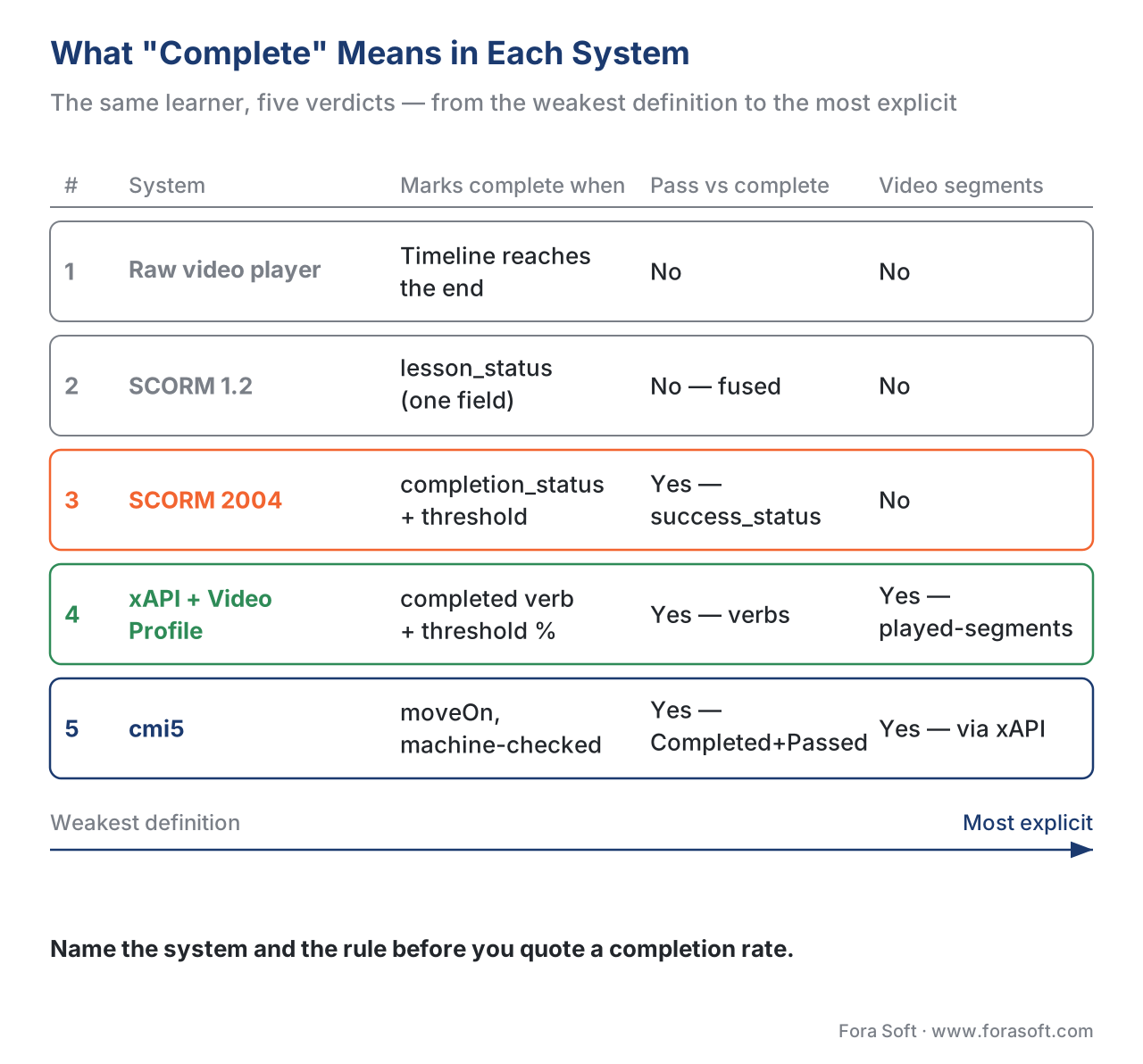 Figure 1. The same learner, five verdicts. Each system encodes "complete" differently — the raw player is the weakest, cmi5 the most explicit. Pick the rule before you report the rate.
The practical lesson: before you quote a completion rate, name the system and the rule behind it. We unpack each standard in depth in SCORM Explained, xAPI (Tin Can) Explained, and cmi5 Explained; the video-specific tracking lives in Tracking Video with xAPI.
The denominator decides the number
Even with the rule fixed, completion rate is a fraction, and the fraction has a denominator that quietly changes everything. Completion rate is simply:
completion rate = learners who met the completion rule ÷ a chosen population
The numerator is the rule from the section above. The fight is over the denominator. Do you divide by everyone who registered, everyone who started, or everyone who was assigned the course? Each is defensible, each answers a different question, and quoting the friendliest one without saying so is how completion rates lie.
Walk the arithmetic with one cohort. A company assigns a five-module video course plus a final assessment to 2,000 employees over a month. The vendor dashboard says 1,250 completions, counting "video timeline reached the end."
The raw, flattering read divides by assigned learners: 1,250 ÷ 2,000 = 62.5%. It feels like a pass.
Now apply a defensible rule — all five modules watched past the Video Profile completion threshold and a final score of at least 80% — and only 820 learners qualify. Against the assigned population that is 820 ÷ 2,000 = 41%. Same cohort, same month, twenty-one points lower, and this is the number that survives an audit.
Look closer and the population matters too. 500 employees (25%) never pressed play once, so only 1,500 actually started. Completion among starters is 820 ÷ 1,500 = 54.7% — useful for judging whether the content works, but misleading if you quote it to a compliance officer who cares that a quarter of the workforce never began.
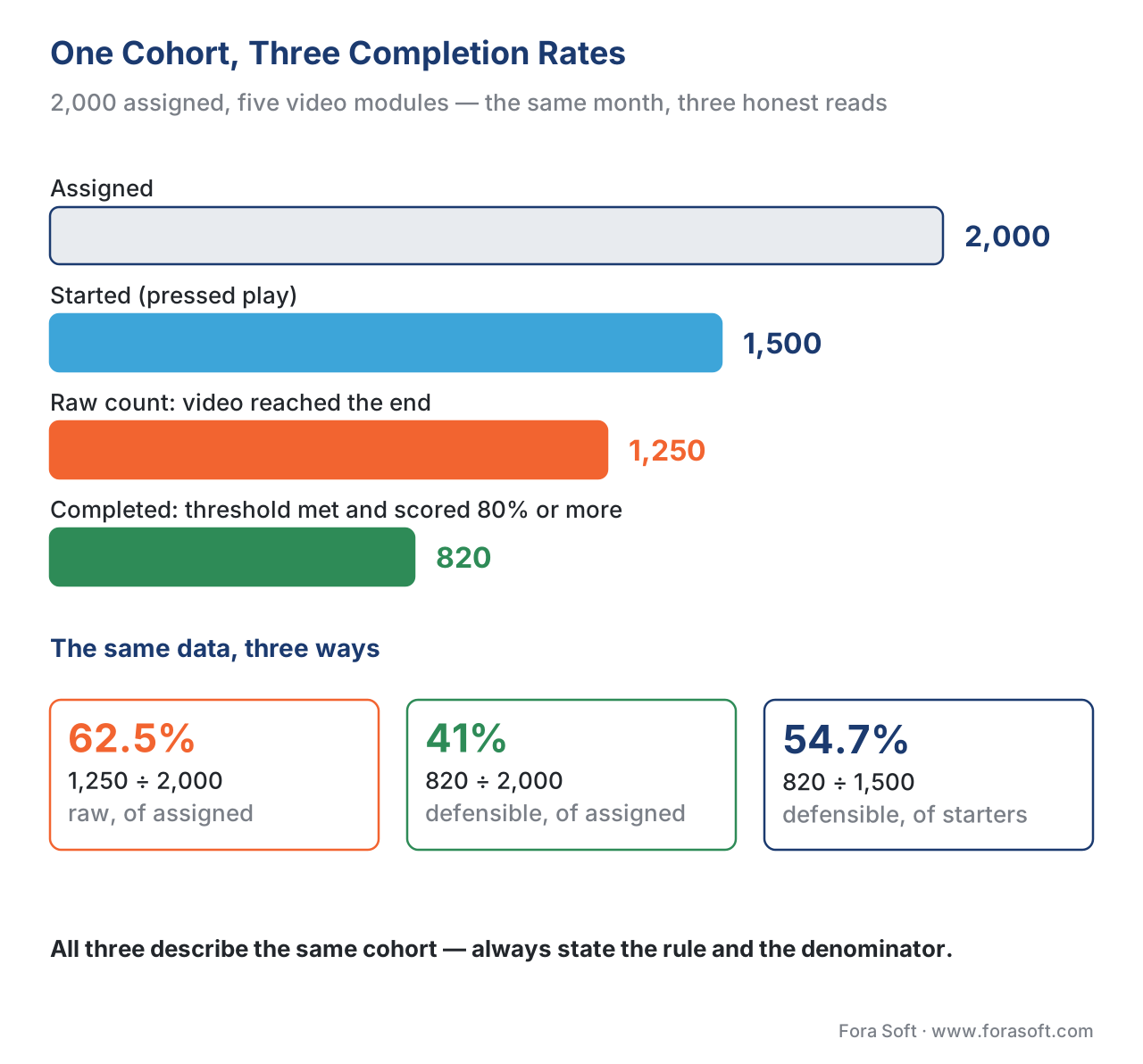 Figure 2. One cohort, three honest completion rates. The number you quote depends entirely on the rule and the denominator — so state both, every time.
None of these three numbers is wrong. The failure is reporting one without naming its rule and denominator, because a reader cannot compare 62.5% against another course's 41% if the two used different fractions. A completion rate that matters is reproducible: a written rule and a written denominator that any two analysts apply to get the same answer. This is the same discipline we argue for across the whole measurement block in Learning Metrics 101.
Why completion rates are usually low
Once the number is honest, it is usually humbling — and that is normal, not a defect in your platform. Completion sits on a wide spectrum set mostly by motivation and stakes.
At the low end are massive open online courses (MOOCs) — free, self-paced, open to anyone. Large studies find that roughly half of registrants never start the content at all, and completion runs about 5–15% of those who registered [6]. A registration there is a hope, not a commitment, so the denominator is enormous and the finish line distant.
At the high end is mandatory corporate and compliance training, where completion is a condition of employment. Industry benchmarks put the cross-sector average completion rate around 72%, while compliance programs are held far higher: roughly 90% is considered good, 95% is leading practice, and safety- or privacy-critical topics target near-100% on time [7][8]. The same human in both settings finishes the mandatory course and abandons the free one — the content didn't change, the stakes did.
Between those poles sit cohort courses, academic online programs, and customer education, each landing where their mix of motivation, deadline, and relevance puts them. The takeaway for a builder: benchmark completion against courses of the same type and stakes, never against an absolute "good" number. A 14% MOOC completion can be excellent; a 72% compliance completion is a problem.
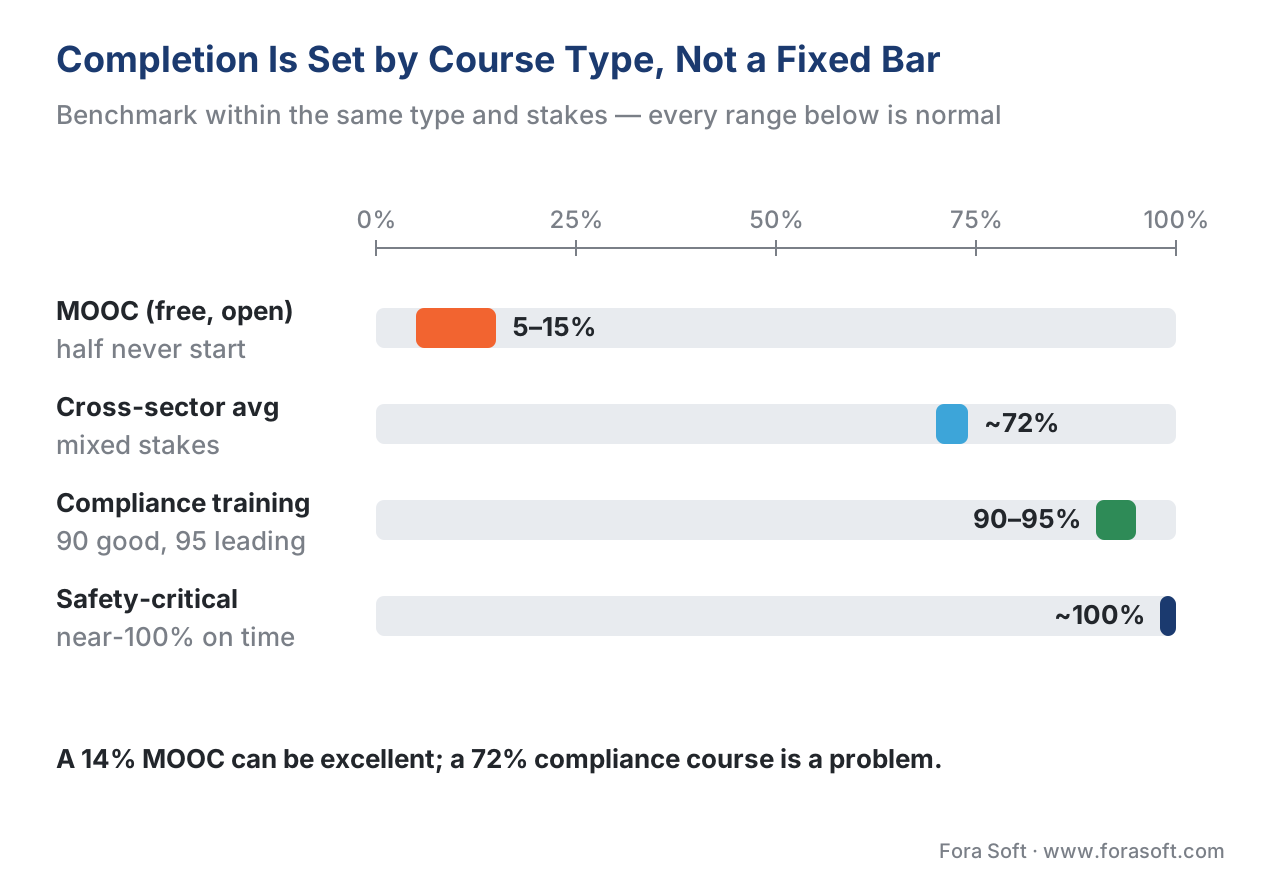 Figure 4. Completion is set by course type, not an absolute bar. Every range here is normal for its type — compare like with like.
A large part of what is left — the gap you can close — comes down to friction and format rather than motivation. The best evidence is a study of 6.9 million video sessions across four edX courses, which found that video length was by far the strongest predictor of engagement: median engagement time was at most six minutes regardless of how long the video ran, and students rarely made it through videos longer than nine minutes [9]. A 40-minute lecture does not get watched; it gets abandoned at minute six. Completion is lost in the content long before it shows up in the dashboard.
The levers that move completion
Improving completion is not a dashboard task; it is a product, content, and people task. The levers below are ordered by how reliably they move the number in practice.
Cut video into sub-six-minute chunks. This is the highest-leverage change and the best-evidenced. Segmenting a long lecture into short, single-idea videos aligns with how learners actually watch [9] and how attention works, which we cover in The Pedagogy of Video. Shorter segments also give the completion rule more, smaller checkpoints, so progress feels visible.
Send nudges and reminders. Automated reminders are the most consistently reported product lever for completion: industry data attributes a large share of high-completing compliance programs to automated reminders and workflows [7]. A reminder costs almost nothing and works because most non-completion is forgetting, not refusal.
Set deadlines and make stakes explicit. Open-ended courses drift; dated ones get finished. A deadline, a manager's visibility, or a required certificate converts a "someday" into a "this week." This is why compliance completion is high — the stakes are real and stated.
Make progress visible. A progress bar, a module checklist, and a clear "next step" exploit the human pull toward closing an open loop. The completion rule you chose earlier becomes the progress signal learners see.
Remove friction: mobile and offline. If the course only runs on a desktop on the corporate network, learners with field jobs or commutes never finish. Mobile-first delivery and offline playback widen the window in which completion can happen.
Caption everything. Captions are an accessibility requirement under WCAG 2.1 AA, covered in WCAG 2.1 AA for Educational Video — and they also lift completion for learners watching without sound, in a second language, or in noisy environments. Accessibility and completion pull in the same direction.
Tune relevance and difficulty. A course that is too hard sheds learners at the assessment; one that is too easy or irrelevant sheds them from boredom. Per-module drop-off and first-attempt pass rate tell you which modules to re-cut — the diagnostic side covered in Video Engagement: Watch-Time, Drop-Off, and Re-Watch.
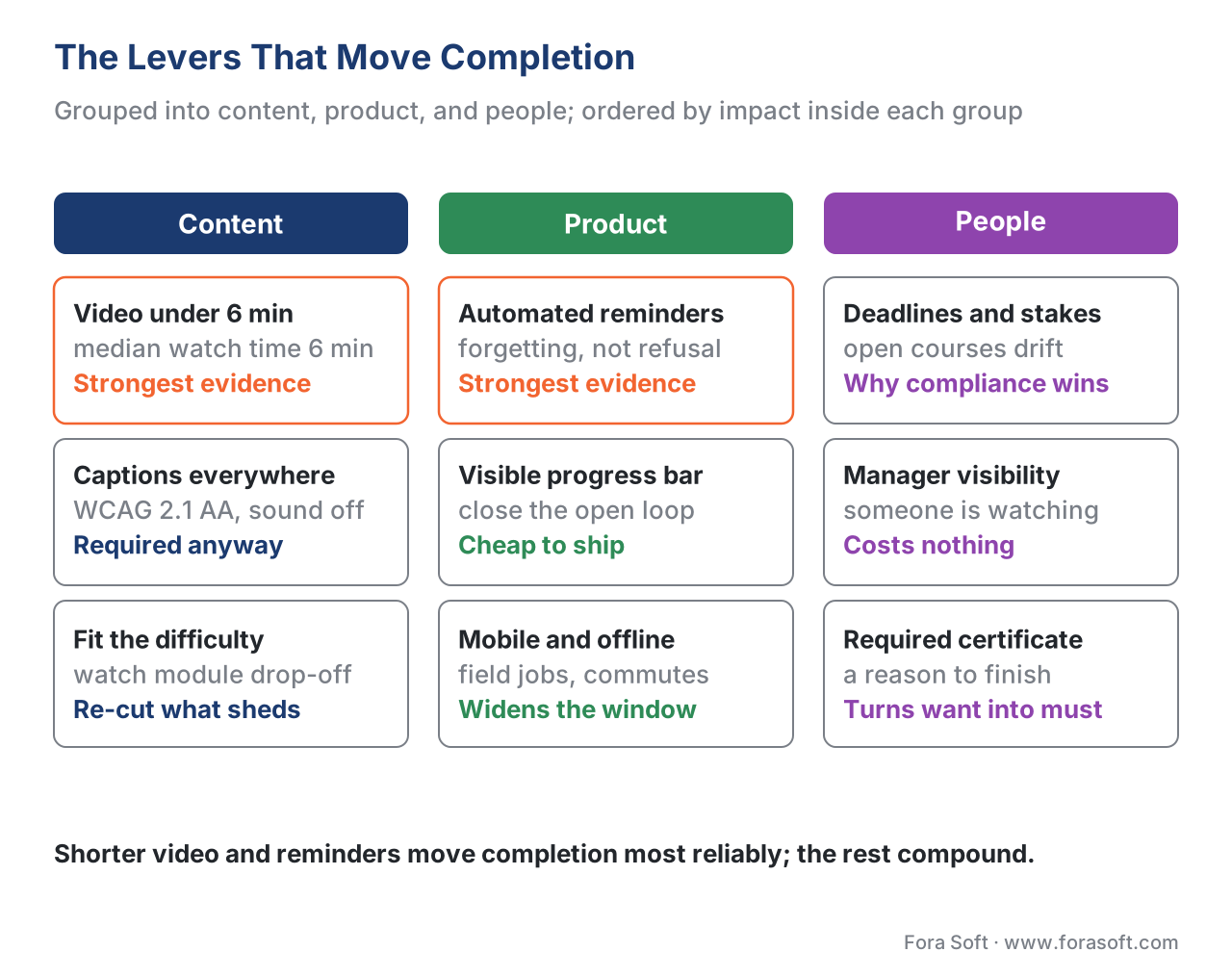 Figure 3. The levers that move completion, grouped into content, product, and people. Shorter video and reminders move the number most reliably; the rest compound.
A comparison: what each system can prove about completion
Before you promise a stakeholder a completion number with any nuance — per-segment watching, separate completion-and-pass, a configurable threshold — check that your chosen standard can actually carry it. The richness of a completion metric is capped by the standard the player emits to.
| Completion capability | Raw player | SCORM 1.2 | SCORM 2004 | xAPI + Video Profile | cmi5 |
|---|---|---|---|---|---|
| Marks "finished" at all | Timeline end only | Yes (lesson_status) |
Yes (completion_status) |
Yes (completed) |
Yes (moveOn) |
| Separates completed from passed | No | No (one field) | Yes (success_status) |
Yes (separate verbs) | Yes (CompletedAndPassed) |
| Configurable completion threshold | No | No | Yes (completion_threshold) |
Yes (Video Profile) | Yes (via xAPI) |
| Per-segment video watched | No | No | No | Yes (played-segments) |
Yes (via xAPI) |
| Completion outside the launching system | No | No | No | Yes (any activity) | Partial (AU-scoped) |
The reading is blunt: if your roadmap promises "they watched the parts that matter, and we know they passed separately," plain SCORM cannot deliver it — you need SCORM 2004's split fields at minimum, and the xAPI Video Profile or cmi5 for per-segment truth. Choosing the standard is choosing what "complete" can ever mean for your product.
Common mistakes
Wiring "watched 100%" straight to "course completed." The defining error. The player's timeline position is not achievement; gate completion on a real rule — threshold plus assessment — not on playback reaching the end.
Quoting a completion rate without its denominator. 62.5% of assigned and 54.7% of starters describe the same cohort. A number with no stated population cannot be compared or trusted; write the denominator next to the percentage, always.
Mapping only completion_status when migrating SCORM 1.2 to 2004. Because SCORM 2004 splits completion from success, teams that map only completion leave success_status as "unknown" and silently break certificate logic [2]. Map both fields.
Benchmarking against an absolute number. Holding a free MOOC to compliance-grade completion, or celebrating a mandatory course that merely matches MOOC rates, both misread the data. Benchmark within course type and stakes.
Treating completion as proof of learning. Finishing is necessary, not sufficient. In the Kirkpatrick model of training evaluation, completion is barely past Level 1; learning and on-the-job behavior change are Levels 2 and 3 [10]. Pair completion with a mastery or behavior signal before claiming the training worked.
Free download: Completion Rate Improvement ChecklistA one-page worksheet that walks from a defensible completion definition through diagnosis to the content, product, and people levers that lift the number: settle the rule and the denominator first, find where learners actually leave, then pick the fixes in the order the evidence supports.Where Fora Soft fits in
Fora Soft has built video streaming, real-time WebRTC, and interactive-player software since 2005, and in e-learning the completion-rate work is rarely the chart — it is wiring the player so a defensible completion rule can exist at all. The build-vs-buy trade-off is usually this: an off-the-shelf learning system gives you a canned completion flag tied to playback for free, but the moment you need a configurable threshold, separate completed-and-passed status, or per-segment video truth, you are building an interactive player plus an xAPI Video Profile or cmi5 pipeline. We help teams decide which completion nuance genuinely justifies that custom layer, then build the tracking so the number you report holds up to an audit. The same real-time and streaming foundations show up across our conferencing, telemedicine, and OTT work.


The handbook
Fora Soft Video Engineering Handbook
We wrote a seven-volume series that takes the whole video stack apart across 9,000+ pages — encoding, delivery, audio and AI — and someone who works through it can design and build the player and the tracking that make a completion number hold up. Volume 3 sits closest to the work here: players, stall recovery and QoE monitoring, the layer that knows which seconds a learner actually watched rather than that the timeline ended. Volume 1 covers the encoding side of cutting a 40-minute lecture into the six-minute segments people finish, and volume 4 the captions and accessibility lever this article lists. Written by Nikolay Sapunov, CEO at Fora Soft.
Is the completion number you report one you could defend in an audit?
Send us the completion rule you quote today, the denominator behind it and the standard your courses launch under — and we will come back with what your player has to emit for that number to hold up, what per-segment video truth costs to add, and which part of it an off-the-shelf system already gives you. 250+ video products shipped since 2005.
See our case studies
Case study
BrainCert
The first WebRTC and HTML5 virtual-classroom LMS, bootstrapped to 100K+ customers and 500M+ real-time classroom minutes across 10 datacenters, built from the architecture up with us. An LMS is exactly where a completion rule stops being a dashboard setting and becomes a contract between the player, the course package, and the record it writes.
Case study
Scholarly
Sydney’s selective and scholarship test-prep platform: 15,000+ active users, live classes for up to 2,000 students at once, homework review and an admin panel with analytics on ClickHouse. Named the most innovative EdTech startup in Asia Pacific by AWS. Completion here is measured against the deadline that actually moves people — the exam.
Case study
Tabsera
A multilingual K-12 LMS in English, French, Arabic and Turkish, with gamified courses, quizzes and an interactive whiteboard. It is the product half of the lever list in one place: visible progress, stakes a learner can see, and a quiz that says whether a module was understood rather than merely played to the end.
What to read next
Analytics
Learning Analytics: The Metrics That Matter and the Ones That Mislead
The hub this article is the deep dive of: which numbers earn a place on the dashboard.
Metrics
Learning Metrics 101: Completion, Progress, Mastery, Engagement
Completion next to progress, mastery and engagement, and what each one can and cannot prove.
Standards
Tracking Video With xAPI: The Video Profile and What to Capture
How played-segments turns “the video ended” into which seconds were actually seen.
Pedagogy
The Pedagogy of Video: Attention, Retention, and Chunking
Why the six-minute limit moves the number more than anything else on the list.
References
- ADL Initiative. SCORM 1.2 — Run-Time Environment (
cmi.core.lesson_status). https://adlnet.gov/projects/scorm/ — Tier 1 (primary standard). SCORM 1.2 records status in a singlelesson_statusfield (completed/passed/failed/incomplete/browsed/not attempted), fusing completion and success. - ADL Initiative. SCORM 2004 4th Edition — Run-Time Environment (
cmi.completion_status,cmi.success_status,cmi.completion_threshold,cmi.progress_measure). https://adlnet.gov/projects/scorm/ — Tier 1 (primary standard). SCORM 2004 separates completion from success and adds a 0–1 progress measure compared against a completion threshold. - ADL Initiative. Experience API (xAPI) Specification v1.0.3 — Part 2: Statements (the
completedverb andresult.completion). https://github.com/adlnet/xAPI-Spec — Tier 1 (primary standard). Completion is marked by thecompletedverb withresult.completion = truein an actor-verb-object statement. - ADL / xAPI Video Community Profile. xAPI Video Profile (the
completion-thresholdandplayed-segmentsextensions). https://github.com/adlnet/xapi-authored-profiles/tree/master/video — Tier 1 (primary profile). Defines the percentage-watched completion threshold and the played-segments list that proves which intervals were watched. - AICC / ADL. cmi5 Specification — the
moveOnproperty (Completed,Passed,CompletedAndPassed,CompletedOrPassed,NotApplicable) andmasteryScore. https://github.com/AICC/CMI-5_Spec_Current/blob/quartz/cmi5_spec.md — Tier 1 (primary standard). The LMS usesmoveOnto decide an assignable unit is satisfied; aPassedscore must meet the scaled (0–1)masteryScore. - Reich, J., & Ruipérez-Valiente, J. A. (2019). The MOOC Pivot. Science 363(6423). https://www.science.org/doi/10.1126/science.aav7958 — Tier 5 (peer-reviewed). About 52% of MOOC registrants never start; completion runs roughly 5–15% of registrants.
- Absorb LMS. Ways to Increase Compliance Training Completion Rates (automated reminders and workflows as the dominant completion levers). https://www.absorblms.com/resources/articles/8-ways-to-increase-compliance-training — Tier 6 (vendor practitioner source). Automated reminders and workflows are credited with a large share of high-completing compliance programs.
- KnowBe4. What Is a Good Completion Percentage for Security and Compliance Training? (90% good, 95% leading, near-100% for new hires/critical topics; ~72% cross-sector average per ATD). https://blog.knowbe4.com/good-completion-percentage-for-security-compliance-training — Tier 6 (practitioner benchmark). Compliance completion targets sit far above the ~72% cross-industry average.
- Guo, P. J., Kim, J., & Rubin, R. (2014). How Video Production Affects Student Engagement: An Empirical Study of MOOC Videos. ACM Learning @ Scale. https://up.csail.mit.edu/other-pubs/las2014-pguo-engagement.pdf — Tier 5 (peer-reviewed). Across 6.9M sessions, median engagement was ≤6 minutes regardless of video length; students rarely finished videos over 9 minutes.
- Kirkpatrick Partners. The Kirkpatrick Model: Four Levels of Training Evaluation. https://www.kirkpatrickpartners.com/the-kirkpatrick-model/ — Tier 5 (institutional/foundational). Completion is barely past Level 1 (Reaction); learning and behavior change are Levels 2–3.
Where sources disagreed, the official specifications were followed. Many vendor articles describe a single "completion" as universal; this article follows the standards' own data models — SCORM 1.2's fused lesson_status [1] versus SCORM 2004's separated completion_status and success_status [2], the xAPI completed verb [3], the Video Profile's threshold [4], and cmi5's explicit moveOn [5] — and notes that raw playback percentage is the weakest, not the canonical, definition.
