


Why this matters
If you have shipped video but never measured it rigorously, sixty-four articles is a wall, and the first question is not "where do I start" but "which door is mine". This orientation piece is for the streaming or encoding lead, the QA engineer, and the technical product owner who arrived with a concrete job — choose a metric, design a test, or wire a quality gate — and wants the shortest honest path to it. It also draws the one boundary that confuses everyone at first: the line between measuring quality (here) and producing it (the Video Encoding section). Get that line right and you will always know which section to open, and you will never read two of our articles fighting over the same ground.
What this section is, in one sentence
This is the part of Fora Soft Learn about measuring delivered video quality: turning "the picture looks fine to me" into a number you can defend, compare, and put in a contract. Measurement is the discipline that validates every encoding and streaming decision after the fact — it does not compress anything, transcode anything, or change a single bit of your video. It reads the result and tells you, with a stated method and a known error, how good the result is.
That is the whole identity of the section, and it is also the border. The moment a question becomes "how do I make the file smaller" or "which codec should I encode with", you have stepped over into the Video Encoding section — compression is its job, not ours. Keep that test in your head: measure or recognize quality is here; produce or compress it is next door.
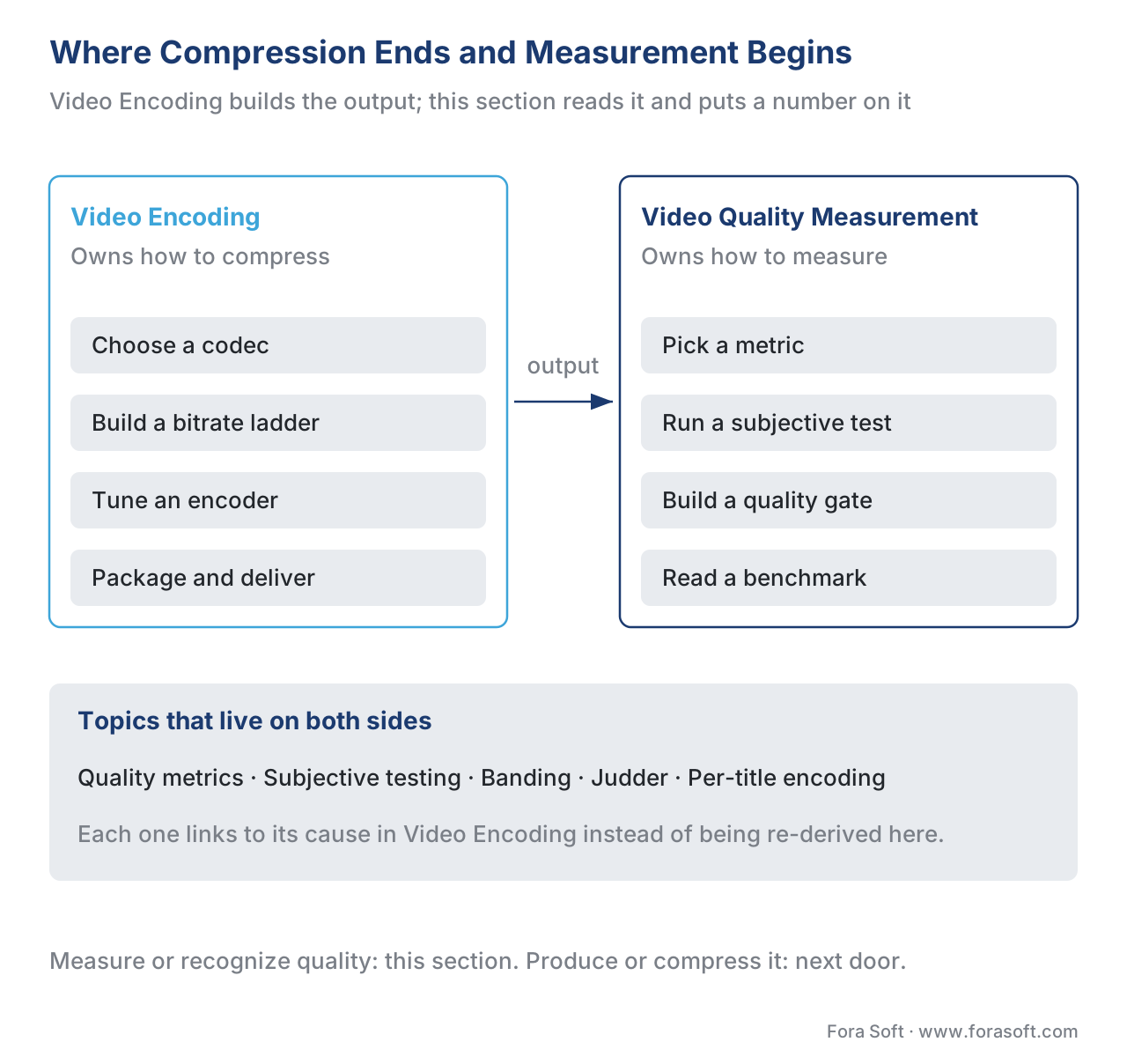 Figure 1. The border in one picture. This section reads the output of the pipeline; Video Encoding builds it. Shared topics live on both sides — cause on the left, measurement on the right.
The eight blocks, and what you can do after each
The section is organized as a self-paced course of eight blocks. You do not have to read them in order, but they do build, and each one leaves you able to do something concrete.
Block 1 — Why measure video quality is where you are now: why a number beats an opinion, where quality is actually lost in a pipeline, the subjective-versus-objective distinction, QoE versus QoS, and the full-reference, reduced-reference, no-reference taxonomy that every metric falls into. Finish it and you understand what the numbers are worth.
Block 2 — Objective metrics is the technical heart: PSNR, SSIM, MS-SSIM, VMAF and its variants, each from first principles with the math shown once and the blind spots named. Block 3 — Subjective testing is the ground truth those metrics are validated against — the ITU methodologies, the statistics, and the failure gallery. Block 4 — The artifact gallery teaches you to recognize blocking, banding, ringing, and judder by eye and trace each to its cause. Block 5 — Production QC wires measurement into a pipeline: quality targets, gates in CI/CD, regression tests, and monitoring at scale. Block 6 — Streaming QoE covers the viewer-experience metrics — rebuffering, startup time, the ABR trade-off — that predict whether someone stays. Block 7 — Fora Soft benchmarks is our own measured data on real content, with the methodology written down so you can trust it. Block 8 — Tools is how to actually run all of this with FFmpeg, libvmaf, VQMT, and the rest.
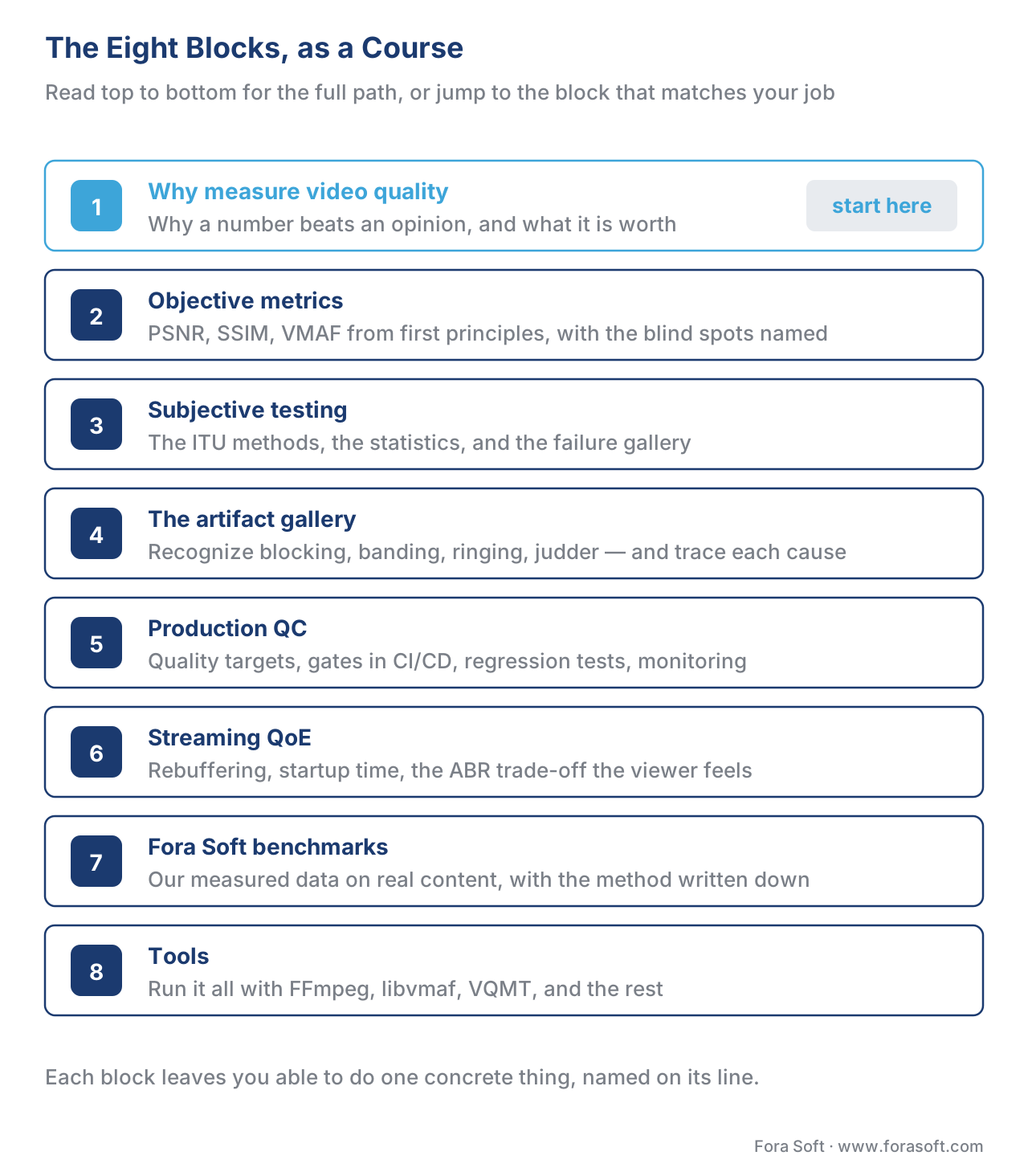 Figure 2. The eight blocks as a course. Read top to bottom for the full path, or jump to the block that matches your job.
Three reading paths to the job in front of you
Most readers do not need all sixty-four articles. They need one of three things. Pick the path that matches your job and follow it; ignore the rest until you need it.
Path 1 — "I need to pick a metric." Start with the full-reference, reduced-reference, no-reference taxonomy so you know which family your situation allows — a live feed with no pristine original rules out half the metrics before you begin. Then read the Block 2 article for each candidate (PSNR, SSIM, VMAF), and finish with choosing the right metric for the job. You will leave knowing not just which metric, but which model and pooling method to quote with it.
Path 2 — "I need to run a subjective test." Begin with subjective versus objective quality to see why human scores are the ground truth, then work through Block 3: the rating scales, the ITU test methodologies, the design, the statistics, and the common mistakes. The standards behind these articles are ITU-T P.910 (2023) and ITU-R BT.500-15 (2023) — the recommendations that make a test defensible.
Path 3 — "I need to build a quality gate." Read what a metric can and cannot tell you first, because a gate built on a number you over-trust will pass bad encodes, then go to Block 5 for quality gates in CI/CD and the surrounding QC articles. Block 8 shows you the tooling to automate it.
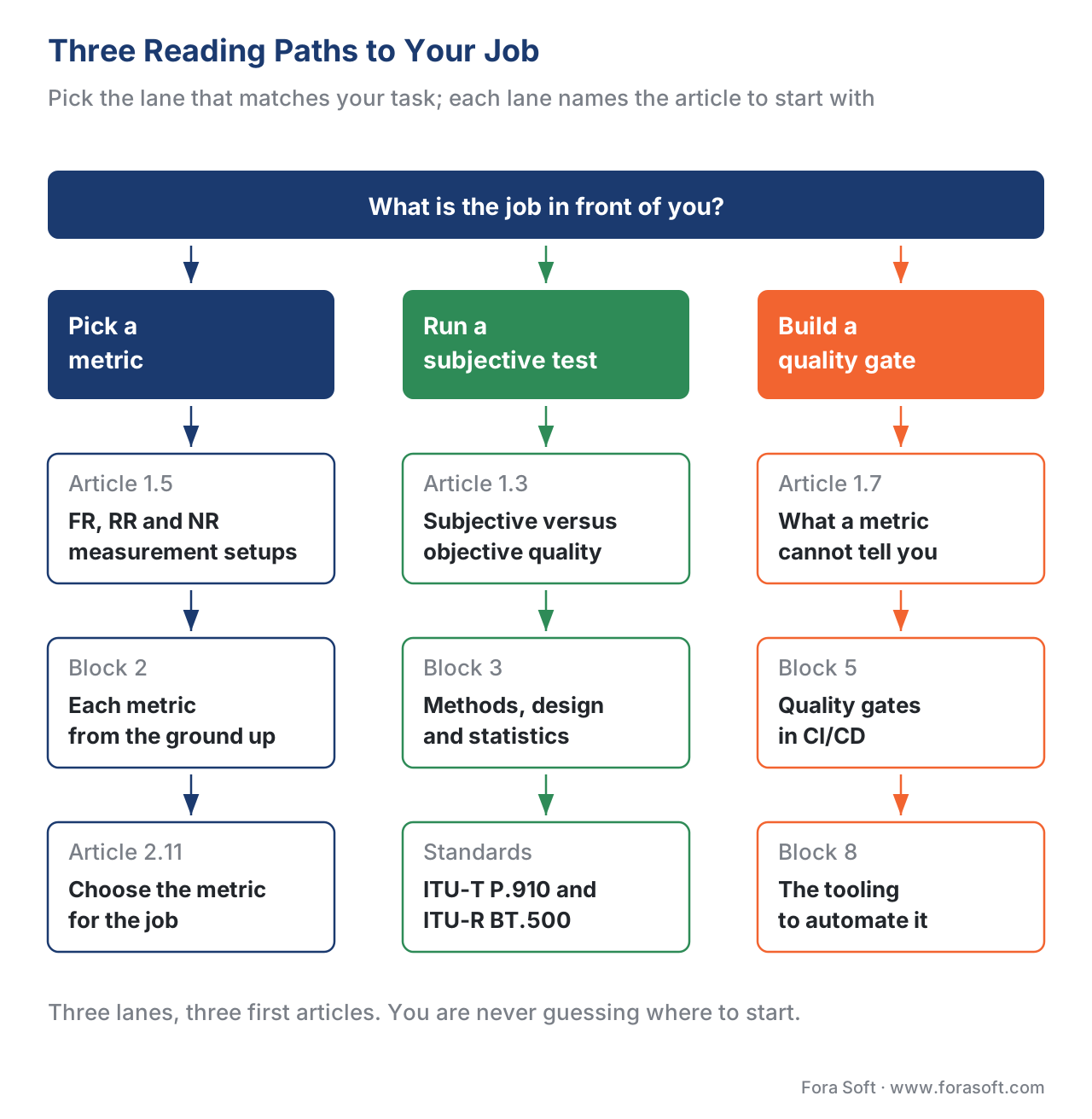 Figure 3. Three jobs, three routes. Each path names its first article so you are never guessing where to start.
Where this section borders Video Encoding
The cleanest way to understand the border is by the topics that live on both sides. Several subjects have a cause that belongs to Video Encoding and a measurement that belongs here, and we deliberately split them so neither section repeats the other.
| Shared topic | Video Encoding owns (the cause) | This section owns (the measurement) |
|---|---|---|
| Quality metrics | The encoder-operator's one-screen view while tuning an encode — PSNR, SSIM, VMAF in context | The deep dive: each metric from first principles, its validation, and where it lies (Block 2) |
| Subjective testing | The single-article overview an encoder operator needs | The eight-article treatment: design, statistics, crowdsourcing (Block 3) |
| Banding | Why it happens — bit depth and 8/10/12-bit | How to see it, which metric catches it, how to trace it (Block 4) |
| Judder | Why it happens — frame rate and motion | How to recognize and measure it (Block 4) |
| Per-title encoding | How the bitrate ladder is built | How a quality target drives the ladder (Block 5) |
Table 1. The border as a handoff, not a wall. Wherever a topic appears here, it links to its cause-side home in Video Encoding instead of re-deriving it — and vice versa.
The same rule extends to the other Learn sections. The delivery side of experience — adaptive bitrate, players, CDNs — lives in the Video Streaming section, so our QoE block measures the viewer's experience and links there for the mechanics. Audio quality (PESQ, POLQA) belongs to Audio for Video; quality estimated by machine-learning models belongs to AI for Video Engineering. This section stays on one job: video quality, measured.
Common mistake: treating an encoder's own quality number as an independent measurement. When
x265or a per-title tool reports a VMAF score for the encode it just produced, that is the encoder grading its own homework — useful for tuning, but not an independent check. An honest quality gate re-measures the output with a stated model and pooling method, on the content you actually ship. Knowing which section a number came from is the first step to knowing what it is worth.
A small worked example of what "measurement" buys you
Measurement earns its keep by validating an encoding decision in numbers. Say two encoder settings both land at the same measured quality — VMAF 93, default model, mean-pooled — but setting B reaches it at a lower bitrate. The bitrate saving is simple arithmetic:
saving = (bitrate_A − bitrate_B) / bitrate_A

  bitrate_A = 5.0 Mbps
  bitrate_B = 4.0 Mbps
  saving    = (5.0 − 4.0) / 5.0
            = 1.0 / 5.0
            = 0.20  →  20% lower bitrate at equal measured quality
The encoder produced the saving; the measurement proved the quality held while it happened. Without the measured VMAF — at a named model and pooling, on matched content — "B is just as good and cheaper" is an opinion. With it, it is a result you can take to a CDN bill. The formal version of this comparison, BD-rate (the Bjontegaard delta-rate, 2001), reports exactly this kind of equal-quality bitrate difference across a whole rate-quality curve, and it gets its own article in Block 7.
Where Fora Soft fits in
Fora Soft has built video software since 2005 — streaming, OTT and internet TV, video conferencing, e-learning, telemedicine, and surveillance — and this section is the measurement discipline behind all of it. We wrote it the way we work: name what a number means before how to compute it, and always say where it can mislead. When you read our benchmark methodology, you will see the same model, pooling, and content provenance attached to every figure that we ask of any number we trust. The section is vendor-neutral on purpose; the only thing we are selling is the habit of honest measurement.
The handbook
Fora Soft Video Engineering Handbook
We wrote a seven-volume handbook that walks the whole video stack, from a single pixel to a running production system, across more than 9,000 pages - and it draws the same border this article does. Volume 1, Video Encoding, is the compress side: codecs, bitrate ladders and the encoder decisions that produce the quality you then measure. Volume 3, Video Streaming, carries the delivery side that Block 6 measures - ABR, players, CDNs, rebuffering and startup time. Volume 6, AI for Video, covers the learned models now used to score video with no original to compare against. Read the three in that order and you can design and build the pipeline, not just grade it. Written by Nikolay Sapunov, CEO at Fora Soft.
Is your video problem a measurement problem or an encoding one?
Tell us what you are seeing and where you are seeing it, and we will say which side of the border it sits on: a number you cannot defend, a metric quoted without its model and pooling, or an encode that needs fixing before any score will improve. 250+ video products shipped since 2005.
See our case studies
Case study
Speed.Space
Remote production recording at 1080p and 8 Mbps for Netflix, Electronic Arts and HBO shoots - the encoding side of the border, where the ladder and the encoder settings are the decision.
Case study
Worldcast Live
Concert streaming at 1.5 Gb/s with 0.4-0.5 s latency for 10,000 simultaneous viewers - the QoE side, where startup time and stalls are what the viewer actually grades.
Case study
Mindbox
An intelligent VMS with 50+ deployments pulling RTSP camera feeds through FFmpeg into HLS - hundreds of streams that have to be watched by measurement, not by a person looking at a wall.
What to read next
Foundations
What is video quality measurement
The first article of Block 1: what the discipline actually claims, and why it is harder than it looks.
Setups
Full-, reduced-, no-reference metrics
Path 1 starts here: how much of the original you have decides which metrics you may use.
Limits
What a metric can and cannot tell you
Path 3 starts here: a gate built on a number you over-trust will pass bad encodes.
Choosing
Choosing the right metric for the job
Where Path 1 ends: the metric, the model and the pooling method you quote with it.
References
- Recommendation ITU-T P.910 (2023), Subjective video quality assessment methods for multimedia applications. International Telecommunication Union. Tier 1 (official standard). The subjective-testing methods (ACR, DCR, PC) that Block 3 is built on and that objective metrics are validated against. https://www.itu.int/rec/T-REC-P.910
- Recommendation ITU-R BT.500-15 (2023), Methodologies for the subjective assessment of the quality of television images. International Telecommunication Union. Tier 1 (official standard). The viewing conditions and grading scales behind a defensible subjective test. https://www.itu.int/rec/R-REC-BT.500
- Z. Wang, A. C. Bovik, H. R. Sheikh, E. P. Simoncelli, "Image Quality Assessment: From Error Visibility to Structural Similarity (SSIM)," IEEE Transactions on Image Processing, vol. 13, no. 4, 2004. Tier 1 (metric author). The defining work for the structural-similarity articles in Block 2. https://ece.uwaterloo.ca/~z70wang/publications/ssim.html
- Recommendation ITU-T P.1401 (01/2020), Methods, metrics and procedures for statistical evaluation, qualification and comparison of objective quality prediction models. International Telecommunication Union. Tier 1 (official standard). The procedure (PCC, SROCC, RMSE, outlier ratio) for grading any metric against human scores — the backbone of the measurement-honest stance. https://www.itu.int/rec/T-REC-P.1401
- G. Bjontegaard, "Calculation of average PSNR differences between RD-curves," ITU-T VCEG document VCEG-M33, 2001. Tier 1 (defining note). BD-rate: the equal-quality bitrate-difference measure used in the worked example and Block 7. https://www.itu.int/wftp3/av-arch/video-site/0104_Aus/VCEG-M33.doc
- Recommendation ITU-T P.808 (2021), Subjective evaluation of speech quality with a crowdsourcing approach (the crowdsourcing methodology applied to media quality testing). International Telecommunication Union. Tier 1 (official standard). The basis for Block 3's crowdsourced-testing article. https://www.itu.int/rec/T-REC-P.808
- Recommendation ITU-T P.1204 series (2023–2025), Video quality assessment of streaming services over reliable transport for resolutions up to 4K (P.1204.3 bitstream, P.1204.4 pixel, P.1204.5 hybrid). International Telecommunication Union. Tier 1 (official standard). The next-generation bitstream/hybrid models named in Block 2's "beyond VMAF" article. https://www.itu.int/rec/T-REC-P.1204
- Netflix / VMAF project, Frequently Asked Questions (resource/doc/faq.md), accessed 2026-06-23. Tier 3 (metric author / first-party). The model-and-pooling discipline (default/phone/4K, mean vs harmonic-mean) referenced throughout the section. https://github.com/Netflix/vmaf/blob/master/resource/doc/faq.md
- Netflix Technology Blog, "VMAF v1: Good Is Not Good Enough," June 2026. Tier 4 (credible deployer). Current state of VMAF (the v1 model generation) that Block 2 tracks. https://medium.com/netflix-techblog/vmaf-v1-good-is-not-good-enough-60d7e4244ea8
- FFmpeg, Filters Documentation —
libvmaf,ssim,psnr(the measurement filters). Tier 3 (first-party tooling). The tools Block 8 uses to actually run the metrics this section explains. https://ffmpeg.org/ffmpeg-filters.html
