


Why this matters
If you are evaluating a Video Management System (the software platform that ingests, records, and manages camera streams, abbreviated VMS), Avigilon will appear on most enterprise, government, and public-safety shortlists, and for reasons that have little to do with raw feature counts. It is backed by Motorola Solutions, a publicly traded company (NYSE: MSI) that reported 11.7 billion US dollars of revenue in 2025, with its video-security-and-access-control business growing 14 percent that year. Understanding Avigilon well teaches you how the camera-plus-software, conglomerate-backed VMS behaves — its analytics-first pitch, its two very different deployment suites, the licensing fork between them, and the gravitational pull of a wider safety ecosystem you may or may not want to be inside. Read this profile to judge whether Avigilon fits your deployment, and to calibrate it against the two reference platforms we have already profiled, Milestone XProtect and Genetec Security Center.
Where Avigilon sits: the appliance-and-ecosystem reference
In the VMS vendor landscape we argued that the durable way to read this market is by deployment family first — enterprise on-prem, cloud-native video-surveillance-as-a-service, open hybrid, and custom-built — because the family fixes your cost shape and your lock-in long before the brand does. Avigilon is unusual because it spans two of those families at once, under one name, with two different products. To understand it you have to hold two ideas, just as Genetec's whole story flowed from "unified" and "cyber-first."
The first idea is the appliance mindset. Milestone is a software company that records other people's cameras; Avigilon designs and manufactures the cameras, the recording software, and the analytics that run on them, and sells them as a matched set. When the analytics live on the camera you bought from the same vendor, installation is simpler and the artificial-intelligence features "just work" without a separate analytics server — the trade is that you lean toward Avigilon's own hardware to get the full value. Think of Avigilon less as a VMS you point at any camera and more as an integrated camera system, the way a console is a matched set of hardware and software rather than a PC you assemble.
The second idea is the conglomerate behind it. Avigilon is not an independent company making a focused bet on video; it is one division of Motorola Solutions, whose other divisions sell land-mobile-radio communications (the two-way radios police, fire, and utilities use), command-center software (the software that runs a 911 center), body-worn cameras, and license-plate systems. Avigilon is the enterprise-and-commercial video pillar of that ecosystem. For some buyers — a city, a transit agency, a campus already running Motorola radios — that gravity is the whole point. For others it is a reason to look closely at how much of the ecosystem you are signing up for. Hold both ideas — appliance and ecosystem — because the rest of the product follows from them.
 Figure 1. One brand, two suites. Avigilon Unity is the on-premises platform built around the software formerly called Avigilon Control Center; Avigilon Alta is the cloud-native platform assembled from the Ava Security (video) and Openpath (access control) acquisitions. Both combine video and access control; they share a brand, not a codebase.
How Avigilon was assembled: one brand, three acquisitions
A fair profile has to explain the history, because the product you evaluate today is the visible result of a five-year shopping list, and the seams still show.
Avigilon was founded in Vancouver in 2004 and grew into a respected maker of high-definition cameras and the Avigilon Control Center (ACC) recording software, known for sharp video and early, unusually useful analytics. Motorola Solutions announced its acquisition in February 2018 and closed it that March for roughly one billion US dollars. Over the next four years Motorola bought more: Openpath, a cloud-based mobile access-control company, in 2021 for about 297 million dollars; and Ava Security, a cloud-native video company, in 2022. By 2022 this combined video-security-and-access-control business was selling more than 1.5 billion dollars a year.
In March 2023 Motorola folded all of it under a single modernized Avigilon brand split into two suites. Avigilon Unity is the on-premises suite — the original Avigilon DNA, including ACC (now called Avigilon Unity Video), the Access Control Manager (now Avigilon Unity Access), and Avigilon Cloud Services for remote access — for organizations that want to run their own servers. Avigilon Alta is the cloud-native suite — Ava Security's video portfolio plus Openpath's access control — that needs no infrastructure beyond cameras, controllers, and readers, with everything else managed in Motorola's cloud. The practical consequence for a buyer is the single most important fact about Avigilon today: "Avigilon" names two products with different lineages, different management consoles, and different cost models. Conflating them is the most common scoping error in the entire evaluation, so the rest of this article keeps them separate.
The appliance model: cameras, software, and AI as one package
To understand both Avigilon's strength and its lock-in, picture the on-premises Unity Video path end to end, because the value is in how tightly the pieces fit.
Avigilon manufactures camera lines — the H4, H5A, H5SL, and H6 families — with an artificial-intelligence processor on the camera itself, so the analytics run at the edge (on the device) rather than on a central server. The cameras send video to Avigilon Unity Video, the recording-and-management software that behaves like a Network Video Recorder (the appliance or software that records IP cameras, abbreviated NVR) but scales to a full VMS. Between camera and recorder sits a patented bandwidth-and-storage technique Avigilon calls High Definition Stream Management (HDSM): instead of pushing every full-resolution frame to every viewer, the system streams only the detail each viewer actually needs — a thumbnail-grade stream for a wall of small tiles, full resolution only when an operator zooms in. The newer HDSM SmartCodec pushes the same idea into the encoder. The result is the dominant cost lever in any surveillance system — storage and bandwidth — turned down without throwing away image quality. We walk through the underlying arithmetic in the surveillance cost model.
Because Avigilon owns the camera, the recorder, and the analytics, its self-learning features are the cleanest in the market to deploy, and they are the real reason Avigilon wins shortlists. We cover what each one is below; the point here is structural. A senior video engineer should read this as: the AI is co-designed with the silicon and the VMS, so you give up some hardware freedom and get back a system where the analytics are configured by the manufacturer to the camera's field of view, not tuned by you. The mechanics of detection models themselves — how a neural network finds a person or a vehicle — belong to a different section; we link to object detection and classification in surveillance rather than re-deriving them here.
 Figure 2. The appliance model, end to end. Avigilon cameras run analytics on an on-board AI processor; HDSM streams only the detail each viewer needs; Avigilon Unity Video records and manages the fleet; operators watch from one client. Owning every layer is the strength and the lock-in.
Self-learning analytics: the differentiator
One cluster of features deserves its own section, because it is the genuine reason buyers choose Avigilon, the way the Privacy Protector was the standout for Genetec. Avigilon's pitch is "self-learning" analytics — artificial intelligence that calibrates itself to a scene without an engineer tuning trip-wires and zones.
Three features carry that pitch. Unusual Motion Detection (UMD) continuously learns what a normal scene looks like over time, then flags motion that deviates from the learned pattern — a person in a yard at 3 a.m., a vehicle on a footpath — without any rule being written; it runs on the H5A and the entry-level H5SL camera lines. Unusual Activity Detection (UAD) goes a step further: it is object-aware, so instead of "unusual pixels moving" it flags the atypical behavior of learned objects like people and vehicles, which cuts false alarms from swaying trees and changing light; it runs on the H5A line. And Appearance Search is an artificial-intelligence search engine: an operator can find a specific person or vehicle across an entire site, and across days of recording, by entering a physical description, uploading a photo, or clicking an example in recorded video — turning hours of scrubbing into minutes. A complementary interface called Focus of Attention uses the analytics to lay out a video wall by which scenes most likely need a human's attention, rather than showing every camera equally.
Two honest caveats keep this accurate. First, self-learning analytics reduce configuration; they do not deliver perfect detection. Like every analytic, UMD, UAD, and Appearance Search have a precision-and-recall range that depends on scene, lighting, angle, and crowd density — useful, often very good, never "100 percent." We treat that reality in tuning analytics: false alarms and accuracy. Second, search and recognition are not the same legal thing. Appearance Search matches a person's appearance — clothing, color, shape — which is different from biometric face recognition that matches the geometry of a face. The moment a deployment crosses into biometric face matching or license-plate reading, it crosses a legal gate: face templates are special-category data under the European Union's General Data Protection Regulation (GDPR Art. 9), and biometric and plate data carry consent and retention obligations that vary sharply by jurisdiction. We treat the law itself in GDPR for video surveillance and the biometric gate in face recognition in surveillance; the point here is that Avigilon's analytics are powerful enough to walk you up to that gate, so know where it is before you switch a feature on.
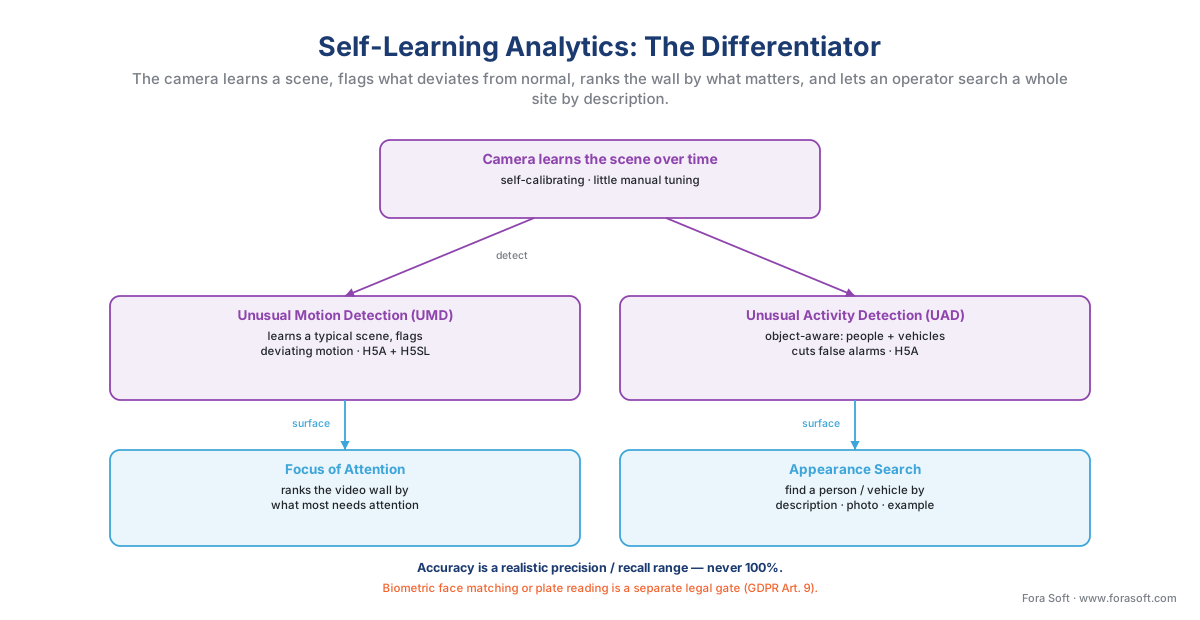 Figure 3. The self-learning analytics chain. The camera learns a scene over time; Unusual Motion Detection and the object-aware Unusual Activity Detection flag deviations; Focus of Attention ranks the video wall by what needs attention; Appearance Search finds a person or vehicle across the whole site. Accuracy is a realistic range, never a perfect number.
Openness, in plain terms: the appliance bet
Every VMS vendor says "open." Avigilon's openness is real but pointed in a particular direction, and naming that precisely is the most useful thing you can do before committing a camera fleet.
Avigilon Unity Video supports ONVIF, the common language that lets cameras and video software from different makers work together, so you can record third-party ONVIF cameras and you are not strictly locked to Avigilon hardware. The on-premises software also exposes a published integration interface — a Microsoft .NET-based Application Programming Interface (API) and Software Development Kit (SDK) — so integrators can connect Unity Video to access control, building management, and other systems. The mechanics of the standard are in ONVIF explained for engineers, and the boundary where ONVIF runs out and a vendor's own driver takes over is in proprietary camera SDKs beyond ONVIF.
Here is the honest contrast, drawn without spin. Milestone optimizes for maximal interoperability — more than sixteen thousand tested devices and a vast third-party marketplace. Genetec optimizes for curated openness with native depth — a hardened, certified-device program. Avigilon optimizes for the appliance: third-party cameras connect over ONVIF for basic recording, but the self-learning analytics, the edge AI, and the tightest performance come from Avigilon's own cameras and appliances. You can mix brands; you get the full product when you do not. That is neither better nor worse than the other two bets — it is a different one. The buyer's job is to be honest about which side of it they are on, because an "Avigilon system" running mostly third-party cameras over ONVIF is buying the recorder and leaving the best part — the analytics — on the shelf. Keep "ONVIF-conformant" and "fully featured on Avigilon hardware" as separate ideas, exactly as you would with any appliance vendor.
The Motorola Solutions ecosystem: video as one pillar
This is the section that separates an Avigilon profile from a Milestone or Genetec one, because Avigilon does not stand alone. Motorola Solutions describes its business as an integrated ecosystem of safety-and-security technologies built on three pillars: land-mobile radio (the mission-critical two-way radios used by public safety and utilities), video security and access control (Avigilon), and the command center (the dispatch, records, and evidence software that runs an emergency-operations or security-operations center). Avigilon is the video pillar, and the strategic promise is that the pillars connect: a license-plate hit or an Avigilon analytics alert can flow into the command-center software and out to a radio in an officer's hand.
For the right buyer, that integration is the differentiator nobody else can match. A city, a university, a transit authority, or a large utility that already runs Motorola radios and command-center software gets a video system from the same vendor, on the same support contract, with the same procurement relationship — and Motorola's portfolio reaches into license-plate recognition (the Vigilant and Avigilon ALPR lines), body-worn and in-car cameras, and 911 software. The whole thing is positioned as one situational-awareness fabric rather than a VMS in isolation.
Two facts make the ecosystem matter even to buyers who do not want the radios. First, Avigilon is a trusted-supplier play: Motorola Solutions builds its cameras to let customers comply with the United States National Defense Authorization Act (NDAA) Section 889 (enacted in the John S. McCain NDAA for Fiscal Year 2019, Public Law 115-232), which bars federal agencies and their contractors from buying video-surveillance equipment from specific Chinese manufacturers on national-security grounds. For a government, critical-infrastructure, or federally funded buyer, NDAA compliance is not a nicety — it is a procurement gate, and Avigilon clears it. Second, the ecosystem is also a lock-in consideration: the more pillars you adopt, the more the switching cost grows. Neither fact is a flaw; both are things an honest evaluation weighs up front. The deployment-model trade-offs themselves — bandwidth, cost, resilience, data residency — are covered in on-prem, cloud, and hybrid VMS.
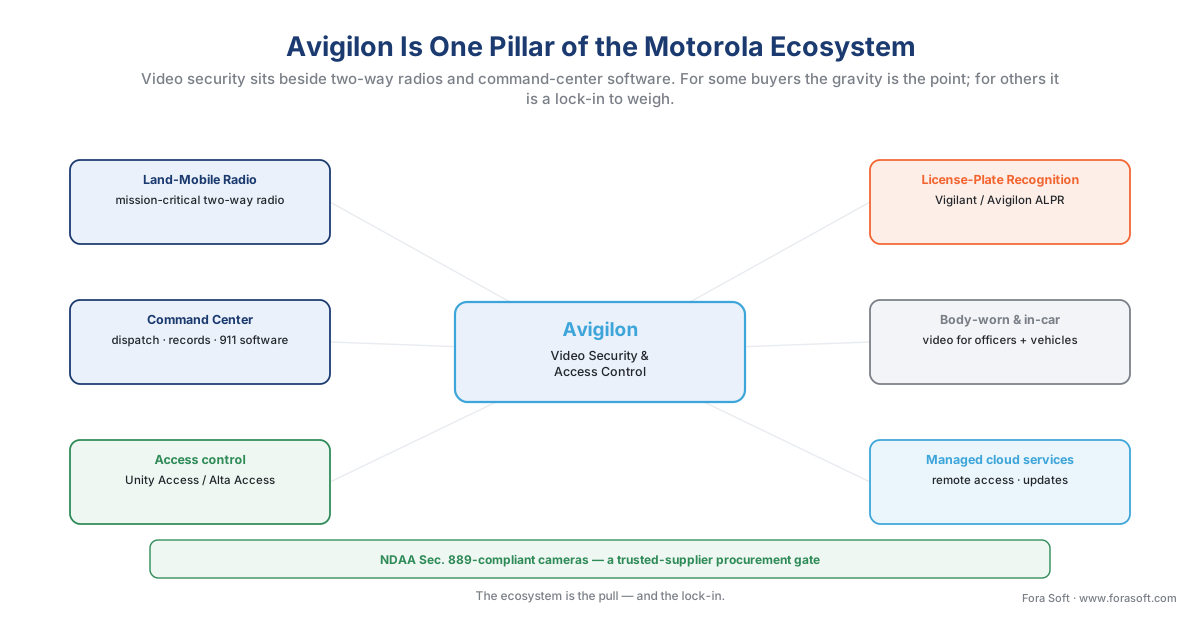 Figure 4. Avigilon inside the Motorola Solutions ecosystem. Video security and access control sits beside land-mobile radio and the command center, with license-plate recognition and body-worn cameras in the portfolio. NDAA Section 889-compliant cameras make it a trusted-supplier choice; the same gravity is a lock-in to weigh.
Licensing and the cost shape: two suites, two models
Avigilon's pricing is the clearest illustration of why the two-suite split matters, because the suites are priced in opposite ways.
Avigilon Unity Video (on-premises) is priced like the enterprise on-prem family: as a capital expense, per camera channel. You buy a one-time licence for each camera you connect, in one of three editions — Core (small sites, up to 24 cameras per server), Standard (up to 75 cameras per server), and Enterprise (300-plus cameras per server, scaling to many thousands across a site) — with the self-learning analytics included on the Avigilon cameras and appliances you bought rather than billed as a separate recurring analytics fee. Avigilon Alta (cloud-native) flips the shape entirely: it is an operating expense, a per-camera subscription that bundles the recording, storage, updates, and remote access into a monthly or annual fee, with no servers to buy or maintain.
Walk one comparison out loud, because the shape is the point, not the exact figures. Take a 200-camera site and look only at the video software over five years (servers, storage, and cameras cost roughly the same whichever way you go, so leave them out). On the on-premises Unity path, treat the channel licence as an illustrative one-time cost:
unity_5yr_software = channel_licence × cameras
unity_5yr_software = $150 × 200
unity_5yr_software = $30,000   (≈ $30 per camera per year over five years, analytics included)
On the cloud Alta path, treat it as an illustrative per-camera subscription:
alta_5yr_software = subscription_per_camera_per_month × cameras × 12 × 5
alta_5yr_software = $25 × 200 × 12 × 5
alta_5yr_software = $300,000   (≈ $300 per camera per year, but storage and servers are included)
The two numbers look wildly different because they are buying different things: the Unity figure is software only and assumes you provide and run the servers and storage; the Alta figure is the whole service with no infrastructure. That is the real decision — not "which is cheaper" but "do you want to own infrastructure and pay capital up front, or rent the whole thing and pay monthly." The numbers are illustrative; Avigilon sells through integrators who quote real, discounted prices, and the channel licence varies by edition. The lesson is the one from the landscape article: compare the shapes on the same five-year footing, including storage and servers, before you sign.
A common mistake to avoid
The costliest Avigilon mistakes are about the two suites and the appliance bet, not the software quality. Three recur. First, buying the wrong suite: choosing on-premises Unity for a small, server-less, multi-site business that would be live faster and cheaper on cloud Alta — or, in reverse, putting a large, latency-sensitive, bandwidth-constrained site on cloud Alta when on-prem Unity would record locally and cost less to run at scale. Second, buying the recorder and skipping the analytics: standing up an "Avigilon system" on mostly third-party ONVIF cameras, then wondering why the self-learning analytics that sold the system are not available — those features need Avigilon cameras and appliances. Third, under-counting the ecosystem: treating Avigilon as a standalone VMS when the value case quietly assumed Motorola radios or command-center integration that has its own cost and its own lock-in. None of these is a flaw in the product; each is a planning gap an honest evaluation closes up front.
Avigilon versus Milestone versus Genetec, without spin
Because these three now define the enterprise on-prem family, the most useful thing a profile can do is place them side by side. All three are top-tier, globally deployed, NDAA-compliant platforms; the choice is about philosophy, not quality.
| VMS platform | Core idea | Deployment model | Open SDK? | Makes its own cameras | Best fit |
|---|---|---|---|---|---|
| Avigilon (Motorola Solutions) | Appliance — cameras + software + edge AI as one package, inside a safety ecosystem | On-prem (Unity) and cloud-native (Alta) as two distinct suites | Yes — .NET API/SDK + ONVIF; analytics tied to Avigilon hardware | Yes — H4/H5/H6 camera lines with on-board AI | Government, public safety, education; buyers wanting self-learning analytics and/or the Motorola ecosystem |
| Genetec Security Center | Unified video + access + ALPR in one cyber-first platform | On-prem · hybrid · SaaS | Yes — Genetec SDK, curated; certified-device program | No — records third-party cameras | Large, regulated, city/enterprise; unified operations |
| Milestone XProtect | Open video platform, maximal interoperability | On-prem · hybrid · cloud | Yes — MIP SDK, maximal; huge partner ecosystem | No — records 16,000+ third-party devices | Multi-vendor camera estates; integration-heavy |
Table 1. Three reference VMS platforms compared on the dimensions a buyer weighs. All three ship a developer kit; the real fork is appliance-and-ecosystem (Avigilon) versus unified-and-curated (Genetec) versus open-and-maximal (Milestone) — and whether you want the camera maker, the access-control owner, or the open recorder.
The plain reading: choose Avigilon when the analytics and the ecosystem are the job — you want self-learning analytics that deploy with minimal tuning, you value buying cameras and software from one NDAA-compliant vendor, or you already live in the Motorola Solutions world of radios and command center, and you want one situational-awareness fabric. Choose Genetec when unification and governance across video, doors, and plates are the job. Choose Milestone when hardware freedom and the widest integration ecosystem are the job. Avigilon's appliance bet gives you the smoothest analytics at the cost of leaning on its hardware; the open camp gives you hardware freedom at the cost of integrating the analytics yourself. Whether to adopt any of the three, assemble on open components, or build is the subject of custom vs off-the-shelf VMS.
Where Fora Soft fits in
Fora Soft has built real-time video, streaming, and computer-vision software since 2005, across 625+ shipped projects, and a meaningful share of our surveillance work lives exactly where a packaged platform like Avigilon meets a customer's own systems — pulling video and analytics events out of a VMS through its API, wiring them into bespoke dashboards, business systems, and custom operator workflows, or building the analytics a buyer needs on third-party cameras that an appliance vendor will not light up. The discipline we bring is the one this section preaches: design for how the system behaves at full camera load and on a bad-network day first — realistic detection precision and recall under real lighting, latency you have measured, recording that does not drop frames under stress — then the feature list. When a team's needs sit between "buy Avigilon" and "build everything," we help weigh extending an appliance platform against assembling on open components, with the honesty that reinventing recording and edge analytics is expensive and the incumbents solved it a long time ago.
Where Avigilon fits — and where it doesn't
An honest profile names both. Avigilon fits when self-learning analytics, a single trusted hardware-and-software vendor, or the Motorola ecosystem is the job: a school district, police department, city, transit authority, or utility that wants strong analytics with minimal tuning, NDAA-compliant cameras from a US-listed vendor, and ideally integration with radios and command-center software it already owns. It is a strong reference choice when the analytics sell the system and the buyer is comfortable leaning on Avigilon hardware to get them.
Avigilon is the wrong tool when the job wants maximum hardware freedom or a single, simple model. A buyer with a large existing multi-vendor camera estate it refuses to replace will get more from the open-platform camp, because Avigilon's best features assume Avigilon cameras. A buyer who wants one clean product, rather than choosing between two suites with different lineages and consoles, may find the Unity-versus-Alta fork more decision than they wanted. And a buyer wary of vendor and ecosystem lock-in should weigh how much of the Motorola world they are stepping into. The leading example of "appliance and ecosystem" is, by the same token, more hardware-coupled and more gravitational than "open and flexible" or "unified and curated" — which is exactly why the next profiles in this block, starting with the AI-native platforms Ambient.ai, Spot AI, and Eagle Eye Networks, are worth reading before you choose.
What to read next
- Genetec Security Center
- AI-native platforms: Ambient.ai, Spot AI, Eagle Eye Networks
- Custom vs off-the-shelf VMS: the real decision
For the commercial overview of the market this profile sits inside, see Fora Soft's video surveillance management systems playbook and the rundown of modern VMS software features.
Call to action
- Talk to a surveillance engineer — book a 30-minute scoping call to talk through your avigilon plan.
- See our case studies — 250+ shipped projects across video streaming, WebRTC, OTT, telemedicine, e-learning, surveillance, and AR/VR.
- Download the Avigilon and Motorola Solutions — Evaluation Field Guide — One-page evaluation field guide for Avigilon under Motorola Solutions: the one-brand-two-suites split (Unity on-prem vs Alta cloud), the appliance model (cameras + recorder + edge AI + HDSM), the self-learning analytics (UMD, UAD,….
References
- ONVIF — "ONVIF Profiles" (an ONVIF profile is a fixed set of features a conformant device and client must support; "conformance to profiles is the only way that ensures compatibility between ONVIF conformant products"; video systems use Profiles D, G, M, S, and T; "compliance to regulations… are outside the scope of ONVIF." Page modified 2026-05-11). Primary standard (tier 1). https://www.onvif.org/profiles/
- United States Congress — "John S. McCain National Defense Authorization Act for Fiscal Year 2019, Section 889 (Public Law 115-232)" (bars federal agencies, their contractors, and grant/loan recipients from procuring or using telecommunications and video-surveillance equipment or services from named manufacturers on national-security grounds; signed 13 August 2018; implemented via the FAR interim rule). Primary law (tier 1). https://www.congress.gov/bill/115th-congress/house-bill/5515/text
- European Union — "General Data Protection Regulation (Regulation (EU) 2016/679)" (Art. 9 treats biometric data used to uniquely identify a person as special-category data; Art. 25 requires data protection by design and by default; Art. 35 requires a Data Protection Impact Assessment for high-risk processing such as large-scale systematic monitoring — the legal frame any face-recognition or plate-reading feature in an Avigilon deployment must answer to). Primary law (tier 1). https://eur-lex.europa.eu/eli/reg/2016/679/oj
- IEC — "IEC 62676 series: Video surveillance systems for use in security applications" (specifies minimum requirements and recommendations across the system lifecycle; EN IEC 62676-4:2025 covers application guidelines including information security and data privacy — the system-level floor any VMS, appliance or open, should meet). Primary standard (tier 1). https://webstore.iec.ch/en/publication/34391
- Motorola Solutions — "Motorola Solutions Unveils New Avigilon Security Suite, Introduces Avigilon Alta Cloud and Avigilon Unity On-Premise" (14 March 2023: the suite integrates technologies from three acquisitions — Avigilon 2018, Openpath 2021, Ava Security 2022; Avigilon Alta is cloud-native, Avigilon Unity is on-premises with Avigilon Control Center, Cloud Services, and Access Control Manager; the business reached over $1.5 billion annual sales in 2022; Motorola Solutions cameras let customers comply with NDAA Sec. 889 — the two-suite structure, lineage, and NDAA posture). First-party press (tier 3). https://www.motorolasolutions.com/newsroom/press-releases/avigilon-security-suite.html
- Avigilon — "Avigilon Unity Video 8" datasheet and on-premise product pages (Avigilon Unity Video, formerly Avigilon Control Center / ACC; Core, Standard, and Enterprise editions with per-server camera limits of 24 / 75 / 300+; ONVIF support; HDSM and HDSM SmartCodec high-definition stream management; H.265/H.264 support — the on-prem suite, editions, HDSM, and ONVIF claims). First-party engineering (tier 3). https://www.avigilon.com/vms/on-premise
- Avigilon — "Unusual Activity Detection" and "Unusual Motion Detection" / "Appearance Search" analytics pages (UMD continuously learns a typical scene and flags deviating motion, embedded on H5A and H5SL; UAD is object-aware and flags atypical behavior of learned people and vehicles, embedded on H5A; Appearance Search finds a person or vehicle by description, photo, or example across a site; Focus of Attention ranks the video wall — the self-learning analytics differentiator). First-party engineering (tier 3). https://www.avigilon.com/products/ai-video-analytics/unusual-activity-detection
- Avigilon / Motorola Solutions — "Avigilon Alta" and "Alta Aware" cloud documentation (Avigilon Alta is the cloud-native suite combining Ava Security video and Openpath access control; Alta Aware includes license-plate recognition as a licensed feature, working with Alta cloud-native, Avigilon Ava, and third-party cameras — the cloud suite and its LPR). First-party engineering (tier 3). https://docs.avigilon.com/bundle/alta-video/page/Products/aware/lpr/lpr.htm
- Motorola Solutions — "Motorola Solutions to Complete US $1 Billion Acquisition of Avigilon" (announced February 2018, closed 28 March 2018, ~US$1.0 billion enterprise value, CAD$27.00 per share all-cash — the acquisition that made Avigilon part of Motorola Solutions). Vendor press (tier 4). https://www.motorolasolutions.com/newsroom/press-releases/motorola-solutions-to-acquire-avigilon-leader-in-advanced-video-surveillanc.html
- Motorola Solutions — "Motorola Solutions to Acquire Cloud-Based Mobile Access Control Provider Openpath" (July 2021, ~$297 million; Openpath's cloud mobile access control became the access half of Avigilon Alta — the 2021 acquisition). Vendor press (tier 4). https://www.motorolasolutions.com/newsroom/press-releases/motorola-solutions-to-acquire-cloud-based-mobile-access-control-provider-op.html
- Motorola Solutions — "Motorola Solutions Reports Fourth-Quarter and Full-Year 2025 Financial Results" (full-year 2025 revenue of $11.7 billion, up 8%; Video Security and Access Control up 14% for the year; business organized into Products & Systems Integration and Software & Services segments across LMR, Video, and Command Center — the parent's scale and the video-business growth). Vendor press / SEC (tier 4). https://www.motorolasolutions.com/newsroom/press-releases/motorola-solutions-reports-q4-2025-financial-results.html
- IPVM and Gartner Peer Insights — "Avigilon vs Genetec vs Milestone" (independent practitioner comparison: Avigilon is camera-led with strong built-in analytics and an appliance model; Genetec leads on unified access and cyber posture; Milestone leads on open interoperability — the honest, even-handed market comparison and where each fits). Institutional / analyst (tier 5). https://www.gartner.com/reviews/market/video-surveillance-management-systems
