


Why this matters
If you are evaluating a Video Management System (the software platform that ingests, records, and manages camera streams, abbreviated VMS), Genetec Security Center will be on almost every enterprise and public-sector shortlist, and for a specific reason: independent analysts at Omdia have ranked Genetec the world's number-one video-surveillance-software vendor, and number one in the Americas for fourteen years running. Understanding it well teaches you how the unified, vertically integrated VMS family behaves — its cost shape, its integration philosophy, and the cybersecurity-first posture that sets it apart from the open-platform camp. Genetec is a privately held company, founded in Montreal in 1997, that sells almost entirely through certified integrators, so its choices ripple across the whole market you are buying into. Read this profile to judge whether Security Center fits your deployment, and to calibrate it against the open-platform reference we profiled in Milestone XProtect.
Where Security Center sits: the unified, cyber-first reference
In the VMS vendor landscape we argued that the durable way to read this market is by deployment family first — enterprise on-prem, cloud-native video-surveillance-as-a-service, open hybrid, and custom-built — because the family fixes your cost shape and your lock-in long before the brand does. Genetec Security Center is the leading example of the enterprise on-prem family, like Milestone. But where Milestone's identity is openness, Genetec's identity is unification, and that one word is the most useful thing to understand about the product.
A traditional security site runs three separate systems that barely talk: a VMS for cameras, an access-control system for doors and badges, and — if there is one — a license-plate-reading system for the parking lot or gate. Each has its own software, its own operator screen, its own database, and its own vendor. Security Center collapses those three into one platform. The cameras run on a module called Omnicast, the doors and badges on a module called Synergis, and the plate reading on a module called AutoVu — and all three are native parts of the same product, watched from one operator screen and configured with one tool. Think of Security Center less as a VMS and more as a single control room for everything a security team touches.
That unification is both the product's core value and the reason it is heavier and more expensive to adopt than a sealed cloud box or even an open VMS that only does video. It also comes wrapped in a second trait that defines Genetec: a cybersecurity-first posture. Where some vendors will record any camera you point at them, Genetec leans toward a curated, hardened, certificate-managed system — a deliberate trade of maximum openness for maximum control over the attack surface. Hold those two ideas — unified and cyber-first — because everything else about the product follows from them.
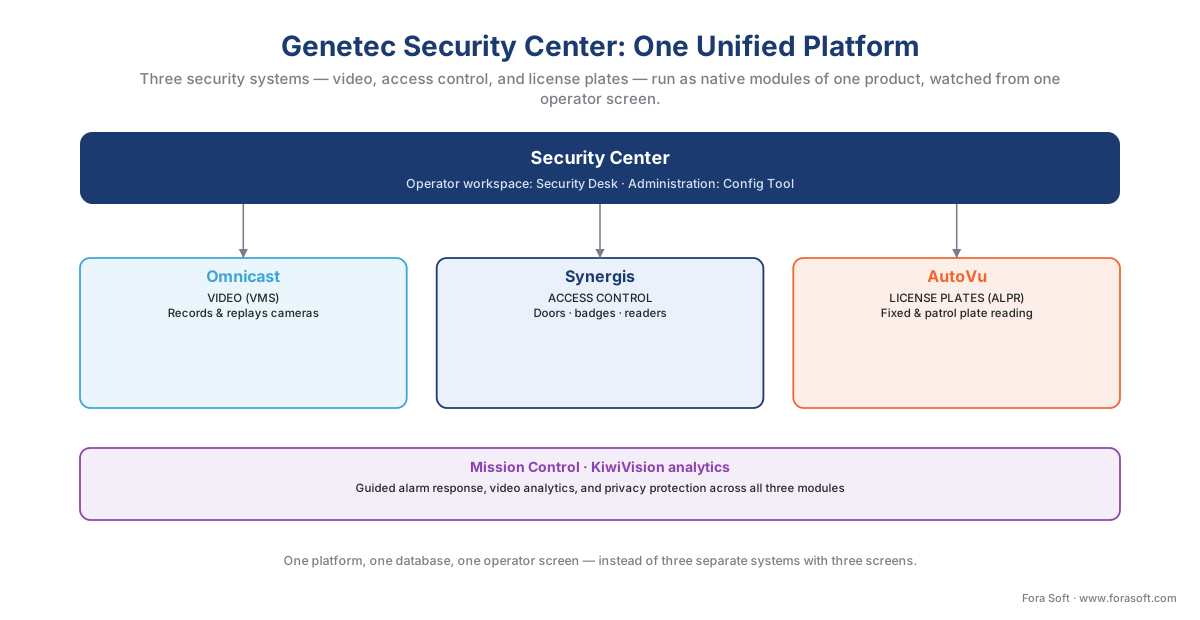 Figure 1. The unified platform. Omnicast (video), Synergis (access control), and AutoVu (license-plate recognition) are native modules of one product, sharing one operator workspace (Security Desk) and one administration tool (Config Tool).
The unified platform, module by module
Security Center is not one feature but a family of native modules that share a database, a permission model, and an operator screen. Knowing the names saves you from a common confusion, because integrators use the module names and the platform name interchangeably.
Omnicast is the video management system inside Security Center — the part that ingests, records, and replays camera streams. When someone says "Genetec for video," they mean Omnicast running on Security Center. Synergis is the access-control system — the part that governs doors, badge readers, and who may enter where, integrating with door-controller hardware. AutoVu is the automatic license-plate-recognition system (ALPR, also called ANPR) — fixed cameras at a gate or patrol-vehicle cameras on a city street that read plates for parking, access, and law enforcement; the mechanics of plate reading itself are covered in license-plate recognition (LPR/ANPR).
Around those three sit higher-level modules. Mission Control is a decision-management layer that turns a flood of alarms into guided, step-by-step operator responses — the kind of tool a city or a large campus needs when one operator watches thousands of cameras. KiwiVision is Genetec's built-in video-analytics engine, including the privacy feature we cover below. The single operator application that ties everything together is Security Desk; the single administration application is Config Tool. One badge swipe, one plate read, and one camera alarm all land in the same Security Desk timeline — that is what "unified" buys an operator.
How Security Center is built: roles on servers
To understand both Security Center's scale and its weight, you need a plain picture of how it is assembled. Like XProtect, it is a distributed system of cooperating services — Genetec calls them roles — not a single application, and that design is what lets one deployment grow from one building to a federated city.
At the center is the Directory role: the brain that identifies the whole system, holds its configuration in a Microsoft SQL Server database, authenticates users, and enforces permissions. Every other role communicates through the Directory. Doing the heavy video work is the Archiver role: it discovers and polls the cameras, pulls each camera's stream, and writes the recordings to storage — the part that behaves like a Network Video Recorder (the appliance or software that records IP cameras, abbreviated NVR). Sitting between the cameras and the people watching them is the Media Router role: it routes live and recorded video streams efficiently to each operator, so that ten operators viewing one camera do not each open a separate pull from that camera.
The practical move, exactly as in the open-platform family, is that these roles can be spread across servers. The main server hosts the Directory; expansion servers host Archivers, Media Routers, and the rest. When you need to record more cameras, you add an Archiver server rather than replacing the system. For resilience, Genetec supports failover — a standby server takes over a failed role — including Directory failover with load balancing and redundant archiving, often backed by SQL Server's own high-availability features. The headline is the one from the storage and scaling articles: recording throughput and storage, not the licence, are what actually size the hardware, so a serious Security Center project always includes a capacity plan. We walk through that arithmetic in scaling a VMS: capacity planning, and the full cost treatment, including the storage math, lives in the surveillance cost model.
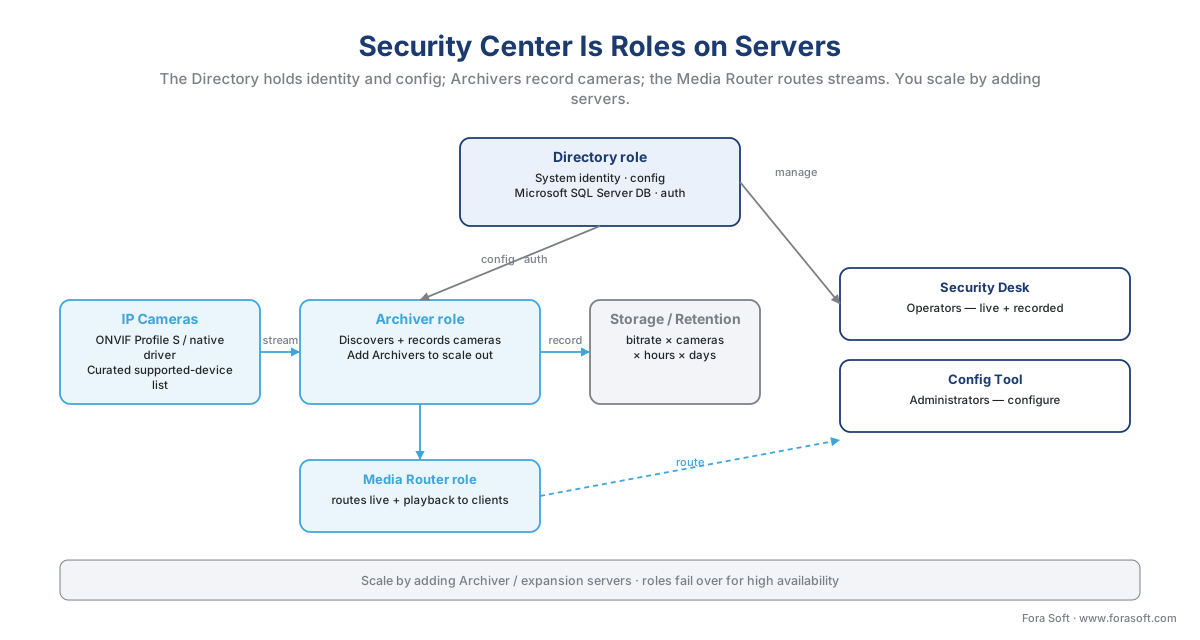 Figure 2. Security Center as roles on servers. The Directory holds configuration and identity in SQL; Archivers ingest and record camera streams; the Media Router routes live and playback video to clients. You scale by adding Archiver and expansion servers, not by swapping the platform.
Openness, in plain terms: curated, not maximal
Every VMS vendor says "open." Genetec is open in a real but deliberately narrower sense than Milestone, and naming that difference precisely is the single most useful thing you can learn before you commit a camera fleet.
Security Center does support ONVIF, the common language that lets cameras and video software from different makers work together. Its cloud platform conforms to ONVIF Profile S — the streaming profile — and its on-premises Archiver speaks ONVIF and native, camera-specific drivers for the major manufacturers. So you are not locked to a single hardware brand. But Genetec curates which devices it fully supports through a tiered program: Genetec Certified devices are tested by Genetec itself; Partner Certified devices are tested by trusted partners; and other devices are "supported by design" if they meet ONVIF technical criteria. Major camera makers — Axis, Bosch, i-PRO, Hanwha — sit on the certified list. The mechanics of the standard are in ONVIF explained for engineers, and the boundary where ONVIF runs out and a vendor driver takes over is in proprietary camera SDKs beyond ONVIF.
Here is the honest contrast, drawn without spin. Milestone's philosophy is maximal interoperability: more than sixteen thousand tested devices, a Universal Driver fallback for almost anything, and a vast third-party application ecosystem built on its developer kit. Genetec's philosophy is curated openness with native depth: a published Software Development Kit (SDK) for partners and your own team, native modules for access control and plates rather than third-party wrappers, and a supported-device program that trades the long tail of cheap cameras for a known, hardened, tested set. One is a marketplace; the other is a walled garden with a wide, well-kept gate. Neither is "more open" in a way that wins every argument — they are different bets, and the right one depends on whether you value the widest hardware choice or the deepest native integration and the tightest control of your attack surface.
That cyber-first control is not marketing. Genetec ships a hardening guide, manages camera certificates and passwords from inside the platform, encrypts streams, and openly advises public-sector buyers to identify and replace cameras from manufacturers flagged under the U.S. National Defense Authorization Act (NDAA) as a cyber risk. For a buyer in a regulated or critical-infrastructure setting, that posture is a feature, not a limitation — but it is the reason a bargain camera you already own may not be on the certified list. Keep "ONVIF-conformant" and "fully supported and hardened" as separate ideas.
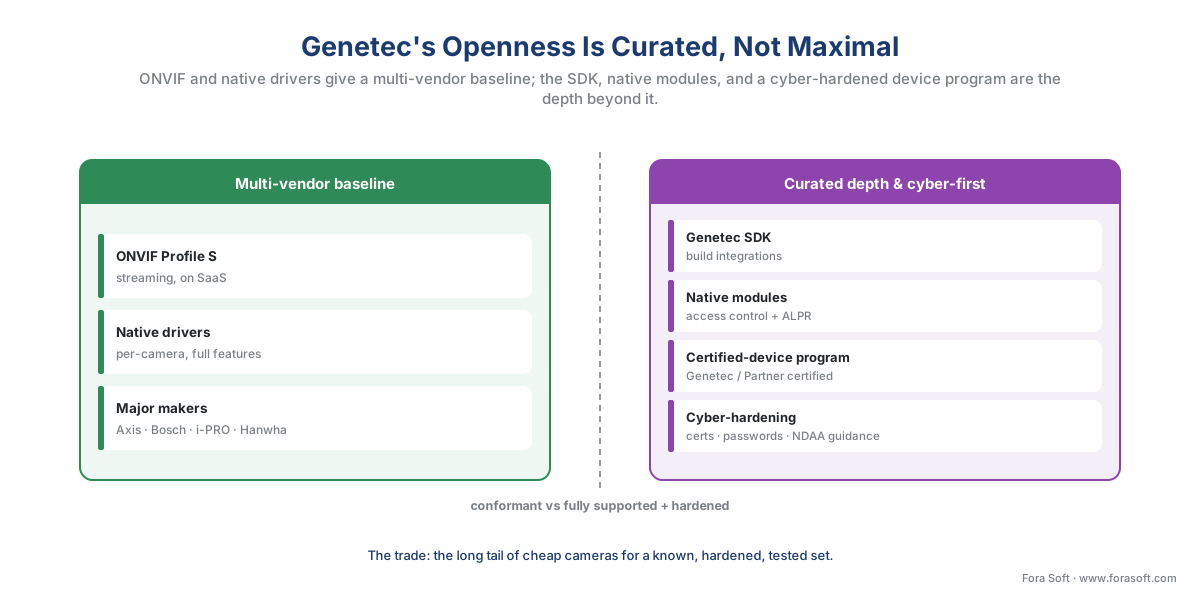 Figure 3. Genetec's curated openness. ONVIF Profile S plus native drivers give a multi-vendor baseline; the Genetec SDK, native access/ALPR modules, and a cyber-hardened certified-device program are the depth beyond it. The trade is the long tail of cheap cameras for a known, hardened set.
Cloud and hybrid: where Genetec is heading
Security Center began as on-premises software, but Genetec now spans the deployment spectrum, and a fair profile has to account for the direction of travel. On-premises Security Center remains the core — software you license and run on your own servers, at a scale that reaches from one building to a federated national estate.
For the cloud, Genetec runs two distinct products, and confusing them is a common scoping error. Stratocast is the cloud video-surveillance-as-a-service (VSaaS) offering aimed at smaller and multi-site deployments: cameras record directly to the cloud, with no on-site recording server, billed as a subscription. Security Center SaaS is the newer, full cloud version of the unified platform itself — cloud access control and video together, with built-in video anonymization — evolving quickly, with 2026 updates adding a unified front-desk experience, broader intrusion-panel support, and optional biometric authentication. Bridging on-prem and cloud is a line of appliances: Streamvault turnkey servers and edge appliances, and Cloudlink cloud-managed bridge appliances that connect local cameras to Security Center SaaS without shipping every full stream to the cloud. The deployment-model trade-offs themselves — bandwidth, cost, resilience, data residency — are covered in on-prem, cloud, and hybrid VMS.
In short, Genetec's answer to the cloud-native challengers is the same shape as Milestone's: offer on-prem, hybrid, and cloud-native under one umbrella rather than forcing a single model. The difference is that Genetec's umbrella covers access control and plates too, not just video.
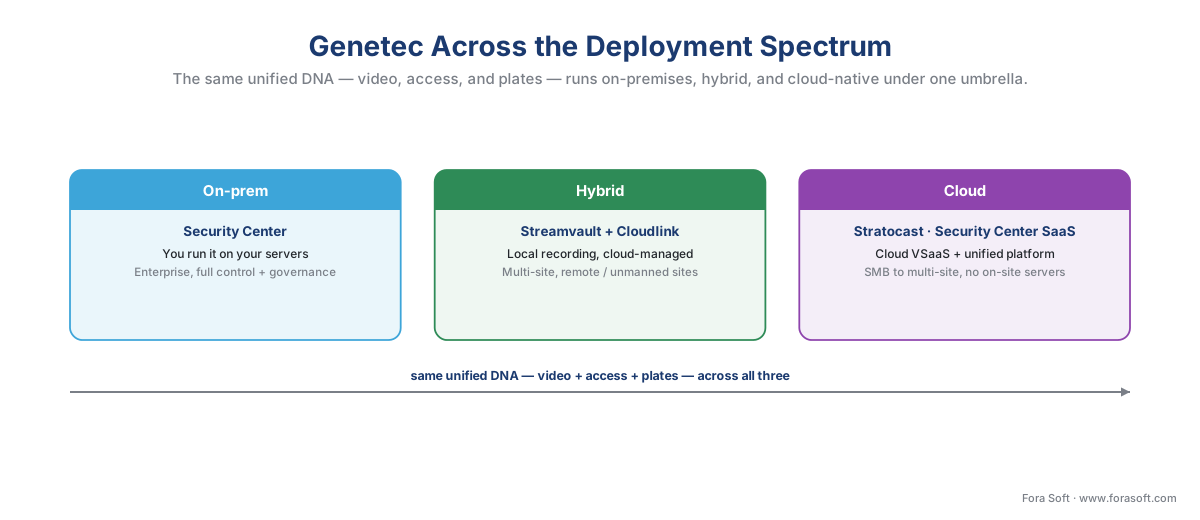 Figure 4. Genetec across the deployment spectrum. The same unified DNA runs on-premises (Security Center), hybrid (Streamvault and Cloudlink appliances), and cloud-native (Stratocast VSaaS, Security Center SaaS).
Privacy by design: the KiwiVision Privacy Protector
One Genetec feature deserves its own section, because it is a genuine differentiator and it ties straight into the privacy law this whole section takes seriously. The KiwiVision Privacy Protector is a module that automatically blurs or pixelates the moving people in a video stream — live and recorded — while keeping their actions and movements visible. An operator watches anonymized figures going about a space; the original, identifiable footage is locked, and only a specifically authorized user, passing a second layer of authentication, can lift the anonymization for an investigation.
Why this matters legally: under the European Union's General Data Protection Regulation (GDPR, Regulation (EU) 2016/679), identifiable video of people is personal data, and the regulation expects "data protection by design and by default" (Art. 25). A system that records everyone in the clear, all the time, and shows their faces to every operator is harder to justify than one that anonymizes by default and reveals identity only on a controlled, logged exception. Privacy Protector is the first video product to earn the EuroPriSe "GDPR-ready" European Privacy Seal — an independent certification that the source code cannot be trivially exploited to suspend the anonymization. For buyers in privacy-sensitive or European deployments, that is a real, certifiable advantage, not a slogan.
It remains, of course, a tool and not a legal absolution. Anonymizing the routine view does not by itself make face recognition or plate reading lawful where they are restricted, and the underlying biometric questions still apply — face templates are special-category data under GDPR Art. 9, and reading and storing plates carries its own retention-law weight. We treat the law itself in GDPR for video surveillance and the biometric gate in face recognition in surveillance; the point here is that Genetec gives you a strong, certified mechanism to honor those obligations, which not every VMS does.
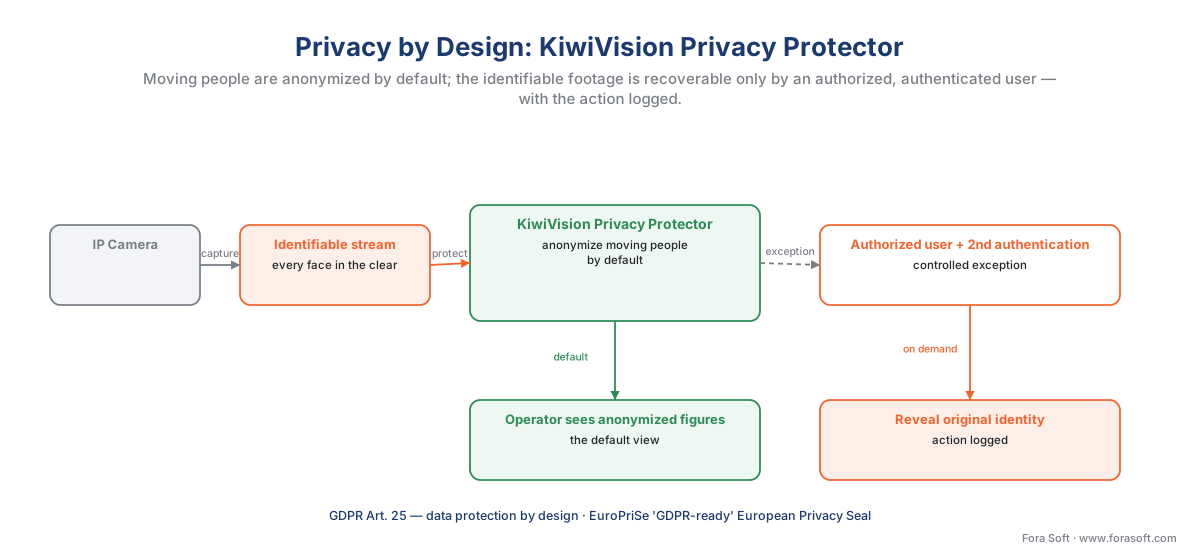 Figure 5. Privacy by design in Security Center. KiwiVision Privacy Protector anonymizes moving people by default; the identifiable footage is recoverable only by an authorized user through a second authentication layer, with the action logged.
Licensing and the cost shape
Security Center is priced the way the enterprise on-prem family is priced: as a capital expense, not a subscription, and per connection. You buy a licence for each camera connection, each door or reader, and each ALPR unit you connect, then add Genetec Advantage — the software-maintenance plan that entitles you to upgrades, premium support, and system-availability monitoring (the same role Milestone Care plays for XProtect). Genetec also sells Streamvault appliances that bundle the server hardware and the software, which simplifies procurement at the cost of buying Genetec's box. The cloud products — Stratocast and Security Center SaaS — flip the shape to a recurring subscription per camera per month.
Walk the arithmetic out loud once, because the shape is the point, not the exact figures. Take a unified site with 200 cameras and 50 access-controlled doors, and look only at the software over five years (servers, storage, and cameras cost roughly the same whichever VMS you pick, so leave them out). Treat the connection licence as an illustrative one-time cost and Advantage as an illustrative annual percentage of licence value:
gsc_5yr_software = (camera_licence × cameras)
                   + (door_licence × doors)
                   + (advantage_per_year × 5)
gsc_5yr_software = ($250 × 200) + ($300 × 50) + ($13,000 × 5)
gsc_5yr_software = $50,000 + $15,000 + $65,000 = $130,000
That is the cost of running video and access control on one platform — roughly $108 per camera-or-door per year for software over five years, with one vendor, one database, and one operator screen instead of two separate systems to license, integrate, and maintain. Put that beside the alternative of buying a separate VMS and a separate access-control system and paying an integrator to wire them together, and the unified shape often wins on total operational cost even when its sticker price is higher. The numbers are illustrative — Genetec sells only through certified partners who quote real, discounted prices, and the connection licence varies by edition and module. The lesson is the one from the landscape article: compare the shapes on the same five-year footing, including maintenance, before you sign.
A common mistake to avoid
The costliest Security Center mistakes are not about the software at all — they are about assumptions. Three recur. First, buying the platform when a product would do: a 20-camera single site with no access control and no plates does not need the unified flagship — Stratocast, the cloud VSaaS, will be live faster and cheaper, and reaching for full Security Center there is over-buying. Second, assuming any camera will be fully supported: Genetec's curated, cyber-hardened device program means a bargain camera you already own may connect over ONVIF but miss native features or sit off the certified list — check the supported-device list for the exact models and features you need before buying the fleet, not just "does it connect." Third, forgetting Advantage in the multi-year budget: the connection licences are a one-time number, but the maintenance plan recurs, and a quote that omits it understates the real total. None of these is a flaw in the product; each is a planning gap that an honest evaluation closes up front.
Genetec versus Milestone, without spin
Because these two define the enterprise on-prem family, the most useful thing a profile can do is place them side by side. Both are top-tier, globally deployed, NDAA-compliant platforms; the choice is about philosophy, not quality.
| VMS platform | Core idea | Deployment model | Open SDK? | Native access control | Best fit |
|---|---|---|---|---|---|
| Genetec Security Center | Unified video + access + ALPR in one platform | On-prem · hybrid · SaaS (Stratocast, Security Center SaaS) | Yes — Genetec SDK, curated; native modules over wrappers | Yes — Synergis is native | Large, regulated, city/enterprise; unified operations; cyber-first buyers |
| Milestone XProtect | Open video platform, maximal interoperability | On-prem · hybrid · cloud (Kite, XProtect on AWS) | Yes — MIP SDK, maximal; huge partner ecosystem | No — wraps third-party access systems | Multi-vendor camera estates; integration-heavy; mid-market to enterprise |
Table 1. Two reference VMS platforms compared on the dimensions a buyer weighs. Both ship a developer kit and span the deployment spectrum; the real fork is unified-and-curated (Genetec) versus open-and-maximal (Milestone), and whether you need native access control in the same product.
The plain reading: choose Genetec when unification and governance are the job — you want video, doors, and plates in one cyber-hardened platform, you operate at city or enterprise scale, and you are in a regulated sector that values a privacy-certified, NDAA-aware posture. Choose Milestone when hardware freedom and the widest integration ecosystem are the job — a multi-vendor camera estate you refuse to lock down, a need to plug in best-of-breed analytics from many partners, or a tighter budget at mid-market scale. Genetec tends to cost more and assumes more infrastructure; Milestone tends to be more flexible on hardware and price. Whether to adopt either, assemble on open components, or build is the subject of custom vs off-the-shelf VMS.
Where Fora Soft fits in
Fora Soft has built real-time video, streaming, and computer-vision software since 2005, across 625+ shipped projects, and a meaningful share of our surveillance work lives exactly where a platform like Security Center meets a customer's own systems — integrating a unified VMS with bespoke analytics, external business systems, and custom operator workflows through its SDK, or building the parts a packaged platform does not cover. The discipline we bring is the one this section preaches: design for how the system behaves at full camera load and on a bad-network day first — realistic detection precision and recall under real lighting, latency you have measured, recording that does not drop frames under stress — then the feature list. When a team's needs sit between "buy Genetec" and "build everything," we help weigh extending a unified platform against assembling on open components, with the honesty that reinventing recording and access control is expensive and the incumbents solved it a long time ago.
Where Security Center fits — and where it doesn't
An honest profile names both. Security Center fits when unification, scale, and governance are the job: a campus, airport, transit authority, or city that wants video, access control, and license plates in one cyber-hardened platform; a regulated environment that values a privacy-certified, NDAA-aware posture; or any operation large enough that running three separate systems is the real cost. It is the safe reference choice for big, serious, security-led deployments precisely because so much is native and so much is hardened.
Security Center is the wrong tool when the job is small and simple. For a 20-camera single site with no access control, no plates, and no IT staff, the full unified platform is over-bought — Genetec's own Stratocast cloud VSaaS, or another cloud platform, will be live faster, update itself, and skip the servers and the integrator. Security Center also assumes you bring infrastructure and competence: servers to size, recording capacity to plan, substantial bandwidth for multi-site viewing, and almost always a certified integrator to deploy it well. And teams that want the widest possible hardware choice, or the lowest price at mid-market scale, will often find the open-platform camp a better fit. The leading example of "unified and cyber-first" is, by the same token, heavier and more premium than "open and flexible" — which is exactly why the next profiles in this block, starting with Avigilon and Motorola Solutions, are worth reading before you choose.
What to read next
For the commercial overview of the market this profile sits inside, see Fora Soft's video surveillance management systems playbook and the rundown of modern VMS software features.
Call to action
- Talk to a surveillance engineer — book a 30-minute scoping call to talk through your genetec security center plan.
- See our case studies — 250+ shipped projects across video streaming, WebRTC, OTT, telemedicine, e-learning, surveillance, and AR/VR.
- Download the Genetec Security Center — Evaluation Field Guide — One-page evaluation field guide for Genetec Security Center: the unified platform at a glance (Omnicast video, Synergis access control, AutoVu ALPR, Mission Control, KiwiVision), what 'unified' means and the trade vs an open VMS, the….
References
- ONVIF — "ONVIF Profiles" (an ONVIF profile is a fixed set of features a conformant device and client must support; "conformance to profiles is the only way that ensures compatibility between ONVIF conformant products"; video systems use Profiles D, G, M, S, and T; "compliance to regulations… are outside the scope of ONVIF." Page modified 2026-05-11). Primary standard (tier 1). https://www.onvif.org/profiles/
- European Union — "General Data Protection Regulation (Regulation (EU) 2016/679)" (Art. 25 requires data protection by design and by default; Art. 9 treats biometric data used to uniquely identify a person as special-category data; Art. 35 requires a Data Protection Impact Assessment for high-risk processing such as large-scale systematic monitoring — the legal frame KiwiVision Privacy Protector and any biometric analytics in a Security Center deployment must answer to). Primary law (tier 1). https://eur-lex.europa.eu/eli/reg/2016/679/oj
- IEC — "IEC 62676 series: Video surveillance systems for use in security applications" (specifies minimum requirements and recommendations across the system lifecycle; EN IEC 62676-4:2025 covers application guidelines including information security and data privacy — the system-level floor any VMS, unified or not, should meet). Primary standard (tier 1). https://webstore.iec.ch/en/publication/34391
- Genetec — "Security Center architecture overview" / "About the Directory role," "About the Archiver role," "About the Media Router role" (Security Center Administrator Guide 5.13: the Directory identifies the system and holds configuration in a Microsoft SQL Server database; the Archiver handles camera discovery, status, and video recording/storage; the Media Router routes live and playback streams; roles run on a main server plus expansion servers, with failover for high availability). First-party engineering (tier 3). https://techdocs.genetec.com/r/en-US/Security-Center-Administrator-Guide-5.13/Security-Center-architecture-overview
- Genetec — "Security Center unified security platform" (Security Center unifies Omnicast video management, Synergis access control, and AutoVu automatic license-plate recognition, plus communications and intrusion, in one interface — the unified-platform claim and the module names). First-party product page (tier 3). https://www.genetec.com/products/unified-security/security-center
- Genetec — "Notes about integrating ONVIF compliant units" / "Supported device list" and Security Center SaaS device-compatibility guidelines (Security Center supports ONVIF — Profile S on SaaS — alongside native drivers; devices are Genetec Certified, Partner Certified, or supported-by-design; Axis, Bosch, i-PRO, and Hanwha among supported manufacturers — the curated-openness and supported-device-tier claims). First-party engineering (tier 3). https://www.genetec.com/supported-device-list
- Genetec / EuroPriSe — "About the KiwiVision Privacy Protector module" and the "GDPR-ready" European Privacy Seal (Privacy Protector dynamically anonymizes individuals in live and recorded video while preserving actions; original footage is recoverable only by authorized users with layered authentication; it is the first/only video product certified GDPR-ready by EuroPriSe, whose code review checks that anonymization cannot be trivially suspended). First-party engineering + independent certification (tier 3). https://techdocs.genetec.com/r/en-US/KiwiVisionTM-User-Guide-for-Security-Center-5.12.1.0/About-the-KiwiVision-Privacy-Protector-module
- Genetec — "Security Center SaaS" and "Stratocast" / "Streamvault" / "Genetec Cloudlink" (Security Center SaaS is the cloud unified platform with built-in video anonymization; Stratocast is the cloud VSaaS for smaller and multi-site deployments; Streamvault appliances and Cloudlink bridge appliances provide the hybrid path — the deployment-spectrum claims). First-party product pages (tier 3). https://www.genetec.com/products/unified-security/security-center-saas
- Genetec — "Genetec Advantage" (the software-maintenance plan: software upgrades, premium support, and system-availability monitoring — the recurring maintenance layer over the per-connection capital licence). First-party product page (tier 3). https://www.genetec.com/support/lifecycle-management
- Omdia (via Genetec press) — "Genetec retains top global ranking in video surveillance software" (Omdia's 2025 Video Surveillance & Analytics Market Share Database ranks Genetec number one worldwide in video surveillance software and in combined video-surveillance software + VSaaS; number one in the Americas for the fourteenth consecutive year, number two EMEA, number three Asia-Pacific). Analyst data cited via vendor press (tier 4). https://www.genetec.com/press-center/press-releases/2025/10/genetec-continues-to-expand-its-share-of-the-global-access-control-software-market-according-to-latest-omdia-report
- Genetec — "Genetec cautions public sector to harden physical security systems" (Genetec advises buyers to identify and replace cameras from manufacturers listed under the U.S. NDAA as a high cyber risk, and to unify physical and cyber controls on one open-architecture platform — the cyber-first posture and the hardening guidance). First-party / company guidance (tier 4). https://www.securityinfowatch.com/perimeter-security/physical-hardening/press-release/21264187
- IPVM and Gartner Peer Insights — "Genetec Security Center vs Milestone XProtect" (independent practitioner comparison: Genetec pushes vertical integration with native access control while Milestone champions open interoperability and wraps third-party access; Milestone is generally lower-priced for small-to-mid projects, Genetec stronger for very large and cloud-and-access deployments — the honest market comparison). Institutional/analyst (tier 5). https://www.gartner.com/reviews/market/video-surveillance-management-systems/compare/genetec-vs-milestone-systems
