


This is engineering guidance, not legal advice. Confirm specifics — especially anything touching children's data, background checks, and payments — with qualified counsel.
Why This Matters
If you are scoping a tutoring or repetitor marketplace — a language-exchange platform, a K-12 homework-help service, a test-prep marketplace, a music-lessons site — you are commissioning a two-sided business whose hardest problems are liquidity and trust, not media delivery. A massive open online course lives or dies on whether the cost of serving a free learner stays below the revenue from the few who pay; a tutoring marketplace lives or dies on whether a learner who searches for "GCSE physics, Tuesday evening" finds a bookable tutor, trusts a stranger enough to pay, and comes back next week through your platform instead of a private bank transfer. This article gives a founder, product lead, or education-business operator the complete architectural map of a tutoring marketplace, so you can brief engineers precisely, judge a vendor or a no-code marketplace stack against a real reference design, and understand where the money and the risk actually sit. It is written for the non-engineer making the build-versus-buy call, but it stays accurate enough for the platform architect and the real-time-video engineer who will build it.
First, the Three Facts That Organize Everything
A tutoring marketplace looks, in a demo, like any other learning product: a catalog, a video call, a payment. As with every learning product, the resemblance hides the point. We covered two other shapes already — the corporate-LMS reference architecture, shaped entirely by its integrations into the systems it does not own, and the MOOC / open-course reference architecture, shaped by scale and a steep completion funnel. A tutoring marketplace is shaped by something different again. Three facts, none of which a content platform faces, drive every architectural choice.
The first fact is that there is no content to own — the product is a person's live time. A corporate LMS and a MOOC both deliver media: recorded lectures, readings, quizzes that exist whether or not anyone is watching. A tutoring marketplace has almost no inventory of its own. What it sells is a slot on a tutor's calendar and the live hour that fills it. That single fact inverts the architecture. The hard engineering is not authoring, transcoding, and delivering video to a crowd; it is matching the right two people, locking a time across time zones, running one excellent live lesson, and moving money between strangers. Video at scale, the cost center of a MOOC, is here a small line item, because a one-to-one lesson is one of the cheapest things you can stream.
The second fact is that liquidity is the whole game. A marketplace is two-sided: it has to attract tutors (the supply) and learners (the demand) at the same time, and neither side shows up for an empty room. This is the classic chicken-and-egg, or cold-start, problem — neither side wants to join until the other is present, but the other will not join either. A MOOC serves one crowd of free learners; a marketplace must balance two populations so that, at the moment a learner searches, a suitable tutor is actually available to book. The measure of that is liquidity — the likelihood that a search returns a bookable match — and it is the single most important property of the platform. Most of the planes below exist to manufacture and protect it.
The third fact is that the transaction is built on trust between strangers, and one of them is often a minor. A learner is about to pay money to a person they have never met and spend a private hour on video with them — and on a great many tutoring platforms, that learner is a child and the tutor is an adult. Identity verification, background checks, reviews, escrow payments, on-platform communication, and recording are therefore not nice-to-have features; they are the reason the marketplace is allowed to exist at all. Layered on top is the constant risk of disintermediation — both sides have a financial incentive to do the second lesson off-platform and skip your fee, which means the trust layer must also be the thing that keeps the relationship, and the money, on your platform.
Hold those three facts in your head — no content to own, liquidity above all, and trust between strangers — and the architecture below explains itself. A tutoring marketplace is best understood as a flywheel spun by six cooperating planes.
The discovery and matching plane turns a learner's need into a shortlist of bookable tutors — the engine of liquidity. The scheduling and booking plane locks a specific time on a specific tutor's calendar, across time zones, and defends it against no-shows. The live lesson plane is the product itself: the one-to-one or small-group video classroom where teaching happens. The payments and escrow plane takes the learner's money, holds it until the lesson actually happens, releases it to the tutor minus the platform's fee, and handles refunds and disputes. The trust and safety plane is why two strangers transact at all — identity, background checks, reviews, child-safety, and the defenses against taking it all off-platform. And the retention and analytics plane keeps the flywheel spinning: messaging, rebooking, and the marketplace-health numbers that tell you whether liquidity is growing or leaking.
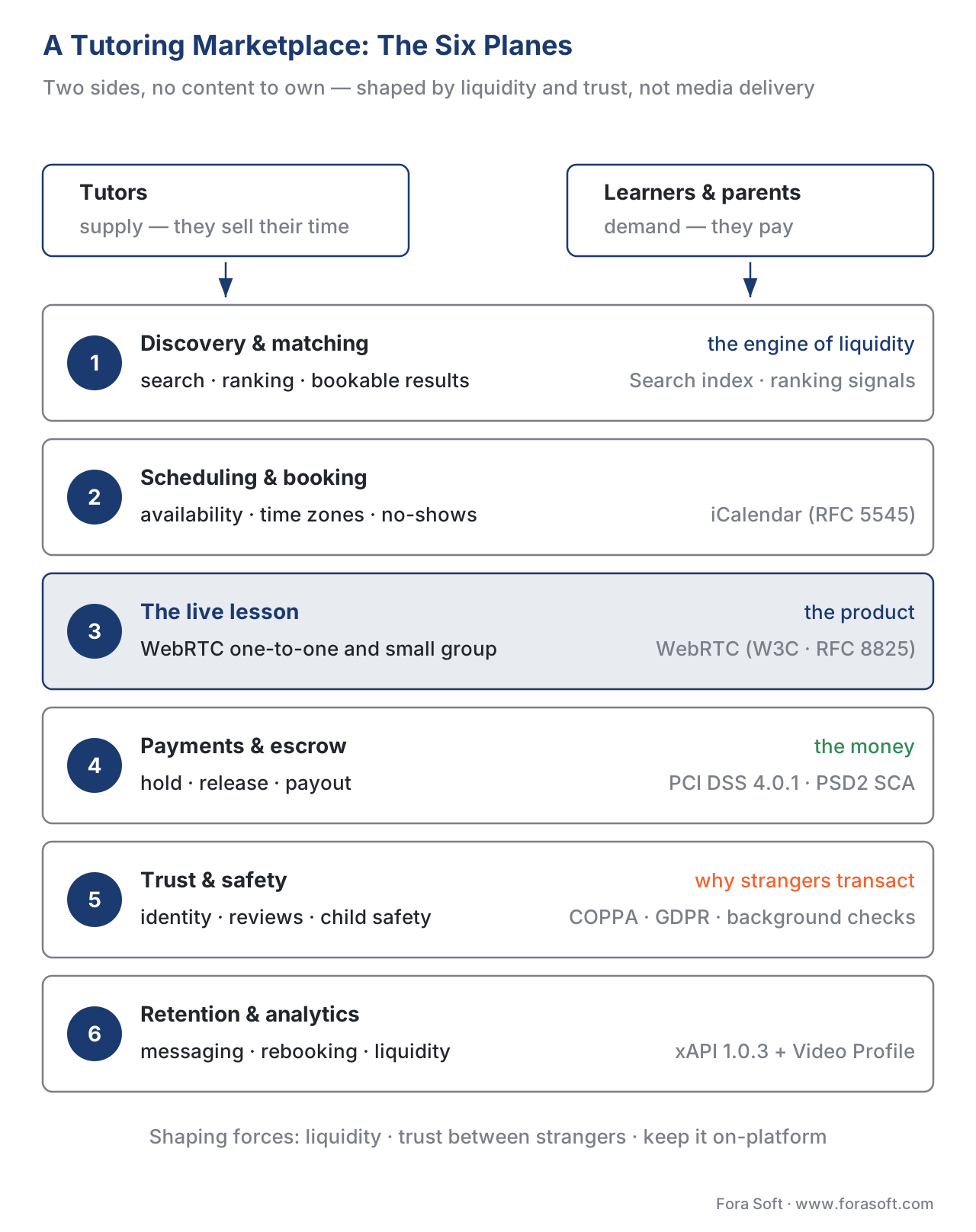 Figure 1. The full picture. Two sides — tutors on the left, learners (and the parents who pay) on the right — meet through six planes. Unlike a content platform, there is no large media pipeline; the shaping forces are liquidity and trust. The blue core is the live lesson; the green plane is where money moves; the orange plane — trust and safety — is what makes a stranger-to-stranger transaction possible.
The Marketplace Flywheel: Why Liquidity Comes First
Before walking the planes, it helps to see what they are all serving. A healthy tutoring marketplace runs on a flywheel — a loop where each turn makes the next one easier. Seed enough tutors and a learner's search returns good matches; good matches produce completed lessons; completed lessons produce reviews and ratings; strong reviews attract more learners; more demand attracts more tutors; and the larger, better-rated supply makes the next learner's search even better. The platform's job is to start that wheel turning and then remove every source of friction that slows it.
The reason this matters before any code is the cold-start problem. At launch you have neither side, and a learner who searches an empty marketplace never comes back. The standard answer, drawn from a decade of marketplace practice, is single-side seeding: pick the side that is easier to acquire — for tutoring that is almost always supply, the tutors — and build it first, even before demand exists, so that when the first learners arrive the marketplace already looks liquid. You accept a lopsided, supply-heavy marketplace early in exchange for never showing a learner an empty result. Concretely, you might recruit a few hundred tutors in two or three popular subjects and one or two time zones before you spend a dollar on learner acquisition.
The single number that tells you whether the wheel is turning is liquidity — operationally, the share of learner searches that end in a booking. If a learner searches for "A-level chemistry, weekday evenings, under $40/hour" and sees five available tutors, your marketplace is liquid in that segment; if they see none, it is not, no matter how many tutors you have in unrelated subjects at unrelated times. This is why the matching plane and the scheduling plane are the first two planes, and why marketplace health is measured per segment — by subject, price band, language, and time window — not as one global average.
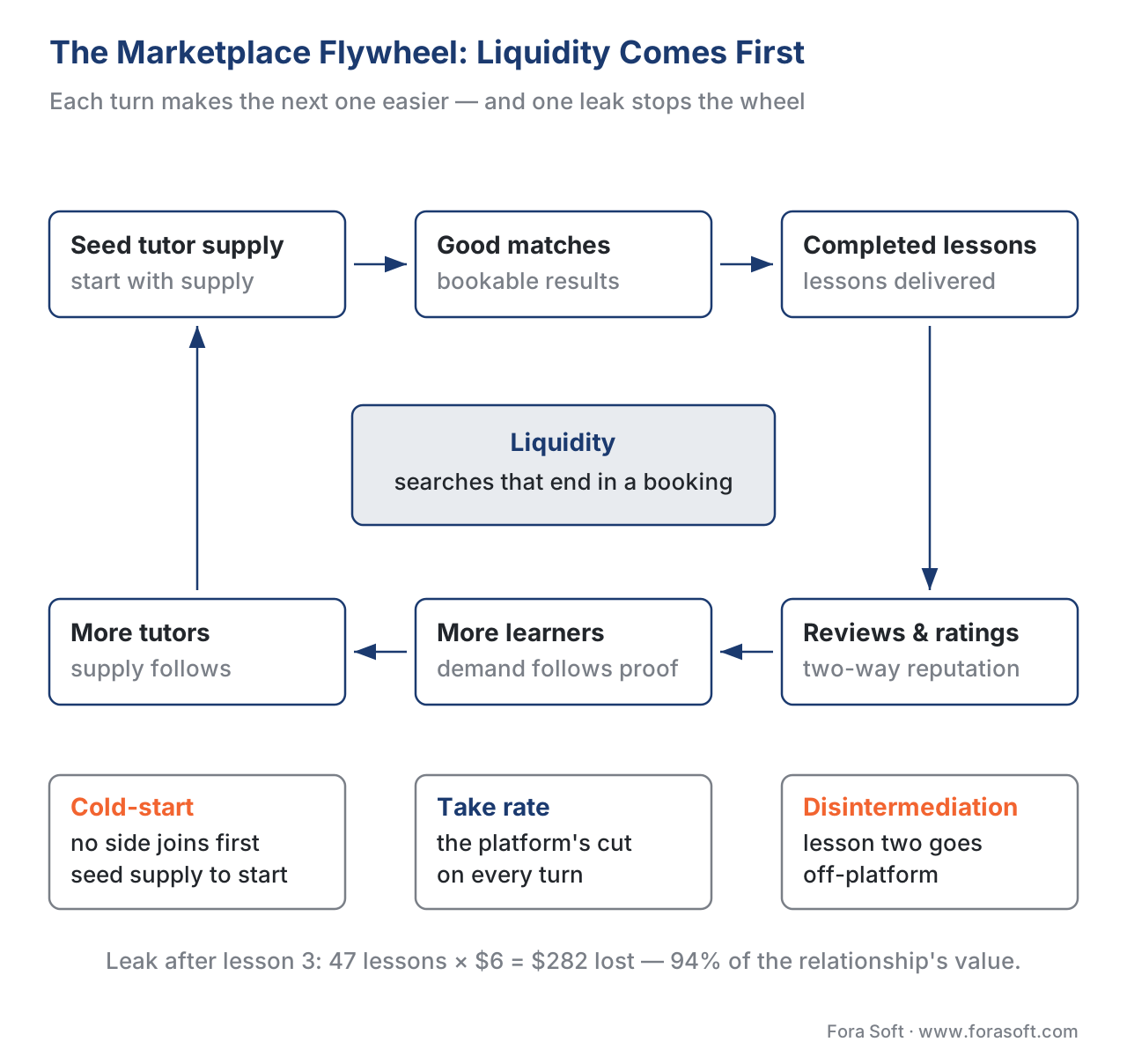 Figure 2. The flywheel that defines the business. Seeded supply leads to good matches, completed lessons, reviews, more demand, and still more supply — each turn easier than the last. Liquidity sits at the hub. The cold-start problem is how you get the first turn; the take rate is how the platform earns from every turn; disintermediation is the leak that stops the wheel.
Plane 1: Discovery and Matching — Manufacturing Liquidity
Start where every learner starts: they need to find a tutor they can trust, who teaches the right subject, at a price they can pay, at a time they are free. The discovery and matching plane turns that need into a short, ranked list of bookable tutors, and the quality of that list is, more than anything else, what determines whether the marketplace feels liquid.
Two distinct mechanisms live here. The first is search and filtering: a learner narrows the catalog by subject, level, price, language, and availability. This is a search problem — the tutor catalog is indexed in a dedicated search engine so a query like "GCSE physics, English-speaking, evenings, under $35" returns results in milliseconds with the right facets. The second, and harder, mechanism is ranking and matching: of the tutors who fit the filter, which ones appear first. A ranking algorithm orders tutors by a blend of relevance (subject fit, level), quality (rating, completion and rebooking rates), responsiveness (how fast the tutor replies and how often they accept bookings), price, and live availability in the learner's time window. The order is not cosmetic — it directly determines liquidity and fairness, because the tutors at the top get most of the bookings.
There is a design tension here worth naming out loud, because it is unique to marketplaces. Ranking purely by rating concentrates almost all demand on a handful of top tutors, who then become fully booked and unavailable — which paradoxically lowers liquidity, because the learner's search returns five five-star tutors who cannot actually take a booking this week. Good matching therefore weights bookable availability heavily and deliberately distributes some demand to newer, good-but-unproven tutors, both to keep results bookable and to give new supply a chance to earn its first reviews and stay on the platform. The matching engine is, in effect, the marketplace's monetary policy.
Common mistake: optimizing for the best tutor instead of the best bookable match. A team that comes from a content background tends to build search like a library catalog — rank by quality and stop. In a marketplace, a brilliant tutor who has no free slots this week is not a result; they are a dead end that sends the learner away. Rank by who the learner can actually book now, not only by who is best on paper.
Plane 2: Scheduling and Booking — Selling Time Across Time Zones
Once a learner has chosen a tutor, the marketplace has to sell them a specific hour — and a calendar is deceptively hard. This plane manages each tutor's availability, converts it correctly across time zones, lets a learner book and pay for a slot, and then defends that slot against the two things that quietly kill marketplaces: double-bookings and no-shows.
The core data structure is the tutor's availability calendar — the recurring and one-off windows in which they are willing to teach. Representing this correctly is a classic source of bugs, because times must be stored without ambiguity and displayed in each user's local zone; a tutor in Warsaw offering "18:00 Tuesday" must appear correctly to a learner in New York, and must survive daylight-saving changes on both sides. The interoperable standard for calendar data, iCalendar (IETF RFC 5545), defines how recurring events and time zones are expressed, and is the right reference model for availability and for syncing a tutor's external calendar so the platform never offers a slot the tutor has already filled elsewhere.
Booking itself is a small transaction with outsized consequences. The moment a learner books, the slot must be locked atomically so a second learner cannot grab the same hour, the payment must be authorized (more on escrow below), and both sides must get a confirmation and a calendar invite. Then the system's real job begins: reducing no-shows, which are pure destroyed value — a slot that earns nothing and sours both sides. The levers are reminders (email, push, and SMS at sensible intervals), a clear cancellation-and-reschedule policy enforced in software, and a cancellation window after which the learner is charged anyway. A no-show or a late cancellation is the single most common bad experience on a tutoring platform, and it is a scheduling-plane responsibility to design it down.
Plane 3: The Live Lesson — The Product Is the Session
This is the plane the learner came for: the live, real-time lesson. On a content platform the video is a recording served to a crowd; here it is an interactive, two-way session between (usually) two people, and it is the moment the entire marketplace exists to produce. The good news for your budget is that this is also the cheap part — and understanding why is the key architectural insight of the plane.
The technology is WebRTC (Web Real-Time Communication), the browser-native standard for real-time audio, video, and data that became a W3C Recommendation in 2021 and rests on a set of IETF protocols (RFC 8825 and its companions). WebRTC gives sub-second, two-way audio and video directly in the browser with no plugin, plus a data channel for the things a lesson needs around the video — a shared whiteboard, a chat, a code editor, file sharing. We do not re-derive WebRTC here; its internals live in the Video Streaming section, and the learning-specific treatment is in WebRTC for live learning. This article is about how the live lesson fits into the marketplace.
The topology decision is simpler than for any other learning product, and it follows directly from the lesson sizes a tutoring marketplace actually runs. For a one-to-one lesson — two participants — the media can travel peer-to-peer (P2P), straight from one browser to the other through a relay only when a firewall requires it, which is the lowest-cost and lowest-latency option. For a small group — a tutor with three to twelve learners — P2P breaks down, because every participant must upload their video to everyone else and a typical home connection cannot push that many copies; the right tool is a Selective Forwarding Unit (SFU), a media server where each person uploads once and the server forwards the streams onward. The deeper topology choices, and the SFU internals, belong to scaling the live class and the Video Streaming section's SFU / MCU / mesh topologies; the marketplace point is that your media cost is tiny — a one-to-one lesson is two streams, not a hundred thousand.
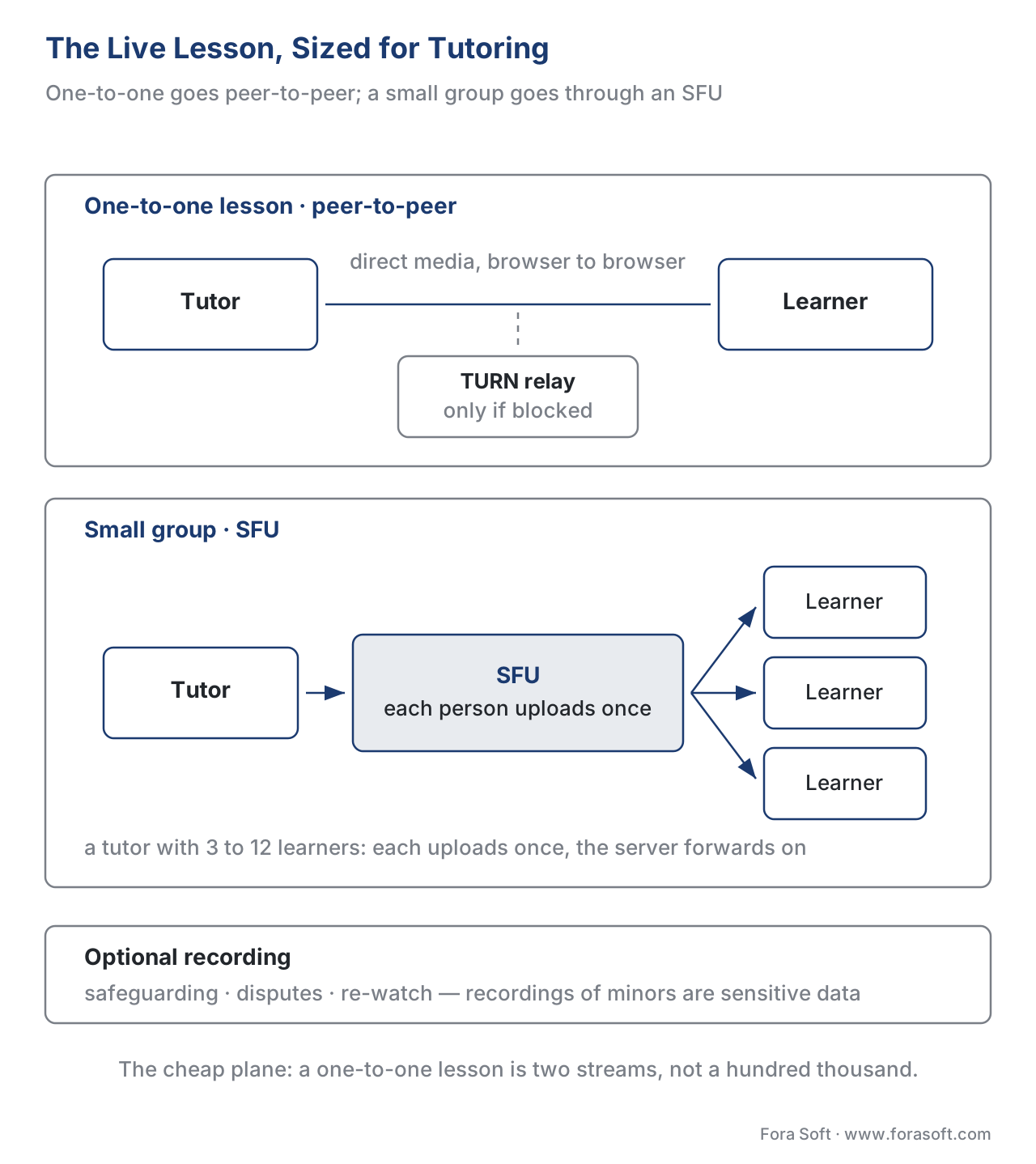 Figure 3. The live lesson, sized for tutoring. A one-to-one lesson travels peer-to-peer (with a TURN relay only when a network blocks the direct path); a small-group lesson routes through an SFU so each participant uploads once. An optional server-side recording pipeline captures the session for safeguarding, dispute resolution, and the learner's later review. Unlike a MOOC, this is the cheap plane.
Three lesson features deserve a mention because learners and tutors expect them and they ride on the same WebRTC data channel: a shared interactive whiteboard for working through problems, screen sharing for showing materials, and session recording. Recording is worth special attention on a tutoring marketplace, because it serves three jobs at once — it lets the learner re-watch the lesson, it resolves "what really happened" disputes, and, when minors are involved, it is a safeguarding control. The whiteboard and screen-share mechanics are covered in the interactive whiteboard and screen sharing for teaching; recording and its post-processing live in recording live classes. For the full live subsystem assembled on its own, link out to the live-learning reference architecture — the tutoring marketplace embeds that subsystem rather than reinventing it.
Plane 4: Payments and Escrow — Holding the Money Until the Lesson Happens
Now the plane that turns a booking into a business. A tutoring marketplace takes money from a learner, has to be sure the lesson actually happens before the tutor is paid, takes its own cut, and pays the tutor out — often across borders and currencies. The design pattern that makes this safe is escrow: the platform holds the learner's payment from the moment of booking and releases it to the tutor only after the lesson is delivered.
Walk the money through one lesson. When the learner books, the platform does not simply charge them and forward the cash; it authorizes and captures the payment into the platform's control, where it sits pending. The lesson happens. Once it is marked complete — by both parties, or automatically after the scheduled end with a short dispute window — the platform releases the tutor's share and retains its fee, then pays the tutor out on a schedule. If the tutor no-shows or the lesson is validly disputed, the held funds are refunded instead. This hold-until-delivered flow is what protects a learner paying a stranger and a tutor teaching one, and it is the backbone of marketplace trust.
In practice most teams do not build this ledger from scratch; they use a marketplace payments provider. Stripe Connect, the most common, handles the three-way flow between learner, tutor, and platform: it can split each payment into the tutor's share and the platform's fee, and it provides delayed payouts that hold a tutor's funds until conditions are met — Stripe is careful to note it is not a licensed escrow service, but delayed payout gives the same effect, and funds can be held for up to 90 days before payout. Using such a provider also moves most of the card-data compliance burden (the Payment Card Industry Data Security Standard, PCI DSS, whose version 4.0.1 made a set of stronger authentication requirements mandatory on 31 March 2025) onto the provider, and handles Strong Customer Authentication — the two-factor check that European law (the second Payment Services Directive, PSD2) requires on most online card payments. The specific mechanics of cross-border payouts and currency belong to the provider; the architectural point is that escrow, the platform fee, and payout are one plane, and you almost certainly buy it rather than build it.
The number that defines this plane is the take rate — the share of each transaction the platform keeps. Across marketplaces it ranges from low single digits to the mid-30s percent; in tutoring specifically the public numbers are concrete: one large language-tutoring marketplace charges tutors a commission that starts at 33% for a new tutor and falls toward 18% as they teach more hours (and takes 100% of the very first trial lesson as an acquisition cost), while another charges a flat 25%. Your take rate is the price of the liquidity, trust, and payments you provide — and, as the next plane explains, it is also exactly the incentive both sides have to leave.
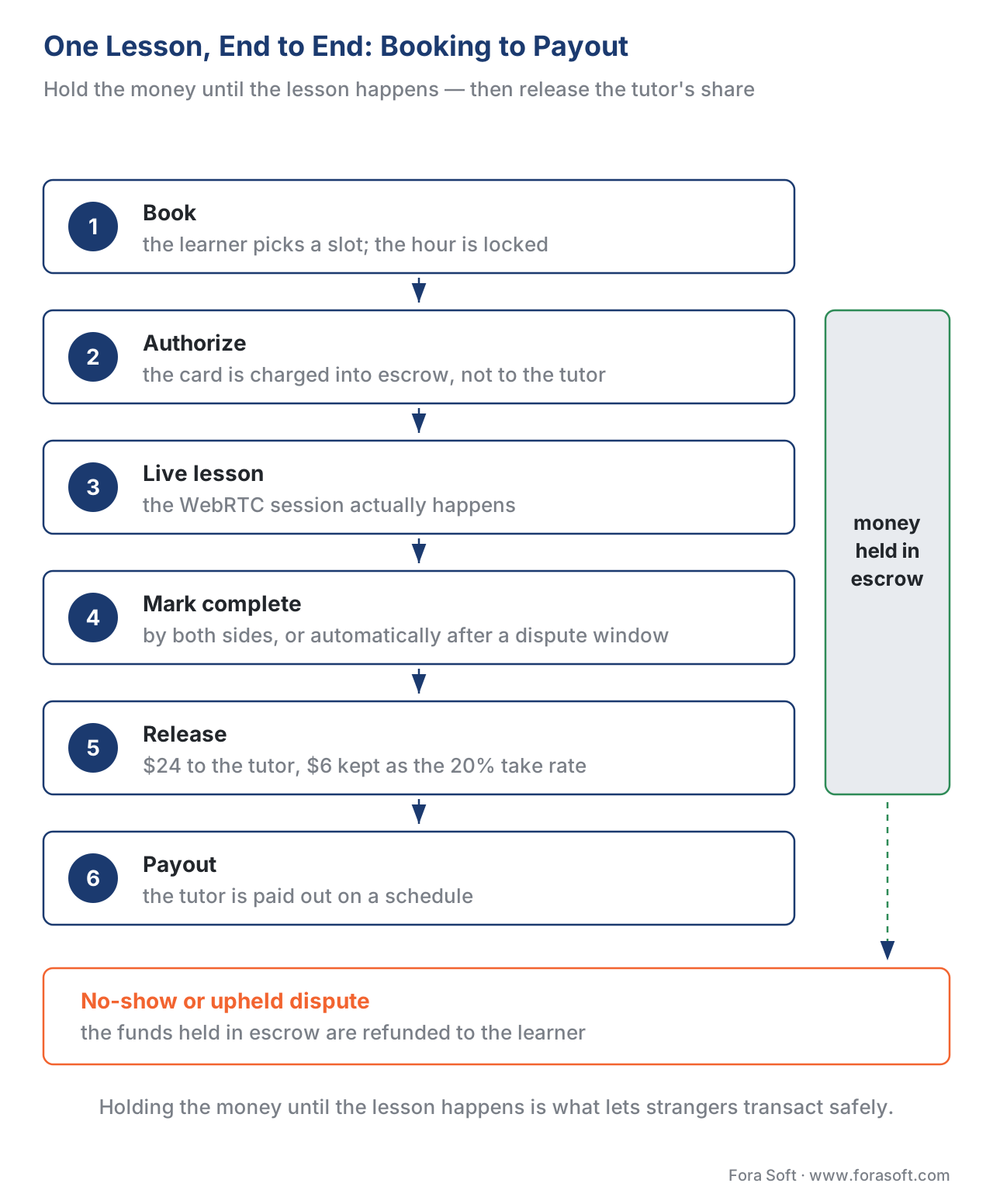 Figure 4. One lesson, end to end. The learner's payment is authorized into escrow at booking and held; the live lesson is delivered; after a short dispute window the lesson is marked complete; the platform releases the tutor's share, retains its take rate, and pays the tutor out. A no-show or upheld dispute routes the held funds back to the learner. Holding the money until the lesson happens is what lets two strangers transact.
Plane 5: Trust and Safety — Why Strangers Transact
This is the plane that makes the whole marketplace possible, and the one a content platform barely needs. Its job is to make it safe for a learner to pay and meet a stranger on video — and, on a great many tutoring platforms, to make it safe for that learner to be a child. It is also the plane that keeps the relationship, and the money, on your platform.
Trust starts with identity and reputation. Tutors are verified — at minimum an identity-document check, and for anyone teaching children, a criminal-background check (in the United States typically through a screening provider; in the United Kingdom a Disclosure and Barring Service, or DBS, check). After the lesson, a two-way review and rating system lets each side build a public reputation, which feeds back into the matching plane and is the main reason a learner trusts a tutor they have never met. Identity verification deserves its own design care; the techniques overlap with assessment identity and are covered in identity verification for assessments.
When learners are minors, trust and safety becomes a legal and ethical obligation, not a feature. In the United States, the Children's Online Privacy Protection Act (COPPA) requires verifiable parental consent before collecting personal information from a child under 13, and the Federal Trade Commission's 2025 amendments to the COPPA Rule expanded covered data to include biometric identifiers such as voiceprints and facial geometry — directly relevant when you run, and especially when you record, live video of children — and added a written children's-data security-program requirement, with compliance required in 2026. In the European Union the General Data Protection Regulation (GDPR) gives children's data special protection and a higher consent bar. The engineering consequences are concrete: collect the minimum data on a child, gate a minor's account behind verified parental consent, treat lesson recordings of children as sensitive data with tight access control and retention limits, and keep the analytics you run on minors deliberately narrow. This is the part of the build where "move fast" is the wrong instinct.
The last job of this plane is to defend against disintermediation — both sides agreeing to do the next lesson off-platform to dodge the fee. This is not a minor leak; it is an existential one, because every lesson that moves off-platform takes its take rate, its safety controls, and its dispute protection with it. The defenses are partly product and partly policy: keep the highest-value features — the scheduled video room, the recording, the payment protection, the dispute process, the rebooking convenience — inside the platform so leaving is genuinely worse for both sides; route early communication through on-platform messaging (with appropriate masking) so a relationship cannot form entirely in private; and price the take rate so that staying is rational. A marketplace that makes on-platform the easiest and safest path keeps its flywheel; one that is merely a directory gets used once and abandoned.
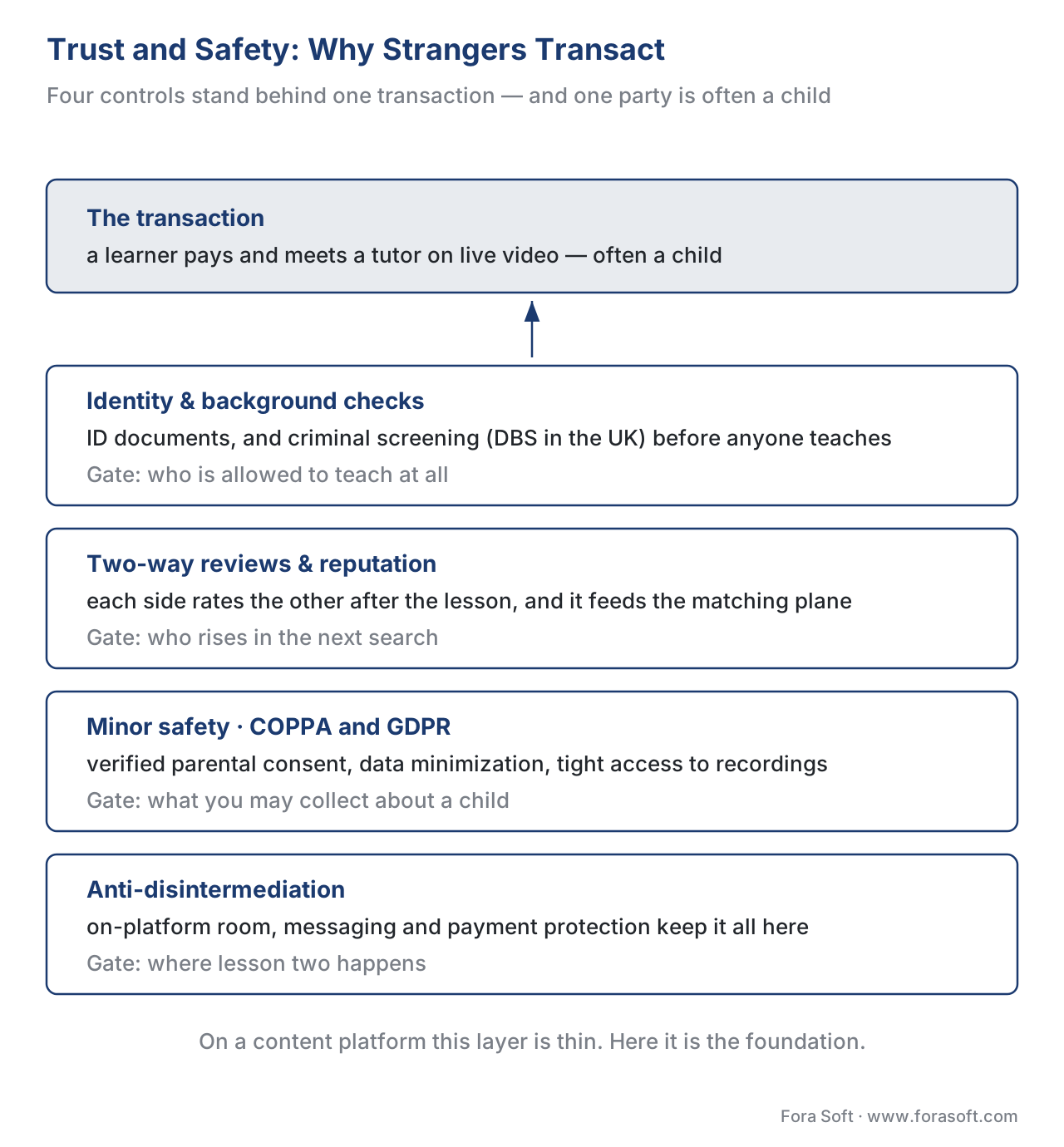 Figure 5. The layer that lets strangers transact. Identity and background checks gate who can teach; two-way reviews build reputation; minor-safety controls (parental consent, data minimization, recording access limits) satisfy COPPA and GDPR; and anti-disintermediation defenses keep the booking, the money, and the safety controls on-platform. On a content platform this layer is thin; on a tutoring marketplace it is the foundation.
Plane 6: Retention, Communication, and Marketplace Analytics
The final plane keeps the flywheel spinning after the first lesson, because a tutoring marketplace's economics live or die on repeat bookings. Acquiring a learner is expensive; the profit is in the learner who books the same tutor every week for a year. This plane carries the messaging, the rebooking flow, and the analytics that tell you whether the marketplace is healthy.
Communication is the connective tissue: on-platform messaging so a learner and tutor can agree on what to cover next, automated nudges to rebook after a lesson, and notifications that bring both sides back. It doubles as a trust-and-safety surface — keeping conversation on-platform is both a safeguarding control and an anti-disintermediation defense, so messaging is designed to be the easiest channel, not an afterthought.
Analytics here is marketplace analytics first and learning analytics second. The numbers that matter are the health of the two-sided business: liquidity per segment (what fraction of searches convert to bookings, by subject, price band, and time zone), supply and demand balance, time-to-first-booking for a new learner, tutor utilization, rebooking and retention rates, no-show rate, and the leakage that signals disintermediation. These are the instrument panel for the flywheel. Where the platform also wants to measure learning — progress across a series of lessons, not just transactions — it can layer the learning-analytics tools the rest of this section describes, capturing lesson events with the Experience API (xAPI) and its video profile and routing them to a learning-record store; that machinery is covered in learning analytics and tracking video with the xAPI Video Profile. The distinction matters: a MOOC's analytics measure a funnel, a tutoring marketplace's analytics measure liquidity and retention.
Putting the Planes Together: How One Booking Runs
Walk a single booking through all six planes, because the choreography is the architecture. Mara, a parent in Toronto, needs a French tutor for her 11-year-old. She searches; the discovery and matching plane returns a ranked shortlist of French tutors who teach children, are rated well, and — crucially — have free evening slots in her time zone. She opens a profile, sees a verified-identity badge and a completed background check from the trust and safety plane, and reads two-way reviews from other parents. She picks a Tuesday 6 p.m. slot; the scheduling and booking plane locks that hour atomically, converts it correctly from the tutor's zone, and sends both sides a calendar invite and reminders. Her card is charged, but the tutor is not yet paid: the payments and escrow plane holds the money. Because her child is a minor, the account sat behind verified parental consent, and the lesson recording she opts into is stored as sensitive data with limited access — the trust and safety plane again. Tuesday arrives; the live lesson plane connects tutor and child peer-to-peer over WebRTC, with a shared whiteboard for conjugations. The lesson ends; after a short dispute window it is marked complete, and the escrow plane releases the tutor's share, retains the platform's take rate, and schedules the payout. Mara leaves a five-star review, which lifts the tutor in the next parent's search; the retention and analytics plane nudges her to rebook, and she books the same tutor for next Tuesday — on-platform, because that is where the recording, the payment protection, and the convenience live. One booking has turned the flywheel one notch.
That single walkthrough is the whole product. Every feature you will ever add — group lessons, packages, subscriptions, an in-app coding tool — lands in one of those six planes.
The Unit Economics, Shown Out Loud
The tutoring-marketplace question is rarely "can we afford the video" — the video is cheap. It is "does the take rate cover the cost of liquidity and trust, and can we stop the relationship leaking off-platform." Make it concrete, and show the math out loud.
The take rate on one relationship. Suppose a tutor charges $30 per hour and the platform's take rate is 20%. On each lesson the split is:
$30 lesson × 20% take rate = $6 to the platform, $24 to the tutor
Now follow a committed learner who books weekly for a year:
50 lessons × $30 = $1,500 gross booked value (GMV)
$1,500 × 20% = $300 to the platform over the year
That $300 is the lifetime value of one retained relationship — and it is the whole reason retention, not acquisition, is where the profit sits.
Why disintermediation is the number that matters. Now suppose that learner and tutor like each other and, after the third lesson, agree to continue over a private video call and a bank transfer. The platform keeps the first three lessons and loses the rest:
47 remaining lessons × $6 = $282 of take rate lost to one leak
A single relationship leaking off-platform erases 94% of its value to you. Multiply that across a marketplace and the lesson is stark: the trust, payments, and communication design that keeps relationships on-platform is not a feature set — it is the business. This is the opposite of a MOOC, where the delivery cost is the thing to engineer down; here the thing to engineer is on-platform stickiness.
What the build itself costs. A custom marketplace minimum viable product with search, profiles, scheduling, a WebRTC lesson room, and marketplace payments through a provider commonly runs in the tens of thousands of dollars and a few months of work; a fully featured, scalable tutoring marketplace runs higher and longer, because — as builders consistently report — marketplace payments, payouts, and trust-and-safety are heavy scope, often pushing a serious build past nine to twelve months. The fuller treatment of scoping and estimating is in scoping and estimating a learning-video project, which reuses the learning-platform cost model; the point here is that the expensive parts of a tutoring marketplace are payments and trust, not video.
Build, Buy, or Extend: The Realistic Decision
For a tutoring marketplace, "build versus buy" has three doors, and which one is right depends on how much of your differentiation lives in the marketplace mechanics themselves.
Build fully custom. Writing the whole stack — search and matching, a time-zone-correct scheduler, a WebRTC lesson room with whiteboard and recording, an escrow-and-payout ledger on top of a payments provider, a trust-and-safety system with background checks and child-safety controls, and marketplace analytics — is justified when the matching, the lesson experience, or the trust model is your actual differentiator, and when you have the engineering depth to run a real-time-video product. It is the most powerful door and the slowest.
Buy a marketplace platform and assemble. A no-code or low-code marketplace platform (the Sharetribe-style products) gives you the catalog, search, booking, reviews, and Stripe Connect payments out of the box, and you add a WebRTC lesson room and your trust controls on top. This is the fastest way to test whether a marketplace has liquidity in your niche, and the right door when speed to a liquid marketplace matters more than owning the platform — most early-stage tutoring marketplaces should start here.
Extend or integrate specialist pieces. Between the two, you assemble best-of-breed components — a payments provider for escrow and payouts, a video provider or open-source SFU for the lesson, a screening provider for background checks, a search engine for discovery — and write only the marketplace logic that is yours. This hybrid is where many serious tutoring marketplaces land: buy the commodity planes (payments, video transport, identity), build the planes that are your edge (matching, the lesson experience, retention).
The decision is not one decision; it is six, one per plane, and the table makes the realistic options explicit — including the standard or protocol each plane should speak.
| Plane | Buy / platform | Extend / assemble | Build custom | Standard / protocol it should speak |
|---|---|---|---|---|
| Discovery & matching | Platform's search | Hosted search engine + own ranking | Custom matching engine | Search index; ranking signals |
| Scheduling & booking | Platform's booking | Calendar lib + external-calendar sync | Custom scheduler | iCalendar (RFC 5545); time zones |
| Live lesson | Embedded video SDK | Video provider or open-source SFU | Full WebRTC stack | WebRTC (W3C / IETF RFC 8825) |
| Payments & escrow | Platform's payments | Stripe Connect + own ledger | Bespoke payments | PCI DSS 4.0.1; PSD2 SCA |
| Trust & safety | Platform's reviews | Screening + ID provider + own policy | Custom trust system | COPPA; GDPR; DBS / background checks |
| Retention & analytics | Platform's dashboards | Product analytics + xAPI for learning | Custom analytics | xAPI 1.0.3 + Video Profile |
The pattern most successful tutoring-marketplace builds follow is the middle column: buy the commodity planes and build the ones that are your edge. A full custom build is justified only when the marketplace mechanics themselves are the product; a pure platform is right when you are testing for liquidity and speed beats control. The dedicated decision matrix and the build-vs-buy decision tool live in the section's capstone, build vs buy vs hybrid for learning video.
The Pitfalls That Define a Bad Build
"It's a course platform with a booking button." The root error. A tutoring marketplace owns almost no content; its product is a person's live time, and its hard problems are liquidity and trust, not media delivery. Design for the match and the transaction, not the catalog.
"Rank tutors by rating and stop." Ranking by quality alone concentrates demand on a few fully booked stars and returns un-bookable results. Weight live availability and seed demand to good new tutors, or liquidity collapses even with plenty of supply.
"Charge the learner and pay the tutor immediately." Without escrow, a learner pays a stranger with no protection and a no-show becomes a chargeback war. Hold funds until the lesson is delivered; refund on no-show; release minus the fee on completion.
"Treat child-safety as a later feature." When learners are minors, parental consent, data minimization, background checks, and tight control of recordings are legal obligations under COPPA and GDPR — and the 2025 COPPA amendments now cover biometric data like voiceprints and facial geometry in your video. Build this in from the first sprint.
"Ignore disintermediation." Both sides have an incentive to take lesson two off-platform. A marketplace that is merely a directory gets used once. Keep the highest-value features — scheduled room, recording, payment protection, rebooking — on-platform so staying is the easy, safe choice.
"Over-build the video." A one-to-one lesson is two streams; small groups need a modest SFU. Spending your runway gold-plating a video stack while matching and trust are weak is solving the cheap problem and ignoring the expensive ones.
Free download: Tutoring Marketplace — Architecture & Trust Readiness ChecklistOne page across all six planes — matching, scheduling, the live lesson, escrow, trust and safety, retention — plus the take-rate math and the anti-disintermediation defenses, so you can pressure-test a plan before you fund it.Where Fora Soft Fits In
Fora Soft has built real-time video, WebRTC, and e-learning systems since 2005, and a tutoring marketplace sits exactly at that intersection — a matching-and-trust marketplace wrapped around a live one-to-one video core, with escrow payments and, very often, child-safety obligations on top. The build-versus-buy trade-off we help teams make is per-plane and honest: the commodity planes — payments through a provider, video transport, identity and background-check providers — are usually bought, while the planes that decide whether your marketplace wins — the matching engine, the lesson experience, and the retention design that keeps relationships on-platform — are where custom engineering pays back. We work across e-learning, video conferencing, streaming, OTT, and telemedicine, so we are typically brought in when the live-video quality, the recording-and-safeguarding pipeline, or the trust-and-payments wiring is the hard part — not the directory. No hype: for an early marketplace testing liquidity, the right first move is often a platform plus a solid lesson room, and we will say so.


The handbook
Fora Soft Video Engineering Handbook
We wrote a seven-volume series, 9,000+ pages, that works through the whole video stack from the pixel to production — encoding, delivery, audio, and AI. A tutoring marketplace stands on that stack: volume 3 covers WebRTC and real-time delivery, players, and the economics of streaming, which is exactly the live-lesson plane; volume 4 covers real-time voice — echo cancellation, gain control, noise suppression — which is what a lesson actually lives or dies on; and volume 1 covers the encoding and quality underneath any recording you keep. Work through them and you can specify, cost, and build the lesson room yourself. Written by Nikolay Sapunov, CEO at Fora Soft.
Scoping a tutoring marketplace and deciding which planes to build?
Tell us the subject, the lesson sizes, and whether your learners are minors, and we will walk the six planes with you and say plainly which ones to buy and which are worth your engineering — 250+ video products shipped since 2005.
See our case studies
Case study
TransLinguist
Planes 1 and 3 in another vertical: a marketplace of 30,000+ certified interpreters across 75+ languages, matched to a session and delivered live over a MediaSoup SFU — the shape that won the NHS national framework across the UK.
Case study
BrainCert
Plane 3 proved cheap at scale: a WebRTC virtual classroom that has delivered 500M+ real-time class minutes to 100K+ customers from 10 datacenters at 99.995% uptime, under SOC 2 Type II, GDPR and PCI DSS.
Case study
Tabsera
Planes 4 and 5 where the learners are children: teachers earn on the platform and withdraw through PayPal or Waafi, and every student account sits behind parental controls, across four languages on web and iOS.
What to read next
Reference design
Live-learning reference architecture: the full picture
Plane 3 assembled on its own — the live subsystem a marketplace embeds rather than reinvents.
Live video
WebRTC for live learning, and its classroom gotchas
What actually carries the one-to-one lesson, and why the TURN relay is the line item that surprises people.
Decision
Build vs buy vs hybrid for learning video
The section capstone, with the decision matrix behind the per-plane call this article sketches.
Cost
Scoping and estimating a learning-video project
Turn the six planes into a number and a timeline before you commit the budget.
References
- W3C. WebRTC: Real-Time Communication in Browsers — W3C Recommendation; the browser-native real-time audio/video/data APIs (getUserMedia, RTCPeerConnection, RTCDataChannel) behind the live lesson. WebRTC 1.0 reached Recommendation 26 January 2021; updated Recommendation 2025. https://www.w3.org/TR/webrtc/ (Tier 1, primary standard). Accessed 2026-06-22.
- IETF. RFC 8825 — Overview: Real-Time Protocols for Browser-Based Applications — the IETF protocol suite (ICE, STUN, TURN, SRTP) underneath WebRTC, including the relay used when a one-to-one lesson cannot connect peer-to-peer. https://datatracker.ietf.org/doc/html/rfc8825 (Tier 1, primary standard). Accessed 2026-06-22.
- IETF. RFC 5545 — Internet Calendaring and Scheduling Core Object Specification (iCalendar) — the standard for representing recurring events and time zones, the reference model for tutor availability and external-calendar sync. https://datatracker.ietf.org/doc/html/rfc5545 (Tier 1, primary standard). Accessed 2026-06-22.
- U.S. Federal Trade Commission. Children's Online Privacy Protection Rule (COPPA), 16 CFR Part 312, and the 2025 amendments — verifiable parental consent, the 2025 expansion to biometric identifiers (voiceprints, facial geometry) and a written children's-data security program, with compliance required in 2026. https://www.ftc.gov/legal-library/browse/rules/childrens-online-privacy-protection-rule-coppa (Tier 1, primary law). Accessed 2026-06-22.
- European Union. General Data Protection Regulation (GDPR), Regulation (EU) 2016/679 — lawful basis, data minimization, and the special protection of children's personal data relevant to a marketplace serving minors. https://eur-lex.europa.eu/eli/reg/2016/679/oj (Tier 1, primary law). Accessed 2026-06-22.
- PCI Security Standards Council. Payment Card Industry Data Security Standard (PCI DSS), v4.0.1 — card-data security requirements; the future-dated v4.0 requirements (including MFA into the cardholder-data environment) became mandatory 31 March 2025. https://www.pcisecuritystandards.org/ (Tier 1, primary standard). Accessed 2026-06-22.
- European Union. Revised Payment Services Directive (PSD2), Directive (EU) 2015/2366 — Strong Customer Authentication (two of knowledge, possession, inherence) required on most online payments; the basis for 3-D Secure 2 checks at checkout. https://eur-lex.europa.eu/eli/dir/2015/2366/oj (Tier 1, primary law). Accessed 2026-06-22.
- Stripe. Stripe Connect — marketplace payments, split payments, and delayed payouts — the three-way learner/tutor/platform flow, fee splitting, and the delayed-payout mechanism used for escrow-like holds (Stripe notes it is not a licensed escrow service; funds can be held up to 90 days). https://stripe.com/connect (Tier 4, first-party engineering). Accessed 2026-06-22.
- Andreessen Horowitz (a16z). The Marketplace Glossary — liquidity, the cold-start (chicken-and-egg) problem, single-side seeding, GMV, and take rate (low single digits to the mid-30s). https://a16z.com/the-marketplace-glossary/ (Tier 6, industry). Accessed 2026-06-22.
- Preply. Preply commission model (Help Center) — tutor commission from 33% for new tutors declining toward 18% with hours taught, and 100% of the first trial lesson; a concrete tutoring take-rate data point. https://help.preply.com/en/articles/4171383-preply-commission-model (Tier 6, vendor). Accessed 2026-06-22.
- Wyzant. Tutor Payment Policies (Support) — a flat 25% platform commission and twice-monthly payouts; a second concrete tutoring take-rate data point. https://support.wyzant.com/tutors/tutor-payments/tutor-payment-policies (Tier 6, vendor). Accessed 2026-06-22.
- Grand View Research. Online Tutoring Services Market Size & Outlook — the online-tutoring-services market estimated near $10.4B (2024) growing at roughly 14–15% CAGR toward the early 2030s; broader "online tutoring" estimates run much higher depending on scope. https://www.grandviewresearch.com/industry-analysis/online-tutoring-services-market (Tier 6, industry). Accessed 2026-06-22.
Where sources disagreed, the official standard or law won. Vendor and blog descriptions of "escrow" were reconciled against Stripe's own documentation (delayed payout, not a licensed escrow) and the controlling payments standards (PCI DSS 4.0.1, PSD2 SCA); child-safety claims were grounded in the FTC COPPA Rule and the 2025 amendments and in GDPR, not in summaries. Market-size figures vary widely by methodology and scope (online-tutoring-services figures near $10–11B in 2025 versus broad "online tutoring" figures above $120B); the conservative services figure is used and the divergence is flagged. The take-rate and cost/timeline numbers are illustrative 2026 ranges synthesized from vendor commission pages and published build estimates — confirm against live vendor quotes and your own funnel before budgeting.
