


Why This Matters
If you are scoping a cohort-based course platform — a professional-upskilling academy, a corporate leadership program, a creator's premium course, a bootcamp — you are commissioning a product whose hardest problem is engagement, not media delivery. A massive open online course lives or dies on serving free video cheaply at scale; a corporate learning system lives or dies on its integrations; a cohort-based course lives or dies on whether a learner who enrolls on a Monday is still showing up, posting, and finishing eight weeks later. That difference is worth real money: cohort programs command three-to-five times the price of self-paced courses and report completion rates many times higher, and both of those facts trace back to the same social design. This article gives a founder, L&D leader, or course operator the complete architectural map of a cohort platform, so you can brief engineers precisely, judge a no-code cohort tool against a real reference design, and spend your budget where completion actually comes from. It is written for the non-engineer making the build-versus-buy call, but it stays accurate enough for the platform architect and the real-time-video engineer who will build it.
First, the Three Facts That Organize Everything
A cohort-based course platform looks, in a demo, like any other learning product: a lesson list, a video player, a discussion tab, a calendar. As with every learning product, the resemblance hides the point. We covered three other shapes already — the corporate-LMS reference architecture, shaped by its integrations into systems it does not own; the MOOC / open-course reference architecture, shaped by scale and a steep completion funnel; and the tutoring-marketplace reference architecture, shaped by liquidity and trust. A cohort-based course is shaped by something different again. Three facts, none of which a self-paced content platform faces, drive every architectural choice.
The first fact is that the cohort is the unit, not the individual learner. A self-paced course serves one person whenever they happen to show up; the platform's job is to be available. A cohort-based course enrolls a group that starts together on a fixed date and moves through the material on one shared timeline — Module 3 opens for everyone on the same Tuesday, the live session is the same Thursday for all of them. That single fact inverts content delivery. Instead of every lesson being available on demand, content is released on a schedule — an approach the industry calls drip — so the group stays roughly in step. A massive open online course is a library: open any time, mostly empty rooms. A cohort-based course is a train that leaves the station on a date, with everyone aboard travelling together.
The second fact is that community and accountability are the product, not a feature. This is the part newcomers underestimate, and the data is blunt about it. The median completion rate across massive open online courses is about 12.6%, and self-paced courses more broadly sit between 10% and 20%. Cohort-based and community-driven courses routinely reach far higher: an analysis of more than 32,000 courses found scheduled cohorts completing at 64.2% versus 48.2% for open-access, and courses with active discussion completing at 65.5% versus 42.6% without — a 54% lift from nothing but a place where learners talk to each other. The marquee programs go higher still: Seth Godin's altMBA reports around 96% completion, and Harvard Business School Online, after redesigning around peer discussion, reported above 85%. People do not finish because the videos are better; they finish because they are not alone. That makes the community and accountability machinery the core of the architecture, not a forum bolted on at the end.
The third fact is that the platform runs the same course many times — the cohort lifecycle repeats. A self-paced course is published once and sits there. A cohort has a beginning, a live middle, an end, and a graduation — and then it runs again, with new people, on the same rails. Operationally, you are not building a catalog; you are building a system to run a time-boxed live event, repeatedly, with the recorded content reused across runs and only the people, the schedule, and the facilitation changing each time. That shapes everything downstream: the schedule is a first-class object, the roles (instructor, facilitator, teaching assistant) are first-class, and the recorded lessons are an asset you amortize across many cohorts.
Hold those three facts in your head — the group is the unit, community is the product, and the cohort repeats — and the architecture below explains itself. A cohort-based course platform is best understood as a scheduled journey a group takes together, run by five cooperating planes.
The cohort and curriculum plane defines who is in the group, when it runs, and the schedule on which content unlocks. The content delivery plane carries the two kinds of video a cohort uses — recorded lessons on demand and live sessions in real time. The community and discussion plane is the product itself: the threads, groups, and peer feedback where the learning and the accountability actually happen. The engagement and accountability plane keeps people moving — onboarding, nudges, progress, completion, and the credential at the end — and measures whether the cohort is healthy. And the operations, roles, and monetization plane runs the business: enrollment and payment, the instructor and facilitator tools, integration into a company's systems, and the machinery to run the next cohort.
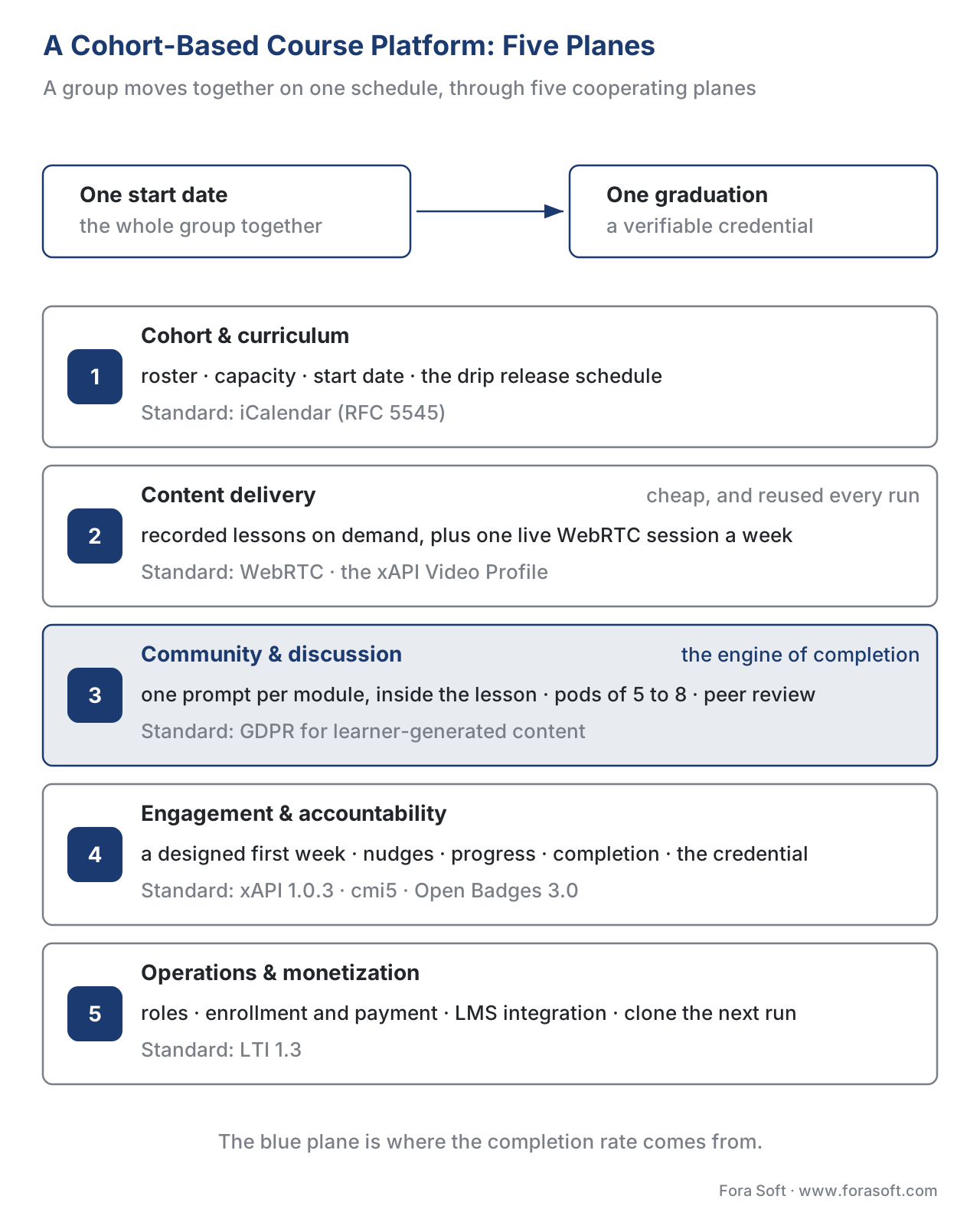 Figure 1. The full picture. A cohort — a group, not a stream of individuals — moves left to right along one shared schedule through five planes. Unlike a MOOC, the recorded-video pipeline is the small, reusable part; the large, defining machinery is the blue community-and-discussion plane and the cadence around it. The shaping force is completion through shared cadence and community, not scale or integration.
The Completion Gap: Why Community Is the Architecture
Before walking the planes, look squarely at the number that justifies the whole build, because it is the reason a cohort platform exists at all. Self-paced online courses have a completion problem that a decade of better video, shorter lessons, quizzes, and drip emails has barely moved: a median around 12.6% for massive open online courses, 10–20% for self-paced courses generally. Cohort-based and community-driven designs do not nudge that number; they multiply it.
The clearest evidence comes from an analysis of more than 32,000 courses: scheduled cohorts completed at 64.2% against 48.2% for open-access versions of the same kind of content, and — the single most striking finding — courses with active community discussion completed at 65.5% versus 42.6% without, a 54% relative improvement from adding nothing but conversation. The programs that commit fully to the model report higher still: altMBA around 96%, Harvard Business School Online above 85%, executive-education cohorts in the 70s and above. The same study found that learners active in a course's first week were roughly fourteen times more likely to complete — which is why the onboarding week, not the final module, is where engineering attention pays back most.
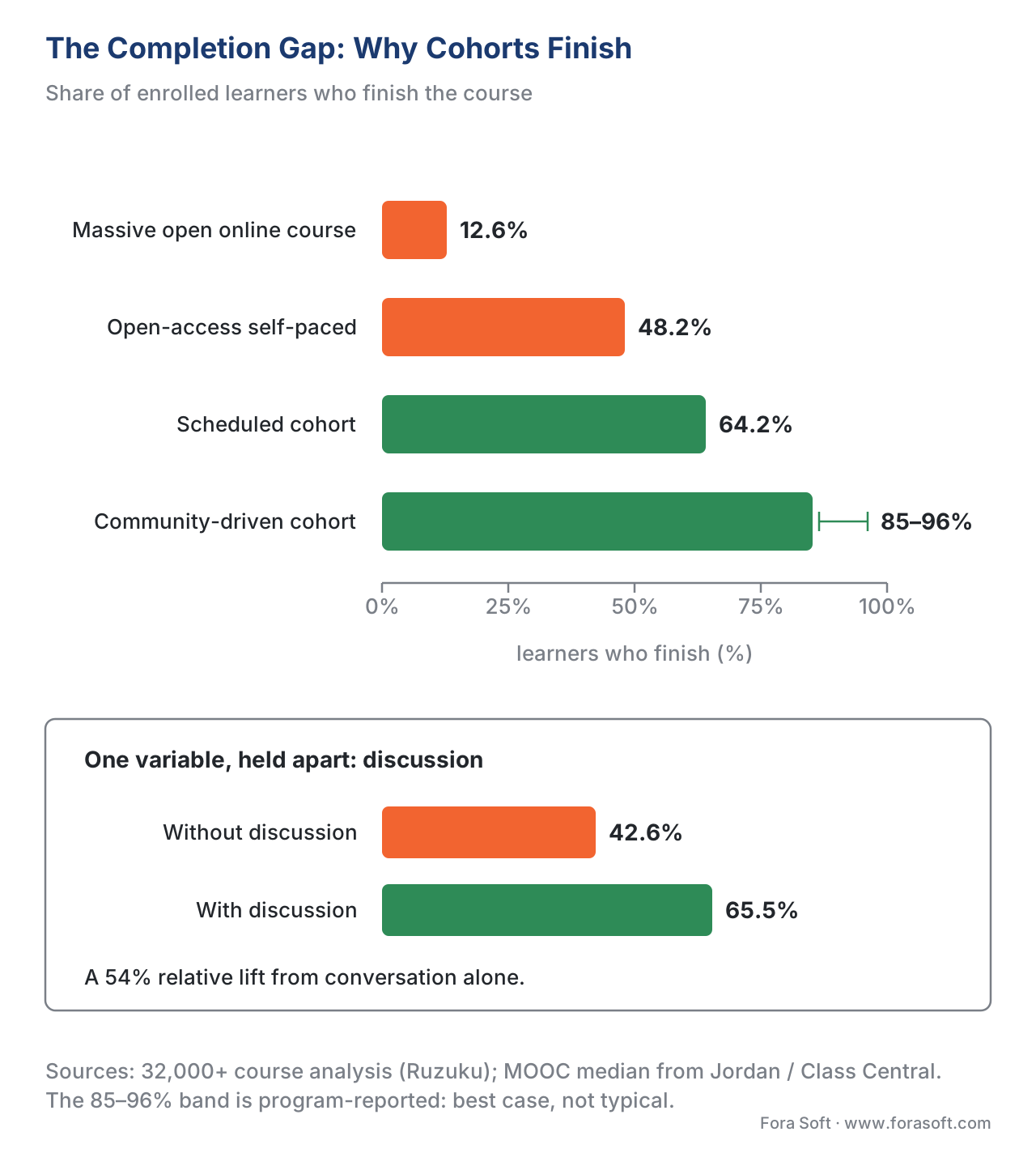 Figure 2. The completion gap, the reason to build a cohort platform at all. A typical massive open online course finishes around 12.6% of enrollees; the same content run as a scheduled cohort reaches 64.2%, and programs built fully around community and live facilitation reach 85–96%. The orange-to-green bars show the isolated effect of one variable — community discussion — lifting completion from 42.6% to 65.5%.
Why does community work? The research points to four mechanisms, and they map directly onto features you will build. Social accountability: when a learner can see that peers are active — and that their own absence is visible — they show up; forum activity has been found to correlate with retention at around r = 0.53. Learning by articulating: writing an explanation or a reflection in your own words strengthens memory more than passively watching, an effect (the "generation effect") measured at around d = 0.40 across hundreds of studies. Belonging: feeling connected to the group is among the strongest predictors of staying engaged, outperforming both perceived competence and autonomy in studies of online learners. And instructor presence: when a teacher actively participates in the discussion rather than just recording videos, that presence has been found to have the largest direct effect on engagement. The takeaway for an architect is concrete: the discussion plane, the live sessions, the small groups, and the instructor tools are not decoration around the video — they are the parts of the system that produce the completion rate you are selling.
Plane 1: Cohort and Curriculum — The Schedule Is the Spine
Start where every cohort starts: a defined group, a start date, and a schedule. This plane holds the objects a self-paced platform never needs — the cohort (a named group with a start and end date and a roster), the curriculum (the ordered modules), and the release schedule that ties them together.
The defining mechanism here is scheduled content release, or drip: lessons unlock on dates relative to the cohort's start, not all at once and not purely on demand. Drip is what keeps a group in step — everyone reaches Module 3 in week three, so the week-three discussion is full of people working on the same thing at the same time. It is worth being precise about what drip is and is not, because this is a common point of confusion: drip alone, on a self-paced course, is a weak lever (the 32,000-course data shows scheduling helps, but community helps far more). Drip earns its keep only when it synchronizes a group so the community plane has something to chew on. Scheduling on a cohort platform also means real calendar mechanics — live-session times across participants' time zones, reminders, and calendar invites — for which the interoperable reference model is the iCalendar standard (IETF RFC 5545), which defines how recurring events and time zones are represented without ambiguity.
Two enrollment patterns live here, and they change the build. The simpler is open enrollment: anyone can buy a seat in the next cohort until it fills. The more involved is an application flow: prospective learners apply, and the team admits a curated group — common in premium and corporate programs where fit and group composition matter. An application flow adds a small admissions subsystem (forms, review, accept/waitlist/decline states) that the open-enrollment model does not need. Either way, the cohort has a capacity and a roster, and both are first-class: the roster is the membership list every other plane reads from to know who belongs to this run.
Common mistake: treating a cohort as "a self-paced course with a start date." Drip-scheduling a solo course does not make it a cohort; it makes it a slower solo course. The cohort is the group plus the shared timeline plus the community — if you build the schedule but not the social machinery in planes 3 and 4, you have spent effort on the weakest of the levers and skipped the strongest.
Plane 2: Content Delivery — On-Demand Video Plus the Live Session
This is the plane people assume is the whole product, and it is the plane that matters least to your completion rate — which is exactly why it should consume the least of your budget. A cohort course carries two kinds of video, and the architecture treats them very differently.
The first is on-demand (recorded) lessons — the core teaching content, recorded once and watched asynchronously by each learner on their own time within the week's window. This is ordinary video-on-demand: encode once, store, and stream through a content delivery network. It is cheap per learner and, crucially, it is reusable across every cohort — you record the lesson once and run twenty cohorts on it. The delivery and cost mechanics are the same as any streaming product and are covered in scaling delivery: CDN, transcoding, and cost; the cohort-specific point is that this is your reusable asset, not your differentiator.
The second is the live session — the weekly real-time class, workshop, office hour, or guest session where the instructor is present and the group meets. This is the synchronous heart of the cohort, and the technology is WebRTC (Web Real-Time Communication), the browser-native standard for real-time audio, video, and data that became a W3C Recommendation in 2021. For a discussion-style cohort session, every participant both speaks and is seen, which means the media routes through a Selective Forwarding Unit (SFU) — a media server where each person uploads their stream once and the server forwards it to everyone else — rather than peer-to-peer. We do not re-derive WebRTC or SFU internals here; they live in the Video Streaming section and the live-learning treatment is in WebRTC for live learning and scaling the live class. The build decision that matters at this plane is almost always buy or embed, don't build: a hosted video SDK or a conferencing integration (many cohort platforms simply integrate Zoom) gets you a reliable live room far faster than building one, and the live room is not where your product wins.
Three live-session features deserve a mention because cohorts depend on them. Breakout rooms split the class into small groups for discussion and are one of the highest-engagement tools a facilitator has; their design is covered in breakout rooms. Screen sharing and a shared whiteboard support live teaching. And recording the live session matters more on a cohort platform than anywhere else, because the recording immediately becomes on-demand content for the learners who could not attend and for the next cohort — the live session and the recorded library are the same pipeline, captured once and reused. Recording and post-processing are covered in recording live classes; the full live subsystem, assembled on its own, is the live-learning reference architecture, which a cohort platform embeds rather than reinvents.
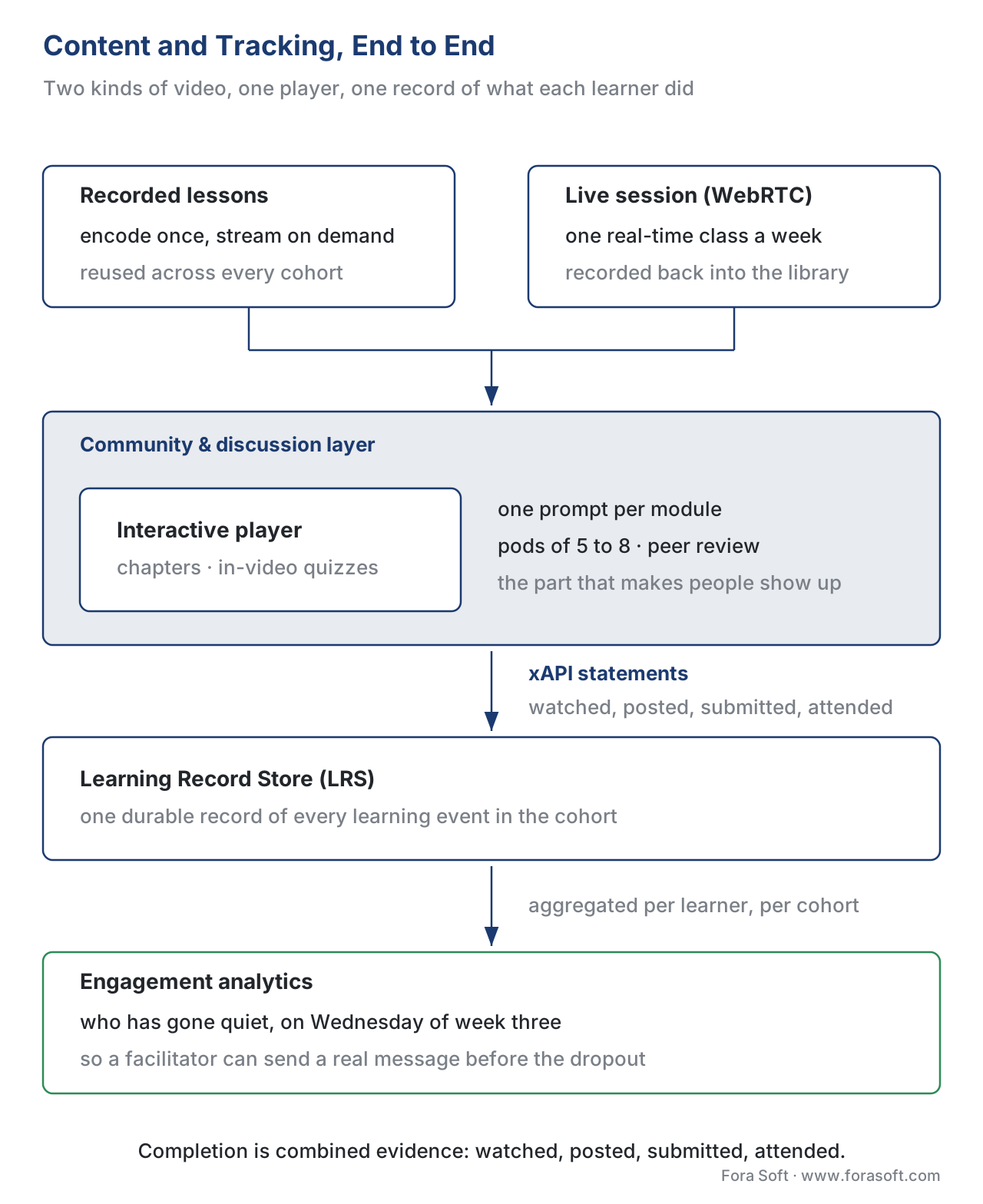 Figure 3. Content and tracking, end to end. Recorded lessons (reusable, cheap) and the live WebRTC session (recorded back into the library) both reach the learner through a player wrapped by the community layer. Player and discussion events are emitted as xAPI statements to a learning record store, then aggregated into the engagement analytics that tell a facilitator who is falling behind.
Plane 3: Community and Discussion — The Engine of Completion
This is the plane that makes a cohort a cohort, and the one a self-paced platform treats as an afterthought. Its job is to turn a group of strangers who happened to enroll in the same week into a community that pulls each member toward the finish line. Everything the completion data rewards lives here.
The base layer is discussion — and the single most important design decision in the whole platform is that discussion is woven into the curriculum, not parked in a separate forum. The pattern that works, drawn from the courses with the highest completion, is one specific discussion prompt per module ("share one way you applied this and what happened"), with student responses appearing in a threaded conversation inside the learning flow, and peer responses explicitly encouraged. The further the discussion lives from the content, the less it gets used; the closer it sits, the more it becomes part of the learning rather than a chore.
On top of discussion sit the structures that scale intimacy as cohorts grow. Small groups or "pods" divide a large cohort into stable teams of five to eight, so a learner has a handful of named peers rather than an anonymous crowd — this is how a 200-person cohort still feels personal. Peer review and group projects turn learners into each other's audience and graders, which both deepens learning (you learn by evaluating others' work) and multiplies the instructor's reach. And a cohort-wide social space — a chat channel, an activity feed — carries the informal connection (introductions, wins, "respawn, welcome back" when someone falls behind) that produces belonging. Many real cohort platforms either build this or integrate a community tool; either way it is core, not peripheral.
A note on data, because community means user-generated content. Discussion posts, project submissions, and profile information are personal data, and when your learners are in the European Union the General Data Protection Regulation (GDPR, Regulation (EU) 2016/679) governs how you collect, store, and delete it — lawful basis, data minimization, and the learner's rights over their own posts. (This is engineering guidance, not legal advice; confirm specifics with qualified counsel.) The architectural consequence is modest but real: treat community content as personal data from the first sprint, with deletion and export designed in, rather than retrofitted.
Common mistake: bolting a forum on at the end. The most common failure is building the whole course, then adding a discussion feature and hoping people use it. It does not work — discussion has to be part of the curriculum's design, prompt by prompt, or it stays empty. Community is the load-bearing wall of a cohort platform; you frame the building around it, you do not nail it on after.
Plane 4: Engagement, Accountability, and the Credential
The fourth plane keeps people moving through the schedule and proves they arrived. It is the difference between a cohort that fills up and a cohort that finishes, and it runs on a loop of nudge, measure, and reward.
It starts with the first week, because the data is emphatic that early engagement is the strongest single predictor of completion — learners active in week one are many times more likely to finish. So the onboarding flow is a designed experience, not a welcome email: a fixed start, an introductions thread, an early easy win, and a personal nudge to anyone who has not posted by day three. Accountability mechanics carry the rest of the program — deadlines tied to the live sessions, visible progress, reminders across email and push, and the gentle social pressure of a cohort where peers are visibly moving ahead. None of this requires the instructor to be available around the clock; it requires the system to notice who is drifting and prompt a small, timely intervention.
To notice, the platform has to track learning events, and this is where the standards come in. The right model for capturing rich, cross-activity learning events — watched a lesson, posted in a discussion, submitted a project, attended the live session — is the Experience API (xAPI, version 1.0.3), the standard maintained by ADL that records events as simple statements ("Maria completed Module 3") and stores them in a Learning Record Store (LRS). (xAPI is the standard; "Tin Can API" was only its project name.) Where the cohort runs inside or alongside a traditional learning management system, cmi5 — an xAPI profile, also from ADL — defines how an LMS launches the content and exchanges that data, and the xAPI Video Profile specifies what to capture for video specifically (play, pause, completed, the watched segments). This matters for an accuracy reason worth stating plainly: "watched 100% of the video" is not the same as "completed the module" and neither is the same as "learned." A good cohort platform defines completion as a deliberate combination of evidence — watched, posted, submitted, attended — not a single progress bar, and xAPI is what lets you express that precisely. The broader treatment is in learning analytics, tracking video with the xAPI Video Profile, and completion rate: defining, measuring, improving.
The plane ends with the credential. A cohort that finishes wants proof, and the modern, tamper-evident, portable way to issue it is a digital badge or certificate built on Open Badges (1EdTech, version 3.0) or the related W3C Verifiable Credentials — a credential a learner can carry to LinkedIn or a CV and anyone can verify, rather than a PDF that proves nothing. The mechanics are covered in certificates, badges, and verifiable credentials. The credential is also a business asset: it is the thing graduates show off, which markets the next cohort.
Plane 5: Operations, Roles, and Monetization — Running It Again
The final plane runs the cohort as a business and prepares it to run again, because a cohort platform's economics depend on amortizing one body of content across many runs.
Roles are first-class here in a way no self-paced platform needs. A cohort has an instructor (teaches, sets the curriculum), often one or more facilitators or teaching assistants (run breakout rooms, answer discussions, chase stragglers), and learners — and the platform's permission model has to express "TA for the March cohort but not the May one." Facilitation is the labor that produces the completion rate, so the tools that let a facilitator see who is behind and act are not back-office extras; they are the product's working surface.
Enrollment and payment sit here too — selling seats in the next cohort, handling the application-and-admission flow when there is one, and the higher price point that cohorts sustain (cohorts commonly price at three-to-five times the equivalent self-paced course, which is both what the high-touch model costs to run and what learners will pay for a result they actually reach). And integration is where a cohort platform meets the systems around it: a corporate buyer will want the cohort to launch from their existing learning management system and recognize their employees without a second login, which is exactly the job of Learning Tools Interoperability (LTI, version 1.3) from 1EdTech. It is worth being precise about LTI, because it is widely misdescribed: LTI 1.3 is not a password login — it is an OpenID Connect–based launch that passes a signed token (a JWT) from the LMS to your tool, so single sign-on is a consequence of the trusted launch, not a separate password check. The detail is in LTI explained and the corporate wiring in the corporate-LMS reference architecture.
Finally, re-running. The operational reality of a cohort platform is that you clone a cohort — same curriculum and recorded content, new dates, new roster, new facilitators — and run it again. The architecture should make that a routine action, not a rebuild: content is an asset that lives above any single cohort, and a cohort is an instance that points at it.
Putting the Planes Together: How One Cohort Runs
Walk a single cohort through all five planes, because the choreography is the architecture. A leadership academy opens enrollment for its eight-week March cohort; the cohort and curriculum plane holds the roster, the start date, and the schedule that will unlock one module a week. Two weeks before the start, learners get access to an introductions thread — the community plane — and the engagement plane runs the onboarding that the data says matters most, because learners active in week one are the ones who finish. Each week, the content delivery plane releases a set of recorded lessons (watched on each learner's own time) and hosts one live WebRTC session with the instructor; the session is recorded straight back into the library for anyone who missed it and for the next cohort. Inside each module, a discussion prompt pulls learners into the community plane, and a stable pod of six gives each person named peers; a mid-course peer-reviewed project turns learners into each other's audience. Throughout, the engagement plane emits xAPI statements — watched, posted, submitted, attended — to a learning record store, so a facilitator (a first-class role in the operations plane) can see on Wednesday that four learners have gone quiet and send a real message before the silence becomes a dropout. In week eight the cohort graduates; the engagement plane issues an Open Badges credential each graduate can verify and show off. Then the operations plane clones the whole thing for May — same content, new people — and the credential the March graduates are now displaying markets that next cohort. One cohort has completed the journey; the rails are ready for the next.
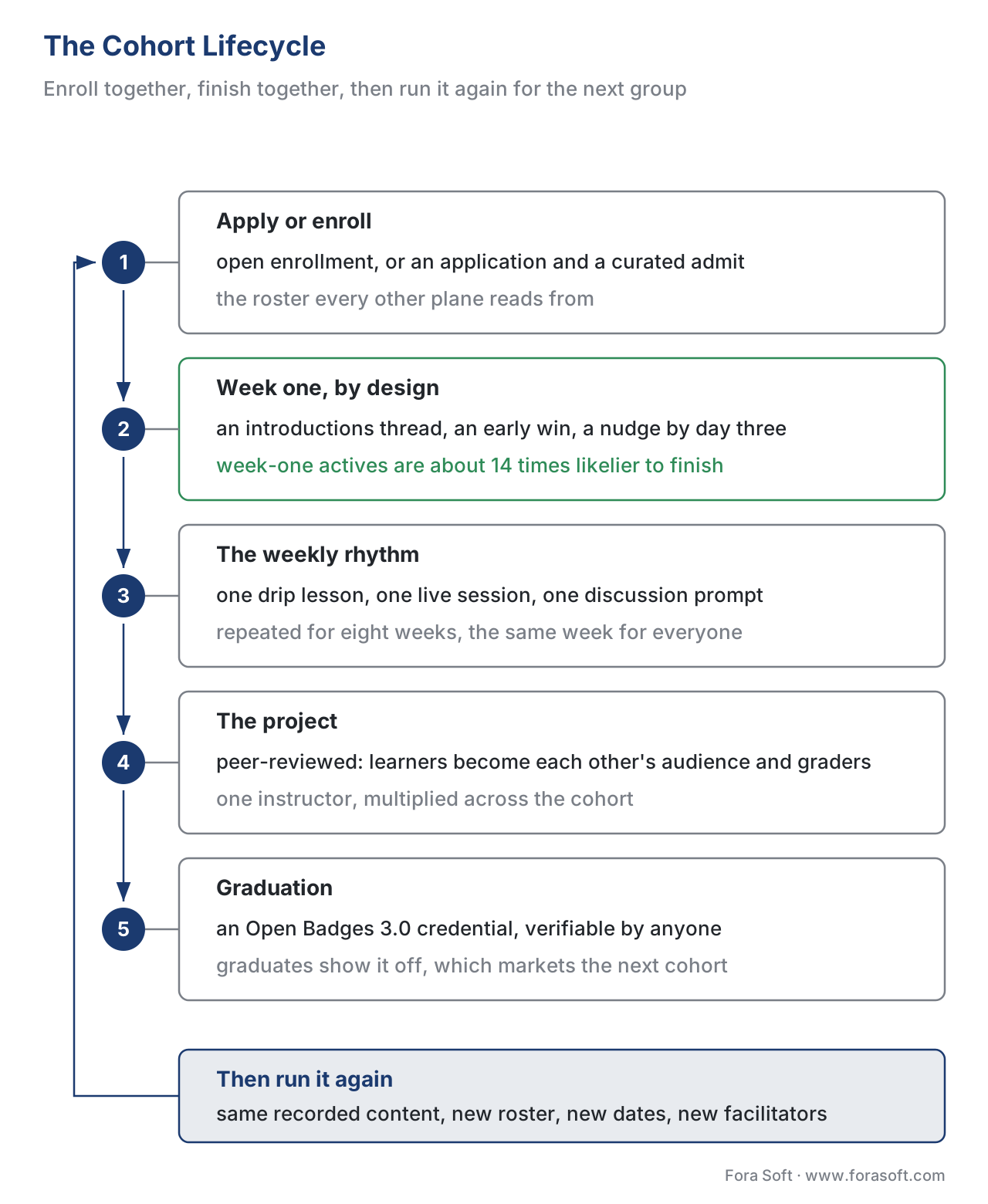 Figure 4. The same journey as a timeline. Enroll, a designed first week (where early-active learners are far likelier to finish), a weekly rhythm of drip lesson plus live session plus discussion, a peer-reviewed project, graduation with a verifiable credential — then re-run with new people on the same content.
That single walkthrough is the whole product. Every feature you will ever add — a second track, a capstone, an alumni space, an AI study buddy — lands in one of those five planes.
The Unit Economics, Shown Out Loud
The cohort question is rarely "can we afford the video" — the recorded video is cheap and reused. It is "does completion justify the high-touch model," and the math runs in two parts. Show it out loud.
Completion is the product, so count finishers, not enrollees. Compare a self-paced course and a cohort run on the same content. The self-paced course is cheap to enter and finishes few:
1,000 enrollments × 15% self-paced completion = 150 learners who actually finish
The cohort enrolls fewer but finishes far more:
300 enrollments × 65% cohort completion = 195 learners who actually finish
The cohort produces more completers from fewer than a third of the enrollments — and completers are the ones who write testimonials, refer colleagues, and come back, which is why a cohort's worse-looking enrollment number hides a better business.
Content is built once and amortized across runs. Suppose recording and producing the course costs $40,000, and you run it as eight cohorts over two years:
$40,000 content build ÷ 8 cohorts = $5,000 of content cost per cohort
The recurring cost per cohort is then mostly facilitation and live sessions — the human time that produces completion — not video production. That is the inversion to internalize: on a cohort platform you spend once on content and repeatedly on people, the opposite of a MOOC, where you spend repeatedly on delivery at scale. The fuller treatment is in scoping and estimating a learning-video project, which reuses the learning-platform cost model; the point here is that your money goes to facilitation and community, because that is where completion — and therefore revenue — comes from.
Build, Buy, or Assemble: The Realistic Decision
For a cohort platform, the build-versus-buy decision is best made one plane at a time, because the planes differ sharply in how much they differentiate you. The live video and the recorded-video delivery are commodities you should buy or embed; the community-and-engagement machinery is where a serious build pays back, because it is the part that produces your completion rate.
| Plane | Buy / platform | Assemble / integrate | Build custom | Standard / protocol it should speak |
|---|---|---|---|---|
| Cohort & curriculum | Cohort platform's scheduler | Calendar lib + drip logic | Custom cohort engine | iCalendar (RFC 5545) |
| Content delivery (VOD + live) | Built-in player + Zoom | Video SDK / SFU + CDN | Full WebRTC + VOD stack | WebRTC (W3C / IETF); xAPI Video Profile |
| Community & discussion | Platform's forum | Community tool + own pods | Custom community layer | GDPR for user content |
| Engagement & accountability | Platform's progress + emails | Product analytics + LRS | Custom analytics + nudges | xAPI 1.0.3 + cmi5; Open Badges 3.0 |
| Operations & monetization | Platform's checkout + roles | Payments + LMS integration | Custom roles + billing | LTI 1.3; payments (PCI DSS) |
Three doors, in plain terms. Buy a cohort platform (the Maven / Disco / Circle / Thinkific-cohort style of product) when speed matters more than ownership and your differentiator is your teaching, not your software — most first cohorts should start here, validating that the program works before building anything. Assemble best-of-breed when you want to own the experience but not reinvent commodities: embed a video SDK and a payments provider, integrate or build the community, and write the cohort and engagement logic that is yours. Build fully custom when the cohort mechanics themselves — a particular community model, a particular accountability or analytics design, deep integration into a corporate stack at scale — are your actual product and you have the engineering depth to run real-time video. The dedicated decision matrix and the build-vs-buy tool live in the section capstone, build vs buy vs hybrid for learning video.
The Pitfalls That Define a Bad Build
"It's a self-paced course with a start date." The root error. A cohort is the group plus the shared timeline plus the community; drip-scheduling a solo course just makes it slower. Build the social machinery, or you have not built a cohort.
"Bolt the community on at the end." Adding a forum to a finished course leaves it empty. Discussion has to be designed into the curriculum, one prompt per module, sitting inside the learning flow — it is the load-bearing wall, not trim.
"Over-produce the video, under-invest in facilitation." Spending the budget on cinematic lessons while the discussion and live facilitation are thin optimizes the cheap, reusable plane and starves the one that produces completion. Presence beats production.
"Skip the first week." Early engagement is the strongest predictor of finishing; a generic welcome email wastes it. Design onboarding — introductions, an early win, a personal nudge to the quiet — as carefully as the capstone.
"Confuse 'watched 100%' with 'completed.'" A full progress bar is not learning and often not completion. Define completion as a deliberate mix of evidence — watched, posted, submitted, attended — and express it precisely with xAPI, not a single video percentage.
"Build the live room from scratch." A weekly group session is a solved problem; a hosted SDK or a conferencing integration delivers it in days. Spending runway gold-plating video transport while community is weak solves the easy problem and ignores the hard one.
Free download: Cohort-Based Course Platform — Architecture & Engagement Readiness ChecklistOne page across all five planes, plus the completion levers that decide whether your cohort finishes: the first-week onboarding, the discussion woven into each module, and visible instructor presence.Where Fora Soft Fits In
Fora Soft has built real-time video, WebRTC, and e-learning systems since 2005, and a cohort-based course platform sits squarely at that intersection — a community-and-scheduling product wrapped around a recorded-video library and a live WebRTC classroom. The build-versus-buy trade-off we help teams make is per-plane and honest: the commodity planes — recorded-video delivery, the live room, payments — are usually bought or embedded, while the planes that decide whether your cohorts finish — the community model, the engagement and accountability machinery, the facilitator tooling, and the analytics that flag a drifting learner — are where custom engineering pays back. We work across e-learning, video conferencing, streaming, OTT, and telemedicine, so we are typically brought in when the live-session quality, the recording-to-library pipeline, the tracking-and-analytics layer, or a deep corporate-LMS integration is the hard part — not the lesson list. No hype: for a first cohort testing whether a program works, the right move is often a cohort platform plus a solid live room, and we will say so.


The handbook
Fora Soft Video Engineering Handbook
We wrote a seven-volume series that walks the whole video stack, from the pixel to production: encoding, delivery, audio, and AI. Plane 2 of this article — the recorded library and the weekly live room — is the stack those volumes cover end to end: volume 3 is the one to start with, on players, ABR, CDNs, WebRTC and the economics of delivery, which is what a cohort's live session and its recording actually run on; volume 2 covers the transport and packaging underneath it (HLS, MPEG-DASH, ingest), and volume 1 covers the encoding that makes a lesson you record once cheap to serve to twenty cohorts. Written by Nikolay Sapunov, CEO at Fora Soft.
Scoping a cohort platform, and not sure which planes to build?
Tell us what your program looks like and we will say which planes to buy, which to assemble, and which are worth a custom build — per plane, with the live room and the recording pipeline costed honestly. 250+ video products shipped since 2005.
See our case studies
Case study
Scholarly
Planes 1 and 2 in one product: live classes for up to 2,000 students at once plus DASH/HLS video on demand, with scheduling, homework review and an LMS replacing a stack of Zoom and Discord for 15,000+ users.
Case study
BrainCert
Planes 3 and 4 at scale: a WebRTC virtual classroom with discussion, assessments, proctoring and SCORM/xAPI tracking, 500M+ class minutes for 100K+ customers under SOC 2 Type II, ISO 27001 and GDPR.
Case study
Tabsera
Plane 5 as a first-class thing: teachers, students with parental controls and admins each get their own permissions, and instructors are paid out through PayPal or Waafi across four languages on web and iOS.
What to read next
Reference design
Reference architecture: a MOOC / open-course platform
The opposite shape: scale and a steep funnel instead of cadence and community. Read it to see what you are trading away.
Live video
Live-learning reference architecture: the full picture
Plane 2's live half, assembled on its own — the subsystem a cohort platform embeds rather than reinvents.
Metrics
Completion rate: defining, measuring, and improving it
The number this whole architecture exists to move, and how to define it as combined evidence rather than a progress bar.
Decision
Build vs buy vs hybrid for learning video
The section capstone, with the decision matrix behind the per-plane call this article sketches.
References
- ADL Initiative. Experience API (xAPI), Version 1.0.3 — the specification for recording learning experiences as statements ("actor–verb–object") in a Learning Record Store; the basis for tracking watched-lesson, discussion, project, and live-attendance events across a cohort. https://github.com/adlnet/xAPI-Spec (Tier 1, primary standard). Accessed 2026-06-22.
- ADL Initiative. cmi5 Specification — the xAPI profile defining how a learning management system launches content and exchanges xAPI data (the AU/launch model); the bridge between a cohort tool and a traditional LMS. https://github.com/AICC/CMI-5_Spec_Current (Tier 1, primary standard). Accessed 2026-06-22.
- 1EdTech (formerly IMS Global). Learning Tools Interoperability (LTI) 1.3 and LTI Advantage — the OpenID Connect–based launch with a signed JWT that lets a tool launch from any LMS with trusted single sign-on; the integration path for corporate cohort programs. https://www.1edtech.org/standards/lti (Tier 1, primary standard). Accessed 2026-06-22.
- 1EdTech. Open Badges Specification, Version 3.0 — the standard for portable, verifiable digital credentials, aligned with W3C Verifiable Credentials; the basis for a tamper-evident cohort-completion certificate. https://www.1edtech.org/standards/open-badges (Tier 1, primary standard). Accessed 2026-06-22.
- W3C. WebRTC: Real-Time Communication in Browsers — W3C Recommendation (26 January 2021; updated 2025); the browser-native real-time audio/video/data APIs behind the cohort's live session. https://www.w3.org/TR/webrtc/ (Tier 1, primary standard). Accessed 2026-06-22.
- IETF. RFC 5545 — Internet Calendaring and Scheduling Core Object Specification (iCalendar) — the standard for representing recurring events and time zones; the reference model for the cohort schedule, live-session times, and reminders. https://datatracker.ietf.org/doc/html/rfc5545 (Tier 1, primary standard). Accessed 2026-06-22.
- European Union. General Data Protection Regulation (GDPR), Regulation (EU) 2016/679 — lawful basis, data minimization, and learner rights governing community user-generated content (discussion posts, projects, profiles) for EU learners. https://eur-lex.europa.eu/eli/reg/2016/679/oj (Tier 1, primary law). Accessed 2026-06-22.
- Ruzuku (Abe Crystal, PhD). The Completion Gap: What 32,000 Courses Reveal About Completion — platform analysis of 32,000+ courses: scheduled cohorts 64.2% vs open-access 48.2% completion; active community discussion 65.5% vs 42.6% (a 54% lift); first-week-active learners ~14× more likely to complete. Published 2026-03-17. https://www.ruzuku.com/learn/articles/completion-gap (Tier 5, platform data). Accessed 2026-06-22.
- Class Central / Jordan, K. (2015). MOOC completion rates — median completion ~12.6% across MOOCs (range 0.7%–52.1%), the benchmark the cohort model improves on. "Massive open online course completion rates revisited," IRRODL 16(3). https://www.classcentral.com/report/ (Tier 5, research/industry). Accessed 2026-06-22.
- Dr. Philippa Hardman. Three Design Lessons from Cohort-Based Courses — analysis of altMBA's ~96% completion and the three design drivers (social learning, active learning, accountability) behind cohort-based completion. https://drphilippahardman.substack.com/p/three-design-lessons-from-cohort (Tier 5, practitioner research). Accessed 2026-06-22.
- Kajabi. State of Creator Commerce 2025 — creators who include community elements earn roughly 2× more than those who do not; a business-case data point for community on a cohort platform. https://kajabi.com/state-of-creator-commerce-25 (Tier 6, vendor report). Accessed 2026-06-22.
- Dataintelo. Cohort-Based Courses Market Report — global cohort-based-courses market estimated near $3.8B (2024) growing at ~16% CAGR toward the early 2030s; cohorts priced 3–5× self-paced. https://dataintelo.com/report/cohort-based-courses-market (Tier 6, market research). Accessed 2026-06-22.
Where sources disagreed, the official standard or law won. The standards claims (xAPI 1.0.3, cmi5, LTI 1.3, Open Badges 3.0, WebRTC, iCalendar RFC 5545, GDPR) are grounded in the issuing bodies' own documentation, not in vendor paraphrases; in particular the LTI framing ("OIDC launch with a signed JWT, not a password login") and the xAPI-vs-"Tin Can" naming follow the specs against the common loose summaries. Completion figures vary by source and methodology: the headline cohort/community numbers are platform data from a 32,000-course analysis and the MOOC baseline is the widely cited ~12.6% median; the 85–96% figures (altMBA, HBS Online, executive cohorts) are program-reported and should be read as best-case, not typical. Market-size and price-multiple figures are market-research and industry estimates — confirm against a single agreed source and your own funnel before budgeting.
