


Why this matters
If you run or are planning an OTT platform — a service that streams video over the internet instead of through a cable box — you will be sold dashboards with hundreds of metrics, and almost none of the sales pitch will tell you which number should change which decision. This article is for the non-technical operator — the founder, product lead, or streaming executive — who has to turn data into action and defend those actions to a board. It is the capstone of the analytics block: the analytics map named the three data families, viewership metrics and the QoE quartet defined the numbers, and retention analytics and real-time operations put them to work live. This article joins them into one decision loop you can run every week.
The capstone idea: a metric is only worth collecting if it can change a decision
Start with the single test that organizes this entire article, because it quietly fixes most analytics waste. Before you put a number on a dashboard, ask: what decision would a different value of this number cause me to make? If the answer is "none," the number is decoration. Decoration is not free — someone instruments it, stores it, and spends a meeting explaining why it moved — but it never changes what the platform does.
This is the difference between a metric and a key performance indicator. A metric is any number you can measure; a key performance indicator (KPI) is a metric you have tied to a goal and a decision. Concurrent viewers is a metric. "Concurrent viewers versus provisioned capacity, which triggers adding a content delivery network when it crosses 70%" is a KPI. The capstone skill of OTT analytics is not collecting more metrics; it is promoting the few that drive action and demoting the rest.
Think of it like the cockpit of a plane. The instruments a pilot watches on final approach — airspeed, altitude, glide slope — are the handful that change what the pilot does in the next ten seconds. The plane records thousands of other readings for engineers to study later, but they are not on the approach panel, because a number you cannot act on right now is a number competing for attention you cannot spare. Your weekly operating dashboard is an approach panel, not a data warehouse.
The loop: measure, decide, change, measure again
Decisions on a streaming platform are not one-time events; they are a loop. You measure the platform, you decide what the numbers say to do, you change something, and then you measure again to see whether the change did what you predicted. The loop is the whole game, and most failed analytics programs fail because they stop after "measure" — they produce reports nobody acts on, or they act and never check the result.
The loop has a tempo. Some turns are minute-by-minute, run by the operations team during a live event and covered in real-time operations and alerting. Some are weekly, run in a product or growth review. Some are quarterly, run at the level of pricing and content strategy. The skill is matching the decision to the right tempo: you do not re-price a subscription tier every hour, and you do not wait a quarter to react to a region going dark.
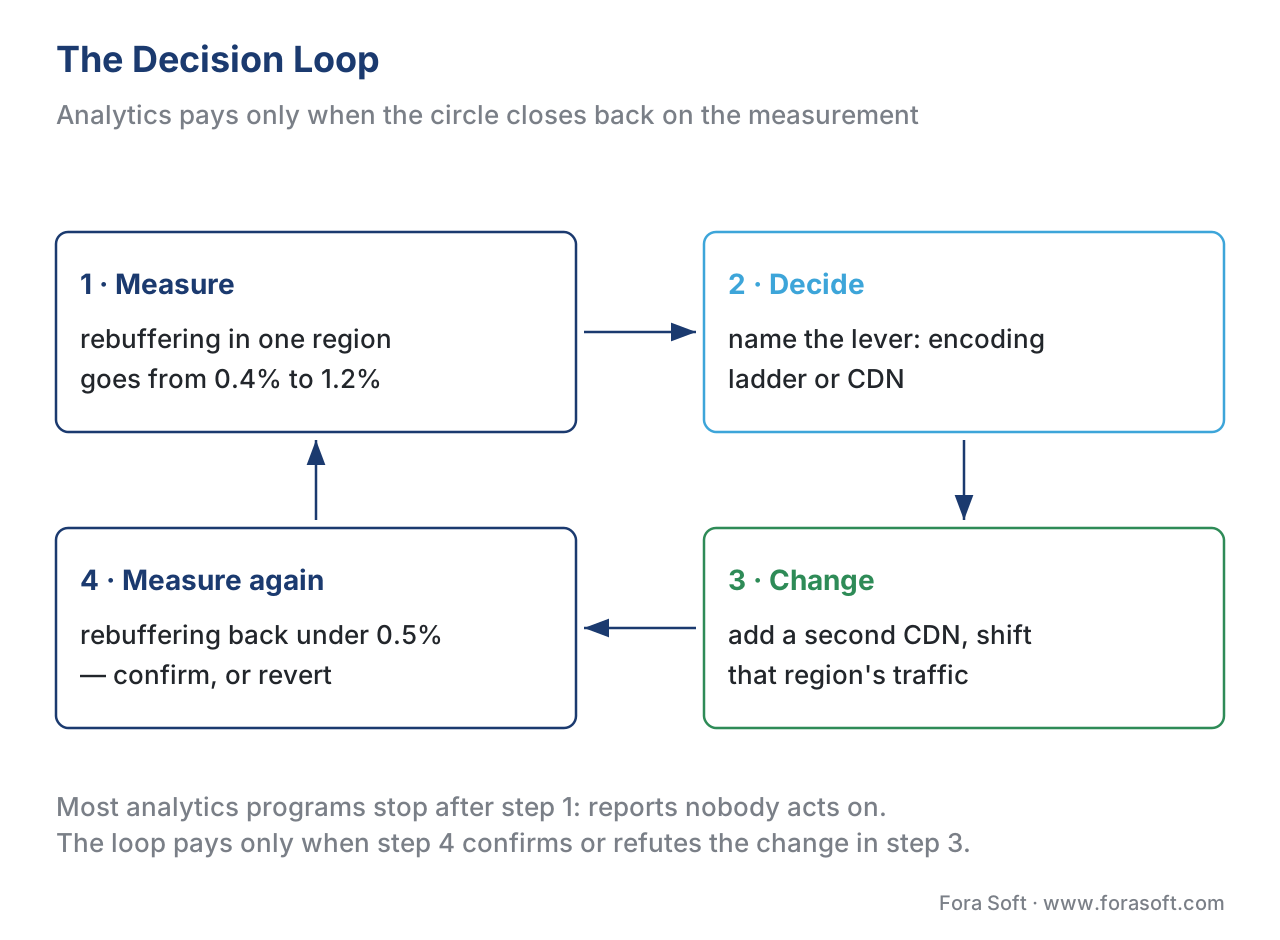 Figure 1. The decision loop. Analytics is only useful when the full circle runs: a measurement leads to a decision, the decision leads to a change, and the next measurement confirms or refutes it.
Pick a North Star, then the inputs that move it
A platform with fifty KPIs and no hierarchy will pull in fifty directions. The fix is to name one metric that sits above the rest. Growth investor Sean Ellis popularized the term North Star metric — "the single metric that best captures the core value that your product delivers to customers." For most subscription OTT services that is some form of engaged watch time per subscriber, because a subscriber who watches is a subscriber who renews; for an ad-supported service it leans toward viewed ad impressions, and for a transactional service toward purchases per active viewer. Pick the one that predicts the revenue your business model actually earns.
The North Star is too high up to act on directly — you cannot "go fix watch time." So you decompose it into input metrics: the few numbers that, when they move, move the North Star. Engaged watch time, for instance, is driven by how many titles a viewer finds worth starting (a discovery problem), how often a start succeeds and plays smoothly (a quality problem), and how often they come back (a retention problem). Each input belongs to one of the three data families from the analytics map — audience, engagement, quality — and each points at a different lever the rest of this section already built.
This hierarchy is what keeps a review meeting sane. You watch the North Star to know whether the business is winning; you watch its inputs to know why; and you change the levers under the inputs to do something about it. The next four sections are those levers.
Lever one: quality metrics tune the encoding ladder and the CDN
The most direct line from a metric to a decision in streaming runs from quality of experience to two cost-and-capability choices: the encoding ladder and the content delivery network. Quality of experience, or QoE, is the set of measures of how well the video actually played — chiefly video startup time, rebuffering (the spinner mid-play), the bitrate delivered, and the playback-failure rate. The encoding ladder is the menu of resolution-and-bitrate versions the platform makes of each title so the player can pick one that fits the viewer's connection. The CDN is the global network of cache servers that stores copies of your video close to viewers.
Here is why QoE is a revenue lever and not a vanity number, with the arithmetic shown once. The foundational large-scale study by Krishnan and Sitaraman (2012), which first established causation rather than mere correlation, found that viewers begin abandoning a video after about 2 seconds of startup delay, with each additional second adding roughly 5.8% to the abandonment rate, and that a viewer who suffers rebuffering equal to 1% of a video's duration plays about 5% less of that video. Put numbers on it: if a 60-minute show carries 36 seconds of rebuffering (1% of its length), the average viewer watches about 3 minutes less. Across a million views that is roughly 3,000,000 viewer-minutes of engaged watch time lost — the exact North Star you are trying to grow — and on an ad-supported service those lost minutes are lost ad impressions you can price.
So the decision rule writes itself. If rebuffering rises in a region or on a device type, the platform does not shrug; it acts on the two levers that control delivered quality. It can re-tune the encoding ladder — adding a lower rung so weak connections step down instead of stalling, or, conversely, trimming a wasteful top rung that burns delivery cost for no perceived gain. The economics of doing this per-title rather than with one fixed ladder are the subject of per-title encoding economics; the ladder design itself lives in the encoding ladder explained. Or it can act on delivery — shifting traffic toward a better-performing CDN or adding a second one, the multi-CDN decision detailed in multi-CDN architecture and orchestration, while watching the egress bill explained in CDN cost engineering. The metric pointed at the lever; the operator pulled it.
A note on where the numbers come from, because a decision is only as trustworthy as its measurement. Players and servers emit standardized telemetry so QoE is measured, not guessed: the Consumer Technology Association's CTA-2066 standard defines the streaming QoE event vocabulary — startup time, rebuffering, and related terms — so the metrics mean the same thing across players, and CTA-5004, Common Media Client Data (CMCD), defines how a player attaches its bitrate, buffer length, and session id to each request so quality can be traced per session. The measurement stack that collects all this is covered in the QoE measurement stack.
Lever two: engagement and retention metrics change recommendations
The second lever runs from engagement data to what the platform shows each viewer. Engagement metrics describe what people watch and for how long; retention metrics describe whether they come back. When these soften — completion rates fall, the home screen's click-through drops, a cohort's week-four return rate declines — the lever is discovery: the recommendation rows, the search results, the artwork, and the ordering that decide what a viewer sees first.
The causal chain is well established across the section. Discovery decides retention because a viewer who cannot quickly find something worth watching churns, the argument made in why discovery decides retention. The engine that turns watch history into ranked rows is the recommendation system, whose model internals live in the AI section's recommendation models — this section links out rather than re-deriving the math. The point for the capstone is the decision: a falling engagement input is a signal to change what the recommender optimizes for or to refresh the metadata that feeds it, the fuel described in metadata: the fuel for discovery. The metric exposed a discovery problem; the change happened in the recommendation and merchandising layer.
Lever three: audience and revenue metrics set price and packaging
The third lever runs from audience and revenue data to the monetization model — the choice of subscription, advertising, or transactional revenue, and the price and tiers attached to it. Audience metrics tell you who and how many; revenue metrics tell you what each viewer is worth. When they diverge — a tier with high sign-ups but high churn, an ad tier with strong viewing but thin yield, a price point that converts trials poorly — the lever is pricing and packaging.
These are the slowest, highest-stakes turns of the loop, and the decisions feed directly back into architecture. Whether you run subscription video on demand (SVOD), ad-supported (AVOD), transactional (TVOD), or a hybrid changes the billing, the ad insertion, and even the analytics you must collect — the map is the OTT monetization map, and the model choice itself is pricing, packaging, and the monetization decision. Churn is the metric that most often forces this lever, and turning churn cohorts into a pricing or retention action is the work of churn, retention, and subscription analytics. A metric — say, involuntary churn from failed card charges — points at a precise change: dunning and smarter retries, not a price cut.
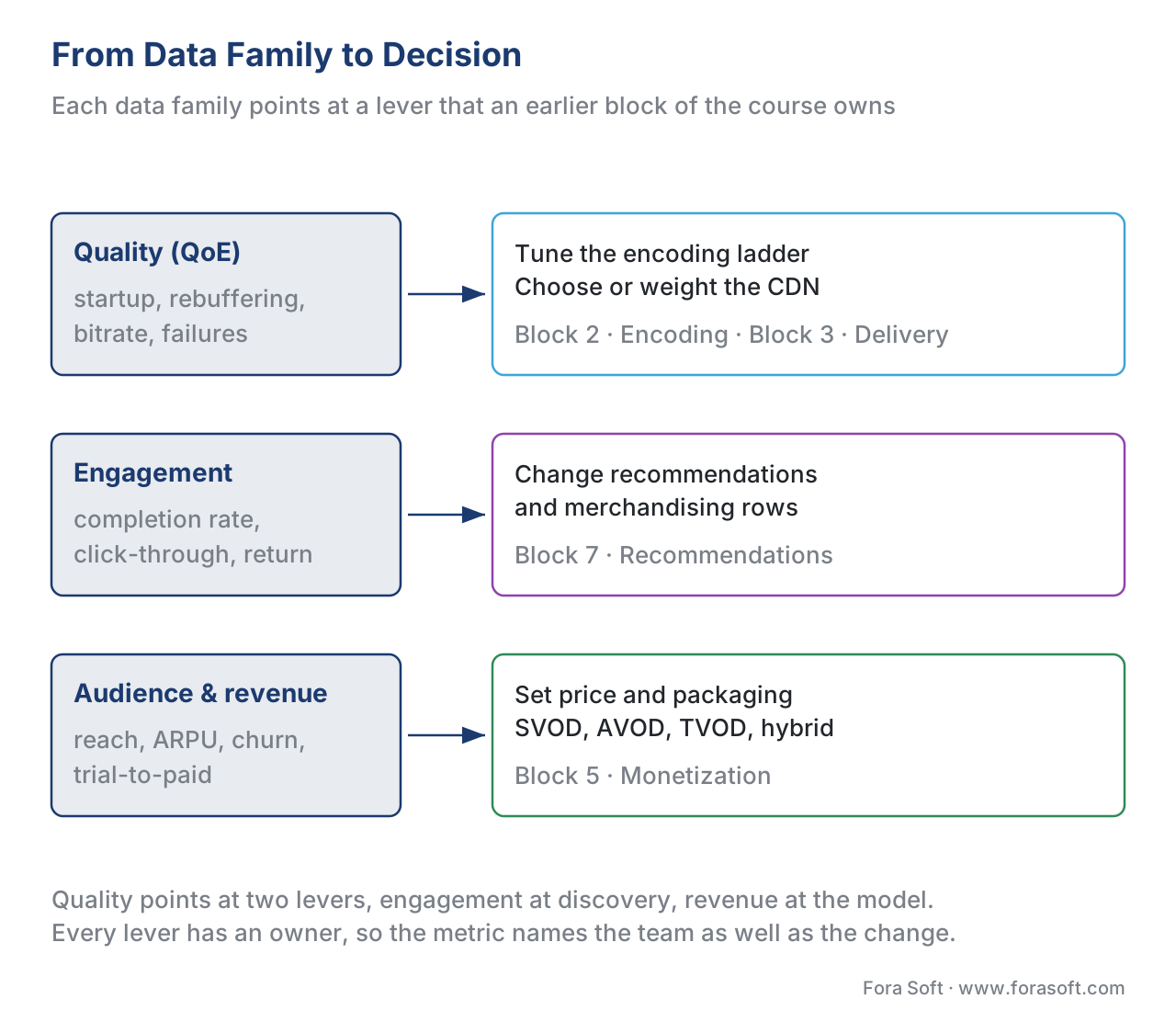 Figure 2. From data family to decision. Quality data tunes the ladder and CDN; engagement and retention change discovery; audience and revenue set price and packaging — each lever owned by an earlier block.
The method that closes every loop: controlled experiments
Every lever above shares one danger: you change something, the North Star moves, and you credit your change when the real cause was a holiday weekend, a hit new title, or a competitor's outage. The only honest way to know a change worked is a controlled experiment — an A/B test, where you split comparable viewers into a group that gets the change and a group that does not, then compare. The difference between the groups is the change's true effect, because everything else — the weekend, the hit title — hit both groups equally.
The largest streaming services run on this discipline. Netflix's engineering teams describe a "culture of experimentation" in which new ideas are tested in production and run thousands of experiments a year through a dedicated platform, precisely so decisions rest on causal evidence rather than opinion. You do not need their scale to adopt the habit. You do need two things on every experiment: a clear hypothesis stated before you look at results, and guardrail metrics — numbers that must not get worse — so a change that lifts watch time but spikes rebuffering or churn is caught before it ships to everyone.
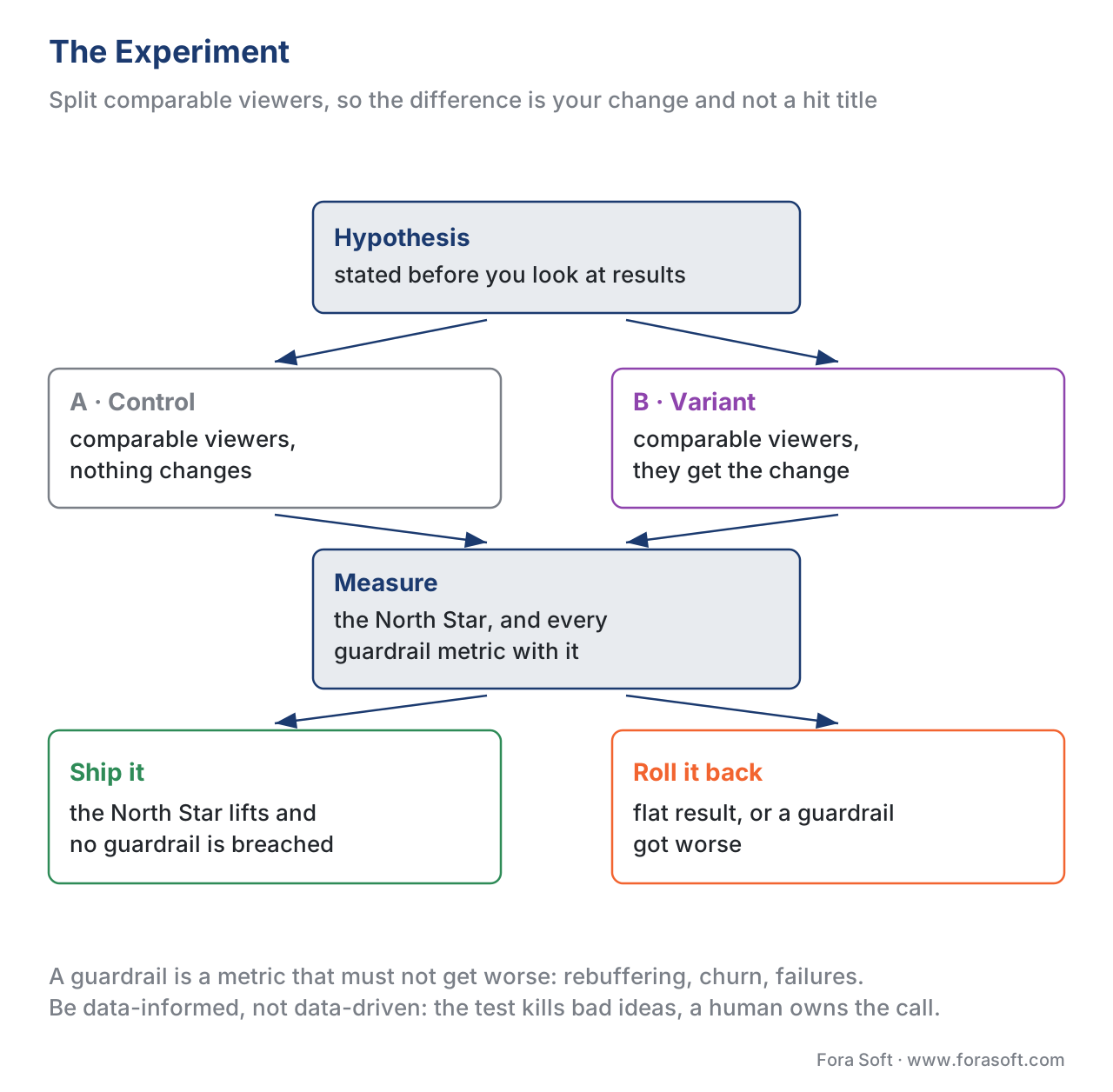 Figure 3. The experiment loop. A hypothesis splits comparable viewers; the change ships only if it lifts the North Star without breaching a guardrail. This is how a correlation becomes a decision.
Common mistake: the vanity-metric trap. The classic failure is steering by numbers that always look good and never change a decision — total registered users (which only ever rises), raw cumulative views, or "engagement" defined so loosely it cannot fall. These feel reassuring in a board deck and are useless on a Tuesday. A vanity metric has two tells: it has no target it can fail against, and no value of it would change what you do next. The fix is the capstone test — for every number on the wall, name the decision a worse value would trigger. If there is none, move it off the operating dashboard and into the archive. Be data-informed, not blindly data-driven: the numbers narrow the choices and kill the bad ideas, but a human still owns the call, because a metric can only measure what you already thought to instrument.
A boundary on the loop: viewing data is regulated
One caution sits over every decision that uses viewing history. What people watch is sensitive personal data, and acting on it has a legal boundary, not just an ethical one. In the United States the Video Privacy Protection Act (VPPA, 18 U.S.C. § 2710) restricts disclosing a viewer's specific viewing records, and in the European Union the General Data Protection Regulation (GDPR, Regulation (EU) 2016/679) governs how viewing data is collected, stored, and used, including a lawful basis for personalization. The decision loop must run inside that boundary: you can optimize recommendations and pricing on viewing data, but how you collect consent, how long you retain it, and what you share are constrained. The full treatment is privacy and viewing data: VPPA, GDPR, CCPA; the capstone point is that the analytics loop is powerful precisely because it uses personal data, which is exactly why it is fenced.
The decision-oriented KPI dashboard
Pull it together into the artifact you actually operate from: a dashboard organized by decision, not by data source. Most vendor dashboards group numbers by where they came from — a QoE tab, a billing tab, an ad tab — which forces the operator to assemble the decision in their head. A decision-oriented dashboard inverts that. It puts the North Star at the top, then a small panel per lever, and against each metric it writes the target and the decision a breach triggers: "rebuffering ratio, target < 0.5%, breach → re-tune ladder / shift CDN"; "week-4 retention, target > X%, breach → review discovery"; "trial-to-paid, target > Y%, breach → revisit price/packaging." The dashboard stops being a wall of numbers and becomes a list of pre-agreed decisions waiting for a trigger.
That is the template attached to this article. It is deliberately small — a North Star, the four levers, a handful of KPIs each with a target and a decision — because the discipline is subtraction, not addition. You adapt the targets to your business model and your scale, but the structure holds: every number on it has already earned its place by naming the decision it drives.
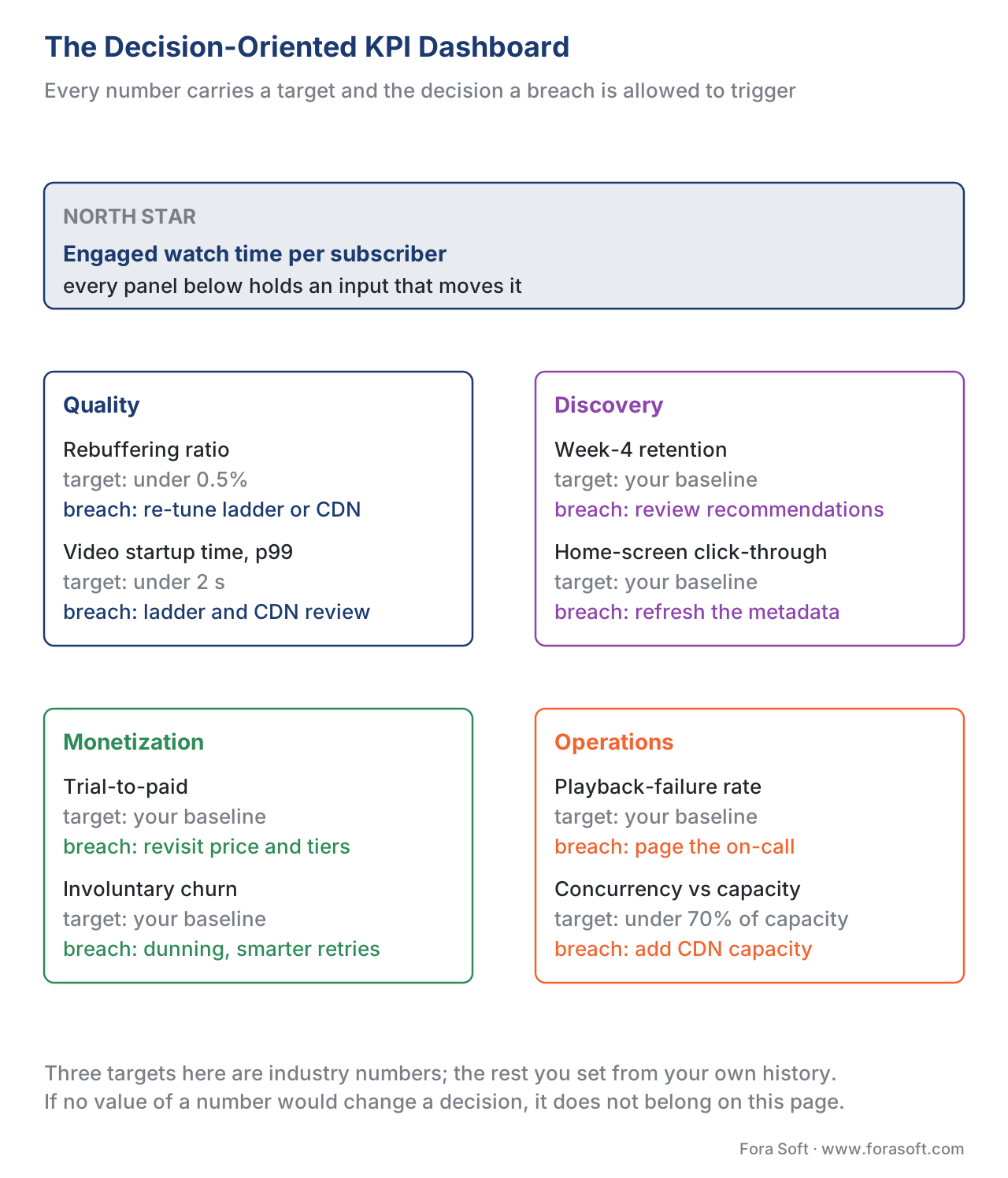 Figure 4. The decision-oriented KPI dashboard. The North Star sits above four lever panels — quality, discovery, monetization, operations — and every KPI carries the target and the decision a breach is allowed to trigger.
Where Fora Soft fits in
The decision loop earns its keep at scale, where a 0.5-point move in rebuffering across millions of views is millions of lost watch-minutes, and where a pricing change shipped without a controlled experiment can quietly cost a quarter's growth. Fora Soft has built video streaming, OTT/Internet TV, e-learning, and telemedicine platforms since 2005 — 625+ shipped projects for 400+ clients over 20+ years — so we treat analytics as platform engineering, not an add-on: standardized CMCD/CTA-2066 telemetry feeding a decision-oriented dashboard, an experimentation harness with guardrail metrics wired in, and the data pipeline that connects QoE, engagement, and revenue to the ladder, the CDN, the recommender, and billing. We are vendor-neutral; we instrument the platform so the numbers point at levers, not at a particular analytics product. The aim is a platform whose every important number is tied to a decision someone is ready to make.



The handbook
Fora Soft Video Engineering Handbook
We wrote a seven-volume handbook that takes the whole video stack apart, from the pixel to production, across 9,000+ pages — so the person who works through it can design and build a platform like the one this dashboard watches. Volume 3 is where this article keeps going: QoE monitoring, the ABR ladder and the rung-selection algorithms behind it, CDN caching, and the delivery economics that price a 0.5-point move in rebuffering. Volume 1 covers the encoding half of that same lever, and volume 6 covers the discovery half — search over a video archive and the models behind the rows a viewer sees first. Written by Nikolay Sapunov, CEO at Fora Soft.
Which numbers on your dashboard would change a decision tomorrow?
Send us the dashboard you operate from and the calls you currently make by hand, and we will tell you which metrics are missing, which are decoration, and what it takes to wire CMCD and CTA-2066 telemetry into a page that names the decision behind every number — 250+ video products shipped since 2005.
See our case studies
Case study
Worldcast Live
A concert platform holding 10,000 simultaneous viewers at 0.4-0.5s latency and 1.5 Gbit/s, with quality stepped down automatically on weak connections — the quality panel of this dashboard, running live.
Case study
Sprii
A live shopping platform where viewers watch for 20 minutes against 54 seconds on a static page, worth up to 20x the conversion — watch time as the North Star, with the analytics that connect it to 12.3 million products sold in 2024.
Case study
Mindbox
An AI video management system in 50+ deployments that pages an operator the moment a stream misbehaves and starts recording on its own — the operations panel, where a breached metric has to reach a human in seconds.
What to read next
Analytics
The OTT Analytics Map: Audience, Engagement, Quality
The three data families this capstone joins into one loop.
Quality
The QoE Measurement Stack: Mux, Conviva & Telemetry
Where the quality numbers on the dashboard actually come from.
Experiments
A/B Testing and Experimentation for Streaming
How to run the controlled test that makes a change provable.
Monetization
Streaming Monetization Models: the Pricing Decision
The slowest lever: what the revenue metrics are allowed to change.
References
- Krishnan, S. S. and Sitaraman, R. K. Video Stream Quality Impacts Viewer Behavior: Inferring Causality Using Quasi-Experimental Designs. ACM Internet Measurement Conference (IMC) 2012 — the foundational causal evidence: abandonment begins after ~2 s startup and rises ~5.8% per added second; rebuffering equal to 1% of duration cuts play time ~5%; a failure makes a return visit within a week ~2.32% less likely. Tier 5 (foundational academic). https://people.cs.umass.edu/~ramesh/Site/HOME_files/imc208-krishnan.pdf
- Consumer Technology Association. CTA-2066: Streaming Quality of Experience Events, Properties and Metrics, 2020 — defines the QoE metric vocabulary (startup time, rebuffering, Play Time) that makes quality metrics comparable across players and decidable. Tier 1 (standard). https://shop.cta.tech/products/cta-2066
- Consumer Technology Association. CTA-5004: Web Application Video Ecosystem — Common Media Client Data (CMCD), 2020 — standard for player-reported telemetry (bitrate, buffer, session id) attached to each CDN request, the source of per-session quality data. Tier 1 (standard). https://shop.cta.tech/products/cta-5004
- U.S. Code. Video Privacy Protection Act, 18 U.S.C. § 2710 — restricts disclosure of a consumer's video viewing records; the U.S. legal boundary on acting with viewing data. Tier 1 (statute). https://www.law.cornell.edu/uscode/text/18/2710
- European Union. General Data Protection Regulation (GDPR), Regulation (EU) 2016/679 — governs collection, storage, lawful basis, and use of personal data, including viewing data used for personalization. Tier 1 (statute). https://eur-lex.europa.eu/eli/reg/2016/679/oj
- Netflix Technology Blog. Experimentation is a major focus of Data Science across Netflix and A/B Testing and Beyond. Netflix, 2017–2021 — describes the culture of experimentation, thousands of experiments per year, and the platform that makes streaming decisions causal. Tier 4 (first-party engineering blog). https://netflixtechblog.com/experimentation-is-a-major-focus-of-data-science-across-netflix-f67923f8e985
- Ellis, S. and Brown, M. Hacking Growth / North Star metric framework — the definition of the North Star metric as the single measure that best captures the core value a product delivers to customers. Tier 6 (practitioner framework). https://growthmethod.com/the-north-star-metric/
- Beyer, B., Murphy, N. R., Rensin, D., Kawahara, K. and Thorne, S. (eds.). The Site Reliability Workbook — Implementing SLOs. Google / O'Reilly, 2018 — the SLI/SLO/error-budget framing and the discipline of targets that a metric can fail against, applied here to KPI targets and guardrail metrics. Tier 3 (first-party engineering doctrine). https://sre.google/workbook/implementing-slos/
- Conviva. State of Streaming and Streaming Performance Index — industry methodology defining video start failure, exits before video start, rebuffering ratio, and video playback failure as the operative quality KPIs benchmarked across the industry. Tier 5 (industry/analyst). https://www.conviva.com/state-of-streaming/
